Covering COVID-19 Alert Level 3 - CMS Law
←
→
Page content transcription
If your browser does not render page correctly, please read the page content below
Covering COVID-19 | 1 June 2020

     Covering COVID-19
     Alert Level 3

     1 June 2020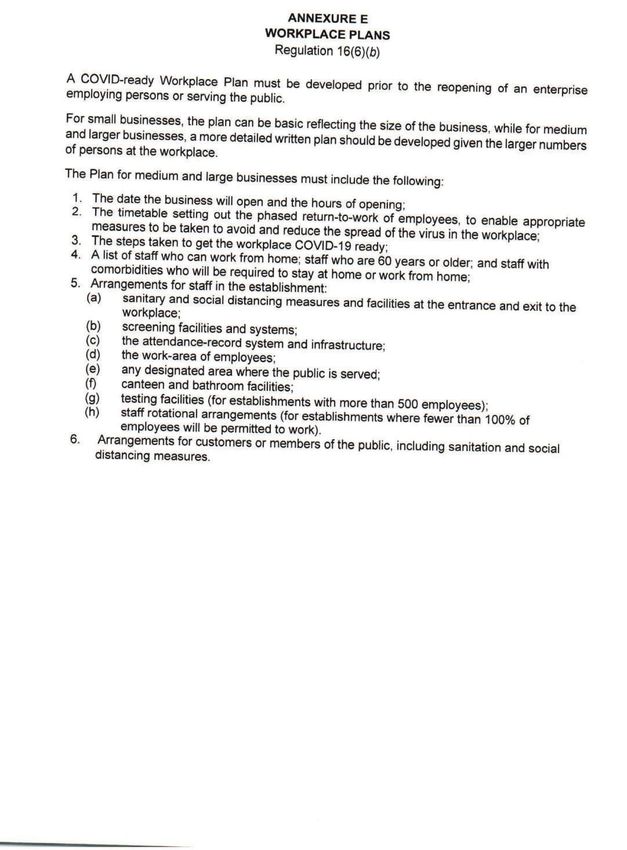
Covering COVID-19 | 1 June 2020

                                        The secret of change is to focus all
                                      your energy not on fighting the old, but
                                              on building the new
                                                     ― Socrates

                                   The new norm of anticipating uncertainty in our
                                   business operations and personal lives is continuing.
                                   The lasting impact of the global COVID-19 pandemic
                                   remains unknown, with the only certainty seemingly
                                   being that there will be one.
                                   Our Corporate and Commercial team provided key
                                   takeaways for business operations during alert
                                   level 4 in South Africa. Now, in this second part to
                                   our handbook series: Covering COVID-19, we
                                   provide similar guidance in relation to the
                                   declaration of alert level 3.
                                   We hope to continue to create certainty for your
                                   business in uncertain times.
                                   Our team will release an updated version with each
                                   alert level declared during the lockdown alert
                                   strategic phases.

=
CMS South Africa | Alert Level 3
                                                                                           2
Handbook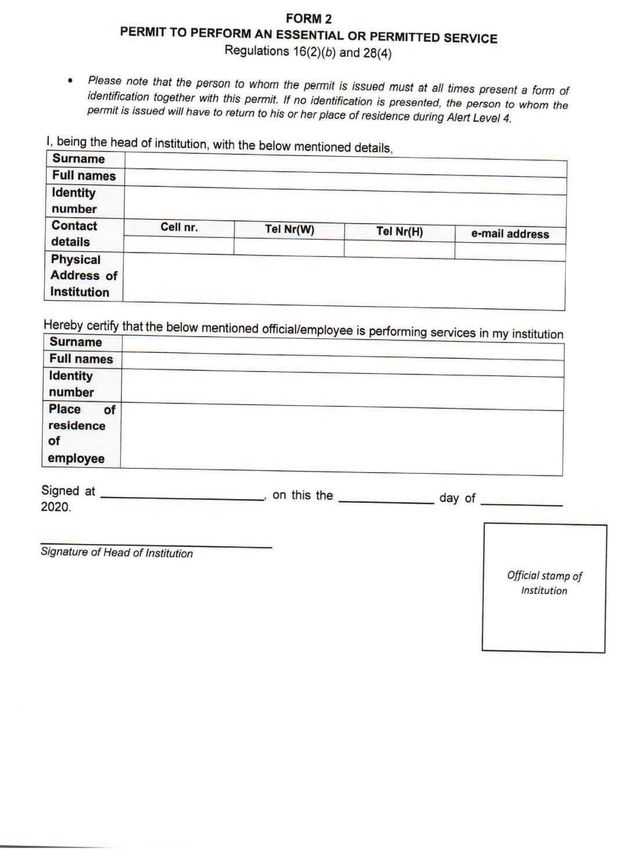
Covering COVID-19 | 1 June 2020

Table of Contents

General Provisions............................................................................................. 4
Duties of Employers and/or Businesses .................................................................. 8
Meet the team ................................................................................................13

CMS South Africa | Alert Level 3
                                                                                                                    3
Handbook
Covering COVID-19 | 1 June 2020

General Provisions

General Risk Approach
o     As mentioned in part 1 of our handbook series covering COVID-19, South Africa
      has moved to a risk adjusted approach in its fight against COVID- 19. This risk
      adjusted approach is based on a system of alert levels.

           o    Currently, South Africa is under a declared national alert level 3. However,
                the following areas have been declared as “hotpots”:

                                                  M ETROS

                         T shwane                                     Johannesburg

                        E kurhuleni                                        E thekwini

                        Cape T own                                     Buf falo City

                                            Ne l son Mandela Bay

                                                DISTRICTS

                               W e st Coast, Overberg and Cape Winelands

                                    Chri s Hani district in Eastern Cape

                                      i Le mbe district in KwaZulu-Natal

o     A hotspot can be declared to have a different risk level and the movement of
      people in and out of a hotspot can be restricted. In addition, a plan will be
      developed by government in relation to the measures to contain the spread of
      COVID-19 in a hotspot.

CMS South Africa | Alert Level 3
                                                                                               4
Handbook
Covering COVID-19 | 1 June 2020

New Regulations
o     The Minister of Cooperative Governance and Traditional Affairs (Mi nister) issued
      new regulations under the Disaster Management Act on 29 April 2020 , and these
      were amended by the Minister on 28 May 2020 (Le vel 3 Regulations).

o     The purpose of the Level 3 Regulations is to amend the previous regulations issued
      in response to the COVID-19 pandemic and to set out the regulations regardi ng
      alert level 3.

o     Under the Level 3 Regulations, the restrictions on movement and the economy
      are further eased from the previous alert level. However, certain of the provisions
      contained in the previous regulations continue to apply.

o     The Minister shall be responsible for the declaration of the alert level that will appl y
      at national, provincial, metropolitan, district level or in a hotspot.

o     All directives that were issued under the Old Regulations will remain in force until
      such time as these directives are amended or withdrawn by the relevant members
      of cabinet.

o     The purpose of this guideline is to summarise certain provisions of the Level 3
      Regulations,    a      copy      of     which     can    be     obtained     at
      https://www.gov.za/sites/default/files/gcis_document/202005/43364gon608s.pdf
      and which should be considered in full.

CMS South Africa | Alert Level 3
                                                                                                  5
Handbook
Covering COVID-19 | 1 June 2020

General measures
  The following general measures to contain the spread of COVID-19, are still in place:

                                          Wear a nose and mouth
                                          covering (Face Mask) in public.

                                                              No use of public transport or
                                                              entry to a building or place
                                                              without a Face Mask.

                                                                            No     gatherings,    except,
                                                                            amongst    others, in the
                                                                            workplace for work purposes.

CMS South Africa | Alert Level 3
                                                                                                            6
Handbook
Covering COVID-19 | 1 June 2020

            Restriction of movement of persons in relation to the workplace
              The Level 3 Regulations restrict the movement of persons and the following is relevant in terms of
              the workplace:

                o    all persons who are able to m ust work from home. However, persons are permitted to
                     perform any type of work outside of the home if health protocols and social distancing
                     measures are complied with, the return to work is phased in and the work is not one of the
                     specific exclusions;

                o    a person may leave their place of residence to, amongst others, go to work or perform any
                     service permitted under the Level 3 Regulations;

                o    persons moving between provinces, metropolitan areas, districts and/or hotspots to carry
                     out work responsibilities or a service permitted under the Level 3 Regulations, must have a
                     permit issued by the employer that corresponds with Form 2 of Annexure A (Pe rmit). A copy
                     of the Permit is attached hereto as S chedule 1;

                o    various places that were previously closed to the public remain closed to the public;

                o    the borders of South Africa, remain closed, save for certain permitted exceptions; and

                o    directives must be issued regarding the re-opening of, amongst others, domestic air travel
                     to allow for the return to work.

CMS South Africa | Alert Level 3
                                                                                                                   7
Handbook
Covering COVID-19 | 1 June 2020

Duties of Employers and/or
Businesses
The Level 3 Regulations provide for numerous duties and responsibilities on employers
and businesses. Importantly, these include:

General obligations under alert level 4 that continue to apply
under the Level 3 Regulations
o     Employers must provide employees, that may come into direct contact with the
      public as part of their duties, with a Face Mask.

o     In terms of every busi ness premises:

      ▪    it must be determined what the floor space area is in square metres;

      ▪    it must be determined what number of customers and employees may be
           inside the business premises at any one time, with adequate space being
           available;

      ▪    steps must be taken to ensure that queuing persons are able to maintain a
           distance of one and a half metres from each other (Approved Social Distance);

      ▪    hand sanitisers for use by the public and employees must be provided at the
           entrance of premises;

      ▪    there must be a written assignment of an employee or other suitable person
           as a compliance employee, which compliance employee must ensure
           compliance with the above and that all hygiene conditions and limitations set
           out in directives are adhered to; and

     ▪     All employers must adopt measures to promote physical distancing including:

            •    enabling employees to work from home;

            •    the provision of adequate space within the workplace;

            •    restricting face to face meetings; and

            •    developing special measures for employees with known or disclosed
                 health issues or comorbidities or high-risk conditions or who are above
                 the age of 60.

CMS South Africa | Alert Level 3
                                                                                           8
Handbook
Covering COVID-19 | 1 June 2020

Compliance officer (applicable also under alert level 4)
o     All industries, businesses and entities, permitted to operate, must:

      ▪    designate a compliance officer, who must oversee (a) compliance with the
           Workplace Plan (as defined below) and (b) adherence to standards of hygiene
           and health protocols relating to COVID-19 at the workplace.

      ▪    pri or to the reopening of a workplace for business, develop a plan
           corresponding to Annexure E of the relevant regulations (W orkplace Plan), the
           Workplace Plan must be retained for inspection and must set out:

            •    which employees are permitted to work;

            •    the plan for the phased-in return of employees;

            •    the health protocols in place; and

            •    the details of the compliance officer;

      ▪    phase in the return of their employees to the workplace to manage the said
           return, including from other provinces, metropolitans and district areas; and

      ▪    develop measures to ensure that standards relating to health protocols,
           adequate space and social distancing are met.

o     The Workplace Plan for small business can be basic and that for medium and large
      business more detailed and which must set out the details per Annexure E. We
      attach a copy of Annexure E to this guide as S chedule 2.

CMS South Africa | Alert Level 3
                                                                                            9
Handbook
Covering COVID-19 | 1 June 2020

                Obligations in relation to the commencement of business
                operations
                 o     As mentioned above, in order to commence operations, a business must first
                       have a Workplace Plan in place.

                 o     Every person in control of a retail store or institution m ust:

                       ▪   take steps to ensure that customers maintain the Approved Social Distance
                           and adhere to all directions in respect of health protocols and social
                           distancing;

                       ▪   designate a compliance officer to ensure that safety controls are adhered to;
                           and

                       ▪   display the name of the compliance officer prominently in the store or in a
                           visible area.

                 o     All businesses and other institutions are permitted to operate in terms of the
                       Level 3 Regulations, save for certain operations that are expressly excluded. We
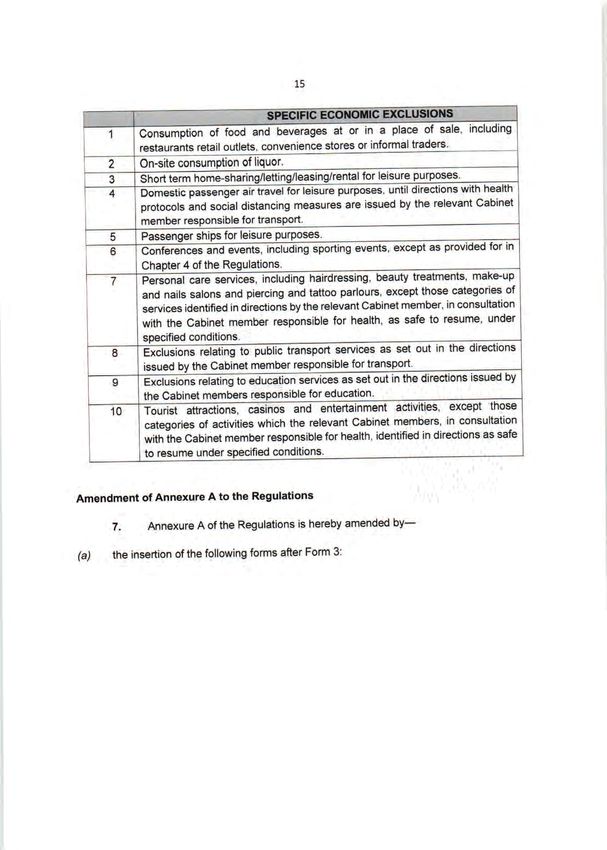
                       attach a copy of the full list of the specific economic exclusions as S chedule 3 .

                                                             ❖

                             CMS practical tip

                             Under the old regulations, only specially mentioned
                             permitted and essential services were allowed to operate.
                             In terms of an issued directive, permitted and essential
                             service companies were required to obtain a certificate
                             from the Companies and Intellectual Property
                             Commission (CIPC).

                             As at the date on which this guide is issued, the website of
                             CIPC was updated to reflect that “essential service
                             certificates” are not required under alert level 3.

                             While it would be preferable for the relevant minister to
                             issue a directive regarding this, it seems that the said
                             certificates are not required.

CMS South Africa | Alert Level 3
                                                                                                             10
Handbook
Covering COVID-19 | 1 June 2020
Permits
o As mentioned above, persons that are re quired to m ove between provinces,
metropolitan areas, districts and/or hotspots to carry out work responsibilities or
a service permitted under the Level 3 Regulations must be issued with a Permit
by the e mployer.
o The Level 3 Regulations therefore only require Permits to be issued to employees
that are required to travel between areas for work. Furthermore, the Level 3
Regulations do not expressly require that the head of institution (as defined)
must sign the Permit. However, the form that the Permit must comply with still
refers to a signature by the head of an institution and thus it is recommended
that this be complied with.
Appointment of persons
As set out above, businesses must appoint, designate and/or assign (as the case may
be) a compliance employee and compliance officer.
Larger Businesses
o Businesses with more than 100 employees must, where possible, minimise the
number of employees at the workplace through rotations, staggered working
hours, remote working and other similar arrangements.
o Construction, manufacturing businesses and financial services firms with more
than 500 employees must arrange the following:
• transport for employees to site, or where this is not possible, consider
alternative working time arrangements which will reduce overall
congestion in public transport;
• stagger the return to work to ensure workplace readiness and avoid traffic
congestion; and
• screen employees daily for COVID-19 symptoms and refer employees
who display symptoms to medical examinations and testing where
necessary and submit the collected data to Director-General: Health.
CMS South Africa | Alert Level 3
11
HandbookCovering COVID-19 | 1 June 2020
Other requirements
o Directives issued by the relevant cabinet member regarding health protocols and
social distancing measures must be complied with.
o Measures must be implemented by employers for employees over 60 or those
with co-morbidities to facilitate their return to work to limit such employee’s
exposure and where possible that these employees should work from home.
o Sector or industry specific bodies (if existing) must develop, in consultation with
the Department of Health, sector specific health protocols in the event of high
health risks.
CMS South Africa | Alert Level 3
12
HandbookCovering COVID-19 | 1 June 2020
Meet the team
Deepa Vallabh Yushanta Rungasammy
Co-Head of Corporate & Co-Head of Corporate & Commercial
Commercial; Head of Africa:
M&A M +72 72 464 1722
E yushanta.rungsammy@cms-rm.com
M +27 82 571 0707
E deepa.vallabh@cms-rm.com
S i hle Bulose Re mbuluwani Nembudani
S enior Associate S enior Associate
M +27 82 776 2038 M +27 79 631 6418
E sihle.bulose@cms-rm.com E rembuluwani.nembudani@cms-
rm.com
Maud Hill Le bogang Molebale
S enior Associate S enior Associate
M +27 76 181 4543 M +27 82 947 5708
E maud.hill@cms-rm.com E lebogang.molebale@cms-rm.com
Aphelele Binta Dumisani Lucas
Candidate Attorney Paralegal
M +27 79 241 5103 M +27 78 344 2406
E aphelele.binta@cms-rm.com E dumisani.lucas@cms-rm.comSCHEDULE 1 - PERMIT
27
FORM 2
PERMIT TO PERFORM AN ESSENTIAL OR PERMITTED SERVICE
Regulations 16(2)(b) and 28(4)
Please note that the person to whom the permit is issued must at all times
present a form of
identification together with this permit. If no identification is presented, the person to whom
the
permit is issued will have to return to his or her place of residence during Alert Level 4.
I, being the head of institution, with the below mentioned details,
Surname
Full names
Identity
number
Contact Cell nr. Tel Nr(W) Tel Nr(H) e-mail address
details
Physical
Address of
Institution
Hereby certify that the below mentioned official /employee is performing services in
my institution
Surname
Full names
Identity
number
Place of
residence
of
employee
Signed at on this the day of
2020.
Signature of Head of Institution
Official stamp of
Institution36
SCHEDULE 2 - WORKPLACE PLAN
ANNEXURE E
WORKPLACE PLANS
Regulation 16(6)(b)
A COVID -ready Workplace Plan must be developed prior to the
reopening of an enterprise
employing persons or serving the public.
For small businesses, the plan can be basic reflecting the size of the business.
while for medium
and larger businesses, a more detailed written plan should be developed
given the larger numbers
of persons at the workplace.
The Plan for medium and large businesses must include the following:
1. The date the business will open and the hours of opening;
2. The timetable setting out the phased return -to -work of employees, to enable
appropriate
measures to be taken to avoid and reduce the spread of the virus in the workplace:
3. The steps taken to get the workplace COVID -19 ready;
4. A list of staff who can work from home: staff who are 60
years or older; and staff with
comorbidities who will be required to stay at home or work from home:
5. Arrangements for staff in the establishment:
(a) sanitary and social distancing measures and facilities at the entrance and exit
to the
workplace;
(b) screening facilities and systems;
(c) the attendance -record system and infrastructure:
(d) the work -area of employees:
(e) any designated area where the public is served;
(f) canteen and bathroom facilities;
(g) testing facilities (for establishments with more than 500 employees);
(h) staff rotational arrangements (for establishments where fewer than 100% of
employees will be permitted to work).
6. Arrangements for customers or members of the public, including sanitation and social
distancing measures.SCHEDULE 3 - SPECIFIC EXCLUSIONS
15
SPECIFIC ECONOMIC EXCLUSIONS
1
Consumption of food and beverages at or in a place of sale. including
restaurants retail outlets, convenience stores or informal traders.
On -site consumption of liquor.
3 Short term home -sharing /letting /leasing /rental for leisure purposes.
4 Domestic passenger air travel for leisure purposes. until directions with health
protocols and social distancing measures are issued by the relevant Cabinet
member responsible for transport.
5 Passenger ships for leisure purposes.
6 Conferences and events, including sporting events, except as provided for in
Chapter 4 of the Regulations.
Personal care services, including hairdressing. beauty treatments, make -up
and nails salons and piercing and tattoo parlours, except those categories of
services identified in directions by the relevant Cabinet member, in consultation
with the Cabinet member responsible for health, as safe to resume. under
specified conditions.
Exclusions relating to public transport services as set out in the directions
issued by the Cabinet member responsible for transport.
Exclusions relating to education services as set out in the directions issued by
the Cabinet members responsible for education.
10 Tourist attractions. casinos and entertainment activities, except those
categories of activities which the relevant Cabinet members, in consultation
with the Cabinet member responsible for health. identified in directions as safe
to resume under specified conditions.
Amendment of Annexure A to the Regulations
7. Annexure A of the Regulations is hereby amended by-
(a) the insertion of the following forms after Form 3:Your free online legal information service. A subscription service for legal articles on a variety of topics delivered by email. cms-lawnow.com CMS Legal Services EEIG (CMS EEIG) is a European Economic Interest Grouping that coordinates an organisation of independent law firms. CMS EEIG provides no client services. Such services are solely provided by CMS EEIG’s member firms in their respective jurisdictions. CMS EEIG and each of its member firms are separate and legally distinct entities, and no such entity has any authority to bind any other. CMS EEIG and each member firm are liable only for their own acts or omissions and not those of each other. The brand name “CMS” and the term “firm” are used to refer to some or all of the member firms or their offices. CMS locations: Aberdeen, Algiers, Amsterdam, Antwerp, Barcelona, Beijing, Belgrade, Berlin, Bogotá, Bratislava, Bristol, Brussels, Bucharest, Budapest, Casablanca, Cologne, Dubai, Duesseldorf, Edinburgh, Frankfurt, Funchal, Geneva, Glasgow, Hamburg, Hong Kong, Istanbul, Johannesburg, Kyiv, Leipzig, Lima, Lisbon, Ljubljana, London, Luanda, Luxembourg, Lyon, Madrid, Manchester, Mexico City, Milan, Mombasa, Monaco, Moscow, Munich, Muscat, Nairobi, Paris, Podgorica, Poznan, Prague, Reading, Rio de Janeiro, Riyadh, Rome, Santiago de Chile, Sarajevo, Seville, Shanghai, Sheffield, Singapore, Skopje, Sofia, Strasbourg, Stuttgart, Tirana, Utrecht, Vienna, Warsaw, Zagreb and Zurich. cms.law
You can also read


