COVID-19 Overcoming organisational challenges and reshaping the workforce - Last updated 24 August 2020 - Bird & Bird
←
→
Page content transcription
If your browser does not render page correctly, please read the page content below

COVID-19
Overcoming organisational challenges and
reshaping the workforce

Last updated 24 August 2020
Introduction
COVID-19: Overcoming organisational challenges and reshaping the workforce
In the wake of the COVID-19 crisis, the global business community is facing one of the most significant challenges of our century.

The disruption the crisis is causing may well lead to a total transformation or rebooting of the globalised economy, altering fundamentals of our society such as the
way in which we produce and distribute, the way in which people work together, communicate and consume and the way in which value is created.

But before we get to see the bright lights of a new working world, the global business community may well take one step backwards before jumping, retrenching
before the new launch.

This document aims to assist businesses in their strategic planning and operational execution of such reorganisation transactions. Certainly, businesses that operate
on a cross-border or global level must navigate a patchwork of laws, rules and regulations when planning for reorganisations. Beyond the law, they also have to
observe, respect and integrate cultural sensitivities and societal specifics, keeping in mind the resulting best practices when engaging in potentially expensive, clearly
disruptive and most certainly delicate processes and transactions.

We hope the document will provide you with an initial overview and impression of such differences and convergences, based on the extensive practical experience
and bespoke expertise of our Bird & Bird employment teams and professionals around the globe.

It is not designed and should not be used as legal guidance to any form of restructuring.

The document is up to date as of 24 August 2020. Given the speed with which current regulations are being amended in various jurisdictions, it will be adapted on an
ongoing basis.

 Ian Hunter                                 Pattie Walsh                                  Pieter De Koster
 Partner                                    Partner                                       Partner

 Tel: +44 20 7415 6140                      Tel: +852 2248 6088                           Tel: +32 2 282 60 81
 ian.hunter@twobirds.com                    pattie.walsh@twobirds.com                     pieter.dekoster@twobirds.com

© 2020 Bird & Bird All Rights Reserved                                                                                                                                   2
Cross-border reorganisations and the
EWC
An integral part of strategic planning and operational execution of cross-border restructurings in Europe is the key role of any European works council (‘EWC’).

As an additional layer in the overall process, organisations with an EWC in operation1 must examine, assess and integrate the EWC in any cross-border
reorganisation involving multiple jurisdictions within the European Union (including the United Kingdom, and other jurisdictions covered by the EWC agreement).
When assessing the EWC’s role, it is fundamental to conduct an analysis of the underlying EWC agreement, understand the impact of the agreement’s governing law
and take into consideration how the organisation has dealt with ‘exceptional circumstances’ in the past.

Every EWC agreement should have substantive and procedural provisions to deal with exceptional circumstances, which under relevant EU legislation clearly cover
cross-border restructurings (collective lay-offs, closure, etc.). The provisions encompass the timing of the procedure, the content of the information to be presented
and the scope of the consultation, as well as the use of experts, the relationship between EU and local procedures and key issues like confidentiality.

The practical application of such rules, their enforcement and sanctions in case of non-compliance will be driven by the agreement’s governing law; hence the wider
embodiment of the EWC’s role and powers in the legal system of such governing law is also crucial. National laws tend to differ quite substantially on important
issues like sequence and timing of the EWC I/C procedure, the concepts of information and consultation, the role of experts, trade unions and administration and the
enforcement of the rules.

Finally, the quality of cross-border collective labour relations before and outside of the punctual reorganisation transaction will dictate the quality of the process in
these exceptional circumstances.

Bird & Bird’s extensive experience and stellar expertise in handling EWC related issues can undoubtedly be a key asset in successfully planning, preparing and
managing cross-border reorganisation transactions on the ground.

1   According to official sources, there about 1,300 EWCs in operation in the European Union.

© 2020 Bird & Bird All Rights Reserved                                                                                                                                      3
twoBirds Access
Coordinating and delivering global projects through effective project management

Large-scale international projects can be challenging to manage, particularly when
multiple time zones are involved and even more so when working remotely.

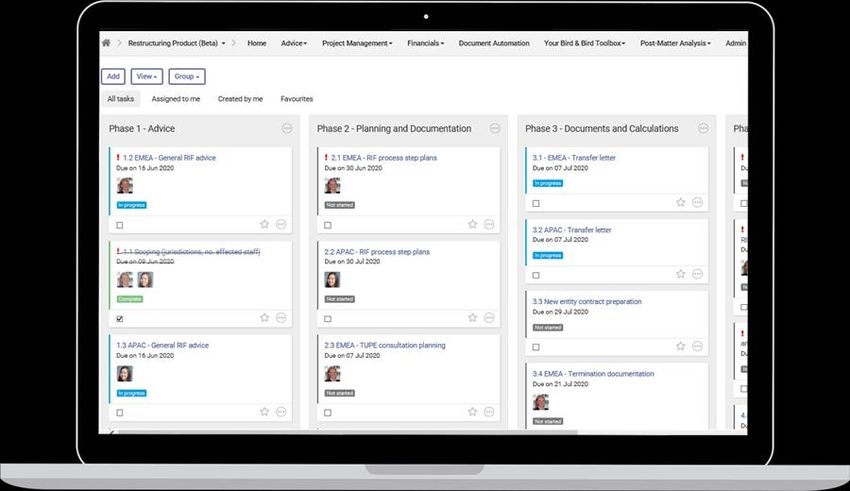
Our twoBirds Access platform enables us to effectively manage tasks and deadlines
on large projects, reduces email traffic and gives clients visibility on progress. This
cloud-based solution incorporates workflow and global project timeline mapping,
giving all users access 24/7 to relevant information, irrespective of location. The
interactive nature of portal means individuals get email alerts when tasks are
assigned and reminders when deadlines due, so the project stays on track.

All Access sites are hosted by HighQ, an ISO 27001 certified and industry leading
collaboration portal. The encrypted security portal ensures that all uploaded
documents are safe and can only be accessed by pre-approved individuals.
Permissions can be set at different levels, so project members only see information
that is relevant to their workstream(s). In addition, multiple log-ins can be issued,
giving you control over which parts of the site can be accessed by different team
members.

Key benefits:
•   Access to key documentation 24/7
•   Visibility on project progress and milestones
•   Reduction in email traffic
•   Tailored views for different teams

© 2020 Bird & Bird All Rights Reserved                                                    4
Glossary
Common terms and abbreviations

 CV        COVID-19 or new Corona virus

 CBA       Collective bargaining agreement

 CLO       Collective lay-off

 ER        Employee representative

 ET        Employment tribunal

 FTO       Freedom to operate

 HW        Home working

 I/C       Information/consultation (procedure/stage)

 Pilon     (Severance) payment in lieu of notice

 RIF       Reduction in force

 SME       Small and medium enterprise

 SSC       Social security contributions

 TU        Trade union

 WC        Works council (or similar body of employee participation at plant/company level)

© 2020 Bird & Bird All Rights Reserved                                                        5
Government aid and recession resources
View resources by country –click on country name

                                                                                       Australia        Hungary

                                                                                       Belgium          Italy

                                                                                       China            Netherlands

                                                                                       Czech Republic   Poland

                                                                                       Denmark          Singapore

                                                                                       Finland          Slovak Republic

                                                                                       France           Spain

                                                                                       Germany          Sweden

                                                                                       Hong Kong        UK
 Bird & Bird has extensive contacts with preferred firms in countries where our firm
 does not have offices.

© 2020 Bird & Bird All Rights Reserved                                                                                    6
Australia
Government aid and recession resources
Restrictions on
CV crisis impact restructurings
Temporary closure and government aid: Aid conditional upon absence of lay-
off/prohibition of lay-off:
• Permissible. Employer may require employees to work from home if the direction is lawful and reasonable in the circumstances (e.g. if employer is forced to close
premises for health or safety reasons). • In order to be eligible to receive the Australian
Government's JobKeeper wage subsidies, an employer must
• In case of temporary business closure, there are now 2 available routes for employers
be able to demonstrate that it has been in an employment
– the first is a 'stand down' under the Fair Work Act; and relationship with eligible employees since 1 March 2020,
and be able to confirm that each eligible employee is
currently engaged by the employer (including those that
– the second is a JobKeeper-enabling stand down direction under the new temporary JobKeeper provisions in the Fair Work Act.. Continued payment of the have been stood down).
employees' wages in full by the employer unless one of following options is exercised by the employer:
• Fair Work Act stand down • JobKeeper enabling directions • The JobKeeper scheme is designed to assist businesses to
If the employees cannot be usefully employed', including by reason of a The Australian Government has introduced new legislation (which has retain their employees whilst they try to manage the
stoppage of work for any cause for which the employer cannot reasonably be introduced temporary amendments to the Fair Work Act) providing financial downturn in their operations caused by CV.
held responsible, an employer has a statutory right to stand down its support to assist employers impacted by CV through the 'JobKeeper'
employees without pay during this period. In circumstances where a stand payment scheme. Under the JobKeeper scheme, eligible businesses (i.e.
down provision is included in the employee's contract of employment or businesses that expect a revenue loss of 30% (if the company's annual
enterprise agreement though (generally uncommon in Australia), additional turnover is less than $1 billion) or 50% (if the company's annual turnover is
requirements that must be met before issuing a stand down direction (e.g. more than $1 billion)) impacted by CV are able to claim a fortnightly payment
consultation or notice requirements) may apply. of AUD$1,500 per eligible employee, for a maximum period of 6 months, in
order to keep those employees on the books.
If statutory or contractual stand down right not available (or not sought to be
invoked by employer), the employer may consider other options (subject to If an employer is eligible to receive a JobKeeper payment, it is then able to:
the employee's conditions of employment) including:
– issue a JobKeeper enabling stand down direction;
– seeking agreement of employees to reduce their hours of work and pay for a – reduce the number of hours worked by employees and to grant such
temporary period. Any such agreement would need to be in writing employees permission to undertake secondary jobs;
between the parties;
– alter employees' usual duties and location of work; and
– requesting that employee takes period of accrued paid annual leave (to be
recorded in writing); – subject to employee agreement, change the days/times of work or provide
employees with twice as much annual leave at half pay.
– requesting that employee take period of unpaid leave (to be recorded in
writing); or
– consider job sharing arrangements between its employees.
• The Australian Government is also providing financial support to eligible small and medium-sized businesses and not-for-profits with aggregated annual turnover
of less than $50 million that employ people in Australia. Eligible employers will receive a payment that is equal to 100% of the total of the salaries and wages
withheld, with a maximum payment being AUD$50,000, and the minimum payment being AUD$10,000.
For more information click here
© 2020 Bird & Bird All Rights Reserved 7Australia
Recessionary measures - CLO and closure
Outline basic redundancy rights Concepts CLO and closure Schedule/ timeline procedure CLO/closure
• Must be a case of a 'genuine redundancy', which means that: • CLO: The rules relating to individual redundancies 1 Planning: Consider business case for implementing redundancies
discussed in the adjoining column also apply to collective (including calculation of notice and redundancy payments) and
– the employer no longer requires the person’s job to be performed by anyone redundancies and mass layoffs. consider contingency arrangements. Plan communications strategy.
because of changes in the operational requirements of the employer’s enterprise;
and • TUs must be informed where 15 or more employees are to be (Timeframe: As long as necessary – 2 weeks may be appropriate)
– the employer followed any consultation requirements in an award or CBA; and made redundant.
2 Notification: Notify each applicable TU of:
– the employer considered any redeployment opportunities. • Modern awards and CBAs also include specific consultation
• Employee must have at least 1 year of continuous service and work for an employer – the proposed dismissals and the reasons for them;
clauses which require employers to consult with employees
that employs 15 or more persons to be eligible for redundancy payments. and their representatives (e.g. TUs) regarding the – the number and categories of employees likely to be affected; and
implementation of major workplace changes, such as – the time at which the employer intends to carry out the dismissals.
• Minimum legislative termination notice requirements (unless greater period are set
redundancy processes. These obligations require the (Timeframe: Notice to be provided as soon as practicable after
out in a contract) are based on employee's length of continuous service:
employer to also consider the employees' responses to any making the decision and before implementing any redundancy
– < 1 year of continuous service: 1 weeks' notice; such proposals. decisions.)
– 1 – 3 years: 2 weeks' notice; • The consultation processes outlined above must take place
– 3 – 5 years: 3 weeks' notice; and prior to notice of termination being given to the affected 3 Consultation: Provide each of the notified parties an opportunity to
– >5 years: 4 weeks' notice. employees. consult the employer on measures:
• An employer can offer Pilon, if allowed by contract.
• If a decision is made to proceed with the redundancies of 15 – to avert or minimize the proposed dismissals; and
• Redundancy payments also depend on the employee's length of continuous service or more employees, the employer must notify Australia's – to mitigate the adverse effects of the proposed dismissals (such as
and are paid at the employee's base pay rate for ordinary hours worked: social services department, Centrelink, of its decision to finding alternative employment).
implement the proposed change.
– 1-2 years of continuous service: 4 weeks' pay; (Timeframe: 1-2 weeks)
– 2-3 years: 6 weeks' pay;
– 3-4 years: 7 weeks' pay; 4 Decision to proceed: if management decides to proceed, employees
– 4-5 years: 8 weeks' pay; to be consulted with and then provided with notice of termination.
– 5-6 years: 10 week' pay;
(Timeframe: 1-2 weeks)
– 6-7 years: 11 weeks' pay;
– 7-8 years: 13 weeks' pay; • Importantly, if the relevant employees are covered by a modern award or
– 8-9 years: 14 weeks' pay; enterprise agreement, employees have a 'right' to consultation including
– 9-10 years: 16 weeks' pay; and a right to be told of the reasons for the redundancies, the impact upon
– 10+ years: 12 weeks' pay. their roles and any measures considered to avoid the redundancies.
Significantly also, employees have a right to have their views on the
• An enterprise agreement or an employment contract may provide for a longer notice matter heard and considered.
or greater redundancy payments than those outlined above.
• In addition to the redundancy payments described above, an employer must also pay
to the employee any accrued entitlements (e.g. holiday) and outstanding pay up to,
and including, their last day of employment.
© 2020 Bird & Bird All Rights Reserved 8Australia
Recessionary measures - CLO and closure
I/C + other rights of in-house bodies of Usual severance package/social plan FTO impact assessment (duration, cost,
employee participation or third parties features (+ cost assessment) risk of disruption)
• As set out in the adjoining column, I/C rights of employee • The entitlements which are available in cases of individual redundancies Duration/timing
associations/third parties include: (discussed under the heading 'Outline basic redundancy rights') also Minimum 1 month process, incl preparation stage.
apply to collective redundancies and mass layoffs.
– right to receive information on business rationale and redundancy Cost
arrangement plans; • In Australia, redundancy pay is the same as severance pay. Key cost is the amount paid to employees in redundancy and other
– right to be provided with an opportunity to consult the employer on outstanding payments, but additional costs may arise if employer is
alternative measures to avert or minimise the proposed dismissals involved in protracted disputes with relevant employee associations and
and measures (such as finding alternative employment) to mitigate negative media publicity (in high profile cases) can have an impact on
the adverse effects of the proposed dismissals. business revenue. Employee morale can also be affected in these
circumstances which can impact on the business' levels of productivity.
• Joint closure of I/C stage is highly recommended
Risk of disruption
• Neither authorization required nor blocking rights from external bodies
Industry and workplace-specific. Redundancies almost always creates a
or agencies, administration to proceed with the proposed change.
level of disruption in a business, but the level of disruption will depend on
• However, the Fair Work Commission can order that the employer the business' adaptability to change, the quality of its management, the
consult with employees' associations if satisfied that there has been a unionization of its workforce and the nature of the industry (e.g. strikes are
failure to notify or consult. It cannot, however, make orders, including more common in certain industries, such as aviation/manufacturing).
orders to reinstate employees, pay an amount in lieu of reinstatement or
provide severance pay, simply because of a lack of consultation. Such
orders can only be made if employees lodge unfair dismissal claims.
© 2020 Bird & Bird All Rights Reserved 9Belgium
Government aid and recession resources
CV crisis impact Restrictions on restructurings
Temporary closure and government aid: Aid conditional upon absence of lay-off/prohibition of lay-off:
• HW possible if agreed upon (forced HW questionable) • N/A
• Temporary suspension of contract for economic
reasons: substantive /procedural rules +
unemployment benefits for blue/white-collar
• Temporary suspension of contract for force majeure:
substantive and procedural rules + unemployment
benefits for all
For more information click here
© 2020 Bird & Bird All Rights Reserved 10Belgium
Recessionary measures - CLO and closure
I/C + other rights of
Usual severance FTO impact
Outline basic Schedule/ timeline in-house bodies of
Concepts CLO and package/social plan assessment
redundancy rights procedure employee
closure features (+ cost (duration, cost, risk
CLO/closure participation or
assessment) of disruption)
third parties
• Termination can be on notice or • CLO: for procedural purposes, • Preparation stage (with 4 C’s – • I/C rights of WC include • Typical scope would exclude Duration / timing
with payment in lieu of notice redundancies of threshold business case, communication, affected management-level Minimum 4-6 month process, incl
(‘Pilon’) at employer’s choice ((1) number of employees within any cost computation, contingency – in-depth information on employees and executives preparation stage (6-8 weeks),
+ (2) below) rolling 60-day period: threshold planning) – preferably 6 – 8 business case (no assistance knowing that I/C process is open-
is 10 or more for businesses with weeks of any TU expert allowed) • Beyond legal entitlements (see ended so quite unpredictable;
1 Indefinite term contracts 20 – 99 employees, 10% for – assessment and opinion on left), a social plan would contain
concluded after 1 January • Kick-off meeting in WC with business case (incl alternative supplementary financial and Cost
businesses with 100 – 299
2014, notice depends solely intention to proceed (or with TU measures to mitigate impact non-financial benefits Well beyond legal entitlements,
employees , and 30 or more
on length of service: delegates, if no WC, or town hall of planned restructuring) impacted by industry specifics, TU
employees for businesses with • Focus is still on financial
if no TUD either) – advice on selection criteria of power, vulnerability to conflict or
– 1st year, 7 weeks’ notice, plus +300 employees package and add-ons, with
affected employees media attention, up to 1.3 or even
– 2nd year, 4 weeks’ notice, plus • Closure: definitive (not • Consecutive I/C meetings in WC bonuses rewarding loyalty, 1.5 of legal entitlements
– as of 3rd year, 3 weeks’ temporary) stoppage of main –open-ended, but on average • Joint closure of I/C stage is supplements on top of
notice/commenced year 2-3 months unemployment etc Risk of disruption
business activity + reduction in highly recommended – open-
Depends on a variety of factors like
workforce of +75% compared to • End of I/C procedure + ended so WC leverage on I/C • Recent practice shows attention
2 Indefinite term contracts pre- overall quality of industrial
previous calendar year, either at end
2014 (as at 31 Dec 2013) + management decision to proceed to ‘flexicurity’ approach, with relations, history of change, nature
plant level (only for 20+ training budget, temporary
above: • No decision required nor of business and workforce
employees ), or at • Cooling-off period for collective supplement to new lower-paid
allowed from internal bodies (industrial/services/high tech),
– blue-collar: determined by department/division level bargaining (no redundancies job, incentives for business impact of TUs; risk of violence is
CBA (X weeks/5-year period allowed ) – 30 days with • No veto nor blocking rights from starters minimal but strikes are more
• In specific industries, particular maximum extension for another
of service) internal bodies commonplace depending on
rules exist for multiple 30 days • Special attention is usually given
– white-collar: either 3 redundancies: procedures of I/C industry.
months/5-year service period • No authorization required nor in regulations and corporate
to be observed, sanctioned with • Implementation stage covering: blocking rights from external practice to affected older
commenced for lower paid, or additional financial liability (e.g.,
1 month/commenced year of – setup of redeployment cell bodies or agencies, employees with soft landing
3-6 months’ compensation) administration to proceed with systems and to ERs and their
service with min 3 months, or (incl outplacement services
for highest paid contract offer, 1 month) transaction statutory protection against
clauses as agreed dismissal
– lifting of protection of ERs (2 • But, Gov’t certification required
• For Pilon, annual compensation months) for the implementation of social
includes salary and all ongoing – securing soft landing system plan (redeployment cell, lifting
benefits (2-3 months for certification of protection, soft landing
by Gov’t) regimes)
• Other exit payments are due
(13th month, exit vacation pay)
and certain services can be
mandatory (outplacement for
certain employees up to €5,500)
© 2020 Bird & Bird All Rights Reserved 11China
Government aid and recession resources
CV crisis impact Restrictions on restructurings
Temporary closure and government aid: Aid conditional upon absence of lay-off/prohibition of lay-off:
• HW possible if agreed upon and adequately compensated. Salary shall be • Employers with no lay-offs or whose lay-off ratio is not higher than the prescribed
paid to employees as if they were in normal attendance. standard, may apply for a lump-sum employment stabilization subsidy and/or
repayment of unemployment insurance as prescribed by local regulations.
• Employers may order employees not to work, provided that employees
consent to this arrangement. However, employers are still required to pay • If an employee is unable to perform job duties due to being quarantined as a result
salary to employees during the period of suspension. The standard varies of a COVID-19 diagnosis, or under mandatory medical observation or other
from different location. For example, in Shanghai, during the first month emergency arrangements implemented by the Government, the employer may not
of suspension, full salary should be paid. Starting from the second month terminate such employee for non-fault reasons or engage in mass lay-off (i.e. lay-off
and onwards, employees should be paid not less than the minimum salary of more than 10% of the entity’s employees) involving the employee until he/she is
in Shanghai. no longer under the above circumstances. In Beijing, the above restriction also
• Government aid program including exemption or extension of social applies to employees in Beijing who are unable to perform job duties due to nursing
his/her underage children during the COVID-19 school closures.
insurance contribution, extension of tax payments, repayment of
unemployment insurance, social insurance subsidy, training fee subsidy,
exemption or reduction of property rent fees, extension of bank loans
might apply, especially to SMEs in financial difficulties caused by CV,
depending on local regulations.
For more information click here
© 2020 Bird & Bird All Rights Reserved 12China
Recessionary measures - CLO and closure
Outline basic redundancy rights Concepts CLO and closure Schedule/ timeline procedure CLO/closure
Mass lay-off • CLO ('Mass lay-off'): an employer reduces its workforce by 20 or more • A mass lay-off requires a rigorous process as below:
employees; or an employer reduces its workforce by more than 10% of its
• Employers may initiate mass lay-offs only under one of the following entire workforce. 1 the employer must first give TU or all employees a 30-day notice and
circumstances: consult for their opinions;
• A Mass lay-off is treated as a unilateral termination by the employer under 1 upon the expiry of the 30-day notice , the employer can then file the
1 the employer undergoes a reorganization in accordance with the PRC
Chinese employment law. lay-off plan to the local labour authority; and
Enterprise Bankruptcy Law;
2 after the labour authority indicates that the filing is complete, the
2 the employer experiences significant difficulties in its business • If an employee is unable to perform job duties due to being quarantined as
employer can then terminate the employees.
operation; a result of a CV diagnosis, or under mandatory medical observation or
other emergency arrangements implemented by the Government, the In practice, the whole process will last for at least 3-4 months.
3 the employer switches production, makes major technological
innovation, adjusts its business model, and after modifying its employer may not terminate such employee for non-fault reasons or • Closure (under a self-determined deregistration case): normally after the
employment contracts, still needs to lay off employees; or engage in mass lay-off involving the employee until he/she is no longer shareholders' resolution on company closure is issued and the company
4 the employer has experienced other significant changes that modified under the above circumstances. has filed a report to the local commercial bureau, the company should
the economic circumstances which formed the basis for its having notify all employees of the decision (no requirement on notice).
• Closure: due to bankruptcy, revocation of business license, shareholders’
signed the employment contracts, and it is unable to perform under the
decision to deregister or otherwise ordered to cease operations.
contracts.
• 30-day's prior notice to all its employees and/or the TU (if exists) must be
given in a mass lay-off. The lay-off plan should be filed with the local
labour authority and the employer should obtain their approval before the
lay-off.
• The following employees shall be given priority to be retained in a mass
lay-off: (i) persons who have concluded fixed-term employment contracts
for a relatively long term with the employer; (ii) persons who have
concluded open-ended employment contracts with the employer; (iii)
persons, none of whose family members has a job, or who have an elder or
minor depending on his/her support. If the employer is rehiring within 6
months, the reduced employees shall be notified and given priority.
Individual Termination
• Where a material change in the objective circumstances (job redundancy
can be deemed such a change in some provinces of China) relied upon at
the time of conclusion of the contract renders it impossible for the parties
to perform and, after consultation, the employer and the employee are
unable to reach an agreement on if/how to amend the contract, the
employer is entitled to terminate the contract by giving the employee a 30-
day prior written notice or one month’s salary in lieu of notice, in addition
to the economic compensation payable by the employer to the employee.
© 2020 Bird & Bird All Rights Reserved 13China
Recessionary measures - CLO and closure
I/C + other rights of in-house
bodies of employee participation or Usual severance package/social plan features (+ cost FTO impact assessment (duration,
third parties assessment) cost, risk of disruption)
• Mass lay-off: at least 30 days before initiating a mass lay- • Payment or accrued wages and benefits: current wages x number of days in last wage period Duration/timing
off, the employer must present its lay-off plan to the TU before termination; In practice, the whole process lasts for at least 3-4 months.
or to all of its employees, and solicit their opinions.
• Statutory minimum severance: one month of the employee's average monthly salary for each year
• Closure (under a self-determined deregistration case): of his/her service ("Average Monthly Income"). The Average Monthly Income should be Costs
the TU or employees cannot prevent a shareholders’ calculated based on his/her total salary over the past 12 months prior to the termination date and Illegal dismissal: An employer may request the labour
resolution on deregistration from taking effect unless the should include base salary, bonuses, allowances, commissions, benefits, overtime payments and arbitration commission/court to confirm that the employer's
company is a state-owned company. any other salary paid in cash. If the period of service in a relevant year is less than 6 months, a half unilateral dismissal is illegal. If successful, the employer will
month's Average Monthly Income will need to be paid as severance payment for that year. For be required to (i) pay damages equal to two times of the
service years after 2008, the Average Monthly Income is subject to a statutory monthly cap financial compensation for the unlawful termination; or (ii)
(currently 3 times the local average wage which varies regionally). rehabilitate the employment contract with the employee, with
back pay of the employee's salary and social insurance during
• Compensation for unused holidays: the compensation of unused statutory holidays is calculated the unlawful termination period.
upon 200% of daily wage, and how to compensate the company holidays depends on the
employer's rules.
Risk of disruption
• Payment in lieu of 30-day prior notice in a unilateral termination case due to individual lay-off, i.e. Strike: Where there is a strike in relation to employee benefits
material change of objective circumstance. and rights, the judicial authorities are usually more protective
of the employees and often uphold claims of termination
• Any other amounts due under contract: e.g. bonus, commission, etc. without legal cause if the employer terminates the employees
for organising or participating in the strike.
© 2020 Bird & Bird All Rights Reserved 14Czech Republic
Government aid and recession resources
CV crisis impact Restrictions on restructurings
Temporary closure and government aid: Aid conditional upon absence of lay-off/prohibition of lay-off:
• Remote work arrangements can be implemented if agreed with the employee; • The entitlement to the financial support from the ANTIVIRUS
program does not arise in relation to employees who have been
• The Government has introduced an employment protection program called 'ANTIVIRUS' that provides
dismissed (i.e. during the notice).
financial support to employers affected by CV and the adopted regulations in the period from 12 March
2020 to 31 May 2020 (with respect to Regime A) or to 31 August 2020 (with respect to Regime B);
– Regime A: (i) If the employer must have closed its business due to the governmental regulations aimed at
combating further spread of the CV, employees are entitled to the compensatory salary corresponding to
100% of their average earnings; or (ii) If an employee is in ordered quarantine, the compensatory salary
paid by the employer during first 14 days of the quarantine is 60% of the employee's earnings. In both
cases (i) and (ii), the employer may receive financial support in the amount of 80% of the compensatory
salary paid to the particular employees including social security and health insurance contributions
(however, no more than CZK 39,000 per employee; i.e. approx. EUR 1,400);
– Regime B: (i) If more than 30% of employees are in quarantine or take care of their children and the
employer thus cannot assign any work to the remaining employees; (ii) if the availability of inputs
necessary for the employer's activity has been limited; or (iii) in the event of drop in sales affecting the
workload (i.e. short-time working), the compensatory salary to be paid to the affected employees is (i)
100%, (ii) 80% or (iii) 60% of the employee's average earnings. The employer may receive financial
support in the amount of 60% of the compensatory salary paid to the particular employees including
social security and health insurance contributions (however, no more than CZK 29,000; approx. EUR
1,100);
• Recently, the Government also introduced Regime C of the ANTIVIRUS program under which certain
employers will be able to defer their statutory social security payments for the period from May 2020 to
July 2020 until 20 October 2020. If they decide to defer the payments, the penalty on outstanding
payments will be reduced by 80%. Please note that this amendment is not yet in effect; it has been approved
by the Parliament and now needs to be signed by the President.
For more information click here
© 2020 Bird & Bird All Rights Reserved 15Czech Republic
Recessionary measures - CLO and closure
Outline basic redundancy rights CLO and closure Schedule/ timeline procedure CLO/closure
• Termination for redundancy is possible only if the following • CLO/closure: Specific rules governing collective dismissals will apply • The process should start with the internal decision on the organizational
requirements are met: if, within a period of 30 calendar days, the employer dismisses on change that results in the redundancy of certain employees (or decision
grounds of redundancy (or if the employer's undertaking, or its part, is on closing down the business);
– the employer or the employer's competent body has decided to change closed down) at least:
the activities (tasks), plant and equipment, to reduce the number of • The TU organization and WC (or the affected employees) shall be
employees for the purpose of increasing labour productivity – 10 employees where the employer employs from 20 to 100 employees; informed about the intended collective dismissals in time and at least
(efficiency) or to introduce other organizational changes – 10% of employees where the employer employs from 101 to 300 30 days before the first termination notice is served;
(restructuring); and employees; and
• At the same time, the employer also notifies the respective Labour Office;
– an employee has become redundant as a result of the adopted decision – 30 employees where the employer employs more than 300 employees
on the organizational change • After the TU organization and WC have been informed about the
• If the employer dismisses at least 5 employees, the total number of intended dismissals, the consultation phase begins;
• The termination ground (i.e. termination for redundancy) as well as the employees pursuant to points (a) to (c) above shall also include those
organizational change that resulted in the redundancy must be specified employees with whom the employment relationship was terminated by • The written report on the employer's decision on collective dismissals
in the written termination notice; an agreement; and on the results of consultation with the TU organization and WC must
be delivered to the respective Labour Office no later than 30 days
• The employment will terminate after the statutory 2-month notice • The employer is obliged to inform and consult the TU organization and before the lapse of the first notice (if it is delivered later, the employment
(unless longer period has been agreed) which shall commence on the WC and notify the respective Labour Office (please see the respective of the affected employee will terminate on the expiry of 30-day period
first day of the calendar month following the receipt of the termination columns). following the delivery of the employer's written report).
notice;
• The employment may also be terminated by a mutual written agreement;
• If the employment is terminated on grounds of the employee's
redundancy (whether by a unilateral termination notice or a termination
agreement), the employee is entitled to statutory severance pay the
amount of which depends on the length of the employment relationship
– please see the respective column.
© 2020 Bird & Bird All Rights Reserved 16Czech Republic
Recessionary measures - CLO and closure
I/C + other rights of in-house bodies of employee participation or third Usual severance FTO impact assessment
parties package/social plan features (duration, cost, risk of
(+ cost assessment) disruption)
• employer shall in time, but no later than 30 days in advance (i.e. before serving the first termination notice), inform the TU • The minimum statutory severance pay Duration/timing
organization and the WC about the intended collective dismissals; amounts to: Minimum 3-4 month process.
• The information shall be provided in writing and shall also include: 1 one times the employee's average earnings
if the employment relationship lasted less
– reasons for collective dismissals; Cost
than 1 year,
Minimum costs are the statutory severance pays.
– number and professional qualifications of employees to be made redundant; 2 twice the average earnings if the
– number and professional qualifications of all employees employed by the employer (by the employer's undertaking); employment relationship lasted at least 1
– period within which collective dismissals are planned to take place; year and less than 2 years, or
Risk of disruption
– criteria proposed for selecting employees to be made redundant; and 3 3 times the average earnings if the Depends on the nature of the business; if the
employment relationship lasted at least 2 statutory procedure is strictly followed, the risks
– redundancy payment (i.e. severance pay) and other rights of the employees being made redundant years. are minimized. In particular, the employer must
• The employer shall also consult the TU organization and WC in order to reach an agreement, in particular, with regard to properly submit all the required notifications,
measures aimed at prevention/reduction of collective dismissals, the mitigation of their adverse implications for employees, and if the ground for the dismissals is
especially the possibility of their placement on suitable positions at other employer's workplaces (sites) redundancy, it must be properly justified –
otherwise, the dismissals could be easily
• Consent of the TU organization and WC is not required to proceed with the collective dismissals – the aim of the challenged.
consultation with the TU organization and WC is to reach agreement, but the validity of the prepared measures does not
require their consent The negotiation with the TU organization might
be rather difficult in certain cases.
• In addition, the employer shall concurrently inform in writing the respective regional branch of the Labour Office, in
particular, of the reasons for the intended measures, the total number of employees and the number and professional
structure of those employees affected by the measures, the period within which the collective dismissals will take place, the
criteria proposed for the selection of employees to be made redundant and also the commencement of consultation with the
TU organization and WC;
• One copy of the written information delivered to the Labour Office shall be delivered also to the TU organization and one to
the WC;
• Following the consultation, the employer shall provably deliver to the respective regional branch of the Labour Office a
written report on its decision on collective dismissals and on the results of consultation with the TU organization and WC –
no later than 30 days before the lapse of the first notice;
• The report shall specify the total number of employees and the number and professional structure of those employees
affected by the collective dismissals. One copy of this report shall be delivered to the TU organization and one to the WC –
they have the right to give each its independent opinion on the employer's written report and deliver it to the Labour Office;
• Where neither a TU organization nor a WC has been formed at the employer's undertaking, the employer shall fulfil its
duties in relation to every employee affected by the collective dismissals;
• In any case, the employer shall inform the affected employees of the date of delivery of the written report to the Labour
Office.
© 2020 Bird & Bird All Rights Reserved 17Denmark
Government aid and recession resources
CV crisis impact Restrictions on restructurings
Temporary closure and government aid: Aid conditional upon absence of lay-off/prohibition of lay-
off:
• HW is possible if instructed by the employer (under the
assumption that this is possible in the specific position) • Salary compensation is conditioned on the employer still
paying full salary to the employees in the salary
• Temporary lay-off is not possible unless mutually agreed or there
is a legal basis in a CBA, or for non-salaried employees; if they are compensation period - even though the company is
suffering hard financially due to CV. The employees in
remunerated with hourly salary and no minimum hours are
agreed or implied. risk of being terminated are not allowed to work but must
be discharged from duty with full salary in the
• Employees will remain entitled to full salary and benefits in compensation period.
accordance with their employment contract and applicable laws
• If the employer terminates employees after the company
and CBA(s) both when working from home and in case of
temporary lay-off. has applied under the salary compensation scheme, i.e.
while the employer receives the salary compensation, the
• Various aid packages presented from the Danish Government. As employer will no longer be entitled to salary
for salary compensation the Danish Act of 24 March 2020 compensation as from the time of the notices of the
regulates the salary compensation scheme applying to all private terminations. This will apply to all employees. So if a
business entities/companies registered in the central business company applies for salary compensation under this
register which are "extraordinarily affected financially" as a scheme, the aid will be conditional upon absence of lay-off
consequence of CV and therefore are faced with having to notify during the period where the company receives
employees as follows of termination: compensation.
– Minimum 30% of the employees (on one or more business • The salary compensation scheme is available until 29
premises) or August 2020. Applications for coverage by the scheme
– More than 50 employees (on one or more business premises) should be filed no later than 20 September 2020.
For more information click here
© 2020 Bird & Bird All Rights Reserved 18Denmark
Recessionary measures - CLO and closure
Outline basic redundancy rights Concepts CLO and closure Schedule/ timeline procedure CLO/closure
• Termination must be with notice pursuant to either the Danish CLO ('mass redundancy'): CLO (mass redundancy):
Salaried Employees Act for salaried employees (office employees, shop
employees, non-executive managers and similar) and for blue collar • if, during a 30 day period, the employer is contemplating terminating: • The following steps must as the main rule be followed after having declared
employees pursuant to the CBA in force for the employment (if any) or that the redundancy qualifies as a mass redundancy:
– At least 10 employees in establishments normally employing more
as agreed in the contract. than 20 and less than 100 employees. Step 1)
• For salaried employees, the statutory notice depends on the length of – At least 10 percent of the number of employees in establishments Identification of employees at risk and their employment and termination terms.
service at the time of the termination: normally employing at least 100 but less than 300 employees. Step 2)
– Up to 5 months' service: 1 month notice (to the end of a month), – At least 30 in establishments normally employing at least 300 Information meeting with all employees (both in scope and other employees) –
employees staff announcement including recommendation to the employees to elect
– Up to 2 years and 9 months’ service: 3 months' notice (to the end of
representatives within 2-3 days.
a month), If these limits have been reached and the terminations are covered by
– Up to 5 years and 8 months’ service: 4 months' notice (to the end of the Danish Act on Mass Redundancies, the procedure in the Danish Step 3)
a month), Mass Redundancy Act must be followed. An employer cannot avoid the Consultation/negotiation carried out:
Act by offering some of the employees a severance agreement, if 5 or – Min. 21 days if at least 50% of 100 employees or more are intended to be
– Up to 8 years and 7 months’ service: 5 months' notice (to the end of
more employees are not offered a severance agreement. Thus, if the dismissed
a month),
employer doesn't give at least 5 employees a severance agreement, also – No minimum time if this threshold is not met
– And, subsequently, 6 months' notice (to the end of a month) the employees offered a severance agreement must be counted in.
When beginning the consultation/negotiation, the employer must provide all
• Salaried employees are entitled to a seniority based severance pay of 1 employees or elected representative(s) (if such are elected), with all relevant
or 3 months' salary if terminated with at least 12 or 17 years of service • If the CLO does not qualify as a 'mass redundancy' as defined above, information relevant to the case and provide a written information with a no. of
(cf. the Danish Salaried Employees Act section 2a). there is no statutory process for the redundancy unless a specific mandatory information pursuant to the Act.
• In case of a redundancy situation, the employer is as the main rule free procedure is described in a CBA in force (if any).
to choose whom to keep and whom to terminate. Simultaneously, the employer must forward a copy of the message/written
– (Danish employment legislation does not recognize or specify the information to the Regional Labour Market Council (Notification letter no. 1).
• For employments covered by CBA's employees with at least 25 years of concept of 'closure' as such.)
seniority are however specially protected and should be terminated last Step 4)
amongst equals. Also other groups of employees are specially protected Finalize consultation / negotiation and file information to the Regional Labour
(e.g. Employees on maternity/parental leave (or employees who have Market Council (Notification letter no. 2) that the consultation/negotiation
informed they – in the future – will go on maternity/parental leave; has ended.
Disabled employees or Members of works councils, work environment
councils (compelling reasons are required)) Step 5)
As soon as possible and no later than 10 days after the above notification letter
no. 2 has been send file the Regional Labour Market Council (Notification
letters no. 3 and 4 combined) with information regarding which employees
will be dismissed (and the terms offered/agreed) and the final result of the
consultation/negotiations.
Simultaneously the employees must be informed about the terminations in
writing.
Note: Individual notices of termination cannot become effective until after 30
days after the completion of the consultancy period (this is in reality a minimum
individual notice and thus runs parallel to the individual notice). If at least 50 %
of 100 employees or above are intended to be dismissed, then it is at least 8
weeks.
© 2020 Bird & Bird All Rights Reserved 19Denmark
Recessionary measures - CLO and closure
I/C + other rights of in-house bodies of Usual severance package/social plan FTO impact assessment (duration, cost,
employee participation or third parties features (+ cost assessment) risk of disruption)
• If the redundancy qualifies as a mass redundancy under the Danish • In addition to the legal entitlements (see left), a severance package will Duration/timing
Mass Redundancy Act, it is recommended (but not required, however) contain: A CLO/redundancy can be carried out (depending on the length of the
to have the employees elect one or more representatives if such are not consultation/negotiation) within 1-2 months (shorter if less than 50 % out
already appointed/elected, to consult/negotiate in the process. There – Provisions on whether the employee is required to work during the of 100 employees or more).
are no statutory requirements to the procedure for the employee's notice or put on garden leave (if so, the employer often waives the
election of the representative(s) and it is up to the employees how to right to offset income earned from new employment during garden
handle this procedure and – of course - who to elect. The employer leave*) against a full and final settlement.
Cost
should simply give the employee time (1-2 days) and tools to elect the – Proportional bonus payment (cf. the Danish Salaried Employees Act The cost in relation to the terminations depends on the number of
representatives. Often it will make good sense to propose that the shop section 17a) employees.
steward or working environment representative(s) which already is – Stock options depending on the terms in the relevant stock option
elected to also be representative in a consultation process (provided that plan
the employees agree with these elected representative also takes on this – Settlement of accrued and not spent holiday allowances to the Danish Risk of disruption
task). Holiday Fund There is only a minor risk of disruption as the purpose with the
• In addition there can be additional requirements stated in the CBA in – Additional severance payments - if offered consultation/negotiation only is to mitigate to the extent possible and seek
force (if any). – Outplacement – if offered to find solutions which will limit the no. of the employees terminated.
– Mandatory terms pursuant to CBA in force (if any) Thus, it is not a requirement that the parties agree to the terms and the
• I/C rights of employees or elected representatives (If any) include: (*): The employer may offset against the claim for salary earned from employer can force through the redundancy after a period of time (i.e. after
new employment during garden leave. For salaried employees; however consultation/negotiation have been carried out).
– the reasons for the projected redundancies;
not for the first 3 whole calendar months.
– the number of employees to be made redundant, the relevant
categories they belong to and the period over which the redundancies
are to take place.
– the number of employees normally employed at the company, and
the categories to which they belong
– the criteria proposed for the selection of the employees to be made
redundant in so far as permitted by the law and / or practice that has
the power to do so; and
– whether the employees to which redundant include employees who
have access to redundancy payments provided by individual or
collective agreement, and if so, how these allowances are calculated.
© 2020 Bird & Bird All Rights Reserved 20Finland
Government aid and recession resources
CV crisis impact Restrictions on restructurings
Temporary closure and government aid: Aid conditional upon absence of lay-off/prohibition of lay-off:
• The employer is entitled to temporarily layoff an employee unilaterally either for a fixed period or • Employers can apply for the various financial support measures offered by several
indefinitely by suspending the work completely or by reducing an employee's regular working time independent operators subject to the conditions and terms set by these operators.
prescribed by law or contract to the extent necessary. As a consequence, a suspension of obligation to work
• Direct benefits related to terminations or temporary lay-offs for the companies are not at
and salary payment shall take place. Employment relationship continues in other respects. In order to
least yet presented by the Finnish Government.
temporarily lay off employees, certain legal grounds must exist. Also the regulated procedures must be
followed.
• Parts of employment legislation were temporarily amended on the initiative of the Finnish Government so
that the employers may adapt their activities more quickly in the CV situation. These temporary legislative
changes do not affect the applicability of the possible CBA which provisions should be reviewed if the terms
deviate from the legislation. The changes entered into force on 1 April and remain in force until 30 June
2020:
– Immediate termination during probationary period is permitted due to financial and production-related
reasons.
– The notice period for temporary layoffs is shortened from 14 days to 5 days.
– Employers are allowed to temporarily layoff fixed-term employees subject to same criteria as permanent
employees.
– The minimum cooperation negotiation period on temporary layoffs is shortened to 5 days regardless of
the number of employees the layoff plan concerns and the length of the planned temporary layoffs.
– The re-employment period for redundant employees who have received a notice of termination prior to 30
June 2020 is extended to 9 months.
• Temporary legislative changes to widen the employees' unemployment security have also been implemented
affecting e.g. the maximum period of unemployment allowance and the waiting period, among other things.
• The Finnish Government has decided on a number of financial support measures for the Finnish
economy. The measures include direct grants, capital investments and loans. SMEs especially now have an
opportunity to benefit from the financial support being offered and arrange their working capital financing
to better face the upcoming pressure. For more information on financial assistance click here.
For more information click here
© 2020 Bird & Bird All Rights Reserved 21Finland
Recessionary measures - CLO and closure
I/C + other rights
Usual severance FTO impact
Outline basic of in-house bodies
Concepts CLO Schedule/ timeline package/social plan assessment
redundancy rights of employee
and closure procedure CLO/closure features (+ cost (duration, cost, risk
participation or
assessment) of disruption)
third parties
• Indefinite employment contract • CLO ('Redundancy'): • If terminations will be completed on these • See column on 'Schedule/ Costs in situation of Duration/timing
can be terminated by giving a See column on 'Schedule/ grounds, the procedure to be followed is timeline procedure CLO / redundancy Depends on the size of the
notice on financial and timeline procedure CLO / determined by the size of the employer and closure ' company and number of
production related grounds*. If closure '. number of employees being terminated. • There is no statutory obligation employees being made redundant
the notice is not agreed or set out • Despite co-operation to pay severance 'Pilon', but the or temporarily laid off
by CBA the employer must apply • (Finnish employment • In case the employer has less than 20 obligations and the employees' applicable notice must be
legislation does not employees: or their representatives' rights observed. Duration from one day + notice to
the statutory notice based on
recognize or specify the to be heard, the employer over 6 weeks + notice.
employees' length of service: – Prior to terminating the employment • Accrued but untaken holidays
concept of 'closure' as makes the final decisions on
contract on the financial and production and other possible outstanding Costs
– Up to 1 year of service: 14 such.) the matters.
related grounds, the employer must explain costs shall be paid. Depends on each situation but as
days' notice
to the employee to be dismissed the a starting point the costs are in
– 1 to 4 years' service: one grounds for termination of employment • In certain cases mandatory accordance with the legal
month and the alternatives. obligations to provide entitlements (see relevant
– 4 to 8 years' service: 2 months. occupational health care column).
– If the termination concerns more than one services for the employees
– 8 to 12 years' service: 4 employee, the explanation may be given to Risk of disruption
made redundant also after the
months. a representative of the employees or, if no Depends on a variety of factors
expiry of employment.
– Over 12 years' service: 6 such representative has been elected, to the like overall quality of industrial
months. employees jointly. • In some situations the relations, nature of business and
employer shall provide workforce.
• (*): Grounds for termination - • In case the employer has at least 20 coaching or training to further
Proper and weighty reasons are employees (CBAs may deviate): the employment prospects of
required. Work must be an employee given notice.
– Co-operation negotiations are needed prior
diminished due to financial or
to making any decision on the matter and • Obligation to re-employ the
production-related reasons or
the negotiations regarding the grounds and
due to the restructuring of the redundant employees for a
effects of the planned redundancies and
enterprise AND the reduction of certain period after the expiry
alternatives to mitigate the effects last from of the employment.
work must be substantial and
14 days up to 6 weeks.
permanent AND the employee
cannot reasonably be – A written proposal for negotiations must • Possible compensation in case
repositioned or retrained AND be given at least 5 days in advance of the of termination without legal
before termination or thereafter start of the negotiations. grounds AND/OR failures in
the employer has not employed a co-operation negotiation
new employee for similar duties
– As a general rule, if the planned process.
terminations concern a number of
if the employer's operating
employees the co-operation negotiations
conditions have not changed
shall be held with the employees'
during the equivalent period.
representative.
© 2020 Bird & Bird All Rights Reserved 22You can also read


