Consumer switching Decision on reforming the switching of mobile communication services NON-CONFIDENTIAL VERSION - Ofcom
←
→
Page content transcription
If your browser does not render page correctly, please read the page content below
Consumer switching
Decision on reforming the switching of mobile
communication services
NON-CONFIDENTIAL VERSION

STATEMENT
Publication Date: 19 December 2017
About this document
Consumers need to be able to switch providers easily to exercise choice and take advantage of
competition in the communications sector.
We have identified unnecessary difficulties that many consumers experience when they switch or
consider switching mobile provider.
This document sets out our decision to address these difficulties by reforming the process for
switching mobile provider, removing requirements on consumers to pay for their old service during
a notice period once they have switched provider, and ensuring consumers are better informed
about switching.
Contents
Section
1. Summary                                               1
2. Introduction                                          4
3. Consumer harm under current switching arrangements   16
4. Reforms to mobile switching                          39
5. Conclusions on introducing mobile switching reform   63

Annex
A1. Glossary                                            79
Consumer switching
Decision on reforming the switching of mobile communication services

1. Summary
Mobile switching can be unnecessarily difficult
1.1       We want to ensure that consumers do not experience unnecessary difficulties when
          switching mobile provider. Consumers should be able to exercise choice and take
          advantage of competition in communications markets by being able to switch provider
          easily. Unnecessary difficulties can give rise to consumers suffering harm, making switching
          difficult or preventing it entirely in some cases.
1.2       We asked consumers about their experiences of switching mobile services. We found that
          a quarter of those who switch mobile provider – equivalent to around 1.7 million – had
          experienced major difficulties with the process. 1 These difficulties also affected 37% of
          consumers who had considered switching but did not do so. 2 We recognise that many
          consumers who have switched mobile providers found the process easy. However, we are
          concerned that there is a significant minority of consumers who either find the process
          difficult or are deterred from switching.
1.3       We have identified three sources of concern for consumers:
          •    some experienced difficulties when contacting their existing provider to transfer (port)
               their number or cancel their old service, including unwanted attempts from their
               provider to persuade them to stay;
          •    many mobile switchers found themselves paying notice period charges for their old
               service weeks after they had switched, which amounts to around £10 million per year
               in unwanted double-payments; and
          •    some consumers experienced short-term loss of service when switching.

Our reforms will make mobile switching quicker and easier
1.4       We have previously consulted on proposals to address these concerns and make mobile
          switching easier. 3 Based on our analysis and responses to our consultations, we have
          decided on the following package of reforms:

1 BDRC 2015 consumer research, adults 16+ who switched in the 18 months prior to research.
2 BDRC 2015, adults 16+ who considered switching in the 12 months prior to research.
3 We consulted on reforming mobile switching arrangements in March 2016, July 2016 and May 2017. These consultations

can be found here:
March 2016 https://www.ofcom.org.uk/consultations-and-statements/category-1/consumer-switching-mobile
July 2016 https://www.ofcom.org.uk/consultations-and-statements/category-2/mobile-switching-jul16
May 2017 https://www.ofcom.org.uk/consultations-and-statements/category-2/consumer-switching-proposals-to-reform-
switching-of-mobile-communications-services
                                                                                                                  1
Consumer switching
Decision on reforming the switching of mobile communication services
Package of reforms
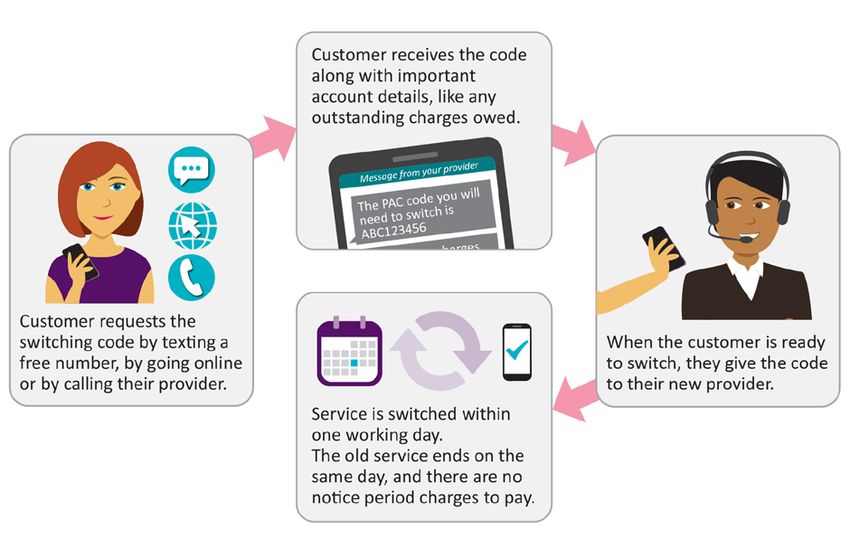
1. Introduction of a new and simplified way to switch (‘Auto-Switch’): consumers will
be able to request and automatically receive a unique code by text, or through their
online account, which they can give to their new provider to switch and port their
number (if they wish to do so). This will remove the need for consumers to call their
old provider.
2. Banning notice period charges after the switching date: consumers will no longer
have to pay for their old and new service at the same time.
3. Providing clear information to consumers: mobile providers will be required to
provide consumers with clear information, for example on their websites, about the
switching and number porting process.
1.5 Our Auto-Switch reform allows consumers to control the contact they have with their
existing provider when they are looking to move away from them, including avoiding
having a phone conversation if they do not want one. Additionally, consumers will only
need to contact their new provider once – to transfer their existing number or cancel their
old service. After doing this, the number transfer or cancellation occurs automatically, and
the new service starts.
1.6 Prohibiting mobile operators from charging consumers for notice periods once they have
switched provider will ensure people do not have to pay for a service they no longer use
after the date they switch. It will also make it easier to switch without worrying about
notice periods.
1.7 Requiring mobile providers to supply consumers with clear information will ensure people
are better informed about the switching process and will be less likely to be put off from
switching because of uncertainties about how to do it.
1.8 This simpler switching process will be available to all mobile customers regardless of
whether they:
• wish to keep their existing mobile number when moving to their new provider or not
(known as “porting” their number);
• are seeking to port a single number, or multiple numbers (or switch a single account or
multiple accounts in cases where they do not want to port their number); and
• are residential or business customers.
1.9 In relation to loss of service, industry is implementing initiatives to address this on a
voluntary basis. We are satisfied that these initiatives are sufficient to address our
concerns, and do not therefore consider it would be appropriate to impose regulation. We
will monitor their effectiveness and revisit the issue in the future if necessary.
2Consumer switching
Decision on reforming the switching of mobile communication services
Effective and proportionate reforms
1.10 We consider that together these reforms will substantially benefit consumers by
addressing the unnecessary difficulties and deterrents they face when switching. We also
expect easier switching to deliver other important benefits to consumers more generally,
as more consumers engage in the market which in turn will encourage greater competition
between providers.
1.11 We have considered the expected benefits of these reforms and their likely impact on
providers. In our judgment, the package of reforms is a proportionate means of achieving
our objective of removing unnecessary difficulties when switching mobile provider and
ensuring a switching process that is quick, simple, and convenient to use.
1.12 The Government has made clear its commitment to improving switching, which is reflected
in the Digital Economy Act. Our reforms support this commitment.
1.13 We require these reforms to be in place within a reasonable implementation period, and
no later than 1 July 2019.
3Consumer switching
Decision on reforming the switching of mobile communication services
2. Introduction
2.1 Around 5 million UK consumers currently switch mobile provider each year, and of these,
around 3.2 million also keep their existing mobile number when they switch provider. 4
2.2 We have found that under current switching arrangements, consumers – including small
businesses – can experience difficulties, service interruptions, or incur unnecessary costs
when switching. These issues fall into three main categories:
• Unnecessary time and difficulties progressing the switch, in particular as a result of
consumers needing to contact their existing provider to request a PAC 5 and/or cancel.
• ‘Double paying’ while switching provider, because of providers’ requirements for
consumers to pay out notice periods when cancelling a mobile service, even where that
service is no longer being provided.
• Loss of service while switching provider, for example because the consumer must
coordinate the switch (start and stop dates), and this does not go to plan, and/or
because of service disruption during the porting process.
2.3 We also found that the risk of experiencing these difficulties was having the practical effect
of deterring some consumers from switching altogether.
2.4 We consulted on proposals to address these harms in a number of previous consultations. 6
This section explains current mobile switching processes and briefly describes the
switching proposals set out in our March 2016 and July 2016 consultations and our final
proposals set out in the May 2017 consultation. It concludes by setting out our regulatory
policy objectives and the legal framework under which our proposals were framed and our
decision in this document is made.
4 Based on data from Syniverse which showed that there were 3.23 million non-bulk (i.e. fewer than 25 numbers) PAC
switches between October 2015 and September 2016. This figure is for total non-bulk ports and was not restricted to
adults only. According to our BDRC 2016 omnibus data, 63% of switchers ported their number and 37% did not keep their
number (figures for adults 16+). These numbers therefore suggest that the total number of switchers was 5.12 million
(3.23/0.63). Our 2017 Switching Tracker, which reflects switching numbers among those aged 16+, similarly found that in
the 12 months to August/September 2017, 60% of mobile switchers ported their number and 40% did not.
5 At present a consumer wanting to port his or her number would need to request a PAC (Porting Authorisation Code) from
their current provider to switch their mobile service. Most providers require that consumers call in and speak to a service
agent to request this.
6 See: https://www.ofcom.org.uk/__data/assets/pdf_file/0013/102037/Proposals-to-reform-switching-of-
mobile-communications-services.pdf. We refer to this document as the ‘May 2017 consultation’. We also published
previous consultations in March 2016 (https://www.ofcom.org.uk/__data/assets/pdf_file/0025/82636/consumer-
switching-mobile-consultation.pdf) and July 2016
(https://www.ofcom.org.uk/__data/assets/pdf_file/0023/83453/Consumer-Switching-Further-proposals-to-reform-
switching-of-mobile-services-July-2016.pdf).
We refer in these documents as the ‘March 2016 consultation’ and the ‘July 2016 consultation’.
4Consumer switching
Decision on reforming the switching of mobile communication services
Current mobile switching routes
2.5 Consumers currently seeking to switch mobile provider must follow either the ‘PAC’
process, or use the default ‘Cease & Re-provide’ (‘C&R’) approach. 7
PAC process
2.6 The ‘PAC’ process must be used by consumers who wish to switch their provider and keep,
or ‘port’, their number.
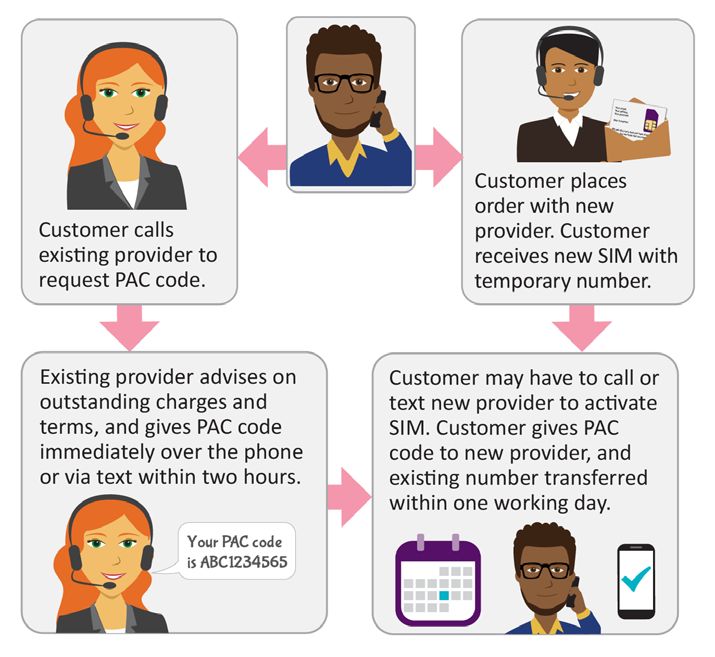
2.7 Figure 1 summarises the steps a consumer must follow when switching and porting using
the current PAC process. Figure 2 describes the PAC process in more detail.
Figure 1: Consumer steps for mobile switching and porting under the current PAC process
7 Our previous consultations described in detail these processes for switching and how, under the PAC process, consumers
can transfer over their existing mobile number to their new provider. They also described how loss of service might occur
in a switching context, as well as how double paying, as a result of notice period requirements, might arise (March 2016
consultation Section 3, July 2016 consultation §3.4 - §3.6, and §3.18 - §3.19, and May 2017 consultation §2.4-§2.15).
5Consumer switching
Decision on reforming the switching of mobile communication services
Figure 2: PAC process in detail
The consumer If the consumer contacts their existing (losing) provider 8 by phone 9 to request a
requests a PAC from PAC, Ofcom regulations require that the PAC is given immediately over the phone
their old provider or within two hours by text. 10 The PAC is valid for 30 days.
The consumer gives When the consumer signs up to a new service with their new (gaining) provider, 11
their PAC to their new the consumer will normally receive a new SIM card from the gaining provider with
provider a temporary number, which they can use to make and receive calls and texts prior
to the port of their existing number. 12 When the consumer receives their PAC from
the losing provider, they port their existing mobile number over to their new
service by giving the PAC to their gaining provider. Ofcom regulations require that
providers port the mobile number within one business day of the consumer’s
request.
The existing number is Following completion of the port, the temporary number on the consumer’s new
transferred to the new service will be replaced by the ported number and the old service will be
service automatically deactivated.
2.8 The consumer is responsible for coordinating the end of the old and the start of the new
service. Notice period policies differ between providers, 13 but where notice periods apply,
a consumer wishing to avoid overlapping services and ‘double paying’ must coordinate the
end of the notice period with the start date of the new service and the transfer of their
existing number. 14 This might involve the consumer deferring the start of the new service
until any notice period for the old service has expired. If a consumer is unable to co-
ordinate the process, they may pay for both their old and new service at the same time.
Cease & Re-provide (C&R) process
2.9 Where the consumer wants to switch provider but not port their number, currently no
formal process exists to achieve the switch. Instead the consumer must follow a default
process involving the consumer contacting their losing provider to cancel their old service,
including giving any required notice. The consumer must separately contact their gaining
provider to take out a new service.
2.10 As with the PAC process, under this approach the consumer is responsible for coordinating
the end of the old and the start of the new service. C&R switchers can avoid overlapping
services and ‘double paying’ by coordinating the end of the notice period with the start
date of the new service, but this might involve the consumer deferring the start of the new
8 We referred to the losing provider as ‘LP’ in previous consultations.
9 Some providers also allow a consumer to request the PAC via webchat or email.
10 By ‘text’ we refer to SMS text throughout this document.
11 We referred to a consumer’s new provider or the provider they are joining as the ‘Gaining Provider’ (‘GP’) in previous
consultations.
12 The consumer is billed by the gaining provider from the date of SIM activation.
13 Some providers charge 30 days’ notice from the day the PAC is requested, some charge this from the day the PAC is used
(the day of the number port), and others do not charge for notice once a number port has taken place. These different
approaches are set out in footnote 120.
14 In some circumstances, it may not be possible to avoid some double paying where a provider charges notice from the
day the PAC is used, unless the consumer knows they have to give notice in advance of redeeming the PAC.
6Consumer switching
Decision on reforming the switching of mobile communication services
service until any notice period for the old service has expired. If a consumer is unable to
co-ordinate the process, they may pay for both their old and new service at the same time,
or they may end up with no service for a period of time.
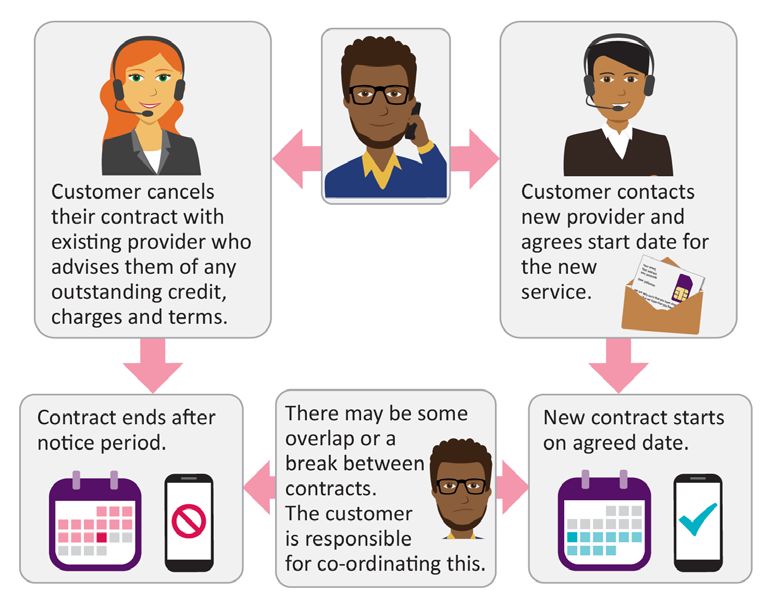
2.11 Figure 3 summarises the steps a consumer takes when switching through the C&R method.
Figure 3: Consumer steps for mobile switching via Cease and Re-provide
The 2016 consultation proposals
2.12 In our March 2016 consultation, we set out our view 15 that a sizeable minority of mobile
switchers experience harm when switching, under both the current PAC process and the
C&R route, as a consequence of unnecessary time spent and difficulties encountered
during the switching process, double paying, and loss of service while switching provider.
2.13 In our July 2016 consultation 16 we provided further analysis on the effects notice period
requirements can have on consumers when applied in a switching context, and concluded
that many consumers experience difficulties when switching, where notice periods apply,
regardless of the switching process (i.e. whether PAC or C&R).
2.14 To address the harms we had identified, we proposed two options for reforming the core
mobile switching process:
15 Based on consumer research conducted by BDRC (BDRC 2015 research)
https://www.ofcom.org.uk/__data/assets/pdf_file/0025/91834/mobile_switching_quantitative_research_feb16.pdf
16 July 2016 consultation Section 3, in particular §3.7 to §3.28
7Consumer switching
Decision on reforming the switching of mobile communication services
• Gaining Provider Led (GPL) process - under this proposal, consumers would only need
to contact the provider they want to switch their service to i.e. they would not need to
contact their losing provider if they did not want to. The gaining provider would
arrange for the consumer to be sent a text message containing information relevant to
their switching decision e.g. any early termination charges (ETCs).
• Auto-PAC - under this proposal, consumers would be able to request a PAC and have it
delivered by text, or through an online account, in addition to being able to request
and receive it over the phone. The message containing the PAC would also contain
information relevant to their switching decision, such as any ETCs. 17
2.15 Across our consultations we also set out proposals for two accompanying measures aimed
at addressing the harms identified:
• A requirement on providers not to charge notice beyond the date on which a consumer
switches. 18
• End-to-end management - we proposed that the switching process should be centrally
coordinated, which would ensure that a consumer’s new service would start before the
old one was deactivated. This was aimed at avoiding any potential loss of service when
porting.
2.16 We also said that it would potentially be helpful to require providers to give consumers
clear guidance on the switching and porting process. We suggested that, in discussion with
Ofcom and other interested parties, industry would be best placed to develop this
guidance.
2.17 In the 2016 consultations, we set out a marginal preference for the GPL option over Auto-
PAC, on the basis that we considered GPL to be simpler for consumers as it did not require
them to obtain a PAC. We were also of the view that the higher costs of implementation of
the GPL option were justified in light of the additional consumer benefits we considered it
would bring.
May 2017 consultation proposals
2.18 Following responses to our March and July 2016 consultations, we undertook further work
to understand the likely costs to industry of implementing our reform options. 19 We also
commissioned further consumer research (BDRC 2017 research) 20 and gathered additional
evidence concerning switchers’ experiences of current processes as well as their views on
the two reform options we proposed (GPL or Auto-Switch (a revised version of Auto-PAC
17 These are charges that may be payable by a consumer for the termination of a contract before the end of any minimum
contract period
18 This proposal was first set out in our July 2016 consultation.
19 In January 2017, we published an update on our estimate of the likely gross implementation costs of our proposed
reforms and invited stakeholders and interested parties to comment.
20 https://www.ofcom.org.uk/__data/assets/pdf_file/0026/101996/Mobile-Switching-Research-2017-Attitudes-towards-
current-and-potential-alternative-processes.pdf
8Consumer switching
Decision on reforming the switching of mobile communication services
which would also include consumers who wanted to switch without porting their
number)). 21 22
2.19 Our updated analysis supported our view, as set out in previous consultations, that a
significant number of switchers experience difficulties when switching. It also suggested
that consumers place significant value on the likely reduction in time and difficulties
offered by both the Auto-Switch and GPL options. In particular, both options enabled
consumers to avoid having to speak with their previous provider – the key factor behind
the time spent and difficulties experienced by consumers under the current arrangements.
2.20 In the May 2017 consultation we also said that, partly as a result of information provided
by stakeholders in response to previous consultations, our estimates of the costs of
implementing these reforms had risen, and significantly in the case of GPL. We were
therefore of the view that Auto-Switch was a more proportionate remedy to address the
problems we had identified as it would meet our policy objectives but at a lower cost than
GPL. Additionally, we were also of the view that the “LP-variant” of Auto-Switch, under
which consumers can make PAC/N-PAC requests directly with losing providers (rather than
the “CPS variant” under which consumers would make requests to the Central Porting
Service (CPS)) was also more proportionate.
2.21 In relation to loss of service, we acknowledged that industry had made commitments to
develop and implement measures to address loss of service on a voluntary basis which we
were satisfied were sufficient to adequately address our concerns, subject to sufficient
progress being made. 23 Thus, we no longer felt it to be proportionate to impose regulation
regarding loss of service (for instance, through end-to-end management). However, we
said that our final view on industry commitments, and whether they sufficiently delivered
against our policy objectives, would depend on the progress industry made in delivering an
improved porting process.
2.22 Our May 2017 consultation therefore proposed the following package of reforms as our
preferred option:
• introduction of Auto-Switch;
• prohibiting charging for notice after the switching date; and
• providing transparency to consumers.
21 Auto-Switch is described in detail in Figure 5 in Section 4.
22 We also took into account data from: Ofcom’ Switching Tracker 2016 (Data tables available online
https://www.ofcom.org.uk/__data/assets/pdf_file/0031/98536/Switching-Tracker-2016-Revised-definitions-for-
standalone-services-Mar2017.pdf); updated data on complaints received by Ofcom concerning changing mobile provider;
further consumer research results concerning loss of service experienced by consumers when they switch mobile provider
(BDRC omnibus December 2016 https://www.ofcom.org.uk/__data/assets/pdf_file/0025/101995/Mobile-Switching-
Research-2017-Omnibus-data-tables.pdf); data on the incidence of number ports taking place within on business day; and
our SME Tracker 2016, which examines small businesses’ experience of communications services (See:
https://www.ofcom.org.uk/research-and-data/multi-sector-research/general-communications/consumer-experience/sme-
research. The scope of reforms covers both residential consumers and businesses, where they are switching fewer than 25
mobile numbers (i.e. excluding “bulk ports” which we defined to be 25 numbers or more.)
23 These measures are set out in §4.7
9Consumer switching
Decision on reforming the switching of mobile communication services
Summary of stakeholder responses to the May 2017 consultation
2.23 We received 21 responses to our May 2017 consultation. 24 Respondents included
consumer groups, communications providers and individuals.
2.24 In response to our consultation, consumer groups and individual respondents generally
agreed with our assessment of consumer harms arising from the current switching
arrangements, while responses from mobile providers were mixed. In addition, many
respondents agreed with our preference for Auto-Switch, including [], Virgin and the
Communications Consumer Panel and Advisory Committee on Older and Disabled people
(CCP/ACOD), as well as all individual respondents. 25
2.25 Others, however, disagreed with our preference for Auto-Switch over GPL, and argued that
GPL is a more effective solution to address the consumer harms we had identified,
including SSE and uSwitch. TalkTalk and Three also expressed a preference for GPL reform,
but nevertheless recognised that Auto-Switch would be an improvement on current mobile
switching arrangements. [] said that their preferred model would be a harmonised
switching process across the telecommunications industry. 26
2.26 In addition, a number of mobile operators (BT/EE, O2 and Vodafone) criticised our analysis
on the need for intervention and disagreed with our proposals for reform overall. BT/EE
and Vodafone also put forward a voluntary code of practice on switching for the mobile
industry, which they argued should be adopted in place of reform. This proposal is
discussed further in paragraphs 4.17 to 4.22.
2.27 We do not consider that responses to our May consultation raised points which mean we
should change our preference for Auto-Switch over GPL. The rest of this statement
therefore focuses on Auto-Switch. Specific stakeholder comments on GPL and our
response to those are discussed separately in Annex 9.
2.28 Stakeholder responses concerning our assessment of harm and the need for intervention,
our package of reforms (Auto-Switch proposal, notice period reform and transparency
requirements) and our assessment of the proportionality of our intervention are discussed
in the following sections and more fully in the annexes to this document.
Our regulatory policy objective on mobile switching
2.29 It is important that consumers do not experience unnecessary difficulties when switching
mobile provider and are not deterred from switching because of the process. The ability of
consumers to switch easily to their preferred provider, or away from a provider they are
dissatisfied with, ensures better outcomes for consumers, and means they can best
24 Non-confidential responses are published on our websites here: https://www.ofcom.org.uk/consultations-and-
statements/category-2/consumer-switching-proposals-to-reform-switching-of-mobile-communications-services
25 We received 10 responses from individuals, all of whom agreed with our preference for Auto-Switch.
26 For our decision on cross platform switching for landline, broadband and pay TV services, please see our July 2017
statement: https://www.ofcom.org.uk/__data/assets/pdf_file/0013/104503/Decision-on-switching-between-
platforms.pdf
10Consumer switching
Decision on reforming the switching of mobile communication services
exercise choice and take advantage of competition in communications markets. It is also a
key enabler of effective competition, which in turn underpins the provision of good value,
high quality products, and drives innovation.
2.30 Our regulatory policy objective, in light of our statutory duties, is to ensure that switching
arrangements do not cause consumer harm by creating unnecessary difficulties or
deterrents for consumers when switching mobile provider. Removing unnecessary
difficulties or deterrents that give rise to consumer harm should result in a switching
process that is quick, simple and convenient to use.
2.31 Government has made clear its commitment to improving switching by introducing
legislation in the Digital Economy Act 2017 to make explicit Ofcom’s powers in relation to
switching.
Legal framework
2.32 Our objectives are based on a number of provisions of the Communications Act 2003 ("the
Act”) and on the European common regulatory framework for electronic communications
services ("the Framework”) which comprises a number of specific Directives and which is
implemented by the Act.
Ofcom’s general duties
2.33 Section 3(1) of the Act states:
“It shall be the principal duty of Ofcom, in carrying out their functions:
a) to further the interests of citizens in relation to communication matters; and
b) to further the interests of consumers 27 in relevant markets, where appropriate by
promoting competition.”
2.34 Section 3(2) goes on to set out things which the duty in section 3(1) requires us to secure
when carrying out our functions. These include securing the availability throughout the UK
of a wide range of electronic communications services (section 3(2)(b)). We are also
required to have regard to the principles under which regulatory activities should be
transparent, accountable, proportionate, consistent and targeted only at cases in which
action is needed, as well as any other principles appearing to Ofcom to represent best
regulatory practice (section 3(3)).
2.35 Section 3(4) says we must have regard, in performing our duties, to a number of matters 28
including:
• the desirability of promoting competition;
27
Consumer is defined in Section 405(5) of the Act and includes people acting in their personal capacity or for the
purposes of, or in connection with, a business.
28 As they appear to us to be relevant in the circumstances.
11Consumer switching
Decision on reforming the switching of mobile communication services
• the opinions of consumers in relevant markets and of members of the public generally;
and
• the extent to which the furthering or securing of the matters mentioned in sections
3(1) and 3(2) is reasonably practicable.
2.36 In addition, section 3(5) requires that, when performing our duty to further the interests of
consumers, Ofcom must have regard, in particular, to the interests of those consumers in
respect of choice, price, quality of service and value for money.
European requirements for regulation
2.37 As set out in section 4 of the Act, when exercising certain functions 29 Ofcom must also act
in accordance with the six European Community requirements described there. These
include promoting competition in the provision of electronic communications networks
and services, and the interests of all EU citizens, while being technologically neutral.
2.38 The requirements of section 4 are read in light of Article 8 of the Framework Directive 30
which sets out the policy objectives of the Framework. It says national regulatory
authorities shall ensure that, when they carry out the regulatory tasks set out in the
Framework, they take all reasonable and proportionate measures aimed at achieving
specific objectives. 31 Those objectives include:
• the promotion of competition in the provision of electronic communications services 32
by ensuring that:
- users derive maximum benefit in terms of choice, price and quality; and
- there is no distortion or restriction of competition in the electronic
communications sector, including the transmission of content. 33
• to promote the interests of EU citizens by ensuring:
- a high level of protection for consumers in their dealings with suppliers; and
- promoting the provision of clear information (in particular, requiring transparency
of tariffs and conditions for using publicly available electronic communications
services). 34
Powers and duties under the Framework in relation to general conditions
2.39 We will implement our decision to make switching mobile providers easier by introducing
consumer protection rules in the form of general conditions (“GCs”).
29 Including those whose exercise we propose in this document.
30 Directive 2002/20/EC of the European Parliament and of the Council (as amended by Directive 2009/140/EC), 7 March
2002. Available at: http://eur-lex.europa.eu/LexUriServ/LexUriServ.do?uri=OJ:L:2002:108:0033:0033:EN:PDF
31 Set out in paragraphs 2, 3 and 4 of Article 8.
32 As well as electronic communications networks and associated facilities and services.
33 Articles 8(2)(a) and (b).
34 Articles 8(4)(b) and (d).
12Consumer switching
Decision on reforming the switching of mobile communication services
2.40 Alongside the Framework Directive, the Authorisation Directive 35 provides for national
regulatory authorities to set conditions of general authorisation for communications
providers. Under Article 6, and paragraph 8 of the Annex, these include conditions
containing “…. consumer protection rules specific to the electronic communications sector,
including conditions in conformity with Directive 2002/22/EC” (“Universal Service
Directive”).”
2.41 The Universal Service Directive concerns the provision of electronic communications
networks and services to end-users and, amongst other things, establishes the rights of
end-users and the corresponding obligations of providers of publicly available electronic
communications services and networks. 36 In this context, Article 30 of the Universal
Services Directive 37 and Recital 47 to the 2009 Directive which amended it are particularly
relevant. 38 The latter states:
“In order to take full advantage of the competitive environment,
consumers should be able to make informed choices and to change
providers when it is in their interests. It is essential to ensure that they can
do so without being hindered by legal, technical or practical obstacles,
including contractual conditions, procedures, charges and so on. This does
not preclude the imposition of reasonable minimum contractual periods in
consumer contracts…..... Experience in certain Member States has shown
that there is a risk of consumers being switched to another provider
without having given their consent. While that is a matter that should
primarily be addressed by law enforcement authorities, Member States
should be able to impose such minimum proportionate measures
regarding the switching process, including appropriate sanctions, as are
necessary to minimise such risks, and to ensure that consumers are
protected throughout the switching process without making the switching
process less attractive for them.”
2.42 Article 30 of the Universal Service Directive includes provisions dealing with the porting of
numbers and the switching of providers. It says national regulatory authorities should take
into account, where necessary, measures ensuring that:
• subscribers are protected throughout the switching process; and
• subscribers are not switched to another provider against their will.
2.43 It also states that, “[w]ithout prejudice to any minimum contractual period, Member States
shall ensure that conditions and procedures for contract termination do not act as a
disincentive against changing provider”.
35 Directive 2002/20/EC of the European Parliament and of the Council (as amended by Directive 2009/140/EC), paragraph
8 of Annex A
36 See Articles 1(1) and (2).
37 Directive 2002/22/EC of the European Parliament and of the Council (as amended by Directive 2009/136/EC), 7 March
2002. Available at: http://eur-lex.europa.eu/LexUriServ/LexUriServ.do?uri=OJ:L:2002:108:0051:0051:EN:PDF
38 Directive 2009/136/EC of the European Parliament and of the Council, available at http://eur-lex.europa.eu/legal-
content/EN/TXT/HTML/?uri=CELEX:32009L0136&from=EN
13Consumer switching
Decision on reforming the switching of mobile communication services
Powers to set General Conditions under the Act
2.44 Section 45 of the Act says we may set General Conditions which contain provisions
authorised or required by one or more of sections 51, 52, 57, 58 or 64. Section 47(2)
governs the circumstances in which Ofcom can set or modify a General Condition. It states
that a condition can be made or modified where doing so is:
• objectively justifiable in relation to the networks, services, facilities, apparatus or
directories to which it relates; 39
• not such as to discriminate unduly against particular persons or against a particular
description of persons;
• proportionate to what the condition or modification is intended to achieve; and
• transparent in relation to what it is intended to achieve.
2.45 Under Section 51(1)(a) the General Conditions we may make include conditions making
such provision as we consider appropriate for the purpose of protecting the interests of
end-users of public electronic communications services. Section 51(2) says this power
includes (but is not limited to) setting conditions for that purpose which:
• relate to the supply, provision or making available of goods, services or facilities
associated with the provision of public electronic communications services;
• give effect to EU obligations to provide protection for such end-users in relation to the
supply, provision or making available of those goods, services or facilities;
• ensure that conditions and procedures for the termination of a contract do not act as a
disincentive to an end-user changing communications provider;
• require the provision, free of charge, of specified information, or information of a
specified kind, to end-users; and
• specify requirements in relation to arrangements that enable an end-user to change
communications provider on request.
2.46 We set out in this statement how our decision accords with our powers and duties,
including meeting the relevant tests.
Impact Assessment
2.47 The analysis presented in the March 2016, July 2016 and May 2017 consultations
constituted an impact assessment as defined in section 7 of the Act. In this document, in
particular in Annex 4, we update our analysis in relation to the impact assessment set out
in our May 2017 consultation, to the extent we consider appropriate in light of the
responses to that consultation. 40
39 Section 47(3) says this does not apply to the setting of a condition. We are likely, however, to take it into account as part
of our assessment of whether any condition is proportionate.
40 For further information about our approach to impact assessments, see the guidelines, “Better policy-making: Ofcom’s
approach to impact assessment”
(https://www.ofcom.org.uk/__data/assets/pdf_file/0026/57194/better_policy_making.pdf)
14Consumer switching
Decision on reforming the switching of mobile communication services
2.48 Impact assessments provide a valuable way of assessing different options for regulation
and showing why the preferred option was chosen. They form part of best practice policy-
making.
Equality impact assessment
2.49 Ofcom is also required to assess the potential impact of all our functions, policies, projects
and practices on the equality of individuals to whom these policies will apply. Equality
impact assessments (‘EIAs’) assist us in making sure that we are meeting our principal duty
of furthering the interests of citizens and consumers regardless of their background or
identity.
2.50 We have given careful consideration to whether or not the decision contained in this
document will have a particular impact on race, age, disability, gender, pregnancy and
maternity, religion or sex equality. We do not envisage however, that our decision would
have a detrimental impact on any particular group of people.
This document
2.51 This document sets out an overview of our decision and the reasons for it. It should be
read together with the Annexes to this document, which contain further detailed reasoning
and which form part of our decision. The remainder of this document is structured as
follows:
• Section 3 sets out our judgement on consumer harm arising from current switching
arrangements;
• Section 4 sets out the reforms to current mobile switching arrangements and how
these will work;
• Section 5 sets out our conclusion on introducing mobile switching reform; and
• Annex 1 contains a glossary of terms.
2.52 The separate document of further annexes is structured as follows:
• Annex 2 sets our Auto-Switch process reform in more detail;
• Annex 3 describes our cost methodology;
• Annex 4 updates the impact assessment for our package of reforms;
• Annexes 5 to 8 provides the supporting calculations to the impact assessment including
time savings, double paying, willingness to pay and benefits to non-switchers;
• Annex 9 sets out consultation responses on GPL; and
• Annexes 10 and 11 set out the modifications to the General Conditions.
15Consumer switching
Decision on reforming the switching of mobile communication services
3. Consumer harm under current switching
arrangements
Introduction
3.1 This section sets out our views of the harm that consumers, including businesses, can
experience when switching mobile providers. We also summarise our provisional views
from previous consultations, and set out stakeholders’ responses to the May 2017
consultation.
Previous consultations
3.2 In our consultations we set out that a quarter of consumers who switch mobile provider -
equivalent to around 1.7 million consumers 41 - had experienced major difficulties with the
current switching process. We also set out that 37% of consumers who had actively
considered switching but did not do so, said that these difficulties were a major factor in
their decision not to switch. 42 We recognised that most consumers who have switched
mobile providers found the process easy, but stated that we were concerned there was a
significant minority of consumers who were either finding the process difficult or were
deterred from switching.
3.3 We provisionally concluded that consumers switching mobile provider can suffer harm
from unnecessary time spent and difficulties encountered during the process, double
paying (namely paying for their old and new service at the same time) and loss of service.
On that basis we provisionally concluded that intervention was appropriate to address
these harms.
Consumers suffer harm from unnecessary time spent and difficulties
encountered while progressing a switch
3.4 In our May 2017 consultation we said that current switching processes can lead to
unnecessary time spent and difficulties for consumers when switching, and can deter some
consumers from switching. In particular, we set out that:
• requesting and obtaining a PAC and porting a mobile number can be difficult and time
consuming, including where the consumer encounters unwanted persuasion to remain;
• cancelling the old service and contacting the losing provider can be difficult for both
PAC and C&R switchers, including where the consumer encounters unwanted
persuasion to remain; and
• such difficulties can deter consumers from switching.
41 BDRC 2015. Figure for adults 16+ who switched mobile provider in the 18 months prior to research
42 BDRC 2015. Figure for adults 16+ who considered switching mobile provider in the 12 months prior to research
16Consumer switching
Decision on reforming the switching of mobile communication services
3.5 We said our conclusions also applied to small and medium sized enterprises (SMEs), on the
basis that the majority of SMEs purchase and use mobile services in ways that substantially
resemble those of residential consumers, and that a significant number can spend
unnecessary time and experience difficulties when switching.
3.6 We also relied on our BDRC 2017 research which suggested that some consumers
remained dissatisfied with current switching methods, and that consumers placed
significant value on likely reduction in time and difficulties offered by our proposed Auto-
Switch reform.
Double paying after the switch has taken place
3.7 Our May 2017 consultation set out our provisional view that consumers face both
unnecessary difficulties and costs when they switch – under either PAC or C&R
arrangements – because they are required to pay notice after the switch has taken place.
For example, we set out that:
• Some consumers double pay because they pay for their old service and their new
service at the same time. PAC switchers continue to pay even though their old service
has been deactivated. We also set out that although C&R switchers can continue to use
their old service, there is little evidence that they always wish to do so. 43
• Some consumers try to avoid or minimise double payments by deferring their switch
(whether via PAC or C&R arrangements). However, we said that avoiding double
payment can be difficult because a consumer would have to have a good
understanding of their current provider’s notice period policy and actual charging
practices. We said that avoiding double payment may result in an unnecessary delay of
their switch date.
3.8 We also provisionally concluded that some consumers are deterred from switching
because of their perception that there is a risk of double paying.
Loss of service while switching provider
3.9 Finally, our consultation set out that consumers switching provider may suffer harm where
there is a break in service during the switch, for example as a result of a porting process
failure or difficulties coordinating the end of the old service with the start of the new
service.
3.10 We provisionally concluded that loss of service in a switching context is an issue for a
significant number of mobile switchers under both PAC and C&R switching routes. We also
set out our view that concerns about loss of service may deter switching.
3.11 We said that we particularly regarded any extended service interruptions of a day or more
as likely to be especially harmful.
43 This is discussed further in paragraphs 3.85 to 3.90
17Consumer switching
Decision on reforming the switching of mobile communication services
Stakeholder responses on consumer harm
General views
3.12 In Section 2 we explained that consumer groups and individual respondents generally
agreed with our assessment of consumer harms arising from the current switching
arrangements, but that responses from mobile providers were mixed.
3.13 In particular, [], [], CCP/ACOD, SSE and Three, as well as a number of individual
respondents, agreed with our views.
3.14 However, several mobile providers criticised our harm analysis:
• BT/EE said that our research showed only a small minority of switchers indicated they
had issues when switching, and highlighted that Ofcom’s own complaints data show
very small numbers of complaints regarding switching, with a downward trend over
time, indicating that the process is working better for consumers. They said that this is
also reflected in EE’s complaints data on switching. 44
• O2 said that the current PAC process works well for most consumers, and that
customer satisfaction is high, mobile switching prevalent, complaint levels low, and
mobile compares favourably to fixed markets, where Ofcom has already made
interventions in the switching process. O2 said that Ofcom relied too heavily on its
BDRC research as evidence and that Ofcom had dismissed broader indicators of
satisfaction in the market. 45
• Virgin said that, while it had not reviewed our revised estimates of harm in detail, in
their view our updated analysis strengthened the evidence that the current system
works well for the clear majority of consumers. 46
• Vodafone also said our BDRC 2017 research showed that there were very few
consumers not satisfied by the current process, and that 86% reported that they were
satisfied. 47
3.15 [] specifically disagreed with our view that harms to SMEs are similar to those suffered
by residential consumers. It said that while this may be true for sole proprietors or
businesses with a handful of employees, this is not true for typical businesses that would
be covered by Ofcom’s proposals. It also highlighted that many residential packages only
allow customers to take up to four numbers, and that those with over four numbers would
behave differently and have different needs from residential consumers. 48
3.16 Some stakeholders argued that our analysis did not go far enough and said we had not
included all the harms caused by existing processes:
44 BT/EE May 2017 consultation response §25 and §30-§34.
45 O2 May 2017 consultation response §21-§23
46 Virgin May 2017 consultation response §21 and §23
47 Vodafone May 2017 consultation response pages 14-16
48 [] May 2017 consultation response, []
18Consumer switching
Decision on reforming the switching of mobile communication services
• [] said that we had not considered barriers to switching from the wider research
journey, such as access to information or the impact of differing contract lengths in
bundles. 49
• Three said that we had not considered the harm to consumers and to competition in
general from providers being able to offer discount deals to consumers trying to switch
in order to retain them as customers (referred to as ‘reactive save’). 50
Stakeholder views on unnecessary time spent and difficulty encountered
while progressing a switch
3.17 Many stakeholders agreed with our view that consumers face harm from unnecessary time
spent and difficulty encountered progressing a switch. [] and Three agreed that we were
correct to identify this as a source of harm. 51 Individual respondents also agreed with our
assessment, with one commenting that the need to call their existing provider is
‘unnecessary time’ and leads to ‘emotional duress’. 52 Others described the current process
as ‘a headache’, and said providers wasting time could lead to customers being on hold for
up to 2 hours. 53
3.18 In addition, [] said that our analysis was in line with the feedback they received, which
suggested there are problems with offices not being open 24/7, call waiting times being
too long and customers not being given their PACs immediately due to retention activity. 54
3.19 A number of mobile providers criticised our harm assessment. In particular BT/EE, O2,
Virgin and Vodafone disagreed that consumers face unnecessary time and difficulties when
switching: 55
• Vodafone and Virgin said that the research showed that consumers were more likely to
identify things they liked than disliked about the switching process, and that many of
those who disliked the process could not specify a reason why they disliked it. 56
• Virgin said that our BDRC 2017 evidence showed that people were more satisfied with
phone based PAC and cancellation requests, in comparison to other routes, and that
people who requested their PAC by phone were less likely than those using other
methods to say they felt it was a ‘sales pitch’. 57
49 [] May 2017 consultation response []
50 Three May 2017 consultation response pages 4-8 and page 18.
51 [] May 2017 consultation response [], and Three May 2017 consultation response page 18
52 Individual respondents May 2017 consultation responses, page 1
53 Individual respondents May 2017 consultation responses, pages 3-4
54 [] May 2017 consultation response []
55 Many of these points have previously been raised in response to our March and July 2016 consultations.
56 Virgin May 2017 consultation response §23, and Vodafone May 2017 consultation response pages 14-15
57 Virgin May 2017 consultation response §24-§25.
19Consumer switching
Decision on reforming the switching of mobile communication services
• BT/EE and O2 argued that it was invalid to compare our evidence on the average length
of calls which resulted in a successful PAC request (7.7 minutes) 58 with []’s IVR 59
system which takes 97 seconds, as call times include genuinely necessary steps such as
the provision of important information about the switch (such as outstanding charges)
and authentication of the customer. 60
3.20 BT/EE submitted that in the case of C&R switchers not porting their number, the fact that
in 20% of cases this was due to the old or new provider telling them they could not do so,
is not a reason for regulatory reform. It said this was a breach of Ofcom rules which would
be better addressed through an enforcement programme. 61
Stakeholder views on double paying
3.21 Most stakeholders continued to agree with our assessment that double paying is a harm,
and [], Three, CCP/ACOD, and [] agreed it is a harm arising from switching
arrangements. 62
3.22 [] said that an average bill overlap of 13-20 days equated to around a £20 surcharge for
switching, which could go some way to offset the benefit of switching in the first place. It
also said that avoiding double paying is not easy for consumers. [] added that a
consumer does not have a choice about whether to agree to notice periods in order to get
a mobile connection. 63
3.23 The CCP/ACOD argued that consumers should not have to pay twice for a service, nor
should they have to defer the start of a new service to avoid this. It said they could see no
justification for the retention of a notice period once the service has been deactivated. 64
3.24 Other providers argued that, while double paying may constitute a harm, this is
independent of switching and so could not be identified as a harm arising from current
mobile switching arrangements. O2 said double paying was a function of contractual notice
periods and not part of the switching process itself. 65 BT/EE said that double paying was
separate from the switching process, and should be addressed separately. 66
58 This is set out in §3.42 of the May 2017 consultation. We recognise that some of the calls related to switchers who
actively wanted a save conversation with their losing provider, which would therefore be lengthier in nature. We further
note in this context uSwitch’s response to our March 2016 consultation, in which they quoted their own research findings
that it takes an average of 25 minutes’ worth of phone conversations to go through the switching process for mobile.
59 This is an automated telephony system that picks up calls, interacts with callers and routes calls to a customer service
agent.
60 BT/EE May 2017 consultation response §26, O2 May 2017 consultation response §119-§121
61 BT/EE May 2017 consultation response §29
62 [] May 2017 consultation response [], Three May 2017 consultation response page 18, CCP/ACOD May 2017
consultation response page 2, [] May 2017 consultation response []
63 [] May 2017 consultation response []
64 CCP/ACOD May 2017 consultation response page 2
65 O2 May 2017 consultation response §73
66 BT/EE May 2017 consultation response §35. BT/EE raised this point in response to previous consultations.
20Consumer switching
Decision on reforming the switching of mobile communication services
3.25 BT/EE also said that in the case of C&R switchers, and contrary to our conclusions, the
majority benefit from contract overlap. It said that contract overlap does not indicate that
there are issues with switching arrangements for C&R switchers. 67
3.26 BT/EE and Virgin also said that where consumers wish to avoid double payment, it is
possible for them to do so. 68
3.27 Virgin continued to disagree with our view that double paying as a result of notice periods
constitutes a harm. 69 It said that:
• Notice periods are legitimate charges and are voluntarily entered into by consumers. It
argued that there are many legitimate charges consumers may not like, but this does
not mean they should be prohibited by the regulator.
• Consumers not being aware of their notice period at the time of a switch and incurring
double payment as a result should not be identified as a harm, as long as the obligation
to provide this information at the start and end of the contract is met.
3.28 Virgin also said that Ofcom had not provided robust data on the likely increase to switching
numbers following a ban on notice periods, meaning we had not considered the likely
impacts on the market of our reforms, which further weakens our justification for
intervention. 70
3.29 Furthermore, Virgin said that Ofcom’s proposals were going further than consumer law
and argued that Ofcom should be seeking to align its position with UK consumer law rather
than broadening its powers. 71
Stakeholder views on loss of service
3.30 Several respondents agreed with our views on consumer harm arising from the loss of
service that can occur when consumers switch mobile provider, including [], [], and
Three. 72
3.31 In particular, [] said it strongly believed that reforming the porting process should
address loss of service, and said 85% of the complaints they received about porting related
to delayed or failed ports. It said the average time to resolve this was 9 days. However, it
added that loss of service of less than a day should also be addressed, and this can cause
emotional distress and inconvenience, as well as having potential safety concerns (such as
a lack of access to emergency numbers) and financial implications for businesses.
67 BT/EE May 2017 consultation response §39-§41 and §106
68 BT/EE May 2017 consultation response §36, and Virgin May 2017 consultation response §10. This point was raised in
response to our March and July 2017 consultations.
69 Virgin May 2017 consultation response §9-§10. Virgin raised this point previously in response to our March and July 2017
consultations.
70 Virgin May 2017 consultation response §9
71 Virgin May 2017 consultation response §12
72 [] May 2017 consultation response [], [] May 2017 consultation response [], and Three May 2017 consultation
response page 18.
21You can also read


