SAFEGUARDS AND MONITORING: Mental Health Coordinating Council
←
→
Page content transcription
If your browser does not render page correctly, please read the page content below
SAFEGUARDS AND
MONITORING:
protecting the rights of people receiving care and
support in community-managed mental health
organisations in NSW

Summary Report and Landscape Review

                          PREPARED FOR MENTAL HEALTH COORDINATING COUNCIL
                                            BY MICHELLE WHEELER CONSULTING
                                                             December 2018
Mental Health Coordinating Council Inc.
Building 125, Corner of Church & Glover Streets
Lilyfield NSW 2040

PO Box 668
Rozelle NSW 2039

Corinne Henderson
Principal Advisor/Policy & Legislative Reform

Carmel Tebbutt
Chief Executive Officer

© Mental Health Coordinating Council Inc. 2018

This publication is copyright. Apart from the conditions specified in the Terms of Use/Purchase
provided, you may not reproduce or redistribute this material in part or whole, without the
express permission of MHCC.

Please cite this paper as follows:

Mental Health Coordinating Council (MHCC) 2018, Monitoring and Safeguards: protecting
the rights of people receiving care and support in community-managed mental health
organisations in NSW Summary Report and Landscape Review, MHCC, Sydney, Australia

Prepared for MHCC by MICHELLE WHEELER CONSULTING

For any further information please contact:
Corinne Henderson, Principal Advisor/Policy & Legislative Reform
Tel: (02) 9555 8388 # 101
E: corinne@mhcc.org.au

SAFEGUARDS and MONITORING PROJECT                                                                 i
ACKNOWLEDGEMENTS
MHCC wish to acknowledge these organisations and individual contributors to the
consultative process that informed the project:
Australian Commission on Safety and Quality in Health Care
Commissioner, Mental Health Commission of NSW
Director, Quality and Safeguards, Social Policy Group, NSW Department of Premier and
Cabinet
Health Care Complaints Commission
Mental Health Coordinating Council
NDIS Quality and Safeguards Commission
New Horizons
NSW Official Visitors Program
NSW Ombudsman
NSW Health, Community Partnerships, Mental Health Branch
NSW Health, Manager, Partnerships for Community Living Initiative, Mental Health Branch
Department of Social Services, Disability Advocacy Branch
WEAVE Youth Services
Wellways
Accrediting and auditing companies – in relation to certification and assessment
processes
MHCC particularly thanks consultant for the project Michelle Wheeler and her colleague Sally
Gaven and MHCC manager of and contributor to the project Corinne Henderson, Principal
Advisor/Policy & Legislative Reform.
MHCC thanks the NSW Ministry of Health, Mental Health Branch, and appreciates their
support which enabled us to conduct this important project.
MHCC also acknowledges the researchers and academics both in Australia and
Internationally whose work informs and is referenced in this document.
TERMINOLOGY
In this document the authors have used the language of lived experience. Where other
terminology is used, it reflects the resources cited and referenced.
SAFEGUARDS and MONITORING PROJECT ii
CONTENTS

Summary Report

EXECUTIVE SUMMARY                                                                                  1
Areas for future action                                                                            3
SECTION 1: BACKGROUND                                                                              4
1.1   Introduction                                                                                 5
1.2   The policy research question                                                                 6
1.3   Project research approach                                                                    8

SECTION 2: KEY FINDINGS                                                                           10
SECTION 3: AREAS FOR FUTURE ACTION                                                                15

LANDSCAPE REVIEW                                                                                  19

SECTION 4: NATIONAL AND NSW POLICY CONTEXT                                                        20
4.1   National policy directions emphasise safeguards and monitoring in all delivery settings     21
4.2   NSW policy and strategy expands the role and priority of community mental health services   22
4.3   The NDIS presents opportunities and challenges for the mental health CMO sector             25
SECTION 5: ELEMENTS OF SAFEGUARDING AND MONITORING IN AUSTRALIA                                   28
5.1   Safeguarding and monitoring with national mechanisms                                        29
5.2   Safeguards and monitoring landscape in NSW                                                  38
5.3   Safeguarding and monitoring landscape in other states                                       45
SECTION 6: INTERNATIONAL MODELS FOR SAFEGUARDING AND MONITORING                                   49
6.1   Safeguarding and monitoring in selected nations                                             50

SECTION 7: CONCLUSIONS                                                                            57
7.1   Limitations of looking at overseas models                                                   58
7.2   General principles to guide good practice                                                   58
7.3   The impact of current policy agendas – national, NDIS and NSW                               59
7.4   Gaps and overlaps in safeguarding mechanisms                                                60
7.5   Points of pressure                                                                          60

SAFEGUARDS and MONITORING PROJECT                                                                 iii
EXECUTIVE SUMMARY

SAFEGUARDS and MONITORING PROJECT   1
EXECUTIVE SUMMARY
Mental health community-managed organisations (CMOs) play a crucial role in achieving
the goals of the Fifth National Mental Health and Suicide Prevention Plan1 and Living Well: A
Strategic Plan for Mental Health in NSW 2 which both envision an expanded role for the
community-managed mental health sector with an emphasis on strengthened safeguarding,
monitoring and compliance processes.
CMOs are pivotal in providing support for people with mental health conditions living in the
community and facilitating improved access to services and programs that embody a
trauma-informed recovery-oriented practice approach. Through increased access to these
services, the sector aims to support individuals to stay well and out of hospital, while offering
greater choice and control.
Major changes to the service delivery environment have increased the focus on ensuring
that services are safe and high quality. These changes include:
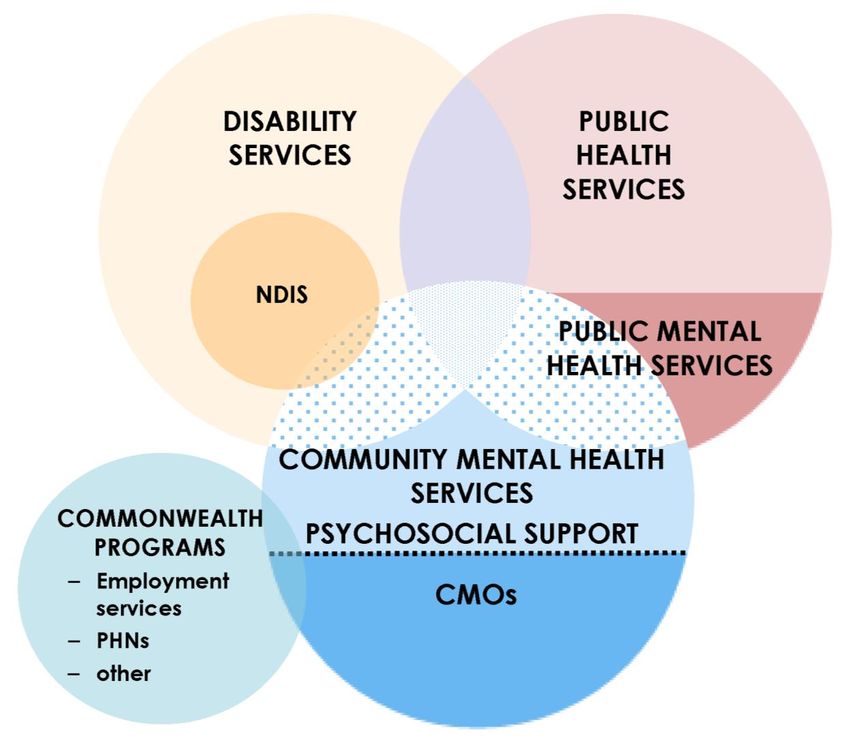
the National Disability Insurance Scheme (NDIS) which has a self-contained quality and
safeguarding framework, applying to CMOs providing psychosocial supports through the
NDIS (but not to other mental health CMOs)
other community-provided services commissioned by both Primary Health Networks
(PHNs) and NSW Health
many CMOs providing a range of services under different Commonwealth or State
funding programs, which are integrated with each other at the point of service delivery
providers increasingly collaborating and forming partnerships to deliver on the full range
of integrated supports people need
services led and directed by the people using them, and delivered through innovative
approaches.
In this context, and at this early stage of an evolving transition, it is timely to examine the
function and effectiveness of safeguarding and monitoring and safeguarding mechanisms 3
across community-managed mental health services.
This project investigated whether there is a need for the sector to have further or changed
safeguarding and monitoring and mechanisms, in the light of transforming service delivery.
Specifically, the project undertook analysis, informed by consultations and a Landscape
Review, in order to:
outline the national and NSW policy context which provides the drivers of change in the
operational service delivery environment
document the safeguarding and monitoring elements and mechanisms in NSW that
apply to CMOs providing psychosocial supports
identify the implications of national and state reforms (including the NDIS Quality and
Safeguarding Framework) for NSW mental health CMOs who are registered NDIS
providers, and those who are not
explore and document examples of international and other states’ models of
safeguarding and monitoring for CMOs providing psychosocial supports
make tentative conclusions to be tested through further research and consultation.
SAFEGUARDS and MONITORING PROJECT 2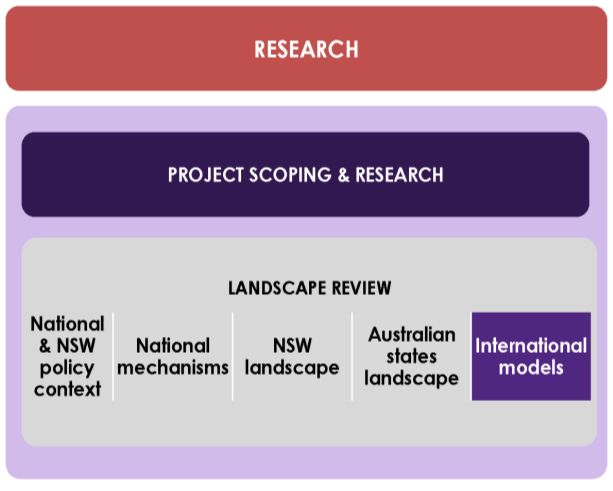
AREAS FOR FUTURE ACTION
The project identifies the following directions for future consideration and action by all
partners in the design, delivery and oversight of community managed mental health services
in NSW:
Advocating for good practice principles in the design of safeguarding and
monitoring systems, identified from this project’s national and international review:
effective and accessible complaints mechanisms
strengths-based approaches to building workforce capacity
oversighting bodies with genuine monitoring and enforcement powers
transparent reporting of service quality, safety, health outcomes and consumer
and carer experience measures.
Revising and developing existing mechanisms, in partnership with consumers and
carers, CMOs and the MHCC, in particular:
the revision of the National Standards for Mental Health Services ensuring that
services provided outside major funding programs (and thus not captured by
monitoring and reporting frameworks and other contractual requirements)
have oversight mechanisms commensurate with the service model and
associated risks
the revisions to the national mental health performance framework to support
reporting on performance and quality and its underpinning infrastructure for
data collection and reporting.
Addressing gaps in safeguarding mechanisms, in particular by investigating the
feasibility and desirability of any additional mechanisms. (No definitive assessment
has been made by this project analysis as to whether these mechanisms should be
implemented and in what circumstances). The mains gaps identified are:
the oversight of the use of restrictive practices in this sector and incident
management of reportable incidents
mandatory codes of conduct and employment screening
extended community visiting schemes—in the light of the national review
currently underway, for services for NDIS participants
systemic overview and public reporting of complaints and reportable incidents.
Further work must give emphasis to the views of consumers and carers.
Addressing overlaps in safeguarding mechanisms, particularly in the areas of:
standards and accreditation – exploring systems of mutual recognition of
standards and ‘one-process’ accreditation, rather than so-called alignment
between sets of standards
incident management in collaborative partnerships.
Addressing points of pressure for CMOs in this complex regulatory and monitoring
environment, specifically:
meeting multiple sets of standards, including the resource implications of
accreditation and auditing requirements
the cost of partnerships where multiple systems of safeguarding and monitoring
apply that are not factored into tender budgets
accountability for outcomes for which a CMO may only have partial control
the difficulties the complex NDIS model presents for participants and consumers
living with psychosocial disabilities
the need to build organisational infrastructure and workforce capabilities to
work with added monitoring requirements and diverse contractual
requirements at provider level.
SAFEGUARDS and MONITORING PROJECT 3SECTION 1: BACKGROUND SAFEGUARDS and MONITORING PROJECT 4
1.1    INTRODUCTION
It is possible for people with mental health conditions to live well
in the community when they have access to the right mix of
medical, psychosocial and support services. It is generally
accepted by policy makers and practitioners alike, that mental
health services are optimally delivered in community settings
addressing more than just symptoms of illness. Mental health
community-managed organisations (CMOs) play a crucial role in achieving
the goals of the Fifth National Mental Health and Suicide Prevention Plan4 and
Living Well: A Strategic Plan for Mental Health in NSW which both envision an
expanded role for the community-managed mental health sector.5

CMOs are pivotal in providing support for people with mental health conditions living in the
community and facilitating improved access to services and programs that embody a
trauma-informed recovery-oriented practice approach. Through increased access to these
services the sector aims to prevent crises and support individuals to stay well and out of
hospital, while offering greater choice and control and supporting decision-making in a way
that promotes self-determination and maximises independence.

The benefits to consumers are clear. However, in a rapidly changing and more competitive
environment the rigour of clinical governance mechanisms and a focus on consumer rights
may become less central to service delivery. A lack of attention in these areas may present
opportunities as well as create risks that have the potential to undermine the many consumer
benefits. At worst they could result in significant harm and raise questions about the
effectiveness of the system to provide consumer protection.

In this context, and at this early stage of an evolving transition, it is timely to examine the
function and effectiveness of monitoring and safeguarding mechanisms 6 across community-
managed mental health services providing a wide range of psychosocial mental health and
support services, at times fully integrated with clinical services provided in partnership or
collaborations.

Mental health community-managed organisations (CMOs) are a crucial part of the entire
mental health and human services system in NSW, contributing to improved outcomes for
people experiencing, or at risk of developing, mental health conditions and psychosocial
disability. They play a key role in promotion, prevention, early intervention, and providing the
supports that assist people to stay well in the community. These organisations provide a range
of services, including self-help and peer support, information, advocacy and promotion,
leisure and recreation, employment and education, accommodation support and outreach,
family and carer support, primary healthcare, care and service coordination, helplines and
psychosocial rehabilitation and clinical services. CMOs receive funding from State, Territory
and Commonwealth governments, and deliver services that are planned and commissioned
by Primary Health Networks.

In 2010, the Mental Health Coordinating Council (MHCC) conducted the NSW Mental Health
Community Managed Organisation Sector Mapping Project to provide a picture of the CMO
sector in NSW. A taxonomy of services, was developed with seven core community-
managed mental health service functions that are necessary to meet population-based
needs within each local area. 7

SAFEGUARDS and MONITORING PROJECT                                                              5
Since 2010, the sector has undergone significant expansion and diversification as the
recovery-focused trauma-informed approach has been implemented widely within the
sector. Service providers are increasingly collaborating and forming partnerships to deliver on
the full range of supports a person needs, led and directed by the person and delivered
through innovative approaches. Many CMOs now provide a range of different services under
different Commonwealth or State funding programs which are integrated with each other at
the point of service delivery.
The taxonomy of activity developed for the National Minimum Dataset for Mental Health
Establishments in NSW CMOs: Scoping Study8 is a more flexible approach to looking at ‘who
we are’. It provides a ‘product’ list which can be measured. It reflects in part the menu of
NDIS costed services a provider may deliver and ‘charge’ for, so accommodates the most
recent ‘framework’ CMOs must work with.
NATIONAL MINIMUM DATASET SERVICE TAXONOMY
Care coordination Mental health promotion
Counselling - face-to-face Mental illness prevention
Counselling, support, information and Mutual support and self-help
referral - online Personalised support - linked to housing
Counselling, support, information and Personalised support - other
referral - telephone Sector development and representation
Education, employment and training Self-help—online
Family and carer support Service integration infrastructure
Group support activities Staffed residential services
Individual advocacy
As the NDIS is implemented and as more community-provided services are commissioned by
both Primary Health Networks (PHNs) and NSW Health, demonstrating that services are safe
and high quality is increasingly important. Currently many community-managed mental
health services ensure safety and quality through service accreditation processes and a
variety of mainstream protections and contractual requirements.
Since 1 July 2018, community mental health services that provide psychosocial supports
through the NDIS have their services regulated by the newly established NDIS Quality and
Safeguards Commission (the Commission). The Commission is a new independent body that is
regulating the NDIS market through provider registration and resolutions of complaints about
the quality and safety of NDIS supports and services.
1.2 THE POLICY RESEARCH QUESTION
Monitoring services for safety and quality is an important means of protecting the rights of
people receiving services and can drive service improvements. In this new environment
there are a number of aspects of the system that are unclear or yet to be determined,
including how the design and operation of the NDIS translates to delivery of psychosocial
supports to people eligible for the NDIS. 9 10
SAFEGUARDS and MONITORING PROJECT 6Furthermore, it is unclear how the workforce will be supported with the skills and
competencies to appropriately oversight services delivered to people living with
psychosocial disability by new entrants to the market such as specialist disability providers.
Likewise, how the NDIS Commission will interface with other oversight mechanisms that
monitor services provided to people receiving services both inside and outside of NDIS
eligibility.
The NDIS is not the only policy reform impacting on the sector—there are major changes at
state level outlined in Section 2. Nevertheless, the NDIS has become a major driver of change
as psychosocial disability has been recognised as a disability that may arise from living with a
mental health condition, requiring supports that can be met within its framework. As a
consequence providers have commenced an uneasy and somewhat unplanned entrance
into this new disability services ‘market’.
In this project, the Mental Health Coordinating Council investigates the need for safeguarding
and monitoring the rights of consumers and carers to choice and control and to high quality
support, in the light of changes in the operational delivery environment. The main drivers of
change we canvass are:
the National Disability Insurance Scheme (NDIS) and its regulatory frameworks
growth in CMO delivery of mental health services, including mental health care and
psychosocial support funded by NSW Health as part of the NSW reform agenda,
commissioning of services by Primary Health Networks and other changes to
Commonwealth program arrangements.
The policy research question explored: Does the sector and agencies representing consumer and
carer interests need additional or amended safeguarding and monitoring mechanisms in the light of
a transforming service delivery policy and operational context?
Specifically, the project undertakes analysis (informed by consultations and a Landscape
Review to identify next steps within the NSW context with particular reference to:
analysing the interface between existing mechanisms in NSW and the implications of the
new framework of the NDIS Quality and Safeguards Commission for mental health CMOs
who are registered NDIS providers, and those which are not, but provide direct
psychosocial support
identifying gaps and overlaps in these mechanisms, comparing both the NDIS
framework for registered providers, the existing quality systems applying to all providers
and any best practice models or elements identified in the Landscape Review.
Many NSW mental health CMOs provide programs for NDIS participants and others, often
within an integrated recovery-focused framework. These programs are subject to a range of
quality mechanisms and external accountability requirements. In this context it is possible
that CMOs, or some of their activity, will not be captured by oversight activities to the same
degree, or to a satisfactory degree, or that duplication occurs with different requirements
for similar programs.
CMOs which provide information, advocacy and health promotion services only are out of
scope for this project.
SAFEGUARDS and MONITORING PROJECT 71.3 PROJECT RESEARCH APPROACH
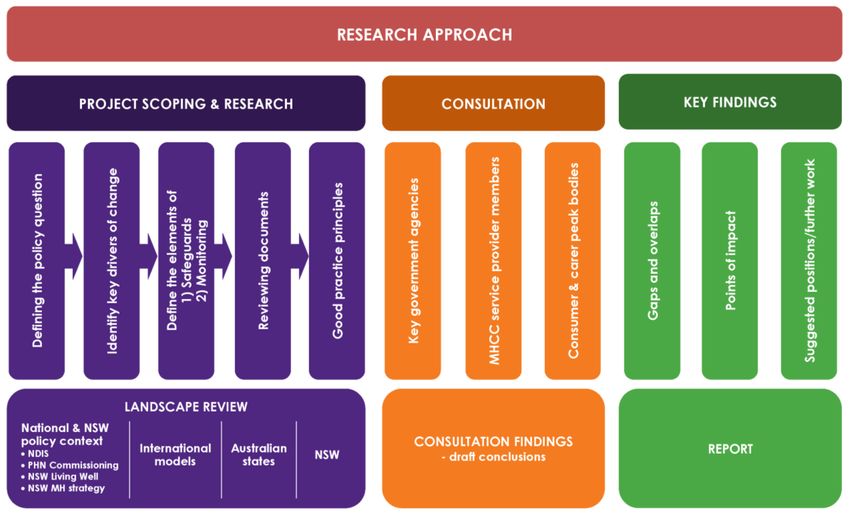
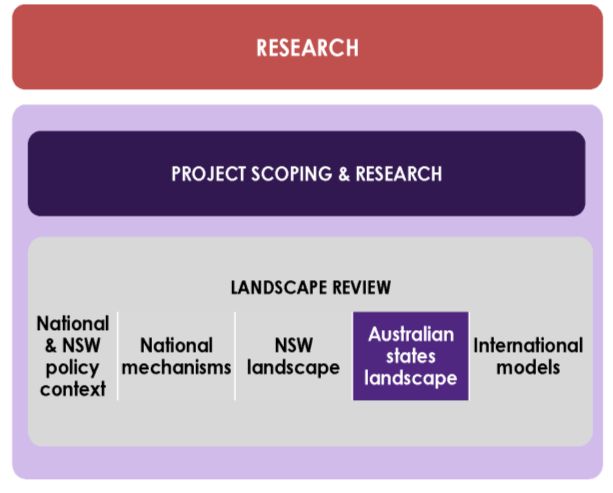
The project approach is illustrated in Diagram 1 below. The project foundation was a
comprehensive Landscape Review which provided the stimulus material for a series of
consultations with key informants identified in specific NSW and Commonwealth
government agencies and for a workshop with MHCC service provider members. Learnings
from these two sources of intelligence were then synthesised into the Key Findings presented
in Section 1.4 below. The Landscape Review is presented in a companion document to this
Summary Report.
Diagram 1: Project Research Approach
The consultations were conducted over a three-week period in face-to-face interviews (with
some telephone interviews where a face-to-face meeting was not feasible) according to a
semi-structured interview format. Interviews were conducted with representatives of:
Australian Commission on Safety and Quality in Health Care
Department of Social Services, Disability Advocacy Branch
Health Care Complaints Commission
Mental Health Commission of NSW
NSW Department of Premier and Cabinet, Quality and Safeguards, Social Policy Group
NSW Health, Community Partnerships, Mental Health Branch
NSW Health, Partnerships for Community Living Initiative, Mental Health Branch
NSW Official Visitors Program
NSW Ombudsman
NDIS Quality and Safeguards Commission
Accrediting and auditing companies – in relation to certification and assessment
processes.
SAFEGUARDS and MONITORING PROJECT 8Representatives of service providers who are members of the MHCC participated in an
interactive forum on November 14 at the MHCC offices and also had the opportunity to
contribute to the project via an online survey.
The Landscape Review uses, as an organising approach:
the safeguarding elements within the NDIS Quality and Safeguarding Framework
11
the monitoring requirements of funding bodies, which extend beyond safeguarding
mechanisms to mechanisms to manage risk and establish accountability.
First it identifies the mechanisms from the NDIS Framework applicable to NSW mental health
CMOs which are registered NDIS providers, and the like mechanisms for those providers that
are not NDIS providers but do provide psychosocial support services. It also sets out the
relevant information about these mechanisms from selected states and other national
models (see Diagram 1 above).
We have chosen to focus on the elements from the NDIS Quality and Safeguarding
Framework, as these were developed following significant and extensive research and
consultation. This Framework provides a comprehensive evidence-based inventory of the
elements being implemented in the disability sector and services providing psychosocial
supports within the scheme, bringing together research and models from Australian and
international jurisdictions. It provides a solid benchmark against which to consider what is
appropriate and suitable for mental health CMOs not captured by the NDIS monitoring and
safeguarding mechanisms. Consultation with key informants indicated this was a sound
approach.
The NDIS Quality and Safeguarding Framework has two main dimensions:
components are divided into three domains—developmental, preventative and
corrective—each with a range of mechanisms or interventions
the ‘target’ of the components—the individual, the workforce, providers.
Within this comprehensive set of mechanisms (17 in total plus links to other frameworks), this
project focuses on the preventative and corrective domains across the three target groups -
individuals, the workforce and providers. These two domains are the province of national,
state and provider-level efforts.
Mechanisms (laws, policies, conventions and charters) which are focused on helping
people protect themselves, through knowing their rights and making informed choices, are
covered in laws on discrimination and human rights. Information, education, workforce
training, levers of an open market, are similarly outside our project scope.
This project is primarily concerned with those mechanisms that keep people who access
mental health services in the community safe and provide pathways and processes if
something goes wrong. This approach is validated in the Consultation Report documenting
stakeholder views and needs for the NDIS Framework. Stakeholders emphasised the need
for high-level regulation in a competitive market for disability care and support.
Second, the Landscape Review examined the monitoring and oversight mechanisms
impacting on CMOs which are usually reflected in contractual arrangements, to different
degrees, depending on the program and the funding body.
SAFEGUARDS and MONITORING PROJECT 9SECTION 2: KEY FINDINGS SAFEGUARDS and MONITORING PROJECT 10
KEY FINDINGS
The key messages identified by the Project in response to the policy research question are
outlined below.

 The policy research question explored: Does the sector and government agencies representing
 consumer and carer interests need additional or amended safeguarding and monitoring
 mechanisms in the light of a transforming service delivery policy and operational context?

 1       National policy directions emphasise safeguards and monitoring in all delivery
         settings

The national mental health reform agenda impacts on CMO service delivery, governance
and internal processes for safeguarding, monitoring and compliance. These impacts are
identified in the table below. Each reform area has implications for the NSW CMO sector.

 Primary Health         PHNs have a significant role in planning, commissioning and integrating mental
 Networks:              health and suicide prevention services at a regional level through a stepped
                        care model. Collaborative approaches with local partners are required. Mental
                        Health CMOs are viewed as one of a number of potential partners in the
                        commissioning process. Long-term funding is also required to develop long-term
                        solutions and, in turn, to provide longer-term contracts through the
                        commissioning process – currently a short-term approach is being used with
                        short contracts of around 12 – 18 months.
 NDIS:                  Development of a psychosocial disability pathway. Key implementation issues
                        are how the NDIS will interact with other systems (such as health, education and
                        justice) to provide coordinated support for people with a mental illness, and
                        how consumers will access Continuity of Support and National Psychosocial
                        Supports measures.
 Suicide prevention:    The local area suicide prevention trials are an opportunity to gain insights about
                        the process and outcomes of systematic implementation of suicide prevention
                        programs targeted to local at-risk groups, however action is need to close
                        persistent gaps in the collection and distribution of key real-time data. There is
                        also a lack of appropriate care and support for people in crisis, and insufficient
                        training on suicide prevention for people working in the health, allied health and
                        community sectors.
 Mental health          Actions are needed to address high turnover, the need for suicide prevention
 workforce:             training, the challenges of rural and remote locations and the need for more
                        peer workers and Aboriginal and Torres Strait Islander representation.
 Seclusion and          Further targeted work is needed to implement the cultural and practice
 restraint:             changes that will ultimately lead to eliminating seclusion and restraint.
 Consumer and carer     The National Mental Health Commission with its partners continues to focus on
 participation:         promoting participation by and engagement of consumers and carers. Specific
                        strategies to capture and use consumer and carer feedback (the YES and CES
                        surveys) are being developed for national implementation.

SAFEGUARDS and MONITORING PROJECT                                                                     11
Mental health The National Outcomes and Casemix Collection data for Years 2008 to 2016
outcomes: showed the majority of consumers in both inpatient and community-based
mental health settings experienced significant improvement in their mental
health and psychosocial functioning. The Your Experience of Service survey was
designed to gather information from consumers about their experiences of care.
It is anticipated that pooled data from the YES survey will be available for three
jurisdictions in 2019, providing valuable insight into the consumer experience of
mental health services. The National Minimum Data Set for Mental Health NGOs
collects nationally consistent information on the activity of mental health CMOs,
and is the subject of further development under the new Mental Health
Information Strategy – while not outcome-focussed, it is an important element in
a comprehensive information system for policy, planning and operations.
2 NSW policy and strategy expands the role and priority of community mental health
services, safeguards and monitoring are one consideration in this expansion
The strategies in the NSW Strategic Framework and Workforce Plan for Mental Health 2018-
2022 present opportunities for the CMO sector, through its peak body the MHCC, to engage
with the NSW Ministry of Health to ensure that the priorities and requirements of the CMO
sector are accounted for.
3 The NDIS presents opportunities and challenges for the mental health CMO sector
The creation of the NDIS has major implications for the mental health CMO sector. It links
these providers directly to a framework designed for the established and diverse disability
sector, with its own language and approaches to working with consumers and carers, service
providers and governance and funding partners. It is a new wholly contained system, with a
detailed quality and safeguarding compliance regime. It has the potential to introduce
overlaps and inefficiencies for those CMOs operating in dual systems of oversight.
Standards and accreditation programs applying to CMOs providing mental health
4
care and psychosocial supports are a major existing element of monitoring and
safeguarding mechanisms for NSW service providers. Diversification into new sectors
introduces the potential for additional costs for providers. The NDIS introduces scope
for duplication
Diversification of service models to better meet needs of consumers and carers has brought
many Mental Health CMOs into the orbit of differing standards frameworks—both mandatory
and optional. The major standards frameworks identified are:
National Standards for Mental Health Services
National Safety and Quality Health Service Standards
National Standards for Disability Services
Health and Community Services Standards
NDIS Practice Standards
SAFEGUARDS and MONITORING PROJECT 12Some CMOs are also operating in the aged care sector—aged care quality standards and
accreditation programs apply. There are also service standards applicable to operating in a
multicultural environment, meeting the needs of Aboriginal people, and other groups such as
people who identify as LGBTQI, women and children, people experiencing family violence
and others. These standards are generally not associated with formal accreditation programs
but represent best practice for particular client groups.
Particular standards compliance, most relevant to MH CMOs operating in NSW, and issues
arising with each particular standards set are identified in the Landscape Review and
summarised below.
The National Standards for Mental Health Services (NSMHS) are currently under national
review. Many informants consider these should be the primary set of standards applying
and tested for compliance by third party accreditation bodies.
The National Safety and Quality Health Service (NSQHS) Standards are most relevant to
NSW mental health CMOs which deliver in partnership models with LHD services. For
example, some LHDs have mental health sub-acute units which provide short term
residential care in a model of care where psychosocial support is provided by a
contracted CMO and the LHD provides clinical care. The NSQHS and the NMHS
standards have both recently been mapped to show alignment, and a user guide
developed.
Accreditation under the National Standards for Disability Services (NSDS) has now largely
been overtaken by registration as an NDIS provider—requiring certification under the
NDIS Practice Standards and assessment and auditing by a third party approved
auditing body.
It is unclear what the future status of the QIC standards and accreditation program is if a
CMO using these standards diversified into NDIS provision or tendered for contracts
requiring compliance with other sets of standards. Accreditation commercial bodies
advise they intend to conduct concurrent but distinct assessment for each set of
standards.
The NDIS Practice Standards seem to be a ‘cost to the provider’ and do not fully replace
other standards and accreditation programs. CMOs may need alternative accreditation
providers who can work with multiple sets of standards. This may not be possible for
providers who have committed training and resources working within one set of
standards or a provider not eligible to provide NDIS auditing services.
ISO 9001 has been to date an acceptable set of standards to meet requirements for
funding agreements in some programs.
Some PHNs have required conformity with National Practice Standards for the Mental
Health Workforce, although evidence, such as accreditation or certifications, are not
required. The degree of take up of these standards in the Mental Health sector is
unknown.
5 Alignment between sets of standards and efficiency in accreditation processes is
critical for CMO providers with diverse activities
The NDIS Practice Standards function as a stand-alone set of standards and assessment
requirements. Only some of the approved accreditation (called auditing) agencies are able
to assess against all the major standards sets (NDIS, NSMHS, NSQHS, ISO 9001).
Notwithstanding the work undertaken to achieve an integrated approach to their business
products, this is a more extensive and expensive exercise than single standards assessment for
accreditation.
SAFEGUARDS and MONITORING PROJECT 136
Effective monitoring for safety and quality, and for accountability of funded
organisations, requires investment in information systems, ongoing training, and
accurate and reliable specification of outcomes to be achieved
There is interest and broad support from NSW CMOs in the implementation of the National
Minimum Standards Set for NGOs. The current work being undertaken in partnership between
the MHCC and the NSW Ministry of Health provides a basis for NSW action on this element.
There is interest and intention from NSW Health to progress the comprehensive use of the
YES/CES survey and the reporting of at least a single outcome tool – the Living in the
Community Questionnaire (LCQ). Mandating would be through funding agreements. All
three initiatives have financial, technology infrastructure and training implications for MH C
SAFEGUARDS and MONITORING PROJECT 14SECTION 3: AREAS FOR FUTURE
ACTION
SAFEGUARDS and MONITORING PROJECT 15AREAS FOR FUTURE ACTION
The project has synthesised five key directions for future consideration and action by all
partners in the design, delivery and oversight of community managed mental health services
in NSW:
3.1 Advocating for good practice principles in the design of safeguarding and monitoring
systems, identified within this project’s national and international review:
effective and accessible complaints mechanisms
strengths-based approaches to building workforce capacity
oversighting bodies with genuine monitoring and enforcement powers
transparent reporting of service quality, safety, health outcomes and consumer
and carer experience measures.
3.2 Revising and developing existing mechanisms, in partnership with consumers and
carers, CMOs and the MHCC.
The Fifth National Mental Health Plan has recently established a program of policy
development which CMOs and the MHCC will need to actively work with. Within
this, the priorities for the MH CMO sector should be with:
the revision of the National Standards for Mental Health Services
a revised national mental health performance framework to support reporting
on performance and quality and its underpinning infrastructure for data
collection and reporting.
Funded MH CMOs are generally required to have a complaints management
system as part of service agreements, but no detailed features are usually specified.
The NDIS quality and safeguarding framework has more rigorous requirements for
complaints and incident management. These now apply to a subset of MH CMO
providers and a subset of people accessing psychosocial supports. The NDIS brings
with it complexity, overlaps and gaps in this area of safeguards.
The NSW Health approach to monitoring and enforcing quality and safeguards is
through national standards, contractual requirements around safeguarding
mechanisms and state-wide reporting frameworks. However, this only captures
services provided under major funding programs.
3.3 Addressing gaps in safeguarding mechanisms, by investigating the feasibility and
desirability of additional mechanisms. No definitive assessment has been made by this
project analysis as to whether these mechanisms should be implemented and in what
circumstances. The main gaps are:
oversight of restrictive practices, incident management in particular for
reportable incidents
mandatory codes of conduct
employment screening for all workers
Community Visitors in all settings – the current review may recommend a broad
national scheme of oversight – for the NDIS. This will leave a gap in coverage
for non-NDIS participants
systemic overview and public reporting of complaints and reportable incidents.
SAFEGUARDS and MONITORING PROJECT 163.4 Addressing overlaps in safeguarding mechanisms, particularly in the areas of
standards and accreditation – there is a need to explore mutual recognition
rather than alignment between sets of standards
incident management in collaborative partnerships.
3.5 Addressing points of pressure for CMOs, in this complex regulatory and monitoring
environment, specifically:
meeting multiple sets of standards, including the resource implications of
accreditation and auditing requirements
the cost of partnerships where multiple systems of safeguarding and monitoring
apply that are not factored into tender budgets
accountability for outcomes for which a CMO may only have partial or limited
control
the difficulties the new and complex NDIS model presents for participants and
consumers living with psychosocial disabilities
the need to build organisational infrastructure and workforce capabilities to
work with added monitoring requirements and diverse contractual
requirements at provider level.
SAFEGUARDS and MONITORING PROJECT 17LANDSCAPE REVIEW SAFEGUARDS and MONITORING PROJECT 18
LANDSCAPE REVIEW
The Landscape Review informs the Summary Report and:

            Outlines national and NSW policy context which provides the drivers of
            change in the operational service delivery environment (section 4)

            Documents the safeguarding and monitoring elements and
            mechanisms in NSW that apply to CMOs providing psychosocial
            supports (section 5)

            Identifies the implications of national and state reforms (including the
            NDIS Quality and Safeguarding Framework) for NSW mental health
            CMOs who are registered NDIS providers, and those who are not
            (section 6)

            Explores and documents examples of international and other states’
            models of monitoring and safeguarding for CMOs providing
            psychosocial supports (sections 5 and 6)

            Makes tentative conclusions to be tested through the next phase of the
            project (section 7).

SAFEGUARDS and MONITORING PROJECT                                                      19
SECTION 4: NATIONAL AND NSW
POLICY CONTEXT
SAFEGUARDS and MONITORING PROJECT 204.1 NATIONAL POLICY DIRECTIONS EMPHASISE SAFEGUARDS AND
MONITORING IN ALL DELIVERY SETTINGS
The Fifth National Mental Health & Suicide Prevention Plan was released in August 2017 to
establish a cross-jurisdictional framework for implementing national action over five years. It
targets action across eight priority areas. Key elements of the context for the Fifth Plan are:
the staged roll-out of the National Disability Insurance Scheme (NDIS)
the establishment of Primary Health Networks to provide primary and specialist mental
health care, include commissioning of local integrated services from CMOs.
Overall, the Fifth Plan established a national approach to improve the provision of integrated
mental health and related services across Australia, together with state and territory mental
health and suicide prevention plans and policy reforms. It continues the focus on lived
experience, choice and control, person-centred care and improving physical health – along
with trauma-informed recovery-oriented practice, programs and suicide prevention services.
Safety and quality is one of the Fifth Plan’s eight priority areas, with actions including:
Inter-jurisdictional development of a National Mental Health Safety and Quality Framework
incorporating:
– identifying new and emerging national safety and quality priorities and updating the 2005
statement of National Safety Priorities in Mental Health
– a revised national mental health performance framework to support reporting on
performance and quality across all mental health service sectors
– a guide for consumers and carers that outlines how they can participate in all aspects of
what is undertaken within a mental health service so that their role in ongoing safety and
quality initiatives is strengthened
– a process for revising the National Standards for Mental Health Services (NSMHS) that
accounts for interfaces with other relevant standards, such as the National Disability
Standards
– inter-jurisdictional development of a mental health supplement to the National Safety &
Quality Health Service (NSQHS) Standards to align them with the NSMHS
monitoring of consumer and carer experiences of care, including the Your Experience of Service
survey tool, across the specialised and primary care mental health service sectors
an updated statement on National Mental Health Information Priorities for information
developments over the next ten years.
The Implementation Plan for the Fifth National Mental Health Plan sets out milestones up to
2022 to provide guidance for governments, stakeholders and the health sector. Progress
against it is monitored by the National Mental Health Commission. The Commission’s recent
National Report 2018: Monitoring Mental Health & Suicide Prevention Reform12 sets out
progress in national mental health and suicide prevention reforms, and a separate report is
provided on progress with the Fifth Plan.
SAFEGUARDS and MONITORING PROJECT 21KEY MESSAGE:
The national mental health reform agenda impacts on CMO service delivery,
governance and internal processes for safeguarding, monitoring and compliance.
These impacts are identified in the following table. Each reform area has implications
for the NSW CMO sector.
4.2 NSW POLICY AND STRATEGY EXPANDS THE ROLE AND PRIORITY
OF COMMUNITY MENTAL HEALTH SERVICES
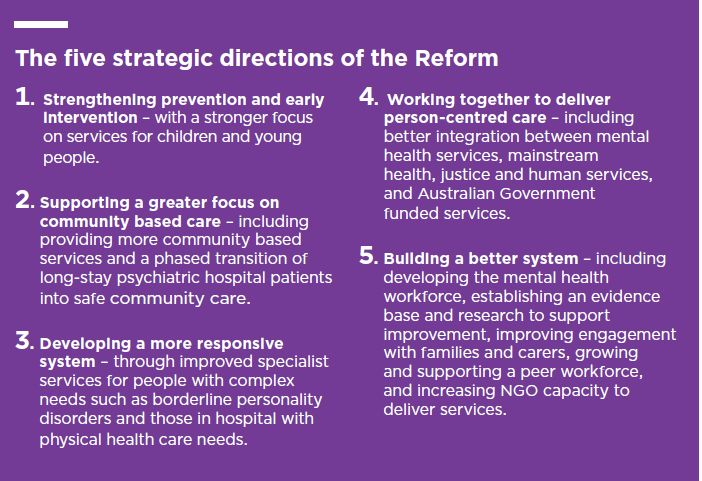
In NSW, the ten year mental health reform agenda for 2014-2024, in response to the Mental
Health Commission of NSW’s Living Well report, has involved an additional $100 million in 2018-
2019 and focuses on partnerships with CMOs, consumers and carers. This figure shows the
reform’s five strategic aims.
NSW Health commissions CMOs to deliver mental health community support services, and is
in the process of moving commissioning processes from block-funded grants towards a
competitive, transparent and accountable purchasing framework. Contestability has already
been introduced to some mental health programs delivered by community managed
services including the larger programs: — Community Living Supports, the Housing and
Supported Accommodation Initiative, the Suicide Prevention Fund, and LikeMind.
SAFEGUARDS and MONITORING PROJECT 22Community mental health programs funded by NSW Health currently are: 13
Community Living Funded through Local Health District (LHD) mental health services and
Supports: delivered by CMOs, it as an integrated care and psychosocial support model
for people living with a severe mental illness. Includes the Youth Community
Living Support and Enhanced Adult Community Living Support.
Family and Carer State-wide initiative delivered in partnership by LHDs, the Justice and Forensic
Mental Health Mental Health Network and five CMOs to support family and carers of
Program: people with mental illness.
Housing and Delivers community-based psychosocial support. HASI is a partnership
Accommodation between NSW Ministry of Health, Housing NSW and the CMO sector. RRSP
Support Initiative & delivers low intensity support for people living with a mental health illness to
Resource and facilitate access to meet employment, educational, recreational and/or
Recovery Support leisure needs.
Program:
HASI Plus: Provides 16 and 24 hour per day coordinated housing, clinical and
accommodation support services for people living with severe or persistent
mental illness to transition to living in the community from long term
institutional care.
LikeMind: A range of clinical and psychosocial services are co-located within LikeMind
centres under a three-year pilot program funded by the NSW Ministry of
Health delivered by CMOs
Ministerial Approved Funding is provided for a range of Aboriginal Medical, Health, Research and
Grants: Community Services; peer support programs, crisis telephone counselling and
community sector development.
Pathways to A state-led program for 300 individuals who experience severe or persistent
Community Living illness who have been patients in hospital longer than 365 days. The initial
Initiative: focus is on people who are elderly who require aged care support.
Suicide Prevention Eight CMOs deliver community-based suicide prevention strategies, which
Fund: range from education programs to postvention care. The eight services seek
to meet identified local need and are aligned with Lifespan, a systems-based
framework for suicide prevention.
Other grants: A range of service provision including CMO learning and development,
National Disability Insurance Scheme training for the mental health sector in
NSW, pop-up drop-in centres, suicide prevention activities and Centre for
Rural and Remote Mental Health program.
NSW mental health CMOs provide a diversity of care and support for people living with
mental health issues. In 2018, of the MHCC’s member organisations:
38% are registered NDIS providers
47% provide residential accommodation – either crisis, short term or longer term.
The recent NGO-E report lists the CMO providers for the principal NSW Health programs –
HASI/RRSP, CLS, FCMHP, and LikeMInd, as well as those funded through Ministerial approved
grants. The report identifies 9 large diverse CMOs and a further 50 CMOs, some of which
provide specialised services (e.g. Aboriginal-controlled) or are community organisations
providing a range of welfare, disability and mental health services.
As part of the NSW reforms, the recent (August 2018) NSW Strategic Framework and
Workforce Plan for Mental Health 2018-2022: A Framework and Workforce Plan for NSW Health
Services provides overarching guidance for NSW Health strategic action over the next five
years, and guidance for CMOs and PHNs.
SAFEGUARDS and MONITORING PROJECT 23Goal 2- NSW Strategic Framework and Workforce Plan – is for safe, high quality care. Actions
include to:
Embed learnings from improvement processes, including the Your Experience of Service (YES)
survey and developing capacity for web-based collections and a CMO trial implementation of
YES, and establishing the Mental Health Carer Experience of Service (MH CES) survey in NSW
public mental health services and CMOs. Strategy 5.1:
Improve safety and quality monitoring and public reporting, by including monitoring of safety
and quality measures in CMO contracts, via the NSW Health System Purchasing and
Performance (SPP) Safety and Quality Framework, and by developing a public mental health
report with BHI. Strategy 5.2
Develop national guidance and information on safety and quality and experience of care by
working with the Commonwealth on the National Mental Health Safety and Quality Framework
and its components identified in the Fifth National Plan. Strategy 5.4:
The NSW reform agenda has changes to the sector. The MHCC’s 2018 scoping study:
Implementing the National Minimum Dataset for Mental Health Establishments in NSW CMOs14
notes that:
fewer contractual arrangements and the move towards larger providers can be at the
expense of the local knowledge and expertise developed by smaller providers and has
prompted the amalgamation of smaller and often specialised CMOs
competitive tendering processes, while aimed at a robust, efficient and dynamic sector,
can disrupt service delivery and negatively impact on service users and support workers,
local community partnerships, and established organisational infrastructure
the administrative burden on CMOs to collect data and produce reports is increasingly
complex and time-consuming. The funding agencies’ needs to focus on accountability,
strategic planning, competitive tendering, costs, privacy and outputs can compete with
CMOs’ focus on individual improvement, outcomes, capacity building, data sharing,
community growth, evaluation, planning and service quality improvement.
KEY MESSAGE:
The strategies in the NSW Framework present additional opportunities for the CMO
sector, through its peak body the Mental Health Coordinating Council, to engage
with the NSW Ministry of Health to ensure that the strategic priorities and requirements
of the CMO sector are accounted for.
SAFEGUARDS and MONITORING PROJECT 244.3 THE NDIS PRESENTS OPPORTUNITIES AND CHALLENGES FOR THE
MENTAL HEALTH CMO SECTOR
The National Insurance Disability Scheme (NDIS) is primarily a major reform focused on the
disability sector in Australia, which presents issues for the mental health providers seeking to
enter and operate within its complex policy and regulatory frameworks. Likewise specialist
disability providers are moving into the provision of psychosocial supports, sometimes without
the experience, understanding and training in the trauma-informed recovery-oriented
practice approach that underpins contemporary community-based mental health service
provision in Australia.
NDIS and mental health: The NDIS is an Australia-wide scheme to support people with
permanent and significant disability which is replacing the current disability support system. It
funds long-term high-quality care and support for people living with significant
disabilities, improves links between the community and people with disabilities, provides
information, and ensures quality assurance and best practice among service providers. With
the inclusion of psychosocial disability within the scope of the NDIS, people experiencing
ongoing impairments and participation restrictions related to mental health conditions can
be eligible for the NDIS – although its original processes were not designed for this group of
people.
The August 2017 report of the Commonwealth Joint Standing Committee on the NDIS: Inquiry
into the provision of services under the NDIS for people with psychosocial disabilities related to
a mental health condition recommended improving planners’ knowledge and
understanding of psychosocial disability, and increased flexibility in plans to respond to
people’s fluctuating support needs. Improving the support provided to NDIS participants with
complex needs is recognised across governments as a key priority as noted in the report.
These issues were reinforced in the NSW Government submission to the NSW Parliamentary
Inquiry. (Submission 313). In the Australian Government Response to the Joint Standing
Committee on the National Disability Insurance Scheme: Progress Report - General issues
around the implementation and performance of the NDIS, the Government responded to the
recommendation by agreeing to ensure Operational Guidelines are provided to give
practical guidance for decision makers on the interpretation of these requirements and the
guidelines are available on the website for public information.
The Productivity Commission’s Study Report into NDIS costs recommended improving planner
capability, the need for specialist planners, and use of specialised staff for people with
psychosocial disability. The recent Independent Pricing Review also recognised the need to
improve the pricing framework’s consideration of complex need.
Informed by the nationwide consultations and a report by Mental Health Australia in October
2018 the Australian Government announced a NDIS psychosocial pathway to improve the
experiences of people living with psychosocial disability entering the NDIS. The National
Disability Insurance Agency (NDIA) announced the initial pilot of the participant pathway
which commenced in mid-December in two NDIS regions in Victoria.
Safeguarding across the NDIS: The NDIS Quality and Safeguards Commission is an
independent Commonwealth body established to oversee the delivery of quality supports
and services under the NDIS. The NDIS Commission is implementing the NDIS Quality and
Safeguarding Framework.
SAFEGUARDS and MONITORING PROJECT 25The Framework came into effect in NSW in July 2018. It sets out standards to support NDIS participants, carers and providers and articulates the rights and responsibilities of participants, providers and their staff. The NDIS Commission also supports NDIS participants to exercise choice and control, ensure appropriate safeguards are in place for NDIS supports, and establish expectations for providers and their staff to deliver quality support. Choice and control also means that participants are able to make decisions about the level of risk they are prepared to take to make informed judgements about the quality and suitability of providers, and have the tools and information they require to support them make those decisions. The NDIS Commission brings together various quality and safeguarding functions under a single agency for the first time, including a suite of education and regulatory powers that will apply across Australia and replace many of the existing state-based quality and safeguarding measures––which are managed both through regulation and policy. SAFEGUARDS and MONITORING PROJECT 26
Functions of the NDIS Commission
respond to concerns, complaints and reportable incidents, including abuse and neglect
promote the NDIS principles of choice and control, and work to empower participants to exercise
their rights to access good quality services as informed, protected consumers – consistent with the
UN Convention on the Rights of Persons with Disabilities
require NDIS providers to uphold participants' rights to be free from harm
register and regulate NDIS providers and oversee the new NDIS Code of Conduct and Practice
Standards
provide guidance and best practice information to NDIS providers on how to comply with their
registration responsibilities including how to provide culturally responsive and appropriate disability
supports
monitor compliance against the NDIS Code of Conduct and Practice Standards including
undertaking investigations and taking enforcement action
monitor the use of restrictive practices with the aim of reducing and eliminating such practices
design and implement nationally consistent NDIS worker screening
education, capacity building and development for people with disability, NDIS providers and
workers.
The NDIS Quality and Safeguarding Framework is founded on principles centred on human
rights, proportionality and effectiveness.
NDIS Quality and Safeguarding Framework’s objectives are to ensure that NDIS-funded supports:
uphold the rights of people with disability, including their rights as consumers
facilitate informed decision making by people with disability
are effective in achieving person-centred outcomes for people with disability in ways that support
and reflect their preferences and expectations
are safe and fit for purpose
allow participants to live free from abuse, violence, neglect and exploitation, and
enable effective monitoring and responses to emerging issues as the NDIS develops.
The Framework consists of:
measures targeted at individuals, the workforce and providers
for each of these groups:
– developmental measures help to strengthen the capability of people with disability, disability
workers and suppliers of supports under the NDIS
– preventative and corrective measures help to ensure appropriate responses to issues that
arise, as well as identifying opportunities to prevent them in future, either through a regulatory
response, or through education and capacity building.
KEY MESSAGE:
The creation of the NDIS has major implications for the mental health CMO sector. It
links these providers directly to a framework designed for the established and diverse
disability sector, with its own language and approaches to working with consumers
and carers, service providers and governance and funding partners. It is a new
wholly contained system, and for MH CMOs it has the potential to introduce overlaps
and inefficiencies for CMOs’ operation in dual systems of oversight.
SAFEGUARDS and MONITORING PROJECT 27You can also read


