Covid-19 Update Twelfth Meeting of the South-East Asia Region Immunization Technical Advisory Group (SEAR ITAG)
←
→
Page content transcription
If your browser does not render page correctly, please read the page content below
Covid-19 Update
Twelfth Meeting of the South-East Asia Region Immunization
          Technical Advisory Group (SEAR ITAG),

                      10 August 2021
                    Jos Vandelaer, WHE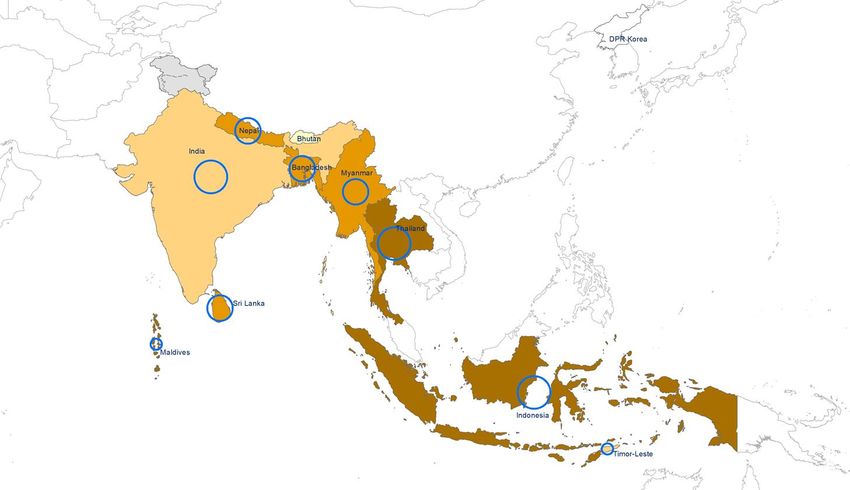
Epidemiology
Globally: third wave

 Source: https://covid19.who.int/ as of 10:37am CEST, 9 August 2021,

Source: https://covid19.who.int/
as of 10:37am CEST, 9 August 2021,
Reported COVID-19 Cases and deaths in SEAR
(data reported as of 6 Aug 2021, 7 am IST)
COVID-19 cases reported in the last seven days per 100 000 population
(from 30 July-5 August 2021)

                                                                                                                             Cases reported in the last 7 days
                                                                                                                             (per 100 000 population)

                                                                                                                                          0.01 – 10.00
                                                                                                                                          10.01 – 50.00
                                                                                                                                          50.01 – 100.00
                                                                                                                                          100.01 – 300.00
                                                                                                                                          >300

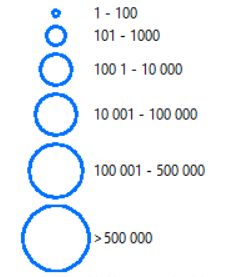
                                                                                                                             Number of new cases in the last 7 days

The designations employed and the presentation of these materials do not imply the expression of any opinion whatsoever on
the part of WHO concerning the legal status of any country, territory or area or of its authorities, or concerning the
delimitation of its frontiers or boundaries. Dotted and dashed lines on maps represent approximate border lines for which
there may not yet be full agreement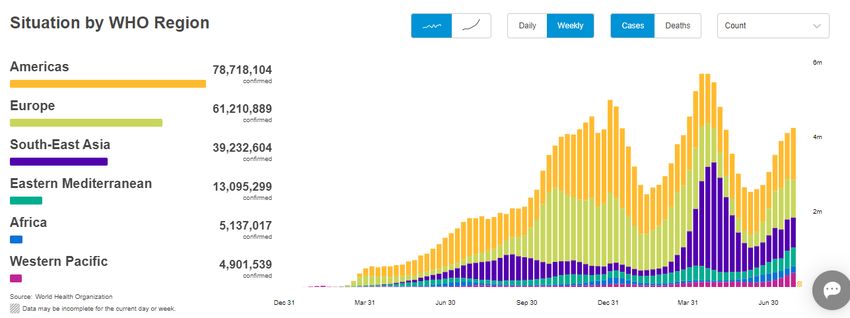
Cumulative COVID-19 Cases and Deaths, by Country
                                          (5 Aug 2021, 7 am IST)

*Percent change in the number of newly confirmed cases/deaths in past seven days, compared to
seven days prior.                                                                               **Test numbers in Thailand and Nepal- only RT PCR; Bhutan testing data as of 1 Aug 2021; Thailand testing
DMA= Day Moving Average; TPR=Test Positivity Rate                                               data as of July 31, 2021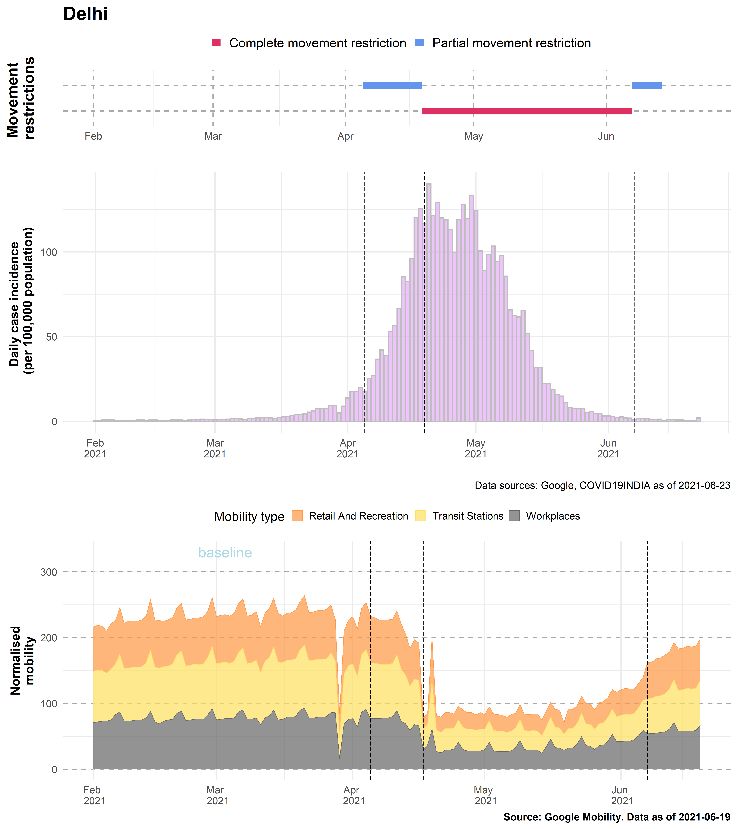
Variants
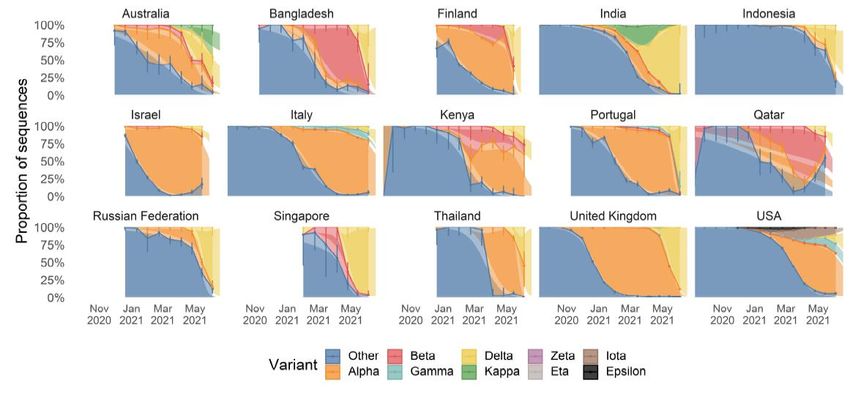
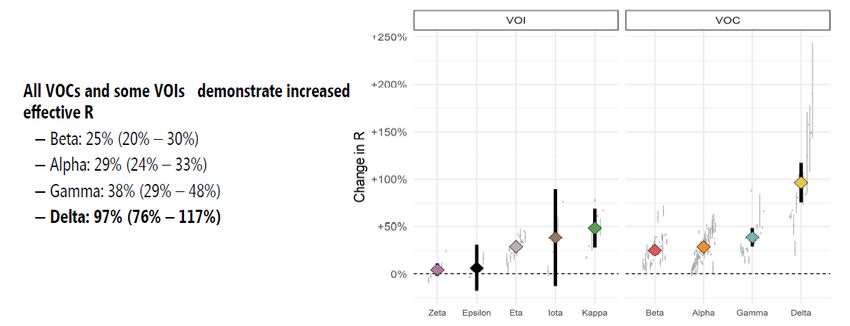
SEARO COVID-19 | Increased Transmissibility of Variants of Concern
SEARO COVID-19 | Delta Has Spread Rapidly Within Countries
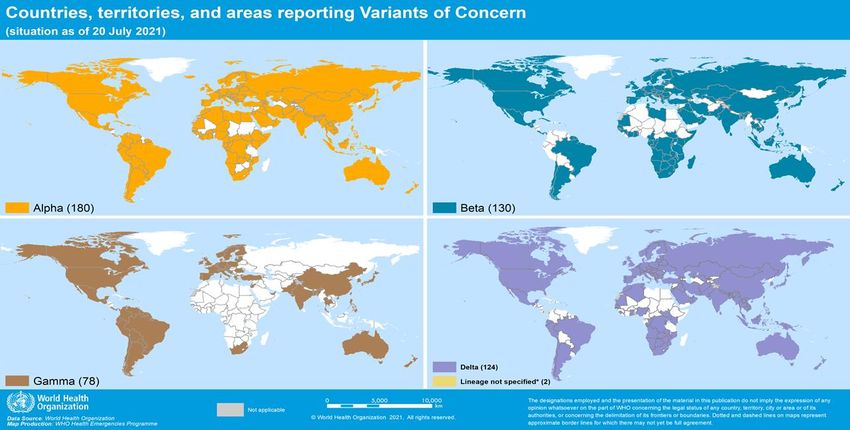
List of countries reporting Variants of Concern
                                                                              as of 25 July 2021        For all Variants of concern (VOC):
 Country                      Alpha             Beta           Gamma               Delta                • Evidence of
 Bangladesh                      ●                ●                 -                ●                       • Increased transmissibility
                                                                                                             • Possible increased risk of severity
 Bhutan                          ●                ●                                  ●                       • Vaccine efficacy/effectiveness retained
                                                                                                               against severe disease (except Gamma for
 India                           ●                ●               ●**                ●                         which impact unclear)
 Indonesia                       ●                ●                 -                ●                  • No evidence
                                                                                                             • to cause different symptoms (e.g.
 Maldives                        ●                 -                -                ●                         conjunctivitis)
                                                                                                             • for lower respiratory tract preference
 Nepal                           ●                 -                -                ●                       • failed RT-PCR test (except ‘SGTF’ in Alpha
 Sri Lanka                       ●                ●                 -                ●                         variant) or impact on Ag RDTs
                                                                                                        Delta variant
 Thailand                        ●                ●               ●**                ●
                                                                                                        • Delta variant is 55% more transmissible than
 Timor-Leste                   ●**                 -                -               ●**                   the Alpha variant and 97% more relative to
                                                                                                          non-VOC/VOI (as estimated)
 Myanmar                         ●                 -                -                ●                  • Expected that Delta will rapidly outcompete
 ** detection of VOCs only among travelers (e.g., imported cases detected at points of entry)             other variants and become the dominant
                                                                                                          circulating lineage over the coming months
 “●” indicates that information for this variant was received by WHO from official sources.

                                                                                                   SGTF = ‘S’ Gene Target Failure implies undetectable S-gene target for some real-time
                                                                                                   reverse transcriptase polymerase chain reaction (RT-PCR) testing methods
Public Health and Social Measures
SEARO COVID-19
PHSM is effective| in the context of   VOCs: Lessons from recent surge

                                                • PHSM works even in the context of
                                                  highly transmissible variants
                                                • PHSM needs to be escalated as soon as
                                                  the situation deteriorates.
                                                • Ensure monitoring systems with indicators
                                                  and criteria for timely PHSM calibration
                                                • Effective enforcement needed; then
                                                  measures can be time-limited.
                                                • RCCE and social support - a critical
                                                  elements for PHSM implementation

                                                Action points:
                                                • Review/optimize indicators/threshold
                                                  for PHSM calibration
                                                • Continue supporting advocacy/RCCE
                                                  for comprehensive PHSM
SEARO COVID-19 | New WHO guidance: Individualized public health measures
• Countries may consider relaxing some
measures for individuals meeting either of
the following criteria:
o completion of full vaccination with one of the WHO
EUL vaccines or approved by a stringent regulatory
authority (and at least two weeks after completion of
vaccination)
o SARS-CoV-2 infection confirmed by RT-PCR within
the past 6 months and no longer infectious as per
WHO’s Criteria for releasing COVID-19 patients from
isolation.
• Depending on the transmission level, below
are some options:
o waiving quarantine following close contact with a
confirmed COVID-19 case
o waiving testing and/or quarantine requirements in
the context of international travel
o allowing congregating in indoor private settings with
other fully vaccinated or recovered individuals
without masks/distancing.
Countries with a low risk tolerance, especially with high level of transmission and low level of
vaccination coverage, may choose not to implement individualized approachSEARO COVID-19 | Risk-based approach to international travel
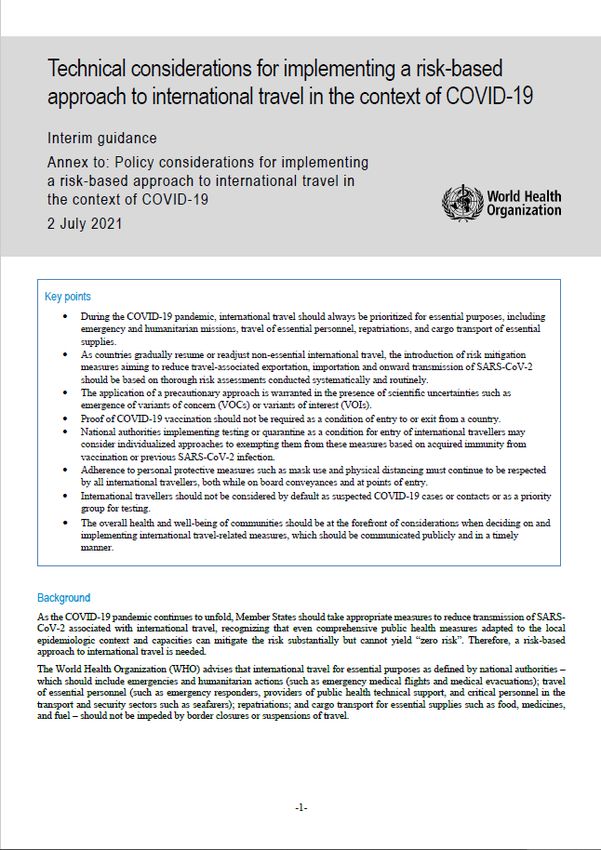
• A risk-based approach to international travel should continue to be applied (taking into consideration risks of
variants)
• Proof of vaccination against COVID-19 should not be used as a condition for entry into or exit from a country.
• Exemption from SARS-CoV-2 testing and/or quarantine requirements may be provided to travellers who:
o are fully vaccinated at least two weeks prior to travelling, with COVID-19 vaccines listed by WHO for emergency use or
approved by a stringent regulatory authority
o have proof of previous SARS-CoV-2 infection confirmed by RT-PCR received within the past 6 months and are no longer
infectious.
• Regardless of the above, any testing/quarantine measures should be guided by a risk assessment.
o Countries with a low risk tolerance may prefer not to implement this individualized approach
o Concerns about possible transmission of immune-escape variants.
• National authorities may record proof of COVID-19 vaccination in the WHO-issued “yellow booklet”, under the
section “other vaccinations” (or its digital format)The Way Forward
→ → 8th Meeting of IHR Emergency Committee on COVID-19
•   Continue to use evidence-informed PHSM based on monitoring of the epidemiologic situation
    and health system capacities
        • Mask use, physical distancing, hand hygiene, and improved ventilation of indoor spaces remains key
        • Contact tracing, quarantine and isolation, must continue

•   Implement a risk-management approach for mass gathering events

•   Achieve the WHO call to action to have at least 10% of all countries’ populations vaccinated by
    September 2021.

•   Enhance surveillance of SARS-CoV-2 and continue to report to WHO to enable rapid
    identification, tracking of variants

•   Improve access to and safe administration of WHO recommended therapeutics

•   Continue a risk-based approach to facilitate international travel and share information with
    WHO on use of travel measures and their public health rationale.

•   Do NOT require proof of vaccination against COVID-19 for international travel
    •      Recognize all COVID-19 vaccines with WHO EUL in the context of international travel.
•   Address community engagement and communications gaps at nat’l/local levels
You can also read


