COVID Safe Paths Privacy-Aware Contact Tracing Towards Resilient Societies - April 2020 - UMGC
←
→
Page content transcription
If your browser does not render page correctly, please read the page content below
COVID
Safe
Paths
Privacy-Aware Contact Tracing Towards
Resilient Societies

April 2020

                                        COVID Safe Paths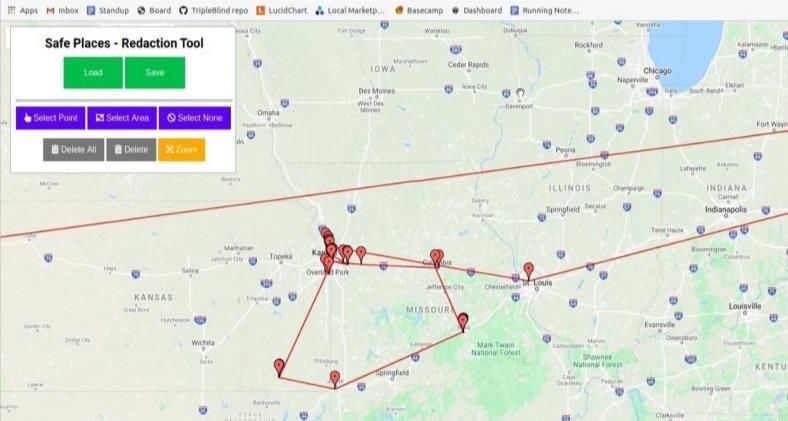
A Systems Approach: Technology To Help Slow The Spread Of Covid-19, Restart The
 Economy, And Build Resilient Societies
 A global, citizen-centric movement to develop free, open-source, privacy-by-design tools for citizens, public health officials, and larger communities to flatten the curve of COVID-
 19, reduce fear, and prevent a surveillance-state response to the pandemic.

 Background                                                                  Technology (see a demo here)                                    Why This Solution is needed

                                                                            Safe Places | A browser-based mapping tool for contact          Track, trace and treat | Contact tracing has been pivotal in
Containment, the key strategy in quickly halting an
                                                                            tracers to more efficiently interview infected patients and     containing and slowing the spread of COVID-19. However, this
epidemic, requires rapid identification and quarantine of
                                                                            create anonymized maps and data files of public places and      process is traditionally time consuming and prone to human
the infected individuals, determination of whom they have
                                                                            times where the infected patient has been.                      memory errors – this technology can help.
had close contact within the previous days and weeks, and
decontamination of locations the infected individual has
                                                                            COVID Safe Paths App | An Android/IOS app that enables          Keep it private and avoid a surveillance state | Safe Places
visited. Achieving containment demands accurate and
                                                                            users to download aggregated and anonymized, infected           creates a reliable tool and infrastructure for public health
timely collection of the infected individual's location and
                                                                            patient location trails and simply compare them on their        professionals, while COVID Safe Paths reduces the risk of
contact history.
                                                                            phone with their location history to see if they have been in   privacy violations by replacing centralized storage of sensitive
                                                                            close proximity to individuals who have subsequently learned    data with time-limited storage of data on the user’s own
Traditionally, this process is labor intensive, susceptible to
                                                                            that they are infected. Available today in Apple App Store      device and requiring user consent for data sharing; hence
memory errors, and fraught with privacy concerns. With
                                                                            and Google Play Store.                                          avoiding a surveillance state.
the recent almost ubiquitous availability of smart phones,
many people carry a tool which can be utilized to quickly
identify an infected individual's contacts. Unfortunately, the                                                                              The future ahead | Safe Places and COVID Safe Paths aims to
                                                                            Requires basic infrastructure | Smartphones + internet + a      help societies get back online by improving the public health
very same first-generation contact tracing tools have been                  computer + minimum training for contact tracers.
used to expand mass surveillance, limit individual freedoms                                                                                 infrastructure for tracking and tracing, and leveraging
and expose the most private details about individuals. We                                                                                   technology to understand how the disease is spread and more
believe there is a better approach.                                                                                                         surgically target interventions. Its open-source and modular
                                                                                                                                            nature allows other applications to be built on top of it, hence
                                                                                                                                            facilitating synergies and enabling a collaborative ecosystem
                                                                                                                                            approach.
Born from MIT, and now made up of global collaborators and volunteers from top academic, business, and technology companies globally
To learn more and get involved, visit us at: https://covidsafepaths.org/ led by Path Checks, Inc.                                                                                             COVID Safe Paths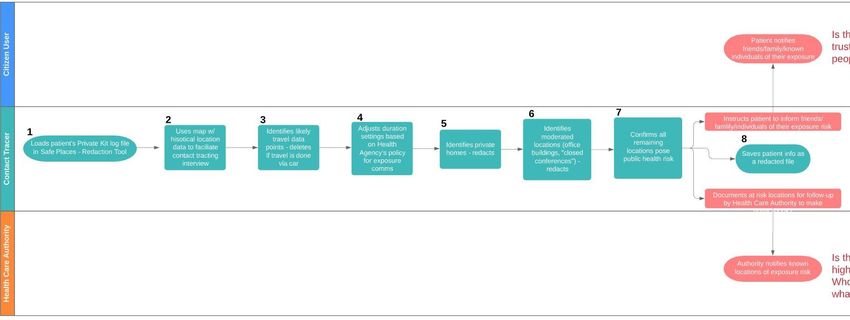
Conceptual model and value statements
                                                                   Providing Value Across Stakeholders

                                                                   • Undiagnosed Citizens:
                                                                     Provides citizens a personalized exposure profile
                                                                     from which they can make informed decisions
                                                                     about their health and interactions with others.

                                                                   • Patients:
                                                                     Provides a fast and easy way to provide details
                                                                     of where citizens have been over the last 28
                                                                     days, eliminating the human error of relying on
                                                                     memory.

                                                                   • Healthcare Authorities:
                                                                     Enables health agencies to communicate to
                                                                     citizens their personal risk profile. Agencies
                                                                     today don’t have the ability to answer the
                                                                     question “Should I be concerned or not?” for
                                                                     every citizen in their constituency.
                                Safe                               • Healthcare Contact Tracers:
                               Places                                Helps contact tracers do their existing jobs more
                                                                     effectively by using data instead of citizens’
                                                                     memories to determine where they have been
                                                                     in the ~14 days leading up to their positive
                                                                     COVID-19 diagnosis.

   COVID Safe Paths and Safe Places has considerable utility for   See Appendix for sample Workflows for users and
                                                                   contact tracers.
     Public Health Professionals and the General Population
                                                                                                         COVID Safe Paths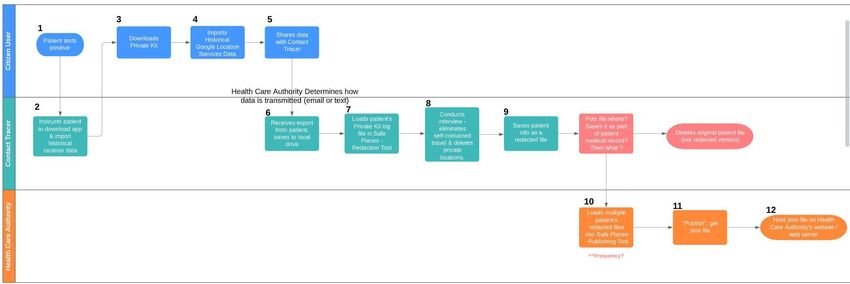
Safe Places- A Web Tool to Make Contract Tracing More Effective and Efficient

• Helps contact tracers do their existing jobs more
  effectively by using data instead of citizens’
  memories to determine where they have been
  in the ~14 days leading up to their diagnosis.
• Safe Places inputs location data from the
  infected person’s phone, either through the
  COVID Safe Paths app or from Google
  Maps/other location tools.
• The health official, in conversation with the
  infected individual, can redact patient
  identifiable information                            Faster and more accurate than
                                                       a traditional patient interview
• The information can then be published in an
  anonymized, aggregated way leveraging the
  encrypted trails.
                                                                                   COVID Safe Paths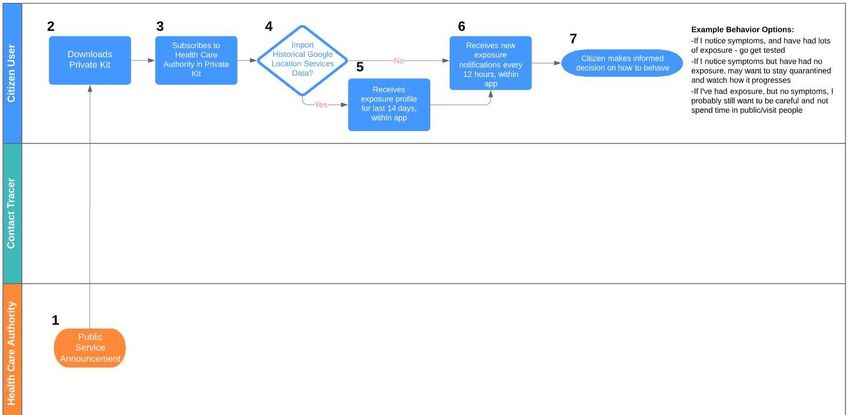
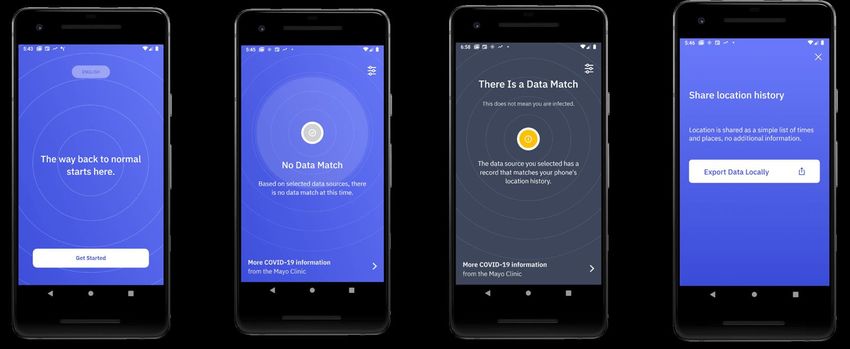
The COVID Safe Paths application has been built to easily capture and share relevant
 information to individuals, with a robust privacy-centric and open source back-end

                                                                                ✓ Notification if you have crossed paths
Privacy-Centric           Open-Source             Secure        Collaborative     with a now diagnosed COVID-19 patient
                  See a quick demo of the user interface here
                                                                                ✓ Advanced capability to send alert that
                                                                                  provides location of where contact may
                                                                                  have occurred
                                                                                ✓ Use phones to look for GPS and
                                                                                  Bluetooth based proximity
                                                                                ✓ COVID Safe Paths will include Google-
                                                                                  Apple Proximity API
                                                                                ✓ Customizable information resources
                                                                                ✓ In future iterations, additional
                                                                                  functionality related to symptom tracing
                                                                                  or health certificate management
                                                                                                                    COVID Safe Paths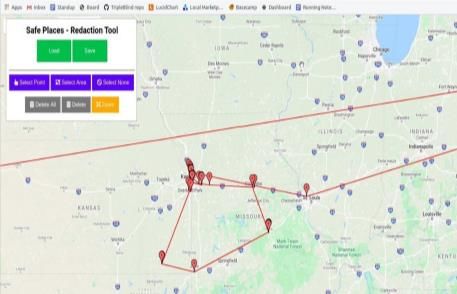
Safe Places and Safe Paths: Integrated tools for track and trace today; tomorrow
comprehensive toolkit of re-entry solutions

                                           Platform incorporates all
                                        relevant data inputs and APIs

       SafePaths App                                                          SafePlaces WebTool
Today:                                                                       Today:
                                              •   Telecom
• Exposure notification                                                      •   Expedite tracing conversation
                                              •   GPS
• Access to resources                                                        •   Improve quality and accuracy
                                              •   BlueTooth
• Ongoing Tracking                                (Apple/Ggl/PACT/Pepp-pt)       of data
• Interface with public health                •   Wifi                       •   Aggregates data for reporting
  infection data                              •   Others                               Coming Soon:
                 Coming Soon:
                                                                                       • Predict HotSpots,
                 • Personalized guidance
                                                                                         Spread Prediction
                 • Symptom tracking
                                                                                       • Coordinate at-home
                 • Quarantine Verification                                               population
                 • Immunity Passport                                                   • Integrated Dashboards
                                                                                                       COVID Safe Paths
                 • Corporate verifications                                             • Certification
COVID Safe Paths Alliance
MIT Safe Paths
Ramesh Raskar, Sandy Pentland, Kent Larson,
Kevin Esvelt Volunteers
Mentors: Amandeep Gill (I-DAIR), Bernardo Mariano
Jr (WHO), Brian McClendon, Don Rucker (HHS),
and Subbu Subramanian, Suraj Kapa (Mayo Clinic)
Faculty Mentors: Ronald L. Rivest, Yael T. Kalai,
Daniel J. Weitzner, Hal Abelson, Jonathan Gruber,
Nickolai Zeldovich, and Adi Shamir.
The technology has been developed with clinical input from
Research Mentors: Yoshua Bengio (MILA), Richard Mayo Clinic and Massachusetts General Hospital, and mentors
Janda (McGill), John Halamka (Mayo Clinic) from the World Health Organization, the US Department of
Health and Human Services, and the Graduate Institute of
Path Check, Inc International and Development Studies. The initiative has
world renowned senior advisors that include Ron Rivest
Greg Nadeau (Encryption), Yoshua Bengio (Machine Learning) and Alex
“Sandy” Pentland (Social Physics) as well as Kevin Esvelt and
CovidWatch, OpenMined, CoronaTrace, CovidActNow Kent Larson on the team.
COVID Safe PathsDeploying technology, thought leadership, and implementation support to unlock
society
Technology Think Tank Implementations
SafePaths Mobile App Interoperability Standards Public Health Engagements
SafePlaces WebTool
Privacy Guidelines Training and Monitoring
Open Source Code
API Landscape Analysis Venture Capital and Startups
Algorithms
Publications Corporate Relations
Interoperable BackBone
COVID Safe PathsPrivacy at its Core The recent announcement of Apple and Google’s work will enable Safe Paths to
accelerate our efforts by providing a critical piece of the technology that would have
Each of us is the primary owner of our personal data. Health, education, location, and been harder to do without them. Safe Paths technology is open source. – We are the
contact tracing data is personal data. No service provider or government agency integration point for public health agencies at all levels to bring the best open, free,
should be able to use that data without user consent.
privacy-by-design technologies together with EY global roll out support. – Greg
Nadeu
Technology should follow Data should be protected in Application of these Principles to Safe Paths:
the principles of Privacy by Design accordance with Fair Information
Practice Principles (FIPPs): a. Possible contacts determined privately on a
a. Proactive not reactive; preventive, user’s own device using open source code and
not remedial a. Notice/Awareness. cryptographic algorithms
b. Privacy as the default b. Choice/Consent b. Data never leave the user’s device (100% local),
c. Privacy embedded in the design c. Access/Participation unless they become ill and opt to release it to a
d. Full functionality – positive-sum, not d. Integrity/Security health official
zero-sum e. Enforcement/Redress c. Trusted health officials remove all diagnosed
e. End-to-end security – full lifecycle patient personally identifiable information –
protection only releasing the redacted location trail
f. Visibility and transparency – keep it d. Only release the redacted, disconnected, and
open aggregated space-time points
g. Respect for user privacy – keep it e. Space-time points will be deleted after they are
user-centric no longer actively needed, estimated at
between 21 and 28 days.
COVID Safe PathsAppendix
COVID Safe PathsFrequently asked questions – for public health officials
1. How does Safe Places help public health officials and 3. How is the patient’s location history shared with public
epidemiologists? health officials?
Containment of an infectious disease requires identification and Patients push the share button on their COVID Safe Paths app. The app
quarantine of infected individuals and potentially infected
gives them a QR code (small square black and white picture) to share
individuals. COVID Safe Places helps health officials and epidemiologists
with their health professional. The health professional can then upload
work more quickly, collect better data, and watch and respond to what is
the file to the Safe Places website.
happening in their community. COVID Safe Places aims to replace a time
consuming interview, vulnerable to the patient’s memory errors, with a
fast transfer of reliable location data. COVID Safe Places quickly builds 4. How is identifying information removed from the patient’s
maps showing where known cases and potential sites of exposure are location history?
located in the community. With this additional data, public health
officials and epidemiologists can make better decisions about how to Public health officials use Safe Places (i.e., browser-based mapping tool)
protect a community’s health. to remove identifying data, such as a person’s home, from their location
history. Easy to use tools make it quick to redact identifying data.
2. Is it secure to use?
5. What about people without a smartphone?
Yes! Data security and personal privacy are the core features of COVID
Safe Places. We made deliberate choices, like storing all data on the
patient’s phone rather than on a central server, time limited data Not all patients use a smartphone. If you choose to collect data from
storage, and using an open-source approach to build the technology, all these patients through an interview, it can easily be added to Safe Places
to keep your patients safe. so you still have a full picture of the situation in your community.
COVID Safe PathsFrequently asked questions – for public health officials (continued)
6. What about presumptive positive cases? 9. How are public health officials trained to use Safe
Places?
Public health officials determine who in the community to collect data
from. Whether or not to include data from presumptive positive cases Public health workers are under enormous stress as the coronavirus
in addition to confirmed cases remains an open question. Our team pandemic spreads. We have minimized the training needed to
looks forward to continuing conversations with you about what successfully use Safe Places. Training occurs by remote video
approach is most useful for you. conference sessions, training videos, and supporting
documents. We also provide one-on-one consultant support during
7. Is Safe Places useful to public health officials after the training. We are here to make your implementation of Safe Places
immediate coronavirus has passed? successful and look forward to customizing a training program that
works for you and your staff.
Yes, collecting and viewing data trends and map exposure sites allows
public health officials to quickly take action to limit a severe peak in 10. What do we tell patients about Safe Places and their
infection rates as communities emerge from the most severe data?
quarantine phase.
Safe Places provides a Communications Kit to help public health
8. What is required to use Safe Places? workers talk to patients about Safe Places. At the heart of that
communication is how we ensure maximum privacy for the
Safe Places operates as a browser extension. All you need is a computer patient’s information. We also provide easy to use diagrams to
with internet access. help the patient share their information from their phone.
COVID Safe PathsFrequently asked questions – for public health officials (continued)
11. Where is the location data stored?
Safe Places does not store user data in order to protect privacy. Each
public health team determines where to store the data they collect - on
hardware, a secure server, or in a cloud based secure system. Teams
generally choose to store data the same way they store other Protected
Health Information (PHI).
COVID Safe PathsSample Scenario 1 – Diagnosed Citizen* *For illustration purposes only – workflow is subject to change COVID Safe Paths
Sample Scenarios 2 – Undiagnosed Citizen*

*For illustration purposes only – workflow is subject to change   COVID Safe Paths
Sample Scenarios 3 – Contact User Story*

*For illustration purposes only – workflow is subject to change   COVID Safe Paths
You can also read


