CUSE Grants Program 2021 - Humanities Information Session - Office of Research - Syracuse ...
←
→
Page content transcription
If your browser does not render page correctly, please read the page content below
CUSE Grants Program
      2021

 Humanities Information Session
Agenda
• Welcome by Vivian May
Director, Syracuse University Humanities Center | Central New York Humanities Corridor,
Professor, Women's & Gender Studies
• CUSE Grants – Program Review
Christina Leigh Docteur, Director of Proposal Support Services
Sarah Workman, Assistant Director for Proposal Development (Humanities)
Stuart Taub, Director of Sponsored Programs
• Panel: Previously Awarded CUSE Grantees
Krista Kennedy, Associate Professor, Writing Studies, Rhetoric, and Composition, College
of Arts & Sciences
Tessa Murphy, Assistant Professor, History, Maxwell School of Citizenship & Public Affairs
Romita Ray, Associate Professor, Art and Music Histories, College of Arts & Sciences
• Q&A Please type questions in the chat throughout the presentation!
Syracuse University 2What are CUSE Grants?
• Support faculty research and various forms of scholarly activities in all
disciplines .
• Expected outcomes include pursuit of extramural funding and the
production of significant scholarly products
• 59 projects funded across the sciences, humanities and creative
research areas (2020 results):
Seed Grants ($5k): 18 funded
Innovative & Interdisciplinary Research ($30K max): 32 funded
Good to Great Grant ($30k max): 2 funded
Interdisciplinary Seminar Grant ($10k max): 7 funded
Syracuse University 35 programs within CUSE Grants 1. Seed Grant 2. Innovative and Interdisciplinary Research Grant 3. Good to Great Grant 4. Interdisciplinary Seminar Grant 5. COVID-Relief Grant (NEW FOR 2021) For all programs: • Individuals & teams eligible to apply. To be competitive, individual applications must demonstrate innovative nature of work, and team applications must be interdisciplinary. • 2-year project periods Syracuse University 4
Seed Grant: Interdisciplinary Seminar
Grant:
New or small-scale projects For seminar or workshop series (e.g.-
refreshments, space rental, travel
Funding capped at $5,000
and/or honoraria invited speakers)
3 pg. Project Narrative
Funding capped at $7,500
Budget Justification and Current &
3 pg. Project Narrative
Pending forms not required
Current & Pending not required
Has supported travel to archives,
domestic travel to conduct interviews, Has supported interdisciplinary
salary to support summer research symposia
Syracuse University 5Innovative and Good to Great Grant:
Interdisciplinary Research
Grant (I2):
Demonstrate current & future success PI must have submitted unsuccessful
(not funded) extramural proposal
Funding capped at $30,000 which received “Outstanding” or
equivalent reviews
6 pg. Project Narrative
Funding capped at $30,000
New this year: Equipment up to $10k
6 pg. Project Narrative
Has supported graduate and
Need School/College’s Associate Dean
undergraduate student support, faculty for Research (ADR) Statement of
salary, research trips, publication costs, Support
human subject incentives
Syracuse University 6COVID-Relief Grant
• COVID-Relief Grant characteristics:
–Funding is capped at $15,000, per application
Funding request must be justified as proportional to the size
and scope of the impacted research project
–Applications support individuals or teams
–Designed to fund the continuation or completion of an
ongoing -research project that has slowed or stalled due to
impacts from the COVID-19 pandemic
–Project Narrative section is 3 pages
Syracuse University 7Proposal Formatting
A. Font 11 points+, Arial, Calibri, Times New Roman or Computer Modern.
Other font faces/sizes may be used for formulas, equations, figures, tables,
captions but text must still be readable
B. Single-spaced 8.5” x 11” pages, 1” margins all sides (except budget,
current & pending, and conflict of interest documents)
C. Each section uploaded as single PDF document, naming convention last
name + proposal component, ex. “PILastName_ProjectNarrative.pdf”
Compliance with proposal formatting guidelines is important!
Questions on contents, formatting, or preparation of any documents?
Sign up for office hours: Wed., February 10th, 17th and 24th 8:30-4:30
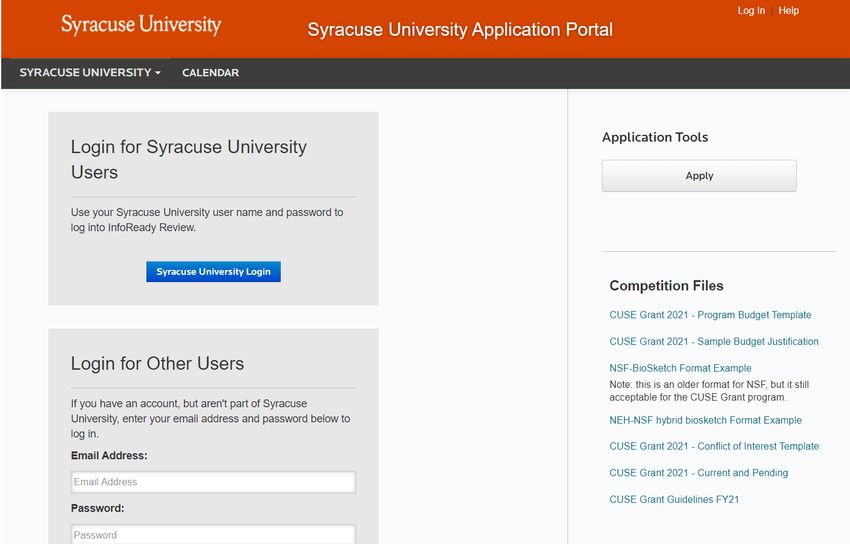
Syracuse University 8Proposal Submission 1 of 3
Application on the Syracuse University Application Portal:
https://syracuse.infoready4.com/#competitionDetail/1830648
Click “Apply,”
click blue button for
“Syracuse University Login,”
use NetID and Password to
create new application!
RFP and link to Application Portal is also posted at:
https://research.syr.edu/proposal-support-services/internal-grant-programs/cuse-grants/
For more on How To Apply, please refer to narrated slide deck posted at:
https://research.syr.edu/wp-content/uploads/2021/01/SUAP-Walkthrough-2021.pptx
Syracuse University 9Proposal Submission 2 of 3
Online Application Form (Continued)
D. Complete application details screen:
– PI appointment title, school/college, dept/center/institute, tenure status, departmental
budget administrator name and email
– Co-PI/Co-I roles & information
– Type of application (Seed, I2, G2G, Seminar, COVID-Relief)
– Proposal Title
– Total funding request
– Indicate if project involves: Human subjects; Animal research; Hazardous materials; Existing
(protected) IP; Potentially non-routine data management (HIPAA etc.); Export controls
– Indicate if previously submitted for CUSE funding
– Project Summary – Text box limited to 250 words
Syracuse University 10Proposal Submission 3 of 3
Proposal Components
i. Project Narrative vi. Budget
ii. Results from Prior CUSE vii. Budget Justification*
Grant*
viii. Biographical Sketch
iii. References Cited
ix. Current and Pending
iv. Response to Previous Review* Support*
v. Facilities and Equipment x. Conflict of Interest
* Indicates to include only if applicable
Syracuse University 11Documents Required by Grant Program
Innovative and
Interdisciplinary
Interdisciplinary Good to Great COVID-Relief
Seed Grant Seminar Grant
Research Grant Grant (G2G) Grant
(Seminar)
(I2)
Project Required, Required, Required, Required, Required,
Narrative 3pp max 6pp max 6pp max 3pp max 3pp max
Results from prior If applicable, If applicable, If applicable, If applicable,
Not applicable
CUSE 2pp max 2pp max 2pp max 2pp max
References
Required Required Required Required Required
Cited
Response to If applicable, If applicable, Required, If applicable,
Not applicable
previous review 1pg max 1pg max 4pp max 1pg max
Required, $5K Required, Required, Required, Required,
Budget
max $30K max $30K max $7.5K max $15K max
Budget Required, Required, Required, Required,
Not applicable
justification 3pp max 3pp max 3pg max 3pg max
Biographical Required, Required, Required, Required, Required,
sketch 5pg max 5pg max 5pg max 5pg max 5pg max
Current and Required, Required, Not Required,
Not applicable
pending PI only PI only applicable PI only
Required, Required, Required, Required, Required,
Conflict of interest PI & Co-PIs, SU PI & Co-PIs, PI & Co-PIs, PI & Co-PIs, PI & Co-PIs,
conflicts SU conflicts SU conflicts SU conflicts SU conflicts
Syracuse University 12Project Narrative (Upload)
• Conform to formatting requirements & observe page limits for CUSE
grant program to which you are applying
• Each Project Narrative should include:
– Introduction and Key Personnel*
– Rationale, Significance, and Broader Impact
– Approach
– Intent to leverage CUSE funding
• Note: Avoid excessive jargon in proposal narratives, as reviewers may
not be experts in your specific area
• 3-6 pages max, depending on program type
Syracuse University 13Intent to Leverage CUSE funding (subsection of narrative)
• Discuss how you will leverage CUSE funding to pursue extramural funding sources
List funding agencies & specific programs you will apply for & how CUSE funding will be
impactful
• And/or demonstrate how you will show impact from this grant external to SU
For disciplines where external funding is limited, describe how CUSE grant will enable you to
leverage success to enhance the reputation of the University, through increased
competitiveness for prestigious awards, creation of significant new scholarship, or through
creation of unique educational programs or collaborations. Be specific!
• COVID-Relief applications: Use this section to discuss why funding is needed
Detail how CUSE funding will move the stalled project forward, and
What progress will be enabled that would otherwise not be possible without relief funding.
Syracuse University 14Results from Prior CUSE Grant (Upload)
Only for lead PIs who previously received a CUSE Grant (2 pages max)
• Include detailed description of how you leveraged previous CUSE Grant to
secure extramural funding and/or enhance reputation of University
• Information on results from prior funding should include:
– Year, title and amount of the previous CUSE Grant
– Proposals submitted and/or awards received, including titles, amounts and funders
(please do not list Syracuse University intramural grants)
– List of publications, patents or other significant research outputs
– Description of relevant meetings, seminars, or presentations conducted
• If not applicable, do not upload a document in this section.
Syracuse University 15References Cited (Upload) • This section lists all work cited in the text • References must be complete, including titles and all co-author names in a professional style appropriate to the primary discipline • No Page Limit Syracuse University 16
Response to Previous Review (Upload)
Only for projects previously unsuccessfully submitted for funding
• Response to Previous CUSE Review – (1 page max)
        – Required for all previously submitted Seed, I2, or Seminar proposals
        – Respond to review panel summary and include how project has changed
• Response to Extramural Reviews – (4 pages max)
        – Required for G2G proposals only. Include:
           1) The PIs response to extramural grant reviews, including how the G2G proposal
           will help make a subsequent extramural submission more competitive
           2) A statement of assessment of the competitiveness of the G2G application
           from the Associate Dean for Research of the college/school
           3) A copy of the external agency review (not subject to page limitations for this
           section) – compile these three documents into one PDF attachment
• If not applicable, do not upload a document in this section
Syracuse University                                                                            17
Budget (Upload) – Allowable Costs
• Utilize CUSE Grant Budget Template provided on the CUSE Grants web page
• Funds can be requested for the following allowable costs:
– Salaries & Wages for PIs and Co-I’s – limited to one (1) month
– Other Salaries & Wages – For I2 & G2G grants, allowable for postdocs, students, and essential staff.
“The CUSE Grant program recognizes the importance of graduate and undergraduate training and
strongly encourages the PI to involve graduate and undergraduate students in CUSE Grant activities.”
– Fringe Benefits – budget template automatically assigns Fringe
– Equipment – total is limited to $10,000 I2 and G2G*
– Travel – Must be directly related to CUSE grant project activities
– Other Direct Costs – Materials & Supplies (ex. meeting supplies, books), Consultant Costs (limit 25%
of budget), Purchased Services (ex. transcription or translation costs), Rental of Off-site Facilities,
Human Subject payments, and other relevant costs (ex. archive fees, food & beverages for all-day
workshops). Event costs for any CUSE funded project should include ASL Interpreting/CART Services
fees as appropriate
*Denotes change from 2020
Syracuse University 18Budget – Unallowable Costs
• The following items are unallowable costs on a CUSE grant:
– Subcontracts to external institutions
– Office Supplies
– Cell Phones/Internet service
– Memberships/subscriptions
– Computer peripherals, software, iPads and computers*
– Indirect costs
• *Project-specific software package(s) and/or computer purchases may be allowed if:
(1) Predominately used for the project
(2) The work proposed cannot be completed without the item(s)
(3) A highly detailed justification is provided
Syracuse University 19Budget Justification (Upload) • A narrative justification to the items requested in your Project Budget • An opportunity to thoroughly explain what budget allocations are needed and why they are important to complete the goals and objectives of your project • Not required for Seed Grant applications • A budget justification template is provided on the CUSE Grants web page • 3 pages max Syracuse University 20
Biographical Sketch (Upload)
• Provide a biographical sketch in any extramural agency format (e.g. NIH, NSF, DOD) for PI, Co-PIs
  and Co-Is, limited to academic & research credentials
• If not using extramural agency format, include:
        –   Brief summary of investigator’s qualifications for proposed project
        –   Brief summary of teaching, scholarship, and research expertise
        –   Education history (degrees) and relevant employment history
        –   Relevant honors and awards (limit to five)
        –   Relevant products, including: Peer reviewed publications, books, book chapters, or other
            academic/artistic outputs consistent w/discipline, such as scores, films, productions, performances or
            artworks.
• Do not list meetings attended, seminars given, personal data
• For Seed & Seminar Grants (which do not require the submission of a Current and Pending
  Support document) you may include a list of grants received or funding applications in process
• 5 pages max, templates provided on the CUSE Grants web page
Syracuse University                                                                                                  21
Current and Pending Support (Upload) • Utilize the Current and Pending form provided on the CUSE Grants web page to provide a listing of all proposals that are Pending, Awarded, or Planned for Submission. • The form is required for the PI of the CUSE Grant only • Not required for Seed and Seminar Grant applications • No page limitation Syracuse University 22
Conflict of Interest Form (Upload)
•   A.k.a. Collaborators and Other Affiliations
•   Utilize COI form provided on the CUSE Grants web page
•   Required for the PI and all Co-PIs, but not for other project personnel.
•   Intended to minimize potential conflicts of interest in the review process
•   Include the following:
        – Syracuse University co-authors on publications within the past three (3) years,
          including pending publications and submissions;
        – Syracuse University collaborators on projects within the past three (3) years,
          including current and planned collaborations; and
        – All Syracuse University thesis or postdoctoral advisees/advisors.

Syracuse University                                                                         23
Review Process 1st Stage Screening • 1st level screening will consist of checking margins, page limits, font sizes, line spacing, and inclusion of required sections, etc. • Program specific items will be checked (e.g. external reviews for G2G) • Compliant proposals will then be prepared for distribution to review panels Syracuse University 24
Merit Review Process
• Review panel
SU faculty with extramural grant experience and former CUSE recipients
Goal of representing expertise across disciplinary and research areas
• Evaluation Criteria
Overall merit (25%)
Potential success for extramural funding, enhanced reputation & compliance with reporting
requirements (25%)
Significance of project and alignment with CUSE Program priorities, current and future
research trends, extramural funding priorities, or with national and international awards for
recognition (25%)
Qualifications of project personnel and adequacy of facilities and resources (25%)
• Reviewers will sort proposals into categories
Excellent - - Very Good -- Good -- Fair -- Poor
• Funding decisions based on evaluation rankings & availability of funds
Syracuse University 25CUSE Review Process - 2020 • 13 review teams formed, with 3 reviewers per application • Alternate reviewers were brought on to minimize COIs • Reviewers were asked to complete non-disclosure agreements to maintain confidentiality • Expertise of review teams were matched with proposals to the degree reasonable/practicable • Each review team assigned between 3-11 proposals to review/score • Teams were multi-disciplinary, with lead reviewer assignments made with intent of most closely aligning expertise to proposals Syracuse University 26
CUSE Grant Submission

• Must be submitted by 5:00 pm March 1, 2021
• Early submission strongly encouraged!
• Submit electronically to the Syracuse University Application Portal
• An email acknowledgment of receipt will be sent once the CUSE
  grant application is received

Syracuse University                                                 27
Panelists
• Krista Kennedy, Associate Professor, Writing Studies, Rhetoric, and
Composition, College of Arts & Sciences
2020 (Seed): Disability, Data, and Surveillance
• Tessa Murphy, Assistant Professor, History, Maxwell School of Citizenship
& Public Affairs
2020 (Seed): Creating a Searchable Database of Enslaved People in the Nineteenth
Century British Empire
• Romita Ray, Associate Professor, Art and Music Histories, College of Arts &
Sciences
2018 (Interdisciplinary Seminar): Landscape Studies
2020 (I2): Leavy Wonders: Art, Aesthetics, and the Science of Tea in Colonial and
Modern India
Syracuse University 28Example Humanities (broadly defined) Awards • Please see the list of funded projects (2018-2020) that touch the humanities that we will share via chat. • The full list of funded CUSE projects can be accessed via Answers.syr.edu, as listed on the CUSE Grants Program page: https://research.syr.edu/proposal-support-services/internal-grant- programs/cuse-grants/ Syracuse University 29
Questions?
    Christina Leigh Docteur                    CUSE Grant General Information
    Director of Proposal Support Services      Session – Recording
    cdocteur@syr.edu                           General Information Session - Slides
    Phone x2195
                                               Jan. 20, 10-11:30 a.m.
    Sarah Workman
    Assistant Director, Proposal Development   CUSE Grant Application Arts-focused
    (Humanities)                               Information Session
    srworkma@syr.edu                           Feb. 5, 10-11:30 a.m.
    Phone x5260
    Stuart Taub
                                               CUSE Grant Office Hours
    Director, Sponsored Programs               Feb. 10, 17 and 24, 8:30 a.m. to 4:30
    staub@syr.edu                              p.m.
    Phone: x9356
Syracuse University                                                                    30
You can also read


