Cypress College Mortuary Science Program - PDF4PRO
←
→
Page content transcription
If your browser does not render page correctly, please read the page content below
BOARD OF GOVERNORS
 CALIFORNIA COMMUNITY COLLEGES
      CHANCELLOR’S OFFICE

        ACADEMIC AFFAIRS DIVISION

     APPLICATION TO PARTICIPATE IN
   CALIFORNIA COMMUNITY COLLEGES
BACCALAUREATE DEGREE PILOT PROGRAM

            SUBMITTED BY

   Cypress College
    Mortuary Science Program

             December 19, 2014
Table of Contents
Need (Statement of Problem) ............................................................................................................. 3
Brief description of the proposed baccalaureate program
College and district demographics, regional characteristics, and enrollment data
Student interest, community support, and regional/statewide demand
Regional/statewide labor market, employer demand, and unmet workforce needs
Further evidence of need
Response to the Need ........................................................................................................................ 7
Description of the size, scope, and success of existing degree program
Building upon existing programs and access for prospective students
Five-year enrollment projections and the number of anticipated graduates
Lack of program duplication with the UC and the CSU statewide
Proposed curriculum and examples of upper division discipline work required
Upper division general education course work that may be appropriate
Timeline for planning, implementation, accreditation approval, and degree completion
Program Management and Institutional Commitment ................................................................... 11
Historical college/district accreditation status and program accreditation
College and district long-term effective and stable fiscal management
Program administration and support staff allocated to ensure project success
Examples of similar programs that the college has successfully implemented
Organizational chart for the pilot program
Identified Resources ......................................................................................................................... 13
Summary of resources, including curriculum and professional development
Discipline faculty and support services and personnel
Description of facilities, instructional equipment, and supplies
Analysis of proposed baccalaureate degree success with identified resources.
Forms (Appendix A) .......................................................................................................................... 15
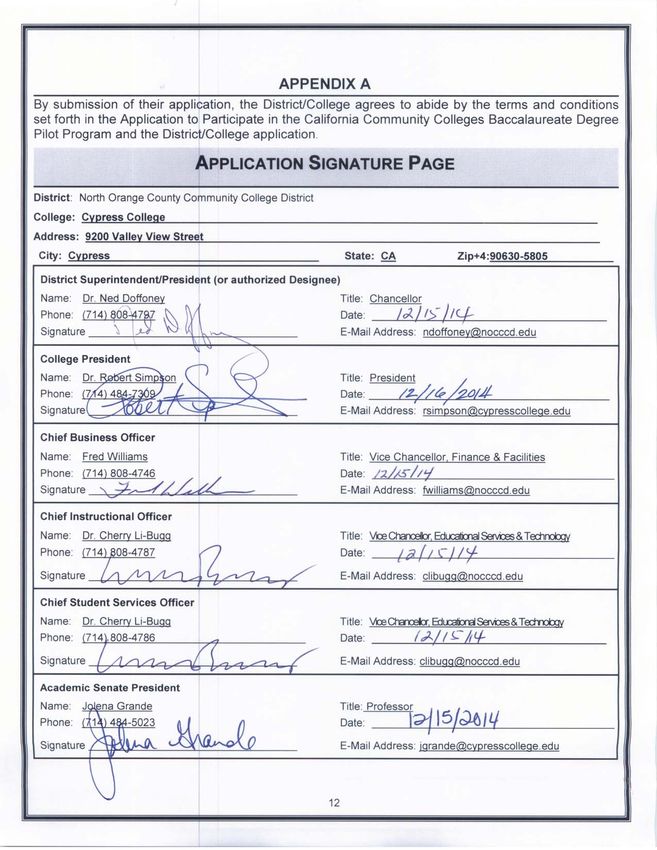
Appendix A: The Signature Page
APPLICATION TO PARTICIPATE IN CALIFORNIA COMMUNITY COLLEGES BACCALAUREATE DEGREE PILOT PROGRAMNEED (STATEMENT OF PROBLEM)
Brief description of the proposed baccalaureate program.
The North Orange County Community College District’s (NOCCCD) mission is
“to serve and enrich our diverse communities by providing a comprehensive program of
educational opportunities that are accessible and academically excellent.” With the
passage of SB 850, we desire to acquire the capacity to include baccalaureate
education in our comprehensive program of educational opportunities. We are therefore
proposing to establish a baccalaureate degree in Mortuary Science (BDMS) to be
offered at Cypress College. This new degree would offer upper division academic and
vocational instruction in Mortuary Science to students, as well as bring expanded
employment opportunities to Southern California and throughout the state in the funeral
service industry. The overarching goal of the Program is to enhance, not supplant, the
current Associate in Science degree program. The Program would be unique to
California since currently there are no other colleges or universities that offer this type of
degree in the Western United States.
The decision to pursue inclusion in the pilot was made after careful consideration
and extensive deliberation among all constituent groups. Members of the faculty,
administration, staff, student senate, and industry and community leaders have been
directly involved in the decision of the College and NOCCCD to offer a BDMS. A
Planning Taskforce on the BDMS formed almost two years prior with the core
membership of the taskforce consisting of the Mortuary Science Advisory Committee. In
addition to the Mortuary Science Advisory Committee, the Taskforce also has
representatives from the local Chambers of Commerce, government, high schools, non-
profit organizations, and the funeral service industry. The industry members were
particularly helpful by bringing external data, forecasts, and business intelligence to the
process. Careful analysis of student needs and the availability of educational
opportunities in support of those interested in a career in funeral service were also
included in the process. The Taskforce produced a comprehensive proposal, which
forms the backbone of this application. The initial proposal by the Planning Taskforce
was reviewed, assessed, and vetted in the context of several Mortuary Science
Department, Health Science Division, campus and district-wide meetings held between
Spring and Fall 2014. The Cypress College Curriculum Committee, Academic Senate,
Planning and Budget Committee, President’s Advisory Cabinet, and other forums were
used to identify the program to be offered by Cypress College, and to elicit support and
inform the College community. The proposal in support of a BDMS was approved by the
NOCCCD Board of Trustees on November 11, 2014, and was subsequently advanced
to the California Community College Chancellor’s Office (CCCCO) for consideration.
College and district demographics, regional characteristics, and enrollment data.
In the Los Angeles and Orange County regions, there are 27 community
colleges, divided into 14 Districts that serve approximately 800,000 students. NOCCCD,
with its two colleges and the School of Continuing Education, is included in this part of
the state’s southern region and encompasses approximately 155 square miles. District
boundaries extend to the Riverside County line on the east and the Los Angeles County
line on the west and north. A portion of Los Angeles County, on the north and west
boundary, is also included in the District's service area. Anaheim, Brea, Buena Park,
Cypress, Fullerton, La Habra, La Palma, Los Alamitos, Placentia, Rossmoor, Yorba
Linda, and portions of Garden Grove, La Habra Heights, La Mirada, Orange, Seal
APPLICATION TO PARTICIPATE IN CALIFORNIA COMMUNITY COLLEGES BACCALAUREATE DEGREE PILOT PROGRAM Page 3NEED (STATEMENT OF PROBLEM)
Beach, Stanton, Whittier, and unincorporated territory in both Los Angeles and Orange
counties, are included in the NOCCCD service area, as well as the following K-12
School Districts: Anaheim City, Anaheim Union High, Brea-Olinda Unified, Buena Park,
Centralia, Cypress, Fullerton (Elementary), Fullerton Joint Union High, La Habra City,
Los Alamitos Unified, Lowell Joint, Magnolia, Placentia-Yorba Linda Unified, Savanna,
and portions of the Garden Grove Unified School District. The District has a population
of nearly one million residents. Enrollment in the District is strong and continues to
grow. Cypress College enrolls approximately 23,000 students each year while Fullerton
College enrolls about 35,000. Additionally, almost 39,000 students are enrolled each
year by the School of Continuing Education. The total NOCCCD student population is
close to 100,000. The 2014-2015 District operating budget is over $200 million.
Within Orange County, Cypress College primarily serves the cities of Anaheim,
Buena Park, Cypress, Garden Grove, La Palma, Los Alamitos, Seal Beach and
Stanton, although residents of any city are welcome, as demonstrated by the almost
50% of Cypress College’s enrollees who reside outside the service area. Cypress
College’s service area has more than 82,000 adult residents. The 2012 Census
reported that of area residents over the age of 18, more than 50% were non-Caucasian.
In 2012, the area had large populations of Latinos (33.3%) and Asians or Pacific
Islanders (20.6%); while African Americans comprised 2.2%. Women comprised the
majority (55%) of students enrolled at Cypress College and have done so for the past
five years. The Cypress College student population is highly diverse, with the current
breakdown as follows: 22.0% White, 46.1% Latino/a, 18.8% Asian or Pacific Islander,
6.8% Filipino, 5.3% African American, and 2.0% other ethnicities or declined to report.
Currently, Cypress College serves 265 documented veterans.
At Cypress College, 27.8% of the students are under age 20 and 42.4% are 20-
24 years old. The proportion of students between the ages of 30 and 49 has been
decreasing and now represents only 13.3% of the student body in Fall 2014. In Fall
2014, the primary educational goal for almost 50% of incoming students was to obtain
an Associate Degree and transfer to a university; another 16% sought to transfer
without a degree; and 11% sought to obtain a degree but not transfer. Since Fall 2002,
the proportion of students seeking a degree and transfer increased dramatically while
the proportion who were undecided about their educational goal dropped. This pattern
of increasing degree-seeking as a goal among the Cypress College students bodes well
for the proposed BDMS.
Student interest, community support, and regional/statewide demand.
Student interest and employer demand for a BDMS has been significant. The
majority of funeral service education programs are located east of the Colorado River,
with more than 75% near the eastern seaboard. Associate degree programs of Mortuary
Science/Funeral Service Education on the west coast include Lake Washington Institute
of Technology in Kirkland, WA; Mt. Hood Community College in Gresham, OR;
American River College in Sacramento, CA; Mesa Community College in Mesa, AZ;
and Salt Lake City Community College in Jordan, UT; in addition to Cypress College.
Bachelor degree-granting institutions accredited by the American Board of Funeral
Service Education (ABFSE) are located in Illinois, Indiana, Massachusetts, Minnesota,
Michigan, New York, Ohio, and Oklahoma. The ABFSE is the only nationally recognized
accrediting agency for funeral service/mortuary science programs in the U.S.
APPLICATION TO PARTICIPATE IN CALIFORNIA COMMUNITY COLLEGES BACCALAUREATE DEGREE PILOT PROGRAM Page 4NEED (STATEMENT OF PROBLEM)
At this time, the Mortuary Science Program at Cypress College has articulation
agreements for our graduates with the University of Central Oklahoma and State
University New York (SUNY)-Canton. With no formal educational program options in
California, three former students are currently completing a baccalaureate at the
University of Central Oklahoma, and four Cypress College ASMS graduates are in the
SUNY online baccalaureate completion program. With this proposed BDMS at Cypress
College, NOCCCD anticipates drawing from all of the west coast funeral service student
populations.
The only other Associate Degree Funeral Service Education program in
California is offered at American River College, which has expressed no interest in
pursuing participation in the pilot program. This fact also boosts Cypress College’s
proposal in that there will only be one Mortuary Science baccalaureate degree pilot
program for all of California, in fact, the entire area west of Oklahoma. We anticipate
not only robust enrollment in the BDMS, but also a high likelihood of student success
and completion based on the track record of student success and completion in the
Mortuary Science Associate Degree (ASMS) program at Cypress College. There is,
therefore, tremendous potential for this program. With the accomplishments of
previous students who have graduated from the Cypress College Mortuary Science
program, there is great potential for success as well.
The evidence for student interest and community support is well documented. It
consists of: (1) student exit surveys, administered on the last day of each semester to
graduating students; (2) graduate surveys, administered 6 months after graduation to
program alumni; and (3) employer surveys, administered at the end of every June to
companies/organizations located within Southern California. We have years of history
with all three surveys and the collective results point to a documented need for
advanced Mortuary Science education in California. These three surveys are required
by the ABFSE for all Funeral Service Education programs to provide data on outcomes
and effectiveness in meeting program aims and objectives; they are also used for
program planning and assessment. Survey findings over the past two years have shown
that 80% of graduates indicated a need for more formal education above that of an
Associate’s Degree. In addition, respondents identified a need for more in-depth and
advanced education in such areas as Restorative Art and Funeral Service Counseling.
Community support has also been documented by support of the Mortuary
Science Program Advisory Committee, which is a representation of privately owned
funeral homes as well as publicly traded companies within the Southern California
funeral industry. The membership of the committee includes managers and owners of
funeral homes and companies along with key members from other supporting
agencies. The Mortuary Science Advisory Committee is active, engaged, and help
guide and assist the department faculty, staff, and students. For almost two years, the
Advisory Committee agendas and minutes document discussions of the BDMS and
strong support for this proposal. Since the Spring 2013 Advisory Committee meeting, it
became abundantly clear that Mortuary Science students needed instruction that is
more advanced. During a special Advisory Committee meeting in May 2013, program
curricula offerings and scope were discussed and a recommendation came forth that
the current ASMS be increased to a minimum of 92 units in order to better prepare the
graduates for employment in local funeral establishments.
Regional/statewide labor market, employer demand, and unmet workforce needs.
APPLICATION TO PARTICIPATE IN CALIFORNIA COMMUNITY COLLEGES BACCALAUREATE DEGREE PILOT PROGRAM Page 5NEED (STATEMENT OF PROBLEM)
According to the U.S. Bureau of Labor Statistics (BLS) website, “Employment of
funeral service workers is projected to grow [nationally] 12 percent from 2012 to
2022…Those who are licensed as both funeral directors and embalmers and are willing
to relocate [have] the best job opportunities.” In California according to the Employment
Development Department, in Orange County alone, the projection is 150 funeral service
positions from 2010–2020. That averages 15 positions per year for the immediate area,
and when Los Angeles and San Diego are added, an additional 830 positions are
anticipated over the same 10-year period, or 83 annually. Considering the entire state of
California, the projection is for 3,900 licensed funeral service practitioners over the ten-
year period from 2012 to 2022, with annual increases of 5%. All of these positions
require a degree for licensure. As of January 1, 2014, there were 1021 licensed funeral
establishments employing more than 2200 funeral directors and 1600 embalmers, as
published by the California Department of Consumers Affairs Cemetery and Funeral
Bureau. All of these establishments will need qualified individuals for the workforce
demands and a BDMS program will help meet this need. Graduates with a bachelor’s
degree are more likely to be employed. According to a BLS report, the employment rate
with an Associate degree was 68%, but the employment rate for those with a
baccalaureate degree or higher was 73%, as of 2013.
Further evidence of need.
Those states without funeral service education programs rely on practitioners
either leaving their home state to pursue their funeral service education, completing
online programs that require students to attend out of state on-campus seminars at
regular intervals, or hiring only those who have previously graduated from a funeral
service education program elsewhere. Furthermore, over the past five years, the
discussion on the need for increasing funeral service practitioners’ minimum level of
education has gained national attention. The National Funeral Directors Association
(NFDA) has written extensively on this topic. Jeffrey Stephenson’s doctoral dissertation
(August 2014) “Perceptions of California Funeral Directors on Educational Attainment
Level of the Profession,” found that an advanced degree such as a baccalaureate may
better prepare people for the mortuary science field. Jacqueline Taylor’s research, as
quoted by Michael LuBrant in his 2013 dissertation, “Practitioners’ Perceptions of the
Academic Preparation of Funeral Directors and Embalmers in the Context of Changing
Death Care Preferences in the United States,” advocates for a national discussion on
the minimum education requirements for professional practice and whether the
associate’s degree is adequate. LuBrant found “[w]ith respect to workforce preparation,
practitioners generally perceived themselves not well prepared for the work they were
expected to perform as entry-level funeral directors and/or embalmers.” His study found
evidence of a significant negative relationship between perceived Associate-degree-
only preparation and perceived qualification to enter the workforce as an entry-level
funeral director and/or embalmer.
APPLICATION TO PARTICIPATE IN CALIFORNIA COMMUNITY COLLEGES BACCALAUREATE DEGREE PILOT PROGRAM Page 6RESPONSE TO THE NEED
Description of the size, scope, and success of existing degree program.
Inclusion of Mortuary Science in the pilot program will build on the current ASMS
program, create baccalaureate degree graduates, and enhance the number of skilled
professionals in the state’s workforce. The current ASMS degree program requires 75
units, including 50 units of Mortuary Science major coursework and 25 units of general
education coursework in the A-E subject matter areas identified on the next page.
Currently, ABFSE accreditation standards require a faculty-student ratio of 1:30, and
therefore 30 students each semester are accepted into the Mortuary Science program
through a prerequisite validation and background certification process. The goal of the
Mortuary Science program is to prepare men and women for licensure as funeral
directors, embalmers, crematory operators, and cemetery managers, all of which
require a criminal background free of any citations, misdemeanors, and felonies that
would constitute grounds for denial of licensure in California. Students admitted to the
ASMS program complete 18-months of intensive study in introductory and advanced
mortuary science curriculum. These students are arranged into cohorts: semester 1
consists of 15 units; semester 2, 18 units; and semester 3, 17 units. Department
success rates are substantially higher than College averages (approximately 86%
versus 71% for past two years), and national licensure exam pass rates are much
higher than national averages (96% and 100% versus 74% and 78%). There are
approximately 85 non-duplicated students currently enrolled in Mortuary Science
courses at Cypress College.
Building upon existing programs and access for prospective students.
The proposed BDMS would enhance the existing ASMS offering at Cypress
College. Prospective students would submit an application to the Health Science
Division Selection Committee, indicating prerequisites have been met and background
clearance obtained, similar to the process in place for the ASMS program. The pilot
program would essentially be a baccalaureate completion program, designed for
graduates of ABFSE-accredited Associate Degree programs who may already be
employed in funeral service; those desiring to increase their career mobility; and those
who already possess both a California Funeral Director’s license and a California
Embalmer’s license. Students selected into the pilot will start as third-year college
juniors, having already completed a minimum of 75 units (required for ASMS). This is
designed to ensure all students are adequately prepared to successfully complete the
BDMS. Starting in Fall 2017, 20 students will begin enrolling in the BDMS program,
which would be their third year of college work. Each semester after that, 20 students
would be accepted to begin the following semester. By the Spring 2019 semester, there
will be 80 students in the pilot program. In five years, the enrollment projection is for 140
students.
Using 120 units as a standard for a degree, this BDMS program will consist of 60
lower division units and 60 upper division (UD) units. With the current ASMS degree at
75 units of course work, 45 additional units will be required. This will necessitate the
renumbering of Mortuary Science courses to the 300 and 400 level, as is common in
other Funeral Service Baccalaureate Degree programs. A minimum of 48-51 general
education units in A-E subject areas will be required to complete the bachelor degree at
Cypress College. Under consideration by the Intersegmental Committee of Academic
Senates (ICAS) is the precise number of those units and how they can be divided
APPLICATION TO PARTICIPATE IN CALIFORNIA COMMUNITY COLLEGES BACCALAUREATE DEGREE PILOT PROGRAM Page 7RESPONSE TO THE NEED
between lower- and upper-division. From the Chancellor’s Office FAQs, “The Upper
Division GE units for CSU and UC are approximately 12 units.” The Academic Senate
for California Community Colleges (ASCCC) is actively discussing this matter and
specific requirements will be identified during initial BDMS pilot program
implementation. Currently, 39 units are required as part of the CSU General Breadth at
Cypress College. Students completing the ASMS will have completed 25 units of
General Education prior to graduation, necessitating a minimum of 14 additional units in
lower division general education, in addition to the 9-12 units required in UD courses
(currently under discussion with ICAS members). A minimum of nine units will be
dedicated to UD general education requirements commensurate with CSU/UC
requirements and at least 10 units of advanced coursework specifically in Mortuary
Science. All UD courses will be equivalent in rigor to that required by California’s four-
year system partners.
Area/ Difference
Cypress College (CC) GE California State University (CSU) GE
Category
CC: LANGUAGE AND RATIONALITY CSU: English Language Communication and Critical Thinking
A A1 Oral Communication (3 units) 3 units
A1. WRITTEN COMMUNICATION: 3 Unit
A2 Written Communication (3 units)
Minimum
A2. ANALYTICAL THINKING: 3 Unit Minimum A3 Critical Thinking (3 units)
B CC: NATURAL SCIENCES AND MATH CSU: Scientific Inquiry and Quantitative Reasoning (Minimum 12 units) 6 units
B1. LIFE AND PHYSICAL SCIENCES: B1 Physical Science (3 units) 3 units
3 Unit Minimum B2 Life Science (3 units) (3 units)
B3 Laboratory Activity associated with a course taken to satisfy B1/B2 Lab
B2. MATHEMATICS: 3 Unit Minimum B4 Mathematics/Quantitative Reasoning (3 units)
CC: ARTS AND HUMANITIES CSU: Arts and Humanities (Minimum of 12 units) 6 units
C C1. ARTS: 3 Unit Minimum C1 Arts: Arts, Cinema, Dance, Music, Theater
C2. HUMANITIES: 3 Unit Minimum C2 Humanities: Literature, Philosophy, Languages Other than English
CC: SOCIAL SCIENCES CSU: Social Sciences
D
6-UNIT MINIMUM Minimum of 12 units 6 units
E PHYSICAL ACTIVITY AND HEALTH Lifelong Learning and Self-Development
1-UNIT MINIMUM Minimum of 3 units 2 units
Upper Division Coursework 9-12 units
Total number of additional units needed of lower division and upper division general education coursework 35-38 units
Furthermore, the additional general education coursework that satisfies UD
requirements for the CSU will most certainly include discussions within the District
Curriculum Coordinating Committee (DCCC) on which current course offerings at
Cypress and Fullerton could be used to meet those areas. It is the intention of the
Mortuary Science Program to provide as many opportunities to collaborate with
colleagues as possible to insure students receive the highest quality of undergraduate
education rivaled by the local CSUs. The table below summarizes these requirements.
A sample curriculum for the BDMS program student entering with the ASMS
course work completed may resemble the following table:
Semester I Semester II Semester III Semester IV
Oral Communication Class Mathematics/Quantitative Reasoning Course Social Sciences Course Social Sciences Course
Physical Science with Lab Arts and Humanities Course Mortuary Science Course Upper Division GE Course
Arts and Humanities Lifelong Learning and Self-Development Course (Funeral Directing III) Mortuary Science Course
Course Upper Division GE Course Upper Division GE Course (Funeral Service Law)
Mortuary Science Course Mortuary Science Course (Funeral Service Mortuary Science Course Mortuary Science Course
(Preparation for Trends) (Embalming III) (Capstone)
Disposition)
APPLICATION TO PARTICIPATE IN CALIFORNIA COMMUNITY COLLEGES BACCALAUREATE DEGREE PILOT PROGRAM Page 8RESPONSE TO THE NEED
Five-year enrollment projections and the number of anticipated graduates.
All students who apply to the NOCCCD BDMS pilot program are required to
complete their degree by the end of the 2022–23 academic year. It is well documented
that students can be expected to complete within 150% of the time allowed for
instruction, therefore, no new students should be accepted after fall 2020. Since Fall
2006, Cypress College has awarded 300 ASMS Degrees. It is estimated that there will
be sufficient student interest to fill cohorts of 20 students for the first seven semesters
starting Fall 2017.
The first cohort will begin in Fall 2017, enrolling in only those new courses that
will be added to the existing program (see below for proposed curriculum) and will
graduate in Spring 2019. As diagramed below, it is anticipated that 140 students
complete the pilot program no later than 2023.
1st Cohort 2nd Cohort 3rd Cohort 4th Cohort 5th Cohort 6th Cohort 7th Cohort Total # of Students enrolled in Classes Total # of Pilot Graduates
Fall 2017 Semester I 20
Spring 2018 Semester II Semester I 40
Fall 2018 Semester III Semester II Semester I 60
Spring 2019 Semester IV Semester III Semester II Semester I 80
Fall 2019 Semester IV Semester III Semester II Semester I 80 20
Spring 2020 Semester IV Semester III Semester II Semester I 80 40
Fall 2020 Semester IV Semester III Semester II Semester I 80 60
Spring 2021 Semester IV Semester III Semester II 60 80
Fall 2021 Semester IV Semester III 40 100
Spring 2022 Semester IV 20 120
Fall 2022
Spring 2023 Hold for students completing in excess of 4 semesters 140
Lack of program duplication with the UC or the CSU statewide.
A formal process was initiated to ensure that there was no similar Baccalaureate
Degree program at any UC or CSU. This process began with discussion among the
dedicated Health Science Counseling faculty, staff, and administrators, who possess
over 30 years' experience assisting Mortuary Science students develop educational
plans and achieve career goals. It was reported that no similar Baccalaureate program
existed in California. This was corroborated by a web-based search of the UC and
CSUs within the state. Additionally, the website of the American Board of Funeral
Service Education was reviewed. This organization lists all accredited educational
programs throughout the nation. Again, corroboration was found that no baccalaureate
degrees are available through the UC or CSU systems in California. Through the office
of the Vice Chancellor of Educational Services and Technology, the District also
informally consulted with UC Irvine. The dean of undergraduate education at UCI said in
an email about NOCCCD’s BDMS proposal that, “This is an exciting opportunity and I
look forward to hearing more about it.”
Proposed curriculum and examples of upper division discipline work required.
The proposed curriculum for this degree will be modeled after those Mortuary
Science/Funeral Service programs that offer baccalaureate degrees. Recall that the
current ASMS degree is 75 units, with 25 units of lower division general education, and
ACCJC requires a baccalaureate degree to consist of 120 units inclusive of lower
division and UD course work; an additional 45 units beyond the ASMS would need to be
developed. This will be accomplished by revising current major course offerings,
bringing the numbering convention into alignment with traditional four-year degree
patterns that offer major coursework in the junior (300) and senior (400) levels.
APPLICATION TO PARTICIPATE IN CALIFORNIA COMMUNITY COLLEGES BACCALAUREATE DEGREE PILOT PROGRAM Page 9RESPONSE TO THE NEED
Additional Mortuary Science offerings (10-15 units) will include new courses similar to
the following: (1) Preparation for Disposition; (2) Funeral Service Law; (3) Funeral
Directing III; (4) Funeral Service Trends/Options; (5) Embalming III; and a Capstone
class.
Upper division general education course work that may be appropriate.
UD general education courses would consist of oral and written communication,
critical thinking, UD math, science with a coordinating lab, humanities, arts, history, and
social sciences. According to our current understanding of regulations and ACCJC
requirements, at least nine semester GE units must be at the UD level, taken by the
students no sooner than completion of 60 semester units. Using the courses listed on
the general education list provided by California State University, Fullerton, the closest
CSU to Cypress College, courses similar to the following would be appropriate for
development in UD GE offerings:
California State University GE Upper Division Example
A: English Language Communication and Critical Thinking English 306 Intermediate Creative Writing
Biology 305 Human Heredity and Development
B: Scientific Inquiry and Quantitative Reasoning
Sociology 303 Statistics for Social Sciences
Anthropology 304 Traditional Cultures of the World
C: Arts and Humanities
Anthropology 311 Culture and Communication
African American Studies 304 The Black Family
Anthropology 360 Contemporary American Culture
Human Services 311 Intracultural Socialization Patterns
D: Social Sciences
Human Communication 320 Intercultural Communications
Human Services 380 Theories and Techniques of Counseling
Sociology 365 Law and Society
E: Lifelong Learning and Self-Development Psychology 362 Psychology of Aging
Timeline for planning, implementation, accreditation approval, and completion.
Year Tasks Responsible Party
2014 December 19, 2014 - Submit pilot program application Discipline Faculty
January 21, 2015 - baccalaureate pilot degree program selection CCCCO
March 2015 - Coordinate with Mortuary Science Advisory Committee to review BDMS
Discipline Faculty
program curriculum
2015 April 2015 - Submit substantive change request with COA/ABFSE Program Director
June 2015 - Submit curriculum proposals to campus curriculum committee Discipline Faculty
September 2015 - First Biannual Progress Report submitted College/District
Early 2016 – DCCC approves curriculum and forwards to Board of Trustees and CCCCO College/District
2016 March 2016 - Biannual Progress Report submitted College/District
September 2016 - Biannual Progress Report submitted College/District
January 2017 – File substantive change with ACCJC Accreditation Liaison Officer
March 2017 - Biannual Progress Report submitted College/District
2017
August 2017 – Enroll first cohort in junior level courses Program Director
September 2017 - Biannual Progress Report submitted College/District
January 2018/2019/2020 – Enroll second/fourth/sixth cohort in junior level courses Program Director
2018/ March 2018/2019/2020 - Biannual Progress Report submitted College/District
2019/2020 August 2018/2019/2020 – Enroll third/fifth/seventh cohort in junior level courses Program Director
September 2018/2019/2020 - Biannual Progress Report submitted College/District
January 2021 – Enroll sixth cohort in senior level courses Program Director
March 2021 - Biannual Progress Report submitted College/District
2021 June 2021 – Fourth and fifth cohorts graduate
August 2021 – Enroll seventh cohort in senior level courses Program Director
September 2021 - Biannual Progress Report submitted College/District
March 2022 - Biannual Progress Report submitted College/District
2022 June 2022 – sixth and seventh cohorts graduate
September 2021 - Biannual Progress Report submitted College/District
2023 July 2023 Final Report Submitted College/District
APPLICATION TO PARTICIPATE IN CALIFORNIA COMMUNITY COLLEGES BACCALAUREATE DEGREE PILOT PROGRAM Page 10PROGRAM MANAGEMENT AND INSTITUTIONAL COMMITMENT
Historical college/district accreditation status and program accreditation.
Cypress College is accredited by Accrediting Commission for Community and
Junior Colleges (ACCJC). The College prepares a self-study that is followed by a site-
visit from a team of representatives appointed by ACCJC. The College is fully
accredited in its present cycle; the next site visit is due in Spring of 2017. If the College
is given an opportunity to offer the BDMS program, a Substantive Change proposal will
be submitted to ACCJC prior to offering the program. The proposal will be in accord with
the guidelines set by ACCJC; it will address the ability of the College to provide the
instructional, student support services, technology, and human support for sustainability
of the BDMS program. In addition to institution level accreditation, the Mortuary Science
Program is accredited by the ABFSE, and as such will submit a substantive change
request to the Committee on Accreditation in April 2016. This request will be submitted
as part of the accrediting process by which, once the degree has been approved by the
COA/ABFSE, graduates will be eligible for employment in all 50 states and will provide
graduates with career mobility throughout the country. Approval by the ABSFE is
anticipated.
College and district long-term effective and stable fiscal management.
The Board of Trustees at NOCCCD is unequivocally committed to the success of
the BDMS by providing all necessary resources. The District historically has maintained
a conservative approach in fiscal management such that the District reserve has always
been maintained well above the 5% minimum, even during the recent economic
downturn. In addition to commitment from the District, Cypress College is committed to
providing the financial support required for the success of the BDMS program. Like the
District, the College has a conservative approach when it comes to allocating its
resources, and this cautious approach has helped the College build a strong reserve to
accommodate its needs. Historically, the College fiscal reserve in the form of
unallocated carryover for the last three years is as follows: June 2014, $1,350,346; June
2013, $1,573,466; and June 2012, $2,483,298. The level of fiscal reserves ensures that
the College can adequately support the BDMS program from its internal resources,
without depending on any other additional revenue stream. The anticipated expenses
associated with a BDMS program and the proposed approach to meeting the expenses
are detailed below:
There will be a need to offer additional general education courses to ensure that the students have an opportunity to
complete the baccalaureate degree requirements. During the Dean’s Council meeting on December 9, 2014, all
instructional deans agreed to provide general education courses in their divisions. Cypress College offers over 1,300
Additional general
course sections in each of its primary terms (Fall and Spring). 1% of the sections will be adequate to meet the needs of
education classes: baccalaureate degree-seeking students. This can be accomplished by utilizing the current budget of the campus.
Historically, the campus has produced FTES in excess of its target; therefore, allocating 1% of FTES towards the BDMS
program will not affect the College’s FTES production in any way.
Faculty members There are approximately 200 full-time faculty members at Cypress College, in addition to another 300 part-time faculty
members. This year, the College will hire 18 additional faculty members. The College is committed to providing the
required to support instructional support that each of its programs need. The College has the financial resources as well as the commitment
the BDMS program: to recruit qualified full-time faculty members needed for instruction in its BDMS program.
The College is committed to reassigning one of the existing faculty members 60% (reassigned) time to be the Program
Appointment of Director to ensure adequate instructional leadership of the program. Additionally, the division dean, Dr. Sciacca has
successfully provided leadership to baccalaureate, masters, and doctoral level programs in Health Science in his
Program Director previous university positions. There is adequate knowledge and expertise among the existing faculty members and
and Administrator: administrators to establish a successful BDMS program and the College has adequate financial resources (in terms of
fiscal reserves) to reassign the faculty and administrators for the success of the proposed program.
Cypress College provides a range of student support services to its existing students. On average, there are nearly
Student Support 16,000 students enrolled during the main terms. Two deans provide leadership to student support services. Students in
Services: the proposed BDMS program will be provided support through the existing student support services infrastructure.
APPLICATION TO PARTICIPATE IN CALIFORNIA COMMUNITY COLLEGES BACCALAUREATE DEGREE PILOT PROGRAM Page 11PROGRAM MANAGEMENT AND INSTITUTIONAL COMMITMENT
In conclusion, Cypress College maintains a reserve in excess of $1 million at any
given point of time. The additional costs required to offer the BDMS program can be met
with the resources the College retains on an ongoing basis.
Program administration and support staff allocated to ensure project success.
With the additional reassigned time, the program director will have adequate
support for the administrative duties that will accompany the new position and program.
The current classified staff position assigned to the Mortuary Science department will be
re-classified to an Admin I position, 12 month, full time employee. This increase will also
help the entire department with the additional clerical support necessary to manage a
double program department.
Examples of similar programs that the college has successfully implemented.
Cypress College has a 48-year history of successfully implementing complex
programs of study and the curriculum associated therewith, including major state and
federal grants; student success and support services initiatives; industry collaborations
such as those with Forest Lawn Mortuaries, Hilgenfeld Mortuary, Toyota, TESLA, Kaiser
Permanente, Mitsubishi, Sherwin-Williams, California Department of Justice, and many
others. The following is a sample list of Cypress College successfully implementing
major initiatives:
•State and federally funded grant projects also include Perkins, Tech Prep, CTE Teacher Preparation, CCRAA STEM, ATTE, WIP, W IB, CTE
Transitions, Nursing Enrollment, CTE Enhancement, Orange County Career Pathways Trust in collaboration with Orange County Department of
Education and other community colleges in our region, SB-1070, and others.
•Title III (1998) developed an effective Supplemental Instruction Program.
•Title V (2003-2008) established a Beacon Peer Assisted Learning Program, the University Transfer Achievement Program, and a Student Internship
Program.
•Title V (2010-2015) established both a successful Math Learning Center (MLC) and English Success Center (ESC) that support the entire campus
student populations.
•The CCRAA-STEM grant (2008-2010) improved participation and success rates in college-level science and provided funding for equipment,
internships, and outreach.
•Cypress has a successful Distance Education Program and has increased the offering of Online/Hybrid Courses from 12 in 2001 to 389 sections
across nine divisions in 2014.
•Recently developed a successful and fully operational NetLab for the delivery of remote instruction. This project has been recognized statewide as a
model program.
Organizational chart for the pilot program NOCCCD
Chancellor
School of
Fullerton College Cypress College
Continuing
President President
Education Provost
Executive Vice
President of
Instruction
Health Science
Division Dean
Baccalaureate
Program Director
Discipline Faculty Classified Staff
APPLICATION TO PARTICIPATE IN CALIFORNIA COMMUNITY COLLEGES BACCALAUREATE DEGREE PILOT PROGRAM Page 12IDENTIFIED RESOURCES
Summary of resources, including curriculum and professional development.
In addition to current fiscal resources, the District will receive new revenue for the
BDMS program through the $84 additional fee per unit for UD courses approved by the
Board of Governors. The Mortuary Science Department has averaged over $13,000
annually in student scholarships from Forest Lawn Memorial Parks and Mortuaries,
Hilgenfeld Foundation, Hillside Memorial Park and Mortuary, Orange County Funeral
Directors Association, Los Angeles County Funeral Directors Association, and the
California Funeral Directors Association among many others. The Hilgenfeld Foundation
for Mortuary Education, along with the Hilgenfeld Mortuary, provides grants and
scholarships for faculty, students, and organizations committed to advancing funeral
service education, and ensuring that program objectives align with industry expectations
of graduates. Students also receive a reduced registration price to state and national
association conventions, and training seminars, as well as a reduced cost for
membership in local area funeral associations and the national association. The
Department also has a work-study agreement with 13 local area funeral homes allowing
students to work in entry-level positions and gain experience while attending Mortuary
Science program.
Discipline faculty and support services and personnel.
There are currently eight faculty members in the Mortuary Science Department,
three tenured and five adjunct. In addition, we employ a Clinical Lab Instructor as well
as two Health Science Counselors who provide for academic advising. According to the
Minimum Qualifications for Faculty and Administrators in California Community
Colleges, Mortuary Science is one of the disciplines for which a “master’s degree is not
generally expected or available, but which requires a specific bachelor or associate
degree.” All current instructional faculty possess an Associate Degree in Mortuary
Science, a Bachelor Degree in Mortuary Science/Funeral Service or another discipline,
and have professional industry licenses. Most possess multiple degrees and licenses as
cemetery managers, crematory managers, embalmers, or funeral directors. It is
anticipated that the BDMS program will require additional faculty members with a
minimum of a bachelor degree in funeral service/mortuary science in addition to a
master’s degree. One faculty member currently meets these anticipated minimum
qualifications, and another faculty member is pursuing her master’s degree.
Cypress College offers a comprehensive financial aid program and approved
Title IV Participation Agreement in programs that provide resources to meet the
financial need of students who qualify. In addition, Cypress College offers: Pell Grants,
Supplemental Educational Opportunities Grants, Federal Work Study, Chaffee Grants,
and Direct Loans. Furthermore, Cypress College students can receive California State
Aid including Cal Grants, Board of Governor’s Fee Waivers, and Dream Act (AB540)
grants. Institutional aid includes scholarships based on student needs. The Financial
Aid Office is staffed and supported to review, process, and deliver aid in a timely
manner. Cypress College also offers various programs directed at special populations
including foster youths, Veterans, single parents, and those on public assistance. The
Guardian Scholars program provides direct support, counseling services, and referrals
for current and former foster youths.
APPLICATION TO PARTICIPATE IN CALIFORNIA COMMUNITY COLLEGES BACCALAUREATE DEGREE PILOT PROGRAM Page 13IDENTIFIED RESOURCES
Description of facilities, instructional equipment, and supplies.
No additional facilities, equipment, or supplies will be required for the pilot,
though the BDMS will increase classroom utilization. Offering courses online, in a hybrid
format, and on weekends will be deliberated, as it is anticipated that many of the
students interested in the pilot program will be funeral service professionals seeking to
further their education. In 2014, the Mortuary Science Department received $125,000
from Cypress College to innovate and upgrade the Department’s laboratory area. This
upgrading will bring the Merchandising and Marketing lab and the Restorative Art lab
into current practice of the funeral industry. The following provides a summary of our
facilities:
All of the Mortuary Science Faculty offices are in the Forest Lawn Center located at Cypress College. The faculty share
Mortuary Science a reception area, conference room, student resource room, faculty workroom, and a faculty test grading room that
Department: doubles as the adjunct faculty office. The department area was designed to resemble an entrance of an operating
funeral home.
The lecture classrooms are located in the Health Science Building. All 12 lecture classrooms have been converted into
smart classrooms and are equipped with a computer, LCD projector, multimedia access, as well as internet access.
Classrooms: The Mortuary Science program, as a component in the Health Sciences Division, utilizes these classrooms for
instruction. The BDMS pilot classes will be held in the same classrooms.
The Department laboratory work areas are located in the Health Science Building, and include the Embalming
Mortuary Science laboratory, the Restorative Art laboratory, and the Merchandise/Selection Room laboratory. All Mortuary Science
Laboratory Areas: laboratories are equipped with adequate lighting and space for small student group instructional activities. The
laboratories are also equipped with up to date supplies and equipment.
Analysis of proposed baccalaureate degree success with identified resources.
The BDMS program will be successfully achieved with identified and available
resources. Project strengths will also contribute to this success. These strengths include
an existing and well-established Mortuary Science program; strong student interest in
the baccalaureate degree; a supportive Board of Trustees; committed district and
college administration and faculty; broad constituency support; a well-established and
efficiently functioning curriculum process; supportive industry and K-12 collaborations;
comprehensive and modern facilities; exceptional student support services; an
established Office of Institutional Research; a well-educated and prepared faculty;
allocation of sufficient college and district financial resources to ensure success; and a
history of sound resource management through a participatory decision-making
process. These will combine so that students are successful and receive the best
possible baccalaureate education available. We will leverage these strengths with
available financial resources to address all program needs that might otherwise become
barriers to student success.
The College planning and budget process will link both educational and financial
planning, allowing us to focus on implementation of the BDMS project goals in a
comprehensive and organized manner. Cypress has an established “Shared-
Governance Plan,” that emphasizes a “collegial” process of constituent review and
approval for all policies, procedures, programs, and practices at the institution, including
funding allocations. A comprehensive strategy for funding this project has been
adopted. Existing identified and new revenues generated will adequately support this
program. Cypress realizes that additional faculty members, new equipment, software,
and other support will be necessary, and pledges commitment to provide the same. The
anticipated expenses have been carefully analyzed. Cypress College President, Dr.
Robert Simpson, has made a firm commitment to cover these expenses to ensure the
absolute success of this precedent-setting project.
APPLICATION TO PARTICIPATE IN CALIFORNIA COMMUNITY COLLEGES BACCALAUREATE DEGREE PILOT PROGRAM Page 14You can also read


