Deceptive packaging and missing ingredients: on the effect of qualifying packaging information - ernährungs umschau
←
→
Page content transcription
If your browser does not render page correctly, please read the page content below
Copyright!
                                                                                                   Reproduction and dissemination – also partial – applicable to all media only

Science & Research | Original Contribution                                                         with written permission of Umschau Zeitschriftenverlag GmbH, Wiesbaden.

Peer-Reviewed | Manuscript received: September 11, 2017 | Revision accepted: April 05, 2018

                Deceptive packaging and missing
                ingredients: on the effect of qualifying
                packaging information
                Ramona Weinrich, Christina Overbeck, Anke Zühlsdorf, Achim Spiller

                                                                                                   and to avoid disappointment over
         Abstract                                                                                  an unexpectedly low quantity. The
                                                                                                   experiences of consumer advice cen-
         In order to prevent false impressions given by visual packaging elements and to
                                                                                                   tres indicate that consumers do nev-
         provide legal protection, many manufacturers label food with qualifying verbal
                                                                                                   ertheless make false estimations [3].
         information, e.g. serving suggestion (“Serviervorschlag”) or fill quantity techni-
                                                                                                   This article examines for the first
         cally limited (“Füllhöhe technisch bedingt”). The precise wording of these desig-
                                                                                                   time the influence of these two
         nations is not stipulated by law. Scientific research on how this information is
                                                                                                   common designations on consumer
         understood and whether it changes product perception has not been available
                                                                                                   perception and asks whether this
         to date. This article examines consumer expectations from the perspective of con-
                                                                                                   information provides meaningful
         sumer research on perception psychology, based on an approximately represent-
                                                                                                   guidance. In the subsequent section,
         ative consumer survey. The study results show that consumer perception is not
                                                                                                   the article provides a general classi-
         significantly influenced by either of these verbal qualifications. They are therefore
                                                                                                   fication of the relationship between
         rather empty phrases providing legal protection than meaningful guidance for
                                                                                                   visual and verbal presentation ele-
         consumers. In light of the plethora of information and labels on food packaging,
                                                                                                   ments from a market research per-
         the benefit of these designations is therefore open to question.
                                                                                                   spective. Finally, the article consid-
         Keywords: food labelling, ingredient illustrations, serving suggestion, fill              ers the two designations – “serving
         quantity technically limited, consumer research                                           suggestion” and “fill quantity tech-
                                                                                                   nically limited” – and illustrates our
                                                                                                   empirical findings.

                                                          Introduction and objective               Consumer understanding
                                                                                                   of packaging labels
                                                          Consumers often make food pur-
                                                          chasing decisions only in front of the   Habitual purchasing behavior and
                                                          supermarket shelf [1]. Verbal and        spontaneous purchasing decisions
                                                          visual packaging elements thereby        are widespread in the food indus-
                                                          deliver important information about      try. In the context of an extremely
                                                          the product [2]. To prevent false        differentiated range of products,
                                                          product expectations arising from        with approx. 170,000 items [4], the
                  Citation:                               visual impressions and to provide        visual presentation of a product is a
                  Weinrich R, Overbeck C, Zühls-          legal protection, food packaging is      core marketing tool to trigger im-
                  dorf A, Spiller A (2018) Deceptive      often presented with qualifying ver-     pulse purchases. The design of the
                  packaging and missing ingre-            bal specifications. The phrase “serv-    front-of-package is seen as decisive,
                  dients: on the effect of qualifying     ing suggestion” aims to e.g. indicate    as it grabs attention in displays of
                  packaging information.                  that an ingredient is not contained      goods on the shelf [5]. However,
                  Ernahrungs Umschau 65(7):               in the form pictured. “Fill quantity     perception times for packaging el-
                  120–125                                 technically limited” (UK close equiv-    ements are extremely short. Con-
                  The English version of this             alent = “this product is packaged        sumers focus on the information
                  article is available online:            to weight not volume”) aims to call      on the product’s front-of-package
                  DOI: 10.4455/eu.2018.028                attention to a high proportion of        on average no longer than 29–351
                                                          empty space within the packaging         msec [6].

                                              120    Ernaehrungs Umschau international | 7/2018
Copyright!
                                                                                     Reproduction and dissemination – also partial – applicable to all media only
                                                                                     with written permission of Umschau Zeitschriftenverlag GmbH, Wiesbaden.

Images attract more attention, are       In recent years, public criticism of        sion is important for marketing
retained in consumers’ memories for      unrealistic product presentations           purposes, alongside color and de-
longer and convey more informa-          has increased and food providers            sign [24, 25]. A large packaging
tion than text during the same pe-       have faced accusations of deception         surface is more readily perceived
riod of observation [7]. They arouse     [20, 21]. Not least in light of the         by consumers, particularly if it is
emotions and associations [8] and        food law banning deception (Regu-           surrounded by small product pack-
thus make products appear more           lation EU 1169/2011, art. 7, para.          ages [23]. Even though fill quantity
attractive [9]. Visual perception is     1, LFGB § 11 [1]), the question must        information is included on the food
dominant [10] and the influence of       be asked as to what extent verbal           packaging in kg, g, L or mL as part
visual appeal on purchasing behav-       clarifications restrict the interpretive    of mandatory information, con-
ior is amply documented by exist-        possibilities of the visual appeal of       sumers extrapolate the fill quantity
ing research [11]. When asked about      packaging and qualify any poten-            from the packaging size [26], and
the most important information on        tial false impressions given by the         less filled packaging is sometimes
the display side of food packaging,      visual perception of packaging. The         criticized [27].
consumers rate the product image         consumer survey discussed below             According to the German Weights
as crucial [12]. It is therefore to be   delivers the first empirical findings       and Measures Act, packaging must
expected that images, as well as the     in response to this question, based         “be designed and filled in such a
size of packaging, play an impor-        on two relevant yet to date not re-         way that it does not feign larger fill
tant role in the purchasing process.     searched case groups.                       quantities than is contained within
Studies in the English-speaking                                                      it” (§7 para. 2 German Weights and
world above all illustrated the rel-                                                 Measures Act). Packaging which is
evance of attention-grabbing core                                                    “generally recognizably excessively
                                         Consumer perception of
information placed on the front-of-                                                  elaborate in relation to content” is
                                         qualifying verbal informa-
package, so consumers could grasp                                                    regarded as “deceptive packaging”
the nature of a food in a short time.
                                         tion on food packaging                      [28]. A benchmark 30% limit is ap-
This information should therefore        Case studies                                plied to the empty proportion in
be particularly reliable. Nutrition      Consumers draw conclusions based            accordance with an administrative
information [13], health-related in-     on product images, including those          guideline [29]. However, this reg-
formation [14], the food traffic light   on processed ingredients, and are           ulation does not affect packaging
system [15] and the impact of im-        thereby also liable to draw the             which includes an empty proportion
ages and brand names [9] should be       wrong conclusions [22]. In order to         as a result of technical necessity or
highlighted in particular.               clarify which food is contained in          for reasons of product quality [28].
Although the prominent influence         the packaging, the product is often         Against this backdrop, this survey
of visual packaging elements in          shown in the context of use [23].           investigated the extent to which the
attracting attention can be consid-      Other foods which are usually as-           “fill quantity technically limited”
ered as established, the interaction     sociated with consumption of the            designation contributed to a realis-
between visual and verbal elements       product are often pictured alongside        tic estimation of the packaging con-
on food packaging is not much re-        the product contained in the pack-          tent in the event of a relatively high
searched. Broadly speaking, it is        aging.                                      empty proportion.
possible to narrow and direct the        The “serving suggestion” desig-
recipient’s analysis of the image        nation aims to indicate that the
by means of text [16]. In the field      product/ingredient contained in the
                                                                                     Study design and
of product advertising, we often         packaging is not in the form pic-
                                                                                     methodology
find dependencies between text and       tured. In practice, this causes prob-
image, which provide reciprocal          lems when it is unclear which of the        The survey was a standardized,
substantiation, restriction, modi-       pictured raw materials are included         computer-assisted personal inter-
fication and extension of meaning        and which could be prepared or con-         view (CAPI) carried out with the
[17]. However, understanding the         sumed alongside the food.                   help of a leading market research
correlation between text and image       This study gathered ingredient ex-          company in April/May 2014. 750
always requires interpretation by        pectations for three sample prod-           German consumers aged 16 and
consumers [18], which may differ         ucts, on which the “serving sugges-         above took part in the survey. Based
from that of the manufacturer. It        tion” information was varied.               on quotas for age, gender, income,
should be noted that the visual ap-      The second product example focused          place of residence and education, the
peal of text largely attracts the pri-   on the designation “fill quantity           sample approximately corresponded
mary attention of the observer [19].     technically limited”. The dimen-            to the composition of the German

                                             Ernaehrungs Umschau international | 7/2018    121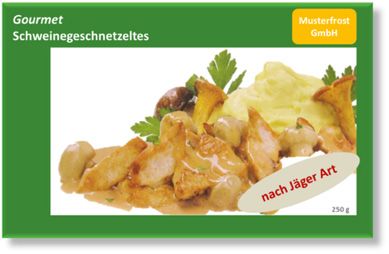
Copyright!
Reproduction and dissemination – also partial – applicable to all media only
Science & Research | Original Contribution with written permission of Umschau Zeitschriftenverlag GmbH, Wiesbaden.
population.
Fictional examples were tested.
However, the dummy packaging
with conspicuous
illustrated was inspired by real ex- information
amples, about which consumers had
complained on the internet portal
www.lebensmittelklarheit.de.
“Serving suggestion”: influence
on ingredient expectation
The test subjects were asked to in-
dicate which of the illustrated in- with inconspicuous
information
gredients they expected to find in
Serviervorschlag
the product (list template) for three
sample products (pork stew, tofu
fricassee, fresh cheese with herbs),
Serviervorschlag
based on a five-level Likert scale (+2
= “yes, definitely” to -2 = “no, defi-
nitely not”).
The characteristics of the “serving
suggestion” designation were varied
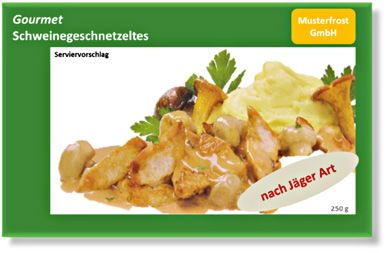
in all examples (see • Figure 1 for
pork stew as an example). To this
end, the sample group was divided without serving
suggestion information
into three similar-sized subgroups
and each was faced with experi-
mentally modified dummy prod-
ucts (front-of-package); the “serv-
ing suggestion” designation was
displayed on the product packaging
either as clearly visible information
or as inconspicuous information. A
third variant presented packaging Fig. 1: Dummy products for the pork stew example product
without this information (• Fig- [study illustration]
Illustrations smaller than in original
ure 1).
These modified characteristics were
randomized, so that each subgroup
I think that the following ingredients are contained in this product:
was faced with three different va- Ich denke, dass folgende Zutaten in dem Produkt enthalten sind:
(yes, defijeden
(ja, auf nitely/yes)
Fall/ja)
riants. The series of examples were
also randomly questioned. withauffälligem
mit conspicuous information
Hinweis
22,2
Kartoffelpüree
mashed potatoes 19,6 mit
withunauffälligem
inconspicuousHinweis
information
19,8
ohne Hinweis
without Serviervorschlag
serving suggestion
“Fill quantity technically 38,2
information
Dem hier anonymisiert dargestellten
parsley
Petersilie 38,8
limited”: influence on consumer 36,1 The liegt
Fall ein konkretes
anonymized case Produkt zu-
illustrated
grunde, bei dem Pfifferlinge nicht
acceptance of voluminous here is based on an actual product
enthalten waren.
49,6 which did not include chanterelles.
packaging Pfifferlinge
chanterelles 50,2
55,4
The test subjects were shown an 63,5
image featuring a biscuit packet, as Champignons
white mushrooms 68,0
69,4
found on the supermarket shelf, and
98,8
adjacent to this the barely half-filled Schweinefleisch
pork in sauce 99,2
in Soße 99,2
inner bag. A split sample design was
0% 10 % 20 % 30 % 40 % 50 % 60 % 70 % 80 % 90 % 100 %
also selected in this instance. Half of
the test subjects were presented with Fig. 2: Ingredient expectations for the pork stew example product
the “fill quantity technically limited” [study survey]
Data in % of all valid answers; five-level scale from “yes, definitely” to “no,
definitely not”.
122 Ernaehrungs Umschau international | 7/2018
Copyright!
                                                                                          Reproduction and dissemination – also partial – applicable to all media only
                                                                                          with written permission of Umschau Zeitschriftenverlag GmbH, Wiesbaden.

information on the packaging (var-
iant A). The information was miss-          I think product content in relation to packaging size is inappropriate/
                                            entirely inappropriate
ing (variant B) for the second group.
All test subjects were asked to indi-
cate the extent to which the rela-                                                 Variante A
tionship between product content                                                   with “fill quantity technically limited”
and packaging size seemed appro-                                                   information
priate according to a five-level scale
(+2 = “entirely appropriate” to -2                                                                                                 83,6%
= “entirely inappropriate”).

Study results                                                                                  20           40              60              80              100

“Serving suggestion”: influence
on ingredient expectation
                                                                                                                                      85,2%
The results for “Hunter’s Pork Stew”
are illustrated below as an example
(• Figure 2). This sample is based on                                              Variante B
a real product which did not con-                                                  without “fill quantity technically limited”
tain chanterelles, mashed potatoes                                                 information
or parsley. As a result of inspection
of the front-of-package alone, be-          Fig. 3: C
                                                     omparison of consumer perception of fill quantity with and
tween 49.6% and 55.4% (• Figure 2;                  without the “fill quantity technically limited” information
                                                    [study survey]
μ1 = 0.5, μ2 = 0.6, μ3 = 0.7)1 falsely             Data in % of all valid answers, five-level scale from “entirely appropriate” to
estimated that chanterelles were an                “entirely inappropriate”
ingredient contained in the product;
the “serving suggestion” informa-
tion corrected this false estimation     enced by the “serving suggestion”                Discussion
only slightly and not significantly.     information, and expectations of
In the case of parsley, many re-         the presence of the food pictured                Although there are many studies on
spondents were “unsure” whether          were not significantly altered. The              labels and health information, other
parsley was included (μ1 = 0.1, μ2 =     prominence of the placing of the in-             food packaging designations are
0.2, μ3 = 0.1). Most assumed that        formation did not significantly alter            much less researched. The “serving
mashed potatoes were not included        the test subjects’ estimation.                   suggestion” and “fill quantity tech-
(μ1 = -0.8, μ2 = -0.7, μ3 = -0.7).                                                        nically limited” references are not
In these cases, the ingredient expec-                                                     regulated by food legislation, but
                                         “Fill quantity technically
tations of the subgroups did not                                                          are widely implemented in practice,
                                         limited”: influence on consumer
significantly differentiate (post-hoc                                                     in order to comply with the fraud
                                         acceptance of voluminous
tests).                                                                                   prevention inscribed in food legis-
                                         packaging
                                                                                          lation. There has been no investiga-
Overall, the three sample products       The dummy products and results are               tion to date on whether the potential
used show that side dishes (mashed       shown in • Figure 3. The respondents             for deception in food packaging can
potatoes, rice, bread) tend not to be    felt that the large empty space in the           be lessened through the inclusion of
expected in products. In contrast, if    biscuit packaging was inappropriate.             such information. This representa-
ingredients are pictured whose use       The “fill quantity technically limited”          tive consumer survey has found no
is commonly associated with the          information did not significantly alter          significant differences in perception
product, a significant proportion        consumer acceptance. In comparison,              among consumers. The proportion
of consumers expect these to be in-      both groups made an almost identi-               of false expectations relating to in-
cluded.                                  cal estimation of the relationship be-           gredients included and the percep-
The results barely differ between        tween the packaging size and content             tion of a gap between packaging
the sample subgroups in all the ex-      (A: μ = -1.2; B: μ = -1.3). Mean com-
amples. The perception of product        parisons (t-tests) show no significant
images was not significantly influ-      differences between the groups.                   µ = mean value
                                                                                          1

                                             Ernaehrungs Umschau international | 7/2018    123
Copyright!
Reproduction and dissemination – also partial – applicable to all media only
Science & Research | Original Contribution with written permission of Umschau Zeitschriftenverlag GmbH, Wiesbaden.
size and content remained almost tions relating to included ingredi- References
constant for the tested variants with ents or fill quantity, hold conflict
and without printed information. potential. The customer satisfaction 1. W artella EA, Lichtenstein AY, Nathan R.
These results indicate that the over- survey stresses fairness as a core Front-of-package nutrition rating systems
all impression of packaging is dom- factor [32]. In this respect, it is in and symbols: promoting healthier choices.
inated by visually prominent design the interests of manufacturers to be Washington (2011)
features, such as product images or careful not to give rise to unfulfilled 2. B rassington F, Pettitt S. Principles of mar-
dimensions. The correction of mis- expectations as a result of packag- keting. 4. Aufl., Pearson Education Limited,
taken impressions by the inclusion ing design. Even if the information Harlow (1997)
of this verbal qualification seems tested may provide successful legal 3. H örmann G. Aktivitäten und Erfahrungen
questionable. protection for the manufacturer, der Verbraucherverbände. In: BMELV (Hg).
Basically, larger information on which must remain unanswered as Fachtagung Täuschungsschutz bei Lebens-
packaging grabs more attention, as to our knowledge there have been mitteln. Erfahrungen. Herausforderungen.
it is perceived as more important no related judgements, it does not Lösungsansätze vom 27. und 28. November
[23, 30]. 60% of German consum- contribute to customer satisfaction. 2012 in Berlin: 58–61. URL: www.bmel.de/
ers also complain of too small writ- SharedDocs/Downloads/Ernaehrung/Kenn
ing on packaging [31]. At the same zeichnung/Tagungsband-Taeuschungs
Limitations
time, in our study, the more prom- schutz-bei-Lebensmitteln.pdf?__blob=publi
inent variants with larger text, bold The study is an initial investigation cationFile Zugriff 12.06.18
type and high-contrast placing in on these two subjects. The explora- 4. B MEL. Initiative Klarheit und Wahrheit
the field of vision did not lead to sig- tive nature of the study must thus bei der Kennzeichnung und Aufmachung
nificant differences in ingredient ex- be regarded as a limitation; hence, von Lebensmitteln. Handlungsbedarf, Ziele
pectation in relation to the “serving for example, questions sometimes und Maßnahmen. Stand: Juni 2015. URL:
suggestion” information. Whether a referred to expectations, and some- www.bmel.de/SharedDocs/Downloads/Er-
further increase in the prominence times to the fulfilment of expecta- naehrung/KlarheitUndWahrheitInitiative
of the lettering would have pro- tions. Further examples should also Zusammenstellung.pdf?__blob=publication
duced different results must remain be investigated where applicable. A File Zugriff 12.06.18
unanswered at this point. In prac- further study could also carry out 5. H arith ZT, Ting CH, Zakaria NNA (2014)
tice, however, there are limits to the target group analysis to find out Coffee packaging: consumer perception on
attention-grabbing highlighting of more about differences among pop- appearance, branding and pricing. Int Food
such information from a marketing ulation groups. Res J 21: 849–853
perspective. 6. G röppel-Klein A, Königstorfer J (2013) Nu-
In addition to perceptibility, under- trition information and consumer behaviour
standing of the information is im- Dr. Ramona Weinrich1, 2 at the point-of-sale. In: Scholderer J, Brunsø
Christina Overbeck3
portant. Both of these widespread K (Hg). Marketing, food and the consumer.
Dr. Anke Zühlsdorf4
and standardized formulations may Prof. Dr. Achim Spiller3
Festschrift für Klaus Grunert: 173–188
be unclear, e.g. because it remains 1
Department für Agrarökonomie und Rurale 7. N öth W. Der Zusammenhang von Text und
open as to which of the pictured Entwicklung, Lehrstuhl Betriebswirtschaftslehre Bild. In: Brinker K, Antos G, Heinemann W,
ingredients are referred to or what des Agribusiness, Zentrum für Biodiversität Sager S (Hg). Text- und Gesprächslinguistik.
und Nachhaltige Landnutzung
is actually indicated by a technical- De Gruyter, Berlin (2000), S. 489–496
Georg-August-Universität Göttingen
ly-limited fill quantity. However, Platz der Göttinger Sieben 5, 37073 Göttingen
8. Kroeber-Riel W, Esch FR. Strategie und Tech-
manufacturers have also adopted 2
ramona.weinrich@uni-goettingen.de nik der Werbung. 7. Aufl., Kohlhammer,
innovative approaches which pres- 3
Department für Agrarökonomie und Rurale Stuttgart (2011)
ent a graphic image of the actual fill Entwicklung, Lehrstuhl für Marketing für Le- 9. Underwood RL, Klein NM (2002) Packaging
bensmittel und Agrarprodukte
quantity. as brand communication: effects of product
Georg-August-Universität Göttingen
Irrespective of the question as to Platz der Göttinger Sieben 5, 37073 Göttingen
pictures on consumer responses to the pack-
whether packaging is misleading 4
Zühlsdorf + Partner age and brand. Journal of Marketing Theory
in the legal sense, providers should Philipp-Oldenbürger-Weg 27, 37083 Göttingen and Practice 10: 58–68
examine their approach to packag- 10. Esch FR, Gawlowski D, Rühl V (2012) Er-
ing design. The overall impression lebnisorientierte Kommunikation sinnvoll
of packaging is decisively shaped gestalten und managen. In: Brauer H, Hein-
by visual elements; there are strict Conflict of Interest rich D, Samak M (Hg). Erlebniskommunika-
The authors declare no conflict of interest.
limits to verbal corrections. Disap- tion: Erfolgsfaktoren für die Marketingpra-
pointed customers, who, in light of xis. Springer, Berlin (2012), S. 13–30
the packaging, make false associa- 11. G aile-Sarkane E, Andersone I (2008) Con-
124 Ernaehrungs Umschau international | 7/2018Copyright!
Reproduction and dissemination – also partial – applicable to all media only
with written permission of Umschau Zeitschriftenverlag GmbH, Wiesbaden.
sumer behavior changing: methods of evalu- (1971)
ation. Trends of economics and management 24. D raskovic N, Temperley J, Pavicic J (2009)
III: 63–71 Comparative perception(s) of consumer
12. Z ühlsdorf A, Spiller A. Verbraucherwahr- goods packaging: Croatian consumers´ per-
nehmung von Lebensmittelverpackungen. spective(s). IJMC (10): 154–163
Ergebnisbericht des Projekts „Repräsentative 25. H ansen U, Hennig-Thurau T, Schrader
Verbraucherbefragungen im Rahmen des U. Produktpolitik ein kunden- und ge-
Projektes ‚Lebensmittelklarheit 2.0‘“. Göt- sellschaftsorientierter Ansatz. Schäffer-
tingen (2015) Poeschel, Stuttgart (2001)
13. H ersey JC, Wohlgenant KC, Arsenault JE et 26. G arber LL, Hyatt EM, Boya ÜÖ (2009) The
al. (2013) Effects of front-of-package and effect of package shape on apparent volume:
shelf nutrition labeling systems on consum- an exploratory study with implications for
ers. Nutr Rev 71: 1–14 package design. Journal of Marketing The-
14. W ansink B, Sonka ST, Hasler CM (2004) ory and Practice 17: 215–234
Front-label health claims: when less is 27. V erbraucherzentrale Hamburg (2015) Rönt-
more. Food Policy 29: 659–667 genbilder enthüllen Luft in Verpackungen.
15. R oberto CA, Bragg MA, Schwartz MB et al. Stichprobe der Verbraucherzentrale Ham-
(2012) Facts up front versus traffic light burg auf Basis von Verbraucherbeschwerden.
food labels. Am J Prev Med 43: 134–141 URL: www.vzhh.de/ernaehrung/403541/
16. M c Quarrie EF, Mick DG (1999) Visual vzhh_Luftpackungen_Roentgen_Juni
rhetoric in advertising: text-interpretive, 2015aktualisiert.pdf Zugriff 31.08.15
experimental, and reader-response analyses. 28. S trecker A, Ernst T, Liebegall A et al. Kom-
J Consumer Res 26: 37–54 mentar Fertigpackungsrecht. IV Eingesetzt –
17. S töckl H. Textstilistische und semiotische Kommentar (zum Bereich Fertigpackungen).
Untersuchungen zu ausgesuchten Wer- § 7 Abs. 1 EichG. 119. Aktualisierungsliefe-
be-Text/Bildkommunikaten unter besonderer rung. Behr‘s Verlag, Hamburg (2014)
Berücksichtigung der Bild/Textverknüpfung. 29. Z ipfel W, Rathke KD, Sosnitza O. Lebens-
Dissertation, Friedrich-Schiller-Universität mittelrecht. EichG § 7. Rn. 35-43. Richtli-
Jena, Jena (1995) nien und Empfehlungen für die Beurteilung
18. Sokolowski A (2002) Zusammenhang von von Fertigpackungen als Mogelpackung.
Schrift und Bild in der Anzeigenwerbung 140. Ergänzungslieferung. Verlag C.H.Beck,
von LEE-Jeans. In: Linguistik-Server Essen. München (2014)
URL: www.linse.uni-due.de/linse/esel/pdf/ 30. D eutsches Krebsforschungszentrum (Hg).
lee.pdf Zugriff 12.06.18 Ein Bild sagt mehr als tausend Worte: Kom-
19. Baumgarten D (2011) Zur Semiotik von Bild binierte Warnhinweise aus Bild und Text auf
und Text in Werbeanzeigen: Wo genau liegt Tabakprodukten. Heidelberg (2009). URL:
der Werbetext? Wiener Linguistische Gazette www.dkfz.de/de/tabakkontrolle/down
(76) A/2012: 153–167 load/Publikationen/RoteReihe/Kombi
20. B MELV (Hg). Fachtagung Täuschungs- nierte_Warnhinweise_Band_10.pdf Zugriff
schutz bei Lebensmitteln. Erfahrungen. 12.06.18
Herausforderungen. Lösungsansätze. Berlin 31. S GS Germany GmbH. SGS-Verbraucherstu-
(2013) die 2014. Vertrauen und Skepsis: Was leitet
21. S piller A, Zühlsdorf A, Nitzko S (2014) die Deutschen beim Lebensmitteleinkauf?
Lebensmittelkennzeichnung und Verbrau- Hamburg (2014)
chervertrauen. Zugleich eine Erwiderung auf 32. S zymanski DM, Henard DH (2001) Cus-
den Beitrag von Dr. Almut Pflüger in ZLR tomer satisfaction: a meta-analysis of the
3/2014. ZLR (5/2014): 523–539 empirical evidence. J Acad Mark Sci 29:
22. N eumayer W (2012) Irreführung durch 16–35
Produktabbildungen und hervorhebende
Bezeichnungen. Ernährung/Nutrition 36:
34–39
DOI: 10.4455/eu.2018.028
23. K oppelmann U (1971) Grundlagen der Ver-
packungsgestaltung – Ein Beitrag zur mar-
ketingorientierten Produktforschung. Neue
Wirtschafts-Briefe GmbH, Herne/Berlin
Ernaehrungs Umschau international | 7/2018 125You can also read


