OUR CARERS AND FAMILIES STRATEGY - 2018-2021 Developed, designed and co-produced by carers and staff
←
→
Page content transcription
If your browser does not render page correctly, please read the page content below
Devon Partnership
                                             NHS Trust

OUR CARERS AND
FAMILIES STRATEGY
2018-2021

Developed, designed and
co-produced by carers and staff

Supporting you to live well
Devon Partnership NHS Trust

                              Introduction                                                           3

                              Working Together                                                       4

                              Foreword                                                               5

                              Who are carers?                                                        6

                              Our shared vision                                                      8

                              Our strategy                                                          10

                              Why do we need a strategy?                                            12

                              What are we going to do?                                              14

                              Our priorities for 2018-2021                                          22

                              Measuring progress                                                    23

                              Appendix 1 - About Devon Partnership NHS Trust                        24

                              Appendix 2 - The Triangle of Care                                     26

                              Appendix 3 - ‘I’ statements                                           27

                              Appendix 4 - Carer assessment                                         29

                              Appendix 5 - Carer recognition tool                                   30

                              Appendix 6 - Acknowledgements                                         31

                              Further information
                              To find out more about the mental health and learning disability services we
                              provide, please visit www.dpt.nhs.uk
Carers and Families Strategy 2018-2021

INTRODUCTION
Our Carers and Families Strategy is aligned to Devon Partnership NHS Trust’s
(hereafter the Trust) overall objectives as detailed in our Delivering quality,
integration and recovery 2018-2021 publication, especially ensuring services are
driven by the voices of people using services and their carers.
This strategy has been co-designed and co-produced with carers and staff and describes the structures
and practices which will deliver the Trust’s services to carers, to give them the best possible experience
in carrying out their role. It describes the tools and processes to create strong engagement between
staff and carers and describes the resources and learning needed to support carers in their role.
It identifies what we want to achieve based on the six standards of the Triangle of Care – see page
14 and Appendix 2 - and to steer operations under the Care Act 2014 which gives the carer a right to
have an assessment of their needs.
It identifies the need for carer awareness training for staff. This training has been co-produced and is
being co-delivered by carers to all staff and began in May 2018.
It describes what we want to do and more specifically how we are going to do it and what carers can
expect.

It identifies the metrics that will be used to measure our progress against carers’ expectations.

                                                    3
Devon Partnership NHS Trust

WORKING TOGETHER
One of our core aims is to ensure that our services are shaped by the voices of the
people who use them.
We have been working with people who use our services, carers, staff and partner organisations to
develop a new approach to involving people in what we do more meaningfully and more routinely.
The programme is called ‘Together’. It provides a simple, inclusive framework that will help all of us
to do a better job to embed working together in everything we do, in our everyday work and in our
service development.
The opinions of people who use our services and their families and carers are paramount in our efforts
to deliver good care and continuous improvement. We use a number of methods to engage with
people and to gather information about their experiences. These include the Friends and Family Test
for both staff and people who use our services, regular local and national surveys, feedback kiosks and
a wide range of events for staff and people who use our services. We also include people with lived
experience within our staff induction programme and, increasingly, in our recruitment activities and
have a regular ‘learning from experience’ session at the beginning of each public Trust Board meeting
There are two ‘Together’ handbooks available, one for staff and one for people involved in service
development that have been co-produced and are available on the Trust website:

                              www.dpt.nhs.uk/about/working-together

                                                   4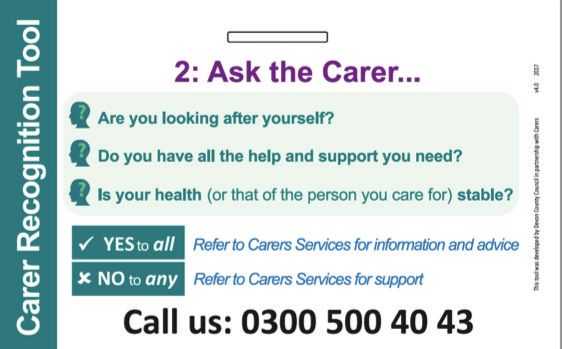
Carers and Families Strategy 2018-2021

FOREWORD
Melanie Walker
It is difficult to overstate the importance of the role that carers play in supporting people with mental
health and learning disability needs. The work that they do to support their loved ones and to work
closely with our teams is invaluable.
This strategy aims to ensure that the critical role of carers is acknowledged and respected - and that
people’s needs as carers are recognised and met. The strategy has been designed and co-produced by
carers and staff.
Through our Together approach, we are committed to involving carers in our work, alongside the
people who use our services and others with lived experience in our communities, including our
staff.
Our organisation’s strategic aims strive to involve people in driving and shaping services
andto include them by promoting equality, valuing diversity and championing recovery.
By doing this, we hope to continue to improve the quality of our services and people’s
experience of them.
Thank you to everyone who has shared their time to make this strategy a reality -
particularly those people who are carers.

Melanie Walker
Chief Executive
Devon Partnership NHS Trust

                                                    5
Devon Partnership NHS Trust

WHO ARE CARERS?
You are considered a carer if you provide unpaid care, (practical help and/or
emotional support) to someone with a medical or emotional problem.
They can be a parent, a partner, other family members or a friend. Sometimes children or young
persons may also be involved, possibly significantly, in the caring process. Carers may also have an
illness or disability themselves. Some may be reluctant to accept the description of the role of a carer,
but are likely to have needs from the relationship.
In the Care Act 2014, the description applies whether the carer or cared for live together or apart.
Both the cared for and their carer(s) are entitled to an assessment of their needs.
Carers for the purpose of this strategy do not include someone who is paid to provide care or who
is provided by a carer organisation as a volunteer.

      84,492 unpaid                    Devon Partnership                    The work of carers
     carers in Devon                    NHS Trust covers                    in Devon has been
                                        a population of                        valued at £1.6
                                            991,000                                billion

                        4,122                                      745
                   people on our                           carers of someone
                   carer’s register                         with a learning
                                                                disability

                                                   31
                                                   6
Carers and Families Strategy 2018-2021
A carers view
Caring for a loved one can be very challenging during difficult times. It is often hard to
think of anything else. Feeling so worried and focused on supporting a family member or friend
can be overwhelming. Understandably, carers often forget about themselves. Life can seem on
‘hold’ whilst all energies go into supporting the loved one and trying to meet their needs.
Our Carers and Families Strategy is a co-produced new initiative from the Trust and recognises
the huge contribution that carers make. It is vitally important and will make a real positive and
sustained impact.
By staff identifying all carers and considering how to support and meet individual needs will
enable carers to continue supporting their family member or friend, whilst also ensuring their
own wellbeing. From my own experience it is often the little things that staff do that can really
make a big difference for a carer.
I would urge you to read this strategy which will inform you about what help and support is
available. You will be signposted to more detailed guidance and support to meet your individual
needs. Making an informed decision you can then choose what is right for you now and in the
future. It is important to remember that you are not alone, Staff will listen and they will be able
to ensure you receive the help and support that you need in supporting your loved one.
I know from personal involvement and by working together with the Trust how carers are
highly valued, respected and listened to. That we are a ‘team’ working together with the
same goal, ensuring the best care for your family member or friend.
Tracy Lang
Mother and a carer
7Devon Partnership NHS Trust
OUR SHARED VISION
We work in partnership with a number of NHS organisations and local councils in
Devon and Torbay to ensure we have a joined up approach to supporting carers.
The support, help and information outlined in this strategy also applies if you are a carer of
someone using our services in Bristol or you are a carer of someone using our services who
lives outside of Devon or Torbay.
Devon Carers’ Partnership
The Devon Carers’ Partnership, which includes Devon County Council and Devon Partnership NHS
Trust, has a joint strategy with the following shared vision:
Carers will be universally recognised and valued as being fundamental to strong
families and stable communities and respected as expert partners in care. We
will support carers to maintain their own health and wellbeing and to achieve
a balance between their caring responsibilities and a life outside caring, while
enabling the person they support to be a full and equal citizen.
In everything we do we will take carers into account.
You can access the Devon Carers Joint Strategy at:
www.newdevonccg.nhs.uk
search ‘carers joint strategy’
8Carers and Families Strategy 2018-2021
I know from personal involvement and by working together with the Trust
how carers are highly valued, respected and listened to. That we are a ‘team’
working together with the same goal, ensuring the best care for your family
member or friend.
Tracy Lang
Mother and a carer
Torbay Carers Service
Torbay Carers deliver support to carers in Torbay and are directed by an interagency Carers
Strategy. You can access this strategy at:
www.torbayandsouthdevon.nhs.uk
search ‘carers strategy’
9Devon Partnership NHS Trust
OUR STRATEGY
Our strategy is for carers of people who are accessing any of Devon Partnership NHS
Trust’s services: www.dpt.nhs.uk/OurServices
Purpose of our strategy
• Our strategy aligns to the Trust’s strategic objectives as detailed in our Delivering quality,
integration and recovery 2016-2021 publication. Our strategy describes the structures, help
and support which will deliver Trust services to carers, to give them the best possible
experience in carrying out their role. It describes the tools and processes to create strong
engagement between staff and carers and describes the resources and learning needed to
support carers in their role.
Research shows that a well-designed strategy supported by staff training in carer matters
will not only improve carers’ experiences, but also provide greater satisfaction to staff, as well
as improving the support and care to people using our services.
Our strategy:
• Includes our commitment to the Triangle of Care as the heart of the strategy.
• Includes tools and processes to receive feedback on the delivery of services to carers and
people using services. It also provides ways in which carers can contribute to service design
and delivery. There will be clear protocols to record when things go wrong and how
resulting actions are implemented and fed back.
• Identifies systems to measure progress in carer engagement and the impact of its
implementation on carer satisfaction, complaints and untoward events. These will be
reported regularly to the Trust Board and the Quality and Safety Committee.
• Steers the operations of the Trust and key partners in line with the national Care Act 2014
which gives the carer ‘a right to an assessment, support according to their needs, and helps
with maintaining their own independence and resilience’.
10Carers and Families Strategy 2018-2021
Our strategic objectives
Our strategic objectives are for carers to:
• Be identified early
• Feel supported and valued
• Have a choice in and about their caring role
• Get good quality information when they need it
• Feel respected as carers, as expert partners in care
• Feel included and being part of the Triangle of Care, which is a therapeutic relationship
between the person using our services, staff member and the carer that promotes safety,
supports recovery, and sustains wellbeing (see Appendix 2)
• Ensure that children and young people do not have to take on inappropriate levels of caring
because of the disability of parents/family member
• Work within our ‘Together’ approach.
Support will be tailored to meet the needs of individuals, enabling carers to maintain a balance
between their caring responsibilities and a life outside caring, whilst enabling the person they
support to be a full and equal citizen.
11Devon Partnership NHS Trust
WHY DO WE NEED
A STRATEGY?
Carers feedback
The need for a strategy is evidenced by feedback from many carers who can identify common areas
and critical points where services have failed to meet their expectations.
People didn’t feel listened to and this was fed back from the ‘Together’ events from 2017 and from
organised carer listening events.
We have a carers charter that was co-produced in 2010, but from the above feedback carers felt that
we needed something more robust and detailed in place if we were going to meet their expectations.
Carers expectations
For carers themselves:
• I have choice in and about my caring role • I am supported when the person I care for
is in a out of area placement
• I find support in my community and from
local community organisations • I am helped to achieve my own most important
life-goals, including education, training and
• I can easily find the information and advice
working
I need in my caring role
• I am assured of the quality of the services I and
• I have a contingency plan agreed for when I
the person(s) I care for use, and that my views
cannot care
are taken into account
• I am respected as an expert partner in care
• I am supported to achieve the above when I
• I am helped to care safely, confidently and have difficulty in doing so and am involved in
effectively designing the support I need
• I am helped to maintain my own health, • I am able to share my experience and skills as a
wellbeing and independence carer with other carers
• I am supported when I stop being a carer • I am given information of what to expect from
through choice or bereavement mental health and learning disability services in
terms of care planning and treatment.
12Carers and Families Strategy 2018-2021
Training for staff: Clear signposting by staff to:
• In welcoming and reassuring visitors • Contact numbers and services which respond in
appropriately, to all Trust services urgent situations
• In carer matters, to show understanding • Sources of help ‘out of hours’, including
of the range and depth of carer concerns weekends
and give assurance
• Where to find extra help and how to get a
• To identify and respond to the specific carer’s assessment
needs of children and young adult carers.
• Information, advice and help from mental
• To confidently provide, receive and hold health carer support workers
carer information
• Advice and help to carers to ‘find a life
• In helping carers to cope with emotionally outside caring’.
challenging situations
• To understand the personal and ‘unique
burden’ including that of carers with a
learning disability and older carers.
13Devon Partnership NHS Trust
WHAT ARE WE
GOING TO DO?
We are committed to delivering the six key standards of the Triangle of Care. This
strategy outlines how we will achieve this commitment.
1. Carers and the essential role they play are
identified at first contact or as soon as possible
thereafter.
What will we do? How will we do this?
• Identify carers and the • All carers and younger carers will be identified and staff
essential role they play at first will have a conversation with them about their role and how
contact or as soon as possible their needs can best be supported, whether that is providing
thereafter information or being referred on to any specialist support and
a carer’s assessment.
• Ensure carers’ views and
knowledge are sought, shared, • Staff will be trained both in corporate and local inductions
used and regularly updated about being carer aware. The courses have been co-designed
as overall care plans and by carers and staff and will be facilitated by carers. These
strategies to support treatment courses will be rolled out in 2018.
and recovery and be mindful • All carers will have an identified contact point who will be their
of the carers own needs. liaison should they need any support, including referral onto
any specialist support, for example Young Carers.
• Each team will appoint a carer champion who will act as a
single point of contact. There may be more than one per
team to cover shifts, but they must be clearly identifiable, for
example, wearing a badge. A defined role description is
needed so that teams do not just solely rely on them to identify
carers - it is everyone’s job to do so.
14Carers and Families Strategy 2018-2021
• Staff members overseeing care recognise the • Carers will be given the opportunity to have a
carer as an expert partner and may be integral carer’s assessment of their needs.
to planning care for the person who they
• Staff will carry a carer recognition tool, (a card
care for. This will be part of the carer awareness
worn on their lanyard), which has a central
training.
phone number on it as a contact for carers for
• We will provide appropriate ‘safe spaces’ for both Devon and Torbay Carer organisations. It
family meetings which may include children. also has a series of questions that staff may ask
to identify a carer (see Appendix 5).
• Once a carer has been identified have a process
in place to register them and input and record
their comments.
• Carers will be given a central phone number for
Devon and Torbay, which all carers can access.
This can be found on the carer recognition tool
(see Appendix 5).
15Devon Partnership NHS Trust
2. Staff are ‘carer aware’ and trained in carer
engagement strategies
What will we do? How will we do this?
• Provide staff with the relevant • Staff to ask carers how the person is different from normal, or
knowledge, training and what the well person is like. This will be part of the carer
support to become carer awareness training.
aware. • We will provide staff with the relevant knowledge, training and
support to become carer aware’ including thoughts and
anxieties of visitors to services and their need for reassurance,
information and hope.
• A carer recognition tool card will be carried by all staff as a
reminder of what questions to ask to confirm caring
responsibilities (see Appendix 5).
• Staff members are trained to recognise the carer as an expert
partner and that their knowledge and insights are integral to
planning care for the person for whom they care.
• Staff to have a conversation with the carer (even if it is only
five minutes – a quote from a young adult carer) and have
the confidence and knowledge to do so. This is part of the
carer awareness training.
• Staff will have access to local leaflets of what support
services are available and a carer handbook. We will develop
this information to be held in each team.
16Carers and Families Strategy 2018-2021
Staff will receive training in the following areas:
• The range of people who are giving the care and • Staff will have access to a directory of local
the challenges they face in each category voluntary services of what support is available.
including: – Young Carers, Young Adult Carers
• Familiarity of the carers’ handbook: the range of
and and where a carer is an older person.
other Trust information leaflets and the carer’s
• Meeting and greeting. section on the Trust website.
• Conversations to new carers to services. • We will review and update this and other
information to be held in each team.
• Trust confidentiality – Good Practice Guide.
The above is perceived as good practice. We
• Sharing knowledge with carers about mental
are currently in the process of piloting a training
health and learning disability including treatment
package for all staff in raising the recognition of
options and dealing with difficult behaviour.
carer needs. This will be an evolving process.
• Carer’s assessments.
• Awareness of other services and what they offer,
for example, drugs and alcohol: self-harm and
suicide, family therapy and how to access them.
17Devon Partnership NHS Trust
3. Policy and practice protocols about confidentiality
and sharing information are in place
What will we do? How will we do this?
• Provide clear policies, protocols • Ensure that staff are aware of the confidentiality guidelines, are
and procedures for carers to confident about sharing information appropriately and have
enable them to be proactively the knowledge that they can always listen. Staff are aware that
involved in the care planning the carer has the same entitlement to confidentiality as the
and treatment process across person they care for. This will be part of carer awareness
the care pathway, that is, for training. Staff to have good working knowledge of the
inpatient, home treatment and publications Confidentiality and carers guidelines and
community and to ensure that Guidelines to sharing information between carers, family,
these are routinely used. friends and people using and providing mental health and
learning disability services. They need to be confident of the
These include:
real boundaries of information sharing rather than perceived
• Guidelines on confidentiality ones.
and for sharing information,
• Staff will be prepared to receive information from carers by any
highlighting this is a three
convenient means – phone, email or letter.
way process between the
person using services, carers • Staff have annual information governance training.
and professionals • The Trust will promote the use of Advanced Statement
• Information release forms and Directive forms and protocols so that people using services can,
protocols when they are well, record their wishes as to what actions are
to be taken, including the role of carers, if a health
• Advance statement forms
crisis develops. Staff will be encouraged to promote this.
and protocols.
18Carers and Families Strategy 2018-2021
4. Defined roles responsible for carers are in place
What will we do? How will we do this?
• Shape roles in a way that • During the local induction training the teams will be
provides most benefit for encouraged to appoint a carer champion. There is a need
carers to develop a role description, and the person needs to be easily
identifiable perhaps wearing a badge. The person needs to
• Appoint a carer lead in the
have understanding and empathy with carers. Some teams
Trust to act as a single point of
may have to appoint more than one person to cover shifts.
contact to deal with carers
Teams will also be encouraged to arrange carer drop-in
issues Trust-wide
sessions and greater carer engagement if appropriate (this
• Recruit carer leads or carer works well on some inpatient units).
champions for all wards and
• There is a senior manager in the Trust responsible for carers.
teams, irrespective of service
• Carers are encouraged to be engaged in involvement to shape
• Provide a dedicated carer’s
services, for example, take part in interview panels through the
contact for each shift/team.
Together approach.
• Carers have contributed to discussions to help inform this
strategy.
19Devon Partnership NHS Trust
5. A carer introduction to the service and staff is
available, with a relevant range of information
across the care pathway
What will we do? How will we do this?
• Produce an introductory letter • At first contact all identified mental health and learning
from the team or ward disability carers receive a carer’s information booklet providing
explaining the nature of the details on what to expect from the Trust as a carer. An
service provided and who to information booklet is currently being produced by carers.
contact, including out of Each service has a leaflet explaining their service, ward
hours orientation, induction procedure and out of hours contacts if
• Arrange an appointment with a applicable.
named member of the team to • A ‘children and young carers’ resource pack’ will be developed
discuss the carer’s for all teams. The under 18 carers will want this in a different
views and involvement format than the 18 – 24 young adult carers, as each group
• Arrange ward orientation, has different support needs.
induction procedure and leaflet • We need to be able to recognise a young carer and give them
• Provide carer information packs the appropriate information pack.
• Involved carers in discharge • This will include details of our obligations to children and
young people, what support they might need, details of
planning and aftercare support.
information available for children and young people, and
details of local young carers’ projects. For example: Devon
Carers and the Devon Bright Futures Project.
• Young adult carers would like to be treated as adults and not
as children.
• Involve and listen to families in distress.
• Specific child friendly mental health and learning disability
information is produced for young carers to ensure that they
do not feel isolated from services. We need to co-produce this
information with young carers and have it in a format(s) that
they are comfortable with.
• The carer wants to know what type of support that they will
get.
20Carers and Families Strategy 2018-2021
6. A range of carer support services are available
What will we do? How will we do this?
• Recognise that some employees • Identify partner organisations and develop working links with
of the Trust may also be carers them.
• Identify the support carers need • Establish clear referral protocols and practice for families/carers
and family interventions to be referred to and be received from Devon Carers and Torbay
Carers services when appropriate.
• Provide information about how
to get a carer needs • Ensure that carer support networks are developed within the
assessment. organisation that can be accessed by carers of people using
services and also by staff carers, as well as ensuring multi
agency working to provide the best possible information on
local support networks.
• Ensure that the Trust is affirming of the needs of staff who are
also carers.
21Devon Partnership NHS Trust
OUR PRIORITIES
FOR 2018-2021
• To involve and engage with carers and families in everything we do
• To implement and embed the Triangle of Care accreditation for our inpatient wards, crisis
teams and community mental health teams and commitment to the six standards made
• To deliver staff carer awareness training to all frontline clinical teams
• To develop co-delivered focused carer awareness as part of Trust corporate induction and local
service staff induction programmes
• To have focused learning from complaints and incidents where carer and family needs fell short
of expected standards
• To produce carer information packs, carer publications, leaflets and other supporting materials
• To develop an infrastructure and resource to ensure carer and family needs are at the centre of
everything we do and provide
• To undertake regular six monthly audits with feedback from carers and families to ensure the
six key standards from the Triangle of Care, exist and remain in place.
• Continue closer working with our community partners.
22Carers and Families Strategy 2018-2021
MEASURING PROGRESS
We receive feedback formally and informally from:
• Family and friends national data, online carers feedback and direct to services, PALS feedback
and formal complaints and complements, operational services qualitative data, and operational
performance data.
• People who use our services – Friends and Family Test. We introduced the Friends and Family
Test, which is a national initiative, as a way to improve the way we listen to people and respond to
their feedback. In 2017/18 4,794 users of our services completed the Friends and Family Test and
the percentage of those who would recommend them to friends and family has consistently
remained over the performance target set by our commissioners of 85%, with an average of
91.3%. This means that 4,377 responses out of 4,794 recommended us as a place to receive care.
• The Triangle of Care self-assessment tools.
• Together and local community listening events.
• Implementation of the six standards of the Triangle of Care through the Directorate Governance
Board.
• ‘I’ statements as a measure of progress (see Appendix 3).
• Specific online carers survey available on the Trust website carers section. www.dpt.nhs.uk/carers
• NHS Choices.
• Our Together delivery group members.
23Devon Partnership NHS Trust
APPENDIX 1
About Devon Partnership NHS Trust
We provide a wide range of mental health and learning disability services, including those for:
Adults and older people with mental health needs
People with a learning disability
Children and young people with mental health and learning disability needs
People who need a secure environment.
Our main services include:
Community teams across Devon for adults, older people and children and young people with mental health
and learning disability needs
Crisis Resolution Home Treatment Teams for people who require urgent care and support
Inpatient services in Exeter, Torbay and Barnstaple
At the county’s three main acute hospitals - liaison psychiatry services to support people with mental health
needs who may be in crisis or also have physical health needs; memory clinics to assess people who may have
dementia and specialist liaison nurses to support people in hospital with a learning disability
A TALKWORKS service for people who are low in mood or feeling stressed, anxious or depressed
A Mother and Baby Unit (MBU) for new mums with serious mental health needs supported by community
outreach teams and a perinatal mental health service
A drug and alcohol service in Torbay
A Dementia Wellbeing Service in Bristol
An assessment and diagnosis service for autism and Attention Deficit Hyperactivity Disorder (ADHD)
A range of secure services provided at Langdon Hospital – which generally support people who have come
into contact with the criminal justice system
The Haldon eating disorder service, which provides inpatient care and treatment for people with severe
disorders, as well as a dedicated community eating disorders service
A Psychiatric Intensive Care Unit (PICU) for people who need more intensive care and treatment than we can
provide on our general inpatient wards
The West of England Specialist Gender Identity Clinic
Street Triage and Liaison and Diversion services to ensure that people with mental health and learning
disability needs get the support they need when they come into contact with the police or wider criminal
justice system
Mental health services in Devon’s three prisons.
24Carers and Families Strategy 2018-2021
Our Vision
An inclusive society where the importance of mental health
and wellbeing is universally understood and valued.
Our Aims
• To deliver consistently, high quality care and treatment
• To ensure our services are driven by the voices of people who use them
• To build a reputation as a recognised centre of excellence and expertise
• To attract and retain talented people and to create a great place to work, with a shared sense of
pride and ambition
• To challenge discrimination and stigma and to champion recovery, inclusion and wellbeing
• To be an efficient, thriving and successful organisation with a sustainable future.
To achieve this we will:
• Involve • Improve
• Ensure that the people who use our • Strive for excellence in everything we do
services are driving and shaping them
• Inspire
• Innovate
• Share our enthusiasm and passion
• Actively pursue innovative solutions and
• Include
new opportunities to develop
• Promote equality, value diversity and
• Integrate
champion recovery.
• Work with our partners to deliver high
quality, joined-up services
25Devon Partnership NHS Trust
APPENDIX 2
The Triangle of Care
Our strategy is in accordance with the principles of the ‘Triangle of
Care’. In 2010 the National Mental Health Development Unit produced
the ‘Triangle of Care’ in conjunction with the Carers Trust following
years of research into carer needs. The implementation of this now
rests with the Carers Trust (2018). It recommends the development
of a therapeutic alliance between the health professional, carer and the person using services that
coordinates support and promotes safety, supports recovery and sustains wellbeing.
The Triangle of care is also available specifically to support carers and staff for people diagnosed with
dementia, for young adult carers and child carers.
In addition to this the Trust has a legal duty to ensure that people who use our services and carers are
adequately involved in the development of the Trust and its services.
Developing a ‘therapeutic alliance’ between the professional, the carer and person using services has
been seen to have a positive impact on recovery, improved the wellbeing of the carer and provides
significant benefits in improving the quality of care.
It is also recognised that carers often play an invaluable role in helping our staff assess and manage
the care of people accessing services. Therefore, part of developing these partnerships can be about
ensuring that staff makes sure that they gather information from carers when planning care.
For example, this requires staff to give carers the chance to speak privately to them, so they have a
chance to share any information about risks or concerns.
26Carers and Families Strategy 2018-2021
APPENDIX 3
‘I’ statements
We will use the ‘I’ statements below to measure progress against carers’ expectations:
1. I was treated with compassion, dignity and respect and kept informed at all times.
2. I was able to share information in confidence with staff knowing that it would be secure.
3. I was treated as an expert on the person I care for and staff used my information to make their
care and mine better.
4. I was asked how the psychological problems had been triggered, how lapses might be avoided
and how I could help to improve things.
5. The people supporting me took other members of the family into account, especially young
people, including children who were affected.
6. I was given the information about people’s roles – ‘a who’s who’ – of the service and guidance in
understanding the path we were taking towards recovery.
7. I was given medical information by staff. They explained what was happening and why and what
the choice of treatments were and any side effects. They also explained what I should look out for
and report.
8. I was given information early on which was explained to me to about how I can share any
concerns about the treatment and care, including care for myself, as well as where to make a
complaint and escalate it, if necessary.
9. I was asked if I wanted a formal carer’s assessment to explore my specific situation and have it
kept on file.
10. I was listened to when I had concerns about my own needs, on the impact on my own health
and wellbeing and offered discussion on coping strategies.
11. I was kept up-to-date with what was happening, involved when decisions were made and when
care was transferred to other parts of the service.
27Devon Partnership NHS Trust
12. I was given practical help to manage difficult situations, including how to deal with the distress of
hallucinations, delusions, hearing voices and showing fear or extreme anger.
13. I was given a reliable number to ring and a plan of action to get a rapid response when a
crisis occurred.
14. I was asked from time to time if my support was sufficient and signposted to additional advice
or if I wanted to continue giving care. I was directed to practical help with benefits, housing
issues, personal budgets, transport.
15. I was helped to understand the prognosis for the person using the service; their prospects for
work and having a partner and family.
16. I was directed to strategies to protect my resources including Finances and how to secure my
relative’s future care in the event of my death.
28Carers and Families Strategy 2018-2021
APPENDIX 4
Carer’s assessment
Our aim is to identify carers as early as possible in their caring journey and provide timely information
and support as quickly and simply as possible, often without the need for a formal carer’s assessment.
However, under the Care Act 2014 carers are entitled to an assessment in their own right and this can
be carried out as appropriate to the situation by a member of staff of the Statutory Health and Social
Care services (usually someone you are already in touch with) or by the Carers’ Service, which can be
contacted by calling:
tel: 03456 434 435
29Devon Partnership NHS Trust
APPENDIX 5
Carer recognition tool
Devon County Council, Torbay Council and NHS organisations have produced a carer recognition tool
card which can be used by professionals to identify carers.
It can be attached to staff’s lanyards or ID badges to help them identify carers and refer them on for
support. It has a few simple questions as shown in the images below.
30APPENDIX 6
Acknowledgements
Thank you to everyone who has been involved in developing this strategy.
We would like to thank, in particular, the following people for their leadership and contributions to
this strategy:
Liz Childs - Non-Executive Director Kay Taylor - Senior Inpatient Manager older
people’s services
Chris Burford - Deputy Director of Nursing
and Practice Dot Throssell - Carer
John Hine - Carer and chair of the Trust’s Carers Delia Wainwright - General Manager learning
Steering Group disability services
Ian Henwood - Together approach support and Pam White - Lived experience as a carer
lived experience as a carer
Julie Wilson - Senior Nurse Manager secure services
Martin Ayres - Learning disability services,
Alan Worthington - Carer
Devon Partnership NHS Trust
Sue Speak - Senior Nurse Manager adult services
Jacqui Bamford - Torbay Carers
Emily Poole - Secure services carers’ lead
Veronica Bray - Carer
Sue Younger Ross - Commissioner Devon County
Jenny Challenger - Bright Futures - young adult carers
Council
Val Christie - Carer
Matthew Byrne - Devon Carers
Kerrie Dale - Engagement and Involvement Manager
We would also like to thank members of the following
Rohan Davidson - Carer Development Manager for their valued contribution:
Torbay
• Collumpton Carer Support Group
Linda Dobson - Bright Futures - young adult carers
• Ottery St Mary Carer Support Group
Emma Gillard - Senior Nurse Manager adult services
• Torbay and Devon Carers
Judy Howard - Business Administrator / PA
• Young Adult Carers - Adam Slater, Jess Broom,
India Jackson-Mack - Young adult carer India Jackson-Mack, Mica Garrett, Lucy Wheater,
Jay Lerwill, Emily Mock, Rosie Parry.
Sue Lock - Devon Carers Lead Practitioner
Elizabeth Moakes - Senior Nurse Manager
adult services
31If you require this leaflet in a different format or language please ask a member of our staff. If you would like to provide feedback about our service please contact: Patient Advice and Liaison Service (PALS) Devon Partnership NHS Trust Franklyn House Franklyn Drive Exeter EX2 9HS t: 01392 675 686 e: dpn-tr.pals@nhs.net Devon Partnership NHS Trust Trust Headquarters Wonford House Dryden Road Exeter EX2 5AF www.dpt.nhs.uk Reference: 591/06/19
You can also read


