Kimberley: Support Clusters and Price Framework for Disability Services - Effective from 1 July 2018
←
→
Page content transcription
If your browser does not render page correctly, please read the page content below
Kimberley:
Support Clusters and Price Framework
for Disability Services

         Effective from 1 July 2018
BLANK PAGE
Contents
Introduction ........................................................................................................................... 1
The Kimberley region ........................................................................................................... 2
The Pricing Band .................................................................................................................. 3
Type of Management ............................................................................................................ 4
Pricing and Self-Management .............................................................................................. 5
Support Clusters ................................................................................................................... 6
Additional Information ........................................................................................................... 8
   Accessibility/Remoteness Index of Australia (ARIA) ......................................................... 8
   Commencement fee .......................................................................................................... 8
   Transport and travel .......................................................................................................... 8
   Travel to provide general and specific therapeutic support ............................................... 9
Cancellations and “no shows” ............................................................................................... 9
Shared and Group activities ................................................................................................10
Assistive Technology and Home Modifications....................................................................10
Consumables.......................................................................................................................10
Subcontracting.....................................................................................................................10
2018–19 Price Clusters .......................................................................................................11
   1: Accommodation ...........................................................................................................11
   2: Daily Living: Independence; personal care and support...............................................13
   3: Communication ............................................................................................................15
   4: Wellbeing: Recreation, education and employment .....................................................16
   5: Having a Break: Supporting positive care relationships ...............................................18
   6: Support Planning..........................................................................................................19
   7: Behaviour Support and Specialist Care .......................................................................20
   8: Therapy and Specific Support ......................................................................................21
Attachment One: Definition of terms ....................................................................................24
Attachment Two: Map ..........................................................................................................28
BLANK PAGE
Introduction
The Kimberley Support Cluster and Price Framework (the Framework) has been
developed to provide:
    •   service providers,
    •   Local Coordinators, and
    •   individuals and their families/carers,
with information about the types of services and associated prices that will be paid
for supports identified in a person with disability’s individual plan.
The Framework aims to enable sustainable and quality services that meet the
needs of individuals, and align with the requirements of the National Disability
Insurance Scheme (NDIS).
A key focus of the NDIS is consumer choice and control and the provision of
reasonable and necessary support and services. Scheme sustainability and a
strong and viable non-government sector are also key objectives.
Please note that in accordance with the Bilateral Agreement between the
Commonwealth and Western Australia – Transition to a National Disability
Insurance Scheme in Western Australia this Framework only applies to areas
administered by the Department of Communities, Disability Services. The
agreement sets out the regional phasing schedule for transfer and transition to the
NDIS as administered by the National Disability Insurance Agency (NDIA).Once a
region is phased into the NDIS, as administered by the NDIA, this framework will no
longer apply.
What will be funded?
Individualised funding can be used for disability-related supports and services that have
been identified through an individualised planning process. In line with the NDIS, supports
and services are those assessed as being reasonable and necessary.
A support will not be funded if:
   •    it is likely to cause harm to the person or pose a risk to others;
   •    it is not related to the person’s disability;
   •    it duplicates other supports provided to the person;
   •    it relates to day-to-day living costs (for example, rent, groceries and utility fees) that
        are not attributable to a person’s disability support needs;
   •    the provision of the support would be contrary to;
             o a law of the Commonwealth,
             o a law of the State or Territory in which the support would be provided,
   •    the support consists of income replacement.

Effective from 1 July 2018: Kimberley Support Clusters and Price Framework                  Page 1
The Kimberley region
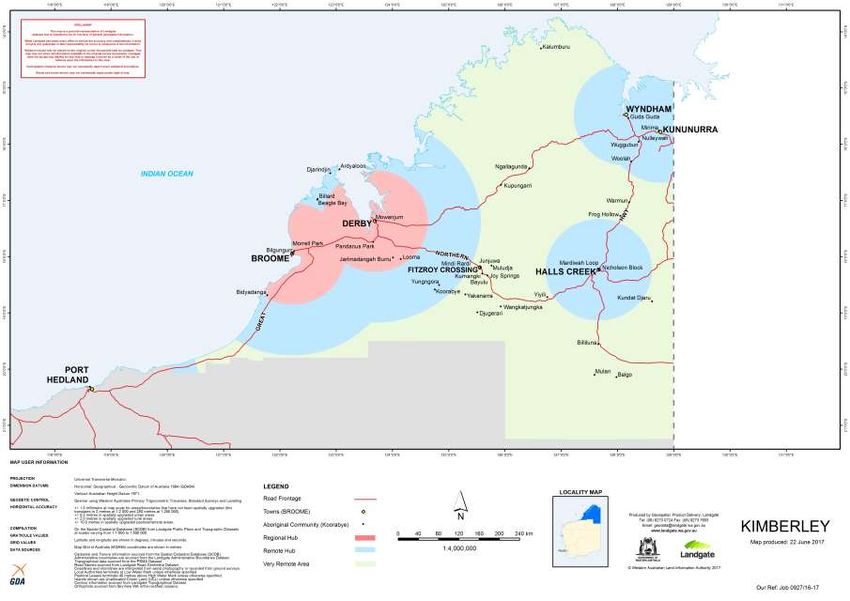
The Kimberley, to which this Framework applies, is defined by Local Government
Area Boundaries. A print ready map can be found in Attachment Two of this
document.
The Kimberley region covers 419,557 square kilometres and has a population of
39,0991 people.
Major towns in the region are Broome, Derby, Fitzroy Crossing, Halls Creek,
Wyndham and Kununurra. There are also over 100 remote Aboriginal
communities2.
Communities range from larger well established communities such as Bidyadanga,
a former mission south of Broome which has over 600 residents3 through to smaller
communities like Bungardi located north east of Fitzroy Crossing with a population
of 20 to 30 people4.
Communities can be located as far as 500km from the nearest town with little or no
sealed road access. The geographical expanse and associated impact upon
service delivery is reflected in the Framework.
Support Cluster and Price Frameworks have also been developed for other regional
areas with prices to reflect those regional contexts. These include:
• Goldfields/Esperance
• Great Southern
• Midwest/Gascoyne
• Pilbara
• South West
• Wheatbelt
The Department of Regional Development’s Regional Price Index (RPI) 2015 has
been applied to the Framework pricing bands in order to account for the increased
cost of service delivery in the Kimberley. The Framework is updated on an annual
basis; in the interim period any changes or inclusions are addressed through the
release of addendums which are included in the next annual Framework.
1 Australian Bureau of Statistics 2014
2 WA Country Health Service – Kimberley regional profile.
3 Regional Services Reform Unit – Resilient Families, Strong Communities.
4 Marra Worra Aboriginal Corporation website
Effective from 1 July 2018: Kimberley Support Clusters and Price Framework Page 2The Pricing Band
The Framework has been structured with services and activities grouped into
clusters. A price band or range has been assigned to each cluster or sub-cluster.
Where there is a price band, the factors affecting the cost of delivering the service
should be taken into consideration when establishing a price. Some examples of
factors influencing price are identified below:
• Model of support
An individual may share a support worker with one or more individuals or be
supported on their own. If the support is shared, it is likely that the price for each
individual in the shared arrangement will be towards the lower end of the price range.
There are also times where individuals participate in group activities in which the
ratio of support personnel to individuals is relatively low and the ‘group price’ will
apply (where someone needs one-to-one support to participate in the group activity
this would be considered as individual support).
• Skill and experience
The level of skills and experience required of either the service provider and/or the
support personnel can affect the price.
• Service Coordination
The time required to implement and maintain a holistic, viable support option.
• Time
The time of the week when the service is predominantly delivered may impact the
price. The price of supports delivered across the week, including weekends, can be
averaged. This averaged price must fall within the pricing band. Where an
individual’s support is adversely affected due to the impact of the time of the week
when the service can be provided, it may be raised for consideration by the Regional
Manager.
• Service Presence/Engagement
The degree of constant attention and active engagement needed to deliver the
service can influence the cost with individual needs influencing the support models,
such as awake night time personnel, on-call or availability such as a sleep-shift.
The price for a strategy is determined by considering each of the factors individually
and establishing a single composite price for the strategy identified in an individual’s
plan. The price should be inclusive of all indirect costs.
Effective from 1 July 2018: Kimberley Support Clusters and Price Framework Page 3Type of Management
The degree to which a person, or a representative acting on their behalf, takes
responsibility for organising, arranging and managing their services and supports can
influence the price. Options may be fully service provider (organisation) managed, fully
self-managed or shared managed between a provider(s) and the person, or their
representative, with the range of responsibilities and tasks needed for the services to be
delivered is agreed between the parties, or a combination of these..
The range of responsibilities and tasks can change over time due to changes in
circumstance and/or a person’s increasing confidence, understanding of the
responsibilities and skill development in managing their services.
The types of management options are described below:
Self-Management
The management of funded supports in a plan by either the person with disability or a
representative acting on their behalf. The person or their representative receives the
funding, engages supports and services and is responsible for meeting relevant legal
obligations. Where a representative manages the supports and services, they receive
funds on trust to be spent according to the person’s plan, and may be wholly or
partially responsible for meeting legal obligations.
Shared Management
This is a type of service provider management under which the funded supports in a
plan are managed in a shared arrangement between a person and a service
provider. The service provider receives the funding, and the person or their
representative engages staff. The person or their representative and the service
provider share responsibility for meeting relevant legal obligations as agreed between
the parties.
Service Provider Management
The management of funded supports in a person’s plan by a contracted service
provider. The service provider receives the funding, engages staff and is responsible
for meeting relevant legal obligations. On agreement with the service provider, the
person and/or their representative may actively direct the provision of those supports
to the extent they desire and have capacity to do so.
Combination Management
The combination of both self-managed and service provider managed supports in a
plan.
Effective from 1 July 2018: Kimberley Support Clusters and Price Framework Page 4Pricing and Self-Management This Framework includes application to self-managed supports. Self-managed supports are funded at provider rates if a provider is engaged to provide the supports. Where an individual engages their own supports for clusters 2,4 or 5, these will be funded at the lowest end of the pricing band in recognition of lower operational costs. If a self-manager considers the lowest price for those bands to be insufficient to meet their support needs, they should discuss this with their Local Coordinator who will consider the need for a higher level of funding. Effective from 1 July 2018: Kimberley Support Clusters and Price Framework Page 5
Support Clusters
Support clusters have been developed to achieve global outcomes. Each cluster
can include a range of service or support strategies designed to achieve the goals
identified in an individual’s plan. This provides flexibility for services to be changed
to meet the individual’s goals, while remaining in line with the cluster’s global
outcome.
The clusters are:
   1. Accommodation – Support to live safely in various accommodation settings.
   2. Daily Living – Support with daily life tasks to enable individuals to live as
      autonomously as possible.
   3. Communication – Enables an individual to communicate their requirements
      and understand information to follow or engage in essential activities.
   4. Wellbeing – Individual is engaged in valued roles through participation in
      community, vocational and/or educational activities, and/or employment.
   5. Having a break – Family/carer relationships are maintained and
      strengthened.
   6. Support planning – Service responses at times of intense change and
      significant transition are appropriate, goal directed and well-coordinated.
   7. Behaviour support and specialist care – Individuals and others are free from
      harm and an individual’s support needs are met.
   8. Therapy and specific support – Improved or maintained functional capacity to
      enable an individual to independently undertake practical activities.
Where a person is engaged with a Local Coordinator and has an individual plan, their
assessment and equipment prescription, including consumables, will be coordinated by the
individual’s Local Coordinator. The Local Coordinator will facilitate an individual’s access to
existing services and schemes available in their region.
An individual may have service strategies that fall under more than one cluster in their
individual plan. For example, an individual may have an accommodation strategy from
Cluster 1, a therapy strategy from Cluster 8 and recreation as a strategy from Cluster 4. To
note, Cluster 1 and Cluster 2 are mutually exclusive as the activities of daily living are
included in an individual’s accommodation strategy.

Clusters 1-7
To be approved, services identified in an individual plan must be within the relevant support
cluster ‘price range’. Some service costs may be higher or lower than the price(s) identified
in the support cluster, such as varying rates over weekdays and weekends, but the overall
(composite) rate should be the average and fall within the price range.
Individuals and families can negotiate shared management arrangements with their support
provider(s). Such arrangements must fall within the support cluster price ranges.

Effective from 1 July 2018: Kimberley Support Clusters and Price Framework                 Page 6
Cluster 8 - Therapy and specific support Therapy supports are therapeutic interventions by allied health professionals that assist an individual to achieve their goals. These interventions are non-acute interventions and would not be expected to be provided by mainstream acute or community Department of Health or Mental Health Services. Services identified in an individual plan will be in line with what is considered as reasonable and necessary. Therapeutic intervention is provided by a range of professionals (e.g. occupational therapists, psychologists, clinical psychologists, orthoptists, podiatrists and dieticians) and includes prescription of equipment, home modifications and orthotics. General therapy services are funded in bands of high, medium and low ranges for Early Childhood, School Age and Adult intervention services. Services should be costed within the ‘band of funding’ related to the person’s age, support needs and other relevant factors. Ideally services should be provided using a transdisciplinary approach with a transdisciplinary package held by one provider. If the person wants to purchase therapy services from more than one provider the total cost of all services must be within the relevant band. The hourly rate within a band should be no more than the hourly rate for specialist therapy services. An individual with complex needs may require support from both general and specialist therapy. Pricing for specialist therapy is based on an hourly unit of service, with different rates for allied health professionals and therapy assistants. Where services are delivered in groups the price should reflect the cost of delivery relative to the cohort and expertise required. The price should be inclusive of the time required for all activities related to the service including assessment, planning and preparation, liaison, report writing, training, direct contact (e.g. face to face, phone, teleconference, skype, email) and indicate the potential hours for assessment, planning and intervention. Business costs such as overheads and general administration should be included within the hourly rate. For example, travel (first 15 kilometres each way); superannuation; workers compensation; training for service provider staff; staff supervision and any other related costs. Clusters 1-8 In exceptional circumstances, higher prices than in the price range may be considered. The individual’s Local Coordinator will assess the need for funding support outside a price range and this will be subject to approval by a Regional Manager. Where people have rapidly changing or very high and complex needs, consideration will be given to funding for an increased volume of coordination. Individuals may also choose to purchase additional services beyond those identified as reasonable and necessary within their individual plan at their own expense. Effective from 1 July 2018: Kimberley Support Clusters and Price Framework Page 7
Additional Information
Accessibility/Remoteness Index of Australia (ARIA)
The Accessibility/Remoteness Index of Australia (ARIA) is applied to determine regional
hubs, remote hubs and very remote areas. The definitions, based on ARIA, are as follows:
    1. Regional hub – area within 100km of locality, such as Broome or Kununurra, with
       moderate levels of road accessibility and available service infrastructure.
    2. Remote Hub – area extending 100km beyond a regional hub, or 100km from a
       service centre with low levels of road accessibility and available infrastructure, such
       as Halls Creek.
    3. Very remote area – area beyond remote with very low levels of road accessibility and
       available service infrastructure, such as Balgo.
The ARIA is used to determine the payment level of the commencement fee and
travel/transport costs.
Please refer to Map in Attachment Two.

Commencement fee
The commencement fee recognises the additional cost that may be incurred when
commencing services to individuals residing in the Kimberley, which are higher than
those in the Perth Metropolitan area and more populated rural areas. These one-off
costs aren’t attributable to the price of a unit of service and may include some of the
following:
•    Time and extra costs of advertising staff/personnel vacancies.
•    Recruitment expenses such as relocation costs.
•    Establishing services where local support workers are not available, such as
     training local, unskilled workforce to required standards
•    Costs associated with providing supervision, such as the establishment and
     maintenance of IT systems for remote supervision and/or travel and time of staff
     to provide face-to-face supervision.
•    Meal allowances and/or staff accommodation when undertaking extensive
     travel.
The commencement fees are as follows:
    1. Regional hub – up to $2000
    2. Remote hub – up to $4000
    3. Very remote areas – up to $6000.
These costs can be provided via a one-off payment at the commencement of an
individual plan. Commencement fees need to be itemised and may not apply to all
individual plans.

Transport and travel
The following can be funded per annum for either travel and/or transport:
    1. Regional hub – up to $1000
    2. Remote hub – up to $6000
    3. Very remote areas – up to $8000.

Effective from 1 July 2018: Kimberley Support Clusters and Price Framework                Page 8
This applies to transport costs in addition to strategies covered by clusters 2 and 4.
Amounts in excess of that allocated for each ARIA area can be approved if there is
an adverse effect on an individual’s support, this must be raised by a Local
Coordinator to the Regional Manager for consideration. The travel and/or transport
fee will be split if multiple providers are involved in the service delivery.
Travel and transport are defined below:
• Travel – when someone travels to a person with disability to provide funded
supports in accordance with the person’s plan.
Staff travel time to provide support to an individual in their place of residence,
up to 15 kilometres one way (a return journey therefore constitutes 30km), is
included within the prices presented in a cluster pricing band.
Travel beyond 15km each way may be funded and is usually calculated from
the service provider base.
In instances where measuring the journey from the service provider base
increases the overall distance, travel may be calculated from the staff member’s
home.
• Transport – instances where staff are required to accompany an individual, so
they can access the services and supports they require.
Where staff accompany an individual to participate in the community, the
transport time is captured within Cluster 4’s rate.
Individual transport, including training and the provision of taxis not covered by
taxi subsidy schemes, are covered within Support Cluster 2: Daily Living.
Where an individual is in receipt of allowances, such as the Mobility Allowance,
this will be taken into consideration when determining funding for transport.
Travel to provide general and specific therapeutic support
An additional travel amount, funded as per the ARIA area, can be included within a
plan on a per annum basis for return journeys of over 30km to provide general
therapy supports. These supports must be directly linked to a general therapy
strategy in the person’s plan.
An additional travel amount, funded as per the ARIA area, can be included within a
plan on a per annum basis for return journeys of over 30km to provide specific or
targeted supports. These supports must be directly linked to a specific or targeted
therapy strategy in the person’s plan.
Cancellations and “no shows”
Providers must provide individuals with information on their cancellation and ‘no
show’ policy. The policy must specify the required notice period of 48 hours prior to
delivery of the scheduled service. Individuals notifying the providers within the
notice period will not be charged for the service.
Where a service is cancelled with less than 48 hours’ notice or there is a ‘no show’,
the individual will forfeit the period of scheduled support and the provider will be
paid as if the service had occurred.
Note: Funding for support unable to be delivered within a financial year will be
recovered by the Department of Communities.
Effective from 1 July 2018: Kimberley Support Clusters and Price Framework Page 9Shared and Group activities
For the purposes of this Framework shared activities and group activities are
considered as follows:
• Shared activities are those where two or three individuals undertake an activity
supported by one support worker. Each person is funded individually and
contributing to the cost of support, the price for each person is expected to be at
the lower end of the range.
• Group activities are those in which an individual joins activities designed for four
or more individuals. They may be community or centre based and the ratio of
individuals to support staff is usually relatively high.
o Where someone needs individual support to participate in a group activity it
should be considered during their individual planning and, if deemed
reasonable and necessary, included in their plan.
o Group activities that include some individual one on one support amongst
the group support should be discussed with the Local Coordinator to
establish an agreed price. Such activities may be holiday camps.
Assistive Technology and Home Modifications
Assistive Technology and home modifications are entered as separate line items in
an individual’s plan. At this time the pricing of assistive technology and home
modifications are not addressed within the Framework.
Consumables
Consumables such as continence products, enteral feeding equipment, dressing
etc. are entered as separate line items in an individual’s plan. At this time the
pricing of consumables is not addressed within the Framework.
Subcontracting
In instances where a service provider does not provide all the services required by
an individual, and the individual wishes to have all of their services arranged by
their primary service provider, the primary service provider may subcontract those
services. The prices charged must be within the Framework pricing band.
All sub-contracting arrangements must meet the Department of Communities
subcontracting policy. For further information on subcontracting and other
contractual issues please refer to the wesite:
www.disability.wa.gov.au Disability Sector Guidelines and Policies Policies
and Business Rules
Effective from 1 July 2018: Kimberley Support Clusters and Price Framework Page 102018–19 Price Clusters
1: Accommodation
Support to live safely in various
Outcome:
accommodation settings
This support cluster incorporates assistance with and/or supervising tasks of daily life in
various accommodation settings. It may be either temporary or ongoing. There is a focus
on developing an individual’s skills to live as autonomously as possible. Reasonable and
necessary support is provided in accordance with an individual’s needs, including cultural
security needs, and includes all aspects of normal daily living activities.
The price for accommodation is inclusive of all daily living support in the accommodation
setting and includes all activities required to live at home, such as clothes shopping,
gardening, attending medical appointments and attending some social activities which
may require transport. Additional support from cluster 2: Daily living is not applied when
someone is receiving support through Cluster 1. The points below are provided as
descriptors of the type and level of support within each band; and, the band in which
most points apply being indicative of the band that will apply.
Individuals are encouraged to explore and examine various options and come up with
creative arrangements that best suit them to achieve their goals and address their
support needs. Individuals’ lives are dynamic and living arrangements may need to be
re-explored and new ones developed as individuals and circumstances change. In
developing the best options, the degree to which an individual takes responsibility for the
management of the arrangement should also be a consideration.
Accommodation can include individualised living arrangements such as host-family, co-
resident and alternative family models, as well as house-sharing with friends and group
home models. An accommodation package is inclusive of the requirements needed to
support the model. This may include supervision and respite in some individualised
options, such as host families.
Effective from 1 July 2018: Kimberley Support Clusters and Price Framework Page 11Cluster 1 - Accommodation Price ($)
Lower support:
• May involve drop-in support, a mix of paid and informal support
and/or shared support where support is provided to more than one
individual.
• Provides overall supervision of living arrangements and generally
Up to
requires limited coordination.
$148,713 per
• Can be delivered with basic levels of experience and skill.
year.
• Can involve providing occasional to intermittent prompting to
undertake tasks and/or self- care activities.
• Relates to whether the support is active, on-call etc.
• Follows a behaviour support /safeguarding plan in place where there
are some behaviours of concern and the strategies can be
implemented effectively within the available support.
Standard support (Provision 24/7 support):
• May involve a mix of one on one and shared support, inactive
overnight support, on-call, degree of informal support etc.
• Requires regular supervision and moderate levels of coordination. Up to
• Can be delivered with some experience and practiced skills. $193,117 per
• Can involve prompting and/or direct assistance to undertake tasks year.
and/or self-care activities.
• Follows a behaviour support/safeguarding plan in place where there
are episodic behaviours of concern and the strategies can be
implemented effectively within the available support.
Higher support (Provision 24/7 support):
• Continual, active interventions and assistance are required. Some
degree of informal support maybe required.
• Usually requires active support overnight.
• Requires flexibility to respond to changing needs and significant
levels of coordination e.g. higher levels of support at specific times.
• Requires skilled, experienced and sometimes specialist staff. Where Up to
tasks are delegated close supervision is required and often specific $257,383 per
staff training. year.
• Often includes ability to manage complex medical/health needs
and/or significant behaviours or vulnerabilities of concern.
Effective from 1 July 2018: Kimberley Support Clusters and Price Framework Page 122: Daily Living: Independence; personal care and support
Outcome: Support with daily life tasks to enable individuals to
live as autonomously as possible
There are many factors affecting the cost of delivering service under this cluster. These
should be taken into consideration when establishing a price. Please refer to The Pricing
Band on page 3 for further information.
Cluster 2 – Daily Living Price ($)
Assistance with daily personal activities
$51.50 -
Assisting with and/or supervising personal tasks of daily life to enable the $70.60 per
individual to live as autonomously as possible. These supports are provided hour.
individually to a person and can be provided in a range of environments,
including but not limited to the individual’s own home.
They may include assistance with personal, self-care, and other domestic
activities such as meal preparation, shopping, cooking and cleaning.
Assistance with Travel/ transport arrangements
This focuses on the provision of transport to enable participation in
community, social, economic and daily life activities: $51.50 -
$70.60 per
• Some taxi fares not covered by other relevant taxi subsidy schemes hour.
• Public transport fare of accompanying provider
Training for independence in travel and transport
Supports focus on assisting an individual to develop their skills to travel and $51.50 -
use public transport independently. This includes training in driving using $70.60 per
adapted equipment or vehicle modification. hour.
Development and support with daily living and life skills
Development of daily living and life skills through training, and where
appropriate ongoing support, for an individual to increase their ability to live
as independently as possible. Training and assistance can be provided $51.50 -
either individually or through shared activities. It can include skills $70.60 per
development and support with daily life activities, communication, social hour.
skills, tenancy, budgeting and/or problem solving.
Effective from 1 July 2018: Kimberley Support Clusters and Price Framework Page 13Training for parents $51.50 -
$70.60 per
Delivering training to parents of children with disabilities to assist them in
hour.
their parenting role.
Training for carers $51.50 -
$70.60 per
Delivering training to carers in matters related to caring for a person with
hour.
disability.
Group activities
$17.20 -
Where activity has a high ratio of individuals to support staff i.e. one support $23.60 per
worker to 4 -10 individuals. Price as negotiated. hour.
Shared activities
$51.50 -
Shared activities are those where two or three individuals undertake
$70.60 per
an activity supported by one support worker. Each person is funded
hour.
individually and contributing to the cost of support, the price for each
person is expected to be at the lower end of the range.
Effective from 1 July 2018: Kimberley Support Clusters and Price Framework Page 143: Communication
Person can communicate their requirements and
Outcome: understand information to follow or engage in
essential activities.
There are a variety of mechanisms that can assist an mindividual to achieve their
communication goals. These funded interpreting and translation mechanisms/supports
can enable independent communication in personal, social or community activities, and
can be included within a plan when determined to be reasonable and necessary.
Cluster 3 - Communication Price ($)
Interpreting and Translation
Can include but are not limited to: Auslan One and Two, Tactile Interpreting,
Training in the use of communication techniques such as Auslan and Braille; Price as
Training for Carer/Parent specifically around communication techniques; and negotiated
print accessibility services.
Effective from 1 July 2018: Kimberley Support Clusters and Price Framework Page 154: Wellbeing: Recreation, education and employment
Person is engaged in valued roles through
Outcome: participation in community, vocational and/or
educational activities, and/or employment.
There are many factors affecting the cost of delivering service under this cluster. These
should be taken into consideration when establishing a price. Please refer to The Pricing
Band on page 3 for further information.
These prices do not cover the cost of standard expenses related to recreational pursuits,
such as entry fees, ticket prices or sporting game fees.
Cluster 4 - Wellbeing Price ($)
Assistance to access and maintain employment
$51.50 -
Support with specialised open employment job searching. This may
$70.60
include time limited or ongoing provision of pre vocational skills, training,
per hour.
advice, coordination with employers, workplace orientation to assist an
individual to get a job and/or induction to assist someone into open
employment.
Participation in community, social and civic activities
Assisting an individual to participate actively in community, social and $51.50 -
civic activities; includes supporting people during these activities and $70.60 per
developing the persons’ ability to partake in these activities. hour.
Recreational activities
Supporting an individual to participate in activities that promote and $51.50 -
encourage physical well-being, including exercise and sporting activities. $70.60 per
These supports relate to the additional requirements due to the disability hour.
to assist the individual to participate in recreation and/or sporting
activities.
Group activities
$17.20 -
Where activity has a high ratio of individuals to support staff i.e. one $23.60 per
support worker to 4 -10 individuals. Price as negotiated. hour.
Effective from 1 July 2018: Kimberley Support Clusters and Price Framework Page 16Shared activities
$51.50 -
Shared activities are those where two or three individuals undertake an
$70.60 per
activity supported by one support worker. Each person is funded
hour.
individually and contributing to the cost of support, the price for each
person is expected to be at the lower end of the range.
Camps
Activities that enable individuals to develop leadership, social and
physical skills and learn about team building, working in groups and Price as
interacting with others in a different environment. negotiated
Camps traditionally provide a combination of one to one, shared and
group support. An hourly rate should be negotiated based on the
individual’s support need over the duration of the camp
Effective from 1 July 2018: Kimberley Support Clusters and Price Framework Page 175: Having a Break: Supporting positive care relationships
Outcome: Family/carer relationships are maintained and
strengthened.
Breaks can be provided through a wide range of activities and services offered to people
with disability and their families. The breaks provide positive experiences for people with
disability, and strengthens and maintain the capacity of families to provide support and
care.
There are many factors affecting the cost of delivering service under this cluster. These
should be taken into consideration when establishing a price. Please refer to The Pricing
Band on page 3 for further information.
Cluster 5 – Having a Break Price ($)
Having a Break – Hourly
Services are tailored to meet the needs of the person with disability and
family, and may include the following types of activities:
• In-home assistance for the carer to undertake typical family $51.50 -
activities $70.60 per
• In-home assistance which gives the carer a break hour
• Out-of-home assistance, which may include individual activities,
centre-based or shared living settings, alternative family setting or
other flexible respite options.
• Respite accommodation in time of immediate need.
Group activities $17.20 -
$23.60 per
Where activity has a high ratio of individuals to support staff i.e. one
hour.
support worker to 4 -10 individuals. Price as negotiated.
Shared activities
$51.50 -
Shared activities are those where two or three individuals undertake an
$70.60 per
activity supported by one support worker. Each person is funded
hour
individually and contributing to the cost of support, the price for each
person is expected to be at the lower end of the range.
Having a Break – Daily
$119.50 -
Respite, either in-home or out-of-home, for periods 13 hours and over. $907.90 per
day/night.
Friday night to Sunday night is considered two 24 hour periods.
Effective from 1 July 2018: Kimberley Support Clusters and Price Framework Page 186: Support Planning
Service responses at times of intense change and
Outcome: significant transition are appropriate, goal directed
and well-coordinated.
This support must be provide by, or purchased from, a professional service, either an
organisation or individual that meets relevant industry standards and legislative
requirements.
Cluster 6A & 6B – Support Planning Price ($)
6A. Assistance in coordinating or managing life stages,
complex situations, transitions and supports
This is time limited planning and coordination for up to three months, to
build capacity to sustain an individual’s ongoing support and/or to assist an
individual in times of transition. It includes support to assist the person to
address an unexpected event or crisis, or to familiarise them with a new
environment; as well as developing capacity and resilience in the person’s $64.60 -
network. $80.10
per hour.
Planning is limited to the episodic provision of support to assist in
stabilising an individual’s situation and reducing their at-risk status.
Planning may be required during instances where there is breakdown or
withdrawal of informal care, significant escalation in behaviour or medical
support needs and/or in relation to justice- related matters.
Where there are complex needs or changing needs it may assist the
individual, their family and carers to envision their goals to assist planning.
6B. Assistance in delivering support activity(ies) that is
beyond what is included in a standard unit price/cost of
service delivery
Involves additional support that is beyond what is included in a standard
unit price/cost of service delivery for the life of the plan, and beyond that
provided by Local Coordination.
$64.60 -
Support may be ongoing or intermittent, rather than crisis based, and is
$80.10
required to manage and align multiple (three or more) services involved in
per hour.
a person’s life, and/or identified barriers to outcome attainment and/or
safeguarding concerns.
Supports should be flexible and adjusted to meet changing needs and
sustained as the individual’s risk status intensifies.
Funding under 6b only applies to the primary service provider who
undertakes to align all of the services required to achieve the individual’s
identified outcomes.
Effective from 1 July 2018: Kimberley Support Clusters and Price Framework Page 197: Behaviour Support and Specialist Care
Outcome: Individuals and others are free from harm and
individual’s high support needs are met
This support must be provided by, or purchased from, a professional service, either an
organisation or individual that meets relevant industry standards and legislative
requirements.
Cluster 7A & 7B – Behaviour Support & Specialist Care Price ($)
7A. Behaviour support
This is time limited behaviour support, based on planned strategies that
aim to reduce the likelihood of behaviours of concern developing and /or
increasing. The behaviours may cause harm to the individual and/or $64.60 -
others. Behaviour support provides assistance to individuals, their family $101.60
and support persons to identify the behaviours of concern, and to design per hour.
specific positive behaviour support strategies.
It includes support for individuals who require assistance from a support
worker with relevant additional qualifications and experience.
7B. Specialist care for persons with high care needs
(includes nursing care in the community for people with
high care needs)
This is the provision of specialist care for persons who have high care
$80.10 -
needs. This involves support from someone with a high level of expertise,
$113.60
knowledge and/or training to respond to the person’s complex needs. It
per hour.
does not include acute nursing care as delivered by the health system.
It includes support for individuals who require assistance from a support
worker with additional qualifications and experience relevant to the
complex high medical support needs that require continuous and active
support.
Effective from 1 July 2018: Kimberley Support Clusters and Price Framework Page 208: Therapy and Specific Support
Improved and/or maintained functional capacity to
Outcome: enable individual’s to independently undertake
practical activities.
This support must be provided by a professional service, either an organisation or
individual that meets relevant industry standards and legislative requirements.
General therapy includes provision of services by clinicians qualified in an allied health
discipline, such as: physiotherapy, occupational therapy, speech pathology, podiatry,
clinical psychology, and dietetics.
Cluster 8A & 8B – Therapy & Specific Support Price ($)
8A. Therapy
Early childhood Low Band
0 – 8 years of Up to
This band is generally for a child with developmental $11,301
age general
delay, or mild disability, who is developing slower than per year
therapy their peers.
Provision of a
combination of Medium Band
therapies,
coordinated by a key This band is generally for a child with disability or
worker together with developmental delay who either has:
the family, to support $11,302 to
• moderate single or multiple areas of
a child’s $14,440
needs/concern;
independence and per year
• behavioural concerns; and/or
participation.
• some family complexities,
Therapies are
expected to fall into that require specific interventions and for those
one of the three interventions to be coordinated with other agencies.
categories.
High Band
This band is generally for a child with a disability, who $14,441 to
has complex needs that may also include complex $19,464
health and medical needs. per year
Effective from 1 July 2018: Kimberley Support Clusters and Price Framework Page 21School age Low Band
children 9 – 17 Up to $7,534
years of age This band is generally for a child with developmental
per year.
delay, or mild disability, who is developing slower than
general therapy their peers.
Provision of a
combination of Medium Band
therapies,
coordinated by a This band is generally appropriate for a child/adolescent
key worker together with a disability who either has:
with the family, to $7,535 to
• moderate single or multiple areas of
support a child $10,046
need/concern;
and/or young per year.
• behavioural concerns; and/or
person’s
• some family complexities,
independence and
participation. that require specific interventions and for those
Therapies are interventions to be coordinated with other agencies.
expected to fall into
one of the three High Band
categories. $10,047 to
This band is generally appropriate for a child/adolescent $16,324
with a disability, who has complex needs that may also per year.
include complex health and medical needs.
Adults 18 years Low Band
of age and over Up to $7,534
general therapy This band is generally for an adult with disability, who
per year.
requires either minimal supports or a short term
Provision of a intervention strategy.
combination of
therapies, Medium Band
coordinated by a
key worker together This band is generally for an adult with disability who
with the family, to either has:
support an adult’s $7,535 to
independence and • moderate single or multiple areas of
$10,046
participation. needs/concern;
per year.
Therapies are • behavioural concerns; and/or
expected to fall into • some family complexities,
one of the three that require specific interventions and for those
categories. interventions to be coordinated with other agencies.
High Band
$10,047 to
This band is generally for an adult with disability, who $16,324
has complex needs that may also include complex per year.
health and medical needs.
Effective from 1 July 2018: Kimberley Support Clusters and Price Framework Page 228B. Specific Therapy Services - single focused supports and strategies for
all ages
These services are defined as single focused, highly specific and unique
Up to
services that are client centred and complementary to other services, for
$212.80 per
example specialised equipment consultancy, positive behaviour support and
hour for
human relationships. Individual strategies form part of a holistic approach to
health
services required to achieve the individual’s identified goals/outcomes detailed
professionals.
in their plan.
Collaboration with other community services that are involved with the
individual are an integral part of ensuring successful outcomes are achieved Up to
and best practice approaches to service delivery are employed. Therapeutic $101.60 per
supports are provided to assist the person to apply their functional skills to hour for
improve participation and independence in daily, practical activities. trained
Targeted services also include the provision of a range of counselling services therapy
which may include relationship, family, grief, family and/or group counselling. assistants.
Counselling services build an individual’s capacity to work towards their
personal goals.
Effective from 1 July 2018: Kimberley Support Clusters and Price Framework Page 23Attachment One: Definition of terms
Term Definition
Accommodation Support to live safely in various accommodation settings. The price
cluster for supported accommodation is inclusive of activities of daily
living, skills development in the home and reasonable engagement
in the community.
Assistive Assistive technology is any device or system that allows individuals
technology & to perform tasks they would otherwise be unable to accomplish,
home and increases the ease and safety with which the task can be
modifications performed.
Home modifications are changes to the structure, layout or fittings
of the person’s home that are required to enable the person to
safely access and move around frequently used areas in their
home as a result of their disability.
Behaviour Provision of services to individuals with either challenging
support and behaviour and/or vulnerabilities or complex medical/health needs.
specialist care
cluster
Cancellation Refers to as individual notifying a provider more than 48 hours
in advance that scheduled hours of service are not required or
are unable to be received.
• Where notice is given with more than 48 hours, individuals
will not be charged for the service.
• Where notice is given with less than 48 hours or there is
a ‘no show’, the individual will forfeit the period of
scheduled support and the provider will be paid as if the
service had occurred.
Combination The combination of both self-managed and service provider
Management managed supports in a plan.
Communication Interpreting and translation services to assist individuals to
communicate during essential activities where alternative
translation is not available. Individual’s day to day communication
needs are addressed in the daily living cluster.
Consumables The provision of single use items, such as continence aids, enteral
nutrition equipment, dressings etc.
Daily living Services required by individuals to assist personal activities and/or
cluster maintain and develop their daily living skills and independence.
Support may also assist in maintaining life in the family home.
Effective from 1 July 2018: Kimberley Support Clusters and Price Framework Page 24Having a break Services providing positive experiences for people with disability
cluster and strengthening and maintaining the capacity of families to
provide support and care.
Higher Provision 24/7 support:
support
• Continual, active interventions and assistance are required.
Some degree of informal support maybe required.
• Usually requires active support overnight.
• Requires flexibility to respond to changing needs and
significant levels of coordination e.g. higher levels of support at
specific times.
• Requires skilled, experienced and sometimes specialist staff.
Where tasks are delegated close supervision is required and
often specific staff training.
• Often includes ability to manage complex medical/health needs
and/or significant behaviours or vulnerabilities of concern.
Hourly unit price The price of an hour of support/service delivered by a provider.
Lower This support:
support
• May involve drop-in support, a mix of paid and informal support
and/or shared support where support is provided to more than
one individual.
• Provides overall supervision of living arrangements and
generally requires limited coordination.
• Can be delivered with basic levels of experience and skill.
• Can involve providing occasional to intermittent prompting to
undertake tasks and/or self- care activities.
• Relates to whether the support is active, on-call etc.
• Follows a behaviour support /safeguarding plan in place where
there are some behaviours of concern and the strategies can
be implemented effectively within the available support.
‘No show’ Refers to an individual not appearing or being available for a
scheduled service that has been arranged with a provider; or
where an individual is not at the agreed location for the
scheduled service.
Price range The distribution of pricing indicating both the minimum and
maximum price that will be paid for a service within a cluster.
Professional Occupations requiring special training, are evidence-based, meet
service relevant industry standards and/or legislative requirements. Some
professional services require holding a professional licence or
membership to a specific body, such as AHPRA. In general, they
offer customised and knowledge-based services.
Effective from 1 July 2018: Kimberley Support Clusters and Price Framework Page 25Self- The management of funded supports in a plan by either the
management person with disability or a representative acting on their
behalf. The person or their representative receives the
funding, engages supports and services and is responsible
for meeting relevant legal obligations. Where a
representative manages the supports and services, they
receive funds on trust to be spent according to the person’s
plan, and may be wholly or partially responsible for meeting
legal obligations.
Service The management of funded supports in a person’s plan by
provider a contracted service provider. The service provider
management receives the funding, engages staff and is responsible for
meeting relevant legal obligations. On agreement with the
service provider, the person and/or their representative
may actively direct the provision of those supports to the
extent they desire and have capacity to do so.
Shared This is a type of service provider management under which
management the funded supports in a plan are managed in a shared
arrangement between a person and a service provider.
The service provider receives the funding, and the person
or their representative engages staff. The person or their
representative and the service provider share responsibility
for meeting relevant legal obligations as agreed between
the parties.
Standard Provision 24/7 support:
support
• May involve a mix of one on one and shared support, inactive
overnight support, on-call, degree of informal support etc.
• Requires regular supervision and moderate levels of
coordination.
• Can be delivered with some experience and practiced skills.
• Can involve prompting and/or direct assistance to undertake
tasks and/or self-care activities.
• Follows a behaviour support/safeguarding plan in place where
there are episodic behaviours of concern and the strategies
can be implemented effectively within the available support.
Support cluster A broad grouping of services related to global strategies, to
achieve an identified goal.
Support planning Assistance in coordinating or managing life stages, complex
cluster situations, transitions and supports.
Assistance in delivering support activity(ies) that is beyond what is
included in a standard unit price/cost of service delivery.
Effective from 1 July 2018: Kimberley Support Clusters and Price Framework Page 26Therapy and Therapy supports are therapeutic interventions by allied health
specific support professionals that assist an individual to achieve their goals. These
cluster interventions are non-acute interventions and would not be
expected to be provided by mainstream acute or community
Department of Health or Mental Health Services. Services
identified in an individual plan will be in line with what is considered
as reasonable and necessary. Therapeutic intervention is provided
by a range of professionals (e.g. occupational therapists,
psychologists, clinical psychologists, orthoptists, podiatrists and
dieticians) and includes prescription of equipment, home
modifications and orthotics.
General (Comprehensive) therapy services are person centred,
focusing on an individual’s needs and desired goals. They are
provided by transdisciplinary teams (e.g. occupational therapists,
speech pathologists, physiotherapists and psychologists). These
teams share knowledge and work together with the person and
their family to provide coordinated and integrated services.
Specific (Targeted) therapy services are single focused, highly
specific and unique services. Examples include specialised
equipment consultancy (e.g. complex wheelchairs, car
modifications, sleep assessments); positive behaviour support (for
people with complex and risky behaviour) and human relationships
(e.g. services which include relationship, family, grief, and/or group
counselling. Counselling services support an individual to develop
their capacity to work towards their personal goals).
Wellbeing cluster Services required by individuals to participate in vocational,
recreational, social, civic and/or physical health activities in their
community.
Effective from 1 July 2018: Kimberley Support Clusters and Price Framework Page 27You can also read


