ARGYLL AND BUTE COUNCIL CUSTOMER SERVICE STRATEGY 2015-2019
←
→
Page content transcription
If your browser does not render page correctly, please read the page content below
Appendix 2

ARGYLL AND BUTE COUNCIL

CUSTOMER SERVICE STRATEGY 2015-2019

Author:       Bob Miller
Title:        Customer Service Support and Development Manager
Date:         February 2014
Version 3.0 Approved by P&R Committee

Argyll and Bute Council Customer Service Strategy 2015-19

                                                                 Table of Contents
1.     EXECUTIVE SUMMARY .............................................................................................................................. 3

2.     INTRODUCTION AND BACKGROUND .................................................................................................... 4

3.    VISION, VALUES AND PRINCIPLES .......................................................................................................... 5

4.     CUSTOMERS AND CHANNELS .................................................................................................................. 6
     4.1      OUR CHANNEL STRATEGY .......................................................................................................................... 6
     4.2      THE CUSTOMER SERVICE CENTRE .............................................................................................................. 6
     4.3      WEB & MOBILE WEB CHANNELS ................................................................................................................ 7
     4.4      FACE-TO-FACE ACCESS .............................................................................................................................. 8
     4.5      WRITTEN COMMUNICATION ........................................................................................................................ 8
5      CUSTOMER SERVICE STANDARDS AND PERFORMANCE MANAGEMENT ................................ 9

6      COMPLAINTS MANAGEMENT ................................................................................................................ 10

7      EMPLOYEE DEVELOPMENT ................................................................................................................... 10

8      CUSTOMER SERVICE DEVELOPMENT AND GOVERNANCE ......................................................... 11

APPENDIX 1 – REVISED CUSTOMER SERVICE CHARTER (TAKING ACCOUNT OF SURVEY
FEEDBACK) .......................................................................................................................................................... 12

APPENDIX 2 – CUSTOMER SERVICE BOARD TERMS OF REFERENCE .............................................. 13

APPENDIX 3 - STRATEGY ACTION PLAN..................................................................................................... 14

12/06/2015                                                                                                                                       Page 2 of 16
1. EXECUTIVE SUMMARY
From 2010-2014 the council’s customer service strategy was determined by the deliverables
of the Customer Management Project agreed as part of the Process for Change
Programme. Following the completion of that project the Customer Service Board directed
that a formal Customer Service Strategy be developed for the council, to act as the
framework for customer service improvement going forward. An extensive consultation of
customers and number of other research and benchmarking activities have informed the
content of the new strategy, which builds on the many advances made since 2010.
The key features of the new Strategy are:
Customer Service Development and Governance
To retain the Customer Service Board (CSB), as the strategic board for customer
service related development management, performance management and employee
development management
Have a dedicated annual Customer Service Development Plan whose delivery is
managed by the CSB, but which is integral to and aligned with the Corporate
Improvement Plan and Annual Service Plans
Review, improve and relaunch the Customer Service Toolkit as the focused
corporate resource for all elements of customer service excellence on the newly
upgraded Hub intranet.
Implement better tools and approaches that allow is to identify specific customer
groups, to better meet their specific needs.
Standards and Performance Management
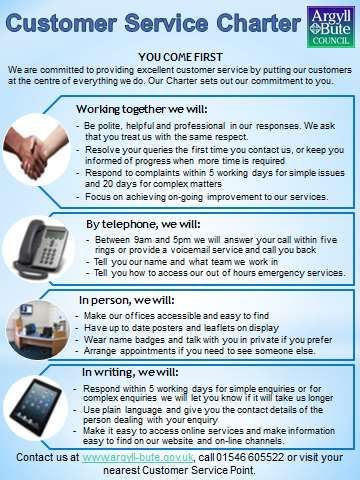
Introduce a revised Customer Service Charter that has additional elements requested
by customers including pledges regarding the council website, customer complaints
and being kept informed of the progress of service requests.
Monitor performance against charter pledges on the corporate Customer Service
Scorecard, reviewing the target levels annually to ensure that they remain
challenging
Procuring a new automated customer satisfaction monitoring tool to continually report
on front and back office achievement of response standards, to replace the annual
mystery shopping approach used in the past
Increase the number of customer consultations and satisfaction surveys undertaken
corporately and by Services each year (tracked by CSB), and report the outcomes to
customers on the council’s website.
Introduce new measurement and reporting of ‘failure demand’ as a means to identify
delivery improvements and reduce avoidable contacts and complaints
Customer Contact and Channel Access
Maintain a range of customer access channels to ensure channel choice, but
implement the “Digital First” approach agreed by the Policy and Resources
Committee
Recruitment of a new Digital Development Officer post to systematically implement
and promote the re-engineering of service delivery to maximise digital self-service
opportunities for customers
Procurement of a next generation customer contact and customer relationship
management system for the Customer Service Centre that can support new mobile
web and social media interactions, streamline the increasingly hard to maintain
mosaic of elderly systems currently in place and help to deal with ever increasing
12/06/2015 Page 3 of 16customer demand by supporting integrated self-service and workforce management
Implementation of an effective successor to the Members Portal that allows elected
members to log and monitor service requests on behalf of their constituents
Ensuring face to face contact via customer service points is retained in each major
town, but exploring the possibility of co-location with other Services or partners to
deliver efficiencies.
Employee Development
Retain the Customer Service Professional Qualification, but expand take up by
making its completion at Award or Certificate level a mandatory element of job
descriptions for certain customer focused posts
Develop a new base level e-learning course in customer care as part of the wider
overhaul of e-learning being progressed by Improvement and HR
Continue to deliver a bespoke and regularly updated Customer Management module
as part of the Argyll and Bute Manager programme
Implement the Customer Service Excellence Standard to at least two Services in
each Department, with a view to building in house expertise in this national standard
and gaining corporate accreditation by 2018
Developing a range of topic specific guides and aids for employees, beginning with a
review of the Effective Call Handling Guide and a new guide to responding to letters
and emails.
Recognise excellence in customer service delivery by ensuring it is maintained as a
distinct category in the corporate employee annual awards
An Action Plan (Appendix 3) with a formal implementation timetable has been developed to
accompany the Strategy and it will be incorporated into the Corporate Customer Service
Development Plan to be managed by the Customer Service Board, with quarterly updates to
the Senior Management Team and the Policy and Resources Committee. It should be noted
that many items on the Action Plan have a dependency to the procurement of a new
Customer Contact System which is being jointly procured with Highland and Aberdeen City
Councils, hence delivery dates may be subject to change.
2. INTRODUCTION AND BACKGROUND
The Council is committed to putting customers at the heart of all it does and is this is
reflected in its drive to provide responsive, high quality and continually improving standards
of customer service, informed by customer engagement. The council’s extensive geography
and demographic make-up mean that many customers are hard to reach and this requires
extra effort to ensure equality of access and consistency of service.
In 2009 and the council established the Customer Management Project to deliver the
customer service improvement strategy agreed as part of the Process for Change
Programme. Following the completion of that project and its successor in 2014 the Customer
Service Board took responsibility for the continued focus on customer service improvement.
The Customer Service Board commissioned a review of the Customer Service Strategy to
bring it up to date and make sure it aligned with corporate plans and aspirations for the
period 2015-19.
This strategy builds on the investments in technology and training made since 2009 and
which led to the independent Customer Service Excellence Assessor remarking in
November 2013 that:
12/06/2015 Page 4 of 16The culture and ethos within the organisation is clearly customer focused. Strong
leadership is demonstrated at all levels and sound policies and procedures are in place.
Customers have high expectations, but delivery matches that requirement.
The scope of the strategy covers:
1. The council’s customer service culture and its alignment with the council’s values,
plans and strategic outcomes.
2. The council’s customer service standards and their performance management
3. Customer service improvement/development planning and management
4. Channel access - review of existing and planning for emerging channels including
customer insight into desired future channel access and priorities
5. Complaints Management; systems, processes, reporting and service improvement
6. Ensuring and effective interface between elected members and customers.
7. Customer service training and employee development.
3. VISION, VALUES AND PRINCIPLES
The strategy supports and helps to enable the following council values:
We involve and listen to our customers and communities
We take pride in delivering best value services
We are open, honest, fair and inclusive
We respect and value everyone
It also underpins delivery of the SOA outcomes:
We provide good customer service
We have a skilled and competitive workforce
Our services are continually improving
We contribute to a sustainable environment.
Our employees have the skills and attitudes to deliver efficient and effective services.
The vision of the original Customer Service Strategy was “ Consistent, Convenient, Efficient
Customer Care”. The ethos was to offer digital self-service as a choice for customers and to
use corporate systems, training and standards to ensure consistency and efficiency. That
vision has not changed, but has been summarised in the new Customer Service Charter
(Appendix 1), into the three words:
CUSTOMERS COME FIRST.
What has changed however is that rather than simply making digital services a channel
choice, the council’s ethos will be to offer “Digital services so good that all who can use them
prefer to use them” as stipulated in the Government Digital Strategy. This will be
underpinned by three digital delivery principles:
Services will be delivered as “digital first” and customers who can self-serve using
digital media will be enabled and encouraged to self-serve;
Customers who are unable to self-serve will be assisted to access services so they
are not disadvantaged;
Service access, delivery and associated business processes will be re-designed to
improve performance and productivity and to reflect the above two principles.
12/06/2015 Page 5 of 16The focus on customers requires the council to have a good understanding of who they are
(customer segmentation), and what matters to them. Using customer profiling to develop
typical customer profiles, known as ‘personas’ and by more intensive use of customer
journey mapping, we will be able to provide services that more closely meet customer needs
and improve take up of online self service. Enhanced reporting and analytical capabilities
provided by our replacement Customer Service Centre contact management systems will
greatly aid customer focus too.
4. CUSTOMERS AND CHANNELS
Customers’ expectations and needs are changing, largely driven by the use of the internet
and the recent revolution in the use of mobile devices such as smartphones to access it.
This change was reflected in the council’s November 2014 Customer Service Survey
completed by nearly 500 respondents. That survey showed a fivefold increase (up to 30%
from only 6%), in those using the council website to access services compared to 2009, with
the other main digital medium of email also being used by 30% of customers.
Of the traditional media the number using white mail nearly halved to only 15% and the use
of telephone also fell from 84% to 71%, although those using face to face services rose from
31% to 35%. It is worth noting that the majority of respondents were aged 50 or over. This
means that, if the council is to keep up with changing expectations and contact preferences,
we must better understand how our customers want to interact with us and then plan and
deliver our services in ways that are convenient to them and also cost effective for the
Council.
4.1 Our Channel Strategy
Argyll and Bute Council will make access to its services available through appropriate and
cost effective contact channels designed with the needs of its customers in mind, keeping
abreast of changes in technology.
We will operate a “Digital First” approach whereby service access, delivery and associated
business processes will be re-designed to encourage and enable those who can use digital
self-service to do so, whilst assisting those who initially cannot use self-service to be able to
use it. For the period of this strategy the council will continue to provide the full range of non-
digital access channels and encourage customers to channel shift to digital by the quality,
ease and efficiency of our digital services and by providing assistive digital support.
4.2 The Customer Service Centre
The Customer Service Centre (CSC) provides initial customer contact support for all council
services except Education and internal teams such as Strategic Finance. It services:
the council’s easy contact ‘Golden Numbers’ (including the council switchboard),
the enquiries@argyll-bute.gov.uk email account
the single number text service
Facebook direct messages
‘Contact Us’ web enquiries
The online ‘Quickbook’ booking service
All voice automated services such as payments, switchboard and service disruptions.
There are no plans to change these arrangements; however the efficiency and quality of
service delivery is being limited by ageing and varied systems that have evolved over time
and which are increasingly difficult to support and to keep compliant with stringent new
security requirements. Nor are the current systems geared for social media or sufficiently
advanced to support the council’s Digital First aspirations.
12/06/2015 Page 6 of 16The strategy is therefore to replace the CSC’s customer contact and customer relationship
and case management systems with a unified modern system by the end of 2015 that aligns
to the council’s ICT Strategy and which will be more resilient. Best value is more likely to be
achieved if this done on a joint procurement basis with other councils, which will also give
the potential for shared service opportunities. The replacement system will have a number of
added value features such as workforce management functionality to help target resources
to demand across channels and an automated customer satisfaction monitoring module.
Above all the system will have digital self-service (online and voice automated) at its core,
aided by advanced integration to other back office systems and mobile workers. This will be
a key enabler for the Digital First element of the Customer Service Strategy.
The existing Customer Relationship Management system has a module that allows elected
members (or Members Services employees), to log service requests and to track their
progress and also to see management information about all customer service activity in their
constituency. This module is no longer being supported by the supplier and was in any case
limited in functionality and scope. The strategy is to replace it in tandem with the
procurement of the new CSC system; to provide a more flexible and usable interface that
can be more tailored to individual member’s needs and which can be accessed from mobile
devices.
4.3 Web & Mobile Web Channels
Although web access to council services has grown faster than any other channel since
2009, the recent Customer Service survey highlighted a number of barriers to even greater
take up by customers, including difficulty in registering for services, the range of fully
transactional services on offer, third party services that are not mobile device friendly,
distrust of online security for confidential matters and ability to deal with more complex
transactions online. Planned provision of high speed broadband and more extensive 3g
mobile coverage will address the other main constraints on digital demand.
To address these issues and to make the council website and its associated mobile media
the main 24/7 access point for council services the Customer Service Strategy includes the
following elements:
1. Ensure all elements of the website, including third party web services are fully mobile
device adaptive. This will require that no back office systems are procured unless they
have a web interface and that all existing third party interfaces are made adaptive by
the end of 2015
2. Adopt the national MyAccount service (managed by the Improvement Service), for the
implementation of a single sign on to all council web services that require registration
and authentication. This will make sign on easier and more trustworthy as it will be
linked to the national Citizens Account database.
3. Improve the range and quality of fully web interactive services that require no rekeying
to back office systems, through a planned and systematic re-engineering of processes
to make them Digital First compliant. This will also involve a greater element of
personalisation of each customer’s web experience, for example so that they can
select and display their most frequently used services
4. Priority will be given to ensuring that the website is fit for purpose and designed around
customer demand; the benchmark of which will be to ensure it achieves and retains
the SOCITM 4 star rating in the annual ‘Better Connected’ national survey
5. Recruitment of a Digital Development Officer in Customer and Support Services to
undertake the Digital First BPR programme and to promote the development of digital
services in the council and to optimise their use by customers. This post will be funded
from channel shift savings generated by the BPR activities
12/06/2015 Page 7 of 166. Maximising opportunities for the use of mobile smart phone technology where feasible,
for example by use of apps and social media services for information and transactional
uses. Initially this will continue to be through the Looking Local digital TV and branded
App service, however the new CSC systems at 4.2 above may offer more cost
effective solutions that are better integrated to the customer management systems
7. Rebrand the Web Team as the Digital Services Team to reflect the fact that its remit is
more than just managing the website, but maximising service delivery via all digital
media. The new Digital Development Officer will be part of this team.
8. Work closely with the Scottish Government and national providers to ensure the
speediest and most extensive implementation possible of high speed broadband and
3g (and 4g when it becomes available), mobile coverage. Progressing local initiatives
to improve coverage where there is a business case to do so.
9. Use lessons learned from participation in Universal Credit Local Support Services Trial
(effective ways to triage needs and enhance digital skills), to develop plans for “Assisted
Digital” support to digitally excluded customers.
If implemented well this strategy will lower costs, empower our customers and enable the
council to make best use of resources, thereby freeing up staff to support more vulnerable
customers.
4.4 Face-to-Face Access
The Customer Service Survey and separate management information shows that demand
for face to face services is undiminished and customers prefer it for complex and
confidential enquiries. Only 5% of survey respondents were in favour of closing Customer
Service Points in favour of a digital only approach, however 80% were happy to see CSPs
co-located with other council services such as libraries or with partner organisations. There
was also majority support for having late opening for one day a week (as opposed to
weekend or lunchtime opening).
The customer service strategy for face to face contact is therefore:
1. To retain a customer service point in all main towns but to explore the potential for
efficiencies through colocation with other council services or with partner
organisations where constraints allow
2. Continue to develop interactive video and self-service PCs in Customer Service
Points as part of the ‘assisted digital’ element of Digital First
3. Undertake a trial of extended opening in CPs and CSC until 6pm one day a week to
determine demand for and viability of the service
4. Explore the potential for ceasing the taking of cash payments in CSPs and direct
customers to readily alternative cash handling outlets such as post offices and
Paypoints, in order to free up face to face capacity for more specialist enquiries and
assisted digital support
5. Ensure that Customer Services processes and technology are embedded within the
new Helensburgh Office Refurbishment Project and any other office rationalisation
project approved over the term of the strategy.
4.5 Written Communication
The Customer Service Survey showed that use of traditional white mail has halved over the
past five years with only 15% of respondents having used it. Conversely the use of email has
dramatically increased and the council now receives more emails than telephone calls.
These two media have the lowest customer satisfaction rating; largely due to the lack of or
speed of response. Feedback on the Customer Service Charter showed that customers
wanted a lower target set for speed of response on emails in particular.
12/06/2015 Page 8 of 16The ever diminishing volume of white mail will require that the disparate resources invested
in mail handling are concentrated in order to maintain efficiencies and economies. This
process has already begun with the Lochgilphead Mail Centralisation Project, but the
process will need to be extended or mail handling will become increasingly inefficient.
The channel strategy for written communication is therefore:
1. To continue to reduce the amount of post and paper communication by better use of
electronic channels to deliver faster, greener services at less cost.
2. To maximise the efficient handling of diminishing white mail volumes through
increased use of centralised mail handling linked to integrated Electronic Document
Management Systems
3. Refocus and rebalance resources towards effective email handling both in services
and in the CSC ensuring newly procured systems have integrated email workflow
capabilities.
4. Reduce the Customer Service Charter target for email and whitemail from the current
10 working days to 5 working days for simple enquiries and let customers with
complex enquiries know it will take longer
5. Ensure all leaflets and information resources are available by digital media to
minimise printing, reduce environmental impact and contribute to Digital First
6. Improve employee training and guidance regarding these media beginning with an
‘Effective Correspondence Guide’, to complement the existing ‘Effective Call
Handling Guide’.
5 CUSTOMER SERVICE STANDARDS AND PERFORMANCE MANAGEMENT
The Customer Service Charter was introduced in 2010 with annual mystery shopping
exercises to monitor performance. Subsequently the CSB introduced the Customer Service
Scorecard to provide a quarterly update on all aspects of customer service delivery
including:
Key elements of the Charter
Customer Consultation
Customer Satisfaction
Complaints Management and Improvement
Customer Service Development.
The Customer Service Survey showed that there was low awareness of the Charter (34%),
but that 95% thought it was important to have such standards and to publish performance
against it. Most respondents were happy with the existing standards but there was a desire
to have new ones regarding, complaints handling, web services and the progress of service
requests, also faster response targets for emails.
Appendix 1 shows the proposed new Customer Service Charter and the Customer Service
Board will continue to be the heart of the structured performance management approach,
using an updated Customer Service Scorecard. Internal Audit has requested that the
Scorecard targets on Pyramid are updated more regularly, so the CSB will now do this
annually. The new Customer Contact Management System being introduced to the CSC will
have a customer satisfaction measurement module that will supplant the need for external
mystery shopping exercises; thereby removing this cost and giving a more continual
assessment of performance.
A new independent assessment of Customer Service standards will be provided by the
rollout of the Government approved Customer Service Excellence (CSE) standard to all
Departments. This is covered in more detail at section 7 below. A key element of CSE is
building in customer insight to service delivery design and delivery using effective
12/06/2015 Page 9 of 16consultation and satisfaction monitoring. Hence the strategy will be to increase insight
activity (monitored by CSB), and crucially to report back to customers on the impact that
their input has had on a ‘You Said, We Did…’ basis.
6 COMPLAINTS MANAGEMENT
The council must continue to abide by the Scottish Public Services Ombudsman’s framework
for complaints management with its two tier approach. The centralised complaints
management system will also be retained as it works well, as evidenced by the fact that only
31 complaints went to the SPSO in 2013/14 (only one was fully upheld and four partially
upheld). The ICT system that underpins centralised complaints management will be replaced
as part of the renewal of the CSC’s systems. The existing mechanisms of reporting via the
Pyramid Customer Service Scorecard and reports to SMT will be maintained, however there
will be more transparency re complaint outcomes on the website, e.g. a summary version of
the quarterly report to SMT published online. A new pledge regarding complaints handling
will be added to the Customer Service Charter and performance on this will also be reported.
The new CSC contact management systems will allow the measurement and reporting of
failure demand, (also known as avoidable contact) which is when a customer has to get in
touch with us unnecessarily. It costs time and money and adversely affects the Council’s
reputation. This might be because:
The Council didn't do something
The Council did something wrong
The customer is seeking unnecessary clarification
There is repeat contact with a customer who has to provide the same information a
number of times
The customer is progress chasing
The customer has tried to find information or request a service online and has been
unable to do so.
Raising the profile of failure demand and analysing its root causes will reduce needless
contacts, increase first point of contact resolution and release resources that were dealing
with low value unnecessary contacts and complaints, to work on added value contacts
instead. In tandem the strategy is also for even greater emphasis on complaint derived
service delivery improvements with the introduction of a new report for Heads of Service that
will allow them to review and identify systemic issues flagged up by customer complaints that
need improvement.
7 EMPLOYEE DEVELOPMENT
The council has adopted a tiered approach to employee training in customer services:
INDUCTION/CORE> PROFESSIONAL> MANAGER
A benchmarking exercise was undertaken to determine if the Customer Service Professional
Qualification should be retained. A survey of other councils found that the Institute of
Customer Services’ qualification and a private sector course provided by World Host
Programmes were the only other courses used. Comparative analysis showed that CSPQ
had the best scope, was most cost effective and above all was the only course that offered
an SQA approved qualification as the outcome.
The strategy is to retain the tiered approach in a refreshed format as follows:
1. Develop a new base level e-learning induction course in customer care as part of the
wider overhaul of e-learning being progressed by Improvement and HR and Aurion.
12/06/2015 Page 10 of 16This will be a mandatory part of induction for all employees
2. Retain the Customer Service Professional Qualification, but expand take up by
making its completion at Award or Certificate level a mandatory element of job
descriptions for certain customer focused posts, that will be identified via the CSB
3. Continue to deliver a bespoke and continually updated Customer Management
module as part of the Argyll and Bute Manager programme; keeping content topical
as this Strategy is implemented.
4. Implement the Customer Service Excellence Standard to at least two Services in
each Department for the next three years, with a view to building in house expertise
in this national standard and gaining corporate accreditation by 2018
5. Developing a range of topic specific guides and aids for employees, beginning with a
review of the Effective Call Handling Guide and a new guide to responding to letters
and emails.
6. Recognise excellence in customer service delivery by ensuring it is maintained as a
distinct category in the corporate employee annual awards
7. Ensuring customer management is part of the induction programme for all newly
elected members following elections.
8 CUSTOMER SERVICE DEVELOPMENT AND GOVERNANCE
SMT recently reviewed its Strategic Boards and agreed that the Customer Service Board should
remain as the corporate forum for the management and improvement of Customer Service standards
and delivery. The Terms of Reference of the CSB have also been reviewed and are at Appendix 2. The
CSB will continue to report to SMT and the Performance and Resources Committee as appropriate.
The Head of Customer and Support Services will also hold regular briefing meetings with the Policy
Lead for Customer Services.
The Corporate Improvement Planning process was also recently reviewed and separated from the
Service Planning process. It was agreed that there should be a dedicated annual Customer
Service Development Plan with input from every Service. Delivery of that plan will be
managed by the CSB, but it will be integral to and aligned with the Corporate Improvement
Plan and Annual Service Plans. Progress on delivery will be reported to SMT and via the
Corporate Customer Service Scorecard and quarterly tracker.
The Customer Service Toolkit has been established as the focused corporate resource for
all elements of customer service excellence on the Hub intranet. There will be a
comprehensive review of the Toolkit based on a user survey and it will also be the place
where progress on delivering this Strategy will be reported to employees.
The technology underpinning how customers contact us and how we respond to service
requests is changing with great rapidity. It is important that the council remains at the fore
front of customer services’ new technologies and the Customer Service Support and
Development Team will be responsible, with the new Digital Services Team, for evaluating
new technologies and making recommendations to the CSB.
The CSB will monitor delivery of the Action Plan that underpins the key elements of this
Strategy and to avoid duplication these will be assimilated into the Corporate Customer
Service Improvement Plan. For ease of reference the Strategy Action Plan is at Appendix 3.
Argyll and Bute Council
Customer Services
February 2015
12/06/2015 Page 11 of 16APPENDIX 1 – REVISED CUSTOMER SERVICE CHARTER (TAKING ACCOUNT OF SURVEY FEEDBACK) 12/06/2015 Page 12 of 16
APPENDIX 2 – CUSTOMER SERVICE BOARD TERMS OF REFERENCE
Purpose:
The CSB’s purpose is to act as the direction and oversight body for the development and
delivery of effective customer service across the council, ensuring that the importance of
high standards of customer service is promoted to all employees and Services achieve
continually high and improving standards of service delivery and customer satisfaction.

Responsibilities:
   1.1   To ensure the best possible customer service is provided to our customers,
         setting the strategic direction and standards for customer service delivery across
         the organisation.

   1.2   To approve all corporate customer service developments, ensuring Departments
         and Services adopt corporately agreed initiatives and align their own
         developments with the corporate direction of travel.

   1.3   To monitor delivery of the corporate Customer Service Development Plan (as
         part of corporate Improvement Plans) and help Services overcome any
         obstacles to its delivery. To approve additional improvement activities inclusion
         in the plan, for example those arising from customer service performance or
         technical innovation.

   1.4   To manage the council’s customer service performance using a corporate
         customer service scorecard; based on Customer Charter outcomes and
         achievement of Customer Service Development Plan milestones.

   1.5   To define and monitor delivery of the corporate Web Development Plan (which
         includes the Intranet Development Plan) and act as the steering group for web
         performance and development and delivery of the ‘Digital First’ approach.

   1.6   To identify additional opportunities and commission initiatives that will contribute
         to the improvement of customer service, keeping customers informed and
         promoting joined up working across the council.

   1.7   To monitor and promote the take up and completion of customer service tiered
         training by relevant employees and to instigate the development of relevant
         customer service guidance where required.

   1.8   To promote the importance of Customer Service across the organisation,
         embedding customer service excellence as a central to the way we do business.

   1.9   To promote customer consultation and input as the basis of service design and
         improvement.

   Reports: to the SMT

12/06/2015                                                                        Page 13 of 16
APPENDIX 3 - STRATEGY ACTION PLAN
Ref Strategy Area Action Action Owner Due Date
1 Values and Publicise the New Customer Service CS Dev.Manager June 2015
Vision Strategy, Vision and Channel
Strategy to employees and
customers.
2 Values and Develop Argyll and Bute Council CS Dev.Manager October
Vision specific ‘personas’ for use by 2015
Services in customer focused
development activities.
3 Values and Adopt Customer Journey Mapping Improvement Ongoing
Vision techniques as part of Business and HR
Process Re-engineering
programme.
4 Channel Procure and implement a new CS Dev.Manager *January
Access Customer Contact and Management 2016
System for the CSC
5 Channel Implement a replacement Members CS Dev.Manager *January
Access Portal in conjunction with the new 2016
CSC Systems
6 Channel Recruit a Digital Development Customer and May 2015
Access Officer to undertake the Digital First Support Services
BPR programme and related tasks. HoS
7 Channel Rebrand the Web Team to become Web Manager May 2015
Access the Digital Services Team following
recruitment of Digital Development
Officer.
8 Channel Ensure all elements of the website, Web Manager December
Access including third party web services 2015
are fully mobile device adaptive and
all existing third party interfaces are
made adaptive by the end of 2015
9 Channel Adopt the national MyAccount Web Manager December
Access service (managed by the 2015
Improvement Service), for single
sign on to council web services that
require registration and
authentication.
10 Channel Develop a plan for the systematic re- Web Manager Sept.2015
Access engineering of processes across
Services to make them Digital First
compliant.
11 Channel Review opportunities for the use of Web Manager *February
Access transactional mobile smart phone 2016
technology following the
implementation of the new CSC
Systems
12 Channel Develop plans for “Assisted Digital” Customer and October
Access support to digitally excluded Support Services 2015
customers following Universal Credit HoS
Trial.
13 Channel Explore the potential for delivering CSC Manager January
12/06/2015 Page 14 of 16Access FTF services through colocation with 2016
other council services or with partner
organisations.
14 Channel Integrate interactive video and self- Customer and *January
Access service PCs in Customer Service Support Services 2016
Points into the ‘assisted digital’ HoS
element of Digital First.
15 Channel Undertake a trial of extended CSC Manager March
Access opening to 6pm in CSC and CSPs and Heads of 2016
one day a week with Service support Services
to determine demand and viability of
the service
16 Channel Explore the potential for ceasing the CS Dev, and Sept.
Access taking of cash payments in CSPs Support Manager 2015
and directing customers to
alternative cash handling outlets
such as post offices and Paypoints
in order to free up face to face
capacity for specialist enquiries and
assisted digital support
17. Channel Establish new CSP as part of CSC Manager June 2015
Access Helensburgh Office Refurbishment
Project
18 Channel Review the corporate mail handling Customer and March
Access arrangements following completion Support Services 2016
of the Lochgilpead centralisation HoS
project.
19 Channel Review and improve effectiveness of Service Heads April 2015
Access email handling resources and and CSC
arrangements in the CSC and Manager
Services.
20 Channel Develop and issue an ‘Effective Communication June 2015
Access Correspondence Guide’ covering Team Manager
email and white mail and a revised
Effective Call handling Guide after
Lync 2013 is implemented.
21 Standards Review and relaunch the Customer CS Dev. And June 2015
Service Charter with revised Support Team
standards. Manager & CSB
22 Standards Review CS Charter Targets on CS Dev. And April 2015
Pyramid Support Team and
Manager & CSB annually
thereafter
23 Standards Implement automated customer CS Dev. And *January
satisfaction monitoring system in Support Team 2016
CSC across main channels. Manager
24 Standards Roll out Customer Service CS Dev. And 3 year
Excellence standard across all Support Team rolling
Departments to agreed plan. Manager prog.
25 Standards Improve customer information Web and CS July 2015
regarding Charter standard Dev. and
outcomes, consultations and Support Team
customer led business Manager.
12/06/2015 Page 15 of 16improvements
26 Complaints Implement a new corporate CS Dev. And *January
Management complaints management system Support Team 2016
using the new CSC customer Manager and the
management System Governance and
Risk Manager.
27 Complaints Implement monitoring and reporting CS Dev. And *February
Management of Failure Demand (Avoidable Support Team 2016
contact) via the CSC using the new Manager
CSC customer management System
28 Complaints Implement process for collating Heads of Service May 2015
Management improvement opportunities arising
from complaints for review by Heads
of Service, DMTs and CSB.
29 Employee Develop a new base level e-learning CS Dev. And July 2015
Development induction course in customer care as Support Team
part of the new e-learning resource. Manager and
IHR Learning
and
Development.
30 Employee Increase take up of CSPQ by Customer July 2015
Development reviewing those posts where its Service Action
attainment should be mandatory. Managers.
31 Employee Ensure all newly elected Members Governance and Ongoing.
Development receive an overview of the councils Law Head of
approach to customer service Service.
management as part of their
induction.
32 CS Collate an annual Corporate CS Dev. And March
Development Customer Service Development Support Team Annually
Plan for monitoring via the CSB Manager
33 CS Review and Update the Customer CS Dev. And November
Development Service Toolkit, adding an element Support Team 2015
for the CS Strategy and Action Plan Manager
* These actions have a dependency to the Joint Council procurement of a new customer
contact management system and therefore timescales may be subject to change.
12/06/2015 Page 16 of 16You can also read


