Development and Implementation of a Mobile Tool for High-Risk Pregnant Women to Deliver Effective Caregiving for Neonatal Abstinence Syndrome: ...
←
→
Page content transcription
If your browser does not render page correctly, please read the page content below
JMIR RESEARCH PROTOCOLS                                                                                                                   Burduli et al

     Protocol

     Development and Implementation of a Mobile Tool for High-Risk
     Pregnant Women to Deliver Effective Caregiving for Neonatal
     Abstinence Syndrome: Protocol for a Mixed Methods Study

     Ekaterina Burduli1,2, PhD; Hendrée E Jones3, PhD; Olivia Brooks1, MS; Celestina Barbosa-Leiker1, PhD; Ron Kim
     Johnson4, MBA; John Roll5, PhD; Sterling Marshall McPherson2,5, PhD
     1
      College of Nursing, Washington State University, Spokane, WA, United States
     2
      Analytics and PsychoPharmacology Laboratory, Washington State University, Spokane, WA, United States
     3
      UNC Horizons, Department of Obstetrics and Gynecology, School of Medicine, University of North Carolina at Chapel Hill, Chapel Hill, NC, United
     States
     4
      Managed Health Connections, LLC, Spokane, WA, United States
     5
      Elson S. Floyd College of Medicine, Washington State University, Spokane, WA, United States

     Corresponding Author:
     Ekaterina Burduli, PhD
     College of Nursing
     Washington State University
     412 E Spokane Falls Blvd
     Spokane, WA, 99202
     United States
     Phone: 1 509 324 7368
     Email: eburduli@wsu.edu

     Abstract
     Background: The United States continues to experience an alarming rise in opioid use that includes women who become
     pregnant and related neonatal abstinence syndrome (NAS) in newborns. Most newborns experiencing NAS require
     nonpharmacological care, which entails, most importantly, maternal involvement with the newborn. To facilitate positive
     maternal-newborn interactions, mothers need to learn effective caregiving NAS strategies when they are pregnant; however, an
     enormous gap exists in the early education of mothers on the symptoms and progression of NAS, partly because no education,
     training, or other interventions exist to prepare future mothers for the challenges of caring for their newborns at risk for NAS.
     Objective: In this paper, we describe a mixed methods, multistage study to adapt an existing mobile NAS tool for high-risk
     pregnant women and assess its usability, acceptability, and feasibility in a small randomized controlled trial.
     Methods: Stage 1 will include 20 semistructured interviews with a panel of neonatology experts, NAS care providers, and
     mothers with experience caring for NAS-affected newborns to gather their recommendations on the management of NAS and
     explore their perspectives on the care of these newborns. The findings will guide the adaptation of existing mobile NAS tools for
     high-risk pregnant women. In stage 2, we will test the usability, acceptability, and feasibility of the adapted mobile tool via surveys
     with 10 pregnant women receiving opioid agonist therapy (OAT). Finally, in stage 3, we will randomize 30 high-risk pregnant
     women receiving OAT to either receive the adapted mobile NAS caregiving tool or usual care. We will compare these women
     on primary outcomes—maternal drug relapse and OAT continuation—and secondary outcomes—maternal-newborn bonding;
     length of newborn hospital stays; readmission rates; breastfeeding initiation and duration; and postpartum depression and anxiety
     at 4, 8, and 12 weeks postpartum.
     Results: This project was funded in July 2020 and approved by the institutional review board in April 2020. Data collection
     for stage 1 began in December 2020, and as of January 2021, we completed 18 semistructured interviews (10 with NAS providers
     and 8 with perinatal women receiving OAT). Common themes from all interviews will be analyzed in spring 2021 to inform the
     adaptation of the NAS caregiving tool. The results from stage 1 are expected to be published in summer 2021. Stage 2 data
     collection will commence in fall 2021.
     Conclusions: The findings of this study have the potential to improve NAS care and maternal-newborn outcomes and lead to
     commercialized product development. If effective, our new tool will be well suited to tailoring for other high-risk perinatal women
     with substance use disorders.

     https://www.researchprotocols.org/2021/4/e27382                                                       JMIR Res Protoc 2021 | vol. 10 | iss. 4 | e27382 | p. 1
                                                                                                                      (page number not for citation purposes)
XSL• FO
RenderX
JMIR RESEARCH PROTOCOLS Burduli et al
Trial Registration: ClinicalTrials.gov NCT04783558; https://clinicaltrials.gov/ct2/show/NCT04783558
International Registered Report Identifier (IRRID): DERR1-10.2196/27382
(JMIR Res Protoc 2021;10(4):e27382) doi: 10.2196/27382
KEYWORDS
neonatal abstinence syndrome; opioid use disorder; mHealth; maternal child outcomes
caregiver [15,17-20]. These are all doable now by mothers and
Introduction other health care providers; however, the missing link is having
Background ready access to an educational platform to promote these
strategies, which is precisely what this study is designed to do.
The United States is experiencing an alarming rise in opioid
use during pregnancy, diagnosis of opioid use disorder (OUD) Facilitating successful postpartum maternal-newborn
in pregnancy, and related neonatal abstinence syndrome (NAS) involvement is critical in lowering NICU admissions and
in newborns [1,2]. The percentage of pregnant women reporting hospital readmissions, boosting breastfeeding, shortening
opioid misuse increased from 2% to 28% in the United States hospital stays, decreasing the need for pharmacological
from 2000 to 2014, and the proportion of pregnant women who intervention for the newborn, reducing the risk of maternal OAT
entered substance use treatment and reported prescription discontinuation, and facilitating maternal-child bonding
opioids as their primary substance increased from 16.9% in [13,15,21-24]. However, the challenging NAS signs can hinder
1996 to 41.6% in 2014 [3]. NAS is a spectrum of symptoms or maternal-newborn bonding, particularly for women who have
signals of substance withdrawal in newborns whose mothers substance use disorders (SUDs) who may have difficulty
used illicit opioids or were being treated with opioid agonist responding to newborns’ cues [15]. To maximize positive
therapy (OAT; ie, methadone or buprenorphine) during maternal-newborn interactions, mothers need to learn effective
pregnancy [4,5]. NAS rates have dramatically increased from NAS caregiving strategies when they are pregnant to optimize
approximately 1.5 to 8.0 per 1000 hospital births from 2004 to their preparedness; however, little to no preparedness strategies
2014 [5-8], which translates to one infant experiencing opioid exist for at-risk pregnant women.
withdrawal every 15 minutes in the United States [1]. There is The American College of Obstetricians and Gynecologists’
evidence that this rate continues to increase as the US Pediatric Alliance for Innovation on Maternal Health Program recently
Health Information System reported an incidence of 20 per 1000 developed a maternal safety bundle on obstetric care of women
live births in 2016 [9]. NAS signs include tremors, increased with OUDs, which emphasizes the need to provide caregivers
irritability, fever, sweating, extreme weight loss, excessive education regarding NAS and newborn care [19]. However,
sucking, and inability to sleep [4,10,11]. NAS is an enormously pregnant women in OAT currently receive virtually zero
costly public health issue, costing the United States US $563 education or consultation for what to expect when they give
million in an aggregate associated hospital charge in 2014, birth to a baby who is at risk of experiencing NAS. One such
largely because of costs associated with lengthy hospital stays, education strategy would incorporate caregiving skills based
neonatal intensive care unit (NICU) admissions, and higher risk on the promising and recently established Eat, Sleep, and
of hospital readmission, and other costly, downstream health Console (ESC) model that stresses newborn sleep, feeding, and
costs associated with depression, anxiety, and other difficulties a low-stimulating environment [20]. We previously developed
that mothers encounter [1,6,12,13]. and implemented a mobile instructional tool designed to
Mothers are often unprepared for what they are about to streamline the assessment of NAS for providers in the NICU.
experience before having a baby while using either illicit or licit This interactive tool includes evidence-based education modules
opioids. Treatment of NAS in the postpartum period is critical covering topics such as NAS epidemiology, symptoms,
in shaping both maternal and newborn outcomes. At least half nonpharmacological treatment, and transition to follow-up care
[14] of the newborns experiencing NAS require [25].
nonpharmacological care, which is best delivered by the Objectives
newborn’s mother or close caregiver [4,15-17]. Up to 95% of
NICUs offer some form of nonpharmacological intervention, As the long-term caregivers of newborns experiencing NAS,
and it is advised that all infants with in utero exposure to opioids mothers are essential to the successful, nonpharmacological
be administered nonpharmacological treatment [14]. treatment of NAS-affected babies. By adapting our instructional
Evidence-based, nonpharmacological care for NAS includes NAS tool, we can address this critical gap and potentially
rooming together with the mother postdelivery and modification improve outcomes for NAS-affected newborns and their
of the environment to support maternal-newborn attachment mothers. This study describes a mixed methods, multi-stage
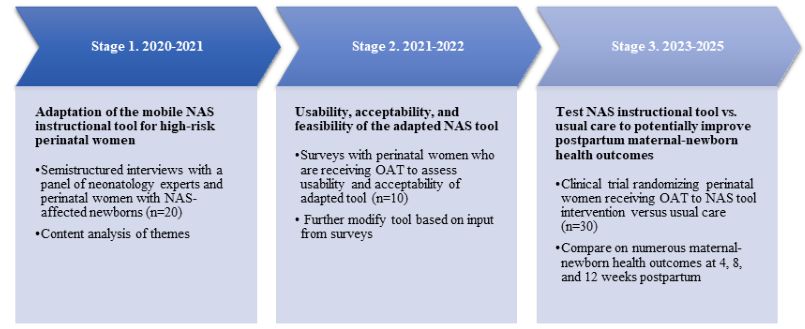
that promotes a soothing environment for the infant. Specific study (see Figure 1 for study stage and timeline) to adapt an
actions include low-stimulating environments (reduced noise existing mobile NAS tool for high-risk pregnant women and
and light), frequent and small feedings, swaddling, promotion assess its usability, acceptability, and feasibility in a small
of breastfeeding, and continual contact and soothing from the randomized controlled trial.
https://www.researchprotocols.org/2021/4/e27382 JMIR Res Protoc 2021 | vol. 10 | iss. 4 | e27382 | p. 2
(page number not for citation purposes)
XSL• FO
RenderXJMIR RESEARCH PROTOCOLS Burduli et al
Figure 1. Stage process and time line of study. NAS: neonatal abstinence syndrome; OAT: opioid agonist therapy.
resources, preparing for hospital length of stay, and preparing
Methods for possibly experiencing health care stigma). For example, one
Overview existing module is titled Epidemiology and Pathophysiology of
NAS, which provides considerable detail and medical
This study will be carried out in 3 stages. In stage 1, we will terminology. We expect that this module will need to be
conduct semistructured interviews with a panel of NAS care substantially reduced and only include a brief overview of this
experts and mothers with NAS-affected newborns until topic in a way that is appropriate for at-risk pregnant women.
saturation is reached (expected n=20) to document their We also expect that the adapted tool will include brand-new
perspectives and gather their recommendations on the care of educational modules and accompanying videos that visually
newborns with NAS. Although findings from stage 1 will demonstrate ESC-based caregiving skills that are known to
ultimately guide the adaptation of the existing mobile NAS tool soothe a NAS-affected newborn and prevent further
for high-risk pregnant women, the skills training in the adapted complications. We expect that the total number of modules for
tool will be largely based on elements of ESC. In stage 2, we perinatal women will not exceed 6.
will test the usability, acceptability, and feasibility of the adapted
mobile tool via surveys with 10 pregnant women receiving OAT After this initial process of modification, the modules will be
at 2 facilities in Washington: one that provides methadone as uploaded to a private account on YouTube, and all participating
its pharmacotherapy and another that primarily treats patients individuals (ie, NAS providers and mothers with NAS-affected
receiving buprenorphine as their pharmacotherapy. In stage 3, babies) will be given free web access (via a YouTube link) to
we will randomize 30 high-risk pregnant women seen at these the existing modules and will have the opportunity to review
facilities to either receive the adapted mobile NAS instructional the existing content before providing feedback on further
tool or usual care. We will compare these participants on necessary changes and modifications. They will be asked to
numerous maternal and newborn health outcomes at 4, 8, and provide their opinion on the relevance of a new audience
12 weeks postpartum, including primary outcomes—maternal (pregnant women in treatment for OUD). Once semistructured
OAT continuation and maternal drug relapse—and secondary interviews are completed and common themes are analyzed
outcomes—length of newborn hospital stay, readmission rates, using qualitative description methodology, we will schedule a
maternal-newborn bonding, breastfeeding initiation and duration, mini conference with the participants of this study stage (ie,
birth satisfaction, and postpartum depression and anxiety. NAS care experts and mothers with NAS-affected babies) to
discuss the interpretation of the qualitative findings and double
Adapting the Mobile NAS Tool for High-Risk Pregnant check for consistency that the planned adaptation of the mobile
Women NAS tool matches what the participants tried to convey.
All videos in the existing modules for NICU providers have a Although findings will ultimately guide the adaptation of the
script, with different content covered in each video. We will existing mobile NAS tool for high-risk pregnant women, the
modify these modules (eg, titles, scripts, and content reading skills training in the adapted tool will be largely based on
levels) to increase their relevance for high-risk pregnant women elements of ESC. Therefore, we anticipate that the NAS mobile
and for nonexperts. We expect that the adaption process will tool intervention will incorporate nonintrusive caregiving skills
require (1) the removal of existing educational modules that are and strategies that encompass providing a low-stimulating
not appropriate for at-risk pregnant women (eg, Epidemiology environment (eg, dimmed light and low noise), swaddling,
and Pathophysiology of NAS), (2) reduction of video lengths, continuous comfort and contact with the caregiver, skin-to-skin
and (3) development of modules based on qualitative findings contact, frequent feeding, and novel components identified in
that are appropriate for high-risk pregnant women (eg, the interviews.
ESC-based caregiving skills for mothers, postpartum maternal
https://www.researchprotocols.org/2021/4/e27382 JMIR Res Protoc 2021 | vol. 10 | iss. 4 | e27382 | p. 3
(page number not for citation purposes)
XSL• FO
RenderXJMIR RESEARCH PROTOCOLS Burduli et al
Stage 1: Adaptation of the Mobile NAS Instructional deidentified interview transcriptions will be uploaded into
Tool for Pregnant Women at Risk for Having NVivo version 11, a software program produced by QSR
Newborns With NAS International for qualitative research. The qualitative description
methodology described by Schreier [26] will be used to analyze
Setting and Data Collection the data. A qualitative description methodology is used when
We will recruit 10 pregnant and postpartum women from 2 the goal is to summarize descriptions of events or experiences
locations: a regional health district’s opioid treatment program in a way that depicts the perspectives of the participants [27,28].
and local recovery center to participate in the semistructured Common themes will be identified in the data (transcripts) to
interviews. Recruitment materials with contact information for provide definitions and details of the most prominent ideas
study staff and a link to a brief information statement that provided by participants’ responses. The qualitative description
describes the screening process and eligibility requirements will methodology will involve combing concept-driven and
be distributed to the 2 programs via email and presented at staff data-driven analysis approaches to the text; reliability will be
meetings to recruit the 10 pregnant and/or postpartum addressed by the process of having each researcher (ie, principal
participants. At least 10 NAS care experts (broadly defined as investigator, research coordinator, and research team) initially
any person providing NAS services such as, but not limited to, review and analyze the data before each meeting and then
nurses, social workers, obstetricians and gynecologists, and comparing consistency of agreement between the researchers,
neonatologists) will also be identified and contacted from and validity will be addressed by considering the applicability
existing partnerships with local and national hospitals. After a of the themes when compared with participants’ responses. An
verbal or PowerPoint description of the adapted module topics audit trail will be kept throughout the analysis process to
and content is provided and participants have a chance to ask document decisions and next steps.
questions, we will ask participants to provide feedback on the
Stage 2: Usability, Acceptability, and Feasibility of the
module topics and content (eg, “What do you think of the
Adapted NAS Tool
modules?” “Do you think you could use it with relative ease?
What are any challenges to using it?” “Are any topics missing Data Collection and Outcomes
from the modules? “Do you think this would help you care for We will recruit 10 pregnant women receiving OAT from 2
a baby with Neonatal Abstinence Syndrome after birth? If yes, locations: a regional health district’s opioid treatment program
how? If no, what could improve it?” “What do you think we and a local recovery center to participate in the survey, as
should add to this study?” “Any additional thoughts and described earlier in stage 1. Consented participants will be asked
suggestions about the modules?”). Each participant who to review the adapted content (via a private YouTube link)
completes the interview will receive a US $25 Amazon e-gift before completing the surveys. Once they review the adapted
card for their time and an additional US $25 Amazon gift card modules, they will be directed to complete a Research Electronic
for participation in a miniconference to discuss qualitative Data Capture survey that will assess several measures.
findings. All interviews will be conducted via video or phone Acceptability will be examined by the 8-item Client Satisfaction
conferences. Questionnaire (CSQ-8) to rate the overall satisfaction with the
Inclusion Criteria adapted NAS tool [29]. Usability will be assessed using the
10-item Systems Usability Scale (SUS), in which they are asked
Eligibility criteria were selected to allow for an accurate
to answer questions about a mobile app (eg, “I think that I would
assessment of challenges to NAS care and necessary
need the support of a technical person to be able to use this
evidence-based skills to care for NAS-affected newborns, while
app”) [30,31]. To assess feasibility, a measure of utility will be
maximizing generalizability of results. Inclusion criteria for
assessed via several questions (eg, “To what extent do you
NAS care experts are (1) NAS providers with significant
expect to be able to incorporate the NAS caregiving tool in your
expertise in NAS care, (2) age >18 years, and (3) ability to speak
daily activities during pregnancy and postpartum?”), tracking
and understand English. The inclusion criteria for pregnant and
how many times participants referred to specific modules within
postpartum participants are (1) a pregnant woman currently in
the mobile tool, and open-ended questions that ask participants
OAT for OUD or a postpartum woman who has experience
to comment on the feasibility of this tool along with overall
caring for NAS-affected newborns, (2) age >18 years, and (3)
impressions and comments on the tool (survey details are given
ability to speak and understand English. Participants not meeting
in Tables 1 and 2). Participants will receive a US $25 e-gift card
the eligibility criteria will be excluded.
for their time.
Data Analysis
All interviews will be digitally audio recorded and then
transcribed verbatim by a professional transcriptionist. The
https://www.researchprotocols.org/2021/4/e27382 JMIR Res Protoc 2021 | vol. 10 | iss. 4 | e27382 | p. 4
(page number not for citation purposes)
XSL• FO
RenderXJMIR RESEARCH PROTOCOLS Burduli et al
Table 1. Measures and timing of data collection for stage 3 randomized controlled trial.
Outcomes Baseline (during the third trimester) 4, 8, and 12 weeks postpartum
Demographic characteristics
Age ✓a N/Ab
Education level ✓ N/A
Marital status ✓ N/A
Time in OATc program ✓ N/A
Number and age of living children ✓ N/A
Employment ✓ N/A
Baseline characteristics
Addiction Severity Index-Lite ✓ N/A
Maternal Antenatal Attachment Scale ✓ N/A
Outcome measures
Addiction Severity Index-Lite ✓ ✓
Maternal Postpartum Attachment Scale N/A ✓
Birth Satisfaction Scale-Revised N/A ✓
Patient Health Questionnaire-9 N/A ✓
Parenting Stress Index N/A ✓
Client Satisfaction Questionnaire-8 N/A ✓
System Usability Scale N/A ✓
Length of hospital stay for newborn N/A ✓
Newborn hospital readmission N/A ✓
Breastfeeding initiation and duration N/A ✓
Maternal OAT continuation and relapse N/A ✓
d
Frequency of NAS tool use (weekly) ✓ ✓
a
Data collected.
b
N/A: not applicable.
c
OAT: opioid agonist therapy.
d
NAS: neonatal abstinence syndrome.
https://www.researchprotocols.org/2021/4/e27382 JMIR Res Protoc 2021 | vol. 10 | iss. 4 | e27382 | p. 5
(page number not for citation purposes)
XSL• FO
RenderXJMIR RESEARCH PROTOCOLS Burduli et al
Table 2. Outcomes and description of measures.
Study stage and outcome Study design Description of measures
Stage 1: NASa tool adaptation
Tool adaptation Semistructured inter- Semistructured interviews with a panel of NAS care experts and mothers with NAS-affected
views newborns until we reach saturation (expected n=10) to document their perspectives and gather
their recommendations on the care of newborns with NAS.
Stage 2: Usability, acceptability, and feasibility of the adapted NAS tool
Usability Survey Participants will complete a 10-item SUSb, in which they are asked to answer questions about
a mobile app (eg, “I think that I would need the support of a technical person to be able to use
this app”) using a 5-point Likert scale, ranging from strongly disagree to strongly agree. The
SUS is currently the industry standard for evaluation of a wide variety of products and services
such as software, mobile devices, websites, and apps [30,31]. The SUS has been shown to
successfully differentiate between usable and unusable systems, and it can be used in small
samples with reliable results [30,31].
Acceptability Survey Acceptability will be examined by the CSQ-8c to rate the overall satisfaction with the adapted
NAS tool [29]. CSQ-8 is a validated questionnaire measuring satisfaction with health services
(eg, “How would you rate the quality of care your received?”) that has been translated in more
than 30 languages [29,32,33]. Possible total scores on CSQ-8 range from 8 to 32, with higher
scores (>23) indicating greater satisfaction with health services.
Feasibility Survey To assess feasibility, a measure of utility will be assessed (eg, “To what extent do you expect
to be able to incorporate the NAS caregiving tool in your daily activities during pregnancy and
postpartum?”), tracking how many times participants referred to specific modules within the
mobile tool and open-ended questions that ask participants to comment on feasibility of this
tool along with overall impressions and comments.
Stage 3: Clinical trial comparing NAS tool with usual care
Demographic character- Randomized clinical Demographics and baseline characteristics, such as age, education, marital status, time in the
istics trial OATd program, number and age of living children, employment, and ASI-Litee, will be collected
at the start of the study to describe the sample and to serve as control variables when comparing
groups on the outcomes.
Maternal drug use and Randomized clinical Maternal drug use and relapse will be assessed via ASI-Lite, a standardized semistructured
relapse trial clinical interview that offers clinical information and assesses severity profiles in the following
domains: medical, employment, alcohol, drug, psychological, legal, and family and social [34].
It has been shown to have adequate to good internal consistency, good test-retest reliability,
independence across the domain composite scores, and agreement with the longer version of
the ASI-Lite [34].
OAT continuation Randomized clinical OAT continuation will be assessed via a single question (“Are you currently receiving OAT
trial (Yes or No)? Please explain”).
Length of newborn Randomized clinical These will be determined by single questions: length of newborn hospital stay (“how many
hospital stay and read- trial days did your newborn stay in the hospital”) and newborn hospital readmission (“has your
mission newborn been readmitted to the hospital for any reason after discharge? If yes, how many times?
Please list reasons for each readmission”).
Perinatal maternal-fetal Randomized clinical Prenatal maternal-fetal attachment will be measured with the Maternal Antenatal Attachment
attachment trial Scale [35,36], a reliable and validated 19-item measure of maternal-fetal attachment that includes
several response formats and assesses 2 dimensions: 1) quality of attachment (11 items) and 2)
intensity of preoccupation (8 items). The total scores range from 19 to 95, with higher scores
indicating a higher level of attachment to the fetus [35-39]. Maternal-newborn bonding will be
measured via MPASf [40,41]. It consists of 19 items assessing 3 dimensions: pleasure in inter-
action with the infant (5 items), absence of hostility toward the infant (5 items), and quality of
mother-infant attachment (9 items). Response categories range from 2-, 3-, 4-, to 5-point scales,
for different items. The total score ranges from 19 to 95, with higher scores indicating higher
maternal postpartum attachment to the baby. The MPAS has been found to have an acceptable
level of reliability (Cronbach α ranging from .75 to .79; test-retest reliability r=0.86; PJMIR RESEARCH PROTOCOLS Burduli et al
Study stage and outcome Study design Description of measures
Maternal Depression Randomized clinical Assess via the PHQ-9g, a psychometrically validated 9-item measure used to assess depression
trial in a variety of populations [45-47]. The PHQ-9 asks participants to report on the degree they
were bothered by 9 symptoms over the past 2 weeks (ie, “little interest or pleasure in doing
things” and “feeling down, depressed, or hopeless”), with response categories ranging from
0=not at all to 3=nearly every day and higher scores indicating greater levels of depression
symptomology.
Maternal stress Randomized clinical PSIh measures parental stress associated with the perception of having a difficult child or a
trial dysfunctional parent-child relationship and consists of 36 items that are rated on a 5-point
Likert scale (from 1=strongly agree to 5=strongly disagree), with higher scores indicative of
less total stress [48]. PSI has been shown to possess good psychometric properties and has been
validated in numerous samples, including high-risk families [49]. It includes parental distress,
parent-child dysfunctional interaction, and difficult child subscales, all of which will be consid-
ered individually. The child and parent domains can and will be combined to form a total stress
scale score.
Breastfeeding Randomized clinical Assessed via several questions “Are you currently breastfeeding? If yes, ‘How often do you
trial breastfeed your baby?’, if no, ‘How long did you breastfeed your baby.’”
Frequency of NAS tool Randomized clinical Throughout their third trimester and postpartum, we will also send participants a brief weekly
use trial web-based survey link asking about the previous week’s frequency of use of the adapted mobile
NAS tool and which specific modules participants viewed most, if any, to track weekly frequency
of use and preference of modules.
a
NAS: neonatal abstinence syndrome.
b
SUS: Systems Usability Scale.
c
CSQ-8: 8-item Client Satisfaction Questionnaire.
d
OAT: opioid agonist therapy.
e
ASI-Lite: Addiction Severity Index-Lite.
f
MPAS: Maternal Postpartum Attachment Scale.
g
PHQ-9: 9-item Patient Health Questionnaire
h
PSI: Parenting Stress Index short form.
intervention, as given in the Study Intervention section) or the
Inclusion Criteria control condition (ie, treatment as usual [TAU], as given in the
Participants will be pregnant women (1) who are in the third Study Intervention section). Participants will be asked to provide
trimester currently in OAT treatment for OUD, (2) aged >18 demographic and baseline information at this point. Women in
years, and (3) who are able to speak and understand English. the intervention condition will go through the mobile-based
Participants who did not meet the eligibility criteria will be NAS instructional tool at least once during pregnancy, with
excluded. their choice of going through the modules gradually while
waiting at the OAT clinic to receive their dose or by scheduling
Data Analysis
a time to review the modules with research staff outside of the
Descriptive analyses will be conducted using percentages, clinic (either at university offices or via a video conference).
means, and SDs to describe the feasibility and acceptability of Participants will be met with a research assistant who will
the adapted mobile NAS tool for pregnant women receiving provide them with an iPad and access to the modules (via a
OAT. All descriptive analyses will be conducted using STATA private YouTube link), and the research assistant will be
version 14.2. This developmental stage will not require limited available for any questions throughout the review. Participants
inferential tests because the sample sizes are small, and the will be able to create a YouTube account on the iPad and will
qualitative work will be the primary driver of the modifications be able to access, skip, pause, and continue the modules at any
to be made and eventually tested in a randomized trial in stage time during the duration of the study through the 12-week
3. follow-up period (ie, access after giving birth as well). They
Stage 3: Clinical Trial to Test the NAS Instructional will also be able to post questions or comments under private
Tool Versus Usual Care to Potentially Improve YouTube videos for research staff to see and address. Each
participant will also be scheduled for the 3 follow-up
Postpartum Maternal-Newborn Health Outcomes
appointments (at 4, 8, and 12 weeks postpartum). Follow-up
Data Collection and Inclusion Criteria appointments will consist of filling out surveys (Table 1).
Similar to previous stages, we will recruit 30 pregnant women Participants will be able to complete the survey on their phones
in their third trimester from the same 2 treatment centers to or iPads. For completing all study appointments, participants
participate in stage 3 of the study. After a brief phone screening, will receive a total of US $125 in Amazon e-gift cards (US $25
eligible participants will then be consented and randomized 1:1 after providing demographic and baseline information, US $25
into either the intervention condition (ie, adapted NAS tool after reviewing the modules with a research assistant, and an
https://www.researchprotocols.org/2021/4/e27382 JMIR Res Protoc 2021 | vol. 10 | iss. 4 | e27382 | p. 7
(page number not for citation purposes)
XSL• FO
RenderXJMIR RESEARCH PROTOCOLS Burduli et al
additional US $25 Amazon gift card for each of the 3 newborn hospital readmission (“Has your newborn been
follow-ups). The inclusion criteria are as follows: (1) a pregnant readmitted to the hospital for any reason after discharge? If yes,
woman currently undergoing OAT treatment for OUD, (2) age how many times? Please list reasons for each readmission.”),
>18 years, and (3) ability to speak and understand English. and breastfeeding (“Are you currently breastfeeding? If yes,
Exclusion criteria are as follows: recurring (eg, daily or almost ‘How often do you breastfeed your baby?’ if no, ‘How long did
daily) thoughts of harming themselves or others in the past 2 you breastfeed your baby?’”). Acceptability and satisfaction of
weeks. the NAS tool will also be examined at follow-up by the CSQ-8
to rate overall satisfaction with the adapted NAS tool [29].
Study Intervention Finally, participants will also complete the 10-item SUS [30,31]
TAU pregnant women in this condition will receive care as (Table 2). Throughout their third trimester and postpartum, we
usual, which involves continued enrollment in OAT and will also send participants a brief weekly web survey link asking
continued obstetric care. We will also provide them with a about the previous week’s frequency of use of the adapted
printed handout containing information on NAS and local mobile NAS tool and which specific modules participants
resources. This level of information meets or exceeds what most viewed the most, if any, to track weekly frequency of use and
mothers in this situation usually receive. Participants in the preference of modules.
TAU condition will not receive iPads with accompanying
modules; however, the handout constitutes more information Data Analysis
than they normally receive. Means (SDs) will be calculated for continuous variables, and
percentages will be calculated for categorical variables for the
Adapted NAS Tool Intervention 2 groups (intervention group and TAU group) at each
Pregnant women in this condition will receive the adapted assessment. Demographic and baseline characteristics will be
mobile-based NAS instructional tool and TAU. Women in this tested across intervention versus TAU via independent-samples
condition will go through the NAS instructional tool at least t tests and one-way analysis of variance (for continuous
once during pregnancy, with their choice of going through the variables) and chi-square tests (for categorical variables).
modules gradually while waiting at the OAT clinic to receive Generalized estimating equations will be used to analyze the
their dose or by scheduling a time to review the modules. primary longitudinal outcomes of maternal drug relapse and
Participants will have free web access to the tool throughout OAT continuation and secondary outcomes and to control for
their third trimester and through 12 weeks postpartum so they any baseline demographic differences across groups, where
can access the modules at any time and as many times as desired, intervention versus TAU remains as the primary independent
including after giving birth. Women will be randomized 1:1 to variable. Analyses will control for baseline and demographic
the intervention or TAU conditions. outcomes and time. All inferential results will be presented as
odds ratios with 95% CIs for binary outcomes and
Data Collection and Outcomes
unstandardized regression coefficients with 95% CIs for
Although the primary outcomes of focus will be maternal drug continuous outcomes. We will use an α error rate of .05 as the
relapse (assessed via Addiction Severity Index-Lite) and OAT threshold for statistical significance. All analyses will be
continuation (“Are you currently receiving OAT (Yes or No)? conducted using STATA version 14.2.
Please explain.”), because of the exploratory nature of this trial,
several other outcomes of interest will also be assessed. At the Results
3 follow-up appointments, participants will complete several
measures assessing numerous maternal-newborn outcomes: the This project was funded in July 2020 (see Multimedia Appendix
9-item Patient Health Questionnaire, a psychometrically 1 for grant review summary statement) and approved by the
validated 9-item measure used to assess depression in a variety institutional review board in April 2020. Data collection for
of populations [45-47]; the Birth Satisfaction Scale-Revised, a stage 1 began in December 2020, and as of January 2021, we
10-item, Likert-type, birth satisfaction questionnaire that completed 18 semistructured interviews (10 with NAS providers
measures experiences of childbearing, stress, quality of care, and 8 with perinatal women receiving OAT). Common themes
and women’s attributes and that was psychometrically validated from all interviews will be analyzed in spring 2021 to inform
in the United States by our research team [42-44]; the Parenting the adaptation of the NAS caregiving tool. Results from stage
Stress Index short form, which measures parental stress 1 are expected to be published in summer 2021. Stage 2 data
associated with the perception of having a difficult child or a collection will commence in fall 2021, followed by the
dysfunctional parent-child relationship and consists of 36 items randomized controlled trial in stage 3 in late 2022.
[48]; and the Maternal Postpartum Attachment Scale (MPAS)
[40,41], which measures maternal-newborn bonding. The MPAS Discussion
consists of 19 items assessing 3 dimensions: pleasure in
interaction with the infant (5 items), absence of hostility toward Conclusions
the infant (5 items), and quality of mother-infant attachment (9 This study is highly innovative in several ways. First, despite
items), with higher scores indicating higher maternal postpartum the need to educate pregnant women at risk for delivering
attachment to the baby [37,40,41]. We will also collect other NAS-affected newborns and equip them with the skills necessary
outcome measures, including the length of newborn hospital to successfully care for a newborn with NAS when they are
stay (“How many days did your newborn stay in the hospital”), pregnant, no published evidence-based interventions exist to
https://www.researchprotocols.org/2021/4/e27382 JMIR Res Protoc 2021 | vol. 10 | iss. 4 | e27382 | p. 8
(page number not for citation purposes)
XSL• FO
RenderXJMIR RESEARCH PROTOCOLS Burduli et al
prepare future mothers of potential NAS-affected babies. This gather data on efficacy and inform a fully powered randomized
study will be the first to adapt an existing mobile NAS tool and controlled trial. Second, recruitment below expectation and
develop an intervention for use with high-risk pregnant women attrition are always possible. If recruitment becomes difficult,
and may be the first NAS-related intervention strategy designed we will hold problem-solving meetings with program staff and
to be administered to pregnant women in an OAT setting. research team on recruitment and study advertisement strategies.
Second, if effective, the mobile nature of our new tool will be However, given our proposed study sample of n=30, we foresee
readily scalable and well suited to tailoring for other populations no issue with obtaining our target enrollment across the 2
of high-risk women (ie, with alcohol and or SUDs) of recruitment sites. Third, although attrition can be high in
reproductive age. Moreover, such a tool will also be easy to high-risk populations, our participants will already be embedded
update and modify, as more evidence emerges for how best to within the OAT system and, therefore, already engaged with
treat NAS. Although the tool is still too new to evaluate its cost services.
efficiency, this study will prepare this tool for future analysis
All activities outlined in the proposed application to develop
in the context of a larger study.
and evaluate the mobile NAS caregiving intervention are
Strengths and Limitations accompanied with enhancing and evaluating the contextual fit
The scope of the project is unavoidably limited. First, the (eg, acceptability and appropriateness) of the NAS caregiving
relatively small number of sites and pregnant women intervention to support the application and scalability of this
participating in stage 3 hinders generalizability and the ability tool. This new tool will be designed to remain flexible to novel
to determine effectiveness. However, this novel and critically scientific breakthroughs in this domain such that new and
relevant trial capitalizes on existing investments to allow us to modified modules can be easily created and integrated into this
unique educational platform.
Acknowledgments
This work was supported by funding from the National Institute on Drug Abuse (K01DA051780; PI: EB). This funding source
had no role other than financial support.
Authors' Contributions
All authors materially participated in the research and manuscript preparation and contributed significantly to the manuscript. In
addition, all authors have read and approved the final manuscript. EB developed the concept and design of the study and drafted
the first version of the study protocol and manuscript. SM, HJ, JR, CBL, and RJ contributed to the study design and revised the
subsequent versions of the study protocol and manuscript. OB helped with institutional review board documentation for the study
protocol, data collection, and manuscript draft preparation and revision. All authors have read and approved the final manuscript.
Conflicts of Interest
SM and JR received research funding from the Bristol-Myers Squibb Foundation. SM received research funding from Ringful
Health, LLC. SM also received research funding from Orthopedic Specialty Institute and consulted for the Consistent Care
company. This funding was not related to the investigation reported here. None of the other authors have any financial, personal,
or other type of relationship that would cause a conflict of interest that would inappropriately impact or influence the research
and interpretation of the findings.
Multimedia Appendix 1
Grant review summary statement from the NIH.
[PDF File (Adobe PDF File), 145 KB-Multimedia Appendix 1]
References
1. Dramatic increases in maternal opioid use and neonatal abstinence syndrome. National Institute on Drug Abuse. 2019.
URL: https://www.drugabuse.gov/drug-topics/trends-statistics/infographics/
dramatic-increases-in-maternal-opioid-use-neonatal-abstinence-syndrome [accessed 2019-05-21]
2. Patrick SW, Richards MR, Dupont WD, McNeer E, Buntin MB, Martin PR, et al. Association of pregnancy and insurance
status with treatment access for opioid use disorder. JAMA Netw Open 2020 Aug 03;3(8):- [FREE Full text] [doi:
10.1001/jamanetworkopen.2020.13456] [Medline: 32797175]
3. Short VL, Hand DJ, MacAfee L, Abatemarco DJ, Terplan M. Trends and disparities in receipt of pharmacotherapy among
pregnant women in publically funded treatment programs for opioid use disorder in the United States. J Subst Abuse Treat
2018 Jun;89:67-74. [doi: 10.1016/j.jsat.2018.04.003] [Medline: 29706175]
4. Kocherlakota P. Neonatal abstinence syndrome. Pediatrics 2014 Aug 28;134(2):547-561. [doi: 10.1542/peds.2013-3524]
[Medline: 25070299]
https://www.researchprotocols.org/2021/4/e27382 JMIR Res Protoc 2021 | vol. 10 | iss. 4 | e27382 | p. 9
(page number not for citation purposes)
XSL• FO
RenderXJMIR RESEARCH PROTOCOLS Burduli et al
5. Reid CN, Foti TR, Mbah AK, Hudak ML, Balakrishnan M, Kirby RS, et al. Multilevel factors associated with length of
stay for neonatal abstinence syndrome in Florida's NICUs: 2010-2015. J Perinatol 2020 Sep 16. [doi:
10.1038/s41372-020-00815-8] [Medline: 32939026]
6. Winkelman TN, Villapiano N, Kozhimannil KB, Davis MM, Patrick SW. Incidence and costs of neonatal abstinence
syndrome among infants with medicaid: 2004-2014. Pediatrics 2018 Apr 23;141(4):- [FREE Full text] [doi:
10.1542/peds.2017-3520] [Medline: 29572288]
7. Haight SC, Ko JY, Tong VT, Bohm MK, Callaghan WM. Opioid use disorder documented at delivery hospitalization -
United States, 1999-2014. MMWR Morb Mortal Wkly Rep 2018 Aug 10;67(31):845-849 [FREE Full text] [doi:
10.15585/mmwr.mm6731a1] [Medline: 30091969]
8. Honein MA, Boyle C, Redfield RR. Public health surveillance of prenatal opioid exposure in mothers and infants. Pediatrics
2019 Mar 17;143(3):- [FREE Full text] [doi: 10.1542/peds.2018-3801] [Medline: 30655335]
9. Wachman EM, Schiff DM, Silverstein M. Neonatal abstinence syndrome: advances in diagnosis and treatment. J Am Med
Assoc 2018 Apr 03;319(13):1362-1374. [doi: 10.1001/jama.2018.2640] [Medline: 29614184]
10. McQueen K, Murphy-Oikonen J. Neonatal abstinence syndrome. N Engl J Med 2016 Dec 22;375(25):2468-2479. [doi:
10.1056/nejmra1600879]
11. Finnegan L, Connaughton JJ, Kron R, Emich J. Neonatal abstinence syndrome: assessment and management. Addict Dis
1975;2(1-2):141-158. [Medline: 1163358]
12. Patrick SW, Burke JF, Biel TJ, Auger KA, Goyal NK, Cooper WO. Risk of hospital readmission among infants with
neonatal abstinence syndrome. Hosp Pediatr 2015 Oct 01;5(10):513-519 [FREE Full text] [doi: 10.1542/hpeds.2015-0024]
[Medline: 26427919]
13. Witt CE, Rudd KE, Bhatraju P, Rivara FP, Hawes SE, Weiss NS. Neonatal abstinence syndrome and early childhood
morbidity and mortality in Washington state: a retrospective cohort study. J Perinatol 2017 Oct 6;37(10):1124-1129 [FREE
Full text] [doi: 10.1038/jp.2017.106] [Medline: 28682319]
14. Mangat AK, Schmölzer GM, Kraft WK. Pharmacological and non-pharmacological treatments for the Neonatal Abstinence
Syndrome (NAS). Semin Fetal Neonatal Med 2019 Apr;24(2):133-141 [FREE Full text] [doi: 10.1016/j.siny.2019.01.009]
[Medline: 30745219]
15. Velez M, Jansson LM. The Opioid dependent mother and newborn dyad: non-pharmacologic care. J Addict Med 2008
Sep;2(3):113-120 [FREE Full text] [doi: 10.1097/ADM.0b013e31817e6105] [Medline: 19727440]
16. MacMillan KDL, Rendon CP, Verma K, Riblet N, Washer DB, Volpe Holmes A. Association of rooming-in with outcomes
for neonatal abstinence syndrome: a systematic review and meta-analysis. JAMA Pediatr 2018 Apr 01;172(4):345-351
[FREE Full text] [doi: 10.1001/jamapediatrics.2017.5195] [Medline: 29404599]
17. Hudak ML, Tan RC, Committee on Drugs, Committee on Fetus and Newborn, American Academy of Pediatrics. Neonatal
drug withdrawal. Pediatrics 2012 Feb 30;129(2):540-560. [doi: 10.1542/peds.2011-3212] [Medline: 22291123]
18. ACOG Committee on Health Care for Underserved Women, American Society of Addiction Medicine. ACOG Committee
Opinion No. 524: opioid abuse, dependence, and addiction in pregnancy. Obstet Gynecol 2012 May;119(5):1070-1076.
[doi: 10.1097/AOG.0b013e318256496e] [Medline: 22525931]
19. Obstetric care for women with opioid use disorder. Council on Patient Safety In Women’s Health Care. URL: https:/
/safehealthcareforeverywoman.org/wp-content/uploads/2017/11/Obstetric-Care-for-OUD-Bundle.pdf [accessed 2019-06-18]
20. Grossman MR, Lipshaw MJ, Osborn RR, Berkwitt AK. A novel approach to assessing infants with neonatal abstinence
syndrome. Hosp Pediatr 2018 Jan 20;8(1):1-6. [doi: 10.1542/hpeds.2017-0128] [Medline: 29263121]
21. Suchman N, Mayes L, Conti J, Slade A, Rounsaville B. Rethinking parenting interventions for drug-dependent mothers:
from behavior management to fostering emotional bonds. J Subst Abuse Treat 2004 Oct;27(3):179-185. [doi:
10.1016/j.jsat.2004.06.008] [Medline: 15501370]
22. Casper T, Arbour M. Evidence-based nurse-driven interventions for the care of newborns with neonatal abstinence syndrome.
Adv Neonatal Care 2014 Dec;14(6):376-380. [doi: 10.1097/ANC.0000000000000118] [Medline: 25068529]
23. Abrahams RR, Kelly SA, Payne S, Thiessen PN, Mackintosh J, Janssen PA. Rooming-in compared with standard care for
newborns of mothers using methadone or heroin. Can Fam Physician 2007 Oct;53(10):1722-1730 [FREE Full text] [Medline:
17934036]
24. Wilder C, Lewis D, Winhusen T. Medication assisted treatment discontinuation in pregnant and postpartum women with
opioid use disorder. Drug Alcohol Depend 2015 Apr 01;149:225-231. [doi: 10.1016/j.drugalcdep.2015.02.012] [Medline:
25735465]
25. Burduli E, Smith CL, Tham P, Shogan M, Johnson RK, McPherson SM. Development and application of a primer and
reference assessment tool for neonatal abstinence syndrome: a phase I pilot study. Contemp Clin Trials Commun 2020
Mar;17:- [FREE Full text] [doi: 10.1016/j.conctc.2019.100494] [Medline: 31867467]
26. Schreier M. Qualitative content analysis in practice. In: The SAGE Handbook of Qualitative Data Analysis. Thousand
Oaks, CA: SAGE Publications Ltd; 2014.
27. Sandelowski M. What's in a name? Qualitative description revisited. Res Nurs Health 2010 Feb 10;33(1):77-84. [doi:
10.1002/nur.20362] [Medline: 20014004]
https://www.researchprotocols.org/2021/4/e27382 JMIR Res Protoc 2021 | vol. 10 | iss. 4 | e27382 | p. 10
(page number not for citation purposes)
XSL• FO
RenderXJMIR RESEARCH PROTOCOLS Burduli et al
28. Sandelowski M. Whatever happened to qualitative description? Res Nurs Health 2000 Aug;23(4):334-340. [doi:
10.1002/1098-240x(200008)23:43.0.co;2-g]
29. Larsen DL, Attkisson CC, Hargreaves WA, Nguyen TD. Assessment of client/patient satisfaction: development of a general
scale. Evaluation and Program Planning 1979 Jan;2(3):197-207. [doi: 10.1016/0149-7189(79)90094-6]
30. Bangor A, Kortum P, Miller J. Determining what individual SUS scores mean: adding an adjective rating scale. J Usability
Stud. 2009. URL: https://uxpajournal.org/determining-what-individual-sus-scores-mean-adding-an-adjective-rating-scale/
[accessed 2021-03-17]
31. System Usability Scale (SUS). 2019. URL: https://www.usability.gov/how-to-and-tools/methods/system-usability-scale.
html [accessed 2019-08-12]
32. Attkisson CC, Zwick R. The client satisfaction questionnaire: psychometric properties and correlations with service utilization
and psychotherapy outcome. Eval Program Plann 1982 Jan;5(3):233-237. [doi: 10.1016/0149-7189(82)90074-x]
33. Attkisson CC, Zwick R. Client Satisfaction Questionnaire-8. APA PsycTests: Citation and Description. 1982. URL: https:/
/doi.apa.org/doiLanding?doi=10.1037%2Ft50119-000 [accessed 2021-03-17]
34. Cacciola JS, Alterman AI, McLellan AT, Lin Y, Lynch KG. Initial evidence for the reliability and validity of a "Lite"
version of the Addiction Severity Index. Drug Alcohol Depend 2007 Mar 16;87(2-3):297-302. [doi:
10.1016/j.drugalcdep.2006.09.002] [Medline: 17045423]
35. Busonera A, Cataudella S, Lampis J, Tommasi M, Zavattini GC. Investigating validity and reliability evidence for the
Maternal Antenatal Attachment Scale in a sample of Italian women. Arch Womens Ment Health 2016 Apr 21;19(2):329-336.
[doi: 10.1007/s00737-015-0559-3] [Medline: 26189447]
36. Condon JT. The assessment of antenatal emotional attachment: development of a questionnaire instrument. Br J Med
Psychol 1993 Jun;66 ( Pt 2):167-183. [doi: 10.1111/j.2044-8341.1993.tb01739.x] [Medline: 8353110]
37. van Bussel JCH, Spitz B, Demyttenaere K. Three self-report questionnaires of the early mother-to-infant bond: reliability
and validity of the Dutch version of the MPAS, PBQ and MIBS. Arch Womens Ment Health 2010 Oct 2;13(5):373-384.
[doi: 10.1007/s00737-009-0140-z] [Medline: 20127128]
38. Mako HS. Reliability and validity of the Hungarian version of the maternal antenatal attachment scale. Int J Gynecol Obst
Res 2014 Jun;2(1):33-44. [doi: 10.14205/2309-4400.2014.02.01.5]
39. Schwerdtfeger KL, Goff BSN. Intergenerational transmission of trauma: exploring mother-infant prenatal attachment. J
Trauma Stress 2007 Feb;20(1):39-51. [doi: 10.1002/jts.20179] [Medline: 17345647]
40. Condon JT, Corkindale CJ. The assessment of parent-to-infant attachment: development of a self-report questionnaire
instrument. J Reprod Infant Psychol 1998 Feb;16(1):57-76. [doi: 10.1080/02646839808404558]
41. Scopesi A, Viterbori P, Sponza S, Zucchinetti P. Assessing mother‐to‐infant attachment: the Italian adaptation of a
self‐report questionnaire. J Reprod Infant Psychol 2004 May;22(2):99-109. [doi: 10.1080/0264683042000205963]
42. Burduli E, Barbosa-Leiker C, Fleming S, Hollins Martin CJ, Martin CR. Cross-cultural invariance of the Birth Satisfaction
Scale-Revised (BSS-R): comparing UK and US samples. J Reprod Infant Psychol 2017 Jul 13;35(3):248-260. [doi:
10.1080/02646838.2017.1310374] [Medline: 29517312]
43. Hollins Martin CJH, Martin CR. Development and psychometric properties of the Birth Satisfaction Scale-Revised (BSS-R).
Midwifery 2014 Jun;30(6):610-619. [doi: 10.1016/j.midw.2013.10.006] [Medline: 24252712]
44. Barbosa-Leiker C, Fleming S, Hollins Martin CJ, Martin CR. Psychometric properties of the Birth Satisfaction Scale-Revised
(BSS-R) for US mothers. J Reprod Infant Psychol 2015 Apr 10;33(5):504-511. [doi: 10.1080/02646838.2015.1024211]
45. Kroenke K, Spitzer RL, Williams JBW. The PHQ-9: validity of a brief depression severity measure. J Gen Intern Med
2001 Sep;16(9):606-613 [FREE Full text] [doi: 10.1046/j.1525-1497.2001.016009606.x] [Medline: 11556941]
46. Manea L, Gilbody S, McMillan D. Optimal cut-off score for diagnosing depression with the Patient Health Questionnaire
(PHQ-9): a meta-analysis. Can Med Assoc J 2012 Feb 21;184(3):191-196 [FREE Full text] [doi: 10.1503/cmaj.110829]
[Medline: 22184363]
47. Santos IS, Tavares BF, Munhoz TN, Manzolli P, de Ávila GB, Jannke E, et al. Patient health questionnaire-9 versus
Edinburgh postnatal depression scale in screening for major depressive episodes: a cross-sectional population-based study.
BMC Res Notes 2016 Sep 27;9(1):453 [FREE Full text] [doi: 10.1186/s13104-016-2259-0] [Medline: 27677844]
48. Abidin RR. Parenting Stress Index. APA PsycTests: Citation and Description 1990. [doi: 10.1037/t02445-000]
49. Barroso NE, Hungerford GM, Garcia D, Graziano PA, Bagner DM. Psychometric properties of the Parenting Stress
Index-Short Form (PSI-SF) in a high-risk sample of mothers and their infants. Psychol Assess 2016 Oct;28(10):1331-1335
[FREE Full text] [doi: 10.1037/pas0000257] [Medline: 26595220]
Abbreviations
CSQ-8: 8-item Client Satisfaction Questionnaire
ESC: Eat, Sleep, and Console
MPAS: Maternal Postpartum Attachment Scale
NAS: neonatal abstinence syndrome
NICU: neonatal intensive care unit
https://www.researchprotocols.org/2021/4/e27382 JMIR Res Protoc 2021 | vol. 10 | iss. 4 | e27382 | p. 11
(page number not for citation purposes)
XSL• FO
RenderXJMIR RESEARCH PROTOCOLS Burduli et al
OAT: opioid agonist therapy
OUD: opioid use disorder
SUD: substance use disorder
SUS: Systems Usability Scale
TAU: treatment as usual
Edited by T Derrick;This paper was peer reviewed by the Clinical Management of Patients in Community-based Settings Study Section
(National Institutes of Health). See the Multimedia Appendix for the peer-review report; Submitted 05.03.21; accepted 08.03.21;
published 15.04.21.
Please cite as:
Burduli E, Jones HE, Brooks O, Barbosa-Leiker C, Johnson RK, Roll J, McPherson SM
Development and Implementation of a Mobile Tool for High-Risk Pregnant Women to Deliver Effective Caregiving for Neonatal
Abstinence Syndrome: Protocol for a Mixed Methods Study
JMIR Res Protoc 2021;10(4):e27382
URL: https://www.researchprotocols.org/2021/4/e27382
doi: 10.2196/27382
PMID:
©Ekaterina Burduli, Hendrée E Jones, Olivia Brooks, Celestina Barbosa-Leiker, Ron Kim Johnson, John Roll, Sterling Marshall
McPherson. Originally published in JMIR Research Protocols (http://www.researchprotocols.org), 15.04.2021. This is an
open-access article distributed under the terms of the Creative Commons Attribution License
(https://creativecommons.org/licenses/by/4.0/), which permits unrestricted use, distribution, and reproduction in any medium,
provided the original work, first published in JMIR Research Protocols, is properly cited. The complete bibliographic information,
a link to the original publication on http://www.researchprotocols.org, as well as this copyright and license information must be
included.
https://www.researchprotocols.org/2021/4/e27382 JMIR Res Protoc 2021 | vol. 10 | iss. 4 | e27382 | p. 12
(page number not for citation purposes)
XSL• FO
RenderXYou can also read


