Disclaimer for sharing or use of any of this presentation
←
→
Page content transcription
If your browser does not render page correctly, please read the page content below

Disclaimer for sharing or use of
    any of this presentation

If you share or use this presentation, any parts of it, or any of the
info in it is used, please ensure you always credit the Ohio
Cardiovascular Health Collaborative (Cardi-OH) AND you provide a
link to www.cardi-oh.org

Please also send the link to where it is being used to Cardi-OH
using the contact email: info@cardi-oh.org
Engaging Patients
in Their Care:
Medication
Adherence &
Health Literacy in
Clinical Practice
Sarah Aldrich, PharmD
Bree Meinzer, PharmD
Joseph K. Daprano, MD, FAAP, MACP
Joseph J. Sudano, PhD
Objectives
1. Describe the impact of medication nonadherence and low
   health literacy
2. Identify different tools that can be used in primary care to
   identify patients with low health literacy and
   nonadherence
3. Review strategies to improve medication adherence and
   health literacy

                                                                  3
Disclosures
The following planners, speakers, moderators, and/or panelists of the CME
activity have no financial relationships with commercial interests to disclose:
Sarah Aldrich, PharmD
Bree Meinzer, PharmD
Joseph K Daprano, MD, FAAP, MACP
Joseph J Sudano, PhD
The Ohio Cardiovascular Health Collaborative is funded by the Ohio Department of Medicaid and administered by the Ohio Colleges of Medicine Government
Resource Center. The views expressed in this presentation are solely those of the authors and do not represent the views of the state of Ohio or federal
Medicaid programs.
4Medication
Adherence
Sarah Aldrich, PharmD & Bree Meinzer, PharmD
University of Toledo College of Pharmacy and
Pharmaceutical Sciences
University of Toledo Medical CenterWhat is adherence?
Extent to which medication intake behavior
Adherence     corresponds with the recommendations of the
              provider

Compliance    Extent to which the patient follows the
              recommendations of the provider

              Length of time between the first and last
Persistence   dose (when patient discontinues
              treatment)

                                     Hugtenburg JG, et al. Patient Preference
                                     and Adherence, 2013.7:675-82.              7
Intentional vs. Unintentional
Nonadherence
Unintentional Intentional
Unplanned behavior Patient ACTIVELY
that is not commonly decides not to use
linked to beliefs or treatment or follow
cognition recommendations
Hugtenburg JG, et al. Patient Preference 8
and Adherence, 2013.7:675-82.Measuring Adherence
• Proportion of Days Covered (PDC)
• CMS defines adherence as a PDC >80%
• Medication Possession Ratio
9
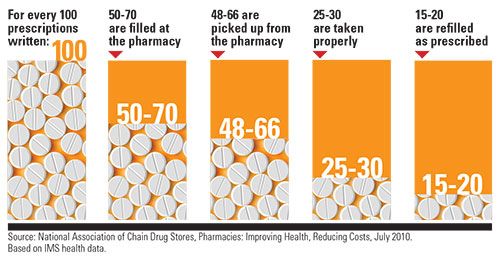
Crowe M. Pharmacy times. 2015.Impact of Nonadherence
National Data

                11
Ohio Medicaid Data 2017-2018
• Only 1/3 of Medicaid enrollees (132,685/424,851) age 18-
64 years old with a hypertension diagnosis filled a blood
pressure (BP) prescription
• Of those who filled at least 1 BP medication (n=292,166),
7% filled their BP medication only once making it
impossible to calculate their adherence
• Of those who filled the BP medications at least twice
(n=271,963), 64% were considered adherent (MPR>80%)
12What factors contribute to medication nonadherence?
Five Dimensions of Adherence
Social and Economic
    ●    Low health literacy                  05                             Patient-Related
    ●    Medication cost                                                 ●    Visual, hearing,
    ●    Lack of health                                                       cognitive impairment
         insurance                                                       ●    Perceived risk of
                               01                          04                 disease
                                                                         ●    Perceived benefit of
                                                                              treatment

Health Care System                                                           Therapy-Related
●       Lack of care                    02            03                 ●    Complexity of
        continuity                                                            regimen
●       Restricted                                                       ●    Frequent changes
        formularies                                                      ●    Actual or perceived
●       Long wait times                 Condition-Related                     side effects
                                    ●    Lack of symptoms
                                    ●    Depression
                                    ●    Severity of symptoms   Sabate E. World Health Organization. 2003.
                                                                                                        14
Common Contributing Factors for
Nonadherence
Actual or perceived; Relation
01
●
Adverse Effect
to benefit of treatment
02 Cost
Health literacy; Risk of disease vs.
Lack of
●
03 Understanding
benefit of treatment; Lack of
symptoms; Mistrust
04 Forgetfulness
● Too many medications; Multiple
05 Regimen Complexity dosing times; specific medication
instructions 15Investigating Medication
Nonadherence
Objective Information
• Claims Data
• How often has the medication been filled within a 90 day period?
• Clinical Data
• Limited or no improvement in signs or symptoms
Subjective Information
• Motivational Interviewing
• Creating a no-judgement / honest environment
16How do we improve medication adherence?
Overcoming Medication Nonadherence

                              Prescribe alternative; Switch formulation;
01   Adverse Effect
                          ●

                              Address perceived AE

                          ●   Coupons; $4 lists/$0 copay at specific
02   Cost                     pharmacies; Investigate insurance
                              formulary

     Lack of
03   Understanding
                          ●   Education

                              Set alarms; Keep pills visible;
04   Forgetfulness
                          ●

                              Incorporate into other routine

                          ●   Change product or formulation;
05   Regimen Complexity       Deprescribing; Medication
                              Synchronization
                                                                           18
Patient Specific Approach to Medication Adherence
Case #1
PA is a 57 yo WM with PMH of HTN, HLD, T2DM
• BP: 160/94, HbA1c: 7.0%, and lipid panel is wnl
• Medications: atorvastatin 20mg daily, metformin 1000mg BID,
  and lisinopril 5mg daily
• You are discussing with him about increasing his lisinopril 5mg
  daily. PA mentions that it doesn’t matter much, because he
  doesn’t take his lisinopril anyway. Upon further questioning, he
  states “I don’t feel any different if I take it, so why bother?”
• How do you respond to the patient?

                                                                     20
Case #2
CM is a retired 78 yo African American female with PMH of CHF,
HTN, HLD, CKD & T2DM
• BP: 148/86, EF: 30%, LDL: 160, HDL: 38, TG: 172, HbA1c: 7.4%
• Medications: Entresto 49mg/51mg BID, carvedilol 6.25mg BID,
rosuvastatin 10mg daily, metformin 1,000mg BID, Januvia
100mg daily
• At the appointment, you notice that some of CM’s pill bottles are
empty. Upon further questioning, she states “I can’t afford to all
of the medications and I know how important it is to take them.
In order to save money, I pick up half of them one month and
pick up the rest the next month.”
• How can we improve the patient’s adherence?
21Case #3
TA is a 62 year-old Caucasian female with a PMH of T2DM,
HTN, and depression
• BP: 124/84, HR: 70, A1c 6.9%, TG: 100, Total cholesterol 110, LDL:
70, HDL 51
• Medications: metformin 1000 mg BID, Lantus 15 units QHS, lisinopril
40 mg daily, atorvastatin 40 mg daily and citalopram 20 mg daily
• She presents to clinic complaining of left hip pain that extends
through her left thigh. Her sister told her it was probably the “statin
drug” because she no longer takes hers due to muscle pain. She
states, “I have enough aches and pains, I do not need a medication to
make it worse.”
• How do you respond to the patient?
22Case #4
SR is a 52 year-old caucasian male with a PMH of HTN, CAD, and anxiety
• BP: 142/90 mmHg, HR: 75, FLP within normal limits
• Medications: lisinopril 40 mg daily, HCTZ 25 mg daily, metoprolol tartrate 25
mg BID, atorvastatin 80 mg daily, ASA 81 mg daily and fluoxetine 20 mg
daily
• During the visit, the patient admits that he often forgets to take his second
dose of metoprolol. He often falls asleep before remembering the dose.
• How can we improve this patient’s adherence?
23Adherence Chart Example 1
Drug For: Dose: Breakfast/Lunch Supper/Bedtime
Aspirin 81mg daily Heart
1 tab X
Metoprolol tartrate Blood
Pressure
½ tab ½ ½
25mg twice daily
Multivitamin daily Supplement
1 tab X
Tradjenta 5mg daily Diabetes
1 tab X
Lisinopril 5mg daily Blood
Pressure
1 tab X
Caduet 5/20mg daily Blood
Pressure
1 tab X
(contains Amlodipine 5mg 24
And
and atorvastatin 20mg)Adherence Chart Example 2
Drug Dose: Breakfast Lunch Dinner Bed
Terazosin 2mg twice daily 1 cap X X
Sertraline 100mg twice daily X (1 tab) X (1.5
tabs)
Omeprazole 20mg twice daily 1 cap X X
Mirtazapine 15mg daily at 1.5 tabs X
bedtime
Atorvastatin 20mg daily 1 tab X
Lyrica 25mg 3 times daily 1 tab X X X
Warfarin 2.5mg (0.5-1 tab) daily Dosed by Anticoag Clinic
25Adherence Chart Example 3
Drug Dose: Breakfast Lunch Dinner Bed
Losartan 25 mg twice daily 1 tab
Omeprazole 20mg twice daily 1 cap
Zolpidem 5 mg daily at bedtime 1 tab
Atorvastatin 20mg daily 1 tab
Gabapentin 100 mg 3 times daily 1 cap
26Questions?
References
Baumgartner PC, Haynes RB, Hersberger KE, Arnet I. A systematic review of medication adherence thresholds dependent on clinical outcomes. Front Pharmacol. 2018; 9:1290.

Crowe M. Do you know the difference between these adherence measures. Pharmacy times. 2015. Accessed 19 March 2019. Available from: https://www.pharmacytimes.com.

Hinson J, Garofoli G, Elswick B. The impact of medication synchronization on quality care criteria in an independent community pharmacy. J Am Pharm Assoc. 2017; 57(2): 236-240.
Hugtenburg JG, Timmers L, Elders P, Vervloet M, Dijk LV. Definitions, variants and causes of nonadherence with medications: a challenge for tailored interventions. Patient Preference and
Adherence. July 2013. 7:675-682.

Kefale B, Tadesse Y, Alebachew M, Engidawork E. Management practice, and adherence and its contributing factors among patients with chronic kidney disease at Tikur Anbessa
Specialized Hospital: A hospital-based cross-sectional study. PLoS One. 2018;13(7):e0200415.

Lycett H, Wildman E, Raebel E, et al. Treatment perceptions in patient with asthma: synthesis of factors influencing adherence. Resp Med. 2018; 141:180-189.

Measuring adherence. American Pharmacist Association. https://www.pharmacist.com/measuring-adherence?is_sso_called=1. Accessed March 13, 2019.
Naqvi AA, Hassali MA, Aftab MT, Nadir MN. A qualitative study investigating perceived barrier to medication adherence in chronic illness patients of Karachi, Pakistan. J Pak Med Assoc.
2019; 69 (2):216-223.

Patton DE, Cadogan CA, Ryan C, et al. Improving adherence to multiple medications in older people in primary care: Selecting intervention components to address patient-reported
barriers and facilitators. Health Expect. 2017;21(1):138-148.

Sabate, Eduardo. Adherence to long-term therapies: evidence for action. Geneva, Switzerland: World Health Organization; 2003.

2018 Medicare-Medicaid Plan Performance Data Technical Notes. Centers for Medicare and Medicaid Services. Updated April 2018.https://www.cms.gov/Medicare-Medicaid-
Coordination/Medicare-and-Medicaid-Coordination/Medicare-Medicaid-Coordination-
Office/FinancialAlignmentInitiative/Downloads/MMPPerformanceDataTechNotesCY2018_04252018.pdf. Updated April 2018. Accessed March 13, 2019.
Thank you!
Bree Meinzer, PharmD
breanna.meinzer@utoledo.edu

Sarah Aldrich, PharmD
sarah.aldrich2@utoledo.edu
Health Literacy
        The Medical Imperative
               Joseph K. Daprano, MD, FAAP, MACP
 Assistant Professor, Internal Medicine & Pediatrics, Case Western
                         Reserve University
               Physician, The MetroHealth System

                      Joseph J. Sudano, PhD
Assistant Professor of Medicine, Population and Quantitative Health
            Sciences, Case Western Reserve University
           Senior Researcher, The MetroHealth System
The Bottom Line
• Only 12 percent of adults have Proficient health literacy. In
other words, nearly 9 out of 10 adults may lack the skills
needed to manage their health and prevent disease.
• Fourteen percent of adults (30 million people) have Below
Basic health literacy. These adults are more likely to report
their health as poor
(42 percent) and are more likely to lack health insurance
(28 percent) than adults with Proficient health literacy.
32Measuring Health Literacy
Measures of health literacy at the individual level were largely
developed in the 1990s:
• Rapid Estimate of Adult Literacy in Medicine (REALM)
• Test of Functional Health Literacy in Adults (TOFHLA and S-TOFHLA)
Recently developed for Spanish speakers:
• Short Assessment of Health Literacy–Spanish and English (SAHL-
S&E) (2010)
• Short Assessment of Health Literacy for Spanish Adults (SAHLSA-50)
(2006)
33Measuring Health Literacy
• Health literacy measures based on functional literacy do not capture the
full range of skills needed for health literacy.
• Current assessment tools (for populations and individuals) cannot
differentiate among:
• Reading ability
• Lack of health-related background knowledge
• Lack of familiarity with language and materials
• Cultural differences in approaches to health
• However, these measures are the best we have at this time for research
purposes involving populations. In the clinical setting, single item
measures are often used for quick screening for health literacy issues.
3435
Literacy
• From the 1991 National Literacy Act, as
     defined by the U.S. Congress:

  “…an individual’s ability to read, write, and
   speak in English, and compute and solve
   problems at levels of proficiency necessary
   to function on the job and in society, to
   achieve one’s goals, and to develop one’s
   knowledge and potential.”
                                                  36
Literacy Statistics
• Average American reads at the 8th grade level
• One out of five read below grade level five
• 9% of Ohio’s population lack basic literacy skills
• Varies from county to county:
• Adams county 13%
• Logan 10%
• Hamilton 7%
• Delaware 4%
https://nces.ed.gov/naal/estimates/StateEstimates.aspx 2003
37Low Literacy
Adults who cannot read or cannot read well:
• Rely on oral sources for information: TV, radio, friends, family
• May be reluctant to ask questions of those they do not know
• May feel embarrassed
• Do not self-identify
• Cannot be identified by appearance
• Exemplify perseverance in life
38Examples of Literacy Levels and
Tasks
Tasks People with Level 1 Literacy Tasks People with Level 2 Literacy
(Grade level K-2) (Grade level 2-6)
Usually Can Perform: Usually Can Perform:
• Locate 1 piece of information from a • Read the gross pay year-to date
short article from a pay stub
• Read current net pay from a pay • Calculate total costs from
stub items on an order form
• Add 2 numbers on a bank deposit
form
Initial Findings, Prepared by the Center on Urban Poverty and Social Change CWRU
39Health Literacy
Health Literacy is defined in the Institute of Medicine report
Health Literacy: A Prescription to End Confusion as:
“The degree to which individuals have the capacity to obtain,
process, and understand basic health information and
services needed to make appropriate health decisions."
- Institute of Medicine. 2004. Health Literacy: A Prescription to End Confusion.
Washington, DC: The National Academies Press
40Why is Health Literacy Important?
Poor health literacy is a stronger predictor of a person's health
than age, income, employment status, education level, and race
Health Literacy and Patient Safety: Help Patients
Understand
2007 American Medical Association Foundation & American Medical Association
41WHY IS HEALTH LITERACY
IMPORTANT?
• Lower health literacy scores were associated with higher
mortality rates within a Medicare managed care setting. -
Baker 2007
• People with low health literacy have a lower likelihood of
getting flu shots, understanding medical labels and
instructions, and a greater likelihood of taking medicines
incorrectly compared with adults with higher health literacy.
-Bennett IM, 2008
42Health Literacy and Hypertension
In multivariate analyses that did not make an adjustment for
the other variable, both lower educational attainment and
more limited literacy were found to be significant independent
predictors of poorer hypertension knowledge and control. -Pandit,
AU 2009
43Health Literacy and Healthcare Cost
• $106-$238 billion is lost every year on health care costs
due to a disconnect in the delivery of health information.
Vernon, J.(2007). Low Health Literacy: Implications for National Health Policy
• In a study of 92,749 veterans with service utilization from
2007–2009, average per patient cost for those with
inadequate and marginal health literacy was significantly
higher ($31,581) than for patients with adequate health
literacy ($23,508).
Huan,J. BMC Health Serv Res. 2015; 15: 249
44What do we know about our
communications with patients?
• Up to 80 percent of medical information provided by
healthcare providers is forgotten immediately by patients.
• Almost half of the information that is remembered is
incorrect.
• Even though approximately 20 percent of American adults
read at or below the fifth grade level, most health
information materials are written at the tenth grade level or
above. - National Assessment of Adult Literacy 2003
4546
Health Literacy Levels
The National Assessment of Adult Literacy (NAAL) measures the
health literacy of adults living in the United States. (2003)
  • Health literacy was reported using four performance levels: Below
    Basic, Basic, Intermediate, and Proficient
     • 36% of adults in the United States have limited health literacy
     • 22% have Basic and 14% have Below Basic health literacy
     • The majority of adults (53 percent) had Intermediate health literacy
     • An additional 12 percent of adults had Proficient health literacy

                                                                              47
Health Literacy Live
Health Literacy includes the ability to understand:
• How to negotiate complex health insurance and health care
systems
• Appointment slips
• Doctor's directions and consent forms
• Instructions on prescription drug bottles
• Medical education brochures
• Pre-surgical and post-surgical instructions
• Research assent / consent forms
48Skills Needed for Health Literacy
• Visually literate - able to understand graphs or other visual
information
• Numerically or computationally literate - able to calculate
or reason numerically
• Information literate - able to obtain and apply relevant
information
• Computer literate - able to operate a computer
49The Single Item Literacy Screener
• "How often do you need to have someone help you when
you read instructions, pamphlets, or other written material
from your doctor or pharmacy?"
• 1-Never, 2-Rarely, 3-Sometimes, 4-Often, 5-Always
• Scores greater than 2 were considered positive, indicating
some difficulty with reading printed health related material
- Morris et al. BMC Family Practice 2006 7:21
50Five Steps to Improve Health
Literacy
1. Conduct patient-centered visits
• Engage in a dialogue with the patient
• Listen more and speak less
• Encourage patient questions -
(ASK Me 3)
• What is my main problem?
• What do I need to do?
• Why is it important for me to do this?
- National Patient Safety Foundation
51Five Steps to Improve Health
Literacy
2. Explain things clearly using plain language
• Slow down the pace of your speech
• Use analogies:
o “Arthritis is like a creaky hinge on a door.”
• Use plain, non-medical language:
o “Pain killer” instead of “analgesic”
52Five Steps to Improve Health
Literacy
3. Focus verbally on key messages and repeat
• Limit information by focusing on 1-3 key messages per
visit
• Review each point and repeat several times
• Have other staff reinforce key messages
53Five Steps to Improve Health
Literacy
4. Use “teach back” or “show me” techniques
• Asking patients to repeat in their own words what they
need to know or do, in a non-shaming way
• Not a test of the patient, but of how well you explained a
concept
• A chance to check for understanding and, if necessary, re-
teach the information
54Five Steps to Improve Health
Literacy
5. Use Patient –friendly educational materials to enhance
interaction
• Evaluate reading level of written health education
materials:
http://www.readabilityformulas.com/free-readability-formula-tests.php
• Focus only on key points in educational material
• Emphasize what the patient should do
55Discussion in Groups of Two
• How can I implement the Who will ask the question?
Single Item Literacy Screener
into my practice?
How will the result be
communicated confidentially
• What would a to all staff?
Plan/DO/Study/Act quality
improvement effort on Health
Literacy look like in my How will we mitigate patient
office? embarrassment?
56Questions?
Thank you!
Joseph K. Daprano, MD, FAAP, MACP
jdaprano@metrohealth.org

Joseph J. Sudano, PhD
jsudano@metrohealth.org
You can also read


