Towards a European Health Union: BREATHE vision for the future - Breathe Vision 2030
←
→
Page content transcription
If your browser does not render page correctly, please read the page content below
Report of the launch event:

Towards a European
Health Union:
BREATHE vision for
the future
A BREATHE Vision for 2030.

European Parliament Lung Health Group
January 27 2021, 10h00-11h15 CET
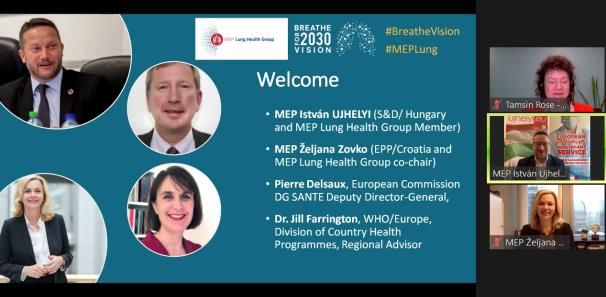
Hosted byMEP István Ujhelyi (S&D, Hungary) and
MEP Željana Zovko (EPP, Croatia)
#BreatheVision                                                                              #MEPLung
Introduction
On 27th January 2021 the European Parliament Lung Health Group hosted the ‘Towards a European
Health Union: BREATHE vision for the future’, the digital launch of the Breathe Vision for 2030. We
were pleased to welcome over 200 participants to this event.

The Breathe Vision for 2030 reflects changes that lung patients want to see in their lives in the coming
years. This initiative is led by a number of leading European-level patient and healthcare professionals’
organisations, who have come together for the first time to focus on a vision for lung health. These
organisations combined give a voice to half a million lung patients and 40,000 health professionals
in Europe.

The Breathe Vision sets out to provide clear goals for lung health towards 2030, linking also to the UN
Sustainable Development Goals (SDGs), such as SDG 3 on good health and well-being and SDG 10 on
reduced inequality. The full range of opportunities in the vision provides a positive approach to how
lung health can be significantly and realistically improved by 2030 and offer synergies in working
towards a European Health Union.

The launch event discussed the current context of health in Europe and the five themes in the Breathe
Vision for 2030: Awareness, Prevention, Access, Research, and the impact of COVID-19. Through these
key themes, the participants reflected on how we can move forward to achieve healthier lungs for all
in Europe by 2030.

The event was moderated by Tamsin Rose, Director at Tamarack.

Welcome                                               defined in the vision. The potential to work
                                                      together to reduce the burden on national
István Ujhelyi MEP: S&D, MEP Lung Health              health systems by producing disease guidelines,
Group (Hungary)                                       prevention campaigns and education is
MEP Ujhelyi remarked on the synergies between         significant and is supported by the EU.
the Breathe Vision for 2030 and the call for a
European Health Union, supported by the MEP             197 member associations provide weight to
Lung Health group alongside all of the large pro-         clear and realistic goals defined in the
European groups. MEP Ujhelyi highlighted the                     Breathe Vision for 2030
challenges and opportunities that the Breathe
Vision provides, drawing on his own interest in       Željana Zovko MEP: European People's Party,
health. For instance, the need for better health      MEP Lung Health Group (Croatia)
care, prevention and more patient-centred             MEP Zovko brought out the importance of
services were clear from the Hungarian                moving the lung health agenda forward during
consultation around creating a European Health        this pandemic, highlighting that the Breathe
Union. The EU4health programme has created a          Vision proposes to make EU healthier and more
step towards this Union, as it was approved at        patient-friendly. With 600,000 deaths a year
the end of 2020 with the historical result of         from lung disease prior to COVID-19, the need to
securing a budget 12 times larger than the            promote lung health for both humanitarian and
previous mandate.                                     economic reasons is seen to be clear. MEP Zovko
                                                      pointed to the need for a better understanding of
MEP Ujhelyi pointed to the importance of the          risk factors and to translate dialogue into action.
Breathe Vision, with the collaboration                This is where the Breathe Vision can have an
representing 197 member associations to               important contribution to prevention policies.
provide weight to the clear and realistic goals

                                                                                                       1
#BreatheVision                                                                                #MEPLung

Pierre Delsaux: European Commission DG                  Moreover, the European Commission will adopt
SANTE Deputy Director-General                           its Beating Cancer Plan in February 2021,
                                                        including targets for lung cancer. This plan will
Mr Delsaux noted that the Breathe Vision comes          have a holistic approach including prevention,
at a time of increased focus on health, due to the      early detection, treatment and quality of life.
COVID-19 crisis. Simultaneously, a dialogue has         Stakeholders will be included in forming an
started over a European Health Union with the           ambitious and timely implementation plan. The
European Commission and the European                    EC commitment to a tobacco free generation
Parliament, with potential to exploit the               and to a greener Europe are also clear synergies
increased funding that the €5.1bn EU4health             with the Breathe Vision.
programme will offer. Mr Delsaux pointed out
that the medium-term targets and objectives in          Dr. Jill Farrington: WHO Europe Division of
the Breathe Vision for 2030 can help improve our        noncommunicable diseases
handling of crises in the future.
                                                        Dr. Farrington linked the Breathe Vision to the
                                                        many WHO Europe programmes on lung heath.
                                                        In this context, significant progress, such as the
                                                        expected achievement of SDG on reducing pre-
                                                        mortality by a third and the reduced incidence
                                                        and mortality in tuberculosis sit alongside big
                                                        differences between eastern and western
                                                        Europe. Dr. Farrington gave the example that in
                                                        Eastern Europe air pollution is higher, which is
                                                        linked to over 500,000 deaths, and tobacco use is
Mr Delsaux regards the European Health Union            among the highest in the world.
as providing the framework to allow all
stakeholders to move in the same direction,             The advances of recent years are equally
working beyond nations as we have seen with the         threatened by the pandemic. Dr. Farrington cited
COVID-19 pandemic. This means more equity in            a WHO survey in 2020 which showed that 59% of
terms of the strength of health systems across          countries had partial or complete disruption of
Europe with a new authority preparing us better         asthma services and 60% had reduced
for the future. All citizens should fight for this to   tuberculosis services.
happen.
                                                        Dr. Farrington stated that WHO Europe calls for a
A European Health Union can better prepare us           partnership approach to enable united action for
              for future crises                         better lung health. This approach aims for
                                                        universal     health    protection,      improved
The Breathe Vision for 2030 demands, according          preparations for health emergencies, stronger
to Mr Delsaux, are valuable input to the EU             health systems and immunisation initiatives.
Health strategy. Policy change requires a wide          Lung health is seen in multiple WHO programmes
range of input, including that from initiatives         including updating global air pollution guidelines,
such as the European Health Emergency                   strengthening the tobacco control framework
Preparedness and Response Authority (HERA)              convention, implementing the tuberculosis
which will aim to help us better prepare for            action plan, improving Cystic Fibrosis services
future crises, the EU pharmaceutical strategy, as       and strengthening palliative care. WHO also
well as existing agencies such as the European          embraces the move to digitalisation, and
Centre for Disease Prevention and Control (ECDC)        accounts for climate and air quality concerns.
and the European Medicines Agency (EMA).
                                                            59% of countries had partial or complete
                                                            disruption of asthma services due to the
                                                                            pandemic

                                                                                                         2
#BreatheVision                                                                             #MEPLung

A poll asked attendees what they want to see         ECDC and EMA operations and massive
from a potential European Health Union. The          investment accelerating research. It is now time
most popular options were:                           to translate what we have learned in the
                                                     pandemic into principles to achieve the 2030
     •   Information and best practice across        SDGs, such as ending infectious disease
         the EU – 62%                                epidemics.
     •   Disease prevention and better
         healthcare outcomes – 54%                   Prof. Troosters related the five Breathe Vision
     •   Greater EU interest in research – 48%       themes to existing EU policies and programmes.
     •   Better response to health threats –         For instance, awareness links to the ECDC work
         54%                                         on disease control, prevention to the EU Green
                                                     Deal and EU4Health programme, care to the new
                                                     EU pharmaceutical strategy and research to the
                                                     Horizon Europe programme. This synergy shows
Towards a BREATHE Vision for 2030
                                                     how we can work together to make
                                                     breakthroughs in lung health, and in related
Mikaela     Odemyr,      President, European         diseases, as lung patients often experience
Federation of Allergy and Airways Diseases           several diseases at the same time.
Patients’ Associations (EFA)
                                                     Coherent collaborations and networks were felt
Ms Odemyr remarked on how COVID-19 has               by Prof. Troosters to be important in helping to
brought health systems to the brink of collapse      push forward research and understanding. This
and that it is time to take lung health seriously.   can build on achievements like the ERS White
The virus has shown how fragile our lungs are and    book, and the ERN Lung network can help
what it means to be out of breath.                   dissemination efforts and in bringing patients
                                                     into policy development. Our networks can also
Ms Odemyr noted that the European Lung Health        provide a European Health Union with
Group produced the Breathe Vision to help move       stakeholders to build and create policy change.
lung health in Europe forward. With 1 in 8 deaths
in the EU due to lung diseases and 30% of asthma      It is now time to translate the lessons we have
and COPD patients visiting the emergency room              learned in the pandemic into principles
each year this shows the severity and impact of
lung disease.

The Breathe Vision provides a set of principles to   BREATHE Vision for 2030 – a path forward,
guide future European policies affecting lung        Roundtable
health with clear, achievable goals to be reached
by 2030. This roadmap is for everyone to make it     Raising awareness on respiratory disease
a reality and Ms Odemyr called on organisations      Gergely Meszaros, Project Manager, Pulmonary
to endorse the vision.                               Hypertension Association Europe (PHA-Europe)

    Breathe Vision for 2030 provides a set of        In the first of the thematic presentations, Mr
   principles to guide future European policies      Meszaros reflected on how shocking it is when
                                                     we think about the number of people with lung
Prof. Thierry Troosters, Past-President,             disease and the resulting human and economic
European Respiratory Society (ERS)                   cost. Given this, it becomes obvious that action
                                                     needs to be taken. The cause of Pulmonary
Prof. Troosters highlighted that despite the         Hypertension (PH), a rare and often mis-
issues in responding to COVID-19, it has shown       diagnosed disease is still unknown. Patients live
that we are able to respond quickly to               with a breathlessness similar to that experienced
emergencies, scaling up the EU vaccines strategy,    after hard exercise. Yet 1 in 5 patients wait over
                                                     2 years for a correct diagnosis.

                                                                                                        3
#BreatheVision #MEPLung
Mr Meszaros put forward that we need to better Ms Baird believes that Education around risk
use resources and structures to improve lung factors is necessary to achieve these goals.
health. This includes focusing on Health People can have a false sense of security if they
Technology Assessments (HTA) and are non-smokers. For instance, COPD may be a
incorporating patients fully into policy making risk for lung cancer, even in the absence of
decisions. Issues, such as a common lack of smoking. A focus on risk reduction for all air
diagnosis or misdiagnosis, mean that pollution and less known but widely prevalent
appropriate and comprehensive information is causes like radon can better get the message
needed for both patients and healthcare across. The EU cancer plan needs to address
professionals. This would allow better awareness these preventable risks.
of the guidelines.
Air pollution is the largest environmental health
Mr Meszaros highlighted that data needs to risk for lung disease, The EU Air quality
improve to better understand current framework must be implemented
prevalence rates, the impact and severity of
disease and how it changes lives. Health literacy Getting the right care
also needs to be improved at all levels, meaning Hilde De Keyser, Chief Executive Officer, Cystic
identifying and exploring policy gaps and Fibrosis Europe (CF-E)
reaching people with lung health issues.
Overcoming the negative perception or stigma Ms De Keyser captured the fact that before care
over lung disease as something caused by can begin, timely and accurate diagnosis is
patients is vital. World PH day has helped make a needed for all lung diseases. To achieve this the
start in getting these messages out. major divide between the western and eastern
European countries in access to healthcare needs
Stigma over lung health has to be overcome to be addressed.
Greater prevention of lung disease The EU Pharmaceutical Strategy promises to
Anne-Marie Baird, President, Lung Cancer foster access to innovative and affordable
Europe (LuCE) medicines for patients. Within this Ms De Keyser
believes that there is ample space for the EU to
Ms Baird brought our attention to the fact that act decisively for multi-disciplinary care which
lung disease accounts for 1 in 8 of all deaths, yet enables active lives and ensures that innovative
only 3% of the EU health budget is spent on digital technology is available to all.
prevention. A multi-pronged risk reduction
strategy and increased funding is needed. With Cystic Fibrosis (CF) the life expectancy of
people has improved in many countries, resulting
Reducing the number of people developing in most countries having more adult people with
diseases and improving the lives of those with CF than children. However, countries remain with
disease can be achieved through prevention more people with CF under 18 due to lack of
measures. Air pollution is the largest access to treatment and early diagnosis. The
environmental health risk for lung disease. Ms innovative drugs involved are very expensive and
Baird called for the EU air quality framework to this has led to health driven emigration in recent
be implemented and that continued tobacco use years, affecting economies and patient lives.
be met with stringent regulation, including for e-
cigarettes. Increased screening and specific lung Ill health costs the EU €380billon, yet access to
health checks must be an EU priority. The WHO healthcare remains inequal
vaccination agenda should also be realised in the
context of COVID-19.
4#BreatheVision #MEPLung
Advancing Research into lung health findings can advance treatment development
Liam Galvin, Secretary, European Idiopathic and disease understanding in other areas. The
Pulmonary Fibrosis and Related Disorder pandemic has shown that that civil society and
Federation (EU-IPPF) patient organisations are effective in reaching
hard to access communities. For example, the
For Mr Galvin, Horizon 2030 itself is the main Stop TB partnership in Tajikistan has trained 850
research priority. This programme provides the imams on COVID-19 and TB. After COVID-19 we
opportunity to contribute towards proven health will need to re-focus on research into TB and
models like the EU health network, and to act as other lung diseases.
a catalyst for best practice while eliminating
duplication as far as possible.
A combination of pan-EU data collectives,
registries and databanks enabling cross boarder
research would address an unmet research need.
Cooperation is vital for Mr Galvin in achieving this
enabling infrastructure. Forming air quality
initiatives and supporting innovation leading to
better treatments is also required. 50,000
European lives are taken by lung scarring, with
more cases expected following COVID-19.
Therefore, a greater emphasis needs to be
placed on a lung health research agenda driven
by patient priorities. Audience questions and answers
Frank Willersinn of Alpha-1 Plus Belgium asked
COVID-19: Help or Hindrance for Other Lung how we can sensitise the general public about
Diseases symptoms of rare conditions. While a difficult
Paul Sommerfeld, Board Chair, Tuberculosis question, Mr Meszaros recalled the patient
Europe Coalition (TBEC) journey descriptions and the hurdles identified.
The focus should be on professional education,
Mr Sommerfeld reported that he is fortunate to with GP’s, cardiologists and pulmonologists
have received a first vaccination for COVID-19, acting differently to shorten time to diagnosis.
which has been developed in just 9 months. Yet
for tuberculosis (TB) we have to live with the Mr Meszaros noted that awareness measures are
weak vaccine developed over a 100 years ago. key to sensitisation, while patients can be
empowered by HTA which give access to new
Mr Sommerfeld has seen the impact of COVID-19 information. Keeping pressure on patient
on TB services. PCR test machines have involvement will help enable patient centred
disappeared to be available for COVID-19 and developments. Mr Troosters noted that medical
staff have been switched to COVID-19 responses. societies can reach many health care
The result is that 6 million more cases and 1.5 professionals through training in recognising the
million more deaths from TB are expected in symptoms of lung diseases. ERS achieves this
next 5 years. with ERN-LUNG by preparing materials
developed with patient input.
Patient groups can play a significant role in
health interventions. Krisnah Poinasamy from Asthma UK and the
British Lung foundation asked how we can
While the overwhelming distraction of COVID-19 influence European research. Mr Troosters
has harmed services of other diseases, it has suggested using positive stories, such as using
given an impetus to digital technology. Mr awareness of well-known outputs such as the
Sommerfeld shares the belief that research COVID-19 vaccine to highlight the opportunity
5#BreatheVision #MEPLung
and importance of research funding. Mr Seán Kelly MEP: European People's Party
Troosters also called for consistency in funding (Ireland)
support, as research evolves over many years. It
is due to long term investment that COVID-19 MEP Kelly noted that COVID-19 has highlighted
vaccines have been able to be developed quickly. health inequalities. In particular, those dealing
with underlying conditions, such as COPD or
Closing remarks asthma are at a higher risk. We have to address
Kjeld Hansen, Chair, European Lung Foundation these health vulnerabilities in society, ensuring
(ELF) that all people living with lung conditions are
prioritised for vaccines. MEP Kelly highlighted
Mr Hansen closed the discussion by emphasising the impact of the backlog of lung disease cases
the efforts that have been made in creating the due to COVID-19, and the danger to individuals
Breathe Vision, forming a great start to improving health that this poses. A European Health Union
lung health in Europe. However, implementation would provide more co-ordinated efficient
is more important than planning. Now is the time response to future crisis.
to build solutions to move forward. The
collaborative effort made developing the Breathe MEP Kelly closed by appealing to take advantage
Vision and the European Lung health group show of the impetus that COVID-19 provides in order
how this can be done. He emphasised that to improve lung health and research, to gain
everyone should disseminate the Breathe Vision better treatment for infections and non-
as far as possible. infectious chronic diseases at each stage of the
disease.
Željana Zovko MEP thanked speakers and
participants and committed to look at how to the We should finish the decade healthier with a
contribution from the Breathe Vision for 2030 common European approach that allows us to
and discussion today can be incorporated into breathe easier
policy making. Over the last year the right will
and means have been shown to achieve
solutions. Building on the EU4Health programme
is a first step in achieving change.
MEP Zovko noted that upgraded screening is
recognised as vital in early diagnosis. Croatia has
become the first EU country to deploy
nationwide screening for early lung detection. It
is hoped that other countries will follow this
example. COVID-19 has been a crisis but also a
stimulus for progress, for a European Health The moderator Ms Tamsin Rose thanked all
Union among things that can improve participants and speakers. 47% of participants
prevention, care and manage health supplies ranked the event as excellent and 40% as good.
through the RISK EU programme. The Breathe Questions can be posted through
Vision for 2030 provides focus and the MEP lung www.breathevision.eu. You can endorse and
health group will act to move forward, aiming to disseminate the Breathe Vision for 2030 here:
finish the decade healthier with a common https://www.breathevision.eu/
European approach that allows us to breathe
easier.
6#BreatheVision #MEPLung
www.breathevision.eu
Watch the event recording
European Lung Health Group:
https://www.efanet.org/inform/lung-health-group
#BreatheVision
7You can also read


