Driving Canada's Industrial & Academic Eminence towards a National Quantum Strategy - IBM
←
→
Page content transcription
If your browser does not render page correctly, please read the page content below

Driving Canada’s Industrial & Academic
Eminence towards a National
Quantum Strategy

Driving Canada’s Industrial & Academic Eminence towards a National Quantum Strategy   A

Introduction
Quantum computing is the first fundamentally new                             To ensure the National Quantum Strategy leads
approach to computing in decades. While the first                            to successful outcomes, there must be renewed
quantum revolution gave humanity new insight into the                        collaboration by all stakeholders — government,
rules that govern the physical world, the second quantum                     industry, and academia — in the Canadian quantum
revolution is applying these rules to develop new                            information science ecosystem. It is critically important
technologies that the industry anticipates will eclipse                      that Canada focuses these efforts on tangible short and
the processing power of even today’s most powerful                           medium-term outcomes, as well as long-term research
supercomputers. In the shorter term, there is great                          health and viability. By doing so, stakeholders will ensure
optimism that hybrid classical/quantum computing will                        that Canadian industry is enabled and empowered to
deliver real value to business and society at large.                         compete in the new quantum era and to leverage our
                                                                             academic leadership in this emerging field.
In Budget 2021, Canada committed $360 million to
launch a National Quantum Strategy to achieve three                          This paper will discuss the economic opportunity of
overall objectives: amplify Canada’s significant strength                    quantum computing and offer guidance on how Canada
in quantum research; grow domestic quantum-ready                             can position itself as a global leader in this technology.
technologies, companies, and talent; and solidify                            The authors do not intend to provide an exhaustive
Canada’s global leadership in this area.1                                    overview of available quantum computing programs,
                                                                             training, or funding. Rather, the paper is intended to
Canada is currently one of the world’s leading                               evoke discussion about the best path forward for
nations in quantum research, ranked 5th in the G7 in                         Canada in the quantum computing industry.
total expenditure on quantum science, and 1st per
capita.2 However, as quantum technology nears the
inflection point of delivering real commercial value,
global competition is intensifying to capitalize on this
burgeoning industry.

Driving Canada’s Industrial & Academic Eminence towards a National Quantum Strategy                                                       1
Quantum computing 101

“
Quantum technology is at the very
leading edge of science and innovation
                                                                             Quantum computers are not a replacement for classical
                                                                             computing systems. They complement classical systems
                                                                             with a promise to resolve intractable problems that
                                                                             are too time-consuming or impossible to solve when
today, with enormous potential for
                                                                             using classical computers. The evolution of quantum
commercialization. This emerging field                                       computing is expected to create new opportunities
                                                                             in scientific discovery, and to eventually disrupt
will transform how we develop and                                            critical areas of technology such as cybersecurity and
design everything from life-saving                                           encryption.3 In fact, this disruption is the reason for
                                                                             industry to implement “quantum safe” cryptography
drugs to next generation batteries,                                          schemes today. To mitigate these risks, IBM has
and Canadian scientists and                                                  developed a clear strategic agenda that includes
                                                                             the research, development, and standardization of
entrepreneurs are well-positioned to                                         core quantum-safe cryptography algorithms as open
take advantage of these opportunities.                                       source tools. In the coming years, these tools will be
                                                                             standardized to protect against the encryption exposure
But they need investments to be                                              created by quantum computing.
competitive in this fast-growing
                                                                             Not all quantum computers are created equal,
global market.
    - Budget 2021
                        ”                                                    nor do they solve the same classes of problems.
                                                                             The ultimate goal is a fully fault-tolerant universal
                                                                             quantum computer that can handle important classes
All computing systems rely on a fundamental ability                          of business and scientific problems exponentially
to store and manipulate information. Today’s classical                       faster than a classical machine.
computers manipulate individual bits, which store
information as binary 0 and 1 states. Millions of bits                       Today, companies such as IBM are developing computing
work together to process and display information with                        systems, which although still noisy, are steps on the path
the speed familiar on smart phones, laptops,                                 towards fault-tolerant universal quantum computing.4
and servers in the cloud.
                                                                             By 2023, IBM expects to demonstrate a new generation
In contrast, quantum computers tap into quantum                              of quantum systems that have a clear path toward
mechanical phenomena to manipulate information.                              quantum advantage – when quantum computers working
To do this, they rely on quantum bits, or qubits.                            closely with classical computers can address problems
Unlike a bit that has to be a 0 or a 1, a qubit can be                       better than any classical system can alone.
in a combination of states. By applying the principles
of superposition, entanglement, and interference,
an exponentially large number of compute states can
be explored as the number of qubits increases. As the
technology improves, alongside the increase in the
number of qubits, we will reach quantum advantage,
the point where certain information processing tasks
can be performed more efficiently or cost effectively
on a quantum computer, versus a classical one, alone.

Driving Canada’s Industrial & Academic Eminence towards a National Quantum Strategy                                                   2
Quantum: Economic Impact
for Canada and the World

Discovery is a driving force of science, business, and                       In a 2017 economic analysis conducted for the
economic prosperity. High performance computing,                             National Research Council of Canada, it was estimated
artificial intelligence, hybrid cloud, and — soon, quantum                   that by 2030, the domestic quantum technology industry
computing — will accelerate discovery in science and                         could be worth $8.2 billion and employ 16,000 people.
business, while expertise in these technologies will                         By 2040, when quantum technology is expected to reach
cultivate the workforce of the future.                                       50 per cent adoption, it was estimated quantum could
                                                                             grow into a $142.4 billion industry and sustain
When combined with other emerging technologies,                              229,000 jobs.6
quantum computing has the potential to speed up the
discovery of new materials that will address significant                     To date, the federal government has invested more
global challenges. Specifically, technology can be used                      than $1 billion in quantum computing research and
to reinvent the materials design process to find solutions                   development (R&D), while provinces such as Quebec,
to challenges such as fostering good health and clean                        Ontario, British Columbia, and Alberta have made early
energy, as well as bolstering sustainability, climate                        investments in quantum research organizations as the
action, and responsible production.                                          technology advances towards application. It is worth
                                                                             noting that billion-dollar quantum R&D programs have
New materials or novel uses of existing ones are likely to                   also been announced by the United States, China,
help address challenges such as capturing carbon dioxide                     the European Union, and India.7
from the overburdened atmosphere and storing it safely,
mitigating climate change; finding more sustainable ways                     As the quantum computing industry is still in early
to grow crops to feed surging populations while reducing                     development, there are no easy predictors to model
carbon emissions; rethinking batteries and energy                            the total economic impact of Canadian academic
storage; and developing more sustainable electronic                          and industry capacity, leadership, and skills in
devices and better antivirals.5                                              quantum technologies. However, these industries
                                                                             are well-represented in Canada, and it is a reasonable
                                                                             expectation that quantum computing investment
                                                                             will have a strong economic impact.

Driving Canada’s Industrial & Academic Eminence towards a National Quantum Strategy                                                   3
Canada’s steps to
  quantum success

  In Budget 2021, the federal government noted that                            Achieving rapid commercial leadership in quantum
  the National Quantum Strategy will be designed to                            computing requires six key actions over the next three
  amplify Canada’s significant strength in quantum                             to five years. In the near term, Canada must focus on
  research; grow domestic quantum-ready technologies,                          three areas:
  companies, and talent; and solidify Canada’s global
  leadership in this area.                                                     1. Highly Qualified Personnel: Canada must attract
                                                                                  and retain a critical mass of trained highly qualified
  A recent global analysis notes four policy measures are                         personnel in the quantum computing field including
  commonly deployed within national quantum strategies:                           highly skilled foreign students, scientists, and
                                                                                  engineers through acceleration of appropriate
  - establishing centres of excellence or innovation hubs;                        academic training and funding. To further this effort,
  - making targeted calls for proposals or competitions;                          immigration policies must be flexible to allow for the
                                                                                  accelerated inflow of quantum capable workers.
  - providing direct funding for special projects of national
    significance; and                                                              Academia, guided by targeted calls for proposals
  - providing government investment or venture capital                             or competitions that leverage government funding,
    for startups.8                                                                 should design quantum training opportunities that
                                                                                   consider the best near-term commercial applications
                                                                                   of quantum computing technology, in order to
  Canada has done well to deploy some of these policy
                                                                                   cultivate a research ecosystem that appeals to
  measures early, despite the historical absence of a
                                                                                   a wide spectrum of highly skilled personnel.
  coordinated national quantum strategy. As a recent
  CIFAR report highlighted, 17 countries including the US,
                                                                               2. Hybrid computing expertise: In this case, we define
  Japan, Germany, and the UK have some form of national
                                                                                  hybrid computing as the combined use of classical
  initiative or strategy to support quantum R&D.9 A further
                                                                                  and quantum computing approaches. Canada
  three, including Canada, have strategies that are in
                                                                                  must develop hybrid classical/quantum computing
  various stages of development.
                                                                                  expertise, where improved high-performance
                                                                                  computing (HPC) infrastructures are leveraged to

“Quantum    technology and artificial
 intelligence are key parts of our
                                                                                  transition research and industry towards quantum
                                                                                  applications, as these capabilities increase.

  government’s plan to make our                                                    Continuous advances in HPC are already helping
                                                                                   to accelerate discovery, while the COVID-19
  post-pandemic economy                                                            pandemic has highlighted the importance of scientific
  stronger than ever.
                                  ”
  – Hon. François-Philippe Champagne,
                                                                                   discovery for the design of new medicines, vaccines,
                                                                                   and pharmaceutical products. High performance
    Minister of Innovation, Science and Industry,
                                                                                   computing, artificial intelligence, quantum computing,
    March 11, 2021                                                                 and hybrid cloud technologies are collectively
                                                                                   converging to accelerate discovery in science and
                                                                                   business and cultivate the workforce of the future.
  In the US, the passage of the National Quantum
  Initiative Act (2018) was a seminal moment for quantum
  information science, and a clear recognition of the critical
  importance of quantum in the security and prosperity of
  the world’s largest economy.10

  Driving Canada’s Industrial & Academic Eminence towards a National Quantum Strategy                                                      4
One innovative example of this technology                                     create sustainable R&D ecosystems driven by a focus
   convergence is the IBM Discovery Accelerator at                               on near-term commercial research and application.
   the Cleveland Clinic, which includes the installation                         Government-funded provincial organizations have
   of an IBM Quantum System One on the medical                                   been established in the past few years alone with the
   centre’s main campus to enable new medical                                    intent of enabling industry-academia partnerships
   breakthroughs and provide access to quantum                                   for quantum computing. Early examples of these
   technology for universities, high schools, and the                            collaborations include the Quantum Algorithms
   government, with particular focus on creating                                 Institute (QAI)12 in British Columbia and the Institut
   the future quantum computing workforce.11 This                                Quantique13 at the Université de Sherbrooke in
   model can be replicated in Canada with the right                              Quebec, where the IBM Quantum Network recently
   partnerships to mutual benefit.                                               established its first Canada-based Quantum Hub to
                                                                                 engage industry and research partners. There is ample
3. Collaboration: Academia has a unique role to                                  opportunity within this ecosystem for the federal
   play in educating the next generation of scientists                           government to further act as an enabler of quantum
   and citizens. But these institutions must develop                             R&D to enhance commercial application.
   innovative teaching partnerships among disparate
   disciplines within academia, between academia                                 Rudimentary quantum education should also be
   and industry, and between academia and government                             integrated into curriculum starting at the secondary
   laboratories to create flexible curricula and industry-                       level and designed with industry-recognized,
   relevant quantum educational and training programs.                           skills-based credentials in mind and be offered
                                                                                 widely at the post-secondary level, in partnership
   By building practical quantum collaborations between                          with industry.
   leading private sector technology companies,
   academia, and government laboratories, we can

Driving Canada’s Industrial & Academic Eminence towards a National Quantum Strategy                                                     5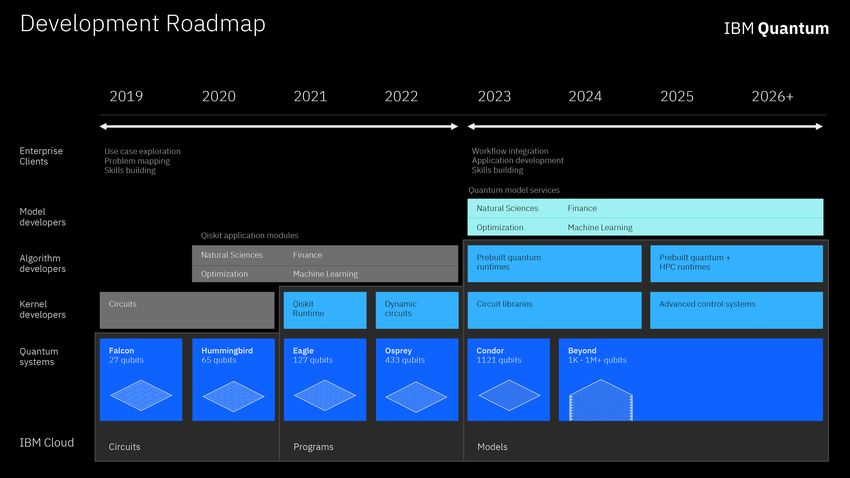
In a second phase, consolidation of Canada’s leadership                      6. Broad Ecosystem of Quantum Enabling Technology:
position in quantum information science will be                                 Quantum software and algorithm development,
achieved by:                                                                    middleware, and specific industry applications that
                                                                                bring competitive advantage will thrive once the
4. Manufacturing: Canada should support quantum-                                foundations of the quantum landscape are in place.
   enabling technologies and photonics, including the                           A coordinated ecosystem would allow for the rapid
   domestic manufacturing of critical advanced hardware                         dissemination of quantum computing capabilities
   and components, thereby securing important                                   across industries through pan-Canadian ecosystems
   ingredients of the hybrid computing and quantum                              and partnerships.
   supply chain. Additionally, manufacturing these
   critical hardware components for quantum technology                       Development of points 2 through 6 — with emphasis on
   will foster increased international collaboration                         broad access to world-class quantum computers — will
   amongst allies.                                                           create a feedback loop that amplifies the development
                                                                             of highly qualified personnel and creates long-term, high-
   CIFAR notes that strengthening the supply chain for                       value Canadian jobs and skills-building opportunities.
   components of quantum technology (such as the
   fibres and satellites needed for a quantum internet,                      While not exhaustive, these action items will help ensure
   or the chip fabrication and manufacturing                                 Canada optimizes its ability to train a quantum-ready
   infrastructure for quantum computers), is a central                       workforce nationwide.
   strategic policy goal of many countries in their
   development of quantum computing.14

   Canada’s national quantum strategy should focus on
   nurturing the existing hardware ecosystem and find
   innovative ways to establish long-term partnerships
   with enterprises to ensure domestic manufacturing
   is bolstered.

5. Hosting: Hosting world-class quantum computers
   in secure facilities on Canadian soil will provide
   dedicated, broad access to academic and government
   researchers, industry, and allow quantum start-ups
   to scale their companies. IBM’s first international
   deployments of its Quantum System One at data
   centres in Germany15 and Japan16 are significant
   investments that support the quantum strategies of
   these countries. By facilitating quantum computing
   access through hosted systems, Canada could
   strengthen its leadership in quantum science,
   business, and education and benefit from a stronger
   position to attract and retain highly skilled talent as
   global competition intensifies.

Driving Canada’s Industrial & Academic Eminence towards a National Quantum Strategy                                                   6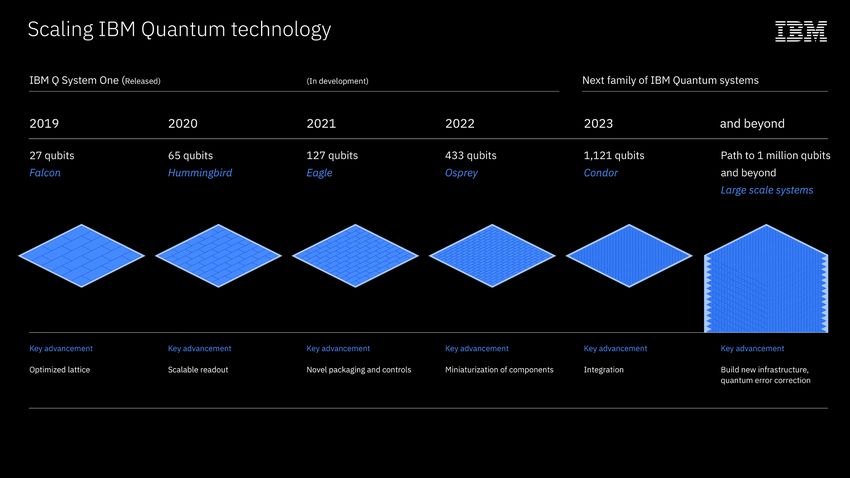
Addressing the Digital Skills
Gap: Additional Resources

                 Use case exploration,                                          Workflow integration, Application development,
                 Problem mapping,                                               Skills building
                 Skills building
                                                                                Quantum model services

                                    Qiskit application modules

IBM Quantum software development roadmap.

Open source access and adoption is how an ecosystem                          To help accomplish this global effort, IBM became
of developers, scientists, educators, and professionals                      the first company to put a quantum computer on the
across different industries will get “Quantum Ready”                         cloud in 2016. IBM Quantum Composer and the IBM
for this next generation of computing. Scaling a global                      Quantum Lab18 have since built up an active community
community with the right skillset is key to advancing                        of more than 325,000 users, who have run hundreds
quantum computing for science and business, and                              of billions of circuit executions (more than two billion
countries that choose to invest and engage early on will                     per day), on real hardware and simulators, which have
derive an economic advantage in doing so. A National                         led to the publishing of more than 500 third-party
Quantum Strategy will also require the development                           research papers. Underpinning this effort is an open
of a better understanding around the deployment,                             source software development kit called Qiskit,19 which
monitoring, and assessment of emerging approaches                            allows programmers to accelerate the development of
to digital skills identification, development,                               quantum applications by providing the complete set
and employment.17                                                            of tools needed for interacting with quantum systems
                                                                             and simulators. Qiskit allows for easy research and
                                                                             development for specific industry use cases that have
                                                                             the highest potential for quantum advantage. Qiskit has
                                                                             been downloaded more than 650,000 times to date.

Driving Canada’s Industrial & Academic Eminence towards a National Quantum Strategy                                                     7
Key advancement Key advancement Key advancement Key advancement Key advancement Key advancement
Optimized lattice Scalable readout Novel packaging Miniaturization of Integration Build new infastructure
and controls components quantum error correction
IBM Quantum software development roadmap.
To provide guidance to all stakeholders on quantum
development, IBM has also made public a Quantum
Development Roadmap20 which points towards our
larger mission: to design a full-stack quantum computer
deployed via the cloud that anyone around the world can
program.
Industry training resources like those listed here allow
for greater competency and lower-barrier adoption of
quantum skills that Canada requires to fuel the quantum
computing economy of tomorrow.
Driving Canada’s Industrial & Academic Eminence towards a National Quantum Strategy 8Conclusion Each element of quantum computing requires specific skills and provides unique opportunities for Canadian technology start-ups, businesses across disciplines, and researchers with the outcomes affecting society as a whole. A Canadian National Quantum Strategy should enable the rapid expansion of collaboration to achieve a critical mass of quantum technology and foster quantum-ready skills that will ensure Canada can compete globally. Exploring practical applications and future use cases for quantum computing requires cohesive partnerships between industry, academia, and government. As we work together to prepare the quantum-ready workforce of tomorrow, we must all do our part to enable access to this emerging technology and to secure Canada’s quantum leadership on the global stage. Driving Canada’s Industrial & Academic Eminence towards a National Quantum Strategy 9
Notes and Sources

1. https://www.canada.ca/en/department-finance/news/2021/04/budget-2021-building-an-innovation-economy-of-the-future.html

2. https://nrc.canada.ca/en/research-development/research-collaboration/programs/economic-impact-quantum-technologies

3. https://cyber.gc.ca/en/guidance/addressing-quantum-computing-threat-cryptography-itse00017

4. https://www.ibm.com/thought-leadership/institute-business-value/report/quantumstrategy

5. https://www.research.ibm.com/5-in-5/

6. https://nrc.canada.ca/en/research-development/research-collaboration/programs/economic-impact-quantum-technologies

7. India: https://dst.gov.in/budget-2020-announces-rs-8000-cr-national-mission-quantumtechnologies-applications; China: https://
   iopscience.iop.org/article/10.1088/2058-9565/ab4bea; European Union: https://ec.europa.eu/digital-singlemarket/en/policies/
   quantum-technologies-flagship

8. https://cifar.ca/wp-content/uploads/2021/04/quantum-report-EN-10-accessible.pdf

9. https://cifar.ca/wp-content/uploads/2021/04/quantum-report-EN-10-accessible.pdf

10. https://science.osti.gov/-/media/_/pdf/about/pcast/202006/PCAST_June_2020_Report.pdf?la=en&hash=019A4F17C79FDE-
    E5005C51D3D6CAC81FB31E3ABC

11. https://www.cnn.com/2021/03/30/tech/ibm-cleveland-clinic-quantum-computing/index.html

12. https://quantumalgorithms.ca/

13. https://www.usherbrooke.ca/iq/

14. https://cifar.ca/wp-content/uploads/2021/04/quantum-report-EN-10-accessible.pdf

15. https://newsroom.ibm.com/2019-09-10-IBM-and-Fraunhofer-Join-Forces-on-Quantum-Computing-Initiative-for-Germany

16. https://newsroom.ibm.com/2020-07-30-IBM-and-the-University-of-Tokyo-Unveil-the-Quantum-Innovation-Initiative-Consor-
    tium-to-Accelerate-Japans-Quantum-Research-and-Development-Leadership

17. https://ppforum.ca/publications/bridging-the-digital-skills-gap/

18. https://quantum-computing.ibm.com/

19. https://qiskit.org/

20. https://www.ibm.com/blogs/research/2021/02/quantum-development-roadmap/

Driving Canada’s Industrial & Academic Eminence towards a National Quantum Strategy                                                10
© Copyright IBM Corporation 2021 IBM Canada 3600 Steeles Ave E Markham, ON L3R 9Z7 Produced in Canada May 2021 IBM, the IBM logo, and ibm.com are trademarks of International Business Machines Corp., registered in many jurisdictions worldwide. Other product and service names might be trademarks of IBM or other companies. A current list of IBM trademarks is available on the web at “Copyright and trademark information” at www.ibm.com/legal/copytrade.shtml. This document is current as of the initial date of publication and may be changed by IBM at any time. Not all offerings are available in every country in which IBM operates. THE INFORMATION IN THIS DOCUMENT IS PROVIDED “AS IS” WITHOUT ANY WARRANTY, EXPRESS OR IMPLIED, INCLUDING WITHOUT ANY WARRANTIES OF MERCHANTABILITY, FITNESS FOR A PARTICULAR PURPOSE AND ANY WARRANTY OR CONDITION OF NON- INFRINGEMENT. IBM products are warranted according to the terms and conditions of the agreements under which they are provided. This report is intended for general guidance only. It is not intended to be a substitute for detailed research or the exercise of professional judgment. IBM shall not be responsible for any loss whatsoever sustained by any organization or person who relies on this publication. The data used in this report may be derived from third-party sources and IBM does not independently verify, validate or audit such data. The results from the use of such data are provided on an “as is” basis and IBM makes no representations or warranties, express or implied. Driving Canada’s Industrial & Academic Eminence towards a National Quantum Strategy B34117 ENG 11
You can also read


