Europe in the World 2018/2019 - Your Study Guide to
←
→
Page content transcription
If your browser does not render page correctly, please read the page content below
Your Study Guide to

                       Europe
                        in the
                        World
                                         2018/2019

Hogeschool Utrecht, School of Journalism, the Netherlands
Danish School of Media and Journalism, Aarhus, Denmark
www.europeintheworld.com
Study Guide EitW 2018-2019

CONTENTS

WELCOME ................................................................................................................... 2
MISSION STATEMENT AND OBJECTIVES .......................................................... 3
STUDY LOAD AND CREDITS .................................................................................. 5
PROGRAMME POLICY - STANDARDS OF JOURNALISM ............................... 6
RULES AND REGULATIONS ................................................................................... 7
ACADEMIC CALENDAR UTRECHT ....................................................................... 8
ACADEMIC CALENDAR AARHUS .......................................................................... 8
PROGRAMME DESCRIPTION UTRECHT ............................................................ 9
   UTRECHTVIEWS - INTRODUCTION............................................................................. 9
   KNOWING ......................................................................................................................... 10
   European Politics.............................................................................................................. 10
   European Economics ....................................................................................................... 11
   European Law ................................................................................................................... 13
   THINKING.......................................................................................................................... 15
   Sustainable Development in European Regions ......................................................... 15
   European Culture & Identity............................................................................................ 17
   Honours in the Knowing and Thinking Tracks ......................................................... 2018
   Reporting Europe ......................................................................................................... 1820
   Doing Honours .............................................................................................................. 2022
INTERNSHIPS .......................................................................................................2829
ALUMNI ..................................................................................................................2829
PRACTICAL INFORMATION UTRECHT ..........................................................2930
   LIVING IN UTRECHT .................................................................................................. 3132
PRACTICAL INFORMATION AARHUS ............................................................3334
   LIVING IN AARHUS ..................................................................................................... 3435
COURSE FEE AND ADMISSION ......................................................................3637
BUDGET .................................................................................................................3637
CONTACT DETAILS ............................................................................................3738
STAFF UTRECHT .................................................................................................3839
STAFF AARHUS ...................................................................................................4041

                                                                  1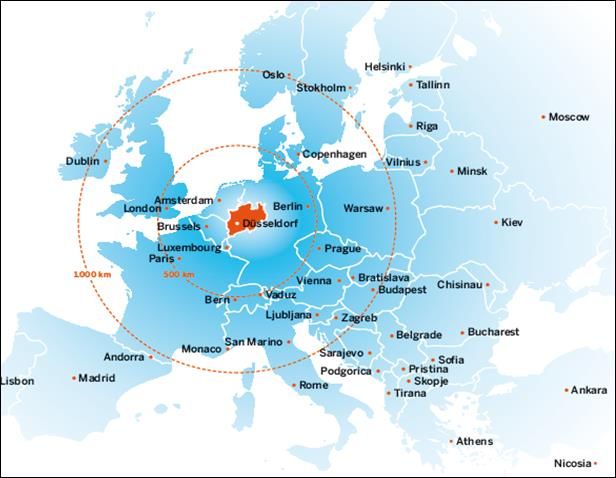
Study Guide EitW 2018-2019

WELCOME
A warm welcome to participants of the 28th Europe in the World programme, an international
programme for advanced undergraduate journalism students and young professionals, to take
place in Utrecht, the Netherlands and in Aarhus, Denmark from August 2018 - June 2019.

Understanding Europe through reading, writing, travelling and living in two European countries
is what Europe in the World is all about. You will also have the opportunity of working in other
European countries. This Study Guide provides you with the details, the requirements and an
overview. Read it carefully. It is your guide to a successful year.

The Utrecht part concentrates on Europe and the European Union: its politics, culture and
identity, social economic structure and relevant policies and legislation. The Utrecht part of the
programme provides you with the theoretical framework, contextualized within the journalism
profession. In the practical workshop “Reporting Europe” all theory is translated into web based
products for the news platform Euroscope, that reflect the broad field of journalism and media.

In Aarhus the focus of the programme changes, the perspective becomes wider: from Europe
to the world. The position of Europe in the world will be discussed in various lectures and
assignments with focus on foreign policy and euro reporting.
The course gets more practical as it goes on. After the lectures, generally starting in March,
there is a travel period. During this period students practice their knowledge and understanding
by collecting material in various European countries for the production of the multimedia
website and magazine "Euroviews" that finalizes this practical period of European and world
affairs.

The programme ends with the main production of this course; the final exam project, which is
defended at an official oral exam. Students choose their own theme for the exam project.

The whole programme is offered both on bachelor and on honours level. In this Study Guide
the requirements for both levels are explained in detail.

So we welcome you all, the 28th group of participants, and hope you all will have a wonderful
and successful year!

Carien J. Touwen                                           Asbjørn Slot Jørgensen
Institute for Media, HU University of Applied Sciences     Danish School of Media and Journalism
Utrecht, The Netherlands                                   Aarhus, Denmark

                                                    2
Study Guide EitW 2018-2019

MISSION STATEMENT AND OBJECTIVES

The goal of the Europe in the World programme is to develop the understanding of Europe and
the European Union, both on regional and global level, for future journalists and media
professionals.

The courses aim to provide grounding in politics, economics and society at the European level
with a view to the wider world. The emphasis is on providing: the background knowledge
necessary, the tools you must have to become capable journalists and the challenges that allow
you to grow personally, intellectually and professionally.

The programme is based on interactive learning, and requires a high degree of commitment
and work from the student, both individually and in team settings. Learning takes place in a
multicultural framework where you work with students from other countries. During the course
we combine text, audio, video and photos on online platforms. Multimedia productions will be
part of your work, and tools for this will be taught progressively during the programme.
The teaching staff is from the Danish and the Dutch schools of journalism, supplemented by
lecturers and journalists from other countries, institutions and media.

Europe in the World is offered on both bachelor and honours level. The bachelor level is the
basic level of the programme and should be achieved to successfully complete the programme
and acquire the Europe in the World certificate. For some students the programme is the
finalisation of their journalism bachelor and with completion they acquire their bachelor diploma,
issued by their home institution.
On top of this an honours level can be achieved, which results in an additional honours
certificate in European journalism. All courses contain both bachelor and honours competences
and requirements. In the final exam, all requirements are integrated.

The competences required for bachelor level follow the Tartu Qualification Profile 2013
published by the European Journalism Training Association (see www.ejta.eu).

1. The competence to reflect on journalism’s role in society
Reflect on the societal role of and developments within journalism, specifically in the European
context and as a euroreporter.
2. The competence to find relevant issues and angles
Find relevant issues and angles, concerning Europe and the European Union, given the public
and production aims of a certain medium or different media
3. The competence to organise journalistic work
Produce a quality work plan based on European topics, relevant content, medium, target group,
length and deadline
4. The competence to gather information swiftly
Work in an international context of news gathering and use sources from various cultures in an
efficient way through relevant research methods and by contacting oral sources
5. The competence to select the essential information
Select the essential information from your research and literature. Basic understanding of
various relevant subject areas concerning European issues is required. Ability to reflect on the
information and perspectives, analyse and explain issues in a journalistic manner
6. The competence to present information in an effective journalistic form
Organize journalistic work in a professional way, while planning accurately and
communicating effectively with other participants. Structure information in a journalistic
manner. Present information based on research in a journalistic product, in several genres,
and on different platforms.
7. The competence to account for journalistic work
Reflect on the quality of your work by evaluating own work and the work of fellow students.
Reflect on ethical aspects of the work and of the role of journalism in society, and understand
the rights and responsibilities of the journalist.
8. The competence to cooperate in a team
Understand the basic requirements needed to cooperate in a team and experience specific
editorial settings.

                                                3
Study Guide EitW 2018-2019
9. The competence to act as an entrepreneurial journalist
Work as a freelance euroreporter, showing ability to produce and publish items in a
professional context, understanding the challenges and requirements of working as a
journalist in Europe, for local and international platforms
10. The competence to contribute to the renewal of the profession
Define a complex practical/professional situation in the context of Europe and provide
workable solutions in the scope of the future of journalism.
Competences for the honours level follow the profile characteristics of the Excellent
Professional as defined by the HU University of Applied Sciences, applied for Journalism and
Media Studies. Apart from competences the honours level is defined by a higher level of
complexity, a broader scope and autonomous professional conduct, in line with the Dublin
Descriptors, level 6+ (bachelor with honours).
The honours certificate is issued by the HU University of Applied Sciences.
Reflective Practice/ learning practitioner
Shows to systematically understand the discipline and masters skills and
methodologies
Assesses his own professional conduct critically and systematically adjusts his
actions accordingly
Acts in a realistic professional context
International Perspective/ global professional
Is able to position his professional practice in an international context
Takes into account cultural diversity
Can make an internationally oriented contribution to the professional development
Leadership Qualities / inspiring leader
Can analyze problem situations, generate possible solutions and make decisions.
Acts proactively and inspires and stimulates others
Reflects on his actions and adjusts his practice accordingly (learning ability). Is aware
of his own personal abilities and perceptions.
Acts from vision
Can work within a team, is able to plan, execute, and delegate.
Can communicate effectively within a team and individually, focusing on the
successful completion of a task and /or process of cooperation.
Professional Drive / entrepreneur
Has a clear vision on the profession and his own professional development
Dares to set challenging goals and takes initiative to achieve them.
Learns from setbacks, continues to achieve goals and shows creativity in problem
solution.
Can work purposefully and self-directed. Masters skills such as goal setting,
monitoring and process evaluation. Can thus successfully complete tasks within the
stipulated time.
Innovation and dissemination/ digital creative
Is able to think divergently by developing innovations and convert them into a useful
product or service.
Recognizes opportunities to implement new innovations.
Is able to develop and share products and services for the needs and benefits of
society.
4Study Guide EitW 2018-2019
STUDY LOAD AND CREDITS
The total study load is based on time spent on lectures combined with an estimated amount of
self-study. For each passed course students receive ECTS credits (European Credit Transfer
System). For each achieved honours activity or project students receive a star.
(For further details about grades, see the section about Study rules and regulations.)
Utrecht: August – January
Courses and fieldtrips ECTS
Knowing JJO-EITW.PEL-18 10
European Economy
European Politics
European Law
‘Economic Hub Ruhr Area’ (Fieldtrip Germany)
Thinking JJO-EITW.RDCI-16 10
Sustainable Regional Development
Culture and Identity
‘Economic Hub Ruhr Area’ (Fieldtrip Germany)
Doing JJO-EITW.RE-16 10
UtrechtViews (introduction)
Reporting Europe
English Writing (optional)
‘Euroreporter’ (Fieldtrip Brussels)
Total ECTS Utrecht 30
Aarhus: January - June
Course ECTS
Introduction - Euroviews 10
Foreign Policy – World politics 10
Final exam project and honours assessment 10
Total ECTS Aarhus 30
Total ECTS EitW 60
GRADING SYSTEMS – COMPARATIVE TABLE
HU DMJX EU
9.0-10 12 A Excellent: outstanding performance with only minor errors
10 B
8.0-8.9 Very good: above the average standard but with some errors
7 C
7.0-7.9 Good: generally sound work with a number of notable errors
4 D
6.0-6.9 Satisfactory: fair but with significant shortcomings
2 E
5.5-5.9 Pass, sufficient: performance meets the minimum criteria
00 FX
5.0-5.4 Fail: some more work required before the credit can be awarded
-3 FStudy Guide EitW 2018-2019
PROGRAMME POLICY - STANDARDS OF JOURNALISM
We strive to uphold the standards of excellence in education and professionalism. We require
the students to uphold the IJF standards of journalism in all their work:
The IFJ Declaration of Principles on the conduct of journalists:
“This international declaration is proclaimed as a standard of professional conduct for
journalists engaged in gathering, transmitting, disseminating and commenting on news and
information in describing events.
1. Respect for truth and for the right of the public to truth is the first duty of the journalist.
2. In pursuance of this duty, the journalist shall at all times defend the principles of
freedom in the honest collection and publication of news, and of the right of fair
comment and criticism.
3. The journalist shall report only in accordance with facts of which he/she knows the
origin. The journalist shall not suppress essential information or falsify documents.
4. The journalist shall use only fair methods to obtain news, photographs and documents.
5. The journalist shall do the utmost to rectify any published information which is found to
be harmfully inaccurate.
6. The journalist shall observe professional secrecy regarding the source of information
obtained in confidence.
7. The journalist shall be aware of the danger of discrimination being furthered by the
media, and shall do the utmost to avoid facilitating such discrimination based on,
among other things, race, sex, sexual orientation, language, religion, political or other
opinions, and national or social origins.
8. The journalist shall regard as grave professional offences the following:
plagiarism;
malicious misrepresentation;
calumny, slander, libel, unfounded accusations;
acceptance of a bribe in any form in consideration of either publication or
suppression.
9. Journalists worthy of the name shall deem it their duty to observe faithfully the
principles stated above. Within the general laws of each country the journalist shall
recognise in professional matters the jurisdiction of colleagues only, to the exclusion of
every kind of interference by governments or others.
(Adopted by the 1954 World Congress of the IFJ. Amended by the 1986 World Congress.)
When submitting your student work, be aware that plagiarism is presenting someone else’s
words, images or other work as your own without credit or attribution. This includes copying
without proper quotation and/or attribution. Automated plagiarism control systems are
implemented both in Utrecht and in Aarhus. Be aware that fabrication in the form of deliberate
use of bogus information is an act of dishonesty and unprofessionalism.
Violations of the basic rules of journalism and/or exam rules will be brought before the exam
board of the institute and can result in failing the course. Severe cases will result in expulsion
from the programme. Violation of the rules in honours assignments will result in exclusion from
participation on honours level.
6Study Guide EitW 2018-2019
RULES AND REGULATIONS
General
1. Students’ grades are not merely based on the results of their assignments and exams. Also
taken into account are their attendance at lectures and field trips, preparation of the
lectures, class participation and professional attitude. Students are expected to attend all
classes. If you are unable to attend, you should notify the lecturer(s) in advance.
2. Courses in Utrecht will be graded by the Dutch grading scale. Courses in Aarhus will be
graded by the Danish grading scale.
3. The International Office translates national grades to ECTS grades according to the
comparative table of grading systems.
4. Grades are published in the relevant intranet systems.
5. In Utrecht, all written assignments have to be submitted both digitally via the Ephorus
plagiarism control system and by email. In Aarhus the Urkund plagiarism control system
and the Moodle online learning system are used.
6. In Utrecht each student has two chances per year to obtain a passing mark, for each
course. One regular chance and one rewrite. For both the full grading scale is used, but for
rewrites the extra time and feedback is taken into account.
7. In Denmark each student has three chances in total to obtain a passing mark for each
course, one regular chance and two rewrites. For the regular chance the full grading scale
is used. Rewrites will be marked with either pass (ECTS: E) or fail. Special regulations
apply for the exam project.
8. No student who has received a passing mark for an assignment will be permitted to
resubmit in order to gain a better result. The first result stands.
9. All subjects have to be graded at least pass (ECTS: E) to graduate.
10. Results will be available within three weeks after the deadline or exam.
11. In Utrecht students will receive a feedback form to explain their grade.
12. Students may request a consult with the lecturer within ten working days after results are
available.
13. All lecturers have a number of hours for tutorials in order to assist students with their
studies, written assignments, preparation for examinations etc. Students can use these
tutorials by making an appointment with the lecturer.
Deadlines
14. Keeping deadlines for set work is part of journalism professionalism, deadlines must be
met. If students fail to submit work by a deadline the work will not be accepted and the
result will be a fail.
15. Basic requirements for set work (spelling, source list formats, quotation, heading, page
numbers a.s.o.) must be held. If not the lecturer is not obliged to correct the work and can
grade it with a fail.
16. If a student has requested and has been granted permission for an extension on a deadline,
the assignment counts as the first chance and will be graded normally.
17. Permission for an extension within the three week marking period can be given by the
lecturer, any further extension can only be given by the programme coordinator.
18. A written request for extension should be submitted at least a day prior to the concerning
deadline or exam, together with documents to support your request. In certain
circumstances you can only submit afterwards. In such cases, requests have to be
submitted within ten days after the deadline or exam and should contain exclusive proof.
Plagiarism
19. Plagiarism is defined as passing off the ideas or words of someone else as though they
were your own. It applies equally to the work of other students and to published sources.
All work is assessed on the assumption that it is the work of the student: the words, ideas
and arguments should be their own. However, much coursework will be based on what
students have read and hear. It is therefore important that students show where, and how,
their work is indebted to their own sources. Students should list the sources used in a
bibliography or reference section at the end of each piece of work or using footnotes.
20. In Utrecht, each assignment can be digitally checked on plagiarism via the ‘Ephorus’
system. Similar checks will be done in Aarhus via the ‘Urkund’ system.
21. Plagiarism is a very serious offence. Plagiarism can result in expulsion from the
programme.
7Study Guide EitW 2018-2019
ACADEMIC CALENDAR UTRECHT
Week Date Activities
35 31 August 2018 Introduction International Office and EitW
36 3-7 September 2018 Introduction programme: UtrechtViews
Start Tutorials + newsroom Reporting Europe
41 8-12 October 2018 Ruhr fieldtrip
43 22-26 October 2018 Study Break
44 29 October – 2 November 2018 Exams Knowing
47 19-23 November 2018 Brussels fieldtrip
49 3-7 December 2018 Rewrites Knowing
51 17-21 December 2018 Deadlines assignments Thinking & Doing
51,52,1 24 Dec 2018 – 4 January 2019 Christmas Break
2,3,4 7-24 January 2019 Integrated newsroom and rewrites
4 24 January 2019 Farewell supper at Sweeties
4 from 25 January 2019 Leaving for Denmark
ACADEMIC CALENDAR AARHUS
Week Date Activities
5 January 2019 Registration with Danish authorities and student housing
agency.
Student residence housing available from 1 Feb 2019.
6 4-8 February Introduction to the programme, to the Danish School of
Media and Journalism and to Danish society and
Politics.
Start of Euroviews workshop (intro production).
6-11 5 February – 15 March Classes in Foreign Policy - World Politics
6-13 5 February – 29 March Euroviews classes (including Euroskills classes, travel
preparations). Three days of exam project preparations.
13-16 30March – 22 April Euroviews travel period and Easter break
(dates for the Euroviews workshop and for the Exam
Project start to be confirmed; depending on the
Eufactcheck programme and other pending project
plans).
17-18 23 April – 3 May Euroviews production period, and two days of exam
project preparations.
19-24 5 May – 14 June Final exam project – coaching and registration, research
and production.
24 14 June 12:00 deadline final exam project
25 18 June 12:00 deadline honours essay + portfolio
12:00 deadline evaluation survey
26 24 + 25 June 2019 Examination days (18 24 and 25 June)
Honours final assessments and diploma ceremony (19
June).
26 26 June 2019 Start of summer holiday.
Start of re-sit period for exam project.
8Study Guide EitW 2018-2019
PROGRAMME DESCRIPTION UTRECHT
The programme in Utrecht consists of three tracks of 10 EC each. In the first term you will
acquire basic knowledge of European Politics, Economics and Law. At the same time you will
learn how to produce news items in our newsroom Reporting Europe. Productions are
published on an online platform Euroscope and cover all journalistic genres from short blogs to
long features. The track Thinking starts with basic tutorials in the first term and gets more
intense as we go along. Each track has a fieldtrip (see page 5).
The Knowing track ends after one term with written exams, there is a rewrite a couple of weeks
later. The Thinking track is assessed in essays, dossiers and presentations. Deadlines are just
before Christmas break. The Doing track also ends just before Christmas, as far as the
newsroom and Brussels reporting is concerned. After Christmas Knowing, Thinking and Doing
are integrated in a special Euroscope project, productions are part of your Doing assessment.
Honours assignments are part of the Thinking and Doing tracks. You can also make your own
honours project as part of one of the courses.
Europe in the World 2018-2019 Aug Sept Okt Nov Dec Jan
Week 36 37 38 39 40 41 42 43 44 45 46 47 48 49 50 51 52 1 2 3 4 5
3-sep 10-sep 17-sep 24-sep 1-okt 8-okt 15-okt 22-okt 29-okt 5-nov 12-nov 19-nov 26-nov 3-dec 10-dec 17-dec 7-jan 14-jan 21-jan 28-jan
HU schedule 1 2 3 4 5 6 7 8 9 10 1 2 3 4 5 6 7 8 9 10
Christmas
EitW schedule 1 2 3 4 5 6 7 study 8 1 2 3 4 5 6 7 8 9 10 DK
KNOWING Politics e r
(10 EC) Law e r
Economics e r
Ruhr
Brussels
fieldtrips
THINKING Sustainable Regional Development d Reporting
Introduction
(10 EC) Culture&Identity d the regions
ǁ
DOING Euroscope: reporting Europe Euroscope Reporting Europe Euroscope
(10 EC) (i ncl udi ng medi a a nd journa l i s m) d Project
English writing and editing
On the following pages all courses will be introduced briefly, covering the major aspects such
as competences, criteria, assignments, literature. Two week prior to each course the course
lecturer will publish a detailed course manual on the Europe in the World page on the institutes
intranet Sharepoint. Each course has its own subpage where students can also find
assignments, additional literature and announcements.
Communication between programme coordinator, lecturers and students goes via email and
the official course page on the intranet. In addition to this students will set up a Facebook group
for everyday communication and invite all lecturers to participate. The Facebook group can be
used for last minute announcements and social communication.
UTRECHTVIEWS - INTRODUCTION
The introduction programme in Utrecht starts with a general introduction by the International
Office of the university on Saturday 1 September, prior to the first course week. This programme
includes getting to know the university campus and facilities.
The introduction at the School of Journalism starts on Monday morning 3 September. The
introduction continues in the first course week of September with classes for the Knowing and
Doing tracks. The Thinking track starts a week later.
The EitW-introduction programme includes getting to know each other, exploring the School of
Journalism and facilities, meeting the lecturers but also getting to know the city of Utrecht. You
will go out on excursions and write short stories (UtrechtViews) for Reporting Europe.
There are no additional costs for the introduction programme other than regular costs, such as
going out for drinks, lunch or supper with the student group.
9Study Guide EitW 2018-2019
KNOWING
The ‘track’ Knowing consists of three major disciplines to understand how the EU works:
Politics, Economics and Law. This track provides the body of knowledge you will need as a
journalist. This knowledge is not only important for a firm theoretical basis but also to know
where to find sources and to understand how ‘Brussels’ is organized and functions. The courses
in this track are all assessed with a written exam and supported by class work, presentations
and case discussions. Attending the lectures and participating in class work is compulsory. Be
sure to spend time studying the literature during the course, not just because that is a smart
way to study, but also because you need the content in the other tracks (Thinking and Doing).
The assignments in the Doing-track are linked to the disciplines in the Knowing-track. The focus
in the first part is News, the journalistic genre is news items and news stories. The Brussels-
fieldtrip is based on your knowledge of Politics, Economics and Law and your understanding of
how the EU works.
The courses in the Thinking-track show an integration of disciplines, you will need your ‘body
of knowledge’ to understand how regional development works. That is why Knowing is more
intensive in the first part of the programme and Thinking becomes more intensive towards the
end. The Ruhr fieldtrip will provide you with an actual, in the field, case of how EU politics and
economics influence a region.
The total amount of credits for this track is 10 EC. Each course makes up one third of the study
load and the final mark. Each part can be rewritten separately.
European Politics
Lecturer : Arie de Jongh
BA credits : 4 EC
Type of course : tutorial, with presentations
Contact : arie.dejongh@hu.nl
Course content
The course aims to give an introduction into the history and the political structure of the
European Union. We will take a look at the evolving of the EU and try to find out what factors
were dominant in its History and led to the current structure. The creation and working of the
institutions usually were an outcome of the way power was distributed within Europe and they
all have the characteristic of compromise. Of course theories that played part in the the
integration process also will be analyzed and the question will be in how far they were a
relevant constituting force.
Apart from the process the workings of the institutions will be a central theme as this reflects
the relation between the supranational and intergovernmental forces. Knowledge of the formal
relation between the institutions is an important condition for understanding the more informal
power struggle that is going in the European Union. As integration is an ongoing process this
course will try to pick out current affairs and will place them in a political and historical context.
The several policies are discussed in other courses, but we will take a look at the foreign policy
of the EU as this is an important field in which the elements of intergovernmentalism are still
predominant.
Course relevance
In order to publish on and analyze the European Union it is important journalists are aware of
its structure and what are powers determining policies in Brussels. The historical context is
necessary to understand the current situation and helps journalists to see patterns in the
development of the EU. In our Knowing block European Politics is one of the three constituting
elements together with European Economics and European Law.
Learning outcomes
Gather information swiftly, using newsgathering techniques and methods of research(4)
Select the essential information (5)
Students see and reproduce the main trends of the history of the EU
Students can identify the major factors determining EU policies
Students analyze knowledge of the relations between the main institutions of the EU
Students transfer acquired background knowledge into analysis of the current situation
The students are competent to translate the more general knowledge into a specific
topic on European politics
10Study Guide EitW 2018-2019
Present information in appropriate language and effective form (6)
Students show their knowledge about the EU , oral as well as written in a presentation
and a report
Student present a broader and more in depth understanding of certain topics related
to the course content
Assessment
1. Individual assignment: A written exam on the basis of the literature and the topics discussed
in class. The 10 questions will test knowledge and insight on the EU and its institutions (see
assessment document for more detail).
2. Group assignment: In depth research and analyses of a specific topic on European Politics,
resulting in a written and oral presentation. It needs to be a comprehensive and reliable
narrative on the chosen topic.
In order to pass the course both assignments should be graded by at least a pass.
The final grade will consist of adding up both assignments on a 50/50 basis.
Rewrite: In case the group assignment is a fail students will do a rewrite of the written
presentation
Course overview
Week Topics lectures Presentations
36 What’s trending in the EU and Origins of the EU and growth
37 Crisis and Recovery and Enlargement 1980’s – 2004
38 Stumbling from crisis to crisis 2004 till now
39 What is the EU and what is Europe?
40 Institutions and citizens
41 Europe in the World presentations Group 1 and 2
42 Exam practice and questions (optional) presentations Group 3 and 4
43 Study Week
44 Exam Week
Literature
John McCormick, European Union Politics, 2nd edition 2015
specific chapters will be published online at the start of the programme
European Economics
Lecturer : Jeroen Heuts
BA credits : 3 EC
Type of course : tutorial, with practical assignments
Contact : jeroen.heuts@hu.nl
Course content
Today’s European Union developed from the European Economic Community, a purely
economic set-up establishing a common market between member states. Later on, business
interests kept playing a prominent role in driving the development of the European Union
forward. Economics still is at the heart of much what is happening in Brussels. It comprehends
agricultural policy (CAP), cohesion and structural policy, the internal or common market, social
policy and employment, industrial policy and innovation, financial and monetary policy (ECB),
both within the EU as – since 2001 – the EMU or Eurozone
Course relevance
Many current developments regarding the EU can only be understood fully with sufficient
knowledge of the economic context. To be able to write about European subjects, journalists
should have a clear understanding of economic fields, policies and developments, and their
impact upon the citizens of Europe. This information is needed to be well prepared for the
Brussels trip, and also to have sound knowledge for the journalistic articles to be written for
some other subjects of this course
During each lecture the teacher will provide some propositions on current economic policy,
inviting the students to consider, formulate and defend their opinion on these statements.
11Study Guide EitW 2018-2019
Learning outcomes
The student correctly interprets current (newspaper) articles on the EU economy
(Tartu 2)
The student shows sufficient grasp of European economic and financial themes,
problems and debates to report about them. (4)
The student demonstrates basic knowledge of long term (macro) economic trends
and developments in the EU (4)
The student distinguishes the economic, social, financial, technological and political
aspects of European issues and themes (6)
The student selects relevant journalistic articles on current EU issues from quality
papers, summarizes these articles, linking them to the theoretical subject matter (4)
The student actively and confidently participates in economic discussions about the
E(M)U and formulates arguments and statements pro and con current EU and euro
zone economic (and financial) policy.(1)
The student convincingly motivates and justifies his/her personal opinion on
European social economic issues and policy options (2)
Assessment
The students are expected to participate actively and to prepare themselves thoroughly by
reading the subject matter before the lectures. Their knowledge and understanding of the
subject matter in the course literature will be tested in a written exam, consisting of 20 open
questions.
Students can previously earn an exemption for 4 questions at choice (=20 points) by turning in
an assignment each week, consisting of 5 profound and intricate questions (no reproductive or
definition questions) about the relevant chapter in the textbook, and a current qualified and
relevant news article (e.g. from The Economist or a EU oriented paper) about the subject
matter of the week, to be both summarized and linked to the textbook .Obviously the quality of
both questions and summary has to be at bachelor standard in order to be accepted.
The rewrite of the exam will consist of a similar test (20 new questions), the exemption can be
used again
Literature
John McCormick, European Union Politics, 2nd edition 2015, Chapter 5, 6, 7, 19, 20, 21, 22,
25 (only the economic, social and financial aspects in each chapter). The lecturer will provide
additional digital material, consisting of current articles and fragments
Course overview
Week Topics in the lectures
36 From EEC to EU, chapter 5 and 6
37 Euro crisis and beyond, chapter 7
38 Economic policy, chapter 19
39 Euro Zone and ECB, chapter 20
40 Cohesion Policy, chapter 21
41 Managing resources (CAP etc), chapter 22
42 The EU and the World (Trade), chapter 25
43 Study Week
44 Exam Week
12Study Guide EitW 2018-2019
Fieldtrip Ruhr Area
The German Ruhr Area is a perfect example of
economic restructuring in a traditional industrial
and mining region. After a period of industrial and
urban decay the landscape and the economy
changed completely. Now Ruhr stands for
innovating technology, science and culture. Steel-
works and mine pits turned into cultural venues,
museums and creative factories. We will visit
Duisburg and Essen, two major cities in this
fascinating region, on a one day trip in October.
Costs: around 70 euros (transport, entry Ruhr
Museum, lunch).
European Law
Lecturer : Merijn Maassen
BA credits : 3 EC
Type of course : tutorial with practical assignments
Contact : merijn.maassen@hu.nl
Course content
The countries of Europe are to a considerable extent guided and restricted by European law.
The same holds true for the citizens and companies of Europe. But for the latter, there is
another, possibly more important side of the coin: ‘Europe’ also protects them and gives them
rights.
It is a well-known fact that the European Union produces a lot of rules, and obviously, we are
not going to cover this entire body of law. Instead, we focus on a few important areas.
Less well known than the EU, is the European system of human rights that is established by
the Council of Europe, the European Convention on Human Rights and the European Court of
Human Rights. However, this convention and court protect the basic rights of some 800 million
Europeans from 47 different countries. Fairly recently, in 2009, human rights also have been
incorporated in the legal system of the European Union, when the EU’s Charter of Human
Rights entered into force. Before that, the European Union had from early on protected certain
basic rights of an economic nature. Human rights is, therefore, one of the topics the course will
focus on.
Other topics will be:
- The general system of European Union law;
- The importance of the Court of Justice of the European Union;
- The results EU law has produced for citizens and companies, for instance for workers
and professionals, students, migrants and consumers.
Course relevance
Since laws are an important instrument of the EU to achieve policy goals, a journalist that
publishes about the EU needs to understand both the general system and at least a number of
specific effects that EU law has in society.
Human rights play an ever more important role, both close to home and in international politics.
The European Convention on Human Rights is widely regarded as the most effective
international human rights regime in the world. Debates about human rights, however, can
touch on issues of cultural identity and national sovereignty. As a consequence, the successful
European human rights system has caused some friction within individual member states of
the Council of Europe and the EU, which make European human rights a fine example of the
ever-present debate ‘do we need more or less Europe?’
Students can also use the knowledge they acquired in this course when they publish about
subjects related to EU law or European human rights in Reporting Europe.
13Study Guide EitW 2018-2019
Learning outcomes
Students remember and identify the basic principles of European human rights law
and European Union law (Competences: several named under 4).
Students show understanding of the role and importance of the European courts (the
European Court of Justice and the European Court of Human Rights) (under 4).
Students recognize, analyze and interpret news and current affairs concerning EU
law and European human rights law (for instance court cases, political dealings
between member states and / or European institutions). (Competences: under 2, 5)
Students find the appropriate sources for information and research concerning EU
law and European human rights law (4)
Students analyze individual or political issues that are related to European law and
explain the juridical question(s) that are debated (under 5, 6, 7)
Students explain legal matters in clear, simple language, avoiding jargon. In their
presentation, they make an (abstract and usually complicated) legal question
understandable and interesting for a general audience. At the same time, they avoid
possible legal pitfalls and do not oversimplify (6).
Students see and explain what is at stake for the parties in the legal conflict, and also
the wider impact for European citizens, companies, and EU / Council of Europe
member states in general (6 and 7).
Students read a legal text and understand and explain its essence (5 and 6).
Assessment
1. Students will do a written exam on the basis of the studied literature and the discussed
content in class (individual assignment).
2. Students will present an important European court case in class (assignment in small
groups). Other students will be assigned to ask questions about this court ruling.
Rewrite: The exam can be rewritten twice within the time span of the Utrecht part. The
presentation will be substituted by extra questions on the written exam.
Literature
(will be available in August)
Course overview
Week Topics lectures
36 Introduction to EU law
37 Principles of EU Law
38 Internal market I: free movement
39 Internal market II: specific areas
40 Introduction to Human Rights
41 Human Rights I
42 Human Rights II
43 Study Week
44 Exam Week
14Study Guide EitW 2018-2019
THINKING
The courses in the Thinking-track emphasize on journalism research and multidisciplinary
content. They show an integration of disciplines, you will need your ‘body of knowledge’ from
the Knowing track to understand how regional development works or to see the impact of
identity on political and societal choices. That is why Knowing is more intensive in the first part
of the programme and Thinking becomes more intensive towards the end.
The core elements of the Thinking-track are critical/ethical thinking, research and analytical
skills. The course Sustainable Regional Development integrates content from economics,
politics, law, environmental sciences and geography in the context of a region’s development.
The course Culture and Identity triggers you to think out-side-the box and looks at European
culture and identity from a philosophical, psychological and social sciences angle, within the
context of art (film).
These courses require in-depth research and structured planning. Training in journalism
research is part of the SRD course. This serves journalistic genres such as features,
background articles and analyses. You will need these skills in the Danish part of the
programme for the preparation of your reporting trips and your big productions in Euroviews
and for your final exam project.
The total amount of credits for this track is 10 EC. Sustainable Regional Development makes
up 60% of the study load, including the fieldtrip to Ruhr and a short fieldtrip for your project
(region of choice close to Utrecht). Culture and Identity makes up 40%.The final mark is
calculated accordingly. Both parts can be rewritten separately (see course descriptions).
Sustainable Development in European Regions
Lecturer(s) : Marcel Bayer and Carien Touwen
BA Credits : 6 ECTS, including fieldtrip to Ruhr
Type of course : tutorial, research training
Contact : carien.touwen@hu.nl;
marcel.bayer@hu.nl;
Course content
Demographical and social change are connected with economic developments. Unequal
economic development is mirrored in housing- and environmental problems, ethnic conflicts
and social marginalisation. For those reasons it is interesting to study regional development
and the effect of regional economic policy. Especially since European regions with the Lisbon
Agenda and cultural programmes more than ever are competitors in the ‘battle’ for investors,
visitors, attention.
During this course we analyse factors that contribute to regional economic development and
we will study mainstreams in scientific research and thinking on this subject. We compare
perspectives in several European regions and pay attention to regional economic policy on
regional, national and European scale.
Sustainability and Liveability are major topics in our societies since the first UN Earth Summit
in Rio de Janeiro in 1992. Since then these policy-areas have more priority at local, regional,
national and European government-level. The European Commission formulates Sustainability
as one of the three policy-pillars (besides Smart and Inclusive). It’s an integral part of its regional
and environmental policy, so the EU stimulates European regions to integrate these topics in
its programmes and projects. The trending focus of development is to make regions sustainable
and ‘climate proof’. As examples we will visit Rotterdam and the Ruhr Area.
Course relevance
The world becomes increasingly global and regional/local at the same time. This in itself is an
interesting development for journalists to analyse. Regional storytelling is becoming the major
aspect of the work of Euro reporters. In this course we will focus on the way sustainability and
innovation is shaped in a regional context, effecting the local economy and its people.
Learning outcomes
Gather information swiftly, using newsgathering techniques and methods of research (4)
Select the essential information (5)
Students understand the history and importance of economic regional and urban
development in the European context
15Study Guide EitW 2018-2019
Students understand the development and importance of environmental and climate
policy and regulation in the European context
Students recognize the regional economic dynamics in the European regions and can
mention relevant factors behind it
Students are able to analyse regional, European and global ideas and discourses on
environment, climate change and sustainability
Students are familiar with and can use efficient research strategies and tools.
Students know where to find reliable sources on economic and sustainable urban
performance of European regions
Find relevant issues and angles, given the public and production aims of a certain medium or
different media (2)
Students are able to translate acquired information on sustainable and economic
development in European regions in useful journalist subjects
Students have the knowledge of current events and are able to assess if a subject is
both interesting and newsworthy enough for an specific audience
Organise and plan journalistic work (3)
Students are able to make a realistic work plan and keep to deadlines
Students show flexibility and creativity when changes to the plan are required
Cooperate in a team or an editorial setting (8)
Students show social skills, dedication and initiative as part of a research team
Reflect on the societal role of and developments within journalism (1)
Student have insight in the role and influence of journalism in modern European
society, especially in relation to topics such as development and sustainability
Assessment
Group assignment for a research team of 2 students: Produce a research portfolio on
sustainable development of a region of your choice in Europe. Relevant list of sources is
required. You may design your research portfolio in a format of your choice, print-based or web-
based. Give a presentation of your region on the basis of your research.
Detailed requirements can be found in the study manual on the course page at the start of the
programme in September.
The research portfolios can be input for Euroscope newsroom in January, which will focus on
fact checking the European political agenda’s in a run up to the elections in May 2019 (see
honours, page `18)
Rewrite: Deadline for the rewrite is before leaving for Denmark in January.
Literature
1. Vanessa Edwards, Research Skills for Journalists
Routledge, 2016 ISBN 9781408282977
2. John McCormick, European Union Politics, 2nd edition 2015, Chapter 21
3. https://jurnaluleuropean.files.wordpress.com/.../andreas-staab-the-european-union-exp.
Chapters 10 and 16 on Regional Policy and Environment
Course overview (more detail on course page on Sharepoint at the start of the programme)
16Study Guide EitW 2018-2019
European Culture & Identity
Lecturers : Brian Maston and Carien Touwen
BA Credits : 4 ECTS
Type of course : tutorial, workshops
Contact : carien.touwen@hu.nl; brian.maston@hu.nl;
Course content
The course is based on didactical theory of experiential learning. The starting point is a
European film, which is shown at the institute (in the evening). Each film revolves around a
different topic in continental philosophy and cultural/social theory. The course highlights
different aspects of European identity and discusses contemporary issues.
This course is about the role of ‘big ideas’ in shaping notions of European identity. ‘Isms’
including liberalism, Marxism, fascism, post-modernism, multiculturalism, globalism,
nationalism, feminism, and orientalism have all contributed to the formation of European world-
views. The representation of these ideas in contemporary European film is the starting point of
our search and analyses. Theory on representation and construction will serve to identify
ideologies in film and to analyse their function in culture and identity.
The various and often related ideologies will be discussed in class, based on close watching of
the film and group based workshops (on the principle of ‘flipping the classroom’).
The class and individual work is supported by relevant literature, which is added to the body of
knowledge co-created by students and lecturers.
Course relevance
The course provides an essential reference to the most relevant and influential tenets of
European thought. Notions of a just society, the relationship between an individual and the
state, and the relations between social classes, have played a tremendous role in shaping world
events way beyond Europe’s borders. In addition, these big ideas provide a framework for
understanding the socio-cultural fabric of European life. They are, in short, necessary,
foundational material for journalists working internationally in Europe and elsewhere.
Learning outcomes
Gather information swiftly, using newsgathering techniques and methods of research (4) and
Select the essential information (5)
The student interprets and places in a historical framework important political, social,
economic and cultural developments relating to European identity;
The student can demonstrate a good general knowledge and societal insight in
economic theories, political ideologies and socio-cultural issues;
Find relevant issues and angles, given the public and production aims of a certain medium or
different media (2) and Organise and plan journalistic work (3)
The student can use relevant, authoritative sources on European cultural identity in
the production of his work;
The student can translate theoretical concepts of European cultural identity to a
journalistic context and find relevant angles to address a European audience
Cooperate in a team or an editorial setting (8)
Students show social skills, dedication and initiative as part of a research team
Assessment
* Workshop developed and carried out by a team of three to four students. The workshop is
based on research and has interactive elements. The group will also write an analytical essay.
* Blog posts on the course blog site. Each student posts at least two blogs and reacts to at least
two other blogs. Blogs are related to the films and discuss relevant issues in a professional and
academic way. Both parts (group portfolio and individual blogs) need to be at least a pass and
make up an equal part of the final grade.
Rewrite: Incomplete portfolios and individual essays can be rewritten (see regulations of this
programme). Deadline for the rewrite is in January before departure to Denmark.
Literature
Stuart Hall, Representation: Cultural Representations and Signifying Practices,
Sage Publishers, 2013, 2nd Revised edition ISBN 9781849205634
Course overview (more detail on course page on Sharepoint at the start of the programme)
17Study Guide EitW 2018-2019
Reporting Europe
Lecturer(s) : Bram Peeters and Elvira van Noort
BA Credits : 10 ECTS
Type of course : workshop /newsroom
Contact : bram.peeters@hu.nl / elvira.vannoort@hu.nl
Course relevance
Reporting Europe is the practical component of the EitW programme in Utrecht. This course
works as a newsroom; students select news issues from the European policy areas and
produce news stories on a website.
This is easier said than done, as the EU is widely regarded by the public as boring, bureaucratic
and complicated. People's confidence in the EU has dropped to record lows in most member
states. The EU is under attack, one can say. Is it up to reporters to defend the construction of
the European Union, and the decisions made by its institutions? Certainly not. However, it’s the
obligation of the media to inform the public. And to do so, reporters should have an
understanding of the working of the main European organisations and institutions.
How to ‘sell’ Europe to your reader is therefore the key question in this course. How can you
‘seduce’ your reader to take an interest in European affairs? What do you need to know as a
journalist about the EU in order to offer quality reporting? Where can you find the right
information in order to write stories that will actually be read because they are interesting?
These challenges will be faced in the newsroom of Reporting Europe.
Course content
Reporting Europe teaches students to debate, find, interpret, process and publish European
news. We will start the course with publishing about the themes that are addressed in the other
courses. We will practice researching for information and human sources, brainstorm about the
content which will consist of news articles as well as background stories based on the Brussels
trip and research related to the Sustainable Development course.
The group will meet twice every week with the lecturers, and continue during the week as a
newsroom. The week starts with news selection and discussion about the news angle. When
stories have been assigned and the news team has decided on the type of stories, students
start production during that week. Production is discussed in class the week after, and students
will read and comment on an assigned article of a classmate in the week after it has been
published. Articles will also be assessed by the lecturers.
The first part of Reporting Europe pivots around News, resulting in news items and stories. The
major event is the Brussels fieldtrip, this also concludes the first part of Reporting Europe (for
more info on the trip see ‘Excursions and Fieldtrips’).
In the second part, after the Christmas break, the Doing-track is finalised with productions about
the European Parliament elections. These productions will include fact checks and analyses
(see honours).
During the whole Reporting Europe course, everybody will regularly contribute to the website’s
social media. Besides our journalistic production concerning ‘Europe’, we will also focus on
practical topics like freelance journalism.
Learning outcomes
Bachelor level
Students will know how to find news and background stories regarding Europe. They
recognize news connected to Europe which is fit to print or to publish otherwise.
(Tartu 2)
Students are able to research Europe-related topics creatively and thoroughly. They
find the relevant people, organisations and data bases. (3,4,5)
Students can analyse European current affairs and background developments and
find news angles and interesting approaches to / basic statements about these
developments. (competence 2,3,4)
18Study Guide EitW 2018-2019
Students can produce articles on EU developments and publish them on a website.
(5,6,8,9)
Students are able to explain European topics to a general, not-specialized audience.
(2,5,6)
Students know how to write in an attractive manner about European current affairs.
(2,5,6)
Student can work in teams and will also know how to evaluate each other’s work
constructively. (7, 8)
Students will have an idea how to approach media and sell story ideas or articles as a
freelancer. (9)
Assessments – newsroom productions
The articles will be assessed as ‘fail-pass-good’. When deadlines are missed, the articles will
be marked as a ‘fail’. The assessments of the articles as well as the professional behaviour will
be part of a portfolio that will be marked at the end of the course.
Rewrite
Only the Brussels assignment and the final production can be rewritten when marked as a ‘fail’.
When too many articles were marked as ‘fail’, resulting in a final grade lower than 5.5 or if the
general input/attitude is seen as insufficient, an extra assignment (news analysis of 1500 words
on a current EU related topic) will be the consequence.
Course overview
See general schedule on page 9 and detailed schedule on the course page
Suggested literature
Mike Gandon, (edited by Heather Purdey), English for International Journalists,
2013 – Routledge
Fieldtrip Brussels
In the second term we will spend a week in Brussels. Visits to the
European Parliament and the European Commission aims to
illustrate how Economics, Politics and Law work in every day
practice. We will also focus on subjects in the Thinking track
(Regional Development, Sustainability and Culture). In three
days you will meet a number of speakers who will tell you about
Europe from different points of view, covering different topics.
The second part of the week you will work on your own stories
and do research, speak to sources and collect material.
The ‘school’ makes arrangements for accommodation for the first three days and will inform
you in time about costs and deposits. You have to arrange your own accommodation for the
remainder of the week, and must also arrange your own transport.
The exact programme will be available mid-October.
Approximate costs for the field trip:
Hostel : 35 euro per night, including breakfast
Meals : own choice
Trip : 55/60 euro return train ticket or 25/30 Euro return bus ticket with Eurolines
Travel : 10-20 euro within Brussels
You will not need a visa for Belgium, as Belgium is a Schengen-country, but you have to bring
your passport or ID-card.
19You can also read


