Evictions in Philadelphia: Race (and Place) Matters
←
→
Page content transcription
If your browser does not render page correctly, please read the page content below
Evictions in Philadelphia:
Race (and Place) Matters
Prepared by REINVESTMENT FUND
Published FEBRUARY 2021

                                RESEARCH CONDUCTED BY

                                Policy Solutions at Reinvestment Fund

                                Ira Goldstein, President, Policy Solutions
                                Emily Dowdall, Policy Director
                                Colin Weidig, Senior Policy Analyst
                                Janine Simmons, Policy Analyst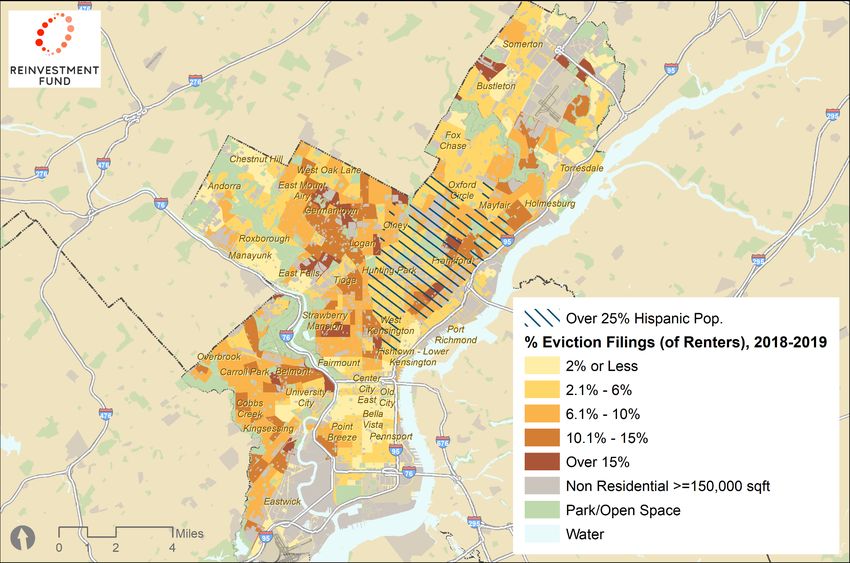
Acknowledgments
Reinvestment Fund has received funding from the Oak Foundation and the William Penn Foundation
to pursue research into evictions with the goals to support and inform ongoing efforts to reduce the
effects of eviction on households and communities. This report is the fifth in a series to catalogue our
findings.

We also gratefully acknowledge the ongoing support of Evictions Advisory Group members and others
who have helped refine the research.
Background
Reinvestment Fund’s research on evictions in Philadelphia began in 2016 in support of the City of
Philadelphia’s Assessment of Fair Housing. As such, race and ethnicity, which are protected
characteristics under federal and state fair housing laws, have been an essential part of our framework
for understanding the causes, experiences, and impacts of eviction. Our 2017 1 and 2019 2 Policy Briefs
documented the persistent, statistically significant effect of Census tract-level racial composition on
filing volume, independent of incomes, tenure mixes, and concentrations of public housing. Through
courtroom observation, we were able to collect information about the race and ethnicity of the small
share of defendants whose cases go before a judge. But we heretofore lacked a complete understanding
of the racial/ethnic characteristics of the universe of defendants in Landlord-Tenant Court.

In this Policy Brief, we apply a statistical method called Bayesian Improved Surname Geocoding (BISG) to
infer the race/ethnicity of individual tenants subject to an eviction filing. We compare filing rates, the
share each racial/ethnic group comprises of renter households receiving a filing to that group’s share of
all renter households—and how that relationship varies with neighborhood demographics. Eviction is
one form of involuntary displacement; so too is gentrification, albeit for different reasons. We therefore
conclude this Brief with an examination of the contrasts in filing rates by race/ethnicity in gentrifying
and non-gentrifying areas.

While the Landlord-Tenant Court data analyzed here reflect circumstances prior to the onset of the
COVID-19 pandemic, in August of this year Reinvestment Fund presented data in the form of an affidavit
submitted to the United States District Court for the Eastern District of Pennsylvania illustrating the
outsized impact the current health and economic crises are having on the same groups of people who
were already more likely to face an eviction filing. 3 As the United States grapples with the myriad
manifestations of entrenched racism and discrimination, understanding the difference between people-
based and place-based impacts of eviction filings and outcomes can inform local changes in policy,
procedures, and resources to promote racial equity and community stability.

Methodology
The BISG approach calculates probabilities of racial/ethnic identity of tenants based on: 1. Comparing
tenant surnames to the racial/ethnic distribution of that surname in the 2010 Census; and 2. Refining
those probabilities based on the racial/ethnic distribution of the Census tract the tenant lives in. The
dataset in this analysis includes Philadelphia households that had an eviction filing in 2018-2019. 4 We
use the shorthand terms “race” and “ethnicity” (and the categories within each group) in the analysis
that follows to reference probable tenant characteristics. 5

1 See: https://www.reinvestment.com/research-publications/evictions-in-philadelphia/
2 See: https://www.reinvestment.com/research-publications/evictions-in-philadelphia-a-data-policy-update/
3
  Affidavit of Ira J. Goldstein, Reinvestment Fund, submitted August 2020. https://www.reinvestment.com/news/2020/09/18/reinvestment-
fund-provides-expert-witness-affidavit-in-philadelphia-case-on-evictions/
4 Households were counted once per year, so they can appear twice in the dataset if filed against in both 2018 and 2019. Race/Ethnicity was

estimated for households (represented by the first named defendant) with an eviction filing. Defendant surname was joined to Census 2010
data on surname distribution of race/ethnicity (prior). Probability of household race/ethnicity was then updated based on Census 2010
racial/ethnic distribution of the Census tract the household lives within.
5In the BISG analysis of tenant names, all race and ethnicity categories are exclusive, (i.e., non-Hispanic Black, non-Hispanic White, non-Hispanic

Asian, and Hispanic of any race). In analyses using Census tract characteristics, we note that due to ACS data limitations, while the White

                                                                                                                                                 1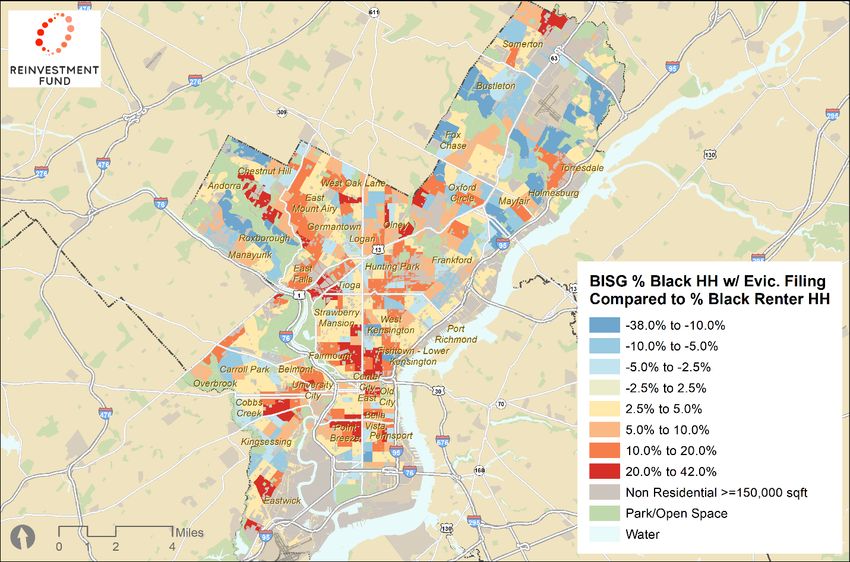
Race/Ethnicity of Tenants Facing Eviction
In Reinvestment Fund’s 2019 Brief, we observed filing rates in areas of Philadelphia that were 40-80%
Black to be 2.1 times greater than the rates in areas that were under 10% Black; in areas that were over
80% Black, the filings rates were 2.5 times greater. Analysis of the race/ethnicity of individual tenants in
Landlord-Tenant Court reveals a similar racial disproportionality to that observed at the tract level.

Table 1 shows households that faced an eviction filing in 2018-2019 by their BISG-estimated
race/ethnicity. It further breaks down tenants and filing rates by public housing (owned by the
Philadelphia Housing Authority) and private housing (which includes tenants using Housing Choice
Vouchers in addition to those using no subsidy).

Table 1: Annualized eviction filing rate by race and ethnicity, 2018-19. Reinvestment Fund analysis of Philadelphia Municipal
Court data, ACS 5-Year estimates, and Philadelphia Housing Authority reported units.
                Households with                     HH with Public                   Annual Public           HH with Private          Annual Private
 Matched                          Annual Eviction
                Eviction Filings,                 Housing Eviction                  Housing Eviction        Housing Eviction         Housing Eviction
 Surnames                         Rate, 2018-2019
                   2018-2019                      Filings, 2018-2019                Rate, 2018-2019         Filings, 2018-2019       Rate, 2018-2019
 All Names            33,953                 6.1%                 3,797                  14.9%                    30,156                    6.0%
   Black              22,373                 8.8%                 3,240                  14.5%                    19,133                    8.3%
   White              5,860                  3.1%                  250                   19.0%                    5,610                     3.0%
   Hispanic           3,907                  5.2%                  183                   13.9%                    3,724                     5.1%
   Asian               848                   2.6%                  37                    6.6%                      811                      2.5%
   Other               965                   1.9%                  87             *Units n/a                       878                      1.7%

As a group, Black Philadelphians experienced an annual eviction filing rate that was 2.8 times higher
than the rate for White Philadelphians (8.8% of Black renter households compared to 3.1% of White
renter households). 6 The rate for Hispanic tenants was also higher than for Whites.

Public housing tenants face a much higher filing rate overall, and the vast majority of public housing
tenants are Black. However, the overall disparity between filing rates for Black and White renters is
driven by the larger volume of cases in the private housing market. Black public housing residents
actually experience a lower eviction filing rate than White public housing residents (14.5% v. 19.0%), but
because the population in public housing is so heavily dominated by Black tenants, there were almost 13
times more filings against Black households compared to those that were White.

In private market housing, the filing rate for both Black and Hispanic renters was substantially higher
than the rate for White renters. The Black rate (8.3%) is almost three times that of Whites (3.0%) and
the Hispanic rate (5.1%) was also higher than the rate for White residents.

category is non-Hispanic, the Black, Asian, and Other Race categories may include renters who also identify as Hispanic. Therefore, the total of
Philadelphia renter households across categories in Figure 1 exceeds 100%. The probabilities for all households were then aggregated and
compared to ACS estimates of the count of renter households for each race/ethnicity to calculate eviction rates. The probabilities were
aggregated because the method has been found to be more accurate than either surname or tract race/ethnicity alone in the aggregate.
6 We were able to estimate the race/ethnicity of the first-named tenant on the eviction filing record for 93% of the 36,471 households facing an

eviction filing during this 2-year period. The overall annualized eviction filing rate for the matched surnames (6.1% ) was nearly identical to the
rate calculated for all filings during this period (6.2%).

                                                                                                                                                  2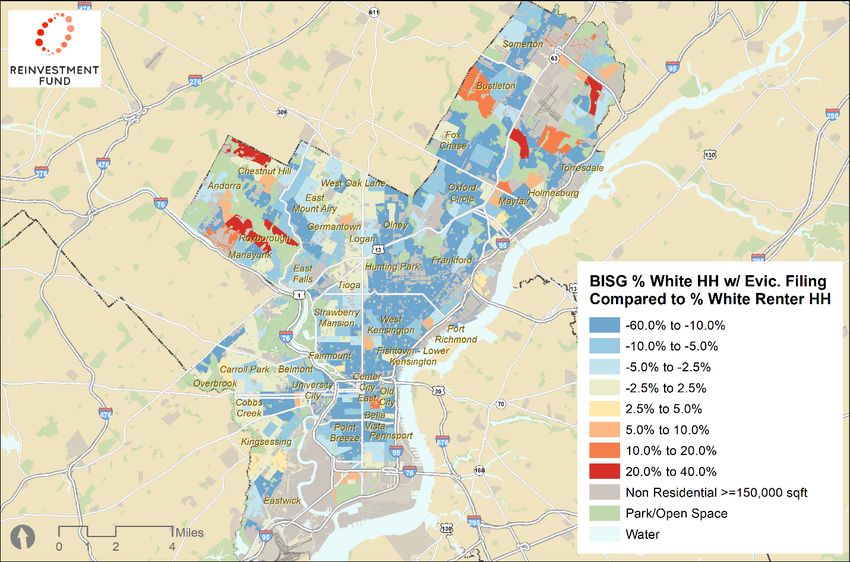
Proportionality of Racial/Ethnic Group Share of Eviction Filings Compared to Renter Population
Another way to measure the relative concentration of evictions within different demographic groups is
to compare the share each group comprises of renter households that receive a filing to the group’s
share of all renter households. This creates a measure of over- or under-representation in eviction filings
for each group relative to their share of the renter population. Specifically, if for example, Black renters
comprised 20% of all those receiving an eviction filing but only 10% of all renters, they would be over-
represented among eviction defendants by 10%.

The analysis found that Black tenants were substantially over-represented among households facing an
eviction filing. Black renter households comprised 45.4% of the city’s renter households and 65.9% of
households facing evictions. White households, on the other hand, accounted for 33.9% of renters and
less than 20% of eviction filings. (See Figure 1).

Figure 1: Households as share of renters and share of filings, 2018-2019.

                   Racial/Ethnic Group Share of Philadelphia Renters Compared to Group Share of
                                Households with an Eviction Filing, 2018-2019

           70%                                   65.9%

           60%
           50%                            45.4%
           40%      33.9%
 Percent

           30%
                          17.3%
           20%                                                  13.4% 11.5%
                                                                                                    9.3%
           10%                                                                   5.9%
                                                                                        2.5%               2.8%
           0%
                    White
                     White(Not                Black               Hispanic         Asian             Other
                    Hispanic)
                                                           Race / Ethnicity

                        % Philadelphia Renters                  % Households with Eviction Filing

Table 2 presents the number and share of Philadelphia’s Census tracts in which a given racial/ethnic
group is under-represented, over-represented, or approximately proportionately represented among
households facing eviction. In 43% of the city’s Census tracts, the Black share of renter households with
an eviction filing is substantially greater than the share of all renters that Black households comprise.
Black renters are under-represented in filings in only 15% of the city’s tracts. Conversely, the White
share of households with a filing is substantially greater than the White share of all renters in under 7%
of tracts while they are under-represented in 59% of all tracts. The experience of Hispanic renters fell
somewhere between that of Black and White tenants. That is, Hispanics were over-represented among
tenants facing eviction at about double the rate (and number of tracts) compared to Whites.

                                                                                                                  3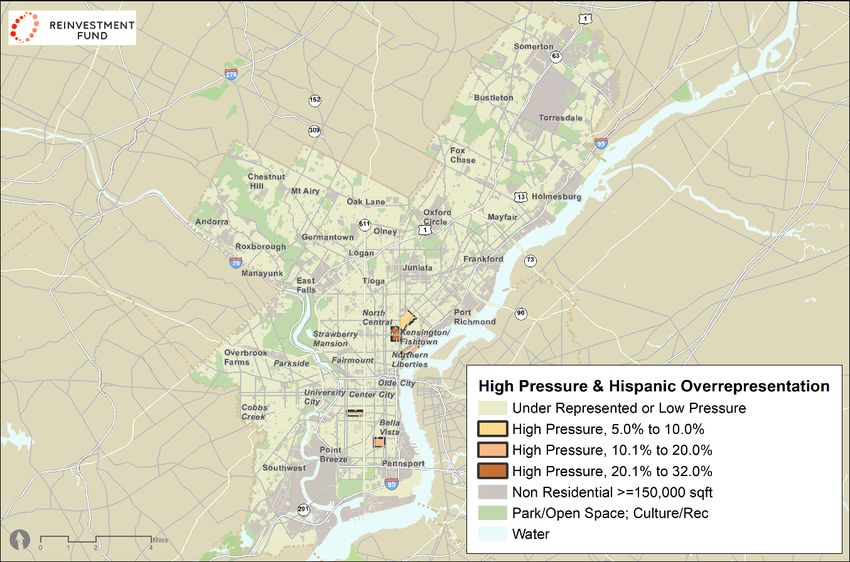
Table 2: Racial and ethnic group share of eviction filings compared to their share of renter households at the tract level

                                                   Number (Percent) of Census Tracts in Which:

                           Group's Share of                Group's Share of                  Group's Share of
 Inferred
                          Filings is Less Than            Filings is Similar to          Filings is Greater Than             Total
 Race/Ethnicity
                         Their Share of Renters          Their Share of Renters          Their Share of Renters              Tracts
 Black Renter
 Households                      54 (14.5%)                     158 (42.4%)                     161 (43.2%)              373 (100%)
 Hispanic Renter
                                 86 (23.1%)                     232 (62.2%)                     55 (14.7%)
 Households                                                                                                              373 (100%)
 White Renter
                                220 (59.0%)                     128 (34.3%)                      25 (6.7%)
 Households                                                                                                              373 (100%)

In order to better understand how over-under-representation varies by neighborhood demographics,
we estimated the average difference between the share that each racial/ethnic group comprises of
renter households receiving a filing to the group’s share of all renter households by the share of each
Census tract that was Black. Black renters were over-represented in filings regardless of the racial
makeup of their neighborhood (see Table 2), and that over-representation is especially pronounced in
areas that are racially mixed.

Table 3: Average difference between racial/ethnic group share of renter households with eviction filings and group share of all
renter households by Census tract level racial demographics (Positive values indicate over-representation in evictions, negative
values indicate under-representation)

Tract Demographics                             Black         White         Hispanic         Asian          Other
< 20% Black Renters                            4.44          -13.68          2.45           -1.17           -4.79
20-50% Black Renters                           5.71          -13.59          -3.09          -2.26          -10.86
50-80% Black Renters                           7.61           -9.50          -2.47          -1.84           -5.98
> 80% Black Renters                            1.61           -2.47          -1.08          -0.67           -1.01

The following maps show where in Philadelphia the specific over- and under-representation is found.
Blue areas, and lower/negative values, indicate the degree to which a given racial/ethnic group is under-
represented in the given tract. Red areas, and higher/positive values, indicate over-representation.
Figure 2 shows the handful of tracts in which White households are over-represented, in the Northeast
and Northwest. Figure 3 shows that Black renters were over-represented–often substantially so–in areas
adjacent to Center City and University City, in much of North Philadelphia, and into the Lower Northeast
and Northwest.

                                                                                                                                   4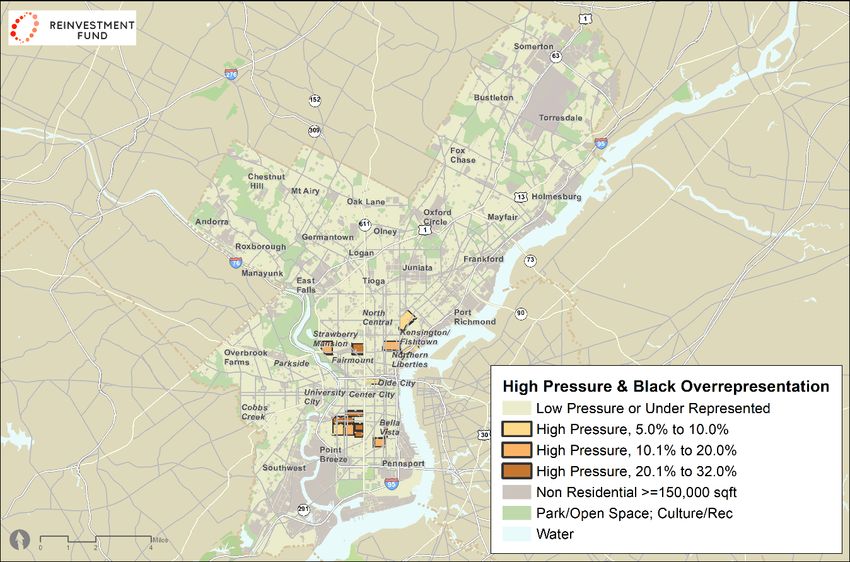
Figure 2: White households: difference between their percentage of all renter households with an eviction filing and their
percentage of all renter households.

                                                                                                           Under-represented

                                                                                                            Over-represented

Figure 3: Black households: difference between their percentage of all renter households with an eviction filing and their
percentage of all renter households.

                                                                                                          Under-represented

                                                                                                           Over-represented

                                                                                                                               5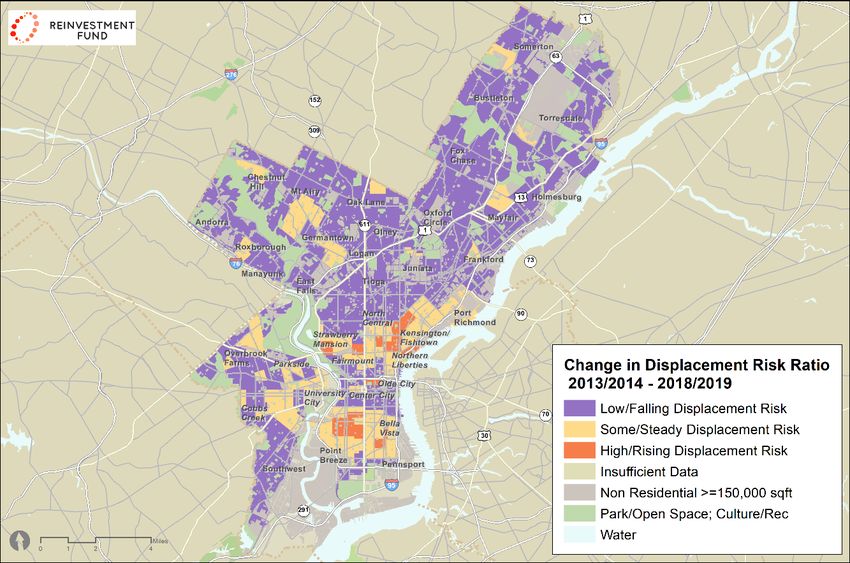
Study in Contrast: Eviction Filings for Hispanic Households
Compared to Hispanic Neighborhoods
Philadelphia’s 227,711 Hispanic residents account for close to 15% of the city’s population and are
the most likely of any racial/ethnic group to rent the homes in which they live (56.6% of the city’s
66,268 Hispanic households compared to 51.6% of Black households, 46.3% of Asian households and
41.6% of White households are renters). Hispanic residents also had the lowest median household
income of any group. Close to 60% of Hispanic residents live in tracts where they make up 25% or
more of the population, expressing the degree to which Hispanics in Philadelphia are residentially
segregated.

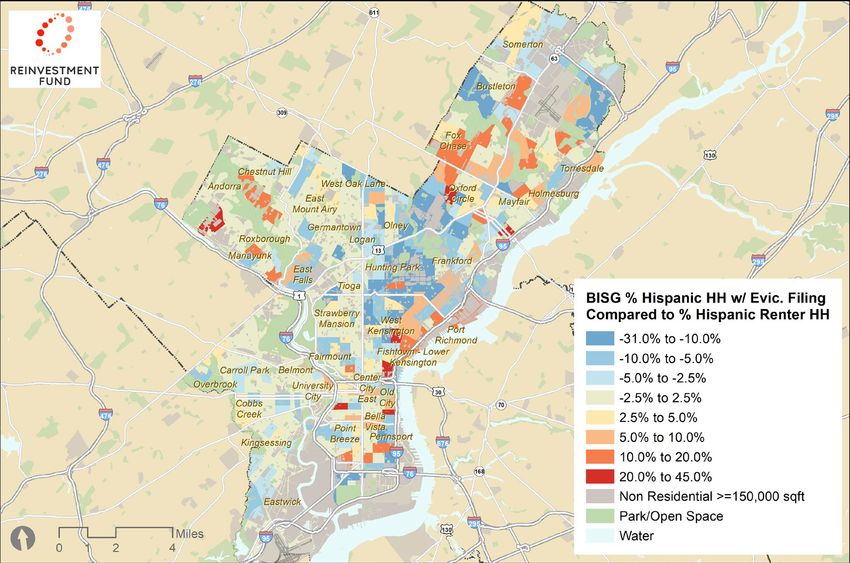
Observing the filing rates for Hispanic households at the tract level reveals a stark difference in
eviction activity in the parts of Eastern North Philadelphia, the Lower Northeast, and South
Philadelphia where these households are most concentrated compared to other parts of the city.
The estimated filing rate for all Hispanic renters in Philadelphia was lower than the city average
(5.2% compared to 6.1%) while in our neighborhood-level analysis, overall filing rates in tracts with
the highest shares of Hispanic residents averaged 6.4% (see Figure 4).

Figure 4: Eviction filing rates and Hispanic population
                                                                     Tract Demographics Hispanic Household
The filing rate for Hispanic individuals in tracts where they                             Eviction Rate
made up more than 25% of the population was 4.9%, in                 < 5% Hisp. Renters                 10.3%
contrast to 10.3% in tracts where they totaled less than 5% of       5-15% Hisp. Renters                 3.9%
                                                                     15-25% Hisp. Renters                6.8%
the population. Additionally, Hispanic over-representation
                                                                     > 25% Hisp. Renters                 4.9%
among those who face eviction was frequently observed in
areas just outside communities wherein Hispanics predominate.                                               6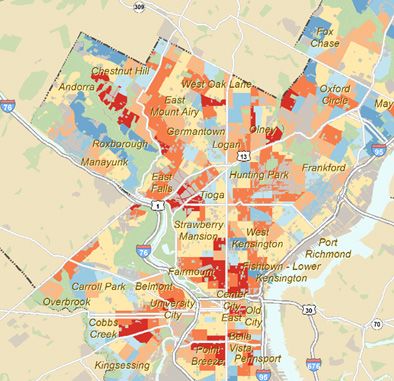
Under-represented

                                                                                                                    Over-represented

Figure 5: Hispanic households: difference between their percentage of all renter households with an eviction filing and their
percentage of all renter households.

Leaders from organizations working in the city’s Hispanic community reported in group interviews
that reliance on friends-and-family networks, general prevalence of living arrangements without a
written lease, and a longstanding lack of connection or trust between the Hispanic community and
city government and the courts all contribute to lower formal filing rates in Hispanic neighborhoods,
and even lower rates for the Hispanic renters who live there. Hispanic Philadelphians who rent
outside of these communities, however, appear to have a heightened likelihood of facing a formal
eviction where those circumstances are not as prevalent.

At the same time, research from The Pew Charitable Trusts found that, “among the neighborhoods
with the biggest concentrations of unlicensed rental properties was eastern North Philadelphia,
where many of the city’s Hispanic poor live.”I This becomes relevant because unlicensed landlords
may engage in illegal “self-help” eviction because they are unable to file formally. Licensed landlords
may also be more likely to engage in illegal evictions if they believe tenants will not seek legal
assistance.

Further research into the experience of Hispanic renters in neighborhoods with different
demographic and economic profiles could help to articulate the protective benefits of a rental
system embedded in social connections, the impacts of formal, informal, and illegal evictions, and
the specific challenges of Hispanic renters inside and outside of neighborhoods where they have a
higher presence.
I Pew Charitable Trusts, Philadelphia’s Poor: Experiences From Below the Poverty Line (2018). https://www.pewtrusts.org/en/research-

and-analysis/reports/2018/09/26/philadelphias-poor-experiences-from-below-the-poverty-line

                                                                                                                                       7
Eviction, Race, and Gentrification
Public discourses around eviction and gentrification 7 are often intertwined, in Philadelphia and across
the country. 8 Both can be a mechanism of displacement—forcing a household to leave a housing unit—
and may contribute to demographic change if that household leaves the neighborhood and similar
households follow (or a different group(s) of people move in). Yet both are complex topics, and their
relationship to one another is also complicated. There are racial justice concerns raised by both
processes: in Philadelphia, eviction has an outsized impact on Black renters and, to a degree, Hispanic
renters. The decline of Black and Hispanic populations in gentrifying neighborhoods is well-documented
in several cities. 9 The City of Philadelphia’s 2016 Assessment of Fair Housing identified rising rents and
property taxes in gentrifying areas as a contributing factor to segregation. 10
The displacement of longtime residents is currently a concern in Philadelphia areas like historically Black
Point Breeze and Hispanic East Kensington/Norris Square, and it has been documented going back to the
departure of Puerto Rican households from the Spring Garden neighborhood in the 1980s and Black
households from Society Hill in the 1960s and 70s. 11 Neighborhoods that have higher shares of renters
before gentrification tend to see larger and swifter changes than those that begin with high
homeownership; evictions are one way that a rental unit turns over. 12 Differences in housing outcomes
for those who are displaced raise legal questions as to whether there might be actionable violations of
federal and state fair housing law, as well as policy questions as to how local officials can help lower-
income, and in particular non-White households, remain in their homes in changing neighborhoods.
Understanding how and where eviction and gentrification interact can help to fine-tune efforts to
reduce involuntary moves and promote racial equity and neighborhood racial diversity.
Prior research shows that the vast majority of eviction activity in Philadelphia takes place far from
gentrifying parts of the city. Eviction filings are clustered in the city’s lowest income neighborhoods,
including upper North Philadelphia and Southwest Philadelphia, as well as in middle-income,
predominantly Black neighborhoods along the city’s edges. Gentrification in Philadelphia has been
primarily associated with proximity to Center City and universities. 13 We set out to identify
neighborhoods where heightened eviction rates have coincided with steep price appreciation, and in
particular, areas where Black and Hispanic renters are impacted.
7 Though definitions vary, the term gentrification generally refers to the arrival of higher income households and the departure of lower
incomes ones in a neighborhood, sometimes accompanied by racial change. See, e.g., Hwang, J., and Sampson, R. J. (2014). Divergent pathways
of gentrification: Racial inequality and the social order of renewal in Chicago neighborhoods. American Sociological Review, 79(4), 726-751,
Kirkland, E. (2008). What's Race Got to Do With it? Looking for the Racial Dimensions of Gentrification. Western Journal of Black Studies, 32(2).
8 See, e.g., https://www.inquirer.com/news/gentrification-philadelphia-african-american-latino-investment-neighborhood-20190320.html,
http://ucreview.com/philadelphia-forum-on-gentrification-and-displacement-p8137-1.htm,
https://gobigread.wisc.edu/2017/02/gentrification-consequences-impacts-eviction/; http://www.westphillylocal.com/2018/12/18/neighbors-
protest-arvilla-sale-owners-say-deal-nearly-final/
9 Chronopoulos, T. “What’s Happened to the People?” Gentrification and Racial Segregation in Brooklyn. J Afr Am St 24, 549–572 (2020).
https://doi.org/10.1007/s12111-020-09499-y; Jackson, J. (2015) The Consequences of Gentrification for Racial Change in Washington, DC,
Housing Policy Debate, 25:2, 353-373, DOI: 10.1080/10511482.2014.921221
10 https://www.phila.gov/documents/assessment-of-fair-housing/, see pages 109 and 120.
11 Richardson, J., Mitchell, B., Franco J. (2019). Shifting Neighborhoods: Gentrification and cultural displacement in American cities. National
Community Reinvestment Coalition. https://ncrc.org/gentrification/. Beauregard RA. (1990) Trajectories of Neighborhood Change: The Case of
Gentrification. Environment and Planning A: Economy and Space; 22(7):855-874. doi:10.1068/a220855
12 Pew Charitable Trusts, Gentrification and Neighborhood Change in Philadelphia, 2016. https://www.pewtrusts.org/en/research-and-
analysis/articles/2016/05/gentrification-and-neighborhood-change-in-philadelphia
13 Pew, (2016).
8Displacement Risk
Reinvestment Fund’s Displacement Risk Ratio (DRR) identifies areas of concern for involuntary, price-
based displacement, which is commonly associated with gentrification. 14 It compares median family
income at a fixed start year (adjusted for inflation) to changes in home sale prices over time, while
simultaneously accounting for city-wide home price trends.
Large increases in the DRR over time help pinpoint areas of Philadelphia where there is the greatest
displacement pressure due to rising prices. 15 According to our calculation of tract-level DRR changes
between 2013-2014 and 2018-2019, areas showing the highest risk of price-based displacement are
located in historically Black Point Breeze and Brewerytown, and historically Hispanic Kensington (see
Figure 7). Compared to the first decade of this century, when a wave of gentrification moved outward
from Center City and impacted some majority White neighborhoods like East Passyunk and
Fishtown, a more recent trend in price-based displacement risk appears to be more concentrated in
communities of color.
Figure 6: Risk of price-based displacement based on change in DRR between 2013-14 and 2018-19
14For examples of the application of the DRR, see City of Philadelphia “Assessment of Fair Housing,” (2016), and Goldstein, I., Dowdall, E. and
Weidig C. (2017), “Understanding Neighborhood Change: An approach to assessing displacement risk among NYC residents” A working paper in
the Culture and Social Wellbeing in New York City – 2014-2017, Social Impact of the Arts Project, University of Pennsylvania, 2017.
http://bit.ly/2HnRTY6.
15 Although the DRR is based on home sales generally where home prices are rising, rents are rising too.
9Figure 7: Tracts with high displacement risk and Black overrepresentation in eviction filings, 2018-2019
Figure 8: Tracts with high displacement risk and Hispanic overrepresentation in eviction filings, 2018-2019
10Displacement Risk and Proportionality of Racial/Ethnic Group Share of Eviction Filings
To examine the interplay between price-based displacement risk and eviction, we again compared the
share that each racial/ethnic group comprises of renter households receiving a filing to the group’s
share of all renter households, and calculated the average difference between the two by tract-level
DRR change. We found that in those places where there was evidence of increasing price pressure (i.e.,
increasing DRR areas), Black renters were substantially more over-represented among those facing a
filing than they were in tracts with stable and declining price pressure (and they were over-represented
on average in each of these categories). In these currently “hot” areas–including Point Breeze,
Brewerytown, East Kensington, and Mifflin Square in Southeast Philadelphia–Black renters are
experiencing eviction rates at a share much greater than Black renters represent of all renters.
We observe a similar pattern among Hispanic renters. In and adjacent to the city’s gentrifying markets–
Kensington, Fishtown, Northern Liberties–Hispanic renters are over-represented among those facing
eviction (see Figures 8 and 9).
Table 4: Average difference between racial/ethnic group share of renter households with eviction filings and group share of all
renter households by Census tract level change in displacement risk ratio (DRR) from 2013-14 to 2018-19
Average Difference Between Group Share of Renter Households with Eviction
Filings and Group Share of All Renter Households in Tracts with:
Probable Increasing DRR (2.0+) Stable DRR (0-2.0) Declining DRR (Displacement Pressure and Demographic Change
Analysis of tract-level changes in the number of Black and Hispanic residents finds notable declines in
those populations in areas experiencing both displacement pressure and over-representation of these
groups in eviction filings. The size of the city’s Black population was essentially flat between the 2009-13
and 2014-2018 ACS estimates; the Hispanic population expanded by 16.9%. While it is impossible to
know the extent to which population changes are a result of racially disproportionate evictions or price-
based displacement, in increasing DRR/Over-representation tracts, the Black population declined by
about 10.9% and the Hispanic population by nearly 20%. In contrast, these populations actually grew in
increasing DRR/Non-Over-representation tracts during this period; almost all of these tracts were
adjacent to increasing DRR/Over-representation tracts, which may indicate that households facing
eviction or displacement pressure moved nearby. In raw numbers, the largest increases in both Black
and Hispanic populations took place in areas with decreasing displacement risk. This may reflect trends
identified in previous research that when lower-income families move, they typically move to areas with
lower median incomes than those from which they departed. 16
Table 5: Change in Black population by DRR change from 2013-14 to 2018-19 and relative representativeness
Citywide Increasing DRR, Increasing DRR, not Stable DRR Decreasing No DRR/
(384 Over-represented Over-represented (86 tracts) DRR Insufficient Sales
tracts) (15 tracts) (3 tracts) (262 tracts) (18 tracts)
2009/2013 665,332 23,254 1,751 141,547 492,349 6,431
Black Pop
2014/2018 666,047 20,730 2,242 136,895 500,784 5,396
Black Pop
Difference 715 -2,524 491 -4,652 8,435 -1,035
(Percentage) (0.1%) (-10.9%) (28.0%) (-3.3%) (1.7%) (-16.1%)
Citywide Increasing DRR, Increasing DRR, not Stable DRR Decreasing No DRR/
(384 Over-represented Over-represented (86 tracts) DRR Insufficient Sales
tracts) (5 tracts) (13 tracts) (262 tracts) (18 tracts)
2009/2013 194,714 4,682 4,449 29,197 154,585 1,801
Hispanic Pop
2014/2018 227,711 3,829 6,344 35,224 180,533 1,781
Hispanic Pop
Difference 32,997 -853 1,895 6,027 25,948 -20
(Percentage) (16.9%) (-18.2%) (42.6%) (20.6%) (16.8%) (-1.1%)
16Ding, L., Hwang, J., and Divringi, E. (2015), Gentrification and Residential Mobility in Philadelphia (2015-10-15). FRB of Philadelphia Working
Paper No. 15-36, Available at: https://www.philadelphiafed.org/community-development/housing-and-neighborhoods/gentrification-and-
residential-mobility-in-philadelphia
12Conclusion
Research to date shows that areas in Philadelphia that are home to larger shares of the Black population
experience evictions disproportionately compared to similar White areas. 17 However, just because an
area that has a larger share of Black people disproportionately experiences evictions, we cannot
conclude that those facing eviction in those areas are Black. What we do know is that these areas
experience adverse consequences when their residents, regardless of race, experience the involuntary
displacement associated with eviction. The contribution of this Brief is its demonstration that Black
individuals are, disproportionate to their presence among Philadelphia’s renters, more likely to
experience eviction filings. In other words, even when Black people live in predominantly White or
mixed-race areas, they are more likely to be subject to an eviction filing by their landlord. Hispanic
residents are also at a disadvantage to Whites, particularly when they live in areas where they make up
a smaller share of the population. Hispanic renters, like many Black renters, are more likely to be subject
to evictions in areas of Philadelphia that have undergone changes we generally acknowledge as
gentrification.
Following the recent deaths of George Floyd in Minneapolis and Walter Wallace, Jr. in Philadelphia, to
name just a few who have lost their lives in police-related incidents, and the outsized impact of the
COVID-19 pandemic on the city’s Black and Brown residents, Philadelphia policymakers have indicated a
renewed focus on racial justice. The data in this Policy Brief suggest that a multifaceted approach to
stabilizing housing for Black and Hispanic renters is an essential part of addressing equity. This would
include concerted efforts to reduce the volume of avoidable evictions through various programmatic
and legal supports. The data also suggest that both people- and place-based approaches to stabilize
Philadelphia’s renters would be beneficial.
Reinvestment Fund’s next Policy Briefs will present: 1. An analysis of differences in the Landlord-Tenant
Court process and outcomes after the point of filing for tenants of differing racial / ethnic identifications
and 2. Research on the relationship of eviction filings to multiple dimensions of social wellbeing. The
first Brief is intended to inform changes in policy and court procedures that may better ensure that all
who are in an eviction dispute can access the court procedures that may better ensure access to court
for those facing eviction, and equitable outcomes that are not influenced by race or ethnicity, or the
neighborhood in which they live. The focus of the second Brief on neighborhood-level wellbeing
indicators such as health access, social engagement, and education will help identify systems and
stakeholders outside of the housing sector and municipal courts that are impacted by eviction, and may
present opportunities to reduce evictions and their effects.
17 Reinvestment Fund (2017), (2019), https://www.reinvestment.com/research-publications/evictions-in-philadelphia-a-data-policy-update/
and 2017, https://www.reinvestment.com/research-publications/evictions-in-philadelphia/
13Reinvestment Fund has published a range of reports addressing critical
public policy issues. The highlighted reports below represent recent housing
research projects. For details, please visit our Policy Publications site:
WWW.REINVESTMENT.COM/IMPACT/RESEARCH-PUBLICATIONS
2014 2016
Philadelphia Residential West Philadelphia Scattered
Mortgage Foreclosure Site Model: An Affordable
Diversion Program: Update Housing Impact Study
2017 2019
Evictions in Philadelphia HEMAP’s Enduring Impact
in Pennsylvania
REINVESTMENT FUND is a national mission-driven financial institution that creates
opportunity for underserved people and places through partnerships. We marshal the capital,
analytics, and expertise necessary to build strong, healthy, and more equitable communities.
PHILADELPHIA BALTIMORE ATLANTA
www.reinvestment.com 1700 Market Street 1707 North Charles Street 229 Peachtree Street NE
www.policymap.com 19th Floor Suite 200B Suite 750, International Tower
Philadelphia, PA 19103 Baltimore, MD 21201 Atlanta, GA 30303
TEL 215.574.5800 TEL 410.783.1110 TEL 404.400.1130
real estate early healthcare healthy housing k-12 data & clean
education food education analysis energy
Reinvestment Fund is an equal opportunity provider.You can also read


