Exploring Direct Provision: Freedom of Information File Database Information - Exploring Direct ...
←
→
Page content transcription
If your browser does not render page correctly, please read the page content below
www.exploringdirectprovision.ie

Funded by UCD Seed Funding               Prepared by Dr Liam Thornton, Associate Professor, UCD School of Law   Last Updated: 23 August 2021

                Exploring Direct Provision: Freedom of Information File Database

                                                              Information

The Exploring Direct Provision: Freedom of Information File Database is updated to 23 August 2021 . All new additions/updates to
the previous version of this file database, from November 2019, are highlighted in Yellow. A number of other changes to the database
have occurred:
    1. All documents in this database are PDF files, and all PDF files can now be searched for discrete words/phrases.
    2. All URLs to documents remain the same as the November 2019 database.

                                                               Attribution
Where you utilise materials sourced from this database, please attribute to Exploring Direct Provision (www.exploringdirectprovision).
Links can be made directly to all file-sets (even if the file-sets are updated with new material, the hyperlink will remain the same).

                                                                     Page 1 of 63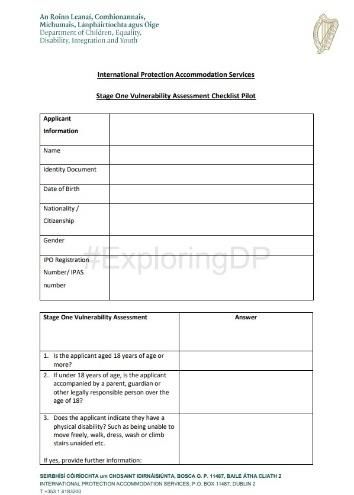
www.exploringdirectprovision.ie

Funded by UCD Seed Funding                 Prepared by Dr Liam Thornton, Associate Professor, UCD School of Law   Last Updated: 23 August 2021

                                                                        1997

  Document                                                              Content Description

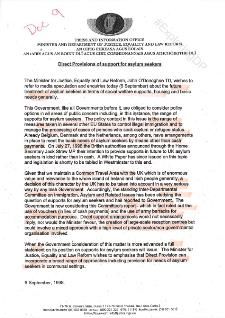
                      Discussion of Irish Independent newspaper reports alleging abuse of social welfare system by asylum seekers
                      between Ministers for the Department of Social, Community and Family Affairs (DSCFA) and the Department of
                      Justice, Equality and Law Reform (DJELR). DJELR noted that the newspaper reports were false and of the Irish
                      Independent’s own making.

  2210to0411-
  97-SW-JUST

                                                                       Page 2 of 63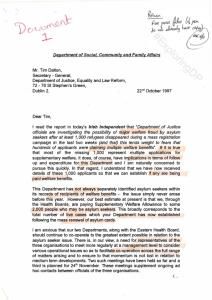
www.exploringdirectprovision.ie

Funded by UCD Seed Funding                       Prepared by Dr Liam Thornton, Associate Professor, UCD School of Law       Last Updated: 23 August 2021

                                                                              1998

    Document                                                                     Content Description

                             Analysis of the Department of Environment and Local Government (DELG) on the pressures on accommodation
                             provision for asylum seekers in the Dublin region. The note stated that given the gravitation of persons seeking asylum
                             to Dublin, significant challenges were being faced in ensuring asylum seekers could be accommodated. Prepared for
                             the Interdepartmental Committee on Immigration, Asylum and Related Issues.

    0307-98-DELG

                             Concerns raised by Minister for SCFA to Minister for JELR around safeguarding of welfare system from ‘abuse’ by
                             asylum seekers, and issues related to perceived weaknesses in border security, duplicate asylum claims, and asylum
                             seekers entering and leaving the State without permission. The Minister for JELR in response noted the strengthening
                             of border security, while also highlighting that the UK’s system for social welfare for asylum seekers was less generous
                             than Ireland’s.

   2407to0708-98-
     SW-JUST

                                                                             Page 3 of 63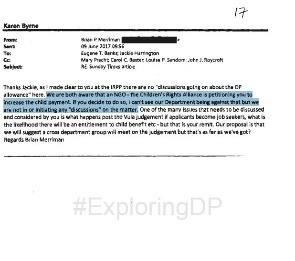
www.exploringdirectprovision.ie

Funded by UCD Seed Funding                       Prepared by Dr Liam Thornton, Associate Professor, UCD School of Law     Last Updated: 23 August 2021

                             Press statement by the then Minister for JELR publicly noting the United Kingdom Home Secretary’s statement on the
                             Immigration and Asylum White Paper. This statement indicated that Ireland was to move away from inclusion of asylum
                             seekers within the general social welfare system.

    2707-98-JUST

                             Public announcement by Minister for JELR of the establishment of the system of direct provision for asylum seekers.

    0609-98-JUST

                                                                             Page 4 of 63
www.exploringdirectprovision.ie
Funded by UCD Seed Funding Prepared by Dr Liam Thornton, Associate Professor, UCD School of Law Last Updated: 23 August 2021
Decisions sought by the DJELR from Cabinet on establishing the system of direct provision. These documents include
portions of the Report from the Interdepartmental Committee on Immigration, Asylum and Related Issues recommending
that Ireland introduce a system of direct provision. The tensions between various Government departments surrounding
these approaches are outlined in these documents. The system of direct provision was formally approved by
Government on 28 August 1998. Questions remained on operationalisation e.g. provision of accommodation in army
barracks, involvement of the church, provision of vouchers, rather than cash allowances for asylum seekers. On 03
November 1998, it was decided that the DJELR would be the lead government body responsible for direct provision,
with significant input from Health Boards (who then administered the supplementary welfare allowance system) and
DSCFA.
2808to0311-98-
GOV
This significant cache of documents starting in 1998 and ending in 2000, reflect discussions on persons
seeking asylum that occurred during the drafting of Integration: A Two Way Process by an Interdepartmental
working group on integration of refugees (1999-2000). There was significant consultation with various civil
society actors in this field. Various presentations and drafts of the report make up this 1000 page file set. This
included significant discussions on rights and entitlements for persons seeking asylum in Ireland that provides
some understanding to the development of the system of direct provision. The documents also provide
fascinating insights to how issues of race and racism were discussed at the end of the 1990s. [Note, these
0212-1998 to documents commence in 1998 and end in 2000.The documents are presented in order of time rather than
1002-2000-INTEG in the Schedule of Records at the start of this document. Also included is the full Integration report, as well as
a speech by the then Minister for Justice launching the report in February 2000].
Page 5 of 63www.exploringdirectprovision.ie
Funded by UCD Seed Funding Prepared by Dr Liam Thornton, Associate Professor, UCD School of Law Last Updated: 23 August 2021
1999
Document Content Description
SWA Circular 01/1999 from the Supplementary Welfare Allowance (SWA) Policy Section of DSCFA establishing
procedures for dealing with asylum seekers.
0104-99-SWA
Circular 01 of 1999-
SW
SWA Circular 02/1999 from the Supplementary Welfare Allowance (SWA) Policy Section of DSCFA relating to modalities
for making social welfare payments to asylum seekers.
0104-99-SWA
Page 6 of 63www.exploringdirectprovision.ie
Funded by UCD Seed Funding Prepared by Dr Liam Thornton, Associate Professor, UCD School of Law Last Updated: 23 August 2021
Circular 02 of 1999-
SW
Minister for JELR formally announces that Ireland will introduce a system of dispersal for asylum seekers. This meant
that asylum seekers, who required accommodation, would not be permitted to decide where in the country they were
placed.
1910-99-JUST
Correspondence between DJELR and DSCFA on need for co-ordinated government action relating to asylum seekers.
26to2910-99-JUST-
SW
Page 7 of 63www.exploringdirectprovision.ie
Funded by UCD Seed Funding Prepared by Dr Liam Thornton, Associate Professor, UCD School of Law Last Updated: 23 August 2021
Preliminary response of the Department of Health and Children (DHC) to the proposed establishment of the system of
direct provision to the Interdepartmental Committee on Immigration, Asylum and Related Issues. The DHC stated that
a legislative response was needed, including amendments to various legislative enactments. Support was expressed
for DJELR being the lead government department with overall control of reception conditions for asylum seekers. Some
blame was placed on local authorities, with DHC saying that issues with accommodation for asylum seekers were
foreseeable.
0211-99-DHC
DSCFA response to the Interdepartmental Committee on Immigration, Asylum and Related Issues. DSCFA proposed
that asylum seekers be entitled to comfort payments of between IR£10 and IR£15 weekly. The totality of communal
accommodation, low weekly payment rates may make Ireland less ‘attractive’ as a destination for asylum seekers.
DSCFA noted legislation may be needed for this. This response also notes financial challenges that DSCFA projected
in moving to a system of direct provision. This response also acknowledged that asylum seekers would still be entitled
to certain social assistance payments (such as One Parent Family Payment, child benefit, old age (non contributory)
pension) and questioned did changes need to occur.
0511-99-SW
Page 8 of 63www.exploringdirectprovision.ie
Funded by UCD Seed Funding Prepared by Dr Liam Thornton, Associate Professor, UCD School of Law Last Updated: 23 August 2021
The Southern Health Board’s Protocol on Asylum Seekers. This document outlines the entitlement of asylum seekers
to supplementary welfare allowance (where the individual/family has no other income or source of financial support), as
well as modalities for accommodating asylum seekers in Cork region.
2911-99-SHB
On International Human Rights Day 1999, the DSCFA sets the rates of the payment of direct provision allowance at a
rate of IR£15 (€19.10) for adults per week, and £7.50 (€9.60) per child per week. The rate of this payment will remain
unchanged, for children, until 07 January 2016, and for adults, until June 2017.
1012-99-SW
Page 9 of 63www.exploringdirectprovision.ie
Funded by UCD Seed Funding Prepared by Dr Liam Thornton, Associate Professor, UCD School of Law Last Updated: 23 August 2021
These are the 1999 cache of documents prepared for government meetings. Many of documents above give effect to
the decisions made by Government within these documents. Further agreement to establish the system of direct
provision, changes to asylum and refugee legislation so as to attempt to curb arrivals of asylum seekers to Ireland were
also discussed. On 19 October 1999, Government policy was to mainly provide accommodation to asylum seekers on
a ‘full board’ basis, without access to cooking facilities. This was done on the basis that stays in communal direct
provision centres would be for no longer than six months. Government policy on dispersal of asylum seekers, and moving
asylum seekers away from Dublin, is also contained in this tranche of documents. Concerns were expressed at the slow
progress in issuing decisions on refugee claims. There is some discussion of the Minister for JELR intensifying
deportations. Other issues such as access by non-European Union/European Economic Area citizens to the workplace
are also discussed in these documents.
2602to1312-99-
GOV
Page 10 of 63www.exploringdirectprovision.ie
Funded by UCD Seed Funding Prepared by Dr Liam Thornton, Associate Professor, UCD School of Law Last Updated: 23 August 2021
2000
Document Content Description
A series of communications between DSFCA and the Eastern Health Board (EHB) and Eastern Regional Health
Authority (ERHA). Concerns were expressed at a local level, some Community Welfare Officers were providing asylum
seekers with rent supplement, rather than placing them in hotels/bed and breakfasts, or the direct provision centres that
had informally commenced. Some community welfare officers stated that the DSCFA was ‘manipulating’ the law, and if
they wanted to prevent asylum seekers from accessing rent supplement, then legislation would be needed. It is
acknowledged in the correspondence that Community Welfare Officers may have some residual discretion to provide
asylum seekers with rent supplement so as to access private rented accommodation. However, generally, asylum
seekers should only be not be provided with rent supplement. Managers within the EHB/EHRA stated that they fully
supported government policy, and would communicate this to community welfare officers.
1401to2102-00-
SW-EHB
SWA Circular 02/2000 establishing further particulars of making payments to persons seeking asylum.
0802-00-SWA
Page 11 of 63www.exploringdirectprovision.ie
Funded by UCD Seed Funding Prepared by Dr Liam Thornton, Associate Professor, UCD School of Law Last Updated: 23 August 2021
Circular 02 of 1999-
SW
Concerns expressed by a manager in EHRA to the DSCFA that community welfare officers were having their discretion
unlawfully fettered by the DSFCA, in the DSFCA seeking to set the precise amount of money that was to be paid to adult
and child asylum seekers.
2003-00-ERHA-SW
SWA Circular 04/00 is the formal communication that the system of direct provision in Ireland commenced for all persons
claiming asylum from 10 April 2000. The circular confirms the weekly rates of IR£15/£7.50 payable to asylum seekers,
and informing Community Welfare Officers that generally rent supplement and full-rate of supplementary welfare
allowance, should not be paid to asylum seekers.
1004-00-SWA
Circular 04 of 2000-
SW
Page 12 of 63www.exploringdirectprovision.ie
Funded by UCD Seed Funding Prepared by Dr Liam Thornton, Associate Professor, UCD School of Law Last Updated: 23 August 2021
Correspondence between Ministers in DJELR and DSCFA, where Justice expressed concerns that Community Welfare
Officers were granting asylum seekers full rate supplementary welfare allowance and rent allowance, frustrating the
government’s intention to establish the system of direct provision. The Minister for DSCFA noted that it was important
not to adopt a ‘heavy handed’ approach, and that certain vulnerable asylum seekers should be permitted access to full
supplementary welfare allowance and rent supplement.
1305to1705-00-
JUST-SW
SWA Circular 05/00 further emphasised that where asylum seekers refused direct provision accommodation, access to
supplementary welfare allowance nor rent supplement should be granted. However, DSCFA recognised that direct
provision may not be appropriate for pregnant asylum seekers, asylum seekers suffering illness or where family
members of asylum seekers are already in the State, and that person wishes to live with them. Within these enumerated
exceptions, full rate supplementary welfare allowance (and rent supplement) was to be paid.
1505-00-SWA
Circular 05 of 2000-
SW
Page 13 of 63www.exploringdirectprovision.ie
Funded by UCD Seed Funding Prepared by Dr Liam Thornton, Associate Professor, UCD School of Law Last Updated: 23 August 2021
Correspondence between the EHB/ERHA, DSFCA and DJELR where the latter bodies requested DJELR to take over
the weekly payment to asylum seekers. Questions about legal appropriateness of fettering discretion of Community
Welfare Officers, along with organisation of reception conditions more generally, dominates this correspondence.
1805to1406-00-
EHB-SW-JUST
Communications between DSCFA and officials within DJELR (and the then Directorate of Asylum Support Services
(DASS), which was subsequently replaced with the Reception and Integration Agency (RIA). DSFCA formally requests
that DJELR/DASS take over responsibility for weekly payments to asylum seekers. Upon allegations being made that
Community Welfare Officers are not following Government policy through granting of full rate Supplementary Welfare
Allowance and Rent Supplement payments, DSFCA notes the poor quality of DASS accommodation as a key reason
for payments being made.
1807to2507-00-
SW-JUST
Page 14 of 63www.exploringdirectprovision.ie
Funded by UCD Seed Funding Prepared by Dr Liam Thornton, Associate Professor, UCD School of Law Last Updated: 23 August 2021
Notification of the commencement of the Refugee Act 1996 (as amended).
1011-00-JUST-SW
Government documentation between 08 February 2000 and 20 October 2000 relating to establishing and operating the
system of direct provision for asylum seekers. Throughout significant concerns dominate cabinet decisions relating to
the perceived high number of persons seeking asylum. This documentation includes more developed discussions
relating to different types of potential accommodation:
• Establishing Flotels (floating hotels) in various harbours for persons seeking asylum. However, harbour
authorities strongly objected to this, and the plan was never preceded with (but was also discussed publicly in
2003 by then Minister for JELR, Michael McDowell);
• Placing accommodation for asylum seekers in former army barracks. There were significant objections to this
from the armed forces;
• Use of hotels and Bed and Breakfasts to continue until there was enough capacity within purpose built or acquired
accommodation for asylum seekers.
0802to2010-00- Although not fully discussed (within this documentation), some concerns were expressed that many asylum seekers did
GOV not accept the offer of direct provision like accommodation, and were often granted supplementary welfare allowance,
and rent supplement, in order to source accommodation in the private sector.
Page 15 of 63www.exploringdirectprovision.ie
Funded by UCD Seed Funding Prepared by Dr Liam Thornton, Associate Professor, UCD School of Law Last Updated: 23 August 2021
This document is the first document amongst these FOI files that discusses the Interim Advisory Board of the Reception
and Integration Agency (RIA). This document confirms the appointment of the National Social Policy Officer of St.
Vincent de Paul to the Interim Advisory Board of RIA. The document also outlines the role of the Advisory Board. See
further: 0102to2409-01-JUST and 1802to2010-02-JUST-SW.
1611-00-JUST-SW
Page 16 of 63www.exploringdirectprovision.ie
Funded by UCD Seed Funding Prepared by Dr Liam Thornton, Associate Professor, UCD School of Law Last Updated: 23 August 2021
2001
Document Content Description
Statement by the then Minister for JELR rejecting the Irish Refugee Council report, Beyond The Pale. The Minister stated
that the sample size of the research was small, and the accommodation and meals provided to asylum seekers in Ireland
were excellent.
2803-01-JUST
The establishment of the Interim Advisory Board of the Reception and Integration Agency (RIA), and its programme of
work, including minutes of its meetings during 2001 are set down in these documents. It had been the Minister for JELR’s
intention to place this Interim Board on a legislative footing (which never occurred). The purpose of the Interim Board
was to advise the Director of RIA on the implementation of government policy as it pertained to the functions of RIA.
Although mainly RIA deals with direct provision, it also had/has a number of other objectives pertaining to integration of
recognised refugees. Focusing on its direct provision remit, these documents provide some rich insights into how non-
governmental representatives of the Interim Board, attempted to ameliorate conditions for asylum seekers in direct
provision. Discussions on granting asylum seekers the right to work, increase weekly payments to asylum seekers, and
seeking to influence Ireland’s engagement with the then Draft EU Reception Conditions Directive all emerge from this
documentation. In saying that, many of these suggestions (backed up with a draft report), were put forward by the
0102to2409-01- National Social Policy Officer of St. Vincent de Paul.
JUST
Page 17 of 63www.exploringdirectprovision.ie
Funded by UCD Seed Funding Prepared by Dr Liam Thornton, Associate Professor, UCD School of Law Last Updated: 23 August 2021
These files provide an insight into the approaches of DJELR, DSCFA (along with health boards), of differing approaches
being adopted towards permitting asylum seekers exit the system of direct provision. DJELR felt that Community Welfare
Officers (in certain areas), were all too readily permitting asylum seekers exit direct provision, and granting them full rate
Supplementary Welfare Allowance and rent supplement. DSFCA criticised the slow progressing of cases, and noted
that a “one size fits all” approach to a varied asylum seeker population would not be possible, so as to take account of
individual needs of different asylum applicants.
The files also discuss Draft SWA Circular 04/01 (this is not to be confused with the issued Circular 04/01 discussed
below). A copy of this Draft Circular is not available. However, the circular appeared to seek to permit asylum seekers
whose children were Irish, to seek and enter employment (which would have been contrary to the Refugee Act 1996 (as
amended). In addition, the Draft Circular, sought to bring consistency to the issue of when Community Welfare Officers
could exercise their discretion and pay full rate Supplementary Welfare Allowance and rent supplement.
3005to1412-01-
JUST-SW
Confirming no change of payment rates to asylum seekers in direct provision within Budget 2001.
2906-01-SWA
Circular 0401-SW
Page 18 of 63www.exploringdirectprovision.ie
Funded by UCD Seed Funding Prepared by Dr Liam Thornton, Associate Professor, UCD School of Law Last Updated: 23 August 2021
2002
Document Content Description
Linked with 3005to1412-01-JUST-SW, requests from DJELR official to an official within DSCFA for a meeting on Draft
SWA Circular 04/01 (3005to1412-01-JUST-SW) was reiterated. From the documentation available it does not seem
that the meeting ever took place, despite several requests over a five-month period.
1402to1904-02-
JUST-SW
These are the final set of files relating to the Interim Advisory Board of the Reception and Integration Agency (RIA).
Only one meeting of the Advisory Board occurred in 2002. It discussed issues relating to delays in processing asylum
applications, as well as highlighted what was regarded as a significant increase in individuals applying for residence
on the basis of the Irish citizenship of their child. On 20 October 2002, the new Minister for JELR informed members of
the Interim Board that it was being disbanded, and there were no plans to place RIA on a legislative footing.
1802to2010-02-
JUST-SW
Page 19 of 63www.exploringdirectprovision.ie
Funded by UCD Seed Funding Prepared by Dr Liam Thornton, Associate Professor, UCD School of Law Last Updated: 23 August 2021
Discussions at Cabinet in 2002 relating to the system of direct provision (and related issues). Minister Michael McDowell
had proposed that the Department of Justice be provided with power to make regulations to exclude asylum seekers
from accessing any social welfare payments, rent supplement, and for supports to be provided ‘in cash or in kind’. No
such regulations were ever adopted (however significant changes in 2003 and 2005 purported to remove asylum seekers
from the Irish welfare state).
1111to1211-02-
GOV
DSFCA, after a meeting with Community Welfare Officers trade union officials, sought a meeting with officials within
DJELR. According to DSFCA, the trade union officials were concerned at what they saw as the ‘manipulation’ of law
and the community welfare system, for asylum seekers in direct provision. Union officials proposed that the system of
direct provision be provided with a legislative underpinning if that is what the Government sought to do. It appears a
meeting may have taken place in December 2002, but no further documentation is available on this.
1007to0312-02-
SW-JUST
Page 20 of 63www.exploringdirectprovision.ie
Funded by UCD Seed Funding Prepared by Dr Liam Thornton, Associate Professor, UCD School of Law Last Updated: 23 August 2021
2003
Document Content Description
Letter to official in DJELR relating to meeting with trade unions regarding asylum seekers and the welfare system (see
also, 1007to0312-02-SW-JUST).
0804-03-SW-JUST
In response to correspondence received from Masters of the Dublin Maternity Hospitals, the Minister for Justice in this
note for government stated that there was an urgent need to consider SWA Circular 00/05 (1505-00-SWA Circular 05
of 2000-SW). The Masters stated that by Health Boards granting pregnant asylum seekers full rate supplementary
welfare allowance and rent supplement, this was resulting in women in the late stages of pregnancy relocating to Dublin.
The Midlands Health Board confirmed that within its operative area, women in late stage pregnancy (post 28 weeks)
were granted full rate supplementary welfare allowance and rent supplement. (Not documented, but this would have
been the general approach of many Health Boards at the time).
The Minister stated that direct provision, including for pregnant asylum seekers, was suitable and provided adequate
accommodation. The Minister stated there was no need for Community Welfare Officers to grant any asylum seeker
rent supplement and requested that SWA Circular 00/05 be withdrawn. While then passed (but not commenced)
1102-03-GOV legislation would resolve the issue, the Minister wanted the practice to stop prior to the commencement of this legislation.
The Minister also expressed concerns with the practice of Community Welfare Officers granting supplementary welfare
Page 21 of 63www.exploringdirectprovision.ie
Funded by UCD Seed Funding Prepared by Dr Liam Thornton, Associate Professor, UCD School of Law Last Updated: 23 August 2021
allowance and rent supplement to non-national asylum seeking parents of an Irish child. The Government noted this
issue in its meeting on 11 February 2003.
SWA Circular 02/03 informed DSCFA officials about the legal changes adopted in section 13 of the Social Welfare
(Miscellaneous Provisions) Act 2003, which legislatively prohibited asylum seekers from accessing rent supplement.
From this date, Community Welfare Officers had no discretion as regards granting rent supplement to asylum seekers.
The Circular states that all asylum seekers needs are met through direct provision accommodation and the weekly
allowance. This circular replaced SWA Circular 00/05 (1505-00-SWA Circular 05 of 2000-SW).
3005-03-SWA
Circular 02/03-SW
Page 22 of 63www.exploringdirectprovision.ie
Funded by UCD Seed Funding Prepared by Dr Liam Thornton, Associate Professor, UCD School of Law Last Updated: 23 August 2021
2004
Document Content Description
These series of documents illustrate significant issues with the operation of direct provision. The Midlands
Health Board (and potentially other Health Boards) stopped providing payments for nappies for children in direct
provision. It appears that in some direct provision accommodation centres, the Reception and Integration
Agency provided nappies, but possibly not in other centres. Various requests for ‘refunds’ by the Reception and
Integration Agency to DSCFA were made to cover the cost for the provision of nappies (estimated at €80,000
per month) were made (and ignored).
Within these files, there also appears to have been agreement that the DJELR would take over the
administration of the direct provision allowance payment. While it would be funded by Department of Social and
Family Affairs (DSFA), it would be administered by the Reception and Integration Agency on behalf of RIA.
0402to1310-04-SW-JUST
However, as outlined in documentation below, DJELR eventually stated it would not take over the administration
of direct provision allowance payments for asylum seekers.
With the coming into force of the ‘habitual residence condition’ and the accession of new member states to the
European Union, this documentation outlines (i) the approach to removing EU citizens from direct provision; (ii)
the approach to be adopted as regards access to welfare payments for these EU citizens; (iii) repatriation of
non-economically active EU citizens. This includes SWA Circular 02/04 establishing processes for determining
whether an individual is habitually resident. Along with SWA Circular 06/05 (1511-05-SWA Circular 06 05 –
SW), these were key documents utilised in arguing that asylum seekers could not be habitually resident.
Therefore, access to child benefit, and certain other contingency social assistance payments (one parent family
payment, non-contributory old age pension, blind pension etc.) were no longer paid to persons seeking asylum.
This did not impact on asylum seekers who received these payments prior to the implementation of the habitual
residence condition.
0105to2209-04-SW-JUST
Page 23 of 63www.exploringdirectprovision.ie
Funded by UCD Seed Funding Prepared by Dr Liam Thornton, Associate Professor, UCD School of Law Last Updated: 23 August 2021
These are the Government memoranda and reports that related to the system of direct provision and broader
asylum/protection issues in 2004. This was the first year of the operation of the formal legislative withdrawal of
rent supplement from persons seeking asylum (see, 3005-03-SWA Circular 02/03-SW).
Government concerns with numbers of persons seeking asylum feature, in particular as regards protection
applicants from Nigeria. Promises on lessening status determination times and increasing deportations also
feature. This file set of Government documentation also outline the rationale for the introduction of the habitual
residence condition in Irish social welfare law (see also, 0105to2209-04-SW-JUST and 1511-05-SWA Circular
06 05 – SW).
Most importantly, the Government acknowledged that with the introduction of the habitual residence condition,
this required an expansion of the direct provision system.
2404to1407-2F004-GOV
On 26 August 2004, officials within the Reception and Integration Agency drafted a (never implemented)
Circular titled DPA Circular 01/04. The contents of this circular were to move administration of direct provision
allowance from DSFA to the DJELR (while costs for this would still be met by DSFA). DPA Circular 01/04 simply
confirmed that asylum seekers would be entitled to €19.10/€9.60 per week per adult/child. However, it also
proposed a separate payment ‘Direct Provision Supplement’, which would be paid to cover travel costs (to
refugee interviews) or other unexpected costs that could potentially arise for persons seeking asylum. DSFA
had a number of questions surrounding how operationally this arrangement would work.
Within two days of sending DPA Circular 01/04, the Reception and Integration Agency stated at a meeting that
it would not be in a position administer direct provision allowance. No FOI correspondence was released assists
with explaining why such a drastic change in approach occurred.
2608to3008-04-JUST-SW
Page 24 of 63www.exploringdirectprovision.ie
Funded by UCD Seed Funding Prepared by Dr Liam Thornton, Associate Professor, UCD School of Law Last Updated: 23 August 2021
2005
Document Content Description
Following on from the introduction of the Irish Born Child (IBC) 05 Scheme, this letter outlines the entitlement of
beneficiaries to this scheme, many being former asylum seekers still in direct provision, to access full rate supplementary
welfare allowance and rent supplement.
1305-05-JUST-SW
This is one of the first formal issuance of Reception and Integration Agency House Rules, Services and Procedures
documents. This outlines various entitlements for asylum seekers within direct provision accommodation centres.
Complaints mechanisms are also outlined. These ‘House Rules’ were updated on a number of occasions.
2909-05-JUST
Page 25 of 63www.exploringdirectprovision.ie
Funded by UCD Seed Funding Prepared by Dr Liam Thornton, Associate Professor, UCD School of Law Last Updated: 23 August 2021
SWA Circular 06/05 reconfirmed how the habitual residence condition operated. Along with SWA Circular 02/04
(0105to2209-04-SW-JUST), this was a key basis for arguing that asylum seekers could never be considered habitually
resident.
1511-05-SWA
Circular 06 05 – SW
This undated document, albeit from 2005, continues to raise issues surrounding the availability of nappies for children
within direct provision accommodation. This follows on from the 2004 documents which more substantially discussed
this issue. It appears the issue was still unresolved in 2005 (see, 0402to1310-04-SW-JUST).
xx-05-SW
Page 26 of 63www.exploringdirectprovision.ie
Funded by UCD Seed Funding Prepared by Dr Liam Thornton, Associate Professor, UCD School of Law Last Updated: 23 August 2021
2006
Document Content Description
DSFA wrote to the then Secretary General of the DJELR stating that the continued payment of direct provision
allowance, as a Supplementary Welfare Allowance payment, was contrary to social welfare law. The approach of
DSFA was that asylum seekers were not habitually resident, therefore should not be entitled to SWA. An Assistant
Secretary in DSFA claimed the direct provision allowance payments had no legal authority, and requested DJELR to
take over payment of direct provision allowance, possibly by making it a responsibility of direct provision
accommodation managers to make the payment. DJELR responded by stating that it had been unable to agree with
DSFA on how DJELR would take over responsibility for direct provision allowance payments. The Secretary General
for DJELR also noted that the suggestion that centre managers would take over responsibility for payments as
concerning, giving the amount of control this would have over asylum seekers. Overall, DJELR stated it was anxious
not to create a ‘parallel and duplicate welfare system’.
0505to3005-06-SW-
JUST
Issues relating to the operationalisation of the IBC-05 Scheme (see, 1305-05-JUST-SW), particularly where spouses
of a person granted residency under the Scheme arrive in the country “by-passing direct provision”, and questions
surrounding entitlement to social assistance payments.
1005to1205-06-SW
Page 27 of 63www.exploringdirectprovision.ie
Funded by UCD Seed Funding Prepared by Dr Liam Thornton, Associate Professor, UCD School of Law Last Updated: 23 August 2021
The Government memoranda and decisions for 2006 focused on issues of processing of protection claims, the use
of the Dublin system to remove protection seekers to another EU member state, as well as issues of deportation. A
few stand out issues:
• Scoping study to ensure non-nationals in the State could only access State services if lawfully resident;
• Suggestion (and just a suggestion) that Ireland was a ‘soft touch’ because it did not regularly detain persons
seeking asylum in comparison with the UK and other countries;
• Updates on the Irish Born Child-05 Scheme, whose operation resulted in the closure of a number of direct
provision centres;
0303to0609-2006- • Permission granted to the Minister for Justice to draft the Immigration, Residence and Protection Bill 2006
GOV (which never became law).
Page 28 of 63www.exploringdirectprovision.ie
Funded by UCD Seed Funding Prepared by Dr Liam Thornton, Associate Professor, UCD School of Law Last Updated: 23 August 2021
2007
Document Content Description
The issue of how nappies were provided for children continued to cause issues between DSFA and DJELR (see also,
xx-05-SWand 0402to1310-04-SW-JUST).
3003-07-SW-JUST
DSFA attempted to provide a legislative underpinning to direct provision allowance in 2007, following on from claims
that the payment had no legal basis in 2006, see 0505to3005-06-SW-JUST. Placement of direct provision allowance in
legislation did not occur due to objections from DJELR. However, it is not clear from documentation available what the
precise objections of DJELR were. DSFA once again requested that DJELR take over the administration of direct
provision allowance payments. DJELR responded by rejecting (in an unspecified manner) some of the claims of DSFA.
By December 2007, the Minister for Social and Family Affairs was claiming in the Dáil that direct provision allowance
was the responsibility of the Minister for Justice.
1705to1212-07-
SW-JUST
Page 29 of 63www.exploringdirectprovision.ie
Funded by UCD Seed Funding Prepared by Dr Liam Thornton, Associate Professor, UCD School of Law Last Updated: 23 August 2021
As with Documents 1511-05-SWA Circular 06 05 – SW and 0105to2209-04-SW-JUST, the issue of asylum seekers not
being capable of being habitually resident, is briefly discussed. These discussions occurred during planning to introduce
a ‘right to reside’ test into Irish social welfare law.
2807-07-JUST-SW
Page 30 of 63www.exploringdirectprovision.ie
Funded by UCD Seed Funding Prepared by Dr Liam Thornton, Associate Professor, UCD School of Law Last Updated: 23 August 2021
2008
Document Content Description
Report of the Working Group reviewing House Rules in direct provision accommodation centres. A number of
recommendations made and adopted, surrounding plain English, translation of house rules to a number of languages
and simplification of complaints procedures.
1405-08-JUST
An Appeals Officer in DSFA contacts officials in DSFA requesting their insights in to how to resolve an appeal. The
appeal related to whether a father of an Irish child could move to Donegal, where the Reception and Integration Agency
were unable to provide a transfer. The move was to enable more sustained contact between father and child. The
outcome of this appeal is not known but raises significant concerns that an independent appeals officer contacts DSFA
to ask them how she should decide a case.
1706-08-SW
Page 31 of 63www.exploringdirectprovision.ie
Funded by UCD Seed Funding Prepared by Dr Liam Thornton, Associate Professor, UCD School of Law Last Updated: 23 August 2021
SWA Circulars 01/08 and 02/08, mainly dealing with issues relating to habitual residence, but confirming the DSFA’s
view that asylum seekers could not be deemed habitually residence (see also: Documents 2807-07-JUST-SW, 1511-
05-SWA Circular 06 05 – SW and 0105to2209-04-SW-JUST).
0105to0107-08-SW
Reception and Integration Agency, Circular 01/08, which prohibited the availability of any political literature during
election campaigns within direct provision accommodation centres (reiterated by Circular 01/14- see: 2304-14-JUST,
until a threat of legal action caused a change in policy in 2014).
1807-08-JUST
Page 32 of 63www.exploringdirectprovision.ie
Funded by UCD Seed Funding Prepared by Dr Liam Thornton, Associate Professor, UCD School of Law Last Updated: 23 August 2021
The issue of the funding of nappies for children within direct provision centres were raised once again (see also:
Documents 3003-07-SW-JUST; xx-05-SW and 0402to1310-04-SW-JUST).
2107-08-HSE-SW
Page 33 of 63www.exploringdirectprovision.ie
Funded by UCD Seed Funding Prepared by Dr Liam Thornton, Associate Professor, UCD School of Law Last Updated: 23 August 2021
2009
Document Content Description
The Health Services Executive expressed concerns surrounding the Community Welfare Officers “inappropriately
supporting asylum seekers” through the use of Exceptional Needs Payments (a form of supplementary welfare
allowance) in order to pay for: travel costs to status determination interviews or hospitals, creche places, nappies, school
books, payments to the Legal Aid Board (with the HSE incorrectly believing the Free Legal Advice Centres were the
body seeking payment from asylum seekers for legal advice). The HSE also noted it continued to have concerns
surrounding the lack of a legislative basis for payments to asylum seekers.
It appears no resolution was ever forthcoming on these issues.
The final document in this file re-confirms that Budget 2010 would not increase weekly payments for asylum seekers
and provided advice on how the €19.10/€9.60 weekly payments were to be entered onto the internal DSFA computer
0204to0912-09- systems.
HSE-SW
This is the decision of the Chief Appeals Officer in the Social Welfare Appeals Office (SWAO), who held that in this
particular case, the asylum applicant was habitually resident in Ireland, and should be entitled to child benefit. The DSFA
had maintained that asylum seekers could never be habitually resident in the State (see previous Documents: 2807-07-
JUST-SW, 1511-05-SWA Circular 06 05 – SW and 0105to2209-04-SW-JUST).
The Chief Appeals Officer stated that if the Oireachtas had sought to designate asylum seekers as not being capable of
being habitually resident in Ireland, then they would have done this explicitly. The Oireachtas explicitly excluded asylum
seekers from being habitually resident in subsequent legislation, meaning the legal interpretation established was
prospectively nullified).
With thanks to Saoirse Brady for sending me the redacted copy of this decision.
1206-09-SWAO
Page 34 of 63www.exploringdirectprovision.ie
Funded by UCD Seed Funding Prepared by Dr Liam Thornton, Associate Professor, UCD School of Law Last Updated: 23 August 2021
This circular updated previous advice provided to decision makers on the habitual residence condition. It included advice
that asylum seekers could never be habitually resident. (It should be noted that this came within days of the 1206-09-
SWAO decision, and it is unlikely the DSFA had received or considered the decision. The Circular would have been
under preparation for some time).
1506-09-SWA
Circular 0809- SW
Over three months post the habitual residence decision of the Chief Appeals Officer (1206-09-SWAO), did DJELR
become aware of the decision. DJELR only became aware of the decision due to the Free Legal Advice Centres (FLAC)
publishing a Briefing Note. So DSFA never informed DJELR about this decision. Further urgency was injected into
DJELR’s correspondence when Fine Gael commented on this issue. Throughout this correspondence, both DJELR and
DSFA agree that they felt that the decision was incorrect, with the DJELR stating it went against what he believed to be
well-established legal principles from Supreme Court decisions. Within this correspondence, concerns are raised that
the decision had the potential to act as a ‘pull factor’ for asylum applicants to the State, and undoing the removal of
asylum seekers from the welfare state since 2000. The correspondence highlights that DSFA were working on a
legislative solution to this issue (see, Document 2711to1012-09-SW-JUST).
2909to2110-09-
JUST-SW
Page 35 of 63www.exploringdirectprovision.ie
Funded by UCD Seed Funding Prepared by Dr Liam Thornton, Associate Professor, UCD School of Law Last Updated: 23 August 2021
In late November 2009, draft legislation was shared between DSFA and DJELR. This draft legislation would have the
effect of nullifying (prospectively) the Chief Appeal Officer decision (see Document 1206-09-SWAO and 2909to2110-
09-JUST-SW). Discussions on tightening up the precise working of the draft legislation occurred. The DJELR prepared
a Briefing for the Minister for Social and Family Affairs, stating that if this legislation was not adopted, the State’s
approach to separating asylum seekers from the welfare state would be under threat. The Briefing Note also provided
an outline of estimated costs for Government on supports provided to persons seeking asylum.
The draft legislation was passed on 21 December 2009 in section 15 of the Social Welfare and Pensions (No. 2) Act
2009.
2711to1012-09-
SW-JUST
These documents outline estimated costs spent on persons within the asylum system, relating to social welfare,
education, health and systems for determining asylum claims in 2008 and 2009. Justice estimated that over €200 million
was spent on these supports for asylum seekers in 2009.
0912-09-JUST-SW
Page 36 of 63www.exploringdirectprovision.ie
Funded by UCD Seed Funding Prepared by Dr Liam Thornton, Associate Professor, UCD School of Law Last Updated: 23 August 2021
2010
Document Content Description
These documents illustrate the difficulties faced by the Department of Social Protection (DSP) in calculating the precise
amount spent on certain payments to asylum seekers. As within DSP systems, asylum seekers were granted full rate
Supplementary Welfare Allowance, which was then manually reduced to €19.10/€9.60, with a note attached explaining
that reduction was because the payee was an asylum seeker.
Other difficulties emerged as regards the precise calculation of Exceptional and Urgent Needs Payments, with many
Community Welfare Officers based in or near direct provision centres not responding to requests for calculating amount
paid to asylum seekers.
While figures were provided to DJELR, the tenor of the correspondence indicates the difficulties for DSP in calculating
precise amounts spent on persons seeking asylum. DSP also informed DJELR that it would be unable to assist in such
calculations in future years, due to significant time having to be spent collating figures.
0104to2110-10-
JUST-SW The final document continues to insist that DSP simply pays direct provision allowance on an “administrative basis”
pending its move into DJELR (which never occurs).
Page 37 of 63www.exploringdirectprovision.ie
Funded by UCD Seed Funding Prepared by Dr Liam Thornton, Associate Professor, UCD School of Law Last Updated: 23 August 2021
This tranche of documents continued the practice of the HSE complaining to DSP regarding the use of Exceptional and
Urgent Needs Payments being used for travel to asylum interviews and hospitals, for nappies, and schoolbooks for
children. These documents also raise an issue with some Community Welfare Officers ceasing payments to asylum
seekers in Further Education or University (where fees were paid by charities or NGOs). Other Community Welfare
Officers continued such payments.
See also: Documents 3003-07-SW-JUST; xx-05-SW and 0402to1310-04-SW-JUST and 0204to0912-09-HSE-SW.
2204to1706-10-
HSE-SW
This is seemingly the first cabinet discussion since 2006 on the system of direct provision. The Government at this time
consisted of Fianna Fail and the Green Party. The Government noted the contents of the May 2010 Value for Money
Report on Direct Provision. There is also mention (on 06 July 2010) of ‘Accommodation at the Mosney Camp’. People
resident in Mosney were protesting their removal to other direct provision centres, see RTÉ News report for further
context. See also, 3108to0109-10-SW-JUST.
0207to0607-2010-
GOV
Page 38 of 63www.exploringdirectprovision.ie
Funded by UCD Seed Funding Prepared by Dr Liam Thornton, Associate Professor, UCD School of Law Last Updated: 23 August 2021
The DJELR requested the DSP to stop direct provision allowance payments to asylum seekers who were protesting
their removal from Mosney direct provision accommodation centre. DSP expressed concerns with this request, noting
that in an unspecified previous but similar incident, they refused to stop asylum seekers direct provision allowance
payments. No further correspondence is available on this issue. Mosney was briefly discussed at cabinet in July 2010,
see 0207to0607-2010-GOV.
3108to0109-10-
SW-JUST
The Irish Human Rights Commission invited officials from DSP to a roundtable on the system of direct provision.
Summarising DSP input, an official noted that they communicated at the roundtable that the habitual residence condition
remains in place; it would be inappropriate to use Exceptional/Urgent Needs Payments to supplement income for asylum
seekers. A number of issues surrounding divergent practices relating to some asylum seekers attending
college/university not being granted direct provision allowance (there appears to be no further follow up on this issue
from documentation available).
1709to1310-10-SW
Page 39 of 63www.exploringdirectprovision.ie
Funded by UCD Seed Funding Prepared by Dr Liam Thornton, Associate Professor, UCD School of Law Last Updated: 23 August 2021
Confirmation that the weekly rates of direct provision allowance for asylum seekers in Budget 2011 would remain
unchanged at €19.10 per adult per week, and €9.60 per child per week.
0812-10-SW
This file relates to discussion of a judicial review that was then underway, whereby a non-Irish national asylum seeker,
who was parent to Irish children, and whose husband was Irish, was being refused child benefit.
*Potentially a different case. In 2019 the Supreme Court overturned the Court of Appeal decision which had declared
that refusing child benefit to a non-national parent of an Irish citizen child to be unconstitutional. See: O v Minister for
Social Protection [2019] IESC 82 (see judgment of Dunne J. here, with whom all members of the Supreme Court agreed,
and the separate decision of O’Donnell J here).
1412to2012-10-SW
Page 40 of 63www.exploringdirectprovision.ie
Funded by UCD Seed Funding Prepared by Dr Liam Thornton, Associate Professor, UCD School of Law Last Updated: 23 August 2021
2011
Document Content Description
Extract from Annual Report of SWAO. The Appeals Officer granted access to supplementary welfare allowance to an
asylum seeker on grounds of “exceptional circumstances”, due to ill-health caused by being subject to direct provision
accommodation. Although not stated in this extract, it is likely that the legal basis for this is (currently) s.202 of the
Social Welfare (Consolidation) Act 2005 (as amended).
3107-11-SWAO
Page 41 of 63www.exploringdirectprovision.ie
Funded by UCD Seed Funding Prepared by Dr Liam Thornton, Associate Professor, UCD School of Law Last Updated: 23 August 2021
2012
Document Content Description
Report from the DSP on the use of Exception Needs Payments (ENPs). This Report, dealing with the generality of the
ENP system, discusses issues that inhere with utilising ENPs to ensure asylum seekers can travel to appointments,
which the group recommended should be covered by DJE and the HSE. In some parts of the country, practices
developed so that ENPs were paid to pay prescription charges on medical card medications, and charges for non-
medical card covered medicines. Covering the cost of clothing (which generally had been twice yearly €100 payments
per person) were recommended to continue, but at a rate of €150 per year per adult, and €75 per year per child. The
issue of nappies for children in direct provision were once again discussed, and once again DSP concluded that these
should be paid by the RIA. The report also concluded that creche costs for asylum seekers, and costs for education
(school tours, books, school activities) should not be paid to asylum seekers.
See also: Documents 3003-07-SW-JUST; xx-05-SW; 0402to1310-04-SW-JUST; 0204to0912-09-HSE-SW and
2204to1706-10-HSE-SW.
3004-12-SW
With thanks to Dr Charles O’Sullivan for making this report available to me.
Information note on direct provision prepared by DSP.
0206-12-SW
Page 42 of 63www.exploringdirectprovision.ie
Funded by UCD Seed Funding Prepared by Dr Liam Thornton, Associate Professor, UCD School of Law Last Updated: 23 August 2021
2013
Document Content Description
This was the first occasion that the then Fine Gael and Labour coalition government (2011 to 2016) discussed the issue
of direct provision at Cabinet. The documents discussed the Private Members Motion of then Senator, Jillian van
Turnhout (see Seanad debate on the motion here). The then Minister for Justice strongly defended the system of direct
provision in this documentation, with the Ministerial note pondering whether this was part of an orchestrated campaign
against the system of direct provision given that a court action had commenced in the High Court (my note: it most
certainly was!). Overall, the Minister outlines his rejection of HIQA inspections for direct provision centres, stated that
the needs of children were fully met in direct provision, while noting that the time spent in direct provision was longer
than it should be. Again, promises were made that legislative change would ‘speed up’ the system.
2110to2210-2013-
GOV
Report by the DSP Decisions Advisory Office on the habitual residence condition. Just brief mention of the fact that
asylum seekers could not be habitually resident, and therefore not entitled to social assistance payments in Ireland.
With thanks to Dr Charles O’Sullivan for forwarding this report onto me.
3011-13-SW
Page 43 of 63www.exploringdirectprovision.ie
Funded by UCD Seed Funding Prepared by Dr Liam Thornton, Associate Professor, UCD School of Law Last Updated: 23 August 2021
2014
Document Content Description
Circular 01/14 reiterated Circular 01/08 (1807-08-JUST) on prohibiting political literature in direct provision centres
during the local election. A then Sinn Fein local election candidate, Donnchadh Ó Laoghaire (represented by KOD Lyons
and Patrick Dillon-Malone SC), commenced legal action against the RIA due to the contents of Circular 01/04. In
response to this threat of legal action, on 14 May 2014, Circular 02/14 was issued, permitting local election candidates
to leave literature at designated points within direct provision accommodation centres.
2304to1405-14-
JUST
With the public announcement that a group would be established to assess the protection process and direct
provision, this file makes available some of the initial suggestions for inclusion within what became the McMahon
Group. A number of individuals expressed an interest in participating within the Group, while two organisations, the
Immigration Control Platform, and Doras Luimní, wrote to the Minister for Justice requesting they appointed to the
group.
2907to0110-14-
JUST
Page 44 of 63www.exploringdirectprovision.ie
Funded by UCD Seed Funding Prepared by Dr Liam Thornton, Associate Professor, UCD School of Law Last Updated: 23 August 2021
In August and September 2014, officials within the DJE discussed which persons should be appointed to what became
the McMahon Group Report on the Protection Process, Direct Provision and supports for asylum seekers. In appointing
non-governmental organisations, a key impulse was to bring these groups “into the tent”, while arguing that asylum
seeker led organisations should not be included due to their ‘strident’ demands.
The draft terms of reference for the Group were agreed upon, with it being very clear that there would be no abolition of
direct provision. Rather, focus was to be on what ways could usefully speed up the systems for determining entitlement
to protection status, and what additional supports could be provided to asylum seekers. All of this was to be achieved in
a manner that did not overly impact on budgets.
0708to0309-14-
JUST
The issue of direct provision was discussed by Government in the latter part of 2014. These documents contain
discussions on responses to Opposition motions on the system of direct provision, as well as information provided to
Government on the work of the McMahon Group. The approach of Government is clearly outlined- the system of direct
provision is generally functioning as it should be. This document set also discusses payment of the ‘Christmas Bonus’
to persons seeking protection in direct provision.
1609to1811-2014-
GOV
Page 45 of 63www.exploringdirectprovision.ie
Funded by UCD Seed Funding Prepared by Dr Liam Thornton, Associate Professor, UCD School of Law Last Updated: 23 August 2021
With the McMahon Group established, the draft programme of work and working methods were agreed by 07 November
2014 (McMahon, 2014a). Costings from the DSP provided an approach towards potentially increasing direct provision
allowance (McMahon 2014b, 2014c). In ultimately recommending an increase to €38.74 per adult per week, and €29.60
per child per week (McMahon 2015a, 2015b, 2015c), a majority of the thematic work group stated this would be at limited
cost to the exchequer, would be at a rate to ensure asylum seekers had an adequate disposable income, and would not
be so high so as to be seen as disadvantaging persons reliant on mainstream social welfare payments, or persons in
low paid work. The adult rate was linked to the initial percentage differential that had existed between supplementary
welfare allowance and direct provision allowance when this payment was introduced in April 2000 (around 20%). The
child rate was based on child dependent allowances paid to persons in receipt of certain social welfare assistance
payments. From the documentation, there appears to be very limited engagement with whether child benefit should
have been paid to persons in the protection process. These documents encompass the years 2014 and 2015.
0711-2014 to 3005-
2015-McMahon
This is the undated INIS proposal, likely 2014, relating to what became known as the ‘five year rule’ scheme, seeking
to quantify the number of current and former asylum applicants in the status determination system for a period of five
years and more, and who could potentially benefit from the grant of residency.
xx-2014-McMahon
Page 46 of 63www.exploringdirectprovision.ie
Funded by UCD Seed Funding Prepared by Dr Liam Thornton, Associate Professor, UCD School of Law Last Updated: 23 August 2021
2015
Document Content Description
The McMahon Report (see in particular 0711-2014 to 3005-2015-McMahon) was hailed as a ‘yes equality’ moment by
then junior minister, Aodhán Ó Ríordáin. Budget planning for increases to direct provision allowance, at the rates
proposed in the McMahon Report, and at lesser rates of increases occurred in July and August 2015. However, it was
clear by September 2015, that Budget 2016 would not raise direct provision allowance. Correspondence between the
then Minister for Social Protection (Joan Burton) and the then Minister for Justice (Frances Fitzgerald), indicated
concerns by Social Protection that increases to direct provision allowance in line with the McMahon Report, could only
be considered if there was a central government increase in the budget for Social Protection, and in light of the
increasing numbers seeking asylum in Ireland and “events in Europe”. As late as 17 December 2015, the Department
of Social Protection stated that consideration of the increases proposed by the McMahon Report was “still ongoing”.
However, in late December 2015, costings were conducted on rates of increases for direct provision allowance. By New
Year’s Eve 2015, it looked likely that there would be an increase in the child rate of direct provision allowance, see
further: 0401to1108-2016-SW.
3007to3112-15-SW
This Government file-set engages with the publication of the McMahon Report and outlines the limited number of
recommendations that the Government were prepared to fulfil. The approach of Government was to publish the report
so as to allow time to “absorb its content and recommendations”. Approval for a Pilot Scheme for access to higher
education for children in the protection process for more than five years (since reduced to three years).
2506to1407-2015-
GOV
Page 47 of 63You can also read


