FEATURED PHOTO A POSSIBLE FIRST HYBRID OF ICTERIA ICTERUS
←
→
Page content transcription
If your browser does not render page correctly, please read the page content below
FEATURED PHOTO
A POSSIBLE FIRST HYBRID OF ICTERIA × ICTERUS
Matthew Grube, 1221 Sunnyside Ave., Redlands, California 92373;
mattgrube@gmail.com

    On 10 September 2019, along my typical birding route along San Timoteo Creek
near Redlands, San Bernardino County, California, I encountered a rather odd bird.
About a mile into the walk I first noticed at a distance what superficially appeared
to be a Yellow-breasted Chat (Icteria virens). It struck me as interesting initially just
because I had not seen a chat well in a few weeks, because it was actually out in the
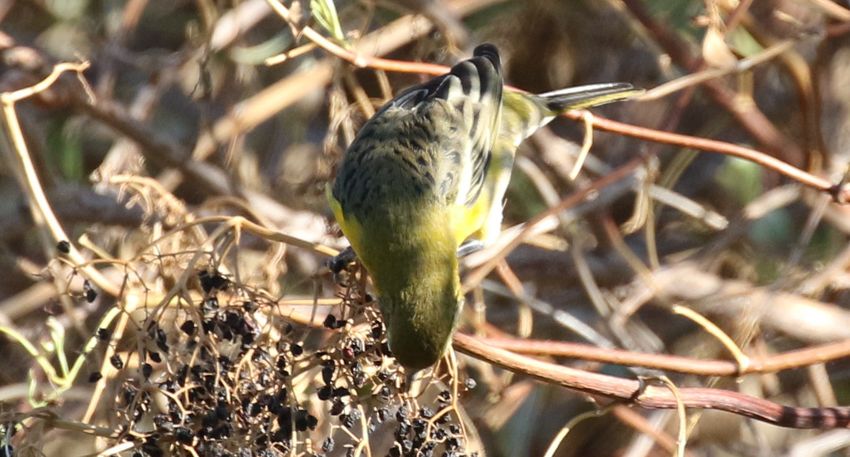
open, and it allowed me to advance up to it slowly for decent photographs (Figures 1
and 2). The bird was silent, and after a minute or two it flew off. The bird was unusual
for a chat not only in its approachability but also in its patterned back, more greenish
color on the back and head, evident wing bars, and blackish tail.
    On a nearly weekly basis I walk along San Timoteo Creek, which is in a broad
canyon with a riparian corridor on the coastal slope of southern California (Fig-
ure 3). In the summer the site is home to a robust population of the Least Bell’s
Vireo (Vireo bellii pusillus), along with other summer residents such as the Ash-
throated Flycatcher (Myiarchus cinerascens), Yellow Warbler (Setophaga petechia),
Blue Grosbeak (Passerina caerulea), Hooded (Icterus cucullatus) and to lesser
extent Bullock’s Oriole (I. bullockii), and Yellow-breasted Chat (www.ebird.org/
barchart?r=L899956&yr=all&m=). In September, many of those summer breeders
are beginning to depart, with only a few Bell’s Vireos and Yellow Warblers remaining.
I had not conclusively seen or heard a Yellow-breasted Chat since 2 August, although
I had a brief view of a silent bird resembling a chat on 2 September.
    I couldn’t help but wonder why the bird appeared so unusual. The pattern didn’t
seem correct for leucism, and I couldn’t find any examples of a juvenile plumage that
matched. I sent the photos to some of my local birding friends, and they all agreed
that it clearly wasn’t a typical Yellow-breasted Chat. I then distributed the photos to
expert birders across the country and started to receive feedback over the next day.
    On 12 September 2019 I returned to look for the bird again, and after a brief
search refound it at nearly the same location, this time feeding in an elderberry tree.
Again, I heard no definite vocalizations, but I obtained a few more photos as well as
a short video clip of it plucking elderberries (https://westernfieldornithologists.org/
archive/V51/Grube/). I played songs and calls of the Yellow-breasted Chat, Hooded
Oriole, Baltimore Oriole (Icterus galbula), Orchard Oriole (I. spurius), and Scott’s
Oriole (I. parisorum) but could not detect any physical or vocal response.
    On 13 September I returned with a few other local birders, but on this day the
bird was much more secretive, and only a few of us had any sort of confirmatory view.
The next day we returned again, and with some effort saw and photographed it. Al-
though collection of at least a DNA sample was desirable, because of the habitat and
behavior of the bird, collection of a fecal sample did not prove possible. As the land
is owned by the city of Redlands, and because the Yellow-breasted Chat is a species
of special concern to the California Department of Fish and Wildlife, authorization
of any collection would have been time-consuming at the least. Unfortunately, the
bird could not be relocated after that final sighting on 14 September, so any further
plans to pursue this option were aborted.
    From its physical appearance, the bird appears intermediate between a Yellow-
breasted Chat and an oriole. It may be a hybrid or, possibly, a Yellow-breasted Chat
expressing some latent ancestral genes, resulting in an oriole-like pattern with or
without leucism.

Western Birds 51:167–171, 2020; doi 10.21199/WB51.2.10                               167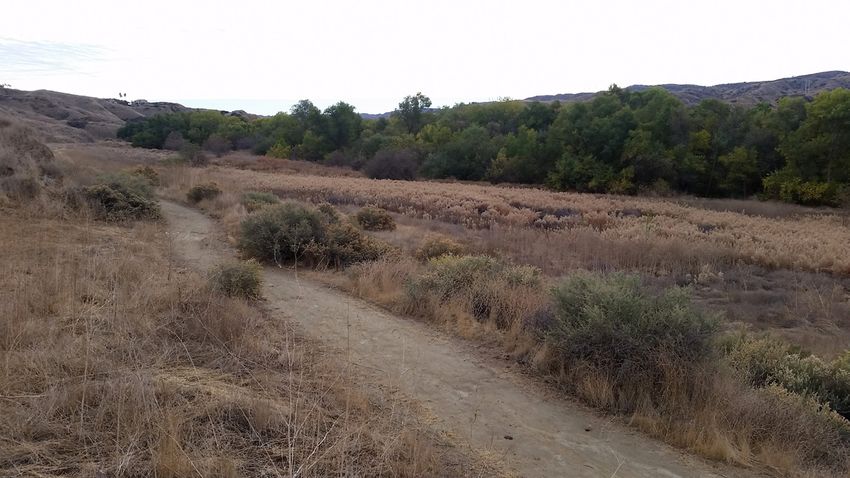
Featured Photo

Figure 1. Apparent chat × oriole in San Timoteo Canyon, San Bernardino County,
California, September 2019. Notice how the wing bar can be obscured depending
on the bird’s posture. An album with additional photos can be found at https://
westernfieldornithologists.org/archive/V51/Grube/.
                                                           Photos by Matthew Grube
    Of course either option would be extremely odd. I have been unable to find pre-
vious documentation of a hybrid Yellow-breasted Chat × oriole. In his Handbook of
Avian Hybrids of the World, McCarthy (2006) mentioned no cases of hybridization
concerning the Yellow-breasted Chat. The affinities of the Yellow-breasted Chat, the
sole member of genus Icteria, have long been unclear. Traditionally it was grouped
with the wood-warblers (e.g., American Ornithologists’ Union 1998), but more re-
cently, on the basis of DNA-sequencing studies finding it may be slightly closer to the
Icteridae than to the Parulidae, has been placed in its own family Icteriidae (Barker
et al. 2013, 2015, Chesser et al 2017). Under the current taxonomy, this proposed hy-
brid may represent the first interfamilial hybrid among the nine-primaried oscines.
    Table 1 compares notable features of the apparent hybrid with those of the
Yellow-breasted Chat and orioles.

168
Featured Photo

Figure 2. Dorsal view of apparent chat × oriole in San Timoteo Canyon, San
Bernardino County, California, September 2019.
                                                     Photo by Matthew Grube

    Provided one of the bird’s parents was an oriole, ascertaining the species of ori-
ole is a difficult problem. The pattern on the back feathers and scapulars with dark
centers and broad greenish edges is reminiscent of the fresh plumage an adult male
Hooded Oriole, in which the edges are buff. On the wing, the white median coverts
recall Bullock’s Oriole.
    I cannot say whether this bird was a summer resident in San Timoteo Canyon.
The Yellow-breasted Chats at this location often are not seen well, if at all, during

Figure 3. Habitat along San Timoteo Canyon. The riparian strip is in the background;
some open valley floor lies between the riparian strip and the hills. The apparent
hybrid was seen both in elderberry trees in the center of the valley as well as in the
edge of the riparian strip.
                                                            Photo by Matthew Grube

                                                                                  169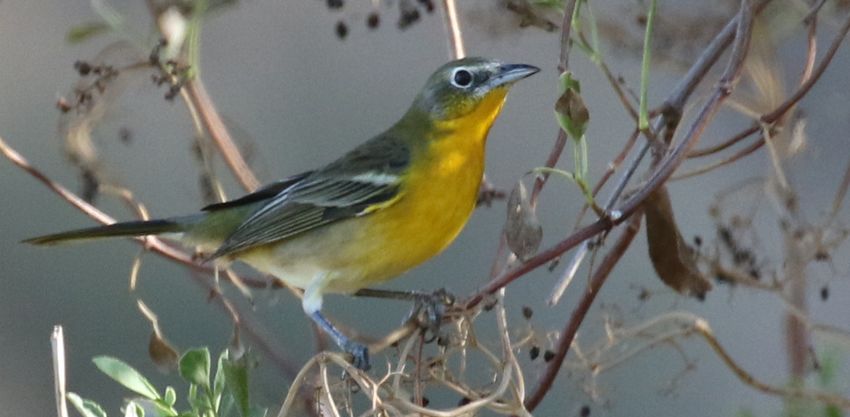
Featured Photo

Table 1 Comparison of the Typical Plumage and Structure of the Yellow-breasted
Chat and California Orioles with the Possible Hybrid
Feature        Yellow-breasted Chat                 Orioles                Possible chat × oriole
Bill      Heavy, gray, fairly short, Longer and more pointed bill,         Length intermediate;
           with curved culmen coming to a sharper tip; culmen              curvature of culmen
                                       nearly straight (e.g., Bullock’s,    intermediate; lower
                                       Baltimore) to slightly curved          mandible bluish
                                      (Hooded); black with the man-
                                          dible pale bluish basally
Back            Plain olive          Variable from nearly plain olive         Black streaks and
 pattern                             to grayish in females and imma-         chevrons patterned
                                      tures, to black with buff to olive    on olive background
                                        edges in adult males in fresh
                                                   plumage
Facial       Dark lores with         Variable from plain olive to con-     Dark lores with pale
 markings   white “spectacles”       fluent areas of black; no eye ring      malar area, pale
                                                                           supraloral line, nar-
                                                                            row white eye ring
                                                                           with slight posterior
                                                                                extension
Wing bars             Absent                        Present                 White upper wing
                                                                           bar (median coverts)
Scapulars           Plain olive       Variable; dark centers typical for    Black centers with
                                       Baltimore and may be seen on           greenish edges
                                                  Bullock’s
Tail          Plain, nearly concolor   Dull yellow in female and im-          Graduated black
              with rest of upperparts   mature, graduated and solid         rectrices with white
                                        black with white tips in adult        tips on the three
                                       male Hooded, and mixture of               outer pairs
                                       black and orange in adult male
                                                  Bullock’s

       my typical walks. This bird could well have been present for some time without my
       encountering it. If it was indeed a local bird, the oriole parentage would be limited
       to the Hooded and Bullock’s. Between those two options, the Hooded Oriole is
       the far more abundant of the two in my experience, and it tends to occupy habitat
       similar to that of the Yellow-breasted Chat in the riparian strip. Bullock’s is much
       less common, and I generally see it only in the eucalyptus groves. If this was not a
       local bird but a migrant passing through, that opens up many more possibilities.
            The bird’s characteristics and their interpretations are summarized in Table 2.
       Ultimately, the color patterns of the wing and tail may be the strongest indicators of
       the possible parent oriole, and would seem to favor the Hooded. The extent of black
       in the plumage implies the bird is an adult male, provided one parent was an oriole.
       Therefore even if the hybridization had taken place locally, the bird had migrated
       and returned at least twice since hatching.
            The apparent hybrid was in entirely fresh plumage. The Yellow-breasted Chat
       differs from the Hooded and Bullock’s Orioles in that it molts before migration, in
       its breeding range, whereas the Hooded and Bullock’s Orioles molt after migration. If
       the bird in question was a hybrid chat × oriole, the freshness of the plumage implies
       that the chat pattern of molt dominated over the oriole pattern and that the bird may
       have summered in or near San Timoteo Canyon.

       170
Featured Photo
Table 2 Characteristics of the Proposed Yellow-breasted Chat × Oriole and Their
Interpretation
Characteristic Interpretation
Wing feathers of a single generation of plum- Bird is an adult male provided that Icterus was
age; black in the rectrices, primary coverts, etc. one parent
Graduated black rectrices with white tips on Favors Hooded; Bullock’s would be mostly
the three outer pairs orange and lacking white tips
White median coverts, but dark greater Favors Hooded; an adult male Bullock’s with
coverts with white tips white median coverts should also show mostly
white greater coverts.
Black-centered, green-fringed back feathers Compatible with either species of oriole
Bill shape and color Might suggest Bullock’s, but of limited value
Despite experts’ analysis, there still is no absolute way to ascertain this bird’s
identity. While many of the features suggest a Yellow-breasted Chat × oriole sp.,
perhaps even a Yellow-breasted Chat × Hooded Oriole, this hypothesis would be
hard to prove without analysis of DNA.
I will certainly keep my eyes open for this bird this year when I continue with
my usual walks at my home patch in San Timoteo Canyon.
Thanks to the following for identification comments and critique of this intrigu-
ing bird: Thomas Benson, Louis Bevier, Kimball Garrett, Alvaro Jaramillo, Tony
Leukering, Curtis Marantz, Steve Mlodinow, Jim Pike, Peter Pyle, Van Remsen,
and Philip Unitt.
LITERATURE CITED
American Ornithologists’ Union. 1998. Check-list of North American Birds, 7th ed.
Am. Ornithol. Union, Washington, D.C.
Barker, F. K., Burns, K. J. Klicka, J., Lanyon, S. M., and Lovette, I. J. 2013. Going
to extremes: Contrasting rates of diversification in a recent radiation of New
World passerine birds. Syst. Biol. 62:298–320; doi.org/10.1093/sysbio/sys094.
Barker, F. K., Burns, K. J., Klicka, J., Lanyon, S. M., and Lovette, I. J. 2015. New in-
sights into New World biogeography: An integrated view from the phylogeny of
blackbirds, cardinals, sparrows, tanagers, warblers, and allies. Auk 132:333–348;
doi.org/10.1642/AUK-14-110.1.
Chesser, R. T., Burns, K. J., Cicero, C., Dunn, J. L., Kratter, A. W., Lovette, I. J., Ras-
mussen, P. C., Remsen, J. V. Jr., Rising, J. D., Stotz, D. F., and Winker, K. 2017.
Fifty-eighth supplement to the American Ornithological Society’s Check-list of
North American Birds. Auk 134:751–773; doi.org/10.1642/AUK-17-72.1.
McCarthy, E. 2006. Handbook of Avian Hybrids of the World. Oxford Univ. Press,
New York.
171You can also read


