Football medicine & performance Issue 32 - The official magazine of the Football Medicine & Performance Association - IFCPF
←
→
Page content transcription
If your browser does not render page correctly, please read the page content below

The official magazine of the Football Medicine & Performance Association

football medicine
& performance                                                                 Issue 32
                                                                           Spring 2020

CEO MESSAGE
In its original format my message for this edition was celebratory. The delivery
of this publication will coincide with the 10th anniversary of the FMPA`s
launch in April 2010 and there is of course much to celebrate in terms of our
achievements. But in the space of a few days it no longer seems important –
or appropriate – to extol the virtues of our successes.

The Covid-19 pandemic is now firmly upon us and our attention has necessarily
turned towards a focus on the devastation this is causing to our way of life, to
our families, our friends, our colleagues and our members.

But it is in times of adversity that renewed vigour can emerge as a driving force
and accordingly the FMPA has never been busier. In the main this has been
in support of our members through discussion and dialogue, via telephone
calls, emails, podcasts, and the posting of vital and key information on legal,
financial and mental health support. All of which has never been needed
more than at this time.

The rallying cry nationally is of course for communities to work together in
dealing with this crisis and that is exactly the strategy that will work for our
community of medicine and performance practitioners. We are all in this
together and need to work as a team supporting colleagues who may be
going through a difficult time.

There is also the belief that we will all come out of this pandemic stronger
and I believe this will be the case for the FMPA. Football will return and our
national game will drive the sense of optimism that will emerge. We will all
be part of that recovery and I look forward to ensuring that our members
are recognised for their efforts and endeavours through this unprecedented
time.

On a personal note I look forward in particular to our Conference in 2021, and
the opportunity to celebrate with everyone, our 11th Anniversary.

                 Eamonn S almon
                          Chief Executive Officer
                Football Medicine & Performance Association

                                                                                    3
®
FROM THE EDITOR
Football has never mattered less, and its absence reflects the surreal nature
of the current situation we are living through. Some day it will return and
we’ll savour it as a beacon of normality. Right now, many of you working in
football may be uncertain about your future, and fearful for the health of
your loved ones. I hope this publication can provide a moment of escape
from these worries. The FMPA is committed to helping all of those working
in football who may be facing hardship, and Eamonn Salmon has done an
admirable job in leading this over the past few weeks.

This is a new situation for everyone. The weeks and months ahead will
continue to deliver new problems we have never faced before. Managing
the health and fitness of players remotely will demand greater trust,
communication and innovation amongst the interdisciplinary team in order
to protect the welfare of players (and their families), while also ensuring
they retain a performance edge once the football season resumes.

While football is largely irrelevant in the grand scheme of the COVID-19
pandemic, we should never underestimate its potential to have a positive
influence. I have been impressed by the role many football clubs are taking
to impart key public health messages to their followers. MK Dons’ players
and staff must be commended for spending their weekend checking up on
older Season Ticket holders over the phone, while Ipswich Town have led
the way by offering their Portman Road facilities to the NHS. All of us are
in this together.

We have taken the decision not to print this edition for the first time in the
publication’s history. Instead, we will share it as a .pdf and open it up to
anyone who would like a copy. We are hopeful it will reach as many readers
as possible.

Stay safe.

                  Sean Carmody
                           Dr Sean Carmody
                          Editor, FMPA Magazine

                                                                                 5
CONTENTS
FEATURES   08
              Reflections on the Decision-Making                    28     uccess in Football is No Longer Enough
                                                                          S
              Processes during the COVID-19 Pandemic                      Professor David Lavallee, Jeff Lowder,
              Dr Imtiaz Ahmad                                             Jane Lowder, Ruth Lavallee

           10
              FIFPRO’s advice to professional                       30
                                                                       The Quadrant of Doom and Hamstring
              footballers during the coronavirus                       Injuries: Sexy but too Easy?
              (COVID-19) pandemic                                      Buchheit M, Avrillon S, Simpson B.M,
              Dr. Vincent Gouttebarge                                  Lacome M, Guilhem G

           13
              The Introduction of Temporary                         36
                                                                       LightForce® Case Study Feature
              Concussion Substitutions in Disability                   Jack Targett
              Football: Are We ‘Headed’ In the
              Right Direction?
              OH Ahmed, M.Fulcher, D.Malone,                        38
                                                                       ‘Availability Equals Winnability’
              C.Mira y Lopez, M.E. Rho1, A.Strojna                     The Effects of a Periodised Training Model
                                                                       on Player Availability in Elite Soccer –
                                                                       A Case Study (Part 1)
           18
              Lessons from Basketball                                  Damian Roden
              Reflective Piece
              Dr Amy Arundale PhD
                                                                    48
                                                                       Athletic Groin Pain –
                                                                       Time to Move From an Anatomical to a
           22
              Injury Mitigation in Team Sports.                        Biomechanical Approach?
              Part-3: Improving Research Quality                       Enda King PhD, Dr. Andy Franklyn Miller
              Colin W. Fuller
                                                                    53
                                                                       FMPA Register
           24	Football as Medicine in
               Physical Activity Promotion
               Marcos Agostinho, Peter Krustrup,
               Daniel Parnell

           Football Medicine & Performance Association
ABOUT      6A Cromwell Terrace, Gisburn Road, Barrowford, Lancashire, BB9 8PT
                                                                                          COVER IMAGE
                                                                                          Cover artwork by Barry Masterson
           T: 0333 456 7897 E: info@fmpa.co.uk W: www.fmpa.co.uk                          Twitter: @barrymasterson
                                                                                          Instagram: @barrymasterson
              FMPA_Official    Officialfmpa     fmpa_official
                                                                                          Facebook: Barry Masterson Art
           LinkedIn: Football Medicine & Performance Association
              FMPA_Register      FMPARegister       fmpa_register

           Chief Executive Officer          Design                                        Football Medicine & Performance
                                                                                          Association.
           Eamonn Salmon                    Oporto Sports                                 All rights reserved.
           eamonn.salmon@fmpa.co.uk         www.oportosports.com                          The views and opinions of contributors
                                                                                          expressed in Football Medicine &
           Executive Administrator          Photography                                   Performance are their own and not
                                                                                          necessarily of the FMPA Members,
           Lindsay Butler                   PA Images, FMPA                               FMPA employees or of the association.
           admin@fmpa.co.uk                                                               No part of this publication may be
                                            Contributors                                  reproduced or transmitted in any form
                                                                                          or by any means, or stored in a retrieval
           Administration Assistant         Dr Imtiaz Ahmad, Dr. Vincent Gouttebarge,     system without prior permission except
                                            O.Hassan Ahmed, M.Fulcher, D.Malone,          as permitted under the Copyright
           Amie Hodgson
                                            C.Mira y Lopez, M.E. Rho1, A.Strojna, Dr      Designs Patents Act 1988. Application
           amie.hodgson@fmpa.co.uk                                                        for permission for use of copyright
                                            Amy Arundale PhD, Colin W. Fuller, Marcos     material shall be made to FMPA. For
                                            Agostinho, Peter Krustrup, Daniel Parnell,    permissions contact admin@fmpa.co.uk
           Project Manager                  Professor David Lavallee, Jeff Lowder,
           Angela Walton                    Jane Lowder, Ruth Lavallee, Buchheit M,
           angela.walton@fmpa.co.uk         Avrillon S, Simpson B.M, Lacome M, Guilhem
                                            G, Jack Targett, Damian Roden, Enda King
           Marketing/Advertising            PhD, Dr. Andy Franklyn Miller
           Charles Whitney
           0845 004 1040
13        18

24             30

38        48

     21
feature

REFLECTIONS ON THE DECISION-
MAKING PROCESSES DURING
THE COVID-19 PANDEMIC
 FEATURE / DR IMTIAZ AHMAD

                             Our players had booked a team bonding         Physicians held a comprehensive expert
                             event at Cheltenham Festival on 11.03.20.     update Webinar for doctors on 12.2.20,
                             With growing public health concerns           which I participated in (2). Following on
                             over COVID-19 we made an unpopular            from this I met our Director of Football
                             decision to cancel this trip, even though     and Manager to explain that it was clear
                             Government guidelines placed no               that a potentially major issue was about
                             restrictions over large gatherings at that    to develop and impact not only on football
                             point in time (1).                            but on society at large. We decided on
Dr Imtiaz Ahmad                                                            early quality communication with all staff
Head of Medical,             Football medics across with country have      and players so that they were prepared
Queens Park Rangers FC       been faced with difficult questions in        for what could happen. We developed an
                             recent weeks. Can we train? Are we at risk?   in-house COVID-19 protocol for dealing
                             How do we keep players fit? Can we travel?    with suspected cases at all of our Club
                             Will the season be completed? Can we play     sites, limiting visitors to the Club and
                             behind closed doors? Can we test?             doing presentations to first team players
                                                                           and staff on 25.2.20 and the same for our
                             We’ve all been taken by surprise by this      Academy teams. We also arranged regular
                             pandemic and have had to make key             deep cleans of our training grounds.
                             decisions for our organisations. Increasing
                             knowledge base in this area was important     Once the decision was made to postpone
                             from the start and the Royal College of       fixtures we decided to send players back

8                                  info@fmpa.co.uk
football medicine & performance

                        I am only one,
                        But still I am one.
                        I cannot do everything,
                        But still I can do something;
                        And because I cannot do everything,
                        I will not refuse to do the something that I can do.
                        Edward Everett Hale

home to their families on 13.3.20, including    learning a skill such as healthy cooking or a       safety of players and staff during a crisis, the
those players from abroad. This decision        new language.                                       support of the Manager, Director of Football,
was made with the Manager and Director                                                              Director of Academy, CEO and Owners to
of Football after carefully reviewing the       To manage staff anxieties, the media team           coordinate a response throughout a Club.
current situation. The EFL postponed            set up a detailed presentation and question         Leadership during difficult times needs
football and matches until 23.3.20, then        and answer session with the Head of                 clear communication and a network of trust
4.4.20 and now 30.4.20 (3). In reality all      Medical, which has been viewed more than            amongst colleagues. Maintaining a human
medics who have been following this             20,000 times on various social media sites          touch is most important though, especially
pandemic know that there is no chance           within the first week (9). At times managing        when people are afraid about their health,
of a return to football as we know it for       staff was the biggest challenge as naturally        families, jobs and general security.
many months (4). When the Government is         people were anxious for their own health            One of the most touching moments however
making an emergency field hospital in the       and also for their loved ones.                      was the feedback from a player who thanked
heart of London, the seriousness of this                                                            me for cancelling Cheltenham even though he
situation cannot be underestimated (5).         Football clubs turned to their medics for           thought it was over the top at the time, ‘You
                                                leadership, placing them in an influential          made the right decision Doc. Thank you.’
Effective communication during this time        position in decision-making at the Clubs.
has been vital. Players were knowledgeable      Whilst each Club is unique in terms of the          Dr Imtiaz Ahmad
through media outlets but wanted to             pressure medics are put under, this really          29.3.20
know the medical facts. As the situation        was a time for medics to give a clear opinion       Head of Medical QPR FC
developed we arranged daily meetings            based on the best available evidence and
with the manager and Head of Medical to         help their Clubs make the right decisions.
make sure our strategy was clear and that
                                                                                                       1. https://www.gov.uk/coronavirus
we could confidently tell the rest of the       There will be many long-lasting implications
                                                                                                       2.  https://www.rcplondon.ac.uk/events/covid-19-
Club our plan. Each player was messaged         of this COVID-19 crisis in football; the                     expert-update-doctors
directly with Top Tips and summaries of         return to play date is yet to be determined,           3. h
                                                                                                           ttp://www.thefa.com/news/2020/mar/19/
current National guidelines including details   completing the season in a short space                    joint-fa-efl-premier-league-statement-update-
on social distancing and self-isolation (6)     of time brings challenges of maintaining                  on-professional-football-covid-19-190320
(7). Players were given individual home         fitness during that period, mental health              4. https://bjsm.bmj.com/content/
programmes and nutrition advice according       issues and the social impact of players and                early/2020/03/26/bjsports-2020-102306
to their status as injured, ill due to          staff potentially being asked to take wage             5. https://www.england.nhs.uk/2020/03/new-nhs-
                                                                                                           nightingale-hospital-to-fight-coronavirus/
COVID-19, or fully fit. Social media was used   cuts. It is a situation that is rapidly evolving
                                                                                                       6. https://www.qpr.co.uk/news/club-news/latest-
for feedback and promoting public health        but the impact will be wide-ranging and                    government-advice-on-the-coronavirus/
awareness. Mental health was monitored          have repercussions at every level of the club
                                                                                                       7. https://twitter.com/qpr/
through regular and coordinated staff           and wider society.                                         status/1242088710847356932?s=12
contact and also an adapted version of the                                                             8. https://bmjopensem.bmj.com/content/5/1/
IOC Sport Mental Health Assessment Tool         I’ve reflected on many things during this                  e000680
(8). We encouraged players to seek positives    time: how a community Club can get                     9. https://www.facebook.com/OfficialQPRFC/video
such as enjoying quality time with families,    together and make clear plans to ensure the                s/685801662191182/?vh=e&d=n

                                                       www.fmpa.co.uk                                                                                       9
feature

FIFPRO’S ADVICE TO
PROFESSIONAL FOOTBALLERS
DURING THE CORONAVIRUS
(COVID-19) PANDEMIC
 FEATURE / DR. VINCENT GOUTTEBARGE

                                  During the current time of uncertainty        Maintain a healthy lifestyle - especially
                                  due to the coronavirus (COVID-19),            sleep and nutrition
                                  it’s normal to feel worried, confused,        Self-care is always important, but even
                                  stressed, sad or even angry. These            more so during social distancing. Keep
                                  are common responses to a very                healthy sleep habits, sleep well in regular
                                  uncommon situation. Players should            hours (7-9h per night). Try to eat healthy
                                  remember to stay engaged with                 (fresh fruits and vegetables, familiar
Dr. Vincent Gouttebarge           their support system and to speak to          protein source, carbohydrate, matching
                                  someone if they need help. Remaining          energy intake to your exercise levels) and
Chief Medical Officer at FIFPRO   physically active is also essential:          to avoid alcohol and other drugs.
(Football Players Worldwide)      players should follow strength and
                                  conditioning programmes focusing on
                                  general endurance, football specific          Maintain general endurance
                                  endurance (intermittent bouts), speed,        General endurance is important for overall
                                  strength, coordination and flexibility.       football performance: it contributes to
                                                                                80-90% of the distance covered during a
                                                                                match during which low speed activities
                                  Follow a routine                              are executed. General endurance is
                                  Your daily routines and schedules have        thus the basic within any strength and
                                  been significantly disrupted. Find a new      conditioning programme and the basis of
                                  routine including the self-care tips below.   football performance: it increases general

10                                       info@fmpa.co.uk
football medicine & performance
physical capacity, optimises recovery, Maintain speed Play and App Store), this app offers
contributes to injury prevention For any position in the field, speed is evidence-based and effective
and decreases technical and tactical the most significant factor for football exercises focusing on strength,
mistakes that might occur toward the performance. Speed in football has coordination and flexibility.
end of matches. Players should consider many different facets, among which
some general principles in order to with or without the ball, straight line
develop/maintain general endurance: or change of direction, from standing Stay connected
still or from walking/jogging, explosive Social distancing should not mean
• ontinuous effort: session usually
C versus progressive speed. Players should social disconnection. Use apps and
lasting 30-60 min or covering consider some principles in order to other technology to stay connected
distances from 6 to 10 km develop/maintain speed: and be mindful that you might want
• L ow to moderate intensity: 60- to ‘check-in’ with your network on
80% of maximal heart rate (130- • horough preparation and structured/
T a more frequent basis than usual.
160 beats per minute depending on precise approach Share feelings with a friend or
player’s age) or easy-to-moderate • ery short intermittent effort:
V family member. Rely on your support
intensity on RPE-scale (rating of repeated bouts lasting up to a few systems and maintain relationships.
perceived exertion) seconds, with total session usually Schedule joint home training with a
• raining frequency: once or twice
T lasting 15-30 min team-mate and work out together
a week remotely via FaceTime, or WhatsApp.
• requency and recovery: 3-4 sets
F
Re-connect with family and friends!
• Training recovery: easy of 8-12 bouts with 3-5 min (active)
recovery between sets and 30-90 sec
• eware of running on hard surfaces
B
(active) recovery between bouts
(eg road, pavement) which you may Take breaks
not be accustomed to – this may • ery high intensity: 95-100% of
V Make time to unplug and decrease
influence your risk of injury. maximal heart rate (>190 beats per sensory overload. Try to turn to
minute depending on player’s age) activities that you enjoy. Listen to
or very-high intensity on RPE-scale music, take a walk, watch a favourite
(rating of perceived exertion)
Maintain football-specific capacity TV show.
Contributing 10-20% of the distance • raining frequency: once or twice a
T
covered during a match, football specific week
endurance is essential as it eases the • Training recovery: one or two per day Work on your mental game
execution of (very) high speed activities • Integrate football specific elements Focus on what you can control as we
(running, sprinting, springing). Players (ball drills) within bouts and/or sometimes fixate on events outside
should consider some principles in order recovery of our control. Ask yourself “what
to develop/maintain football- specific can I control in this situation”, set
anaerobic capacity: your sights on what you can control
and focus on making yourself look
Maintain strength, coordination,
• horough preparation and structured/
T calm and in control.
flexibility
precise approach
Strength, coordination and flexibility
• Intermittent effort: repeated bouts exercises can be performed outside, in
lasting up to a few minutes, with Challenge catastrophic thoughts
the gym or at home. The International
total session usually lasting 30-60 It is easy to assume the worst will
Olympic Committee (IOC) has developed
min occur and you won’t be able to
a free app for elite and recreational
handle it. Instead, remind yourself of
• requency and recovery: 3-4 sets
F athletes; ’Get Set - Train Smarter’.
transitions and challenges you have
of 4-15 bouts with 2-4 min (active) Available in different languages (Google
navigated in the past. Ask yourself:
recovery between sets and 30-60 sec
1. What is the worst case scenario?
(active) recovery between bouts
2. What is the likelihood of this
• oderate to high intensity: 80-95%
M scenario?
of maximal heart rate (160-190 beats 3. Even if this were to happen, what
per minute depending on player’s are the realistic consequences? Could
age) or moderate-to-high intensity I handle it?
on RPE-scale (rating of perceived 4. Does worrying about this outcome
exertion) help prevent it from happening?
• raining frequency: once or twice a
T
week
• Training recovery: one or two days Stay informed with the latest
developments
• gain, beware of running on hard
A
surfaces which you may not be Stay informed with the latest
accustomed to developments from reliable
sites such as the World Health
• Integrate football specific elements Organization. But avoid reading
(ball drills) within bouts and/or everything on COVID-19 in the news
recovery or on social media, as this can
unnecessarily amplify stress or worry.
www.fmpa.co.uk 11www.einercial.com
Inertial Technology at the service of high performance sport
RSP ENCODER RSP APP + web
RSP SQUAT
IMPROVE
YOUR
BRAKE CAPACITY
Contact
info@einercial.com
Telf. +34 659910685feature football medicine & performance
THE INTRODUCTION OF TEMPORARY CONCUSSION
SUBSTITUTIONS IN DISABILITY FOOTBALL:
ARE WE ‘HEADED’ IN THE RIGHT DIRECTION?
FEATURE / OH AHMED1,2,3, M.FULCHER1,4, D.MALONE1, C.MIRA Y LOPEZ1,5, M.E. RHO1,6, A.STROJNA1,7
1. IFCPF Medical Committee, A need for action in expressed some difficulty in performing
International Federation of CP Football Cerebral Palsy football cognitive assessments within this
2. Faculty of Health and Social Cerebral Palsy (CP) football is one of population.
Sciences, Bournemouth University, many adapted formats of football which
Bournemouth, England permit individuals with a wide range of In December 2019, the International
3. The FA Centre for Disability Football disabilities to participate (FIFA Medical Federation of Cerebral Palsy Football
Research, St Georges Park, Network, 2019), including athletes with (IFCPF) announced the introduction of
Burton-Upon-Trent, England CP or an acquired brain injury. Although a “Temporary Concussion Substitution”
several commentary pieces related to rule change (IFCPF, 2019a). This followed
4. Axis Sports Medicine Specialists,
concussion in disability sport have been a consultation process, with input from
Auckland, New Zealand. New Zealand
Football, Auckland, New Zealand published (Kissick & Webborn 2018, West a CP footballer representative (Harry
et al. 2017), at present there are limited Baker) and a professional referee with
5. New Being News, Brazil data-driven studies on concussion in experience of CP Football (Keith Stroud).
6. Department of Physical Medicine and disability football. The study of Weiler et In doing so, this made CP Football the
Rehabilitation, Northwestern University al. (2018) demonstrated that footballers first format of football to introduce such
Feinberg School of Medicine, Chicago, with a disability (including CP footballers) changes. Despite other contact sports
United States of America have baseline concussion values that are (most notably rugby) permitting teams
7. Federazione Italiana Sport Paralimpici significantly different to their mainstream to substitute players who are suspected
e Sperimentali, Rome, Italy peers and recommended that extra of having sustained a concussion for
consideration needs to be given when more detailed assessment, football
interpreting post-concussion assessments has yet to introduce such a temporary
with disability footballers. In addition, the concussion substitution rule. Recent
work of Griffin et al. (2017) highlighted news releases however suggest that
that clinicians working within CP football 2020 may be the year when temporary
www.fmpa.co.uk 13In an exceptional working environment
you need exceptional representation
In these exceptional times
you need exceptional support
The FMPA has collaborated with the following to enable
members to have the latest information and access to;
What employees need to know Knights plc
Podcast employment law; your questions Martin Price FMPA Lawyer
Furlough and what it means for you Knights plc
Looking after our Mental Health; Covid-19 Dr Tim Rogers
Financial advice and guidance Pareto
Member helpline; anxiety & mental health Sporting Chance Clinic
How to series; personal strategies for wellbeing L&M Consulting
Coronavirus; what you need to know Dr Imtiaz Ahmad
STAY INFORMED AND SUPPORTED AS AN FMPA MEMBER
www.fmpa.co.uk /officialfmpa @FMPA_Official @fmpa_officialfeature football medicine & performance
From 2020, all
IFCPF-sanctioned
competitions
will adhere to
the Temporary
Concussion
Substitution.”
concussion substitutions are introduced with the timescales in rugby and also factors relating to classification have not
in mainstream football (IFABa, 2019). the timeframe recommended by the been a barrier to the introduction of the
Concussion in Sport Consensus Group TCS, despite adding an additional layer
Whilst the introduction of temporary (McCrory et al. 2017), this TCS will be of complexity which is not present in
concussion substitutions is potentially permitted to play for 10 minutes whilst mainstream football.
valuable at all levels of football, it is the injured player is being evaluated.
arguably essential in CP football. This If the injured player is deemed fit to
format of 7-aside football is played to continue within this 10-minute window The next steps for Temporary
the International Football Association then the TCS will be removed and the Concussion Substitutions
Board (IFAB) laws of the game with initial player returned to action. If the The implementation of the TCS policy
slight modifications (e.g. no offsides). player is not fit to continue then the will be analysed at upcoming IFCPF
Individuals are only eligible to participate TCS will remain on the field of play, and tournaments by evaluating how the
in CP Football if they have a pre-existing if the 10-minute period expires without process is used by teams. The example of
brain injury- either from congenital CP, or the injured player being passed fit to the Head Injury Assessment in rugby and
from a Traumatic Brain Injury, or Stroke return then the TCS remains on pitch the subsequent analysis by Fuller and
(IFCPF, 2019b). Assessing a head injury as a recorded substitution. Further colleagues (2016) provides an example
sustained by an individual who has a information regarding the details relating for how this evaluation could occur. In
pre-existing head injury is a complex to the TCS in CP football is available this preliminary year of implementing
task with many unknown elements. online (IFCPF, 2019d). the TCS, there may be issues arising
Given these significant challenges, it which result in the modification of the
is important to support the clinician An additional consideration in CP Football TCS in future years. Given that the IFCPF
evaluators who are charged with are the “classifications” given to each TCS policy is in its infancy, adjustments
maintaining the safety of their players player to ensure parity and fairness in and alterations to its current state
following a head injury. the sport. Players are allocated to one of are anticipated. To understand more
three classes based on their impairment about the thoughts of key stakeholders
status and functional ability (IFCPF, (players, medical staff, coaches, and
How will Temporary Concussion 2019b), with these classes being termed referees) towards the TCS, qualitative
Substitutions work? “FT1”, “FT2, and “FT3”. FT1 players are the studies are planned to obtain input from
From 2020, all IFCPF-sanctioned most impaired, with FT3 being the least all parties.
competitions will adhere to the impaired. During competitive matches,
Temporary Concussion Substitution each team must have one FT1 player on It is hoped that the TCS may also lead
(TCS) policy (IFCPF, 2019c). Any player the field at all times and is not permitted to additional research in this area. At
who is suspected of sustaining a head to have more than one FT3 player on present, footballers with a disability
injury should be removed from the field the field. When a TCS is undertaken, are subject to the same return to play
of play by the team medical personnel the player which is the TCS must be of (RTP) timescales as their non-disabled
for a concussion assessment. At this the same classification (or lower) as the peers. The 5th International Consensus
point a TCS will occur, whereby a player they are replacing (i.e. an FT2 Concussion Guidelines (McCrory et
substitute will enter the field of play player could be substituted by either an al., 2017) made specific reference
to replace the injured player. In keeping FT2 or an FT1 but not by an FT3). These to the management concussion in
www.fmpa.co.uk 15feature football medicine & performance
youth athletes-however to date there enable clinicians working in football to FIFA Medical Network (2019). “Disability Football”.
has been no mention of the best have more time to assess head injuries Retrieved 12th January 2020. Available at: https://
practice management of concussion in more effectively without the pressure www.fifamedicalnetwork.com/courses/disability-
football.
athletes with a disability. An increased of gameplay interfering with their
understanding of the management of decision. In the international discussion Kissick J, Webborn N. Concussion in Para Sport.
concussion in athletes with a disability surrounding concussions in football, it Aspetar Sports Medicine Journal 2018;7;156-161.
will enable RTP guidelines to be should be considered that all formats West LR, Griffin S, Weiler R, Ahmed OH. Management
created which will be specific to their of football could benefit from this rule of concussion in disability sport: a different ball game?
needs. In time this may even lead to change to optimize the evaluation and British Journal of Sports Medicine 2017;51:1050-1051.
a “DisabilitySCAT” (or equivalent), in safety of our athletes.
Weiler R, van Mechelen W, Fuller C, Ahmed OH,
order to best inform the management Verhagen E. Do neurocognitive SCAT3 baseline test
of concussion in this population. There scores differ between footballers (soccer) living with
would be many difficulties to the creation Acknowledgements: and without disability? A cross-sectional study. Clinical
Journal of Sport Medicine 2018;28:43-50.
of such a tool however, given the myriad The IFCPF Medical Committee would
of physical and medical complexities like to thank Sam Turner (CEO / Griffin S, West LR, Ahmed OH, Weiler R. Concussion
associated with disability athletics. Secretary General of IFCPF) for helping knowledge, attitudes, and beliefs amongst sports
medicine personnel at the 2015 Cerebral Palsy Football
to generate the TCS Policy, and Harry World Championships. British Journal of Sports
Baker (CP footballer) and Keith Stroud Medicine 2017;51:325.
The future of concussion (referee) for their input into the design
management in football of the TCS. International Federation of Cerebral Palsy Football
(2019a). “IFCPF unveils new Temporary Concussion
The concept of introducing temporary Substitution (TCS) Policy”. Retrieved 12th January
concussion substitutions in all formats 2020. Available at: https://www.ifcpf.com/news/
of football is likely to be a topic of much ifcpf-unveils-new-temporary-concussion-substitution-
%28tcs%29-policy
discussion in the coming year, and there
is strong public interest in the coverage International Football Association Board (2019a). “2019
of concussions in the mainstream Annual Business Meeting confirms The IFAB focus on
concussion assessment and management in football”.
news and media (Ahmed & Hall, 2017).
Regardless of any decisions made by IFAB
The concept of Retrieved 29th January 2020. Available at: https://
at their AGM in February 2020 (IFAB, introducing temporary www.theifab.com/news/2019-annual-business-
meeting-confirms-the-ifab-focus-on-concussion-
2019b), pressure is building on many concussion substitutions assessment-and-management-in-football.
national football federations to introduce
temporary concussion substitutions (The in all formats of football International Federation of Cerebral Palsy Football
(2019b). “About Classification”. Retrieved 12th January
Australian, 2020). The 6th International is likely to be a topic of 2020. Available at: https://www.ifcpf.com/about-
classification.
Consensus Conference on Concussion
in Sport will also take place in 2020, much discussion in the
International Federation of Cerebral Palsy Football
which is likely to provide clinicians with coming year.” (2019c). “Concussion”. Retrieved 12th January 2020.
updated guidance in the management of Available at: https://www.ifcpf.com/concussion.
concussion. The temporary concussion McCrory P, Meeuwisse W, Dvorak J, et al. Consensus
substitution rule was introduced to statement on concussion in sport—the 5th
international conference on concussion in sport held in
Berlin, October 2016British Journal of Sports Medicine
2017;51:838-847.
International Federation of Cerebral Palsy Football
(2019d). “Temporary Concussion Substitution (TCS)
Policy”. Retrieved 12th January 2019. Available at:
https://www.ifcpf.com/static/upload/raw/0953364b-
eb6e-4be7-96ae-0f0afde0ac39/IFCPF+-+Temporary+
Concussion+Substitution+%28TCS%29+Policy.pdf.
Fuller CW, Fuller GW, Kemp SPT, Raferty, M. Evaluation
of World Rugby’s concussion management process:
results from Rugby World Cup 2015. British Journal of
Sports Medicine 2017;51:64-69.
Ahmed OH, Hall EE. “It was only a mild concussion”:
Exploring the description of sports concussion in online
news articles. Physical Therapy in Sport 2017;23:7-13.
International Football Association Board (2019b).
“Agenda of the 2019 Annual Business Meeting of
The IFAB confirmed”. Accessed 13th January 2020.
Available at: https://www.theifab.com/news/agenda-
of-the-2019-annual-business-meeting-of-the-ifab-
confirmed.
The Australian (2020). “Pressure mounts for A-League
concussion protocol”. Accessed 13th January 2020.
Available at: https://www.theaustralian.com.au/
sport/football/pressure-mounts-for-aleague-
concussion-protocol/news-story/40bd702016552d3b8
6365ee918035760.
16 info@fmpa.co.ukwww.einercial.com
Inertial Technology at the service of high performance sport
We take care of your muscles
RSP ISQUIO SPORT
Conical pulley specically designed to
improve the adaptation of the hamstring
muscles in situations of acceleration and
intense braking.
Contact
info@einercial.com
Telf. +34 659910685feature
LESSONS FROM BASKETBALL
REFLECTIVE PIECE
FEATURE / DR AMY ARUNDALE PHD, PHYSIOTHERAPIST WORKING WITH THE BROOKLYN NETS
My background is in football. I The Science occasions where I find now myself looking
grew up playing and was privileged On a weekly basis I receive emails from to the football literature for answers, as it’s
enough to play at University and PubMed notifying me of new scientific the closest evidence base available. I have a
in the Scottish Women’s Premier articles. On average, the keyword “Football” much greater appreciation for the research
League. I coached football prior gets around twenty-five to thirty-five in football. Basketball needs more research
to becoming a physiotherapist, new articles a week whereas the keyword on injury mechanisms, risk factors for injury,
“Basketball” gets about seven, to ten! prevention, and rehabilitation. However,
and combined my love of football
Having grown up professionally in the both sports share a common need for more
with my career, as I carried out research in women and younger athletes.
world of football, I took the accessibility
a PhD focused on primary and
and quality of research for granted. If I had
secondary prevention of ACL a clinical question I could ask networking
injuries in footballers. Unexpected connections from football medicine Resources & Development
opportunities are part of life conferences, researchers including the The NBA draft occurs in late June. Each
though and I now work as a Football Research Group (the group team approaches the draft slightly
physiotherapist and biomechanist behind the UEFA Elite Club Injury Study), differently, however there are aspects
in the NBA. As my second NBA or dive deeper into the literature to find that seem common between the majority
season progresses, I can reflect on answers. Even if the research wasn’t in of teams such as, bringing in potential
the aspects of the two sports that the demographics I was searching for, I draftees to watch them play, performing
I’ve learned and appreciate. could generally find a relating study within medicals and physical testing, interviews,
football. and other tests/measures. I started
working at the Brooklyn Nets (‘Nets’) two
Basketball does not have the same days before the 2018 draft process started.
breadth and depth of resources. Basketball I helped take medical histories, perform
and football are similar with regards to physical exams, and assess movement.
injury epidemiology and in some cases All of the 100+ athletes were different
injury mechanisms. Thus, there are many physically, but it surprised me that some
18 info@fmpa.co.ukfootball medicine & performance
struggled to stand on one leg, most programs, medical/performance staff One or two games a week
struggled with basic movement tasks are responsible for multiple sport now sounds easy!
like squats or single leg squats, and a teams simultaneously. Therefore,
handful lacked skills such as swimming there is a vast difference in how much The NBA season has eighty-two games
or riding a bike. There were some is invested in player development, excluding pre-season and the playoffs.
athletes who had great foundations, particularly physical development, This averages out to 3.3 games per
but the overwhelming majority had week, sometimes on back-to-back
specialized in basketball very early on in In contrast to basketball, in football nights, spanning from Los Angeles to
life and had little exposure to strength there is a financial incentive to invest in Miami to Boston, creating a significant
and conditioning, prevention programs, development. Football teams can loan challenge. On reflection, I now have a
or basic sporting movements. players out or earn money from transfer much greater appreciation for being able
fees by selling players. With the prospect to plan a week in football with more
Prevention is a major focus of research of generating income from developing time between match days.
and clinical practice in football. youth players, it’s in a football club’s best
Observing the NBA draft process made interest to invest in their academy and Keeping athletes healthy to
it evident to me that there is great need foster that revenue stream. In contrast, perform day-in/day-out is a major
for prevention research and development there are no player loans or transfer fees challenge due to the NBA schedule.
in basketball. The resources invested in the NBA, thus without that revenue Rehabilitation of an injured athlete
in football development, particularly in stream, there is less of an incentive poses other scheduling challenges.
the UK, starting with young players are to invest in youth development. In the In the initial stages of rehab, the
greater than that in basketball. Some future, I think we will see a change in medical/performance team has to
of the resource differences extend from the level of investment in basketball decide whether to bring the athlete
developmental pipelines. In contrast development, particularly as the NBA on the road; weighing the benefits
to the football academy system, rules change, allowing athletes to skip of keeping the athlete with the team
basketball has almost two parallel university and go straight from high against the risks of travel and available
pathways. Traditionally basketball school to playing professionally. This is time for rehabilitation. In the later
has been centered around the school a potential area where basketball could stages of rehab there are different
system where athletes develop playing learn from football by building systems challenges. With a game roughly every
for their middle and then high school to support young athlete development other day, full team training sessions
teams before going to university and allowing them to have the longest, may not be at high intensities or at
subsequently playing professionally. healthiest career possible. regular intervals. Thus, returning a
Alongside the school system is the AAU rehabilitated athlete into full training
(Amateur Athletic Union). The AAU host sessions, 5v5 play, or controlled
competitions in multiple sports but are Club Structure game exposure can be difficult. As a
best known for their youth basketball. Unlike the promotion/relegation medical/performance team we have
The AAU is the largest basketball structure of the English football league to be creative with schedules and
organization in the US, hosting youth system, the NBA is a stand-alone league. sometimes, rehabilitating athletes play
teams from across the country. Teams The thirty NBA teams, regardless of against/with coaches to get the loads
can be organized individually, rather their record the previous season, remain and exposures that they need.
than as part of a club, and often the only in the NBA the following season. The
staff is an unpaid coach. AAU also filters G-League is considered a developmental
players into university teams, which then or minor league for the NBA. The teams Learning opportunities
feed into professional teams. Currently in the G-League also remain, regardless
to play in the NBA, amateur athletes Every sport has its positives and
of record. Twenty eight of the thirty NBA negatives posing different unique
must have played at least one year in teams have an affiliated G-League team
university before they can be drafted or challenges. Regardless of the sport,
however, unlike the relationship between communication within teams remains
signed. first teams and reserves/academies at paramount. The Nets have created a
football clubs, G-League teams often medical/performance team composed
The extent of resources available in don’t share facilities with their NBA
youth and collegiate basketball teams of professionals with backgrounds
affiliate. The Brooklyn Nets’ G-League ranging from football, Australian
varies widely. At youth level, it is rare affiliate is about a one-hour drive away in
for an AAU team to have any medical Rules football, American football,
Long Island and this is one of the closest figure skating, skiing, endurance and
or performance support staff. The AAU distances between NBA and G-League
tournaments (sometimes involving motor sports. Our team is diverse
affiliates. The G-League affiliate for demographically, cognitively, and
hundreds of teams) have Athletic the Miami Heat is in Sioux Falls, South
Trainers (similar to a Sports Therapist philosophically. We regularly share
Dakota (2,935 km away, approximately a stories about our previous sports,
in the UK) covering the venue, however five-hour non-direct plane trip away).
given the lack of staffing, they are providing each other with opportunities
only able to provide emergency and to learn from our multidisciplinary
One large difference in the NBA/G- backgrounds. I’ve also learned an
acute care. High schools often have League affiliation compared to football
an Athletic Trainer, however that incredible amount about basketball
is during the return to sport. In a itself, from the intricacies of the rules
trainer may be responsible for all of football club, especially during long-term
the sport teams at the high school and idiosyncrasies of the league, to the
rehabilitation, a player can get training movement patterns of the athletes. I’ve
including but not limited to football, and game exposure with the Under-23s
American football, volleyball, baseball, gone from being able to create and run
or reserve team before returning to first a return to play field session to relying
softball and athletics. University level team action. In basketball, return to
basketball teams also tend to be short on coaches to execute and play within a
play via the G-league is both rare and session. Being away from football has
staffed. At the top programs in the complex. Due to logistical difficulties
country with the greatest financial raised my appreciation for the sport,
such as organizing schedules, travel and but I am incredibly thankful for the
resources, there is often one Athletic staffing, the best analogy in football
Trainer and maybe a dedicated Strength experiences and all that I’ve learned so
would be a Premier League player making far in basketball.
and Conditioning Coach. At smaller a return via a Championship club.
www.fmpa.co.uk 19feature
INJURY MITIGATION IN TEAM SPORTS.
PART-3: IMPROVING RESEARCH QUALITY
FEATURE / COLIN W. FULLER – COLIN FULLER CONSULTANCY
Introduction potential injury arising from the event.
Part-1 of this series1 reviewed models used The left-hand side of the bow-tie diagram
by researchers to develop injury mitigation shows the immediate and root cause threats
programmes and Part-2 outlined2 the sport- leading to the injury, while the right-hand
related risk management model. The aim of side of the diagram shows the immediate
and long-term, consequences resulting from
this paper is to present two techniques that
the injury. Items on the left-hand side of
can be used alongside the risk management the bow-tie impact mainly on the incidence
model to improve the quality of current injury of injury, whereas items on the right-hand
Colin W. Fuller mitigation research. side of the diagram impact on the severity of
Colin Fuller injury. Superimposed onto the left-hand side
Consultancy Ltd Injury Investigations of the bow-tie diagram are potential barriers
Main Street, A poorly researched area within injury that could reduce the number of injuries
Sutton Bonington, mitigation is characterisation of the events and on the right-hand side potential barriers
LE12 5PE leading to sports injuries: this information that could reduce the severity of injuries.
UK is of paramount importance for developing These barriers equate to the preventive and
ways of preventing similar events occurring therapeutic interventions included in the risk
in the future. One management technique management model discussed previously in
This paper is based on the used to characterise injury threats, Part-2. The bow-tie summarises, in pictorial
author’s Keynote lecture presented consequences and barriers is the bow-tie format, the threats, consequences and
at the 6th Football Medicine model3,4, which combines the benefits control barriers in place for a single event
of event-tree and fault-tree analysis5. A and a single injury linked with that event:
& Performance Association
simplified bow-tie diagram is presented in a complete analysis of the risks associated
Conference on 17 May 2019. Figure 1 to illustrate the principles of the with the event would clearly be more
technique. The centre point of the figure complex, as there would be other potential
shows a potential adverse event with a injuries to consider.
22 info@fmpa.co.ukfootball medicine & performance
Bow-tie diagrams add considerable value to One reason why published injury mitigation
the risk management process. The bow-tie interventions fail to be adopted is that
model provides a clear visualisation of the sports medicine Journals generally publish
link between events, injuries, risk factors simple, low quality, before and after
and mitigation measures: this makes the intervention studies, rather than studies
model a better tool for communicating risk that have assessed performance over a
management issues to non-experts than reasonable period of time6. Furthermore,
lists and tables of risk factors and control single-stage interventions are extremely
measures. To gain the full benefits from unlikely to produce optimised mitigation
the bow-tie model, it is also necessary programmes: it is always necessary to
to appreciate that one bow-tie can be review the outcome of an intervention to
connected to one or more other bow-ties identify strengths and weaknesses, such as:
because a consequence included in one
bow-tie may appear as a threat in another • Was there a reduction in injury burden?
bow-tie. • Did the reduction meet expectations?
• Were the benefits achieved greater than
Quality Management
the costs of the intervention?
Injury mitigation procedures, based on the
sequence of prevention model, invariably • Was the compliance level satisfactory?
involve the presentation of an exercise • Were there any adverse implementation
plan followed by a short trial to determine issues?
whether an intervention group using the • Could the content and structure of the
plan has a lower incidence of injury than a intervention be improved in any way?
control group following their own, normal
exercise plan. This simplistic approach has • Could the implementation mode be
many limitations, such as the assumption improved in any way?
that one-off programme assessments • Could the benefits be enhanced?
provide optimised prevention methodologies, • Could the costs be reduced?
the absence of customer evaluations for
suitability and compatibility with other team The intervention should then build on the
requirements, and the lack of a cost-benefit • ct:
A strengths and be modified to address the
analysis. As discussed in Part-2, the risk (i) Accept and apply the injury weaknesses prior to a further round of
management model is based on a cyclical mitigation procedure without change, evaluation.
process that involves on-going evaluations or
of injury risk. This approach is mirrored (ii) Abandon the intervention on the
within Deming’s quality management grounds it is unlikely to achieve the
Plan-Do-Study-Act (PDSA) cycle (Figure desired objectives, or 1. Fuller CW. Injury mitigation in team sports.
1), which was developed between 1939 Part-1: a review of current dogma. Football Med
and 1991 to enhance the translation of (iii) Identify areas for improvement and Perform Assoc J 2019;30 (Autumn).
quality improvement initiatives in business move to the Plan stage of the next cycle.
into practice through a structured iterative 2. Fuller CW. Injury mitigation in team sports.
Part-2: the risk management approach. Football
learning process6. Med Perform Assoc J 2019;31 (Winter).
Few sports injury mitigation studies pre-
The four-stage PDSA cycle can be described, define criteria for success and many studies
3. Acfield AP, Weaver RA. Integrating safety
in terms of injury mitigation, as follows: only report information related to the ‘Do’ management through the bowtie concept: a
and perhaps part of the ‘Study’ stages of move away from the safety case focus. Proc
• Plan: the PDSA cycle. Adopting the principles of Aus System Safety Conf 2012;3-12. Available at:
the PDSA process would greatly enhance http://crpit.com/confpapers/CRPITV145Acfield.
(i) Identify the objective(s) of the pdf (Accessed on 24 June 2019).
intervention, the quality of current injury mitigation
procedures because each subsequent cycle 4. Lewis S, Smith K. Lessons learned from
(ii) Define the intervention and set the builds on the knowledge gained from the real world application of the bow-tie method.
criteria for success, previous cycle. Although small, short-term, Presentation at 6th Global Congress on Process
(iii) Plan the intervention process by stand-alone injury mitigation studies rarely Safety 2010; 1-19.. Available at: https://www.
produce meaningful results, the PDSA researchgate.net/publication/228673189_
identifying the who, when, where and Lessons_Learned_from_Real_World_Application_
how of the intervention; process encourages initial small-scale, pilot of_the_Bow-tie_Method (Accessed on: 24 June
evaluations as cost-effective precursors 2019).
• Do: to larger studies provided they are
(i) Carry out the intervention and collect acknowledged and implemented as such. 5. Fuller CW, Vassie LH. Health and Safety
Management. Principles and Best Practice.
relevant data, Harlow; FT Prentice Hall: 2004
Speroff et al., identified 4 key questions
(ii) Record problems and obstacles that must be addressed in order to define
encountered during the intervention, 6. Moen R. Foundation and history of the PDSA
the merits of an intervention study7: cycle. Detroit; Associates in Process Improvement:
(iii) Analyse the results; 2009. Available at: https://deming.org/uploads/
• Is the study applicable in the context paper/PDSA_History_Ron_Moen.pdf (Accessed on
24 June 2019).
• Study: required?
(i) Evaluate the results, • Are the results of the intervention 7. Speroff T, James BC, Nelson EC, Headrick
(ii) Compare the results with valid in the context required? LA, Brommels M. Guidelines for appraisal and
publication of PDSA quality improvements. Q
expectations, • Have appropriate criteria been used to Manage Health Care 2004;13:33-39.Fuller CW.
(iii) Identify key strengths and interpret the results? Injury risk (burden), risk matrices and risk contours
weaknesses of the intervention and its • Will the intervention improve practices in team sports: a review of principles, practices
and problems. Sports Med 2018;48:1597-1606.
implementation; in the context required?
www.fmpa.co.uk 23feature
FOOTBALL AS MEDICINE IN
PHYSICAL ACTIVITY PROMOTION
FEATURE / MARCOS AGOSTINHO, PETER KRUSTRUP & DANIEL PARNELL
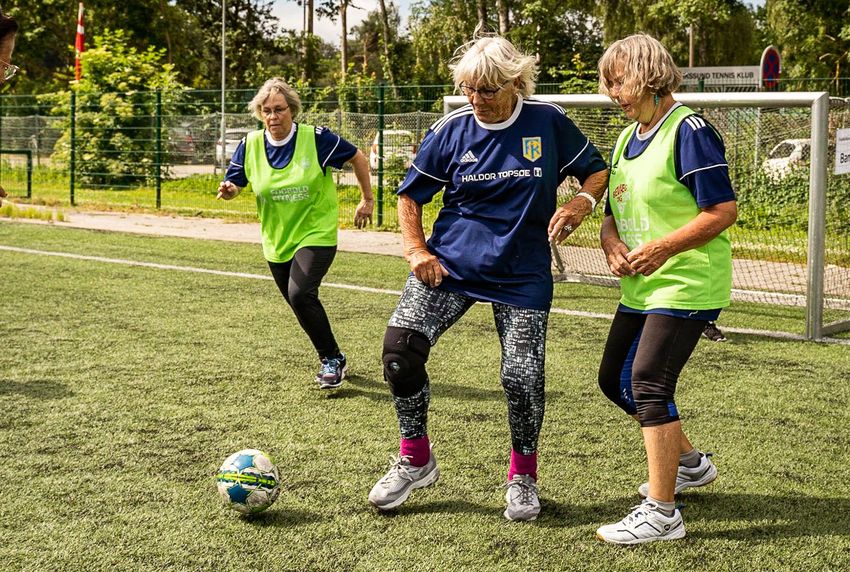
Football as a competitive sport literally small-sided drills. It is characterized by
moves hundreds of millions of people being an intermittent physical effort of
around the world: players, coaches, moderate to vigorous intensity with each
referees, leaders, supporters, and more. training session leading to a considerable
However, there is another football: the amount of energy expenditure and an
schoolyard football, the neighborhood effective combination of cardiovascular,
indoor football, the summertime beach metabolic and musculoskeletal fitness
football and the good ‘ol football training. However, the perceived effort of
match with friends. It’s the so-called the participants tends to be inferior to other
“recreational” football that offers fun and equally intense activities, like strength
pleasure. And health! training, running or even interval training.
This may be due to a greater playful
The first studies of recreational football aspect of this type of football and also to
appeared around 2003 in Denmark the effect of the interaction between the
[1]. Today we know that recreational participants, being that it is a collective
football brings broad spectrum health modality. These aspects are very important
benefits that are transversal to both in an active behavior that is intended to
men and women, of different ages and perpetuate throughout one’s lifespan.
social strata, in healthy and chronically
ill people, with or without previous Playing football in a recreational manner can
experience in the sport [2]. positively influence all dimensions of health:
it improves physical, mental and social
This type of football has no formal or well-being. Regular practice of 60 minutes,
structured form of competition and it 2 times a week is enough to get broad-
consists of pair-based exercises and spectrum effects for adult participants
24 info@fmpa.co.ukfootball medicine & performance
across the lifespan, making recreational proved to be positive and extremely valuable In summary, football - as a sport, physical
football one of the best types of fitness [4] (see above; Krustrup model/figure). activity and social phenomena - can
training! Yet, football can also be undoubtedly be one of the strongest
particularly beneficial for unique groups In many countries, football is the preferred allies of any public health strategy, be it
of participants. sporting activity among boys and girls. national or international, namely through
Among male adults, football and/or futsal the potential increase of the population’s
In a pragmatic, multicentre, parallel is a favorite collective modality, making up physical activity level.
randomised controlled trial in 5 Danish 15% of the preferences, falling only behind
urological departments, research to gym, running and walking activities.
examined the effectiveness of a
community-based football programme In this case, football should play an important 1. K
rustrup P, Hansen PR, Randers MB et al.
and strategic role in promoting active (2010). Beneficial effects of recreational football
for men with prostate cancer [3]. Within on the cardiovascular risk profile in untrained
the trial, participants allocated to lifestyles. “Sport for all” has been identified as
premenopausal women. Scand J Med Sci Sports 20,
football appeared to have improved hip one of the seven major priorities for promoting suppl 1: 40-49.
bone mineral density and fewer hospital physical activity [5]. The European Union’s
admissions. Men who played football recommendations state that elite sport 2. K
rustrup P and Parnell D (2019). Football as
organizations can also make an important Medicine – Prescribing Football for Global Health
more than once a week for 1 year lost
contribution by providing recreational Promotion. Routledge, 1st Edition, 266 pages, 25
fat mass and reported improved mental B/W Illustrations.
health. programs for different age groups and
social strata. Published guidelines already 3. B
jerre ED, Petersen TH, Jørgensen AB et al.
Why is this important? It’s a given that exist for clubs that want to offer health- (2019). Community-based football in men with
physical inactivity is a current problem promoting physical activity programs. These prostate cancer: 1-year follow-up on a pragmatic,
programs can include football as a physical multicentre randomised controlled trial. PLoS
in our society. In general terms, only Med. 16(10):e1002936.
one in four adolescents or adults meets practice in itself and/or take advantage
the recommendations of the World of the club’s facilitating factor in order to 4. K
rustrup P, Krustrup BR. Football is medicine: it is
Health Organization for the levels of promote healthy lifestyles, an example time for patients to play!. British Journal of Sports
physical activity. Given these recent being EuroFIT (European Fans in Training). Medicine 2018;52:1412-1414.
findings, alongside the evidence collated Football’s popularity has also been used
5. Investments that Work for Physical Activity.
surrounding football as medicine (Krustrup in programs such as Football Fitness and
British Journal of Sports Medicine 2012;46:709-712.
and Parnell, 2019) the potential of FIFA’s 11 for Health as a way of promoting
community-based or recreational football healthy lifestyles in different countries.
www.fmpa.co.uk 25You can also read


