Francis Douglas Memorial College 2018 NCEA Assessment Student & Parent Handbook
←
→
Page content transcription
If your browser does not render page correctly, please read the page content below
Francis Douglas Memorial College

    2018 NCEA Assessment
  Student & Parent Handbook

                                   1
Table of Contents
GENERAL INFORMATION                                  3
2018 TERM DATES & PUBLIC                             3
NCEA LEVELS 1 -2                                     5
UNIVERSITY ENTRANCE                                  6
NEW ZEALAND SCHOLARSHIP                              7
VOCATIONAL PATHWAYS                                  7
LEVEL 1 LITERACY AND NUMERACY REQUIREMENTS           7
THE UE APPROVED SUBJECT LIST                         8
PROVIDING NCEA INFORMATION TO PARENTS/STUDENTS       8
APPEALS                                              9
RESUBMISSIONS                                       10
FURTHER ASSESSMENT OPPORTUNITIES                    11
ATTENDANCE                                          11
EXTENSIONS/ALTERNATIVE ASSESSMENT DATES             12
AUTHENTICITY                                        13
MISCONDUCT                                          14
DERIVED GRADES                                      14
SPECIAL ASSESSMENT CONDITIONS (SAC)                 15
WITHDRAWAL FROM INTERNAL AND EXTERNAL ASSESSMENTS   15
PRIVACY (PRIVACY ACT 1993)                          16
FINANCIAL ASSISTANCE                                16
NCEA FEES                                           17
NZQA APP FOR STUDENTS                               17
NZQA APP FOR PARENTS & EMPLOYERS                    17

                                                    2
GENERAL INFORMATION
2018 Term Dates & Public Holidays
Term Dates
Term 1 Monday 29 January to Friday 13 April (11 weeks)
Term 2 Monday 30 April to Friday 6 Jul (10 weeks)
to Friday 28
Term 3 Monday 23 July (10 weeks)
September
(8 weeks)
to Friday 8 December
Term 4 Monday 15 October (3 weeks for Senior students)
31 October for Seniors
Statutory Holidays
Waitangi Day Tuesday 6 February
Taranaki Anniversary Monday 12 March
Good Friday Friday 30 March
Easter Monday & 2 & 3 April
Tuesday
Daylight Saving Ends Sunday 1 April
ANZAC Day Wednesday 25 April (in school holidays)
Queen’s Birthday 4 June
Monday
Daylight Saving Starts
Sunday 30 September
Labour Day
Monday 22 October
School Examination Dates:
Prelim Examinations 17 September - 21 September
NZQA Examination Dates:
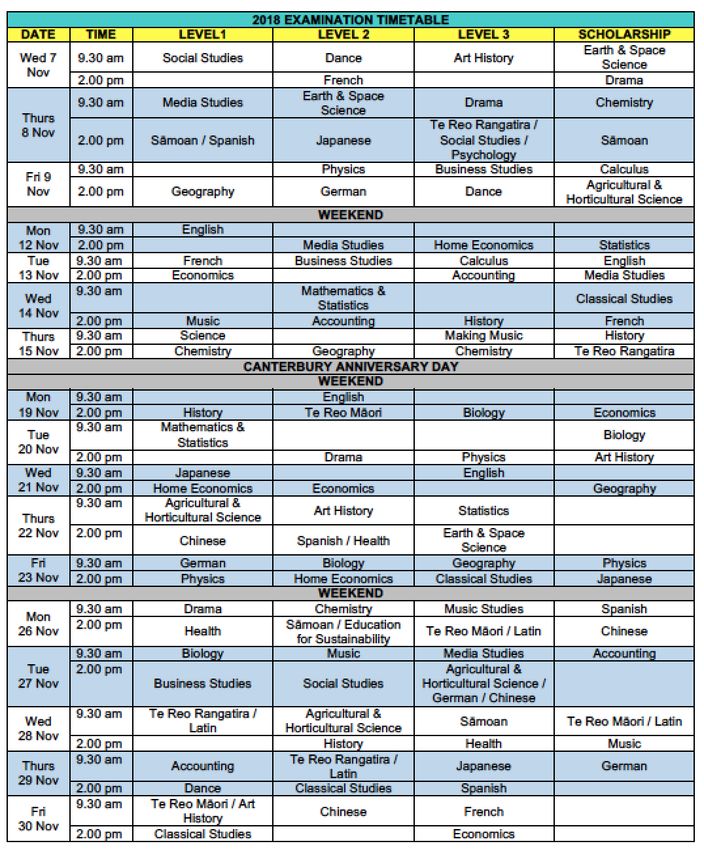
NZ Scholarship/ NCEA Exams Wednesday 7 November – Friday 30
November
34
NCEA General Information
NCEA (the National Certificate of Educational Achievement) is the main
secondary school qualification in New Zealand.

NCEA is actually three certificates: it can be awarded at Levels 1, 2
and 3.

Students usually begin studying for their NCEA Level 1 in Year 11 and
continue through Years 12 and 13 (from ages 15 through to 18).

Many vocational qualifications are also offered in secondary schools.

NCEA factsheets can be found on the NZQA website

NCEA Levels 1 -2

Level 1 80 credits are required at any level (Level 1, 2 or 3) including 10
        literacy and 10 numeracy credits. Schools can explain the literacy
        and numeracy standard pathways they are using.

Level 2 60 credits at level 2 or above
        + 20 credits from level one
        The Level 1 literacy and numeracy requirements must also be
        met.

Level 3 60 credits at level 3 or above
        + 20 credits from level 2 or above
        The Level 1 literacy and numeracy requirements must be met.

Credits gained at one level can be used for (or count towards) more than
one certificate. They may also be used towards other qualifications. For
example, unit standards in the domain 'generic computing' might be used
towards a Level 2 NCEA certificate, as well as towards a National Certificate
in Computing (Level 2); or 20 credits gained at Level 1 can also count
towards a Level 2 NCEA certificate.

                                                                                5
Certificate Endorsement
To gain Level One, Two or Three NCEA with Merit:
• 50 Merit or Excellence credits at the certificate level or higher.
To gain Level One, Two or Three NCEA with Excellence:
• 50 Excellence credits at the certificate level or higher.
Course Endorsement
To gain a course endorsement with Merit:
• 14 credits at Merit level (or a combination or Merit and Excellence
credits) including at least 3 internal and three external credits at Merit
or Excellence level.
To gain a course endorsement with Excellence:
• 14 credits at Excellence level including at least 3 internal and three
external credits at Excellence level.
• Exceptions include Religious Studies, PE and Level 3 Visual Art
This must be gained in a single year
University Entrance
University Entrance (UE) is the minimum requirement to go to a New
Zealand university. To qualify you will need:
• NCEA Level 3
• Three subjects - at Level 3, made up of:
• 14 credits each, in three UE Approved Subjects List
• Literacy - 10 credits at Level 2 or above, made up of:
• 5 credits in reading
• 5 credits in writing
• Numeracy - 10 credits at Level 1 or above, made up of:
• achievement standards – specified achievement standards available
through a range of subjects, or
• unit standards - package of three numeracy unit standards (26623,
26626, 26627- all three required).
6Once you have met the requirements for University Entrance it will appear
on your Record of Achievement.
Universities and other tertiary providers in New Zealand sometimes have
other specific requirements for entry to particular programmes or courses. If
you have a particular university programme in mind, check the entry criteria
as soon as possible, to ensure that you are entering for the right standards
at Level 3.
New Zealand Scholarship
New Zealand Scholarship is designed to extend the very best students and
to financially reward very able students who are going on to tertiary study.
It is not a qualification.
Students entered for New Zealand Scholarship are assessed on their ability
to demonstrate high-level critical thinking, abstraction and generalisation,
and to integrate, synthesise and apply knowledge, skills, understanding and
ideas to complex situations. The examinations or portfolios cover the same
content as level 3 achievement standards, but the standard of performance
required is much higher.
Read about NZ Scholarship here
Vocational Pathways
The Vocational Pathways provide new ways to achieve NCEA Level 2. These
pathways let you see how learning and achievement is valued in the
workplace. They also suggest the types of study options and job
opportunities available to learners.
To find out more visit the Vocational Pathways page on the NZQA website
Read more about Vocational Pathways here
Level 1 literacy and numeracy requirements
The literacy and numeracy requirements for NCEA Level 1 are:
7Literacy requirement
Minimum of 10 credits through either:
• Specified assessment standards - specified assessment standards
available through a range of subjects and English for Academic
Purposes unit standards 22750 and 22751 (minimum total of 10
credits), or
• Unit standards - package of three literacy unit standards (total of 10
credits
- all three required).
Numeracy requirement
Minimum of 10 credits through either:
• Achievement standards - specified assessment standards available
through a range of subjects - (minimum total of 10 credits), or
• Unit standards - package of three numeracy unit standards (total of 10
credits - all three required).
The UE Approved Subject List
You can access the approved subject list by clicking on the link below:
View the Approved Subjects
Providing NCEA Information to Parents/Students
1 All students will be issued with a Course Outline at the commencement of
each course. This will be handed out no later than March 3.
2 The Course Outline will provide specific information relating to that course
– and will include:
o each standard being offered
o the standard title, standard number, credit value of whether the
standard counts towards Level 1 or 2 literacy and/or numeracy
o whether the standard counts towards UE literacy (Level 2 or 3)
o method of assessment
o if a further assessment opportunity is available
o if the course is UE approved; and
o if the course is endorseable
83 For internal achievement standards – students should receive the marked
work and the awarded grade within an appropriate timeframe from the
due date of the assessment activity. At this time, students will have the
opportunity to view their work.
4 A course selection book will be available via the school website
5 Reports are issued to parents/caregivers at least twice a year including a
NCEA print-out showing all assessment standard results.
Appeals
1 The student, upon the return of his work, should seek clarification of the
marking procedures and grade awarded.
2 If the student has any concerns they should discuss the matter with their
subject teacher within two school days of receiving back their work.
3 Students can appeal any assessment decision within two school days
of reviewing their work and the marking cover sheet.
Steps for appealing your grade:
Step 1:
Approach the teacher within two days of receiving the assessment regarding
your grade to discuss why you are appealing it.
NOT
RESOLVED
X
Step 2: Approach the HOD regarding your appeal (use the Appeal Form).
NOT
RESOLVED
X
Step 3: Approach Mrs Stevenson, Deputy Principal, within two school days
of the meeting with the HoD. (use the Appeal Form). Mrs Stevenson will
9discuss the matter with the HoD.
- Mrs Stevenson will then arrange for an independent assessment of the
disputed work. This may mean the work being sent to a teacher from
another school.
- The advice from the independent assessor will be used to guide the
decision making process to determine the final grade.
- Mrs Stevenson, in consultation with the HoD, will be the final arbiters
on the grade.
If you have used TWINK or PENCIL in your assessment task you cannot
appeal the grade awarded.
Copies of Appeal Forms can be found on the school website.
http://www.fdmc.school.nz/ (under the for students link)
Resubmissions
1 A resubmission opportunity should only occur when the teacher judges
that a mistake has been made which the student should be capable of
discovering and correcting themselves and/or if a student is sitting on a
grade boundary and could improve the grade with a minor adjustment to
their script.
2 Can only be offered after final submission of a grade awarded. (Feedback
can be given before that grade is awarded)
3 Should only be offered where a teacher judges the student should be
capable of discovering and correcting a mistake themselves in a timely
fashion
4 Should be limited to specific aspects of the assessment
5 Can be offered after either the first or further assessment opportunity, or
after both.
6 Teachers may give only general advice.
7 A student must have access to any grade - Not Achieved, Achieved, Merit,
and Excellence.
8 No more than one resubmission can be provided per assessment event.
109 A resubmission must take place before the teacher gives feedback to the
class and/or to any student on the work done.
10 If more teaching relating to the assessment has occurred after the
assessment resubmission is not possible.
Further Assessment Opportunities
1 A Further Assessment Opportunity may occur when a new assessment is
provided for students after their first assessment opportunity and after
further teaching and learning has taken place.
2 The teacher will determine whether an opportunity for further assessment
is practicable
3 Students may be offered a maximum of one further opportunity for
assessment against an assessment standard within a year, regardless of
the grade obtained in the earlier assessment.
Attendance
1 Students are expected to attend all classes and any absences from class
must be reported to the School Office via a note or phone call from the
parent/caregiver. (This note is required the day the student returns to
school.)
2 Leave applications should be made by students in all circumstances when
they are to be away from classes for reasons other than illness or
bereavement.
3 This informs the teacher in advance and also the parents/caregivers are
informed about learning and/or assessments, which may be missed.
4 Failure to meet an assessment deadline will be noted, the Year Level
Dean will be notified and the subject teacher will send a letter home. The
students will be awarded a Not Achieved grade.
11Extensions/Alternative Assessment Dates
1 Students should present all material for assessment on the due date.
2 Assignments received after the due date will receive Not Achieved, N.
3 The exception is if an extension or alternative assessment date has been
granted
4 In exceptional circumstances, e.g. acute illness, bereavement, national
representation etc., an extension to the due date may be granted by the
Head of Department (HoD).
5 Copies of the application form for an Extension or Alternative
Assessment Opportunity can be found on the school website.
http://www.fdmc.school.nz/ (under the for students link)
Medical Certificates
6 If a student misses any internal assessment task through illness (or is
away longer than three school days) a Medical Certificate is required.
7 The Medical Certificate is to be given to the Dean on the student’s return
to school.
8 Even when a Medical Certificate is supplied by the student, the
opportunity to sit the assessment may be lost. In this instance, an
application for an alternative assessment date must be sought through
the HoD. If an alternative assessment date cannot be arranged, then the
student will be withdrawn from the standard.
School Representation/School Event
9 It is the student’s responsibility to inform the Dean and class teacher in
advance of the absence.
10 It is generally expected that work be handed in before the event. If this is
12impractical an application for an extension or an alternative assessment
date must be sought through the HoD.
Family Holidays in School Time
11 The College does not condone/recommend holidays during term time.
12 Students must submit their assessment work prior to leaving. Students
should also be told that they must see their Dean.
Other Reasons
13 All other applications for an Extension or Alternative Assessment
Opportunity will go through the HoD and the Deputy Principal, Melinda
Stevenson.
14 Copies of the application form for an Extension or Alternative
Assessment Opportunity can be found on the school website.
http://www.fdmc.school.nz/ (under the for students link)
Authenticity
1 All work submitted by a student for credits towards a NZQF qualification
must be authentic and must be completed by the student involved.
2 Students should not share their work with others or allow others to copy
their work.
3 Students should use a bibliography (or Endnotes/Footnotes) to
acknowledge all sources of information.
4 All students will be asked to sign an Authenticity Form on the completion
of their work. This will be handed in with their assessment work.
5 The Authenticity Form can be found on the school website.
http://www.fdmc.school.nz/ (under the for students link)
13Misconduct
For example: dishonest practice, concerns of authenticity, influencing,
assisting, or hindering another candidate, accessing a cellular phone or other
unauthorised electronic device during any examination or and failure to
follow instructions.
1 Where it is decided a student has committed a breach of the assessment
conditions whether knowingly, fraudulently or unwittingly, and the breach
undermines the credibility of the assessment, the Principal will be
informed. The following actions will take place:
• A formal letter will be sent home and the matter will be noted on the
student’s official KAMAR record.
• The student will be awarded a Not Achieve for that standard and no
further assessment opportunities for that standard will be available.
• The student may also face any of the consequences employed in the
school discipline system.
At all times the principles of natural justice, transparency and a shared
understanding of the processes to be followed will apply.
Reporting Not Achieved
Reporting a Not Achieved grade will result when:
• The student does not pass the assessment
• There is a proven breach of authenticity
• Adequate assessment opportunity has been provided yet the student
has not submitted the required work
Derived Grades
1 A derived grade is available to candidates who are entered for an
externally assessed standard and for an approved reason, the student is
unable to attend an external exam OR whose performance is impaired in
preparing for, or during, an exam session(s).
2 The College Prelim Exams will be used for a Derived Grade.
14Special Assessment Conditions (SAC)
1 SAC are approved in advance so that entitled candidates can demonstrate
their knowledge, skills and understanding, without providing unfair
advantage over other candidates.
2 An application to NZQA will be made by the school for candidates
identified as having permanent or long-term conditions such as a:
• physical disability
• sight impairment
• hearing impairment
• medical condition
• specific learning disability
3 Evidence of need can be established by a current report from an
independent, registered professional, or school based collected evidence,
recommending special assessment conditions to address the candidate’s
specified needs.
4 NZQA approves eligibility for SAC.
5 The report should be completed in time for the first year of assessment
for NCEA, and remains valid for three years.
6 SAC is used for internal standards and external (exams) standards.
Examples of SAC are use of a writer or computer, rest breaks, Braille or
enlarged papers, or reader. If a person is providing support with reading
or writing, they may not guide the student or explain the assessment.
Withdrawal from Internal and External Assessments
1 If the student shows insufficient sign of being prepared for an internal or
external assessment subject teachers will communicate with the
parents/caregivers to discuss alternative strategies to support the
student’s learning.
2 In some circumstances, it may be recommended that the student is
withdrawn from the assessment. In this case, the Dean will complete a
Withdrawal Approval Form and inform the parents/caregivers of the
15decision to withdraw.
3 Parent/caregiver approval must be sought before the withdrawal can take
place.
Privacy (Privacy Act 1993)
Teachers will:
- Maintain the privacy of individual student’s personal data at all times.
- Ensure student’s grades are not communicated to other parties.
- Seek permission from the student before the student’s work is used as
an exemplar.
Financial Assistance
Financial assistance is available to assist with the payment of entry fees for
National Secondary Schools qualifications (i.e. NCEA).
To be eligible to apply you must be the fee-payer (“Fee-Payer” is normally
the parent or guardian of the student, and must be the person paying the
NZQA fees) and meet at least one of the following criteria:
a. be currently receiving a Work and Income or Study Link benefit, or
have a current Community Services Card (benefit-based applications)
b. are not currently receiving a benefit, or do not have a current
Community Services Card, but do have a joint family1 income that
would entitle you to receive a Community Services Card (income-
based applications)
c. have two or more children who are candidates, irrespective of family
income, and the total fees you would have to pay would otherwise be
more than the $200 multiple candidate maximum (multiple candidate
applications).
d. You cannot claim financial assistance for international fee-paying
students.
e. The Application Form for applying for Financial Assistance can be
downloaded from the NZQA website . Students, parents/caregivers
can also get the Application Form from the school office.
f. Applications for Financial Assistance must be submitted to the school
office no later than 1 December 2018.
16Further information for parents/caregivers can be found on the NZQA
website under Financial Assistance.
NCEA Fees
GST GST
Exclusive Inclusive
Domestic student entry for all NCEA $66.70 $76.70
standards per year per year
Domestic student entry for a Scholarship $26.08 $30.00
subject per subject per subject
NCEA fees are to be paid to the school office. Fees may be paid in a lump
sum or with installments over the term or year. Please discuss the payment
options with the school office.
The final date for NCEA payment to the school office is Monday 3
September. After this date, NCEA payments will need to be paid directly to
NZQA using the NCEA payment form.
Further information can be found on the NZQA website
NZQA App for Students
NCEA Student will help students plan their NCEA study programme, set
goals and track their progress.
APP for Students
NZQA App for Parents & Employers
NZQA has launched a new mobile App called NCEA Guide written for parents,
whānau and employers. The App provides quick and easy access to key
information about NCEA.
Content can be viewed in English and Te Reo Māori.
APP for Parents/Family/Whanau & Employers
17You can also read


