Frequently Asked Questions (FAQs) About Serving Bison and Beef in USDA Child Nutrition Programs in South Dakota - SDSU Extension
←
→
Page content transcription
If your browser does not render page correctly, please read the page content below
Frequently Asked Questions (FAQs) About
   Serving Bison and Beef in USDA Child
      Nutrition Programs in South Dakota

                  Page 1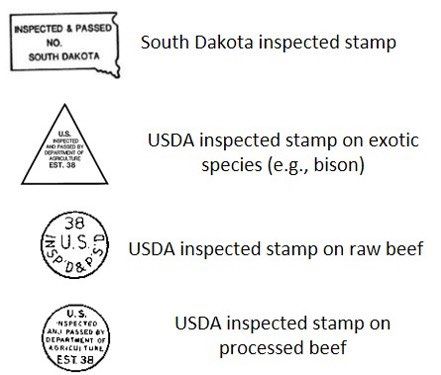
Frequently Asked Questions (FAQs) About Serving
    Bison and Beef in USDA Child Nutrition Programs in
    South Dakota

Anna Barr, SDSU Extension Farm to School Nutrition Field Specialist                                                                                     August 2021
Mikayla Hardy, School Nutrition Programs Assistant Director, South Dakota Department of Education Child and
Adult Nutrition Services
Andrea Alma, Farm to School Regional Lead, United States Department of Agriculture (USDA) Food and
Nutrition Service
Heather Hopwood, Nutritionist, USDA Food and Nutrition Service
Joanna Studt, Farm to School Project Manager, Cheyenne River Sioux Tribe Buffalo Authority Corporation

This FAQ document provides responses to commonly                                           Slaughter and Processing Inspection
asked questions about serving beef and bison in South                                      Requirements
Dakota Child Nutrition Program (CNP) meals and                                             1.   What are the slaughter and processing
snacks. The responses apply regardless of whether                                               requirements for beef and bison served in
the beef or bison is donated to or purchased by the                                             Child Nutrition Programs in South Dakota?
school or CNP operator, and whether the meat is locally                                         In order to be served in USDA CNP meals or
raised, locally processed or not. The following refer to                                        snacks, USDA Food and Nutrition Service requires
federal and state requirements; meat processors or                                              that beef and bison be slaughtered and processed
schools can go “above-and-beyond” the requirements                                              under USDA Food Safety and Inspection Service
described. Local, individual school or tribal                                                   (FSIS) inspection or State of South Dakota
requirements or preferences may be more restrictive                                             inspection. 2
or thorough. The document refers to bison and buffalo
using these two names interchangeably, since the same                                           Beef, not bison, may be slaughtered and processed
animal is referred to both ways in different reference                                          under state inspection at Cooperative Interstate
documents. 1                                                                                    Shipment (CIS) Select Establishments in any of the
                                                                                                eight states participating in the CIS program and be
Need more information or have questions? Contact                                                served in CNP meals or snacks. (The CIS program
information may be found at the end of this document.                                           does not apply to bison).3

                                                                                                The requirements above are in place whether the
                                                                                                meat is purchased or donated to the school.4 (For
                                                                                                details about an inspection exemption for donated
1    Exotic species are defined in 9 CFR 352.1: (e) Bison means any American bison or catalo or cattalo. (f) Buffalo means any animal belonging to the buffalo family.
     (g) Catalo or Cattalo means any hybrid animal with American bison appearance resulting from direct crossbreeding of American bison and cattle. (https://ecfr.
     federalregister.gov/current/title-9/chapter-III/subchapter-A/part-352/subpart-A/section-352.1).
2    South Dakota participates in the State Meat and Poultry Inspection (MPI) program under a cooperative agreement with USDA FSIS. Under the agreement, South
     Dakota’s program enforces requirements “at least equal to” those imposed under the Federal Meat Inspection Act and the Poultry Products Inspection Act. Product
     produced under State inspection is limited to intrastate commerce.
3    South Dakota entered the CIS program in 2021. The other eight participating States are Indiana, Iowa, Maine, Missouri, North Dakota, Ohio, Vermont, and Wisconsin.
     Learn more about the CIS program here: https://www.fsis.usda.gov/inspection/apply-grant-inspection/state-inspection-programs/cooperative-interstate-shipping-
     program.
4    The requirement that all beef and bison served in school meals be slaughtered and processed under State or Federal inspection includes all requirements required to
     receive the State or Federal inspection stamp. The Act, regulations and facility resources are at: https://www.fsis.usda.gov/policy. FSIS does not require all products
     to be tested for E. coli /O157/ STEC. Establishments are required to show that their products are safe, and testing is common, but not required at the Federal level.

                                                                                  Page 2
traditional meat served to primarily Native American page two of the memo below.
or Alaska Native students, see question #2 below.) Source: SP42 CACFP19 SFSP21-2015 Service of
Traditional Foods in Public Facilities https://fns.usda.gov/
At the federal level, bison is not amenable, meaning cn/service-traditional-foods-public-facilities
bison is not a species that requires inspection
under the Federal Meat Inspection Act and Labeling Beef and Bison for Child Nutrition
associated regulations. Any species not required Programs
to be inspected by FSIS falls under Food and Drug 3. What are the labeling requirements for beef or
Administration (and state and local) jurisdiction. bison offered in CNPs?
Under the Agricultural Marketing Act, FSIS can Considering both federal (USDA FSIS) and state
provide voluntary inspection of certain animals, (South Dakota Animal Industry Board) requirements,
including bison, when requested by the processor. the following elements are minimum labeling
FSIS charges an hourly rate for this voluntary requirements for beef or bison offered in CNPs:
service.5
Label Element Requirement
At the state level, bison is considered an amenable Inspected Stamp/ Any one of the following inspection
Legend stamps are allowable on the
species. This means that the State of South Principal Display Panel (PDP).
Dakota will provide a state inspector to inspect the
slaughter and processing of bison at no charge, if
FSIS inspection is not required.
Beef is an amenable species, so inspection of beef
is required, by either FSIS or the State of South
Dakota. There is no charge to the processor for
this mandatory service (except during overtime,
weekends or holidays).
Sources: SP 01-2016, CACFP 01-2016, SFSP 01-2016
Procuring Local Meat, Poultry, Game, and Eggs for Child #38 is used in USDA stamps as
Nutrition Programs: https://fns.usda.gov/cn/procuring- sample establishment number
local-meat-poultry-game-and-eggs-child-nutrition- Common Product Required on the PDP
programs Name
Ingredient Required if product contains more
Selling and Distributing Red Meat in South Dakota
Statement than one ingredient; may be on the
(2021): https://aib.sd.gov/pdfs/To%20sell%20and%20
PDP or the information panel
distribute%20red%20meat%20in%20South%20Dakota.pdf
Handling Required on the PDP
2. What is the inspection exemption for Statement
traditional food donated to Child Nutrition Signature Line – Required; may be on the PDP or
Processor Name the Information panel
Programs that primarily serve Native American and Address
or Alaska Native students? Safe Handling Required for raw or partially
Traditional food, such as bison, that is donated to Instructions cooked meat; may appear
anywhere on the package.
CNP operators that primarily serve Native American
or Alaska Native students and is served in CNP Net weight statements are not required for beef
meals or snacks does not need to be slaughtered products sold for food service use only, but a net
or processed under USDA FSIS or State of South weight statement may be added voluntarily when in
Dakota inspection. The school takes on certain food compliance with 9CFR 317.2(h) or 21CFR 101.7 for
safety and other responsibilities when accepting non-retail packages of bison.
a donation of traditional food, which are listed on
5 USDA FSIS offers voluntary field inspection of exotic species, including bison. The only part of the inspection process that may be performed in the field is ante-
mortem inspection; the postmortem inspection must be performed in a processing establishment. This process may require some coordination on the part of the
school, processor and USDA FSIS as it is a service that must be applied for and then granted by FSIS District Office 25 (https://www.fsis.usda.gov/contactus/fsis-
offices/office-field-operations-ofo), which covers South Dakota. FSIS Directive 12,600.1 describes the application for voluntary inspection on pages 5 and 6 (https://
www.fsis.usda.gov/sites/default/files/media_file/2020-08/12600.1.Amendment%202.pdf). This voluntary service must be paid for by the recipient of inspection, and
9 CFR 352 Subpart A describes the requirements for the establishment/facility requesting the voluntary inspection (https://ecfr.federalregister.gov/current/title-9/
chapter-III/subchapter-A/part-352/subpart-A).
Page 3Sources: Selling and Distributing Red Meat in South statements on their product labels. CN Labels
Dakota (2021) https://aib.sd.gov/pdfs/To%20sell%20
may be available for main dish food products that
and%20distribute%20red%20meat%20in%20South%20
Dakota.pdf contribute at least 0.5-ounce equivalents to the
meat/meat alternate component of the meal pattern
FSIS Labeling Requirements Guide (2007) https://www.
fsis.usda.gov/sites/default/files/media_file/2021-02/ requirements. CN Labels make it easy for school
Labeling_Requirements_Guide.pdf menu planners to determine how foods credit
FSIS Food Standards and Labeling Policy Book (2005) toward meal pattern requirements; they can be
https://www.fsis.usda.gov/guidelines/2005-0003 especially helpful for mixed dishes that contribute
FSIS Regulations: 9 CFR 312.2(a)&(b) - Official toward multiple components.
marks and devices to identify inspected and passed
products of cattle, sheep, swine, or goats. https:// Source: CN Labeling Program https://fns.usda.gov/cn/
ecfr.federalregister.gov/current/title-9/chapter-III/ labeling-program
subchapter-A/part-312/section-312.2#p-312.2(a)
Crediting Beef and Bison Towards
9 CFR 317.2 - Labels: definition; required features. Child Nutrition Program Meal Pattern
https://ecfr.federalregister.gov/current/title-9/chapter-III/
subchapter-A/part-317/subpart-A/section-317.2 Requirements
6. What is the process to determine how a
9 CFR 352.7 Marking Inspected Products. https://
ecfr.federalregister.gov/current/title-9/chapter-III/ food, such as beef or bison, contributes
subchapter-A/part-352/subpart-A/section-352.7 toward Child Nutrition Program meal pattern
requirements?
4. Must beef and bison be labeled with nutrition
To determine how a food product contributes to
information to be offered in a CNP?
meal pattern requirements, menu planners can use
Typically, meat is required to have a Nutrition Facts
information from one of three places: a CN Label, a
label, per USDA’s Food Safety Inspection Service
Product Formulation Statement, and/or the USDA’s
regulations (9 CFR 317.300). However, products
Food Buying Guide for Child Nutrition Programs
not sold to retail consumers (i.e. for food service
(Food Buying Guide) (https://foodbuyingguide.fns.
use only) are exempt from bearing Nutrition Facts
usda.gov). The Food Buying Guide helps menu
labels as long as they do not include any nutrient
planners purchase the right amount of food and
content claims or other nutrition information. If
determine the specific contribution each food
nutrition claims are present, then a Nutrition Facts
makes toward CNP meal pattern requirements. The
label is required.6 Additionally, most South Dakota-
Food Buying Guide contains crediting information
inspected meat establishments are small and very
for ground buffalo and several types of beef. For
small establishments operating under exemptions
example, per the Food Buying Guide:
to 317.300 as described in 317.400 (a)(1)(i) and (ii),
and therefore are not required to include Nutrition 1 pound (16 ounces) raw, ground buffalo = 0.72 lb.
Facts labels. (11.52 oz.) cooked, drained ground buffalo
Sources: FSIS Regulations: 9 CFR 317.300 - Nutrition
labeling of meat or meat food products. https:// Serving Number of
Starting Amount
ecfr.federalregister.gov/current/title-9/chapter-III/ Size Servings
subchapter-A/part-317/subpart-B/section-317.300 11.52 oz. cooked, 1 oz. 11.5
drained ground 1.5 oz. 7.6
9 CFR 317.400 - Exemption from nutrition labeling. buffalo (from 1 lb.
https://ecfr.federalregister.gov/current/title-9/chapter-III/ raw) 2 oz. 5.7
subchapter-A/part-317/subpart-B/section-317.400
The Food Buying Guide contains one entry for
5. Are beef and bison offered in Child Nutrition
buffalo: Game, Buffalo (ground). Schools that opt
Programs required to have Child Nutrition
to offer cuts of buffalo (other than ground) may use
Labels?
Food Buying Guide information for comparable cuts
No, Child Nutrition (CN) Labels are not required for
of beef to determine crediting.
beef, bison or any other food served in CNPs. The
CN Labeling Program provides food manufacturers Schools are required to offer at least one or two
the option to include standardized food crediting ounces of meat (or meat alternate) per day in the
6 For additional information regarding voluntary nutrition claims on package labels, for beef see 9CFR 317.400 for bison see 21 CFR 101.9(j).
Page 4National School Lunch Program (NSLP) depending 8. What is the fat content requirement for ground
on the grade(s) of students being served. Minimum buffalo in CNP meals?
requirements vary by student grades. Schools are Per the Food Buying Guide, there is no fat content
not required to offer meats/meat alternates in the requirement for ground buffalo offered in the CNPs.
School Breakfast Program (SBP) but may choose to Buffalo is typically lower in fat than beef. Menu
offer meat at local menu planners’ discretion. planners may use information in the Food Buying
Guide to determine how ground buffalo credits
Minimum Daily Minimum Weekly
toward meal pattern requirements.
Student Meat that Must Meat that Must
Grade(s) be Offered be Offered Source: USDA’s Food Buying Guide for Child Nutrition
(NSLP) (NSLP) Programs https://foodbuyingguide.fns.usda.gov
Preschool
1.5 oz. 7.5 oz.
(ages 3-5) 9. How might schools work with processors to
K-5 1 oz. 8-10 oz. determine the fat content of a beef or buffalo
6-8 1 oz. 9-10 oz. product?
9-12 2 oz. 10-12 oz. Child Nutrition Program meals must fall below
Sources: FNS Regulations: 7 CFR 210.10 - Meal the saturated fat dietary specifications for the
requirements for lunches and requirements for school week. School lunches offered to all age/
afterschool snacks. https://ecfr.federalregister.gov/
current/title-7/subtitle-B/chapter-II/subchapter-A/part- grade groups must, on average over the school
210/subpart-C/section-210.10 week, provide less than 10% of total calories
USDA’s Food Buying Guide for Child Nutrition Programs
from saturated fat. Based on foods offered over a
https://foodbuyingguide.fns.usda.gov school week, CNP operators may have a sense
of a menu’s saturated fat content without knowing
7. What is the fat content requirement for ground the exact saturated fat content of each individual
beef in Child Nutrition Program meals? product. A state agency is only required to conduct
To credit in CNPs, a creditable meat ingredient a nutrient analysis of a school’s menu if there is
must match or have a similar description to the a high risk that a menu may not meet the weekly
food item in the Food Buying Guide. All Food dietary specifications for calories, saturated fat and
Buying Guide entries for ground beef have 30% or sodium. In this case, the school would need to have
less fat, so all ground beef served in CNPs must documentation showing the saturated fat content of
have 30% or less fat.7 Ground beef that has less the beef or buffalo from the supplier.
than the 30% regulatory maximum may be labeled
in the ingredients statement with the maximum The fat content of ground meat may be listed
amount of fat that the manufacturer blended it to in the ingredients statement with the maximum
be, e.g., “ground beef (not more than 20% fat).” If amount of fat that the manufacturer blended it to
the fat content is not included in the ground beef be, e.g., “ground beef (not more than 20% fat).” If
ingredient declaration, then it assumed to be no the fat content is not included in the ground beef
more than the 30% fat regulatory maximum. Then, ingredient declaration, then it is assumed to be no
this description may be matched to the applicable more than the 30% fat regulatory maximum.
Food Buying Guide entry.
USDA FSIS does not require analytical testing to
Sources: FSIS Regulations: 9 CFR 319.15 - determine nutrition information. If the fat content
Miscellaneous beef products. https://ecfr.federalregister.
gov/current/title-9/chapter-III/subchapter-A/part-319/ is listed on a product, analytical testing is one
subpart-B/section-319.15 acceptable method for determining the precise fat
USDA’s Food Buying Guide for Child Nutrition Programs, content, but an establishment could choose to use
Meat Section: https://foodbuyingguide.fns.usda.gov/ the USDA database (FoodData Central: https://
FoodComponents/ResourceMeat
fdc.nal.usda.gov) or a different computer database
or software program to obtain accurate nutrition
information for the product. Federal and state
7 This standard aligns with USDA FSIS standards of identity for beef products. Per FSIS regulations at 9 CFR § 319.15, ground beef, hamburger or beef patties may
not contain more than 30% fat.
Page 5inspectors are required to perform random fat tests Contacts
throughout the year. Some inspectors have access • SD Department of Education: Child and Adult
to testing equipment and may be willing to help Nutrition Services, School Nutrition Programs
processors develop product specifications to meet Assistant Director Mikayla Hardy; Mikayla.Hardy@
schools’ needs. Commercial laboratories may also state.sd.us; Phone: 605-773-2213; https://doe.sd.gov/
conduct nutrient analyses to determine fat content. cans/
South Dakota State University Extension may also be
able to assist in this area. • SD Animal Industry Board: Staff Veterinarian
Dr. Tammy Anderson; Tammy.Anderson@state.
If the establishment chooses to use analytical testing sd.us; Phone: 605-773-3321; https://aib.sd.gov/
to determine the nutrition values, the test could be meatinspection.html
run once after processing and the establishment
could use that same process that resulted in that fat • SDSU Extension: SDSU Extension Farm to School
content level without retesting. Nutrition Field Specialist Anna Barr; Anna.Barr@
sdstate.edu; Phone: 605-995-7378; extension.sdstate.
Processors must maintain records to verify the edu
nutrient levels claimed on a Nutrition Facts Panel
in accordance with Food and Drug Administration • SDSU Extension: Professor and SDSU Extension
Food Labeling requirements at 21 CFR 101.9(g)(10) Meat Science Specialist Amanda Blair; amanda.
for beef: “The manufacturer must make and keep blair@sdstate.edu; Phone: 605-394-2236; https://
written records (e.g., analyses of databases, recipes, extension.sdstate.edu/meat-inspection-south-dakota-
formulations, information from recipes or formulations, requirements-and-resources-processing-and-selling-
or batch records) to verify the declared amount of meat and https://extension.sdstate.edu/tags/food-
that nutrient on the Nutrition Facts label…” and 9 CFR safety
320.1(b) for bison.
• USDA: Farm to School Regional Lead Andrea Alma;
Sources: FNS Regulations 7 CFR 210.10(f)(2) – Saturated andrea.alma@usda.gov; Phone: 303-844-4417
fat. https://ecfr.federalregister.gov/current/title-7/subtitle-B/
https://www.fns.usda.gov/cfs
chapter-II/subchapter-A/part-210/subpart-C/section-
210.10#p-210.10(f)(2)
• USDA AskFSIS: A helpful service whereby USDA
FSIS Regulations: 9 CFR 319.15 - Miscellaneous beef FSIS answers questions about meat, poultry and egg
products. https://ecfr.federalregister.gov/current/title-9/
chapter-III/subchapter-A/part-319/subpart-B/section- products inspection, FSIS policies and related topics.
319.15#p-319.15(a) https://www.fsis.usda.gov/contact-us/askfsis
9 CFR 320.1(b) – Records required to be kept. https://ecfr.
federalregister.gov/current/title-9/chapter-III/subchapter-A/
part-320/section-320.1#p-320.1(b)
S O U T H DA KOTA S TAT E U N I V E R S I T Y ®
H E A LT H A N D N U T R I T I O N A L S C I E N C ES D E PA R T M E N T
SDSU Extension is an equal opportunity provider and employer in accordance with the nondiscrimination policies of South Dakota State University, the
South Dakota Board of Regents and the United States Department of Agriculture.
Learn more at extension.sdstate.edu. © 2021, South Dakota Board of Regents
P-00219
Page 6You can also read


