Fund 40000: County Transit Systems - Mission - FY 2021 Advertised ...
←
→
Page content transcription
If your browser does not render page correctly, please read the page content below
Fund 40000: County Transit Systems

              To provide safe, reliable, clean and effective public transportation service that complements the other
    Mission   elements of the multi-modal transportation system in Fairfax County and provides a cost-saving
              alternative to Washington Metropolitan Area Transit Authority (WMATA) Metrobus service. To fund
              the County's share of operating costs for the Virginia Railway Express (VRE).

              Fund 40000, County Transit Systems, provides funding for operating and capital expenses for the
      Focus   Fairfax Connector bus system. The Fairfax County Department of Transportation (FCDOT)
              manages, oversees and coordinates the activities of the Fairfax Connector bus system, which in
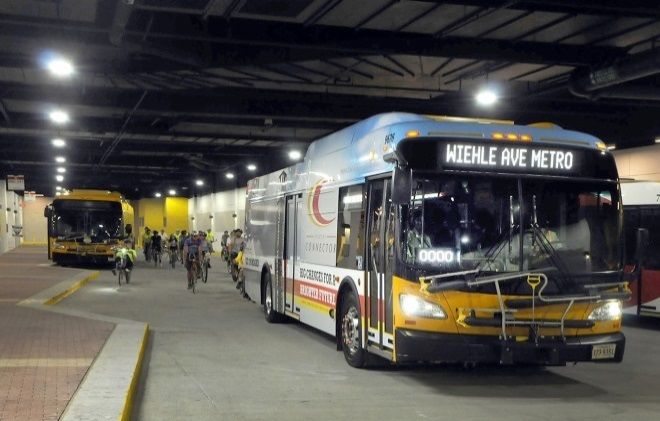
              FY 2019 operated 90 routes providing primarily intra-county service and access to Metrorail stations
              serving County residents. The system includes an authorized fleet of 312 buses.

              Fairfax Connector bus service is operated by a private contractor from three operating facilities.

              The Huntington Division provides local service to the Huntington, Van Dorn Street and Franconia-
              Springfield Metrorail stations and in the Mount Vernon and Lorton areas and express service to the
              Pentagon Metrorail station.

              The Reston-Herndon Division includes service in the Reston, Herndon, McLean and Tysons areas
              to the Wiehle-Reston East, McLean, Spring Hill, and Tysons Corner Metrorail stations; express
              service between Reston, the Pentagon Metrorail station, and Crystal City; local service between
              Herndon, Reston, and Tysons, and cross-county service between Fair Oaks and Reston.

              The West Ox Division provides service primarily in the I-66 Corridor between the Vienna Metrorail
              station and the Centreville, Chantilly, Fair Oaks, Oakton, and Fairfax Center areas; and 495 Express
                                                    service between Tysons, Burke Centre and Springfield.

                                                 The most recent Comprehensive Transit Plan (CTP) was
                                                 completed in the spring of 2016 and the companion Transit
                                                 Development Plan (TDP) was adopted by the Board of
                                                 Supervisors in March 2016. The fiscally constrained TDP
                                                 guides future investments and changes to the Fairfax Connector
                                                 system. The TDP goals and objectives focused on expanding
                                                 and improving access and mobility. To that end, FCDOT has
                                                 made investments in a student pass program, express services,
                                                 cross-county linkages, transit route improvements, an Intelligent
              Transportation System (ITS), the bus fleet, infrastructure and improvements to transit facilities.

              The TDP is scheduled for a full update in FY 2022. FCDOT has developed a route optimization
              planning process to update the TDP incrementally over the next three years. This process involves
              reviewing the Fairfax Connector network in five regional sections. Each section is based on a major
              Metrorail Station or activity center used as a transit center by Fairfax Connector. These include the
              Franconia-Springfield, Reston-Herndon, Vienna, Tysons, and Huntington Metrorail Stations. In
              FY 2019 FCDOT began working on the Franconia-Springfield and Reston-Herndon sections, which
              contain over 51 routes.

              In FY 2020, FCDOT started the planning process for optimizing routes in Vienna and Tysons. As
              part of the planning for Richmond Highway Bus Rapid Transit (BRT), FCDOT will also complete route
              optimization for the Huntington routes. The Vienna, Tysons, and Huntington planning efforts are
              estimated to be completed by the end of FY 2021.

                 FY 2021 Fairfax County Advertised Budget Plan (Vol. 2) - 429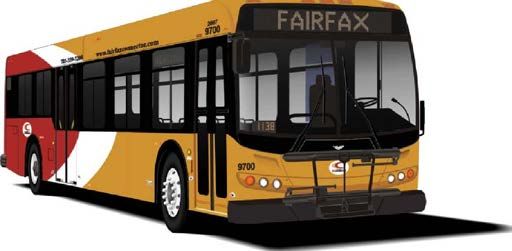
Fund 40000: County Transit Systems

In FY 2016, Fairfax Connector, in partnership with Fairfax County Public Schools (FCPS), initiated
the Student Free Fare Pilot Program (SFFPP), which provides free bus rides to the County’s middle
and high school population. Since program inception in September 2015, the program has provided
over 1.7 million student passenger trips. In FY 2020, approximately 17,000 student SmartTrip cards
have been distributed to schools. As of December 2019, monthly usage was approximately 40,000
passenger trips. Building on prior success, the program is now offering access to Metrobus service
to Justice High School students; replacing special bus passes with regional SmartCards to improve
                                   tracking, connectivity and security; and increasing outreach at
                                   local schools served by transit.

                                   Since FY 2017, FCDOT has received four grant applications to
                                   the Northern Virginia Transportation Commission (NVTC) for
                                   implementation of express bus service along I-66 and I-395 using
                                   the managed High Occupancy Toll (HOT) lanes. Funding for
                                   these express bus services is generated from the HOT lanes’ toll
                                   revenue. The goal of the routes is to reduce congestion within the
                                   I-66 corridor inside the Beltway and along I-395. Route 699 began
                                   operating in December 2017, providing a direct link between the
                                   Fairfax County Government Center and downtown. As of
                                   December 2019, Route 699 provided over 2,700 passenger trips
per week, resulting in over 170,300 passenger trips since route inception. In January 2019, Route
698 began passenger service, providing a direct link from the Vienna Metrorail Station to the
Pentagon. As of December 2019, this route provided over 1,380 weekly trips and has provided
approximately 32,500 passenger trips since inception. In FY 2020, Fairfax Connector anticipates an
additional route, Route 396, along the I-395 corridor that will improve connectivity from Springfield to
the Pentagon. Subsequently, in July 2020, the Fairfax Connector is planning to implement Route
697 along the I-66 corridor with service to L’Enfant Plaza.

As an effort to improve cross-county linkage, Fairfax Connector implemented Route 308 in March
2019, linking the Franconia-Springfield Metrorail/VRE Station to Mount Vernon Hospital via
Richmond Highway and Jeff Todd Way. As of August 2019, Route 308 provided approximately 2,000
weekly passenger trips. To further improve system efficiency and reliability in FY 2020, several
adjustments were made to existing Routes 306, 395, and 950.

Phase II ITS projects are planned for FY 2020, including an upgrade of the Driver Monitoring
Technology (Drive Cam), development of a voice over internet protocol (VOIP) project to replace the
legacy radio system, and deployment of mobile supervisor technology to assist station and field
supervisors with providing enhanced customer service.

FCDOT continues its commitment to environmental protection practices. As part of this effort, Fairfax
Connector buses are equipped with Engineered Machine Products (EMP), which increase miles per
gallon and reduce emissions. Additionally, all new buses have an electric air conditioning system
and a green fire suppression system. Fairfax Connector also has a very strict idling policy to reduce
emissions. Within County facilities, FCDOT adheres to best practices and the Virginia Department
of Environmental Quality (VDEQ) standards and testing. For these programs, the bus operational
garage renovations included storage areas for contaminated parts, enhanced stormwater collection
areas, and bio-tree filters.

FCDOT continues to invest in infrastructure with major construction projects. Recently, major
projects were completed at the three operational garages to increase efficiencies and capacity.
FCDOT is also adding and improving parking facilities. In mid-2020, construction of the new

   FY 2021 Fairfax County Advertised Budget Plan (Vol. 2) - 430
Fund 40000: County Transit Systems
Springfield Parking Garage will begin, which will replace the Old Keene Mill Park-and-Ride Lot. In
addition, FCDOT and DPWES are currently working on designing the Fairfax Corner Commuter
Parking Garage and Transit Center.
FY 2021 Bus Services Funding
Total FY 2021 funding of $100.0 million is provided for bus services, including funding for the mid-
life bus rebuild program, and other capital equipment. A breakdown of the $100.0 million is included
in the table below.
Bus Services $96.4
Mid-Life Rebuild 2.9
Capital Equipment Purchases 0.5
West Ox Building Renovation 0.2
Total ($ in millions) $100.0
County and Regional Transportation Projects
Commercial and Industrial (C&I) real estate tax revenue and Northern Virginia Transportation
Authority (NVTA) local 30 percent funds are collected in Fund 40010, County and Regional
Transportation Projects, and then a portion is transferred to the County Transit Systems budget. In
FY 2021, this amount totals $38.4 million. This amount will be used to:
• Support West Ox Division rush hour and midday service
• Increase frequencies on overcrowded priority bus routes (Routes 171, 401/402,
950)
• Support Route 981 from Wiehle-Reston East to Dulles Airport
• Improve the frequency of Richmond Highway corridor routes and Route 310
servicing Franconia Road to Rolling Valley
General Fund Support / Use of Balances
General Fund support is provided to Fund 40000 for Fairfax Connector requirements and for the
County share of the subsidy for commuter rail services operated by the Virginia Railway Express
(VRE). The FY 2021 General Fund transfer to Fund 40000 is $42.6 million, an increase of $2.0 million
from the FY 2020 Adopted Budget Plan level.
Fairfax Connector Bus Replacement Reserve
A significant long-term issue in transportation concerns the bus replacement needs for the Fairfax
Connector fleet. To help minimize the fiscal impact of future bus replacement needs, funding is being
reserved at the Northern Virginia Transportation Commission (NVTC). Between FY 2022 and
FY 2025, 139 buses are expected to be replaced at an estimated cost of $75.3 million.
Virginia Railway Express (VRE)
Fund 40000, County Transit Systems, includes the County's share of the subsidy for commuter rail
services operated by VRE. The service is a joint effort among NVTC, the Potomac and
Rappahannock Transportation Commission, the Virginia Department of Rail and Public
Transportation, and the participating jurisdictions of Fairfax County, City of Manassas, City of
Manassas Park, Fredericksburg, Prince William County, Spotsylvania County and Stafford County.
The City of Alexandria and Arlington County are also contributing jurisdictions.
FY 2021 Fairfax County Advertised Budget Plan (Vol. 2) - 431Fund 40000: County Transit Systems
The operation and maintenance costs associated with the commuter rail system are funded from a
combination of ridership revenues, state contributions and contributions from the participating and
contributing local jurisdictions. According to the VRE Master Agreement, at least 50 percent of the
operating costs must be paid by passenger fares, with the remainder funded by the participating
jurisdictions according to a funding formula. The FY 2021 Fairfax County subsidy remains
unchanged from the FY 2020 Adopted Budget Plan level of $6.3 million.
The following funding adjustments from the FY 2020 Adopted Budget Plan are necessary to support
FY 2021 the FY 2021 program:
Funding Increased Expenditure Requirements $5,645,429
An increase of $5,645,429 in expenditures includes an increase of $4,900,429 in operating
Adjustments requirements, and an increase of $3,545,000 in capital projects, partially offset by a $2,800,000
decrease in capital equipment requirements.
The following funding adjustments reflect all approved changes in the FY 2020 Revised Budget Plan
Changes to since passage of the FY 2020 Adopted Budget Plan. Included are all adjustments made as part of
the FY 2019 Carryover Review, and all other approved changes through December 31, 2019.
FY 2020
Carryover Adjustments $12,417,907
Adopted As part of the FY 2019 Carryover Review, the Board of Supervisors approved an increase of
$12,417,907 including $4,347,491 in encumbered carryover and $8,070,416 in unspent Capital
Budget Plan Projects funds. Revenues decreased by $85,756 in State Aid revenue.
Total Fairfax Connector ridership for FY 2019 exceeded the total ridership for FY 2018. In FY 2019,
Performance Fairfax Connector provided 8,334,616 passenger trips, an increase of 0.26 percent from the FY 2018
total of 8,312,983. This may indicate that the ridership losses seen in prior years are leveling off.
Measurement Additionally, the Free Student Bus Pass Program has contributed to improving ridership, with student
Results ridership now representing over six percent of all Fairfax Connector passenger trips.
While ridership has shown improvement, the same factors driving declines in public transportation
usage across the region still exist, including Metrorail service disruptions due to WMATA's capital
maintenance program, increased usage of on-demand ride-hailing services (such as Uber and Lyft),
bikeshare, scooters, teleworking and alternative work schedules, and (in particular) declining fuel
prices encouraging automobile use. June 2019 saw a decrease in ridership as compared to June
2018 due to the impact of the WMATA station platform rebuilding effort, which began on May 25,
2019, and closed six Metrorail Stations south of National Airport until September 9, 2019.
FCDOT's strategic planning efforts will use results of the previously mentioned TDP and route
optimization studies to examine the efficiency and effectiveness of routes, conduct public outreach
and solicit stakeholder input, and shift limited resources to improve service and attract riders back to
the system.
FY 2021 Fairfax County Advertised Budget Plan (Vol. 2) - 432Fund 40000: County Transit Systems
Many commuters in the region have expressed interest in new technologies that allow more
interaction with bus services. Fairfax Connector has implemented advanced ITS technology on the
bus fleet. New technology includes near real-time bus arrival information to enhance the travel
experience of Fairfax Connector riders.
FY 2017 FY 2018 FY 2019 FY 2020 FY 2021
Indicator
Actual Actual Estimate/Actual Estimate Estimate
Fairfax Connector
Percent change in Fairfax Connector passengers (3.92%) (3.69%) 0.00% / 0.26% 0.25% 1.00%
Percent change in service provided for platform hours 2.05% 2.01% 2.24% / 0.49% 1.98% 1.73%
Percent change in service provided for platform miles 9.03% (0.38%) 4.69% / 1.78% 2.93% 3.87%
Commuter Rail
Percent change in VRE passengers boarding at stations in
Fairfax County 7.3% 1.6% 0.0% / (3.6%) 2.12% 2.09%
A complete list of performance measures can be viewed at
https://www.fairfaxcounty.gov/budget/fy-2021-advertised-performance-measures-pm
FY 2021 Fairfax County Advertised Budget Plan (Vol. 2) - 433Fund 40000: County Transit Systems
FUND STATEMENT
FY 2020 FY 2020 FY 2021
FY 2019 Adopted Revised Advertised
Category Actual Budget Plan Budget Plan Budget Plan
Beginning Balance $11,200,115 $125,000 $12,623,663 $0
Revenue:
Miscellaneous Revenue1 $39,245 $100,000 $100,000 $100,000
SmarTrip Revenue2 5,753,408 6,100,000 6,100,000 6,100,000
Bus Advertising 353,212 250,000 250,000 300,000
Bus Shelter Program 103,038 132,000 132,000 156,750
WMATA Reimbursements, West Ox Bus Operations
Center3 1,591,565 1,750,000 1,750,000 1,750,000
State Aid (NVTC) Operating4 6,701,147 11,354,258 11,273,502 12,410,000
State Aid (NVTC) Capital4 2,041,068 0 0 0
I-66 Inside the Beltway Tolls (NVTC) Operating 1,320,888 1,598,145 1,598,145 2,739,360
VA Dept. of Rail and Public Transportation (VDRPT)
Operating for I-95 Express Service5 299,866 300,000 300,000 300,000
Total Revenue $18,203,437 $21,584,403 $21,503,647 $23,856,110
Transfers In:
General Fund (10001) $36,151,131 $40,633,472 $40,633,472 $42,555,146
Metro Operations & Construction (30000) 2,915,530 3,032,151 3,032,151 3,153,437
County and Regional Transportation Projects (40010)6 35,065,066 36,974,719 36,974,719 38,430,481
Total Transfers In $74,131,727 $80,640,342 $80,640,342 $84,139,064
Total Available $103,535,279 $102,349,745 $114,767,652 $107,995,174
Expenditures:
Fairfax Connector
Fairfax Connector Operating Expenses
Transit Administration $275,728 $0 $246,447 $3,519,220
Huntington Division 32,686,485 36,075,226 33,219,050 36,745,798
Reston-Herndon Division 28,388,058 32,645,364 32,480,791 32,788,129
West Ox Division, County Connector 18,964,069 22,826,133 22,991,592 23,394,005
Subtotal - Connector Operating Expenses $80,314,340 $91,546,723 $88,937,880 $96,447,152
Capital Equipment $1,348,970 $2,800,000 $1,280,972 $0
Capital Projects 1,020,947 0 16,545,778 3,545,000
Total Connector Service $82,684,257 $94,346,723 $106,764,630 $99,992,152
Total WMATA Service $1,591,565 $1,750,000 $1,750,000 $1,750,000
Total Bus Services, Connector & WMATA $84,275,822 $96,096,723 $108,514,630 $101,742,152
Commuter Rail7 $5,385,794 $6,253,022 $6,253,022 $6,253,022
Total Expenditures $89,661,616 $102,349,745 $114,767,652 $107,995,174
Transfers Out:
County and Regional Transportation Projects (40010)8 $1,250,000 $0 $0 $0
Total Transfers Out $1,250,000 $0 $0 $0
Total Disbursements $90,911,616 $102,349,745 $114,767,652 $107,995,174
Ending Balance $12,623,663 $0 $0 $0
Transportation-Related Requirements $12,623,663 $0 $0 $0
Unreserved Balance $0 $0 $0 $0
FY 2021 Fairfax County Advertised Budget Plan (Vol. 2) - 434Fund 40000: County Transit Systems
1 Miscellaneous revenue includes such items as reimbursement from the Washington Metropolitan Area Transit Authority (WMATA) for the value of WMATA
tokens collected on Fairfax Connector routes, insurance recoveries, and miscellaneous developer contributions.
2 Fare revenue is received either directly by the County as SmarTrip fare payments, or indirectly through contractor billings.
3 WMATA reimburses the County for its share of space at the West Ox Bus Operations Center, a joint use facility for WMATA and the County Connector.
WMATA initiated operations from this site in Spring 2009.
4 State Aid for mass transit is disbursed to NVTC, where it is made available to the County.
5Reimbursement from the Virginia Department of Rail and Public Transportation (VDRPT) for operating assistance in implementing I-95 Express Lane bus
services.
6 The FY 2021 transfer of $38.4 million from Fund 40010, County and Regional Transportation Projects, is consistent with a transportation funding list
periodically updated and approved by the Board of Supervisors. Of this total, $23.9 million is from Commercial and Industrial (C&I) real estate revenue and
$14.5 million is from HB 2313 local revenues.
7 Fairfax County participates in the Virginia Railway Express (VRE) Master Agreement and provides an annual subsidy to VRE operations and construction.
8 In FY 2019, a transfer to Fund 40010, County and Regional Transportation Projects, was included to support bus loop repairs and bus shelter repairs at
the Herndon Metrorail Station Parking Garage.
FY 2021 Fairfax County Advertised Budget Plan (Vol. 2) - 435Fund 40000: County Transit Systems
SUMMARY OF CAPITAL PROJECTS
Total FY 2019 FY 2020 FY 2021
Project Actual Revised Advertised
Project Estimate Expenditures Budget Budget Plan
ADA Remediation (TF-000037) $1,688,660 $0.00 $1,219,853.04 $0
Bus Shelter Replacement (TS-000022) 687,466 233,103.36 314,028.27 0
Connector Intelligent Transportation Sys (3G40-003-000) 9,825,460 21,632.04 3,524,841.50 0
Fairfax Connector Buses - Capital (TF-000048) 5,832,160 0.00 5,832,159.83 0
Fairfax Connector Studies (2G40-165-000) 570,400 314,184.70 256,215.30 0
Farebox Upgrade/Replacement (TF-000039) 3,000,000 48,672.94 2,467,965.19 0
Herndon Garage Security (TF-000046) 33,202 0.00 33,201.94 0
Hunting Operating Facility (TF-000014) 1,279,678 (132,690.72) 392,512.98 0
Mid-Life Overhaul (TF-000040) 9,528,234 536,044.84 2,505,000.00 2,875,000
Shop Equipment (TF-000051) 150,000 0.00 0.00 150,000
Silver Line Snow Removal Equipment (TF-000050) 160,000 0.00 0.00 160,000
Springfield CBD Park-N-Ride Lot (TF-000022) 150,000 0.00 0.00 150,000
West Ox Maintenance Renovation (TF-000049) 210,000 0.00 0.00 210,000
Total $33,115,260 $1,020,947.16 $16,545,778.05 $3,545,000
FY 2021 Fairfax County Advertised Budget Plan (Vol. 2) - 436You can also read


