Security Policy: Astro Subscriber Motorola Advanced Crypto Engine (MACE)
←
→
Page content transcription
If your browser does not render page correctly, please read the page content below
Security Policy: Astro
Subscriber Motorola Advanced
Crypto Engine (MACE)
Cryptographic module used in Motorola Solutions Astro XTS2500,
XTL5000, XTS5000, APX2000, SRX2200, APX2500, APX3000, APX4000,
APX4500, APX6000, APX6000XE, APX6500, APX7000, APX7000XE, and
APX7500 radios.

Version: R01.01.08
Date: December 4, 2013

  Non-Proprietary Security Policy: Astro Subscriber MACE
                                                                 Page 1 of 21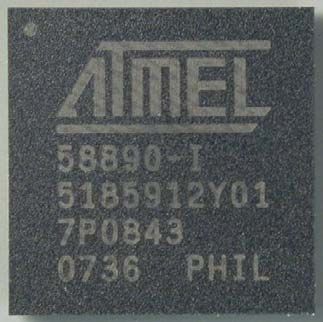
Table of Contents
1.     INTRODUCTION ............................................................................................................................................................... 3

1.1.       SCOPE ............................................................................................................................................................................. 3

1.2.       DEFINITIONS ................................................................................................................................................................ 3

1.3.       OVERVIEW .................................................................................................................................................................... 4

1.4.       ASTRO SUBSCRIBER MACE IMPLEMENTATION .............................................................................................. 4

1.5.       ASTRO SUBSCRIBER MACE HARDWARE / FIRMWARE VERSION NUMBERS .......................................... 4

1.6.       ASTRO SUBSCRIBER MACE CRYPTOGRAPHIC BOUNDARY ......................................................................... 5

1.7.       PORTS AND INTERFACES ......................................................................................................................................... 5

2.     FIPS 140-2 SECURITY LEVELS ...................................................................................................................................... 7

3.     FIPS 140-2 APPROVED OPERATIONAL MODES ....................................................................................................... 8

3.1.       CONFIGURATION SETTINGS FOR OPERATION AT FIPS 140-2 OVERALL SECURITY LEVEL 3........... 8

3.2.       NON APPROVED MODE OF OPERATION.............................................................................................................. 9

4.     CRYPTO OFFICER AND USER GUIDANCE.............................................................................................................. 10

4.1.       ADMINISTRATION OF THE ASTRO SUBSCRIBER MACE IN A SECURE MANNER (CO) ....................... 10

4.2.       ASSUMPTIONS REGARDING USER BEHAVIOR (CO) ...................................................................................... 10

4.3.       APPROVED SECURITY FUNCTIONS, PORTS, AND INTERFACES AVAILABLE TO USERS ................... 10

4.4.       USER RESPONSIBILITIES NECESSARY FOR SECURE OPERATION ........................................................... 10

5.     SECURITY RULES .......................................................................................................................................................... 11

5.1.       FIPS 140-2 IMPOSED SECURITY RULES .............................................................................................................. 11

5.2.       MOTOROLA IMPOSED SECURITY RULES ......................................................................................................... 13

6.     IDENTIFICATION AND AUTHENTICATION POLICY ........................................................................................... 14

7.     PHYSICAL SECURITY POLICY................................................................................................................................... 15

8.     ACCESS CONTROL POLICY ........................................................................................................................................ 16

8.1.       ASTRO SUBSCRIBER MACE SUPPORTED ROLES ............................................................................................ 16

8.2.       ASTRO SUBSCRIBER MACE SERVICES .............................................................................................................. 16

8.3.       KEY MANAGEMENT ................................................................................................................................................. 17

8.4.       CSP ACCESS TYPES .................................................................................................................................................. 19

9.     MITIGATION OF OTHER ATTACKS POLICY ......................................................................................................... 21

                                          Non-Proprietary Security Policy: Astro Subscriber MACE
                                                                                                                                                                 Page 2 of 21
1. Introduction
1.1. Scope
This Security Policy specifies the security rules under which the Astro Subscriber Motorola
Advanced Crypto Engine, herein identified as the Astro Subscriber MACE, must operate.
Included in these rules are those derived from the security requirements of FIPS 140-2 and
those imposed additionally by Motorola Solutions, Inc.. These rules, in total, define the
interrelationship between the:
1. Module Operators,
2. Module Services, and
3. Critical Security Parameters (CSPs).
1.2. Definitions
ALGID Algorithm Identifier
CBC Cipher Block Chaining
CFB Cipher Feedback
CKR Common Key Reference
CO Cryptographic Officer or Crypto-Officer
CODEC Coder/Decode
CPS Customer Programming Software
CPLD Complex Programmable Logic Device
CSP Critical Security Parameter
DES Data Encryption Standard
ECB Electronic Code Book
IV Initialization Vector
KEK Key Encryption Key
KID Key Identifier
KLK Key Loss Key
KMM Key Management Message
KPK Key Protection Key
KVL Key Variable Loader
LFSR Linear Feedback Shift Register
MAC Message Authentication Code
MACE Motorola Advanced Crypto Engine
OFB Output Feedback
OMAP Open Multimedia Applications Platform
OTAR Over The Air Rekeying
RNG Random Number Generator
TEK Traffic Encryption Key
Non-Proprietary Security Policy: Astro Subscriber MACE
Page 3 of 211.3. Overview
The Astro Subscriber MACE provides secure key management, Over-the-Air-Rekeying
(OTAR), and voice and data encryption for the following Motorola Solutions mobile and
portable two-way radios:
XTS2500 (portable)
XTL5000 (mobile)
XTS5000 (portable)
APX2000 (portable)
SRX2200 (portable)
APX2500 (mobile)
APX3000 (portable)
APX4000 (portable)
APX4500 (mobile)
APX6000 (portable)
APX6000XE (portable)
APX6500 (mobile)
APX7000 (portable)
APX7000XE (portable)
APX7500 (mobile)
1.4. Astro Subscriber MACE Implementation
The Astro Subscriber MACE is implemented as a single-chip cryptographic module as
defined by FIPS 140-2.
1.5. Astro Subscriber MACE Hardware / Firmware Version Numbers
FIPS Validated Cryptographic FIPS Validated Cryptographic
Module Hardware Kit Module Firmware Version
Numbers Numbers
5185912Y01, 5185912Y03, or D01.03.08, D01.03.10,
5185912Y05 R07.11.08, R07.11.10,
R07.11.11, R01.03.13,
R07.11.12, or R01.04.07
Note: The Astro Subscriber MACE may operate in FIPS Approved mode with Module
Firmware Version number R01.02.00, R01.02.01, R01.02.02, (previously validated under
FIPS 140-2 Cert. #1535) D01.03.08, D01.03.10, R07.11.08, R07.11.10, R07.11.11,
R01.03.13, R07.11.12, or R01.04.07.
The Astro Subscriber MACE supports the following FIPS Approved algorithms which may be
installed separately from MACE firmware using the Program Update service. While the
installation of AES may be done separately, for the purposes of this validation the module
includes this firmware.
Approved Algorithm Certificate Part Algorithm
Firmware Version
Non-Proprietary Security Policy: Astro Subscriber MACE
Page 4 of 21Number Number Numbers
AES-256 (ECB, CBC, OFB) 819 5185912 R01.00.00
Family
AES-256 (GCM) 1295 5185912 R02.00.00
Family
Note: Either AES Firmware Version R01.00.00 or both R01.00.00 and R02.00.00 must be
loaded for the Astro Subscriber MACE to be in FIPS Approved mode.
1.6. Astro Subscriber MACE Cryptographic Boundary
The Astro Subscriber MACE Cryptographic Boundary is drawn around the MACE IC as
shown below.
Crypto Boundary
KVL
MACE Port
KYLD
1.8 V Power
SSI SSI RX
Port
SSI TX
Audio
CODECs OMAP
CPLD
Figure 1: The Crypto Boundary is drawn around the MACE IC which has an SSI port (used for Data, Control,
Status, and OTAR Key data), a KVL port (used for Key Data, Control, and Status), and Power Connections.
1.7. Ports and Interfaces
The Astro Subscriber MACE provides the following physical ports and logical
interfaces:
Table 1: Ports and Interfaces
Physical Port Qty Logical interface definition Description
- Data Input
Serial 1 The main physical port
Synchronous - Data Output provided by the module. It
Interface (SSI) provides access to the
- Control Input majority of the supported
- Status Output interfaces. This port is not
used by firmware version
R07.11.08, R07.11.10,
R07.11.11, or R07.11.12.
Non-Proprietary Security Policy: Astro Subscriber MACE
Page 5 of 21Physical Port Qty Logical interface definition Description
- Data Input
Serial Peripheral 1 The main physical port
Interface (SPI) - Data Output provided by the module. It
provides access to the
- Control Input majority of the supported
- Status Output interfaces. This port is only
used by firmware version
R07.11.08, R07.11.10,
R07.11.11, or R07.11.12.
- Data Input
Key Variable 1 This interface provides the
Loader (KVL) - Control Input input and output to a Key
Variable Loader (KVL).
- Status Output
- Status Output
Self-test Indicator 1 This interface provides
Interface status output to indicate all
power-up self-tests
completed successfully.
- Power Input
Power 1 This interface powers all
circuitry.
Non-Proprietary Security Policy: Astro Subscriber MACE
Page 6 of 212. FIPS 140-2 Security Levels
The Astro Subscriber MACE can be configured to operate at FIPS 140-2 overall Security
Level 3. The table below shows the FIPS 140-2 Level of security met for each of the eleven
areas specified within the FIPS 140-2 security requirements.
Table 2: Astro Subscriber MACE Security Levels
FIPS 140-2 Security Requirements Validated Level at
Section overall Security
Level 3
Cryptographic Module Specification 3
Module Ports and Interfaces 3
Roles, Services, and Authentication 3
Finite State Model 3
Physical Security 3
Operational Environment N/A
Cryptographic Key Management 3
EMI / EMC 3
Self-Tests 3
Design Assurance 3
Mitigation of Other Attacks N/A
Non-Proprietary Security Policy: Astro Subscriber MACE
Page 7 of 213. FIPS 140-2 Approved Operational Modes
The Astro Subscriber MACE can be configured to operate in a FIPS Approved mode of
operation and a Non-FIPS Approved mode of operation. Documented below are the
configuration settings that are required for the module to be used in a FIPS 140-2 Approved
mode of operation at overall Security Level 3.
At any given time, the FIPS Status service can be used to determine whether the module is
operating at overall Security Level 3 or in a non-FIPS Approved mode. Status is indicated by
the FIPS STATUS RESPONSE message: Non-FIPS Compliance Mode or Level 3 FIPS
Approved Mode.
3.1. Configuration Settings for operation at FIPS 140-2 overall Security Level 3
Documented below are the actions and configuration settings required to enable FIPS 140-2
overall Security Level 3.
1. Disable Motorola Data Communication Over The Air Rekeying (MDC OTAR). The
Download Configuration Parameters service is used to configure this parameter in
the module.
2. Disable Key Loss Key (KLK) generation. The Download Configuration Parameters
service is used to configure this parameter in the module.
3. Disable Red Keyfill. When Red Keyfill is disabled, the module will not allow keys to
be entered in plaintext form; all keys entered into the module must be encrypted.
The Download Configuration Parameters service is used to configure this parameter
in the module.
4. Only Approved and Allowed algorithms installed. The module supports the following
Approved algorithms:
AES-256 (Cert. #819) –Used for encryption and decryption in the following
Approved modes: OFB, ECB, CBC, and 8-bit CFB.
AES-256 GCM (Cert. #1295) – Used for symmetric encryption / decryption of
Encrypted Integrated Data (EID)
SHA-256 (Cert. #817) – used for password hashing for internal password
storage and digital signature verification during software/firmware integrity
test and software/firmware load test
RSA-2048 (Cert. #396) – used for digital signature verification during
software/firmware integrity test and software/firmware load test
ANSI x9.31 RNG (Cert. #471) – used for IV and KPK generation
5. The module supports the following Allowed algorithm:
AES MAC (Cert. #819) – Used to provide authentication within APCO OTAR.
AES MAC as used within APCO OTAR has been vendor affirmed and is
approved when used for Project 25 APCO OTAR.
6. Zeroize default security parameters: The Program Update service should be used to
ensure all default CSP's are zeroized. The Program Update service is invoked in the
factory at programming time and can be invoked in the field either by a FLASHPort
Upgrade through CPS or a FLASHPort Upgrade with a KVL and PCMCIA card.
7. Infinite UKEK Retention is disabled. The Download Configuration Parameters service
is used to configure this parameter in the module.
Non-Proprietary Security Policy: Astro Subscriber MACE
Page 8 of 213.2. Non Approved Mode of Operation
A non-FIPS Approved mode of operation is transitioned to when any of the following is true:
1. MDC OTAR is enabled.
2. KLK generation is enabled.
3. Infinite UKEK Retention feature is enabled. All keys are zeroized including the KEKs
when the Infinite UKEK Retention feature transitions from enable to disable and also
from disable to enable.
The module maintains FIPS mode status and will provide this upon operator request.
Non-Proprietary Security Policy: Astro Subscriber MACE
Page 9 of 214. Crypto Officer and User Guidance
4.1. Administration of the Astro Subscriber MACE in a secure manner (CO)
The Astro Subscriber MACE requires no special administration for secure use after it is set
up for use in a FIPS Approved manner. To do this, set the module’s parameters to the
settings listed in section 3 of this document via the Download Configuration Parameters
service.
Note that all keys will be zeroized after the Program Update service has completed.
4.2. Assumptions regarding User Behavior (CO)
The Astro Subscriber MACE has been designed in such a way that no special assumptions
regarding User Behavior have been made that are relevant to the secure operation of the
unit.
4.3. Approved Security Functions, Ports, and Interfaces available to Users
Astro Subscriber MACE services available to the Astro Subscriber MACE User are listed in
section 8.2.
No Physical Ports or Logical Interfaces are directly available to the Astro Subscriber MACE
User, only indirectly through the Subscriber Radio in which the Astro Subscriber MACE is
installed.
4.4. User Responsibilities necessary for Secure Operation
No special responsibilities are required of the User for secure operation of the Astro
Subscriber MACE.
Non-Proprietary Security Policy: Astro Subscriber MACE
Page 10 of 215. Security Rules
The Astro Subscriber MACE enforces the following security rules. These rules are
separated into those imposed by FIPS 140-2 and those imposed by Motorola.
5.1. FIPS 140-2 Imposed Security Rules
1. The Astro Subscriber MACE inhibits all data output via the data output interface
whenever an error state exists and during self-tests.
2. The Astro Subscriber MACE logically disconnects the output data path from the
circuitry and processes when performing key generation, manual key entry, or key
zeroization.
3. Authentication data (e.g. PINs) are entered in encrypted form. Authentication data is
not output during entry.
4. At FIPS 140-2 overall Security Level 3, secret cryptographic keys are entered in
encrypted form over a physically separate port.
5. The Astro Subscriber MACE enforces Identity-Based authentication.
6. The Astro Subscriber MACE supports a User role and a Crypto-Officer role.
Authenticated operators are authorized to assume either supported role.
7. The Astro Subscriber MACE reauthenticates an operator when it is powered-up after
being powered-off.
8. The Astro Subscriber MACE prevents brute-force attacks on its password by using a
10-digit password that reduces the probability of a successful random attempt to one
in 10,000,000,000. It would require 100,000 attempts in one minute to lower the
random attempt success rate to less than 1 in 100,000. A limit of 15 failed
authentication attempts is imposed; 15 consecutive failed authentication attempts
causes all TEKs and KEKs to be invalidated (key status is marked invalid) and the
password to be reset to the factory default.
9. The Astro Subscriber MACE uses RSA-2048 to prevent brute-force attacks on the
digital signature used to verify software/firmware integrity during a Program Update.
As the Program Update service requires more than one minute to complete the
random attempt success rate during a one minute period cannot be lowered to less
than 1 in 100,000.
10. Authentication data is not output during entry.
11. The Astro Subscriber MACE provides the following services requiring a role:
Program Update
Transfer Key Variable
Privileged APCO OTAR
Change Active Keyset
Change Password
Encrypt Digital
Decrypt Digital
Zeroize Selected Keys
Key/Keyset Check
12. The Astro Subscriber MACE provides the following services not requiring a role:
FIPS Status
Initiate Self Tests
Non-Proprietary Security Policy: Astro Subscriber MACE
Page 11 of 21 Validate Password
Zeroize All Keys
Zeroize All Keys and Password
Non-Privileged APCO OTAR
Reset
Shutdown
Extract Error Log
Clear Error Log
Download Configuration Parameters
13. The Astro Subscriber MACE implements all software using a high-level language,
except the limited use of low-level languages to enhance performance.
14. The Astro Subscriber MACE protects secret keys and private keys from unauthorized
disclosure, modification, and substitution.
15. The Astro Subscriber MACE provides a means to ensure that a key entered into or
stored within the Astro Subscriber MACE is associated with the correct entities to
which the key is assigned. Each key in the Astro Subscriber MACE is entered and
stored with the following information:
Key Identifier – 16 bit identifier
Algorithm Identifier – 8 bit identifier
Key Type – Traffic Encryption Key or Key Encryption Key
Physical ID, Common Key Reference (CKR) number, and Keyset number –
Identifiers indicating storage locations.
Along with the encrypted key data, this information is stored in a key record that
includes a CRC over all of the fields to detect data corruption. When used or deleted
the keys are referenced by CKR/Key ID/Algid, Key ID/Algid, Physical ID, or
CKR/Keyset.
16. The Astro Subscriber MACE denies access to plaintext secret and private keys
contained within the Astro Subscriber MACE.
17. The Astro Subscriber MACE provides the capability to zeroize all plaintext
cryptographic keys and other unprotected critical security parameters within the
Astro Subscriber MACE.
18. The Astro Subscriber MACE provides the following non-FIPS Approved Random
Number Generators to provide random numbers used as Initialization Vectors (IV)
and the seeds for the Approved RNG.
- Maximal length 64-bit LFSR.
- Non-deterministic Hardware Random Number Generator
19. The Astro Subscriber MACE conforms to FCC 47 Code of Federal Regulations, Part
15, Subpart B, Unintentional Radiators, Digital Devices, Class B requirements.
20. The Astro Subscriber MACE performs the following self-tests:
Power up and on-demand tests
- Cryptographic algorithm test: Each algorithm (SHA-256, AES-256 in the OFB,
CBC, ECB, 8-bit CFB, and GCM modes) is tested by using a known key,
known data, and if required a known IV. The data is then encrypted and
compared with known encrypted data; the test passes if the final data
matches the known data, otherwise it fails. The encrypted data is then
decrypted and compared with the original plaintext; the test passes if the
Non-Proprietary Security Policy: Astro Subscriber MACE
Page 12 of 21decrypted data matches the original plaintext, otherwise it fails.
- RNG KAT test: the RNG is initialized with a known answer seed, DT counter
and Triple-DES key. The RNG is run and the result compared to known
answer data. The test passes if the generated data matches the known
answer data, otherwise the test fails.
- Software/firmware Integrity test: A digital signature is generated over the code
when it is built using SHA-256 and RSA-2048 and is stored with the code
upon download into the module. When the module is powered up the digital
signature is verified. If the digital signature matches the test passes,
otherwise it fails.
Powering the module off then on or resetting the module using the Reset service will
initiate the power-up and on-demand self-tests.
Conditional tests
- Software/firmware Load test: A digital signature is generated over the code
when it is built using SHA-256 and RSA-2048. Upon download into the
module, the digital signature is verified. If the digital signature matches the
test passes, otherwise it fails.
- Continuous Random Number Generator test: The continuous random number
generator test is performed on all RNGs supported by the module. For each
RNG, an initial value is generated and stored upon power up. This value is
not used for anything other than to initialize comparison data. A successive
call to any one of the RNGs generates a new set of data, which is compared
to the comparison data. If a match is detected, this test fails; otherwise the
new data is stored as the comparison data and returned to the caller.
21. The Astro Subscriber MACE enters an error state if the Cryptographic Algorithm
Test, Continuous Random Number Generator Test, or RNG KAT fails. This error
state may be exited by powering the module off then on.
22. The Astro Subscriber MACE enters an error state if the Software/Firmware Integrity
test fails. As soon as an error indicator is output via the status interface, the module
transitions from the error state to a state that only allows new software to be loaded.
23. The Astro Subscriber MACE enters an error state if the Software/Firmware Load test
fails. This error state may be exited by powering the module off then on which will
start the download and validation process over.
24. The Astro Subscriber MACE outputs a status indicator via the Self-test Indicator
interface to indicate all self-tests passed. A status indicator is not output via the Self-
test Indicator interface whenever an error state is entered due to a failed self-test.
25. The Astro Subscriber MACE does not perform any cryptographic functions while in
an error state.
5.2. Motorola Imposed Security Rules
1. The Astro Subscriber MACE does not support multiple concurrent operators.
2. All cryptographic module services are suspended during key loading.
3. After a sufficient number (15) of consecutive unsuccessful user login attempts, the
module will zeroize all keys from the Key Database.
4. The module does not support the output of plaintext or encrypted keys.
Non-Proprietary Security Policy: Astro Subscriber MACE
Page 13 of 216. Identification and Authentication Policy
The Astro Subscriber MACE supports two distinct operator roles (User and Crypto-Officer).
The Astro Subscriber MACE uses a 10-digit password to authenticate the User and an RSA-
2048 digital signature to authenticate the Crypto-Officer. The role of the operator is specified
by selecting which physical port will be used to authenticate and access module services.
The authentication data for the Program Update service is the digital signature of the
downloaded software.
Role Authentication Type Authentication Data Required
User Identity-Based User ID and 10-digit Password
Crypto-Officer Identity-Based RSA-2048 digital signature for Program
Update service
Non-Proprietary Security Policy: Astro Subscriber MACE
Page 14 of 217. Physical Security Policy
The Astro Subscriber MACE is a production grade, single-chip cryptographic module as
defined by FIPS 140-2 and is designed to meet Level 3 physical security requirements.
The Astro Subscriber MACE is covered with a hard opaque epoxy coating that provides
evidence of attempts to tamper with the module. The security provided from the hardness of
the module's epoxy encapsulate is claimed at ambient temperature (20 to 25 degrees
Celsius) only. No assurance of the epoxy hardness is claimed for this physical security
mechanism outside of this range. The Astro Subscriber MACE does not contain any doors,
removable covers, or ventilation holes or slits. No maintenance access interface is
available. No special procedures are required to maintain physical security of the module
while delivering to operators.
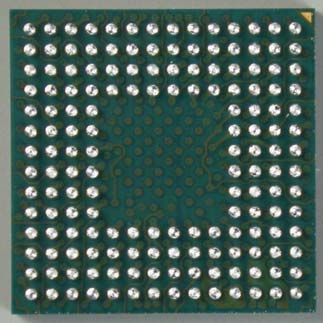
The figures below are applicable to Cryptographic Module hardware kit number 5185912Y01
and 5185912Y03. Cryptographic Module hardware kit number 5185912Y01 and
5185912Y03 have identical physical security characteristics.
Figure 1: MACE Chip (Top) Figure 2: MACE Chip (Interfaces)
Non-Proprietary Security Policy: Astro Subscriber MACE
Page 15 of 218. Access Control Policy
8.1. Astro Subscriber MACE Supported Roles
The Astro Subscriber MACE supports two (2) roles. These roles are defined to be the:
User role and,
Cryptographic Officer (Crypto-Officer or CO) role.
8.2. Astro Subscriber MACE Services
Program Update: Update the module software. Software upgrades are authenticated
using a digital signature. The Program Update Public Signature Key (a 2048 bit public
RSA key) is used to validate the signature of the firmware image being loaded before it
is allowed to be executed. All keys and CSPs are zeroized during a Program Update.
To maintain validation, only validated software should be loaded. Loading non-validated
software will invalidate the modules validation. Available to CO role.
Transfer Key Variable: Transfer key variables to the MACE Key Database via a Key
Variable Loader (KVL). If the Red Keyfill configuration parameter is enabled then keys
will be transferred from the KVL in plaintext. If Red Keyfill is disabled, all keys
transferred from the KVL will be encrypted. The Red Keyfill configuration parameter can
be changed using the Download Configuration Parameters service. Available to User
role. Any modification of the Red Keyfill parameter will zeroize all keys; therefore the
operator shall reinitialize the module in accordance with the instructions provided in
Section 3.1 of this document.
Privileged APCO OTAR: Modify and query the Key Database via APCO OTAR Key
Management Messages. This service has access to non-Approved algorithms if those
algorithms are installed and selected. Only Approved algorithms should be installed to
remain in an Approved mode of operation. Available to User role.
Change Active Keyset: The active keyset is used to store a group of keys for current use
while inactive keysets are used to store keys for future use. This service modifies the
currently active keyset used for selecting keys for encryption / decryption services.
Available to User role.
Change Password: Modify the current password used to identify and authenticate the
User role. Fifteen consecutive failed attempts causes the KPK to be zeroized, a new
KPK to be generated, all TEKs and KEKs to be invalidated (key status is marked invalid),
and the password to be reset to the factory default. Available to User role.
Encrypt Digital: Encrypt digital voice or data. This service has access to non-Approved
algorithms if those algorithms are installed and selected. Only Approved algorithms
should be installed to remain in an Approved mode of operation. Available to User role.
Decrypt Digital: Decrypt digital voice or data. This service has access to non-Approved
algorithms if those algorithms are installed and selected. Only Approved algorithms
should be installed to remain in an Approved mode of operation. Available to User role.
Zeroize Selected Keys: Zeroize selected key variables from the Key Database by
Physical ID (PID) or Common Key Reference (CKR). Available to User role.
Key/Keyset Check: Obtain status information about a specific key/keyset. Available to
User role.
FIPS Status: Provides current FIPS status about whether the module is operating at
Non-Proprietary Security Policy: Astro Subscriber MACE
Page 16 of 21overall Security Level 3, or in a non-Approved mode of operation. Available without a
role.
Initiate Self Tests: Performs module self-tests comprised of cryptographic algorithm
tests, software / firmware integrity test, and critical functions test. Initiated by module
reset or transition from power off state to power on state. Available without a role.
Validate Password: Validate the current password used to identify and authenticate the
User role. Fifteen consecutive failed attempts causes the KPK to be zeroized, a new
KPK to be generated, all TEKs and KEKs to be invalidated (key status is marked invalid),
and the password to be reset to the factory default. Available without a role.
Zeroize All keys: Zeroize all keys from the Key Database. Available without a role.
(Module can be reinitialized using a Key Variable Loader.)
Zeroize All Keys and Password: Zeroizes the KPK and all keys and CSPs in the key
database and causes a new KPK to be generated. Resets the password to the factory
default. Allows user to gain controlled access to the module if the password is forgotten.
Available without a role. (Module can be reinitialized using a Key Variable Loader.)
Non-Privileged APCO OTAR: Hello and Capabilities Key Management Messages may
be performed without a role.
Reset (Crypto Module): Soft reset of module to remove module from error states or a
transition from power off to power on state. Available without a role.
Shutdown (Crypto Module): Prepares module for removal of power. Available without a
role.
Extract Error Log: Status Request. Provides detailed history of error events. Available
without a role.
Clear Error Log: Clears history of error events. Available without a role.
Download Configuration Parameters: Download configuration parameters used to
specify module behavior. Examples include enable/disable APCO OTAR, SingleKey, or
MutliKey mode, etc. If the Tamper configuration parameter changed the module will
zeroize the KPK and all keys and CSPs in the key database and will generate and store
a new KPK. Available without a role.
8.3. Key Management
CSPs: The following table provides a list and description of all CSPs managed by the
module.
Table 3: CSP Definition
CSP Identifier Description
ANSI X9.31 Seed A 64-bit seed value used within the ANSI X9.31 RNG.
The seed is not stored but temporarily exists in volatile
memory and is zeroized by power cycling the module.
The seed is not entered into or output from the module.
ANSI X9.31 Seed Key Key used to seed the ANSI X9.31 RNG during
initialization. The seed key is not stored but temporarily
exists in volatile memory and is zeroized by power cycling
the module. The seed key is not entered into or output
from the module.
Non-Proprietary Security Policy: Astro Subscriber MACE
Page 17 of 21Black Keyloading Key A 256 bit AES key used for decrypting keys entered into
(BKK) the module via a KVL when the Red Keyfill configuration
parameter is disabled. Stored in plaintext in non-volatile
memory and zeroized through the Program Update
service. The BKK is entered using the Program Update
service and is not output from the module.
Image Decryption Key A 256-bit AES key used to decrypt downloaded images.
(IDK) Stored in plaintext in non-volatile memory and zeroized
through the Program Update service. The IDK is entered
using the Program Update service and is not output from
the module.
Key Encryption Keys 256 bit AES key used for encryption of other keys in
(KEKs ) OTAR. Stored encrypted on KPK in non-volatile memory.
Entered through the KVL or APCO OTAR. KEK’s are not
output from the module.
Key Protection Key 256 bit AES key used to encrypt TEKs and KEKs stored in
(KPK) non-volatile memory. The KPK is not entered into or
output from the module.
Password The 10-digit password is entered encrypted on the PEK.
After decryption the plaintext password is not stored but
temporarily exists in volatile memory. The SHA-256 hash
of the decrypted password is compared with the hash
value stored in non-volatile memory during password
validation. The password is not output from the module.
Password Encryption 256 bit AES key used for decrypting password during
Key (PEK) password validation. Stored in plaintext in non-volatile
memory and zeroized through the Program Update
service. The PEK is entered using the Program Update
service and is not output from the module.
Traffic Encryption Keys 256 bit AES key used for voice and data encryption.
(TEKs) Stored encrypted on KPK in non-volatile memory.
Entered through the KVL or APCO OTAR. TEK’s are not
output from the module.
Public Keys: The following table lists and describes all Public Keys managed by the
module.
Table 4: Public Key Definition
Public Key Name Description
Programmed Signature 2048 bit RSA key used to validate the signature of
Key the firmware image being before it is allowed to be
executed and is also used for authentication of the
Crypto-Officer role. Loaded during manufacturing.
The Programmed Signature Key is not output from
the module.
Non-Proprietary Security Policy: Astro Subscriber MACE
Page 18 of 218.4. CSP Access Types
Table 5: CSP Access Types
CSP Access Type Description
c - Check CSP Checks status and key identifier information of key.
d - Decrypt CSP Decrypts TEK or KEK retrieved from non-volatile memory
using the KPK.
Decrypts TEKs or KEKs entered via the KVL when the
Red Keyfill configuration parameter is disabled using the
Black Keyloading Key.
Decrypts entered password with PEK during password
validation.
e - Encrypt CSP Encrypts TEK or KEK with KPK prior to storage in non-
volatile memory.
g - Generate CSP Generates KPK, ANSI X9.31 seed, or ANSI X9.31 seed
key.
i - Invalidate CSP Marks encrypted TEKs or KEKs stored in non-volatile
memory as invalid. TEKs or KEKs marked invalid can
then be over-written when new TEKs or KEKs are stored.
s - Store CSP Stores KPK in volatile and non-volatile memory.
Stores encrypted TEKs or KEKs in non-volatile memory,
over-writing any previously invalidated TEK or KEK in that
location.
Stores plaintext BKK, PEK, or IDK in non-volatile memory.
u - Use CSP Uses CSP internally for encryption / decryption services.
z - Zeroize CSP Zeroizes key.
Non-Proprietary Security Policy: Astro Subscriber MACE
Page 19 of 21Table 6: CSP versus CSP Access
CSP Role
PEK (Password Encryption Key)
TEK (Traffic Encryption Key)
BKK (Black Keyloading Key)
IDK (Image Decryption Key)
KEK (Key Encryption Key)
KPK (Key Protection Key)
ANSI X9.31 seed key
Crypto-Officer Role
No Role Required
ANSI X9.31 seed
User Service
Password
User Role
1. Program Update z, s u, z, s z z z, s z √
2. Transfer Key Variable u
i, e, z,
u
i, e, z,
√
s s
3. Privileged APCO OTAR u
d, u, i,
u
d, u, i,
√
e, z, s e, z, s
4. Change Active Keyset √
5. Change Password i z, g, s d, u, z u i √
6. Encrypt Digital d, u √
7. Decrypt Digital d, u √
8. Zeroize Selected Keys i i √
9. Key/Keyset Check c c √
10. FIPS Status c c √ √ √
11. Initiate Self Tests √ √ √
12. Validate Password i z, g, s d, u, z u i √ √ √
13. Zeroize All Keys i i √ √ √
14. Zeroize All Keys and
i z, g, s i √ √ √
Password
15. Non-Privileged APCO
OTAR (not for key √ √ √
entry)
16. Reset g, u, z g, u, z g, s √ √ √
17. Shutdown √ √ √
18. Extract Error Log √ √ √
19. Clear Error Log √ √ √
20. Download Configuration
i z, g, s i √ √ √
Parameters
Non-Proprietary Security Policy: Astro Subscriber MACE
Page 20 of 219. Mitigation of Other Attacks Policy
The Astro Subscriber MACE is not designed to mitigate any specific attacks outside of those
required by FIPS 140-2, including but not limited to power consumption, timing, fault
induction, or TEMPEST attacks.
Non-Proprietary Security Policy: Astro Subscriber MACE
Page 21 of 21You can also read


