FY 2021 Capital Magnet Fund Application Webinar for Applicants with an Affordable Housing Developer/Manager Approach - September 22, 2021
←
→
Page content transcription
If your browser does not render page correctly, please read the page content below
FY 2021 Capital Magnet Fund Application
Webinar for Applicants with an Affordable
 Housing Developer/Manager Approach

                 September 22, 2021

     COMMUNITY DEVELOPMENT FINANCIAL INSTITUTIONS FUND
                      www.cdfifund.gov
Agenda

1. Overview of CMF
2. Eligibility and CMF Applicant Approaches
3. CMF Program Requirements
4. Application Components & Deadlines
5. Application Guidance for Affordable Housing
   Developer/Manager Approach
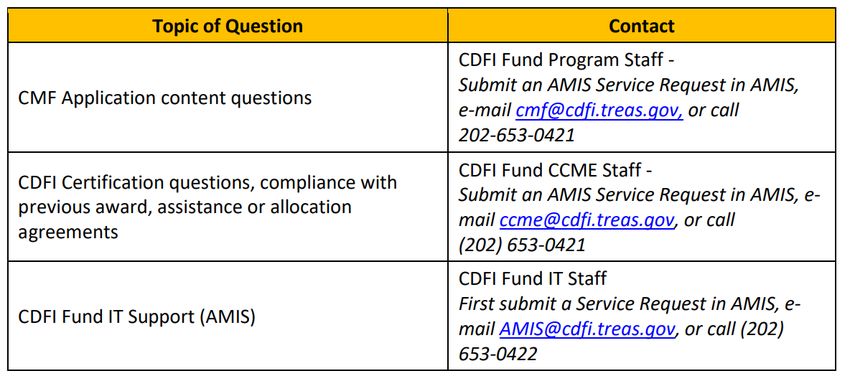
6. Resources and Contacting the CMF Team
Notes:
-    All capitalized terms are defined in the CMF Interim Rule (12 CFR part 1807), FY
     2021 CMF NOFA, FY 2021 CMF Glossary, and/or the 2021 CMF Application
     Instructions.
-    Stars throughout the presentation represent the opportunity for Applicants to
     score more favorably.

                                                                                9/23/2021 // 2
Agenda

1. Overview of CMF
2. Eligibility and CMF Applicant Approaches
3. CMF Program Requirements
4. Application Components & Deadlines
5. Application Guidance for Affordable Housing
   Developer/Manager Approach
6. Resources and Contacting the CMF Team

                                              9/23/2021 // 3
Overview of CMF
• The Capital Magnet Fund (CMF) was established through the Housing
and Economic Recovery Act (HERA) of 2008 (Public Law 110-289,
section 1131).
• CMF provides competitively-awarded grants to certified CDFIs and
eligible Nonprofit Organizations to attract private capital for and
increase investment in:
– Development, Rehabilitation, Preservation, and Purchase of
Affordable Housing – both Homeownership and rental – targeted to
Low-, Very Low-, and Extremely Low-Income Families; and
– Economic Development Activities designed to stabilize and/or
revitalize Areas of Economic Distress such as renovating buildings
that will house neighborhood businesses and Community Service
Facilities.
9/23/2021 // 4CMF Program Topics
• The CDFI Fund has on its CMF webpage a FY 2021 Capital Magnet Fund Pre-
Round Outreach Presentation from June 2021, which provides a basic overview
of the program.
• In addition, there are six modules on the CMF webpage that provide an
overview of the key program requirements and topics. We recommend
prospective Applicants review these modules if they have not already. These
modules cover:
– Introduction to Capital Magnet Fund (CMF)
– CMF Eligibility and Program Requirements
– Attracting Capital Through CMF
– A Good Business Strategy is Key
– Affordable Housing and CMF
– Economic Development and CMF
• For more information on any of these topics, see our website:
www.cdfifund.gov/CMF. The modules are under “Step 2: Apply.”
9/23/2021 // 5FY 2021 CMF Priorities
• Leverage Private Capital
• Affordable Housing: Rental
CMF-supported Rental units targeted to Very Low-Income Families (50% AMI and
below). Note: 45% or more targeted to VLI will score more favorably.
CMF-supported rental units located in either Areas of Economic Distress (AED) or
High Opportunity Areas (HOA).
• Affordable Housing: Homeownership
CMF-supported Homeownership units: Targeted to Low-Income Families (80%
AMI and below)
Located in AED and targeted to Eligible-Income Families (120% AMI and below).
Note: 100% of units targeted LI Families or located in AED will score more favorably
• Geographically Diverse Areas
Areas of Economic Distress
Metropolitan and Rural Areas
Territories not served in recent funding Rounds: American Samoa, Guam, the
Northern Mariana Islands, and the U.S. Virgin Islands.
9/23/2021 // 6FY 2021 NOFA Highlights
More funding will be available in the FY 2021 CMF round, bringing
more opportunity for organizations of all sizes. Minimum awards remain at
$500,000 but larger awards than past rounds are likely (see Slide 16).
High Opportunity Areas added as a Rental Housing priority (see Slide 50-51).
Incomes up to 120% AMI served in Areas of Economic Distress added as a
priority for Homeownership (see Slide 50-51, 53).
Income targeting scoring is clarified (see Slides 52-53).
For FY 2021 Recipients, up to 15% of the CMF Award may be used outside an
approved Service Area (see Slide 32).
Affiliates now are allowed to submit separate Applications (see Slide 10).
Awards may be requested in two payments, extending Commitment time for
Awards. This does not change the disbursement and Project Completion
deadlines.
Based on track record and strategy, CDFIs can select either Entity Approach:
Developers/Managers or Financing Entity (see Slide 12-14).
9/23/2021 // 7Agenda
1. Overview of CMF
2. Eligibility and CMF Applicant Approaches
3. CMF Program Requirements
4. Application Components & Deadlines
5. Application Guidance for Affordable Housing
Developer/Manager Approach
6. Resources and Contacting the CMF Team
9/23/2021 // 8Eligibility for CMF
• To be eligible to apply for a CMF Award, an Applicant must be either:
– A certified Community Development Financial Institution (CDFI) that
1. Must be certified by the CDFI Fund by the date the NOFA was
published in the Federal Register.
2. Has NOT been notified by the CDFI Fund that its CDFI certification is
in default or has been terminated.
OR
– A Nonprofit Organization having one of its principal purposes the
development or management of affordable housing.
• A nonprofit housing affordable housing developer/manager.
• A housing finance agency/authority (HFA) may be eligible to apply
depending on state law. An HFA must be exempt from Federal taxes.
Reach out to the CDFI Fund for guidance.
• All Applicants must have been in existence as a legally formed entity for at
least three years prior to the Application deadline.
• All Applicants must submit audited financial statements for its most recently
completed two fiscal years as of the date of the NOFA.
9/23/2021 // 9Eligibility for CMF – Affiliates
• Affiliates of an Applicant may submit separate applications
under this NOFA.
• Affiliates that will play a role in executing the Applicant’s strategy
cannot apply for the FY 2021 round.
• Each Applicant must propose a substantially different strategy
than its Affiliate(s) applying in the same funding round.
• Each Applicant must also present a distinct project pipeline and
rely on its own track record.
• Any Applicant must be eligible on its own and cannot rely on any
other organization for eligibility purposes, including Affiliates.
• Collectively, all Affiliates may not request more than 15% of the
total amount available for the funding round.
9/23/2021 // 10Additional Eligibility Requirements
Certified CDFIs and qualified Nonprofit Organizations that are NOT
eligible for a CMF Award:
• Any 501(c)(4) organization that engages in lobbying activities.
• Any Applicant that has defaulted on a CDFI Fund loan within five
years of the AMIS Application deadline.
• Any Applicant that is non-compliant or in default of prior CDFI
Fund awards, if, as of the date of the AMIS Application deadline:
The CDFI Fund has made a determination that such entity, or
any of its Affiliates, is in noncompliance with or default of a
previously executed assistance agreement, award agreement,
allocation agreement, bond loan agreement, or agreement to
guarantee; AND
The CDFI Fund has provided written notification that such
entity, or any of its Affiliates, is ineligible to apply for or
receive any CDFI Fund awards during the FY 2021 round.
9/23/2021 // 11Two Approaches for CMF Applicants
Eligibility Types: Entity Approaches:
Certified CDFIs Financing Entity Approach
Affordable Housing
Eligible Nonprofits Developers/Managers Approach
• FY 2021 Update: All Applicants (CDFIs and Nonprofits) will be able to
select whether they are applying using a Financing Entity Approach
or an Affordable Housing Developer/Manager Approach.
• This presentation focuses on Applicants with a Affordable Housing
Developer/Manager Approach; a separate presentation is available
for Applicants with a Financing Entity Approach.
9/23/2021 // 12Which CMF Application Approach to Use?
Each approach is defined in the NOFA and Application:
• Financing Entity Approach should be selected by Applicants that intend
to use the CMF Award to make arms-length loans and equity
investments to individuals, families, and project-sponsors for affordable
housing and community or economic development.
• Affordable Housing Developers/Managers Approach should be
selected by Applicants who have the construction, development,
redevelopment, preservation, or management of affordable housing as
a predominant purpose.
– An Affordable Housing Developer/Manager may own the housing that
is developed, may own it in part such as in a limited partnership, may
sell the housing it develops once completed if single family housing, or
may sell and continue to manage the housing if rental housing.
9/23/2021 // 13Which CMF Application Approach to Use?
• Applicants should choose their Entity Approach based on
the track record and proposed capacity in which it will be acting
in implementing the award.
• Applicants will be evaluated based on the entity approach selected.
– Most CDFIs should not select a developer/manager approach.
– However, CDFIs or Nonprofits that intend to act as an
affordable housing developer to execute the CMF Award and
have a track record as such, may select the affordable housing
developer/manager approach.
• In AMIS, confirm that the “Entity Approach” field in the Program
Profile Section is correct before creating an FY 2021 CMF
Application.
9/23/2021 // 14Agenda
1. Overview of CMF
2. Eligibility and CMF Applicant Approaches
3. CMF Program Requirements
4. Application Components & Deadlines
5. Application Guidance for Affordable Housing
Developer/Manager Approach
6. Resources and Contacting the CMF Team
9/23/2021 // 15General CMF Requirements and Limitations
• The minimum Award request is $500,000.
• By statute, the maximum Award amount is 15% of the total CMF amount
available for the FY 2021 round, which also applies to affiliated applicants.
– In past rounds, the CDFI Fund has typically provided awards significantly
smaller than the statutory cap. For example, for the FY 2020 funding round,
awards ranged from $750,000 to $8 million. The statutory cap was $26 million
but the average award was $3.7 million.
– Given the larger amount of funding available for the FY 2021 CMF Round ($380
million) compared with the FY 2020 CMF Round, the CDFI Fund anticipates
providing larger award sizes under this funding round.
• CMF Recipients are required to leverage their CMF Award at a ratio of at
least ten to one.
• Each CMF Award must result in Eligible Project Costs (CMF Award dollars
plus Leveraged Costs) in an amount that equals at least 10 times the
amount of the CMF Award.
– For example, if the Applicant is requesting a $1 million award, it would need to
leverage another $9 million, resulting in $10 million of Eligible Project Costs.
9/23/2021 // 16Private and Public Leverage Sources
• Sources of capital leveraged by the CMF Award may be loans from banks,
program-related investments from foundations, Low Income Housing Tax Credit
(LIHTC) investments, funds contributed by the Recipient, state or local government,
or any number of other private or public sources.
• Public sources of leverage are typically grants, loans, or awards made to the Applicant
or Projects with funds that are allocated by federal, State, or local governments.
– Please note that costs financed/supported by the Recipient’s award or allocation from
another CDFI Fund program cannot be counted as Leveraged Costs for the CMF
Award.
• Private sources of leverage generally refer to investments or loans from private third-
party entities. Examples include:
– Private activity bonds
– LIHTC equity and other equity investments
– Lines of credit, loans, or other investments that are made to the Applicant or Projects
from private sources, such as banks, private investors, or philanthropic entities.
– For a regulated depository institution, deposits are also considered private.
9/23/2021 // 17Three Ways to Leverage CMF
1) Enterprise-Level Leverage: Capital earned, borrowed, or raised
by the Applicant which is designated for the Applicant’s use and ultimately
used to pay for Leveraged Costs, but is not initially restricted for use for
specific properties at the time it is earned, borrowed, or raised. Enterprise-
Level Leverage can be either private or public. Examples:
• Program-Related Investments (PRIs),
• Loans from third parties,
• An organization’s own contributed capital (equity or retained earnings).
2) Project-Level Leverage: Capital raised or earned that is restricted to a
specific project at the time it is raised that will be used to pay Leveraged
Costs. Examples:
• Mortgages secured by the property
• Proceeds from the sale of bonds
• Equity investment raised through LIHTC
• Deferred developer fees
• Loans and grants from local and state government made directly to a Project
9/23/2021 // 18Three Ways to Leverage CMF
3) Reinvestment Level: Re-deploying repaid proceeds of CMF Award
dollars and/or Enterprise-Level Capital during the five-year Investment
Period.
• Recipients have the option to count reinvestment leverage to meet their total
leverage multiplier. However, there is no requirement to use a reinvestment
strategy to reach your leverage goals.
• Reinvestment of CMF principal and/or equity repayments (Program Income)
into eligible activities is required during the five-year Investment Period.
• Only include projected reinvestment for Projects that will be completed within
the five-year Investment Period.
• If your business strategy will generate CMF Program Income during the five-year
Investment Period for which you plan to reinvest and count as leverage, you
should note that in your Application. This may be the case when a CMF Award is
used for short-term financing needs, such as predevelopment, and will be
repaid during the Investment Period and redeployed to another Project.
9/23/2021 // 19Investing in Affordable Housing
• CMF Awards may be used to finance both rental Housing
and Homeownership.
– Rental housing may be Multi-family (5+ units) or Single-family
housing (4 units or less), and while most rental Housing is
developed as one property, scattered site development is
permitted.
– Homeownership is usually Single-Family Housing. Homeownership
may include single family-detached, condominium, co-operative,
and manufactured housing.
• Some Recipients use their CMF Award to make direct
mortgage loans, purchase homes in order to sell them to
qualified home buyers, or to establish a Loan Loss Reserve
for loans they have made using their own capital.
9/23/2021 // 20Eligible Activities Using CMF Funds
• Capitalize an Affordable Housing Fund
• Capitalize a Revolving Loan Fund
• Capitalize Loan Loss Reserves
• Make Risk-Sharing Loans
• Provide Loan Guarantees
• Capitalize a Fund for Economic Development Activities
– Recipients may use no more than 30% of their Award to finance
Economic Development Activities (if requested in their Application).
• Direct Administrative Expenses
– No more than 5% of the CMF Award can be used for Direct
Administrative Expenses.
9/23/2021 // 21What is an Economic Development Activity?
• An Eligible Economic Development Activity (EDA) is the development,
rehabilitation, preservation, or acquisition of physical structures that house
Community Service Facilities (e.g. daycare centers or health clinics) or
neighborhood-based businesses (e.g. revitalization of a commercial block).
• EDA must be undertaken “In Conjunction With” Affordable Housing.
• EDA must be part of a Concerted Strategy, i.e. a plan adopted by a local
jurisdiction or the State.
• Recipients may spend no more than 30% of their CMF Award on EDA and must
request this as part of their Application.
• Some examples resulting from Economic Development Activities include: day care
centers and schools, grocery stores, health clinics, rehabilitation of dilapidated
commercial property, and/or community centers. Restrictions:
– Providing loans to businesses is not an eligible EDA.
– A facility that is part of a residential property and limited only to those
residents, rather than the broader neighborhood (e.g. a fitness center in an
Affordable Housing development) is not considered an eligible EDA.
9/23/2021 // 22Requirements for Affordability
Income Limits (Eligible-Income): The maximum income level for a Family may
not exceed 120% of AMI for units financed with Eligible Project Costs.
Percentage of Costs: 100% of the total Eligible Project Costs (EPCs) must be
attributable to units that are restricted to Families at incomes of 120% AMI and
below. Greater than 50% of the EPCs must be attributable to units that serve Low-,
Very Low- and Extremely Low-Income Families (80% AMI and below).
Project Level: To qualify as Affordable Housing, at least 20% of units in each Multi-
family Rental Project must be affordable to and occupied by Low-Income Families
(80% AMI and below).
Portfolio Level: Applicants will indicate the percentage and the income levels they
intend to serve in their Application and will be held to that if selected for an Award.
However, this is measured portfolio-wide across all projects financed with a CMF
Award and not project-by-project.
• Committing to a greater percentage of units for Low-Income Families for
Homeownership and/or Very-Low Income Families for Rental is encouraged.
9/23/2021 // 23Requirements for Affordability
Long-Term Restrictions: Each Project funded must ensure affordability
for at least 10 years.
• For Rental Housing, this is accomplished through deed restrictions, land
covenants, or other mechanisms which survive sale and transfer, during
the Affordability Period.
• For Homeownership, the Recipient must develop its own plan for
achieving this 10-year affordability in the event of resale.
Rents: Rents control affordability. Rents are set using a formula similar to
that used for Low Income Housing Tax Credits (LIHTC). Refer to 12 C.F.R.
1807.401 of the CMF Interim Rule for additional information.
Homeownership Cost Limits: The purchase price limits for Homeownership
are capped at 95% of the median purchase price for the area, as
determined by HUD.
9/23/2021 // 24Combining CMF Awards with other CDFI
Fund Awards/Allocations
• A CMF Recipient that has awards/allocations from other CDFI Fund
programs may use a combination of the CMF Award and those other
awards for the same property only in different phases of the Project’s
development.
• The phases are defined as 1) predevelopment; 2) acquisition; 3) site
work (preconstruction); 4) construction/rehabilitation; 5) permanent
financing; 6) bridge financing between two or more phases.
• Costs financed by awards from other CDFI Fund programs may not be
counted as Leveraged Costs.
• Award funds received under any CDFI Fund program may not be used to
pay principal, interest, or other costs related to the CDFI Bond
Guarantee Program.
• See Part II.C of the NOFA for additional requirements related to multiple
CMF Awards.
9/23/2021 // 25Agenda
1. Overview of CMF
2. Eligibility and CMF Applicant Approaches
3. CMF Program Requirements
4. Application Components & Deadlines
5. Application Guidance for Affordable
Housing Developer/Manager Approach
6. Resources and Contacting the CMF Team
9/23/2021 // 26Application Timeline
Application Form Submission Method Due Date
Electronically via October 12, 2021
SF-424 Mandatory Form
Grants.gov 11:59 pm ET
Creation of AMIS Electronically via Awards
October 12, 2021
Organization Account Management Information
11:59 pm ET
(using EIN & DUNS) System (AMIS)
CMF Online Application and November 9, 2021
Electronically via AMIS
Required Attachments* 5:00 pm ET
Application Open Period September 9, 2021 to November 9, 2021 (SF-424 due 10/12)
Announcement Estimated Spring 2022
The last day to contact CMF staff with Application-related questions is November 4, 2021
(5:00 pm ET). Questions received after that will not be answered until after the deadline.
9/23/2021 // 27Application Overview in AMIS
The Application submitted through AMIS has the following
parts:
• Organization and Application Information
• Part 1: Business Strategy and Leveraging Strategy
• Part 2: Community Impact
• Part 3: Organizational Capacity
• Appendices (related to the above sections and including
additional forms and certifications)
• Attachments
9/23/2021 // 28Application Scoring: Two Parts
• External Review and Quantitative Assessment:
– Business and Leveraging Strategy (40 possible points)
– Community Impact (35 possible points)
– Organizational Capacity (25 possible points)
• Internal Review: Each group of Applications (financing or developer
approach) will be ranked separately based on their External Review score.
CMF will initially forward an amount up to the highest scoring 50% of
Applications from the External Review to the Internal Review, as long as the
forwarded Applications reflect, within no more than 5% variance, the
proportion of financing to developer approach in the overall Application
Pool. Scored based on:
– Final External Review score;
– Alignment with CMF statutory and policy priorities;
– The overall quality of the Applicant’s strategy; and
– The Applicant’s organizational capacity and financial health.
9/23/2021 // 29Agenda
1. Overview of CMF
2. Eligibility and CMF Applicant Approaches
3. CMF Program Requirements
4. Application Components & Deadlines
5. Application Guidance for Affordable
Housing Developer/Manager Approach
6. Resources and Contacting the CMF Team
9/23/2021 // 30Organization and Application Information
• The Organization and Application Information section consists
of Questions 1-8.
• In this section you will provide organizational information,
contact information, the amount of your CMF Award request,
your requested CMF Service Area, eligibility criteria, Affiliate
information (if applicable), and a summary of your CMF
strategy.
• Information in this section is largely
informational/administrative and is not specifically scored,
unless noted in the Application guidance.
9/23/2021 // 31Identifying Your States Served
• Indicate the states(s) you plan to serve with your CMF Award in
Question 3 of the Application.
– Indicate “Statewide” if you plan to conduct your CMF activities in one
state/territory.
– Indicate “Multi-State” if you are serving more than one state; limited to
15 states and/or territories.
• The states selected in Question 3 will be used to determine your CMF
Award Service Area. If selected for a FY 2021 CMF Award, Recipients will be
allowed to use up to 15% of their Award outside of the approved Service
Area and Program Income reinvested anywhere in the US.
• You may be held to funding Projects in all or a portion of the states you
propose to serve as part of your Service Area, so make sure you would be
comfortable financing at least one Project in each state you select.
• The Service Area for which you are approved may be smaller than what
you propose in your Application, subject to the overall need for geographic
diversity for the CMF Program.
• An Applicant will score more favorably if it proposes to serve American
Samoa, Guam, the Northern Mariana Islands, or the U.S. Virgin Islands.
9/23/2021 // 32Part 1:Business Strategy & Leveraging Strategy
Applicants are asked to describe:
• The needs of communities and people in the areas that will be served
with a CMF Award and the extent to which the proposed strategy
addresses these needs;
• The affordable housing, economic development, and financing gaps
addressed by their business strategy;
• The projected CMF activities and track record;
• The role CMF plays in their project financing strategy;
• Their strategy for leveraging private capital with a CMF Award; and
• Their strategy for leveraging its CMF Award at the Enterprise-Level,
through reinvestments, and/or at the Project-Level (as applicable).
9/23/2021 // 33Part 1: Business Strategy & Leveraging Strategy
Question 9 (Eligible Activities, Financing Activities, & Proposed Uses)
• Eligible Activities (9a) - Applicants will be restricted in their Assistance
Agreement to use the CMF Award for the options selected.
• Financing Activities (9b) – Activities financed with CMF Award dollars
and any Program Income earned during 5-year Investment Period.
Applicants will not be held to these selections in their Assistance
Agreement.
• Proposed Uses (9c) – The application will generate the applicable
sections, based on the selection of Homeownership, Rental Housing,
and/or Economic Development Activities. Applicants will not be held to
the specific uses indicated in 9c (e.g. Development or Rehabilitation),
but will be held to their chosen activity type of Homeownership, Rental
Housing, and/or Economic Development Activities in the Assistance
Agreement.
9/23/2021 // 34Part 1: Business Strategy & Leveraging Strategy
Question 10 (Community Analysis and Financing Gaps)
• Challenges – describe the nature and extent of affordable
housing needs and your vision for addressing these needs,
and if applicable, economic development needs. (Question
10a)
• Financing Gaps - Discuss financing that is missing or not
available at appropriate rates and terms. (Question 10b)
• An Applicant will score more favorably if it clearly aligns its
proposed CMF Award activities with the identified
affordable housing needs.
Information presented should be supported by relevant data.
9/23/2021 // 35Part 1: Business Strategy & Leveraging Strategy
Question 11(a-d)– Proposed CMF Award Financing Activities
• Financing Strategy (11b): Narrative should tie everything together, and
indicate how the activities you plan to undertake address the needs and
financing gaps in your market.
– Clearly describe how the CMF Award will be delivered to the project (e.g., grant
or loan) and what phase of project financing it will support.
– Financing strategy narrative should discuss the Financing Activities/Products
table in Appendix 1.
– An Applicant will score more favorably if its CMF Award activities will result in
more favorable financing rates and terms.
• Secondary Market Activity (11c): If applicable, describe the anticipated
transaction(s) and how all CMF requirements will remain in place.
• Loan Loss Reserve or Loan Guarantees (11d): If applicable, describe the
strategy, the structure, and the role of a CMF Award.
– This question will only appear if the Applicant selects these options in Q9a.
• For Appendix 1 if a numeric field is not applicable, input “0”.
9/23/2021 // 36Part 1: Business Strategy & Leveraging Strategy
Question 12 – Track Record
• Track Record (Question 12) — describe your track record
relevant to proposed financial products and activities. Discuss
your experience serving the proposed Service Area and
undertaking similar activities.
• Track record narrative should support projections in scale and
scope. Track record narrative should discuss the Track Record
tables in Appendix 2.
• Applicants should rely on their own track record and not
include activities of 1) Affiliates that are not Subsidiaries and 2)
any Affiliate who is also an Applicant for the CMF FY 2021
NOFA.
9/23/2021 // 37Part 1: Business Strategy & Leveraging Strategy
Question 13 –Projected Performance and Pipeline
• Be sure to describe your activities and/or projects so it is clear how a CMF
Award will be used and what outcomes are expected. To the extent you are
undertaking a significant increase in activities compared to your track record;
offering a new product; or serving a new market, be sure to describe what
you are doing to ensure this will be achievable. The projections narrative
should be supported by the Projections Tables in Appendix 2.
• You are not required to have “shovel-ready” projects, but we want to see that
you have a pipeline of projects or can easily build a pipeline. All CMF Awards
must be Committed within two years and all Projects must be completed in
five years.
• The pipeline discussion for Question 13 should be consistent with the
projects identified in Appendix 3.
9/23/2021 // 38Part 1: Business Strategy & Leveraging Strategy
Question 13 – Projected Performance and Pipeline
• For both Homeownership and Rental, an Applicant will score
more favorably if:
– Its projected activities are achievable based on the
Applicant’s strategy and track record
– It has a credible pipeline of projects or can demonstrate clear
demand for its proposed financial products from borrowers
– For projects proposed, it has some financing sources
committed, awarded, or funded
9/23/2021 // 39Part 1: Business Strategy & Leveraging Strategy
Appendix 2 Tables
• Track Record (Tables A1 and B1): Enter data on the Applicant’s
track record of production based solely on activities
undertaken by the Applicant; do not include the activities of
Affiliates that are not Subsidiaries of the Applicant.
• Projections Tables (Tables A2 and B2): Enter data on the
Applicant’s projected production only related to its CMF
Award. The projections in Tables A2 and B2 will be used to
determine a minimum number of units to be produced with
the CMF Award and will become a condition of the Assistance
Agreement.
9/23/2021 // 40Part 1: Business Strategy & Leveraging Strategy
Appendix 3 Tables
• Appendix 3(a) - Project Pipeline
– Include at least two and up to eight projects, unless capitalizing solely a
Homeownership Program.
– For pipelines exceeding eight projects or where not all projects have yet
been identified, provide estimated aggregate cost information on those
projects in the “Total for Additional Projects” category.
– The total EPCs entered in Appendix 3(a) must equal to Question 14(c).
• Appendix 3(b) – Sources
– List the total of all anticipated sources of capital needed to finance pipeline
provided in 3(a).
– List capital by status, “Sources Secured/Received” or
“Anticipated/Projected” as well as by source, “Early Stage” or “Permanent”.
– Net Sources at the bottom of Appendix 3(b) must equal the Eligible Project
Costs in Appendix 3(a).
9/23/2021 // 41Part 1: Business Strategy & Leveraging Strategy
Important Reminders on Leverage:
• The overall amount leveraged by your CMF Award is determined based
on the total Eligible Project Costs (EPCs) for Projects financed/supported
by the Award.
• Guidance on what counts as EPCs is found in the Application FAQ. The
total EPCs for a Project won’t exceed the total development cost for the
Project.
Question 14 – Overall Leverage Summary
• Applicants will enter the total Eligible Projects Costs that will be
supported by the CMF Award (Question 14c).
• Projected Leveraged Costs will be auto-calculated (Question 14e).
• Enter the amount of Leveraged Costs that will be generated from
private sources and public sources (Questions 14f and 14g).
9/23/2021 // 42Part 1: Business Strategy & Leveraging Strategy
Question 15 – Enterprise-Level Leverage
• Applicants will enter the amount of Enterprise-Level Capital raised
from private (15a) and public (15b) sources. Enter $0 if your
organization does not intend to raise any Enterprise-Level Capital.
• Discuss your strategy to attract Enterprise-Level Capital, particularly
private capital (Question 15d).
• Discuss the Applicant’s prior track record in raising and deploying
funds from sources you are targeting for Enterprise-Level Capital.
(Question 15e)
• Identify potential sources of Enterprise-Level Capital in Appendix 4.
– Appendix 4 will not appear if the Applicant is not proposing any
Enterprise-Level Capital.
9/23/2021 // 43Part 1: Business Strategy & Leveraging Strategy
Question 16 – Reinvestment
• Indicate whether the Applicant plans to reinvest any CMF Award proceeds
or Enterprise-Level Capital during the five year investment period in
Questions 16(a), 16(b), and 16(c). Enter $0 for these questions if you don’t
intend to reinvest.
• Be aware that if your strategy involves short term lending/investment that
will generate repayment of principal or equity from your initial deployment
of the CMF Award during the first five years, you will be required to
reinvest these funds, as they are considered Program Income.
• Only include projected reinvestment for Projects that will be completed
within the five year Investment Period when completing Question 16.
• If your CMF Strategy will involve reinvestment, indicate how much the
Applicant intends to reinvest each year during the five-year Investment
Period (16d).
• Discuss your strategy for reinvesting your CMF Award and Enterprise-Level
Capital (if applicable) (16e).
• Describe your track record of managing repayment and reinvesting capital
(if applicable) (16f).
9/23/2021 // 44Part 1: Business Strategy & Leveraging Strategy
Question 17 – Project-Level Leverage
• Indicate the amount of capital that will be leveraged at the
Project-Level from private sources and public sources (Question
17a & b). Enter $0 if you are not proposing to use Project-Level
Leverage.
• If applicable, describe your approach to attracting Project-Level
capital, identifying the likely sources (Question 17d).
• If applicable, discuss the track record of providing financing at the
Project-Level, quantifying amounts (Question 17e).
Question 18 – Adaptability
• Discuss the Applicant’s track record in adjusting its strategy
and/or pipeline due to changing market conditions, availability or
cost of capital or other external pressures, including: loss of
anticipated pipeline projects, changes to interest rates,
availability, & cost of capital.
9/23/2021 // 45Part 1: Business Strategy & Leveraging
Strategy Scoring Summary
In summary, an Applicant will be given more favorable consideration
in scoring, if it:
• Identifies affordable housing needs and financing gaps and aligns its
proposed CMF activities and products to meet them;
• Demonstrates its strategy and activities will result in more favorable
financing rates and terms;
• Demonstrates that its proposed activities are achievable based on the
Applicant’s track record;
• Describes a clear process for selecting projects that need CMF support;
• Has a credible pipeline of projects or can demonstrate clear demand
for its proposed financial products from borrowers; and
• Has a clear strategy for and track record of leveraging, particularly
private capital.
9/23/2021 // 46Part 2: Community Impact
Applicants are asked to describe:
• How the Applicant’s strategy will lead to the impacts referenced in the
Application;
• Its strategy and track record of financing and/or supporting housing
targeted to Low-Income Families (for Homeownership) and to Very Low-
Income Families (for Rental);
• Its plans for financing and/or supporting Affordable Housing in Areas of
Economic Distress and High Opportunity Areas (if applicable);
• Its community engagement and partnerships; and
• If applicable, its strategy and track record of financing and/or supporting
Economic Development Activities and how these activities fit within a
Concerted Strategy and will benefit the residents of nearby Affordable
Housing.
9/23/2021 // 47Part 2: Community Impact
Question 19 – Housing and Economic Development Impacts
• The CDFI Fund is focused on ensuring that its funds have a significant and
lasting impact on the communities where they are invested.
• Applicants should indicate which of the listed impacts will result from an
Award and describe the strategy for achieving the desired impact.
• Applicants will select at least one, and up to three total, from the six
identified Affordable Housing Impacts.
• For those proposing EDA, select one or both of the two identified Economic
Development Activities Impacts.
• For each housing or economic development impact selected, Applicants will
identify the relevant metrics and discuss the plan for tracking the metrics
identified. Applicants may choose from a list of metrics or identify their
own.
9/23/2021 // 48Part 2: Community Impact
Question 19(a) - Affordable Housing Impacts are:
1. Improved financial stability and wealth building for Low-Income Families.
2. Improved health outcomes for Low-Income individuals and Families, particularly
seniors, children, formerly homeless, persons with disabilities, or people with other
health challenges.
3. The opportunity for Low-Income residents to avoid dislocation and remain in their
affordable homes and/or neighborhoods.
4. Improved access to educational opportunities or transportation for Low-Income
Families.
5. Assist in the long term recovery and rebuilding of affordable housing in federally
designated disaster areas through disaster-prevention or disaster-resistant design.
6. Increase homeownership rate for populations with lower rates of homeownership
Question 19(c) – Economic Development Activities Impacts (if applicable):
1. Increased access to goods or services for Low-Income Families, especially community
and educational services.
2. Increased economic opportunity for Low-Income Families, especially those in Areas
of Economic Distress and the most vulnerable.
9/23/2021 // 49Part 2: Community Impact
Question 20 – Rental Housing: Areas of Economic Distress and
High Opportunity Areas
• Areas of Economic Distress (AED) & High Opportunity Areas (HOA)—
serving these areas is a priority of the CMF program (but not a
requirement).
• Rental Applicants that present a strong ability to support Affordable
Housing in AEDs and/or HOAs and propose a larger percentage of
units in AED/HOAs will score more favorably.
• FY 2021 CMF Areas of Economic Distress, Rural, High Opportunity,
Low Income Area datasets posted on the CDFI Fund website:
https://www.cdfifund.gov/programs-
training/Programs/cmf/Pages/apply-step.aspx#step2
9/23/2021 // 50Part 2: Community Impact
Question 20 – Rental Housing: Areas of Economic Distress and High
Opportunity Areas
• Areas of Economic Distress are defined as those census tracts: (a) where at least
20% of Very Low- Income households (50% AMI or below) spend more than half of
their income on housing; or (b) that are designated Qualified Opportunity Zones 26
U.S.C § 1400Z-1; or (c) that are a LIHTC Qualified Census Tract; or (d) where over
20% of the households have incomes below the poverty rate and the rental vacancy
rate is 10% or higher; or (e) where over 20% of the households have incomes below
the poverty rate and the homeownership vacancy rate is 10% or higher; or (f) that
are an Underserved Rural Area as defined in 12 CFR Part 1807.
• High Opportunity Areas are defined by the Federal Housing Finance Agency as: (a)
an area designated by the Department of Housing and Urban Development (HUD)
as a “Difficult Development Area” during any year covered by an Enterprise’s
Underserved Markets Plan (Plan) or in the year prior to a Plan’s effective date,
whose poverty rate falls below 10% (for Metropolitan areas) or below 15% (for Non-
Metropolitan areas); or (b) an area designated by a state or local Qualified
Allocation Plan (QAP) as a high opportunity area whose poverty rate falls below
10% (for Metropolitan areas) or 15% (for Non-Metropolitan areas).An area
designated by a state or local Qualified Allocation Plan (QAP) as a high opportunity
area whose poverty rate falls below 10% (for Metropolitan areas) or 15% (for Non-
Metropolitan areas).
9/23/2021 // 51Part 2: Community Impact
Question 21 – Rental Housing Income Targeting
• Generating rental housing for Very-Low Income Families (50% AMI and
below) is a priority for the CMF Program.
• Question 21(a) – Minimum percentage of the total number of rental
housing units that the Applicant will commit to Very Low-Income Families
– Becomes a Performance Goal in Assistance Agreement
• Question 21(b) - Describe how you will be able to achieve the percentage
listed based on your Application strategy and track record of
financing/producing housing for Very Low-Income Families.
• Applications will scored more favorably in this category if the Applicant
commits that 45% or more of the total CMF Rental Portfolio will be set
aside for Very Low-Income Families, and demonstrates that these
percentages are achievable based on the Applicant’s strategy and track
record. Applicants serving less than 45% are fully eligible but will not score
as high on this question.
9/23/2021 // 52Part 2: Community Impact
Question 22 – Geographic and Income Targeting for Homeownership
• Generating Homeownership housing for Low-Income Families (80% AMI and below)
is a priority for the CMF Program.
• Question 22(a) – Percentage of Homeownership units that will be located in AED for
Eligible Income Families (up to 120% of AMI)
• Question 22(b) - Percentage of Homeownership units will be targeted to Low-
Income Families (80% AMI or below)
• Question 22(c) – Total percentage of Homeownership units located in an AED or
targeted to Low-Income Families
– Will become a Performance Goal in the Assistance Agreement
– Applications where 100% of its Homeownership Affordable Housing units are either
located in an AED or targeted to Low-Income Families will be scored more favorably.
– If a Homeownership unit is located in an Area of Economic Distress AND targeted to Low-
Income Families (80% AMI and below), do not double count it in the percentage total.
• Question 22(d) - Describe how you will be able to achieve the percentage listed in
22(c) based on your Application strategy and experience.
9/23/2021 // 53Part 2: Community Impact
Question 23 - Community Partnerships
• Describe partnerships with other organizations (e.g. housing developers, lenders,
community organizations) that will enhance the Applicant’s strategy and impact
for Low-Income Families and help address priorities of the CDFI Fund.
• Potential areas of partnership include, but are not limited to, those that a)
facilitate supportive services for residents; b) allow the Applicant to reach new
markets, significantly increase production, or undertake new activities; c) facilitate
addressing priorities of the NOFA.
Questions 24 Economic Development Activities (if proposed)
• Describe how the Application will ensure that its activities are certified as being
part of a Concerted Strategy to stabilize or revitalize a Low-Income Area or
Underserved Rural Area In Conjunction with Affordable Housing.
– Concerted Strategy means a formal planning document that evidences the
connection between Affordable Housing Activities and Economic
Development Activities.
• Describe how the planned EDA will serve nearby residents of Affordable Housing.
9/23/2021 // 54Part 2: Community Impact
Question 25 - Rural Areas
• Applicants will score favorably if they commit to investing at least 10% of the
CMF Award in Rural Areas and demonstrate a track record that supports the
proposed percentage.
• For FY 2021, the CMF program is using the following definition of “Rural Area”:
i) a census tract outside a Metropolitan Statistical Area (MSA); or ii) a census
tract in an MSA that is outside the Urbanized Area and outside tracts with a
housing density greater than 64 units per square mile.
• This definition is from 12 C.F.R. 1282.1 (Enterprise Duty to Serve Final Rule).
• Be aware that Applicants will be held to the percentage entered in Question
25(a) as a condition of the Assistance Agreement.
• CDFI Fund published a dataset indicating which census tracts are designated
as Rural Areas for the FY 2021 Round on its website.
– The dataset is available under “Step 2: Apply”:
https://www.cdfifund.gov/programs-training/Programs/cmf/Pages/apply-
step.aspx#step2
9/23/2021 // 55Part 2: Community Impact
Scoring Summary
In summary, an Applicant will be given more favorable consideration in scoring,
if it:
• Demonstrates a clear strategy for achieving the selected Affordable Housing and/or
Economic Development Activities impacts and presents a clear and effective plan to
track metrics related to relevant outcomes;
• Demonstrates a clear and compelling strategy for financing and/or supporting
housing units targeted to Low-Income Families (for Homeownership) and Very Low-
Income Families (for Rental);
• Presents a strong ability and commitment to finance and/or support Affordable
Housing in Areas of Economic Distress and/or High Opportunity Areas;
• If proposing Economic Development Activities, demonstrates how its proposed
Economic Development Activities fit within a Concerted Strategy and will benefit
the residents of the nearby Affordable Housing; and
• Commits to invest at least 10% of the CMF Award in Rural Areas and demonstrates
a track record of serving Rural Areas.
9/23/2021 // 56Part 3: Organizational Capacity
In this section, Applicants are asked to identify and describe:
• Their management team and key staff.
• The roles and responsibilities of those staff in managing a CMF
Award.
• Their past experience managing Federal awards.
• The financial health of the Applicant.
• The Applicant’s property portfolio performance.
* Appendices 5-7 are associated with the Organizational Capacity
Section
9/23/2021 // 57Part 3: Organizational Capacity
Question 26 and Appendix 5 – Key Personnel
• In Question 26, you will discuss the roles and responsibilities of the Key
Personnel in managing the CMF Award. No need to repeat the qualifications
narratives from Appendix 5.
• These roles and responsibilities should be appropriate to an Affordable Housing
Developer/Manager Approach. In particular:
– Building a pipeline of projects
– Developing affordable housing/economic development activities
– Portfolio management
– Managing program compliance
• Appendix 5: List Key Personnel who will be integral to managing a CMF Award
and provide information on their experience and expertise.
9/23/2021 // 58Part 3: Organizational Capacity
Question 27 – Previous Awards
• Appendix 6 should pre-populate with past award information from the CDFI Fund
(if applicable)
• On Question 27(b) narrative, describe
– Experience managing Federal Awards in the last three years
– Any noncompliance with a Federal award or Office of Inspector General (OIG)
audit finding in the past three years.
– If no federal award experience, describe experience administering awards from
other entities, particularly large monetary awards with substantial compliance
requirements.
– Applicants will score favorably if they demonstrate a strong ability to
successfully manage Federal awards based on prior experience
• Question 27(d) – Past CMF experience (if applicable): Discuss your progress in
deploying your past CMF Awards, including funding Committed and disbursed to
Projects/borrowers, as well as Projects that have achieved Project Completion.
9/23/2021 // 59Part 3: Organizational Capacity
Question 28: Financial Health
• Applicants must provide financial health information on audit findings, as well as
a narrative focused on financial health for the three most recently completed
fiscal years.
– Explain any weaknesses. Discuss how you are trying to improve any problem
areas.
– Discuss any recent material changes to the Applicant’s financial health that
are not reflected in the audited financial statement for the most recently
completed fiscal year.
– Ensure that your narrative is consistent with and refers to the financial data
presented in Table D of Appendix 7.
– Applicants will generally score more favorably if they demonstrate strong
financial health, including strong capitalization, sound operating
performance, strong liquidity, and favorable audit results.
9/23/2021 // 60Part 3: Organizational Capacity
Question 29: Portfolio Health
• Developer/Manager Applicants must describe their Property Portfolio.
– Describe key trends or changes in the portfolio for the three most
recently completed fiscal years and the current fiscal year-to-date.
– The narrative should be consistent with and refer to the relevant
portfolio data presented in Table F of Appendix 7.
– Compare the Applicant’s performance with industry benchmarks
where appropriate.
– Explain any weaknesses, especially around low Net Operating
Income (NOI), high vacancy rates, etc.
– Applicants will score more favorably if they demonstrate solid
property portfolio performance.
9/23/2021 // 61Part 3: Organizational Capacity
Appendix 7: Table D and F – Applicant Financial Data and Property
Portfolio Tables
• Appendix 7, Table D– Provide the Applicant’s financial data as of the
Fiscal Year End (FYE) for the three most recently completed fiscal years.
Data entered must be for the Applicant and Subsidiaries, if applicable. It
should not include data for Affiliates that are not wholly controlled.
– Affordable Housing Developers/Manager Applicants may enter $0 in the
fields that are only required for Financing Entities in Table D, as AMIS
requires that data be entered in these fields
• Appendix 7, Table F – Provide data on the Applicant’s property portfolio
for its three most recently completed fiscal years as of the date of the
NOFA.
– Only Developer/Manager Approach Applicants who have a rental
property portfolio under management will complete Table F.
9/23/2021 // 62Part 3: Organizational Capacity
Scoring Summary
In summary, an Applicant will be given more favorable consideration
in scoring if it:
• Presents strong qualifications of its key personnel with respect to
their skills and experience in identifying investments, underwriting
or developing similar projects (as applicable), managing a portfolio
of similar activities and ensuring compliance with program
requirements;
• Demonstrates success in administering Federal awards or
administering state or local government awards, foundation grants,
or other programs with complex compliance requirements;
• Demonstrates strong financial health and favorable audit results; and
• Presents solid property portfolio performance.
9/23/2021 // 63Appendix 8: Application Attachments
Audited Financial Statements for the two most recently completed Required for All Applicants
fiscal years as of the date of the NOFA.
Any management letters related to the audited financial statements
Required for All Applicants
for the two most recently completed fiscal years as of the date of
the NOFA. Refer to Application Instructions for additional guidance.
State charter, articles of incorporation, or other establishing Required only for Applicants that
documents designating that the Applicant is a nonprofit or not-for- are not Certified CDFIs
profit entity under the laws of the organization’s State of formation.
A certification or legal opinion demonstrating tax exempt status Required only for Applicants that
from the IRS. are not Certified CDFIs
Articles of incorporation, by-laws or other establishing documents
Required only for Applicants that
demonstrating the Applicant has a principal purpose of managing or
are not Certified CDFIs
developing affordable housing.
Required for Applicants with
An organizational chart demonstrating the relationship between the
Affiliates, Subsidiaries, or parent
Applicant and any Affiliate, Subsidiary or parent entity that will play
entity that will play a role in
a role in executing the CMF Award.
executing the CMF Award.
9/23/2021 // 64Agenda
1. Overview of CMF
2. Eligibility and CMF Applicant Approaches
3. CMF Program Requirements
4. Application Components & Deadlines
5. Application Guidance for Affordable
Housing Developer/Manager Approach
6. Resources and Contacting the CMF Team
9/23/2021 // 65Additional Resources for FY 2021 CMF
Applicants
• The CDFI Fund has posted many training resources for Applicants
on its website (www.cdfifund.gov/cmf) under “Step 2: Apply.”
• We encourage you to review:
– FY 2021 Capital Magnet Fund Pre-Round Outreach Presentation
– Training Modules 1-6
– CMF Interim Rule (12 CFR 1807), as amended on 2/08/2016
– FY 2021 CMF Notice of Funds Availability (NOFA)
– FY 2021 CMF Application Instructions
– FY 2021 CMF Application FAQs
– FY 2021 CMF Glossary
– FY 2021 CMF Economic Distress, Rural, High Opportunity, Low
Income Area Dataset
9/23/2021 // 66Who can I contact if I have more
specific questions?
9/23/2021 // 67How to Submit a Question (Service Request)
through AMIS
1. Log into your AMIS account
2. Click on the “Service Requests” tab on the top
3. Click on the “Create New Service Request” button
4. Select “Capital Magnet Fund” for the “Program” field
5. Complete all required fields
6. Press “Submit”
CMF Staff will review your Service Request and respond by email
and/or through AMIS.
9/23/2021 // 68You can also read


