Game-Based Learning Outcomes Among Physiotherapy Students: Comparative Study
←
→
Page content transcription
If your browser does not render page correctly, please read the page content below
JMIR SERIOUS GAMES                                                                                                                Molina-Torres et al

     Original Paper

     Game-Based Learning Outcomes Among Physiotherapy Students:
     Comparative Study

     Guadalupe Molina-Torres1*, BSc, PhD; Miguel Rodriguez-Arrastia2,3*, BSc, PhD; Raquel Alarcón1, PhD; Nuria
     Sánchez-Labraca1, PhD; María Sánchez-Joya1, PhD; Pablo Roman1,4,5, BSc, PhD; Mar Requena1, PhD
     1
      Department of Nursing, Physical Therapy and Medicine, University of Almeria, Almeria, Spain
     2
      Faculty of Health Sciences, Pre-Department of Nursing, Jaume I University, Castellon de la Plana, Spain
     3
      Research Group CYS, Faculty of Health Sciences, Jaume I University, Castellon de la Plana, Spain
     4
      CTS-451, Health Sciences Research Group, University of Almeria, Almeria, Spain
     5
      Centro de Investigación en Salud (CEINSA), Health Sciences Centre Group, University of Almeria, Almeria, Spain
     *
      these authors contributed equally

     Corresponding Author:
     Pablo Roman, BSc, PhD
     Department of Nursing, Physical Therapy and Medicine
     University of Almeria
     Carretera de Sacramento s/n
     Almeria, 04120
     Spain
     Phone: 34 950 21 45 63
     Email: pablo.roman@ual.es

     Abstract
     Background: University teaching methods are changing, and in response to a classical teacher-centered approach, new methods
     continue to strengthen knowledge acquisition by involving students more actively in their learning, thus achieving greater
     motivation and commitment.
     Objective: This study aimed to analyze the degree of satisfaction of physiotherapy students who used a board game–based
     approach, as well as to compare the difference between traditional and gamification teaching methods and their influence on the
     final evaluation of these students.
     Methods: A comparative study was conducted. Participants were physiotherapy students who were enrolled in the subject of
     “physiotherapy in geriatric and adult psychomotricity” (n=59). They were divided into two groups (experimental [n=29] and
     control [n=30] groups) through convenience sampling. The experimental group received gamification lessons, where the students
     performed different tests adapted from Party&Co, and the control group received traditional lessons. A total of 16 theoretical
     lessons were received in both groups.
     Results: The scores in the final examination of the subject were higher in the experimental group (mean 7.53, SD 0.95) than in
     the control group (mean 6.24, SD 1.34), showing a statistically significant difference between the two groups (P=.001).
     Conclusions: Overall, the “Physiotherapy Party” game not only stimulated learning and motivated students, but also improved
     learning outcomes among participants, and the improvements were greater than those among students who received traditional
     teaching.

     (JMIR Serious Games 2021;9(1):e26007) doi: 10.2196/26007

     KEYWORDS
     gamification; board game–based approach; health sciences; physiotherapy; teaching innovation

     https://games.jmir.org/2021/1/e26007                                                                  JMIR Serious Games 2021 | vol. 9 | iss. 1 | e26007 | p. 1
                                                                                                                         (page number not for citation purposes)
XSL• FO
RenderX
JMIR SERIOUS GAMES Molina-Torres et al
students in fields not related to health sciences, and
Introduction undergraduate students in health sciences. Nevertheless, further
Defining Concepts: Gamification Versus Game-Based research is needed to know if this results in increased levels of
knowledge retention, application, and professional competence
Learning and Others
[10].
The term “gamification” emerged on the academic scene in the
late 1990s, but was not commonly used in education and training Background
until 2010 [1,2]. This concept describes an approach to teaching, The lack of interaction between students and teachers, as well
in which students explore relevant aspects of games in a learning as between students themselves, is one of the most problematic
context designed by teachers and students in order to add depth scenarios nowadays [11,12]. In this context, where only
and perspective to the experience of playing games. In this student-content interaction exists, the frequency and intensity
sense, this state-of-the-art teaching approach involves fun, of educators’ influences on students using gamification are far
engagement, significant learning, and interactive entertainment, greater [13]. In recent years, there has been a growing interest
and is defined as a type of gameplay that constitutes learning in how gamification can have a beneficial impact on student
outcomes [2]. engagement in different educational settings [3,14,15], with a
focus on learning through incentives [16]. In the current
However, it is common to confuse different terms in these new
literature, however, there is scant evidence that connects
trends, such as gamification, serious games, and game-based
gamification to traditional academic results or focuses on data
learning, which have sometimes been used interchangeably [1].
from game-based initiatives as a source for education analytics
While gamification refers to the implementation of game
[17]. Apart from that, it has been shown that the integration of
mechanics in day-to-day processes or nongaming contexts,
game-based activities [18,19] does improve student enjoyment
including the use of game components in different scenarios
compared to traditional teaching approaches and provides more
with no intention of creating a game [3,4], serious games are
opportunities for class participation, hence increasing motivation
defined as games where the main goal is learning (not
and helping students learn more about the subject [20,21].
entertainment) and where designers do have the intention of
creating a game [5]. Having said that, this may get slightly Consequently, university teaching approaches are adapting as
confusing because game-based learning also uses the educators aim to attain both better learning and more productive
aforementioned game-like elements and mechanics, but the teaching [22]. State-of-the-art approaches, such as the use of
differences are in gamification, which takes the entire learning gamification, seek to strengthen the acquisition of knowledge
process into a game [6]. Gamification typically involves the use by engaging students in their own learning process as a response
of game mechanics or strategies (eg, rules and rewards), as well to a traditional approach, thereby gaining greater encouragement
as visual and game-thinking elements (eg, cards and and confidence [23]. Thus, the aim of this study was to measure
gameboards) to engage people and motivate and promote the learning experience of third-year physiotherapy students
learning [7]. The most popular gamification tactics include (1) using the “Physiotherapy Party” game about geriatric and adult
providing specific goals, (2) providing feedback, (3) showing psychomotricity, which is a teaching game designed based on
progress, (4) providing badges of achievements, (5) using levels a gamification approach to assist them in their learning
for incremental challenges, (6) giving a storyline, (7) allocating experience and help them prepare for their examination, as well
points, and (8) using a scoreboard [8]. as assess the results in the final evaluation of the subject. Our
hypothesis was that the use of a game-based teaching approach
In terms of making these elements more appealing, the rules
will improve the motivation of students and involve them in
are geared toward both processes and objectives, which might
their learning, even if it requires investing time to set up the
be fundamentally unplayable only by themselves. A recent
game. Since the students who use the game will learn in a
systematic review of empirical evidence concluded that
progressive and meaningful manner, the time and preparation
gamification has an impact on learning outcomes through
will result in a higher grade in their final evaluation.
motivation, academic achievement, and social connectivity.
Gamification, used as part of a robust engagement strategy, is
a motivator, both intrinsic and extrinsic, that plays a key role Methods
in promoting student engagement in learning. Additionally,
Study Design
there is a connection between learning achievement and
engagement. The more engaged students are, the greater their A comparative design was used to study the experiences and
achievement, and social comparison can explicitly promote results of a group of students. Of 65 students enrolled in the
social connectivity and a sense of relatedness among students subject of “physiotherapy in geriatric and adult
[9]. psychomotricity,” 59 were allocated into two different groups
through convenience sampling. The groups were an
Despite the promising data on gamification, there is limited experimental group (n=29) and a control group (n=30) (Figure
experimental research and there are apparent limitations, such 1). The experimental group (15 females and 14 males) received
as lack of control groups, short interventions, and nonvalidated gamification lessons, and the control group (18 females and 12
questionnaires [8]. According to a review by Arruzza et al [10], males) received traditional lessons. A total of 16 theoretical
gamification appears to have several benefits for the general lessons were received in both groups.
population, registered health professionals, undergraduate
https://games.jmir.org/2021/1/e26007 JMIR Serious Games 2021 | vol. 9 | iss. 1 | e26007 | p. 2
(page number not for citation purposes)
XSL• FO
RenderXJMIR SERIOUS GAMES Molina-Torres et al
Figure 1. Flow diagram of participants.
conditions in the elderly population; neurological,
Setting and Participants cardiovascular, and respiratory diseases in the elderly
The research population of this study consisted of physiotherapy population; cognitive and affective disorders in the elderly
students from the University of Almeria, and the study was population; endocrine and nutritional disorders in the elderly
carried out in the second semester of the 2018-19 academic year population; urinary incontinence in the elderly population; and
at the Faculty of Health Sciences. “Physiotherapy in geriatric physical activity in the elderly population.
and adult psychomotricity” is a compulsory subject of six
European Credit Transfer and Accumulation System (ECTS) Rules and Game Design of the Physiotherapy Students’
credits taught in the second semester of the third year, which Party Game
has become essential for the aging population. This subject The “Physiotherapy Party” game was named “Guadaña&CO”
consists of theoretical and practical classes, which are divided (Figure 2). The aim of the game was for participants to win each
into groups of 15 to 20 students. Its contents introduce students one of the different challenges in mime, questions, forbidden
to the care of the elderly population; the physiology of aging words, and drawings to obtain cards in the main boxes and
and physiotherapy in traumatological and rheumatological perform the final test. Students were divided into five groups
https://games.jmir.org/2021/1/e26007 JMIR Serious Games 2021 | vol. 9 | iss. 1 | e26007 | p. 3
(page number not for citation purposes)
XSL• FO
RenderXJMIR SERIOUS GAMES Molina-Torres et al
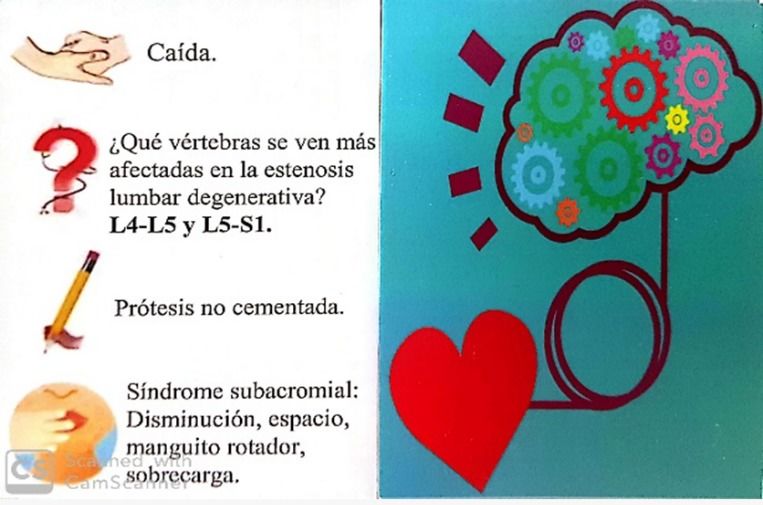
to compete in the game (one group of five students and four on each card (Figure 3), which included the contents of the
groups of six students). These students had to show their subject.
knowledge in the subject to pass each of the four different tests
Figure 2. Physiotherapy Party game.
https://games.jmir.org/2021/1/e26007 JMIR Serious Games 2021 | vol. 9 | iss. 1 | e26007 | p. 4
(page number not for citation purposes)
XSL• FO
RenderXJMIR SERIOUS GAMES Molina-Torres et al
Figure 3. Card used in the game.
the Cronbach α value was .843 for the enjoyment dimension,
Playing “Physiotherapy Party” .898 for the absorption dimension, .865 for the creative thinking
Once all elements of the game, such as the game board, tokens, dimension, .790 for the activation dimension, .841 for the
dice, timer, card holder, and instruction sheet, were organized absence of negative effects dimension, and .860 for the
by two lecturers (GMT and PR), students were asked to create dominance dimension [25].
their own cards of each topic studied in class, which covered
all the content of the subject. The purpose was to work and Final Evaluation
memorize basic concepts of the subject by making cards. A 34-question test with four multiple-choice options on
Following the instructions of the “Physiotherapy Party” game, theoretical contents of the subject was developed for the final
players first have to throw the dice and move their token through evaluation.
the game board. Then, they have to perform each of the tests
that appear on the chosen cards from the corresponding box.
Procedure
The team has 30 seconds (controlled by an hour-glass timer) to Before starting lessons with both groups, students were allocated
carry out each one of the tests. Finally, the team that gets the on the basis of their subgroup enrolment. While subgroups 1
last card out of each main box and performs the final test and 3 were assigned to the experimental group, subgroups 2
correctly wins. and 4 were assigned to the control group and were not informed
of the “Physiotherapy Party” game. The difference between the
Variables and Data Collection two groups was that the experimental group used the
We collected sex and age as sociodemographic variables, as “Physiotherapy Party” game, whereas the control group did not
well as the attendance for gamification and traditional lessons, use this game. There were no further differences (evaluation,
the grades in the final theoretical examination in the subject, lessons, contents, lecturer, etc). Students were informed about
and the game experience. the aim of the investigation, as well as the confidential and
anonymous treatment of their data. Once informed consent was
Measures obtained, the gamification lessons and traditional lessons were
The Gameful Experience (GAMEX) scale was used to assess started. The study data were collected in June 2019, after the
the experience of physiotherapy students in the game [24,25]. last gamification and traditional lesson, as well as after the final
This scale consists of 27 items graded on a Likert scale ranging theoretical examination.
from 1 (never) and 5 (always). The items are distributed into
six different dimensions, which include enjoyment, absorption, Data Analysis
creative thinking, activation, absence of negative effects, and The data analysis was carried out using the statistical software
dominance. The total Cronbach α value was .855. Particularly, SPSS version 22 (IBM Corp). First, a descriptive analysis was
https://games.jmir.org/2021/1/e26007 JMIR Serious Games 2021 | vol. 9 | iss. 1 | e26007 | p. 5
(page number not for citation purposes)
XSL• FO
RenderXJMIR SERIOUS GAMES Molina-Torres et al
conducted from the results. Central tendency and dispersion data, and all consent forms were signed. All ethical aspects
measures were determined for the quantitative variables, while established in the Declaration of Helsinki were followed at all
the frequency and percentage were analyzed for the categorical times.
variables. In contrasting the hypothesis between qualitative and
quantitative variables, after showing a normal distribution with Results
the Kolmogorov-Smirnov test, the Student t parametric test was
used for independent samples. Sociodemographic Characteristics
Ethical Considerations Fifty-nine physiotherapy students from the University of
Almeria participated in this study. Table 1 shows the
This study was approved by the Ethics Committee of the sociodemographic characteristics of the participants. The total
University of Almeria (Spain) (EFM-28/19). All participants sample consisted of 59 students (55.9% [n=33] were female
were informed about the aim of the study prior to participation. and 44.1% [n=26] were male), with a mean age of 23.37 years
Participants were informed about the confidentiality of their (SD 4.91 years).
Table 1. Sociodemographic characteristics of the participants (N=59).
Characteristic Experimental group Control group
Participants, n (%) 29 (49.2%) 30 (50.8%)
Sex, n (%)
Female 15 (51.7%) 18 (60.0%)
Male 14 (48.3%) 12 (40.0%)
Age (years), mean (SD) 22.10 (3.39) 24.60 (5.83)
the control group was 6.24 (SD 1.34). Final scores in both
Attendance for Gamification and Traditional Lessons groups showed significant differences (gamification was either
Out of 16 theory and gamification sessions, the mean attendance applied or not applied) (t57=4.208, P=.001).
by students in both groups was 10.85 lessons (SD 4.84), while
that in the experimental group was 12.66 (SD 3.06) and that in GAMEX Scale
the control group was 9.10 (SD 5.60). Both groups showed a Considering the GAMEX scale (Table 2), the scores were above
significant difference in relation to their attendance for the average in all the dimensions, except negative effects.
traditional lesson (t57=3.009, P=.004). Specifically, the mean scores were as follows: enjoyment, 25.93
(SD 4.01; range 6-30); absorption, 20.03 (SD 5.87; range 6-30);
Results in the Final Qualification creative thinking, 14.10 (SD 3.42; range 4-20); activation, 15.10
Regarding the final qualification of the theoretical examination, (SD 2.89; range 4-20); absence of negative effects, 5.14 (SD
the final mean score was 6.87 (SD 1.32) for both groups, while 2.23; range 3-15); and dominance, 12.79 (SD 3.66; range 4-20).
that in the experimental group was 7.53 (SD 0.95) and that in
Table 2. Data of each Gameful Experience (GAMEX) scale dimension by sex.
Dimension Score, mean (SD) P value
Men Women
Enjoyment 26.00 (3.94) 25.87 (4.22) .93
Absorption 19.43 (5.47) 20.60 (6.35) .60
Creative thinking 14.57 (3.22) 13.67 (3.65) .49
Activation 15.00 (2.74) 15.20 (3.12) .86
Absence of negative effects 4.79 (2.75) 5.47 (1.64) .42
Dominance 13.64 (3.05) 12.00 (4.10) .24
To the best of our knowledge, there is no previous evidence on
Discussion the use of this classic family board game adapted for teaching
Principal Findings in physiotherapy. This innovative educational game is trendy,
enjoyable, and entertaining as the first dimension of the
The aim of this study was to analyze the degree of satisfaction GAMEX scale showed. As our participants reported in the
of students after using the “Physiotherapy Party” game in satisfaction questionnaire, it enabled them to remember and
geriatric and adult psychomotricity, as well as to compare the apply knowledge more easily. In the same line of results,
two different teaching methods (traditional lessons and previous reports on the use of gamification in nursing studies
gamification lessons) and their impacts on the final evaluation. support these findings, such as using an escape room among
https://games.jmir.org/2021/1/e26007 JMIR Serious Games 2021 | vol. 9 | iss. 1 | e26007 | p. 6
(page number not for citation purposes)
XSL• FO
RenderXJMIR SERIOUS GAMES Molina-Torres et al
nursing students [22,26], in which gamification helped to acquire decreased course drop-out rates [43] compared to the findings
competencies by positively shaping the teaching-learning among students who used more traditional approaches.
process. Gamification has been shown to successfully increase
students’ motivation to learn and to be an additional resource
Methodological Considerations
based on student engagement and meaningful learning in There are several limitations to be taken into account in the
education [27]. In this sense, Cain [28] pointed out that it can results of this study. First, the generalization of our results
be used to have a more positive student experience as it should be considered cautiously, as participation in the study
immerses students in their learning process as active participants. was voluntary and sample selection was through convenience
Among medical students, Kinio et al [29] developed a platform sampling. Furthermore, the sample was not randomized and
for learning that may be more enjoyable and serve as a only 59 students participated. Additionally, owing to the nature
complement to traditional lectures. These platforms might be of the intervention, the participants could not be blinded.
used to do quick assessments in learning activities, such as the Besides, the GAMEX scale has been validated in a digital
game “Kahoot!” [30], which have led to a paradigm change in environment and has not been validated for a nondigital game,
classrooms, promoting self-learning among students. although it was previously used with good consistency [44,45].
Despite these drawbacks, the limited number of studies
In addition, these kinds of games promote creative thinking, as exploring the influence of games in the health sciences is one
reflected in the results of this study and those of other studies of the strengths. In this sense, there is no evidence of the use of
[31-34]. In line with the findings of Gómez-Urquiza et al [22], gamification in physiotherapy, and therefore, it offers an
games, such as Escape Room and the one suggested in this opportunity as a new research line in innovative teaching.
study, help students in their day-to-day practice when it comes Moreover, it should be emphasized that the use of the
to thinking critically, as they have to bear in mind all potential “Physiotherapy Party” game improves academic performance
solutions to their problems, which enhances their overall with respect to traditional education. However, this innovative
decision-making skills [35]. Additionally, this gamification-like teaching approach initially requires a considerable amount of
approach promotes the application of knowledge acquired in time for the teacher to prepare game materials, rules, and game
the course of using the platform [22]. dynamics. Students must also prepare game cards based on the
Analyzing other dimensions of the gaming experience, the content of the subject, although they are indeed working and
participants did not feel frustrated in most situations. These studying, which promotes a gradual and meaningful learning
results are similar to those found by other studies [36], where process. Conversely, enjoyment was not measured at each
only a few students showed frustration and confusion. session. It would therefore be interesting to measure this
dimension at each session in order to assess the appropriate
Regarding the learning results, there was a significant difference number of sessions for the use of this innovative teaching
between both groups, and the group involving gamification had method.
the best results. In line with these results, other studies have
shown the benefits of such game-based learning approaches Conclusions
over traditional strategies [37]. Game-based strategies have The “Physiotherapy Party” game was shown to be a learning
been shown to encourage learning and thus result in dramatically activity that allows students to remember and implement the
improved student performance [38]. In the end, game-based knowledge and professional competences acquired in the subject
teaching approaches enhance student motivation while more easily. In addition, it motivates students to study, thus
increasing student participation and providing effective feedback improving their attendance in these classes.
[39]. These interventions have been shown to have a beneficial
impact across educational programs for learners, with improved This study confirms that gamification as an alternative to
grade point averages [40], increased positive student perception conventional approaches can be considered an interesting and
of learning [41], better understanding of concepts [42], and state-of-the-art approach for teaching physiotherapy, which can
be used at the same time to improve knowledge among
university students.
Acknowledgments
The authors would like to thank the physiotherapy students at the University of Almeria for their assistance and for making this
study possible.
Authors' Contributions
Innovation design and proposal: GMT, RA, and MR; game and rule adaptation: MRA, NSL, and PR; game elaboration: MMSJ
and GMT; final review of the game: MRA and PR; implementation of the proposal: GMT and PR; draft of the manuscript: GMT
and PR; final version review: GMT, MRA, RA, NSL, MMSJ, PR, and MR.
Conflicts of Interest
None declared.
References
https://games.jmir.org/2021/1/e26007 JMIR Serious Games 2021 | vol. 9 | iss. 1 | e26007 | p. 7
(page number not for citation purposes)
XSL• FO
RenderXJMIR SERIOUS GAMES Molina-Torres et al
1. Sera L, Wheeler E. Game on: The gamification of the pharmacy classroom. Curr Pharm Teach Learn 2017 Jan;9(1):155-159.
[doi: 10.1016/j.cptl.2016.08.046] [Medline: 29180148]
2. Ahmed A, Sutton MJ. Gamification, serious games, simulations, and immersive learning environments in knowledge
management initiatives. WJSTSD 2017 Apr 06;14(2/3):78-83. [doi: 10.1108/wjstsd-02-2017-0005]
3. Brull S, Finlayson S. Importance of Gamification in Increasing Learning. J Contin Educ Nurs 2016 Aug 01;47(8):372-375.
[doi: 10.3928/00220124-20160715-09] [Medline: 27467313]
4. Huotari K, Hamari J. Defining gamification: a service marketing perspective Share on. In: Proceeding of the 16th International
Academic MindTrek Conference. 2012 Oct Presented at: MindTrek '12; October 03, 2012; New York, NY, USA p. 17-22.
[doi: 10.1145/2393132.2393137]
5. van Gaalen AEJ, Brouwer J, Schönrock-Adema J, Bouwkamp-Timmer T, Jaarsma ADC, Georgiadis JR. Gamification of
health professions education: a systematic review. Adv Health Sci Educ Theory Pract 2020 Oct 31. [doi:
10.1007/s10459-020-10000-3] [Medline: 33128662]
6. Al-Azawi R, Al-Faliti F, Al-Blushi M. Educational Gamification Vs. Game Based Learning: Comparative Study. IJIMT
2016:131-136. [doi: 10.18178/ijimt.2016.7.4.659]
7. Rojas D, Kapralos B, Dubrowski A. Gamification for Internet Based Learning in Health Professions Education. 2014 Jul
Presented at: 2014 IEEE 14th International Conference on Advanced Learning Technologies; July 7-10, 2014; Athens,
Greece p. 281-282. [doi: 10.1109/ICALT.2014.87]
8. Hamari J, Koivisto J, Sarsa H. Does Gamification Work? – A Literature Review of Empirical Studies on Gamification.
2014 Jan Presented at: 2014 47th Hawaii International Conference on System Sciences; January 6-9, 2014; Waikoloa, HI,
USA p. 3025-3034. [doi: 10.1109/HICSS.2014.377]
9. Zainuddin Z, Chu SKW, Shujahat M, Perera CJ. The impact of gamification on learning and instruction: A systematic
review of empirical evidence. Educational Research Review 2020 Jun;30:100326. [doi: 10.1016/j.edurev.2020.100326]
10. Arruzza E, Chau M. A scoping review of randomised controlled trials to assess the value of gamification in the higher
education of health science students. J Med Imaging Radiat Sci 2021 Mar;52(1):137-146. [doi: 10.1016/j.jmir.2020.10.003]
[Medline: 33153931]
11. Quin D. Longitudinal and Contextual Associations Between Teacher–Student Relationships and Student Engagement.
Review of Educational Research 2016 Sep 24;87(2):345-387. [doi: 10.3102/0034654316669434]
12. Pennings HJ, van Tartwijk J, Wubbels T, Claessens LC, van der Want AC, Brekelmans M. Real-time teacher–student
interactions: A Dynamic Systems approach. Teaching and Teacher Education 2014 Jan;37:183-193. [doi:
10.1016/j.tate.2013.07.016]
13. Mann KV. Theoretical perspectives in medical education: past experience and future possibilities. Med Educ 2011
Jan;45(1):60-68. [doi: 10.1111/j.1365-2923.2010.03757.x] [Medline: 21155869]
14. Brigham TJ. An Introduction to Gamification: Adding Game Elements for Engagement. Med Ref Serv Q 2015 Oct
23;34(4):471-480. [doi: 10.1080/02763869.2015.1082385] [Medline: 26496401]
15. McKeown S, Krause C, Shergill M, Siu A, Sweet D. Gamification as a strategy to engage and motivate clinicians to improve
care. Healthc Manage Forum 2016 Mar 12;29(2):67-73. [doi: 10.1177/0840470415626528] [Medline: 26872801]
16. White M, Shellenbarger T. Gamification of Nursing Education With Digital Badges. Nurse Educator 2018;43(2):78-82.
[doi: 10.1097/nne.0000000000000434]
17. Lewis ZH, Swartz M, Lyons E. What's the Point?: A Review of Reward Systems Implemented in Gamification Interventions.
Games Health J 2016 Apr;5(2):93-99. [doi: 10.1089/g4h.2015.0078] [Medline: 26812253]
18. Abdul Jabbar AI, Felicia P. Gameplay Engagement and Learning in Game-Based Learning. Review of Educational Research
2015 Dec;85(4):740-779. [doi: 10.3102/0034654315577210]
19. Ke F, Xie K, Xie Y. Game-based learning engagement: A theory- and data-driven exploration. Br J Educ Technol 2015
Jul 07;47(6):1183-1201. [doi: 10.1111/bjet.12314]
20. Boeker M, Andel P, Vach W, Frankenschmidt A. Game-based e-learning is more effective than a conventional instructional
method: a randomized controlled trial with third-year medical students. PLoS One 2013 Dec 5;8(12):e82328 [FREE Full
text] [doi: 10.1371/journal.pone.0082328] [Medline: 24349257]
21. Stapinski LA, Reda B, Newton NC, Lawler S, Rodriguez D, Chapman C, et al. Development and evaluation of 'Pure Rush':
An online serious game for drug education. Drug Alcohol Rev 2018 Apr 06;37 Suppl 1:S420-S428. [doi: 10.1111/dar.12611]
[Medline: 28986963]
22. Gómez-Urquiza JL, Gómez-Salgado J, Albendín-García L, Correa-Rodríguez M, González-Jiménez E, Cañadas-De la
Fuente GA. The impact on nursing students' opinions and motivation of using a "Nursing Escape Room" as a teaching
game: A descriptive study. Nurse Educ Today 2019 Jan;72:73-76. [doi: 10.1016/j.nedt.2018.10.018] [Medline: 30453202]
23. Chi MTH, Wylie R. The ICAP Framework: Linking Cognitive Engagement to Active Learning Outcomes. Educational
Psychologist 2014 Oct 28;49(4):219-243. [doi: 10.1080/00461520.2014.965823]
24. Eppmann R, Bekk M, Klein K. Gameful Experience in Gamification: Construction and Validation of a Gameful Experience
Scale [GAMEX]. Journal of Interactive Marketing 2018 Aug;43:98-115. [doi: 10.1016/j.intmar.2018.03.002]
https://games.jmir.org/2021/1/e26007 JMIR Serious Games 2021 | vol. 9 | iss. 1 | e26007 | p. 8
(page number not for citation purposes)
XSL• FO
RenderXJMIR SERIOUS GAMES Molina-Torres et al
25. Márquez-Hernández VV, Garrido-Molina JM, Gutiérrez-Puertas L, García-Viola A, Aguilera-Manrique G, Granados-Gámez
G. How to measure gamification experiences in nursing? Adaptation and validation of the Gameful Experience Scale
[GAMEX]. Nurse Educ Today 2019 Oct;81:34-38. [doi: 10.1016/j.nedt.2019.07.005] [Medline: 31319349]
26. Castro TC, Gonçalves LS. The use of gamification to teach in the nursing field. Rev Bras Enferm 2018 May;71(3):1038-1045
[FREE Full text] [doi: 10.1590/0034-7167-2017-0023] [Medline: 29924165]
27. El Tantawi M, Sadaf S, AlHumaid J. Using gamification to develop academic writing skills in dental undergraduate students.
Eur J Dent Educ 2018 Feb 26;22(1):15-22. [doi: 10.1111/eje.12238] [Medline: 27666148]
28. Cain J. Exploratory implementation of a blended format escape room in a large enrollment pharmacy management class.
Curr Pharm Teach Learn 2019 Jan;11(1):44-50. [doi: 10.1016/j.cptl.2018.09.010] [Medline: 30527875]
29. Kinio AE, Dufresne L, Brandys T, Jetty P. Break out of the Classroom: The Use of Escape Rooms as an Alternative Teaching
Strategy in Surgical Education. J Surg Educ 2019 Jan;76(1):134-139. [doi: 10.1016/j.jsurg.2018.06.030] [Medline: 30126728]
30. Jamil Z, Fatima SS, Saeed AA. Preclinical medical students' perspective on technology enhanced assessment for learning.
J Pak Med Assoc 2018 Jun;68(6):898-903 [FREE Full text] [Medline: 30325908]
31. Gagnon M, Gagnon J, Desmartis M, Njoya M. The impact of blended teaching on knowledge, satisfaction, and self-directed
learning in nursing undergraduates: a randomized, controlled trial. Nurs Educ Perspect 2013;34(6):377-382. [doi:
10.5480/10-459] [Medline: 24475598]
32. Brull S, Finlayson S, Kostelec T, MacDonald R, Krenzischeck D. Using Gamification to Improve Productivity and Increase
Knowledge Retention During Orientation. J Nurs Adm 2017 Sep;47(9):448-453. [doi: 10.1097/NNA.0000000000000512]
[Medline: 28834805]
33. Adams V, Burger S, Crawford K, Setter R. Can You Escape? Creating an Escape Room to Facilitate Active Learning. J
Nurses Prof Dev 2018;34(2):E1-E5. [doi: 10.1097/nnd.0000000000000433]
34. Connelly L, Burbach BE, Kennedy C, Walters L. Escape Room Recruitment Event: Description and Lessons Learned. J
Nurs Educ 2018 Mar 01;57(3):184-187. [doi: 10.3928/01484834-20180221-12] [Medline: 29505080]
35. Mullins JK, Sabherwal R. Gamification: A cognitive-emotional view. Journal of Business Research 2020 Jan;106:304-314.
[doi: 10.1016/j.jbusres.2018.09.023]
36. Morrell BLM, Ball HM. Can You Escape Nursing School? Educational Escape Room in Nursing Education. Nurs Educ
Perspect 2019 Jan 4;41(3):197-198. [doi: 10.1097/01.nep.0000000000000441]
37. Groenewald T. A Phenomenological Research Design Illustrated. International Journal of Qualitative Methods 2016 Nov
29;3(1):42-55. [doi: 10.1177/160940690400300104]
38. Marshall MN. Sampling for qualitative research. Fam Pract 1996 Dec;13(6):522-525. [doi: 10.1093/fampra/13.6.522]
[Medline: 9023528]
39. Braun V, Clarke V. Using thematic analysis in psychology. Qualitative Research in Psychology 2006 Jan;3(2):77-101.
[doi: 10.1191/1478088706qp063oa]
40. Dilmac O. The Effect of Active Learning Techniques on Class Teacher Candidates' Success Rates and Attitudes toward
Their Museum Theory and Application Unit in Their Visual Arts Course. Educational Sciences: Theory and Practice
2016;16(5):1587-1618 [FREE Full text]
41. O'Brocta R, Swigart S. Student perceptions of a Top 200 Medication Course utilizing active learning techniques. Currents
in Pharmacy Teaching and Learning 2013 Jan;5(1):49-53.e2. [doi: 10.1016/j.cptl.2012.09.001]
42. Chamundeswari S, Bakiaraj S. Attitude towards and Problems faced by Teachers in the Implementation of Active Learning
Methodology (ALM) in Schools at the Upper Primary Level in Dharmapuri District. Global Journal of Interdisciplinary
Social Sciences 2015;4(3):57-61 [FREE Full text]
43. Felder RM, Felder GN, Dietz EJ. A Longitudinal Study of Engineering Student Performance and Retention. V. Comparisons
with Traditionally-Taught Students. Journal of Engineering Education 1998;87(4):469-480. [doi:
10.1002/j.2168-9830.1998.tb00381.x]
44. Gutiérrez-Puertas L, Márquez-Hernández VV, Román-López P, Rodríguez-Arrastia MJ, Ropero-Padilla C, Molina-Torres
G. Escape Rooms as a Clinical Evaluation Method for Nursing Students. Clinical Simulation in Nursing 2020 Dec;49:73-80.
[doi: 10.1016/j.ecns.2020.05.010]
45. López-Belmonte J, Segura-Robles A, Fuentes-Cabrera A, Parra-González ME. Evaluating Activation and Absence of
Negative Effect: Gamification and Escape Rooms for Learning. Int J Environ Res Public Health 2020 Mar 26;17(7):2224
[FREE Full text] [doi: 10.3390/ijerph17072224] [Medline: 32224978]
Abbreviations
GAMEX: Gameful Experience
https://games.jmir.org/2021/1/e26007 JMIR Serious Games 2021 | vol. 9 | iss. 1 | e26007 | p. 9
(page number not for citation purposes)
XSL• FO
RenderXJMIR SERIOUS GAMES Molina-Torres et al
Edited by N Zary; submitted 24.11.20; peer-reviewed by AJ Ibanez-Vera, A Galán-Mercant, E Braad; comments to author 23.12.20;
revised version received 07.01.21; accepted 18.02.21; published 24.03.21
Please cite as:
Molina-Torres G, Rodriguez-Arrastia M, Alarcón R, Sánchez-Labraca N, Sánchez-Joya M, Roman P, Requena M
Game-Based Learning Outcomes Among Physiotherapy Students: Comparative Study
JMIR Serious Games 2021;9(1):e26007
URL: https://games.jmir.org/2021/1/e26007
doi: 10.2196/26007
PMID: 33759800
©Guadalupe Molina-Torres, Miguel Rodriguez-Arrastia, Raquel Alarcón, Nuria Sánchez-Labraca, María Sánchez-Joya, Pablo
Roman, Mar Requena. Originally published in JMIR Serious Games (http://games.jmir.org), 24.03.2021. This is an open-access
article distributed under the terms of the Creative Commons Attribution License (https://creativecommons.org/licenses/by/4.0/),
which permits unrestricted use, distribution, and reproduction in any medium, provided the original work, first published in JMIR
Serious Games, is properly cited. The complete bibliographic information, a link to the original publication on http://games.jmir.org,
as well as this copyright and license information must be included.
https://games.jmir.org/2021/1/e26007 JMIR Serious Games 2021 | vol. 9 | iss. 1 | e26007 | p. 10
(page number not for citation purposes)
XSL• FO
RenderXYou can also read


