German OER Practices and Policy - from Bottom-up to Top-down Initiatives
←
→
Page content transcription
If your browser does not render page correctly, please read the page content below

German OER
Practices and Policy —
       from Bottom-up to
     Top-down Initiatives
Dominic Orr, Jan Neumann
    and Joeran Muuss-Merholz

     German OER
Practices and Policy —
  from Bottom-up to
 Top-down Initiatives

                Moscow 2017
      Верстка книг: http://verstkapro.ru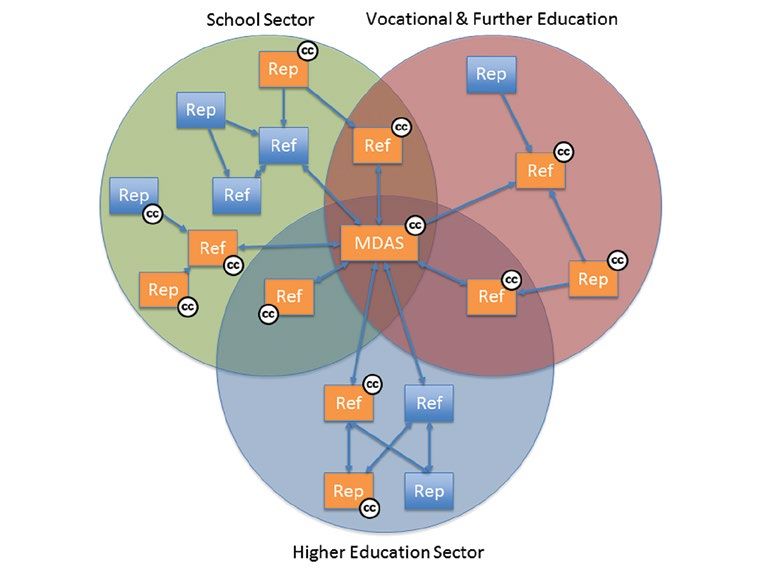
UNESCO Institute for Information Technologies in Education

Authors: Dominic Orr, Jan Neumann and Joeran Muuss-Merholz
Coordinator of the project: Svetlana Knyazeva,
   UNESCO Institute for Information Technologies in Education
Designer: Raminta Targamadzė-Dzikavičienė

The choice and the presentation of facts contained in this publication and the opinions expressed therein are not
necessarily those of UNESCO and do not commit the Organization. The designations employed and the presentation
of material throughout this publication do not imply the expression of any opinion whatsoever on the part of
UNESCO concerning the legal status of any country, territory, city or area of its authorities, or the delimitation of its
frontiers or boundaries. Whilst the information in this publication is believed to be true and accurate at the time of
publication, UNESCO cannot accept any legal responsibility or liability to any person or entity with respect to any loss
or damage arising from the information contained in this publication.

Published by the UNESCO Institute for Information Technologies in Education

8 Kedrova St., Bldg. 3, Moscow, 117292, Russian Federation

Tel.: +7 499 1292990
Fax: +7 499 1291225
E-mail: Liste.info.iite@unesco.org
www.iite.unesco.org

© UNESCO, 2017

                       This work is licensed under the Creative Commons Attribution-Share Alike 3.0
                       Unported License. To view a copy of this license visit
                       http://creativecommons.org/licenses/by-sa/3.0/

ISBN 978-5-9500869-0-8
Printed in the Russian Federation
Foreword
I am pleased to introduce the new publication produced by the UNESCO Institute for Information Technologies
in Education (UNESCO IITE) within its project on Open Educational Resources (OER) in non-English-speaking
countries. This report focusses on a holistic understanding of OER, including the policy perspective, as well as
technical, legal, social and didactical aspects. The report provides a brief overview of the OER-related developments
in Germany, describes the structure of the German education system and reveals major educational challenges.
The authors of this study analyzed the state of advancement of OER in Germany using bottom-up and top-down
perspectives. The study proved that in Germany both types of activities exist in parallel, although more focus is
needed for policy-led, facilitative initiatives in the future.
Since 2009, the needs and challenges for open education and OER have been surveyed by UNESCO IITE in Armenia,
Azerbaijan, Belarus, Kazakhstan, Moldova, Russia, Ukraine, Uzbekistan, as well as in Latvia and Lithuania. The results
of the cross-national survey of OER in the Commonwealth of Independent States were published in the monograph
“CIS on the Way towards OER”. Later on the geographical scope of the IITE OER project expanded to include Japan,
China, Brazil, Turkey and Vietnam. UNESCO IITE published the case studies on OER in Lithuania, Brazil, China, Kenya,
Poland, Russia and France (2011, 2012, 2013, 2015 and 2016, respectively). In total, 21 non-English-speaking countries
were surveyed.
Though Germany could be characterized as a relatively latecomer to the OER scene, there is a strong OER community
in the country and the OER World Map data for Germany shows 166 organisations involved in OER-related
practices. Recent government activities in the field of OER include the OERinfo funding programme, which was
launched in November 2016. There are some important achievements at the level of federal entities, for example,
the establishment of the Hamburg Open Online University, which is currently the most ambitious OER project in
Germany. Considering the fact that for the German educational community and the authorities of different levels,
OER are recognized for their potential in fostering innovation, it is expected that the recent and forthcoming
grassroots OER initiatives and those triggered by the authorities will favour the advancement of open education in
Germany.
The term “open educational resources” was first adopted at UNESCO’s 2002 Forum on the Impact of Open Courseware
for Higher Education in Developing Countries and since then the transformative potential of OER has been proved
in English-speaking countries mostly in higher education. Promoting the production and use of open content in
languages other than English for ensuring wide access to quality education and life-long learning and supporting
linguistic and cultural diversity has become increasingly important.
                                                                                                           Tao Zhan,
                                                                                                             Director
                                                                                                         UNESCO IITE
Acknowledgements
The authors would like to thank everyone who contributed to providing information and insights for this report. First
and foremost, we would like to acknowledge Irina Geanta for her patient and thorough improvements, completions,
connections and corrections of the report. Furthermore, we would like to offer our thanks to the following persons
(in alphabetical order) for advice and support: Ingo Blees, Boris Bockelmann, Sonja Borski, Perrine de Coetlogon,
Karin Driesen, Gabi Eckart, Gabi Fahrenkrog, Barbara Getto, Doris Hirschmann, Till Kreutzer, Kerstin Mayrberger, Luca
Mollenhauer, Felix Ostrowski, Peter Rempis, Christian Richter, Jan Schallaböck, Philipp Schmidt and Annett Zobel.
Table of Contents
    Foreword................................................................................................................................................................................. 3
    Executive summary.............................................................................................................................................................. 7
    Zusammenfassung.............................................................................................................................................................. 9
    Résumé..................................................................................................................................................................................11

1 Introduction: between two World Congresses.....................................................14
2 Overview of OER-related developments in Germany..........................................16
    2.1 Key points and milestones..................................................................................................................................16
    2.2 Timeline......................................................................................................................................................................16

3 German education system.....................................................................................19
    3.1 General organisational structure and division of responsibilities.........................................................19
    3.2 Organisation of teaching and learning media.............................................................................................21

4 Current debates in the German education system relevant for OER.................22
    4.1      Key insights...............................................................................................................................................................22
    4.2      Main educational challenges in Germany.....................................................................................................22
    4.3      Digitalisation and the education sector – a new agenda.........................................................................23
    4.4      Related legal regulations.....................................................................................................................................28
    4.5      Important reports leading to more engagement for OER in the educational field........................30

5 Quantitative overview...........................................................................................33
    5.1      Collecting data with the OER World Map.......................................................................................................33
    5.2      OER activity by educational sector...................................................................................................................33
    5.3      OER activities by German state..........................................................................................................................34
    5.4      A focus on OER services........................................................................................................................................35

6 Top-down policy-led activities related to OER.....................................................37
    6.1      Key insights...............................................................................................................................................................37
    6.2      School sector............................................................................................................................................................38
    6.3      Higher education sector.......................................................................................................................................42
    6.4      Vocational training.................................................................................................................................................44
    6.5      Further education: The Federal Agency for Civic Education...................................................................44
    6.6      Cross-sectional OERinfo funding programme.............................................................................................44

                                                                                                                                                                                                  5
German OER Practices and Policy — from Bottom-up to Top-down Initiatives

    7 Bottom-up activities related to OER.....................................................................48
        7.1     Key insights...............................................................................................................................................................48
        7.2     Presentation of activities by educational sector..........................................................................................48
        7.3     Special focus on events........................................................................................................................................71
        7.4     Special focus on MOOCs and communities..................................................................................................72

    8 Evaluation and lessons learnt in Germany...........................................................73
        8.1     Manner of engagement.......................................................................................................................................73
        8.2     Comprehensiveness of the strategy................................................................................................................75
        8.3     Next steps..................................................................................................................................................................76
        8.4     Lessons learnt...........................................................................................................................................................78

    9 References...............................................................................................................79

    List of tables
        Table 2.1: Timeline of key activities related to OER in Germany......................................................................16
        Table 4.1: Comprehensive digital strategies at state level.................................................................................24

    List of figures
        Figure 5.1 OER World Map entries by data type....................................................................................................33
        Figure 5.2 Entries per sector distinguished by data type...................................................................................34
        Figure 5.3 Entries by state..............................................................................................................................................34
        Figure 5.4 Services according to service type........................................................................................................35
        Figure 5.5 Number of services according to included subjects.......................................................................35
        Figure 5.6 Number of services according to used licenses................................................................................36
        Figure 5.7 Services according to their business model.......................................................................................36
        Figure 6.1 Screenshot of the educational search engine Elixier......................................................................39
        Figure 6.2 Representation of a connected OER infrastructure
             with a ‘metadata exchange service’ in its centre.........................................................................................41
        Figure 6.3 Architecture of the OERinfo funding programme...........................................................................45
        Figure 8.1: Overview of the main components relevant to OER development in Germany.................74

6
                                     Executive summary
This study was commissioned by UNESCO’s Institute for Information Technology in Education as part of their series
on the status of developments concerning Open Education Resources across the world. Germany is an interesting
country for such an overview, since it can be described as a late-comer to OER. With rare exceptions, the international
debate was largely ignored in Germany during the early years of OER. However, this view neglects the strong OER
community in Germany, which has been active for many years. Whilst internationally German’s presence in the OER
discussion was missed, a first white paper on OER was published in early 2012, a first OER-focussed (un)conference
in late 2012 and a first national hearing of OER experts was called by the German Federal Ministry of Education and
Research (BMBF) (see Chapter 1).
The approach chosen by the authors of this study was to structure the report around the question of which bottom-
up (community-led) and which top-down (policy-led) initiatives have occurred and are worth featuring as central
to the constellation of OER practices in Germany today. This approach is illustrated in Figure 0.1 below, where key
aspects for top-down and bottom-up initiatives are also highlighted.
The study shows that Germany is a case where both types of activities exist in parallel, although more focus is hoped
for top-down, facilitative initiatives in the future. This is likely to happen, when the digital agenda for education is
implemented, as OER is frequently mentioned as part of this agenda, but also when the general educational agenda
discovers the potential benefits of OER for improved and more individualised and context-dependent access to
learning opportunities (see Chapter 4). A current and recognised blockage to OER practice are the legal regulations
of copyright, which are in need of further reform (see Section 4.4). An encouraging development in this context
is that close to 10% of OER services in Germany offer resources under the public domain CC 0, which, from a user
perspective, represents the optimum for easy reuse.
Overall, the OER World Map data for Germany shows 166 organisations to be involved in OER-related practices, supporting
104 services (see Chapter 5). Here Germany is no different to other countries in having more services in the school sector
and higher education, but it also with a substantial amount as cross-sector services, which bring the community together
for peer learning and knowledge exchange. It should also be noted that activities in the higher education sector also
have a cross-sectional dimension: experts
                                                                  Figure 0.1: Overview of the main components
from the higher education sector use their                          relevant to OER development in Germany
expertise to support developments in
other educational sectors, e.g. by providing
services for the school sector or leading
projects within the OERinfo funding line.
For each of the educational sectors, the study
offers selected cases, chosen to illustrate the
type of activities in each sector and for their
specific relevance. These cases are provided
for top-down and for bottom-up activities.
As Germany is a federal state, some of the
top-down initiatives come from specific
states (see Chapter 6). In the case of the

                                                                                                                             7
German OER Practices and Policy — from Bottom-up to Top-down Initiatives

    city-state Hamburg, in 2015 it started the Hamburg Open Online University — HOOU (see Section 6.3.1), which —
    at the moment — is the most ambitious and best funded OER project in Germany. The HOOU project follows an
    innovative design, which focusses strongly on openness and cooperation. The project is driven by the six public
    higher education institutions (HEIs) located in Hamburg including a medical university, a technical university, as well
    as universities for music and theatre and fine arts. With the preparation phase complete, the first earnest phase of the
    project has now begun and is funded until the end of 2018, when a first full evaluation of its impact will be possible.
    This is just one example of state-led initiatives. On a national level, it is the so-called OERinfo funding programme
    which is of interest. It is the most significant German government action in the field of OER so far. This programme
    has recognised the importance of an enabling interface between top-down interests and bottom-up activities and
    largely focusses on facilitative activities such as train-the-trainer initiatives and supporting first ideas for trainer
    certification. It is a two-year programme and can be evaluated at the end of 2018.
    When compared to other countries Germany has scored low on top-down and high on bottom-up activities in the past.
    This is a consequence of German politics having largely ignored the topic of OER until recently, although this has been
    changing. Since OER activities are mostly driven bottom-up, there has been a need for sharing questions, experiences
    and materials between players, who have been isolated in their own institutions. These players found opportunities
    for sharing in cross-sector events and communities. Especially the barcamp/unconference format turned out to fit
    tremendously well developing a strong German OER community. Indeed, Germany so far has seen a remarkably strong
    cross-sector community with common interest in OER. So, whilst the presentation of bottom-up initiatives highlights
    particularly cases, it also presents a special focus on the events to support community exchange (see Chapter 7).
    It is interesting to note that the OERinfo funding programme works well, no matter what future political decisions related
    to OER might look like. If there is a decision to step deeper into OER with a sorely needed further funding of infrastructure
    and content development, OERinfo is a perfect starter for the wider programme (see Chapter 8). If on the other hand, no
    major investment in OER follows, OERinfo still makes sense, since the various awareness-raising activities and opportunities
    for knowledge exchange will arguably increase the number of people using existing OER platforms and tools.
    This review of OER-related activities in Germany, therefore, provides at least four key insights for other countries:
     ÂÂ A potential for supporting OER is emerging within the general educational debates on how to assure effective
         digital educational strategies and practices. OER are well-placed within this framework, but it is important to
         review whether their full potential is reflected in key strategic documents.
     ÂÂ In many countries, there are a significant number of OER practitioners. Governments can use top-down policy
         programmes to support them and provide them with the opportunity for exchanging knowledge and practices.
     ÂÂ Copyright clarity remains an important framework condition for OER and indeed for digital education, since legal
         uncertainty before OER practices will not disappear afterwards. But at the same time, the confusing situation in
         Germany can be considered one of the main drivers of OER adoption. The more the law fails to provide practical
         solutions, which make use of the potentials of the new technologies, the more OER appears to be a feasible alternative.
     ÂÂ Quantitative and qualitative information, monitoring and research are important for any educational reforms
         and therefore it is also just as important for OER activities. In this context, the authors would like to point to the
         relevant information, which could be attained for the German entries to the OER World Map. This tool should
         be exploited by other countries to fully highlight their own activities. However, this is not enough. Specific
         evaluations of programmes and practices are vital and it is unfortunate that the very positive OERinfo funding
         programme has not foreseen such requirements in the current funding round. The authors hope that other
         countries will remember this important element of change management.

8
Zusammenfassung

                                    Zusammenfassung
Diese Studie wurde im Auftrag des Institute for Information Technology in Education der UNESCO erstellt. Sie ist
Teil einer Reihe von Bestandsaufnahmen in Bezug auf Open Educational Resources (OER) auf der ganzen Welt.
Deutschland ist für einen solchen Überblick ein interessantes Land, weil es als Spätzünder in Sachen OER bezeichnet
werden kann. Mit wenigen Ausnahmen wurde in Deutschland die internationale Debatte um OER in den frühen
Jahren weitgehend ignoriert. Dies berücksichtigt jedoch nicht die starke OER-Community in Deutschland, die schon
seit vielen Jahren aktiv ist. Während man auf internationaler Ebene eine deutsche Präsenz vermisste, wurde Anfang
2012 ein erstes Whitepaper zu OER veröffentlicht, eine erste (Un-)Konferenz zu OER fand im Herbst 2012 statt, und
das Bundesministerium für Bildung und Forschung (BMBF) lud zu einer ersten Expertenanhörung (vgl. Kapitel 1) ein.
Die Autoren haben diesen Bericht entlang der Zweiteilung in Bottom-up- (von der Praxis ausgehend) und Top-down-
Initiativen (von der Politik ausgehend) strukturiert, sofern sie sich als relevant für die heutige Situation von OER in
Deutschland herausgestellt haben. Abbildung 0.1 illustriert diesen Ansatz und hebt zusätzlich zentrale Aspekte für
Top-down- und Bottom-up-Aktivitäten hervor.
Die Studie zeigt, dass in Deutschland beide Arten von Initiativen parallel existieren, auch wenn für die Zukunft auf
einen stärkeren Fokus zugunsten von unterstützenden Top-down-Initiativen gehofft werden kann. Die Chancen
dazu stehen gut, sofern der Digitalpakt zwischen Bund und Ländern und entsprechende Vorhaben in den einzelnen
Ländern umgesetzt werden, da OER in diesem Kontext bereits häufig genannt wird, aber auch wenn im Rahmen
der allgemeinen Bildungsdebatten die Potentiale von OER für bessere, individualisierte und situationsgerechte
Lernmöglichkeiten entdeckt werden (vgl. Kapitel 4). Ein aktuelles und bekanntes Hindernis für die OER-Praxis sind die
gesetzlichen Bestimmungen im Urheberrecht, die weitere Reformen benötigen (vgl. 4.4). In diesem Zusammenhang
ist es eine ermutigende Entwicklung, dass nahezu 10% der OER-Services in Deutschland Ressourcen unter Public
Domain CC0 anbieten — die aus der Sicht der Nutzer das Optimum für eine einfache Nachnutzung darstellen.
Die Daten der OER World Map zeigen für Deutschland 166 Organisationen, die an OER-bezogenen Aktivitäten
beteiligt sind und insgesamt 104 Services unterstützen (siehe Kapitel 5). In Deutschland liegt — nicht anders als in
anderen Ländern — der Schwerpunkt der
Aktivitäten in den Bereichen Schule und                  Abbildung 0.1: Überblick über die die Hauptkomponenten,
                                                           die die OER-Entwicklung in Deutschland beeinflussen
Hochschule. Gleichzeitig zeichnet sich
Deutschland durch einen hohen Anteil von
bereichsübergreifende Aktivitäten aus, die
die Community für Voneinander-Lernen
und Wissensaustausch zusammenbringen.
Es ist auch zu beachten, dass die Aktivitäten
im Bereich Hochschule zusätzlich eine
Querschnittsdimension aufweisen: Experten
aus dem Hochschulbereich nutzen ihre
Expertise, um Entwicklungen in anderen
Bildungsbereichen zu unterstützen, z.B.
durch die Bereitstellung von Services für den
Schulsektor oder durch die Koordination von
Projekten innerhalb der OERinfo-Förderlinie.

                                                                                                                          9
German OER Practices and Policy — from Bottom-up to Top-down Initiatives
Für jeden Bildungssektor stellt die Studie ausgewählte Praxisbeispiele vor, die die spezifischen Aktivitäten in jedem
Sektor und ihre Relevanz veranschaulichen sollen. Diese Praxisbeispiele werden sowohl für Top-down- als auch für
Bottom-up-Initiativen vorgestellt.
Da Deutschland föderal organisiert ist, kommen einige der Top-down-Aktivitäten aus einzelnen Bundesländern (vgl.
Kapitel 6). Im Fall des Stadtstaates Hamburg wurde 2015 die Hamburg Open Online University (HOOU, vgl. 6.3.1)
initiiert, die im Moment das ambitionierteste und am besten geförderte OER-Projekt in Deutschland ist. Der Ansatz
der HOOU verfolgt ein innovatives Design, das stark auf Offenheit und Kooperation setzt. Das Projekt wird von
sechs öffentlichen Hochschulen in Hamburg getragen, darunter ein Universitätsklinikum, eine Fachhochschule,
die Hochschule für bildende Künste und die Hochschule für Musik und Theater. Die Vorbereitungsphase des
Projektes ist abgeschlossen, so dass nun die erste Hauptphase begonnen hat, die bis Ende 2018 finanziert ist.
Eine erste umfassende Einschätzung zu den Wirkungen wird dann möglich sein. Dies ist nur ein Beispiel für eine
Länder-geführte Initiativen. Auf Bundesebene ist das OERinfo-Förderprogramm, die bisher bedeutendste staatliche
Maßnahme im Bereich OER in Deutschland, von besonderem Interesse. Das Programm hat die Bedeutung einer
fähigen Schnittstelle zwischen Top-down-Interessen und Bottom-up-Aktivitäten erkannt. Es konzentriert sich
weitgehend auf unterstützende Initiativen zur Sensibilisierung und Qualifizierung von Multiplikatoren (Train-the-
Trainer-Maßnahmen) und unterstützt erste Ideen für die Zertifizierung von Lehrenden. Das zweijährige Programm
kann Ende 2018 ausgewertet werden.
Vergleicht man Deutschland mit anderen Ländern, so gab es in Deutschland in der Vergangenheit wenige Top-
down- und viele Bottom-up-Initiativen. Die Ursache dafür liegt in der Vernachlässigung des Themas durch die
deutsche Politik, was sich aber inzwischen verändert hat. Da OER-Initiativen vor allem bottom-up vorangetrieben
werden, gab und gibt es einen großen Bedarf, Fragen, Erfahrungen und Material untereinander auszutauschen,
zumal die Akteure teilweise auch innerhalb der eigenen Institutionen isoliert arbeiteten. Die Akteure und Initiativen
haben dafür Gelegenheiten in bereichsübergreifenden Veranstaltungen und Communities gefunden. Insbesondere
das Barcamp-/ Unkonferenz-Format hat sich als sehr effektives Mittel herausgestellt, um eine starke OER-Community
in Deutschland zu entwickeln. Vor diesem Hintergrund wird neben der Vorstellung von konkreten Bottom-up-
Initiativen auch ein besonderer Fokus auf die Veranstaltungen gelegt, die den Austausch innerhalb der Community
unterstützen (vgl. Kapitel 7).
Interessanterweise lässt sich feststellen, dass das Förderprogramm OERinfo gut funktioniert, unabhängig davon,
wie zukünftige politische Entscheidungen zu OER aussehen mögen. Falls die Entscheidung zugunsten einer
stärkeren Verankerung von OER zusammen mit einer dringend benötigten Förderung von Infrastruktur und
Materialentwicklung fallen sollte, ist OERinfo ein hervorragender Ausgangspunkt für ein weitergehendes Programm
(vgl. Kapitel 8). Falls es andererseits nicht zu weiterer substanzieller Förderung von OER kommen sollte, bleibt
OERinfo weiterhin sinnvoll, da die verschiedenen Initiativen zur Sensibilisierung und zum Wissensaustausch mit
Sicherheit die Anzahl von Personen erhöhen dürfte, die bestehende OER-Plattformen und -Werkzeuge nutzen.
Interessanterweise lässt sich feststellen, dass das Förderprogramm OERinfo gut funktioniert, unabhängig davon,
wie zukünftige politische Entscheidungen zu OER aussehen mögen. Falls die Entscheidung zugunsten einer
stärkeren Verankerung von OER zusammen mit einer dringend benötigten Förderung von Infrastruktur und
Materialentwicklung fallen sollte, ist OERinfo ein hervorragender Ausgangspunkt für ein weitergehendes Programm
(vgl. Kapitel 8). Falls es andererseits nicht zu weiterer substanzieller Förderung von OER kommen sollte, bleibt
OERinfo weiterhin sinnvoll, da die verschiedenen Initiativen zur Sensibilisierung und zum Wissensaustausch mit
Sicherheit die Anzahl von Personen erhöhen dürfte, die bestehende OER-Plattformen und -Werkzeuge nutzen.
10Résumé
Die Analyse von OER-bezogenen Maßnahmen in Deutschland liefert mindestens vier zentrale Erkenntnisse für
andere Länder:
ÂÂ Innerhalb der allgemeinen Diskussion um effektive digitale Bildungsstrategien und -praktiken zeichnet sich die
Bereitschaft zur Unterstützung von OER ab. OER wird bereits jetzt in dieser Diskussion angemessen berücksichtig.
Trotzdem bleibt es wichtig darauf zu achten, dass sich das volle Potential von OER in zentralen Dokumenten
wiederfindet.
ÂÂ Es gibt in vielen Ländern eine signifikante Anzahl von OER-Praktikern. Regierungen können Top-down-Policy-
Maßnahmen so gestalten, dass sie die OER-Praktiker unterstützen und ihnen Gelegenheiten zum Austausch von
Wissen und Praktiken geben.
ÂÂ Klarheit in Urheberrechtsfragen bleibt weiterhin eine wichtige Rahmenbedingung für OER und digitale Bildung
im Allgemeinen. Entsprechende Unsicherheiten bleiben mit oder ohne OER-Praktiken bestehen. Andererseits
kann die verwirrende Rechtslage in Deutschland als einer der Haupttreiber für die Verbreitung von OER gesehen
werden. Je stärker die Gesetzgebung daran scheitert, praktikable Lösungen für die Nutzung des Potentials neuer
Medien zu finden, desto hilfreicher erscheint OER als gangbare Alternative.
ÂÂ Quantitative und qualitative Informationen, Monitoring und Forschung sind wichtig für jede Bildungsreform, also
auch für OER-bezogene Initiativen. In diesem Kontext möchten die Autoren auf die Informationen hinweisen, die
von der OER World Map bereitgestellt werden können. Die OER World Map sollte als Werkzeug auch von anderen
Ländern genutzt werden, um einen Überblick über ihre eigenen Aktivitäten zu erhalten. Allerdings reicht das
alleine nicht aus. Die spezifische Evaluation von Programmen und Praktiken ist von entscheidender Bedeutung.
Und es ist unglücklich, dass das insgesamt sehr gute Förderprogramm OERinfo entsprechende Verpflichtungen
in der laufenden Förderperiode nicht vorgesehen hat. Die Autoren hoffen, dass andere Länder diesen wichtigen
Bestandteil von Change-Management beachten.
Résumé
Cette étude a été commandée par l’Institut de l’UNESCO pour l’application des technologies de l’information à
l’éducation. Elle fait partie d’une série sur l’état des Ressources Educatives Libres (REL) à travers le monde. L’Allemagne
est un cas d’étude intéressant puisque le domaine des REL y est considéré comme relativement récent. A quelques
exceptions près, la discussion internationale sur les REL a été largement ignorée Allemagne dans les premières
années. Il ne faut pas pour autant sous-estimer la force de la communauté des REL existante en Allemagne, qui est
déjà active depuis plusieurs années. Bien que l’Allemagne ait été absente un certain temps de la scène internationale,
un premier livre blanc sur les REL a été publié début 2012, suivi à l’automne d’une première (non)-conférence sur les
REL et enfin d’une première audition des experts du domaine par le Ministère fédéral allemand de l’Education et de
la Recherche (voir Chapitre 1).
Les auteurs ont structuré l’ensemble du présent rapport en distinguant les initiatives ascendantes (venant des acteurs de
terrain, de la pratique) et descendante (partant de la gouvernance politique) [en anglais, respectivement, bottom-up et
top-down] selon leur pertinence au regard de la situation actuelle des REL en Allemagne. La figure 0.1 schématise cette
approche et met en outre en lumière les concepts clés correspondant, activités « descendantes » et « ascendantes ».
L’étude montre qu’en Allemagne, les deux types d’initiatives existent en parallèle, même si l’on peut espérer pour
l’avenir un soutien plus important des initiatives descendantes. Il y a de fortes chances d’aller dans ce sens dans la
11German OER Practices and Policy — from Bottom-up to Top-down Initiatives
mesure où le Pacte numérique entre l’Etat fédéral et les Länder, ainsi que les projets correspondants mis en œuvre
au niveau de chacun des Länder, citent fréquemment les REL, mais aussi parce que l’on découvre dans le cadre des
discussions générales relatives à l’éducation les potentialités des REL pour un apprentissage meilleur, personnalisé
et adapté à toutes sortes de situations (voir Chapitre 4). Parmi les obstacles principaux à l’utilisation des REL, le plus
connu et le plus complexe a trait au droit d’auteur, qui nécessiterait une réforme supplémentaire (voir 4.4). Dans ce
contexte, il est encourageant de constater que près de 10% des services de REL en Allemagne sont des ressources
proposées sous domaine public CC 0, la licence optimale pour en faciliter la réutilisation par l’utilisateur.
Les données de la carte mondiale des REL montrent, pour l’Allemagne, 166 organisations ayant des activités se
rapportant à la pratique des REL et au total, 104 services de support (voir Chapitre 5). En Allemagne, comme dans
d’autres pays, l’essentiel des activités a trait aux enseignement scolaires et supérieurs. En même temps, l’Allemagne
se distingue par une proportion importante d’activités allant au-delà des domaines de chacun, rassemblant
ainsi la communauté pour des échanges de savoirs et de bonnes pratiques. Notons que les activités au sein de
l’enseignement supérieur apportent en outre une dimension transversale : les experts de l’enseignement supérieur
utilisent leur expertise pour soutenir les développements d’autres domaines d’enseignement, en proposant par
exemple de mettre leurs services à disposition du secteur scolaire ou bien par la coordination de projets financés par
la ligne OERinfo.
Pour chaque secteur d’éducation, l’étude présente des exemples pratiques sélectionnés afin d’illustrer les activités
spécifiques dans chaque secteur et leur pertinence. Des exemples pratiques sont présentés tant pour les initiatives
ascendantes que les initiatives descendantes.
L’Allemagne étant un Etat fédéral, certaines initiatives descendantes proviennent de Länder spécifiques (voir Chapitre
6). La ville de Hambourg, qui est aussi un Land, a lancé en 2015 le projet de la Hamburg Open Online University (HOOU),
qui est aujourd’hui le projet REL le plus ambitieux et le mieux financé en Allemagne. Le projet HOOU met en œuvre
un modèle innovant mettant l’accent sur l’ouverture et la coopération. Le projet est mené par les six établissements
d’enseignement supérieur de Hambourg, comprenant un centre hospitalier universitaire, une université de sciences
appliquées et technologies, ainsi qu’une école des beaux-arts et un conservatoire de musique et de théâtre.
La phase préparatoire du projet étant terminée, la première phase principale a démarré, financée jusqu’à la fin de
l’année 2018. Une première estimation
Figure 0.1: Aperçu des principaux composants influant sur le développement
globale de son impact sera alors possible.
des ressources éducatives libres en Allemagne
Il s’agit ici d’un exemple parmi d’autres
initiatives au niveau des Länder. Au niveau
fédéral, le programme de financement
OERinfo est la mesure publique la plus
importante à ce jour dans le domaine des
REL. Elle est également particulièrement
intéressante. Ce programme a reconnu
l’importance de favoriser l’interface entre
les initiatives venant du haut et celles
portées par les acteurs de terrain. Elle se
concentre largement sur des activités
facilitatrices telles que la sensibilisation et
la qualification des formateurs (actions de
12Résumé
formation de formateurs). Elle soutient les premières idées relatives à la certification des apprenants. Le programme
s’étend sur deux ans et pourra faire l’objet d’une évaluation à la fin de l’année 2018.
Si l’on compare l’Allemagne à d’autres pays, celle-ci a connu ces dernières années peu d’initiatives descendantes
et beaucoup d’initiatives ascendantes. Ceci est la conséquence d’une politique allemande qui a largement négligé
le sujet des REL jusque récemment. Mais la situation a depuis évolué. La plupart des initiatives étant ascendantes,
les acteurs ont eu, et ont toujours, un grand besoin d’échanger sur leurs questions, leurs expériences et les outils.
Surtout les acteurs travaillant parfois de façon isolée dans leurs propres institutions. Ces acteurs et ces initiatives ont
su trouver des opportunités au travers d’événements et de communautés au-delà de leur domaine. En particulier,
le format de BarCamp ou de non-conférence s’est montré très efficace pour développer une communauté forte en
Allemagne pour les REL. Dans ce contexte, au-delà de la présentation des initiatives du terrain, une attention toute
particulière est portée aux échanges au sein de la communauté (voir Chapitre 7).
Il est intéressant de remarquer que le programme de financement OERinfo fonctionne bien, indépendamment
des décisions politiques futures en matière de REL. Si la décision d’ancrer plus profondément les REL était prise, en
répondant aux besoins urgents d’infrastructure et de matériel nécessaire à son développement, OERinfo serait le
point de départ idéal pour un programme plus ambitieux (voir Chapitre 8). Si au contraire, aucun soutien financier
supplémentaire ne devait venir, OERinfo tiendrait un rôle toujours aussi central puisque les diverses initiatives de
sensibilisation et d’échange de bonnes pratiques participent sans aucun doute à l’accroissement du nombre
d’utilisateurs des plateformes et outils existants.
L’analyse des mesures prises en Allemagne pour les REL livre au moins quatre éléments centraux pour d’autres pays.
ÂÂ Il ressort des discussions générales sur la mise en place effective des stratégies et des pratiques de formation,
une maturité des pratiques liées aux REL. Les REL sont d’ores et déjà prises à leur juste considération dans la
présente discussion. Pourtant, leur potentiel est encore bien plus grand et décrit dans les documents centraux.
ÂÂ Il existe dans de nombreux pays un nombre significatif d’acteurs REL. Les gouvernements peuvent mettre en
place des mesures politiques pour les soutenir et leur donner l’opportunité d’échanger sur leurs savoir-faire et
bonnes pratiques.
ÂÂ La clarté sur les questions de droit d’auteur reste une condition générale importante de développement des REL
et du développement de la formation numérique en général. Les incertitudes juridiques demeurent, avec ou
sans utilisation des REL. A contrario, la situation juridique confuse concernant la législation sur le droit d’auteur
en Allemagne peut être considérée comme un moteur de l’adoption des REL. Plus la législation faillit à fournir des
solutions praticables pour l’utilisation du potentiel des nouveaux medias, plus les REL semblent une alternative
valable.
ÂÂ Les informations quantitatives et qualitatives, la coordination, et la recherche sont des éléments cruciaux pour
les réformes de l’éducation tout comme pour les REL. Dans ce contexte, les auteurs souhaitent attirer l’attention
sur les informations mises à disposition par la carte mondiale des REL. Cette carte mondiale des REL (OER
World Map) devrait être un outil exploité par d’autres pays pour pleinement rendre compte de leurs activités.
Cependant, cela ne suffit pas. L’évaluation spécifique des programmes et des pratiques est essentielle. Et il
est regrettable que le programme de financement OERinfo, qui est tout à fait satisfaisant dans son ensemble,
n’ait pas prévu de tels engagement pour les porteurs de projets de fournir ces éléments dans les délais de la
période de financement. Les auteurs espèrent que d’autres pays prennent part à cette importante évolution de
management du changement.
13German OER Practices and Policy — from Bottom-up to Top-down Initiatives
1 Introduction:
between two World Congresses
The first World Open Educational Resources (OER) Congress took part 2012 in Paris. Fred Mulder, emeritus UNESCO
Chairholder for OER from the Open University Netherlands, posed the poignant question at the Congress: “But where
is Germany?”. It was characteristic for the state of development at the time — the German OER movement was hardly
detectable.
It is quite interesting to have another look at the major document of the first World Congress — the OER Paris
declaration. When comparing it to the developments in Germany, it is easy to notice, that for each of the ten
recommendations mentioned in the declaration you can find examples in this report — for some more, for others less.
Open Educational Resources have the potential to improve societies in multiple ways. UNESCO supports OER,
because it provides access to high quality education and is therefore key to realising Sustainable Development Goal
4. In this, education is defined as a key driver: “…to reduce inequalities and to reach gender equality. It also empowers
people everywhere to live more healthy and sustainable lives. Education is also crucial to fostering tolerance between
people and contributes to more peaceful societies.”1
When looking at the pathways the introduction of OER took in different countries, it can be seen that they sometimes
significantly differ and that often the actors associate different benefits with the introduction of OER. For example,
in the United States one of the main drivers of OER initiatives have been the aim of saving costs for educational
materials, which otherwise might hinder students finishing their degrees.
Germany sets different priorities. Germany can be typified as a country, which sees OER as having an implicit
potential to foster innovation in the field of education. Despite this focus on innovation in education, this report will
hardly look at didactical practices, because whilst Open Educational Practices are a frequently discussed topic in the
German OER movement, little systematic information is available on implemented practical examples.
This report focusses strongly on policy questions related to OER. It tries to answer questions like “What happened?”,
“Who made it happen?”, “Why did it happen?” as well as “What were the results?”. Other perspectives, which are
equally necessary to develop a holistic understanding of OER, like the technical perspective, the legal perspective,
the social perspective and also the already mentioned, the very important didactical perspective are included only if
necessary for the understanding of the policy-related questions this report mainly tries to answer.
The authors of the report have participated in numerous OER-related projects in the last few years, which provided
them with the possibility of observing many of the often dynamic developments at first hand. They also had the
privilege to discuss the complex and diverse issues related to OER and Open Education with many of the most
knowledgeable experts in the community in Germany and abroad. Nevertheless, the authors approached the
overall system from different positions such as educational policy analysis, grassroots community development and
communications as well as government administration. By bringing these experiences together, they hope to be
1
http://www.un.org/sustainabledevelopment/education/
141 Introduction: between two World Congresses
able to provide an albeit incomplete, but at least all round representation of the German OER movement as it has
developed during the last five years.
The report does not claim to be complete, neither does it claim to be completely objective. The authors sympathize
with the concept of Open Education and have been supporting its uptake in different ways. Two of the authors are
also participating in the current OERinfo website project, which is one of the central projects of the ongoing OERinfo
funding programme. The authors have tried to handle this conflict by transparently addressing their own bias, where
appropriate. All critical passage, which include self-referential explanations, i.e. related to the OER World Map project
or the OERCamps, have been critically discussed internally.
Following an approach of evidence-based advocacy, the authors provide a perspective that combines qualitative
and quantitative methods. At its core, the report is made up of a qualitative description of the current state of
development, which is based on thorough literature research supplemented by observations the authors collected
from the multiple projects, events and discussions they participated in.
A quantitative approach, based on data about the OER movement collected by the OER World Map project, is used to
substantiate the arguments. Indeed, the entries in the OER World Map are used in two ways for this report. On the one
hand, Chapter 5 of the report includes statistics derived from the OER World Map. On the other hand, the electronic
version of this report will include links to the respective OER World Map entry, whenever an organisation, a service,
a project or a report is mentioned within this report.
From a scientific publishing perspective, the report is directly built on top of underlying primary data. Thus, the authors
hope to assure the reliability and robustness of the report. In the long run, the hope is that this approach will contribute
to increasing the quality of OER policy-making and that many other countries will follow this path in the future.
The report uses the following structure: Chapter 2 gives a short overview of the OER related developments in
Germany. Chapter 3 outlines the German education system, which is important information necessary to understand
the relevance of the current debates in Germany in the following chapter. The organisation of the education system
can and does frame the development of OER policies and the uptake of OER practices. Chapter 4 will explain the
main educational challenges, show recent and expected government activity in the field of digitalisation of the
educational sector, show how legal aspects are influencing the discussion and summarise the most important
reports, which have supported the uptake of OER.
In Chapter 5, a quantitative overview of OER activities in Germany will be given before in Chapter 6 and 7 existing
organisations, services and projects will be introduced. While Chapter 6 focusses on top-down policy-led activity,
Chapter 7 gives an insight in the various bottom-up initiatives, which developed in the last five years. Finally,
Chapter 8 offers an evaluation of the overall developments in Germany and possible next steps.
The second World OER Congress has the motto “From commitment to action”. This report aims to provide examples
and insights relevant to the question of how the transition from commitment to action can be achieved. The authors
hope that the second World Congress will encourage many countries to increase their commitment to OER, just as
the first World Congress inspired many to become active.
15German OER Practices and Policy — from Bottom-up to Top-down Initiatives
2 Overview of OER-related
developments in Germany
This section presents an overview of developments in the form of a timeline, with comments on central developments.
It provides a first insight into the German OER landscape.
2.1 Key points and milestones
•• Germany can be described as a late-comer to OER. With rare exceptions, the international debate was largely
ignored in Germany during the early years of OER.
•• Legal issues have been important for developments in Germany (see Section 4.4). Late 2011 things changed
when some bloggers and practitioners publicised details on a leaked agreement between textbook companies
and the administration on the use of copyrighted materials in schools. A software was going to be installed on
school computers to search for illegal copies of the publishers’ contents — this was termed the ‘School trojan
virus’ because of how it would be introduced (“Schultrojaner”). A community against this practice and for the
open use of learning materials was initiated and it organised various annual events. This community was formed
by diverse actors from different educational sectors and institutions.
•• Late 2013 a working group was set up by the educational administrations of the 16 German Länder and the
federal ministry. They published a position paper in January 2015 outlining first policy measures for Germany.
The paper was largely supportive of OER, although the policy focus was on compliance and quality assurance.
Other strategy documents in the context of digitalisation and education began to frequently refer to OER as a
key element (see Section 4.2).
•• 2016 Germany saw the first funding programme for OER on federal level. With ‘OERinfo’ Germany would now
have funding for a central information hub and 23 activities from different educational sectors (see Section 6.6).
The central aim is to raise awareness and build capacity through train-the-trainer exercises.
2.2 Timeline
Table 2.1: Timeline of key activities related to OER in Germany
Date Headline Short description
1999/ OpenCourseWare The OpenCourseWare (OCW) project by the Massachusetts Institute of Technology
2001 movement (MIT) promotes the idea of OER from 2001 on. Though the project initially does
not use the term OER itself, it makes the university’s digital teaching and learning
materials freely available and sorted into courses. Though no institutions from
Germany are active in the OCW project directly, the University of Tübingen,
Germany, had also started offering OER-like materials.
162 Overview of OER-related developments in Germany
Date Headline Short description
Oct “Schultrojaner” (rough The software programme described as “Schultrojaner” creates excitement in
2011 translation: School Trojan the (edu-)blogger world, but also in the media in general. The programme was
Horse) supposed to examine school computers for works protected by copyright. (To
date, 2017, the plans have not been implemented.) The reason for this is a new
contract between copyright holders and the 16 German states. Shortly after that
an online debate arises on OER as an alternative to the schoolbook publishing
houses, which provide learning materials.
Apr First white paper on OER The think tank Internet & Gesellschaft Co:llaboratory publishes the first white
2012 for Germany paper on OER for schools in Germany.
Jun Paris Declaration In Paris, the first OER World Congress takes place and publishes the Paris
2012 Declaration on OER. There is no high-ranking delegate from Germany present.
Sept First OERcamp The first OER-focussed (un)conference in Germany: the three-day OERcamp is
2012 held at the University of Bremen, initiated by Jöran Muuß-Merholz and organised
by Internet & Gesellschaft Co:llaboratory in cooperation with the University of
Bremen, EduCamp e.V. and the Agency J&K — Jöran und Konsorten.
Nov Hearing of experts on The German Federal Ministry of Education and Research calls a hearing of experts
2012 federal level on OER in Berlin. Almost 20 experts discuss the diverse dimensions of OER.
The state of debate is also discussed by the Commission on educational media
programmes (Gemischte Komission Schulfunk/Schulfernsehen KMK/ARD ZDF/
DLR).
Sept First textbook for schools The first schoolbook using Creative Commons licencing ‘Biologie 1’ is introduced.
2013 under CC BY‑SA For the project “Schulbuch-o-mat” Heiko Przhodnik and Hans Hellfried Wedenig
raised 10,000 Euro via crowdfunding. Part of the book is based on OER-materials
from the US foundation CK-12.
Apr COER13 — the first COER13 launches an open online course on OER. COER13 is an international
2013 MOOC2 on OER as OER cooperation project by e-teaching.org, Patricia Arnold (UAS München), Martin
Ebner (TU Graz, L3T), Andreas Link (Learning Agency Network, Brussels), Johannes
Moskaliuk (Univ. Tübingen) and Sandra Schön (BIMS e.V., L3T).
Sept First Conference on OER, The conference ‘OER Konferenz 2013 — Freie Bildungsmaterialien in Deutschland’
2013 together with the 2nd offers both a curated conference and an OERcamp to promote the use of OER in
OERcamp German education. The event host: Wikimedia Germany.
Nov Declaration of the The German Federal Council (Bundesrat) expresses its position regarding the EU-
2013 German Federal Council Initiative ‘Opening Up Education’ and with that also on OER. It is cautious.
on EU-initiative ‘Opening
Up Education’
Nov OER in the coalition The coalition agreement contract adopted by the new governing parties CDU,
2013 agreement on federal CSU and SPD mentions OER indirectly in the section on digital education.
level
Jun Announcement of OER The Berlin administration officially announces the launch of the project ‘Open
2014 for Berlin Project learning materials for Berlin’.
2
MOOC — Massive Open Online Course
17You can also read


