Getting Started in Careers 2021 - Decisions in Year 8 or 9 Information for parents and carers - HONLEY HIGH SCHOOL
←
→
Page content transcription
If your browser does not render page correctly, please read the page content below

Getting Started
      in Careers
            2021

 Decisions in Year 8 or 9   1    2     3     4
    Information for             Gatsby Benchmarks

   parents and carers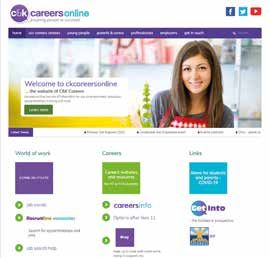
Welcome
Choosing subjects for key stage 4, is the first decision young people
will have to make that may affect their career choices in the future.

Key stage 4 is when students study for national qualifications such as
GCSEs. Most students will take these in Years 10 and 11, but in some
schools, students start these in Year 9.

This booklet provides information and advice to parents and carers,
about the decisions young people have to make in Year 8 or Year 9.
It contains general information about the subjects and qualifications
available to young people, and also ‘useful websites’ on pages
14, 15 and 19 to enable you to do more research. Each school will
produce an options booklet with more detailed information about
what they offer and also hold an options evening, where young
people and their parents and carers can find out more.

The majority of the information in this booklet is for people who live
and study in England.
For people living in Northern Ireland, look at www.nidirect.gov.uk/
campaigns/careers
For people living in Scotland, look at www.myworldofwork.co.uk
For people living in Wales, look at https://careerswales.gov.wales
Contents

How to choose subjects and                                              page 4
qualifications for key stage 4

Key stage 4 curriculum                                                  pages 5-6

Qualifications                                                          pages 7-11

Labour market information (LMI)                                         pages 12-15

Learning options 16+                                                    pages 16-17

How you can help and useful                                             pages 18-19
websites

Disclaimer
C&K Careers is not responsible for the content of external websites. The information in this booklet
was correct at the time of writing, however, please be aware that the information may change.

Copyright
This information must not be reproduced without prior permission from C & K Careers Ltd.
How to choose subjects and
    qualifications for key stage 4
    When thinking about choosing subjects and qualifications that are
    right for them, young people need to consider:
    • The options available to them at their own school
      In most schools, young people are allocated to a ‘pathway’.
      Often, this is a colour or a letter. Which pathway they are on will
      affect which subjects and qualifications they can take.
    • Their career ideas
      Specific subjects at GCSE level are required for some careers.
      For information about different careers, including subjects
      required, look at https://nationalcareers.service.gov.uk/explore-
      careers or talk to the careers adviser in school. Young people
      who are uncertain about their career ideas, could try doing a
      career matching programme such as Jed, Kudos, Fast Tomato or
      U-Explore, which many schools subscribe to.
    • How they learn best
      Vocational qualifications, such as BTECs, are usually more practical
      and are assessed through coursework, projects and tests. GCSEs
      are mainly assessed by exams. Look at pages 7-9 for more
      information about qualifications at key stage 4.
    • How choosing or dropping a subject will affect the courses
      they can choose in the future
      Some subjects, such as languages and the sciences, build on prior
      learning and cannot be studied at a higher level without studying
      them at GCSE.
    • Which subjects they are good at and enjoy
      It is likely that young people will achieve higher grades in subjects
      they enjoy studying. Achieving higher grades will mean more
      options are available after Year 11.
    • Labour market information (LMI)
      LMI can help young people make informed choices when making
      career-related decisions. For more information, see page 12.

4
                                                                              4
Key stage 4 curriculum
Introduction
Every state-funded school must offer a curriculum which is
balanced and broadly based, and which:
• promotes the spiritual, moral, cultural, mental and physical
development of pupils at the school and of society
• prepares pupils at the school for the opportunities,
responsibilities and experiences of later life.
In addition, all local authority maintained schools in England, are
legally required to follow the statutory national curriculum which
sets out the subjects that should be taught to all pupils. More
information about these subjects is outlined below.
Compulsory subjects
At key stage 4, English, maths and science are ‘core’ national
curriculum subjects that all students must study - most young
people will take GCSEs in these. ‘Science’ can be taken as
separate GSCEs - such as biology, chemistry and physics or as
a double GCSE in combined science. Other compulsory subjects
are called ‘foundation’ subjects and include computing, physical
education and citizenship. Schools must also provide religious
education and sex and relationship education, but young people
do not need to take exams in these.
Optional subjects
These are subjects that young people can choose to take
alongside compulsory subjects. Every school will offer a different
range of subjects and qualifications - it is important to check each
school’s options booklet.
Choosing a good spread of subjects will help keep options open
after Year 11. Some subjects, for example biology, chemistry,
physics and some languages, have to be taken at key stage 4, if
young people want to study them at a higher level later.
5Most schools will not offer every subject to every student. Students
will be put into pathways, based on their ability and results from
assessments such as Year 6 SATs and Year 7 and 8 exams.
Schools must offer at least one subject from each of these areas:
• arts (such as dance, music, art and design and drama)
• design and technology
• humanities (such as history and geography)
• modern foreign languages.
These subjects not only help to develop students’ knowledge, but
also their skills, for example:
• Arts subjects can help develop skills in creativity, adaptability,
team work, imagination, research, time management and visual
and spatial awareness.
• Design and technology can help develop creative thinking,
communication skills, planning and computer visualisation.
• Humanities can help develop critical reasoning, problem solving,
open-mindedness, the ability to understand abstract concepts,
self-reliance and the ability to discuss ethical and moral topics.
• Modern foreign languages can help develop confidence, quick
thinking, assessment skills and memory.
If young people don’t have a specific career in mind, choosing a
broad range of subjects that help to develop a range of skills would
be best.
English Baccalaureate (EBacc)
The EBacc is a school performance measure and, as such, young
people do not receive an EBacc qualification or certificate. It is a set
of subjects at GCSE, that the government believes keeps young
people’s study and career options open. Subjects included in the
EBacc are English language and literature, maths, geography or
history, a language and either combined science or three single
sciences - which can include computer science. The government’s
ambition is to see 75% of pupils studying the EBacc subject
6 combination at GCSE by 2022, and 90% by 2025.Qualifications
Qualifications at key stage 4
As well as choosing which subjects to study at key stage 4, young
people may also have to choose the type of qualifications they
want to study, depending on what is offered by their school. They
can choose between GCSEs and vocational qualifications - or a
mixture of both.
GCSEs
• The majority of students will take some GCSEs. GCSEs are
offered in over 40 subjects, although most schools will only offer
a selection.
• Examples of GCSE subjects include English, maths, French,
history, geography, computer science and biology.
• GCSEs are graded from 9-1 (old grades A*-G). To give young
people the most options after Year 11, they should aim to
achieve grades 9-4 (equivalent of old grades A*-C).
• To study some subjects after Year 11, such as maths and the
sciences, GCSE grades 9-6 will be required.
• GCSEs are assessed by exams at the end of two or three years
of study.
Vocational qualifications
• Vocational qualifications are related to an area of work.
• They are more practical than GCSEs and the majority of
assessment is through coursework, although they do also include
some exams.
• Different awarding bodies offer vocational qualifications, for
example BTEC, City & Guilds, IMI, NCFE CACHE, OCR Cambridge
National and WJEC - there are others.
• At key stage 4, vocational qualifications are offered at different
levels - entry level, level 1 and level 2. Levels are explained on
page 9.
• At level 2 (GCSE level), they are graded Distinction*, Distinction,
Merit and Pass.
7• You may see vocational qualifications at level 1 and level 2
referred to as ‘technical awards’. Technical awards are the
equivalent of GCSEs. Young people can choose to study technical
awards alongside GCSEs, depending on what their school offers.
• They are currently available in a wide range of subjects, but this is
under review and may change in the future. Examples include:
Art and design Automotive Business and
maintenance enterprise
Child development Construction and Digital information
the built technology
environment
Engineering Health and social Hospitality and
care catering
Performing arts Sport science Travel and tourism
Most schools will only offer a selection of these subjects, so it is
important to check each school’s options booklet.
With vocational qualifications, students have to undertake a number
of units, which allow them to demonstrate their technical skills and
knowledge and relate them to practical situations. Students who
have lost interest in traditional subjects and methods of assessment,
may prefer the subjects offered by this type of qualification.
8 8Qualifications at different levels
Level 3
A Levels
T Levels
Post-16
BTEC Level 3 Extended Certificate/Diploma/
Foundation Diploma/Extended Diploma
NVQ/VQ Level 3
Advanced Apprenticeship
Level 2
GCSE grades 9-4
BTEC Level 2 Certificate/Extended Certificate/
Diploma
NVQ/VQ Level 2
Key Stage 4
and Post-16
Intermediate Apprenticeship
Entry Level and Level 1
GCSE grades 3-1
BTEC Level 1 Certificate/Diploma
NVQ/VQ Level 1
Entry Level 1-3 Certificates
in English, maths and vocational subjects
Most students at key stage 4 work for qualifications at entry level,
level 1 or level 2. Schools and careers advisers will help young
people choose qualifications at the right level for them.
BTEC, is just one example of a vocational qualification - there are
others. Please visit www.ckcareersonline.org.uk/qualifications-guide
for more information.
9Post-16 qualifications
After Year 11, young people can choose from a range of subjects
and qualifications, at different levels. The decision about which
qualifications to take, and at what level, will depend on the results
they get at key stage 4. For example, to study level 3 qualifications,
at least five GCSEs at grades 9-4 are usually required.
Qualifications at level 3
A levels
• A levels are offered in subjects similar to those studied at GCSE,
for example maths, English, French, history and biology. Usually
three subjects are studied.
• At least five GCSEs at grades 9-4, including English and maths, are
needed to study A levels, and to study some subjects, GCSEs at
grades 9-6 will be required.
• They are two year courses, which are assessed mainly by exam.
• A levels are offered by most school sixth forms, sixth form colleges
and some further education colleges.
Vocational qualifications
• Vocational qualifications are available in a wide range of subjects,
such as animal management, applied science, tourism and sport.
• BTECs are one type of vocational qualification - there are others,
such as City & Guilds and Cambridge Technicals.
• At least five GCSEs at grades 9-4, are usually needed to study a
BTEC at level 3.
• Vocational qualifications are available in different sizes - the
equivalent of between one and three A levels. This means that,
young people can study one or more BTEC subjects (or an A level
alongside a BTEC), but this will depend on what is offered by
different schools and colleges.
• Depending on the size of qualification, they are one or two year
courses and are assessed mainly by coursework.
10Getting Started
in Careers
2021
Decisions in Year 8 or 9
Information for
parents and carers
How C&K Careers
can helpHelp from C&K Careers Careers advisers Careers advisers from C&K Careers work in most schools across Calderdale and Kirklees. They provide information, advice and guidance to students in groups or in one-to-one interviews, and also attend parents and options evenings. www.ckcareersonline.org.uk The website of C&K Careers provides a wide range of careers- related information, including LMI and links to other useful websites. It also has a link to Jed - a career matching programme - which young people can use to match their interests to different careers. Jed also provides information about over 800 jobs. They will need to ask school for a code to use Jed and to access some of the information on the website. Contacting C&K Careers Young people and/or their parents and carers can contact C&K Careers for support, advice and guidance using the Chat service - see the details above. The service is available Monday to Friday, 9.00am - 5.00pm and Thursday, 9.00am - 8.00pm.
Careers information
                    Young people will be given a copy of
                    Directions at school in Year 8 or 9. The
                    booklet, produced by C&K Careers, provides
                    information, quizzes and activities around
                    option choice, as well as an introduction to
                    choices after Year 11.

 In Year 11, young people will receive a
 copy of Get Organised or Get Ahead
 at school. These booklets provide
 information about all their options
 after Year 11.

                  Parents and carers of
                  young people in Year 11,
                  will also receive a copy
                  of Decisions - a guide to
                  post-16 options.
                                      C&K Careers produces over
                                      200 leaflets about a range of
                                      careers-related topics. They
                                      can be downloaded from
                                      ‘Careers info’ at
                                      www.ckcareersonline.org.uk
                                      Ask in school for a code to use
                                      ‘Careers info’. Young people
                                      may also find our leaflets in
                                      their careers library at school.
If you would like information in another format, such as large print,
please contact C&K Careers on 01484 242000.

Please note: not all schools in Calderdale and Kirklees choose to
receive services from C&K Careers.
Places to study locally at key stage 4
Most young people will stay at their current school, however there are
schools which admit pupils in Year 9 or Year 10 - university technical
colleges (UTCs) and studio schools.
schools See page 15 for more information.
If you are considering one of these options, research the qualifications
offered by the current school and what the UTC or studio school offers,
to help you decide.
Below are some examples of local UTCs
• UTC Leeds
Specialisms: engineering and advanced technology - you can start
here in Year 10 or Year 12.
• UTC Sheffield Olympic Legacy Park
Specialisms: computing, health sciences and sports science - you
can start here in either Year 9 or Year 12.
• UTC Sheffield City Centre
Specialisms: creative and digital media and engineering and
advanced manufacturing - you can start here in either Year 9 or
Year 12.
Details of all UTCs can be found at www.utcolleges.org
Studio schools are similar to UTCs, in that they have employer
involvement in the curriculum. In the local area, there is the Creative
and Media Studio School, look at www.studio-school.org.uk for more
information.
Locally, Leeds City College also offers an alternative to school at their
14+ Apprenticeship Academy - for more details, visit
www.leedscitycollege.ac.uk/14-apprenticeship-academy• At level 3, vocational qualifications are offered by some
school sixth forms and sixth form colleges, and by most further
education colleges.
T levels
• T levels are new, two year courses, the first of which started in
September 2020.
• They are the equivalent of three A levels and have been
developed with employers, so that their content meets the
needs of industry.
• T Levels offer students a mixture of classroom learning and ‘on-
the-job’ experience during an industry placement of at least 315
hours (approximately 45 days).
• The first three T Levels are now available at selected schools
and colleges. A further seven T Levels will be available in
September 2021, with the remaining 14 starting in either 2022
or 2023.
• See www.tlevels.gov.uk for more information.
Qualifications at level 2 and below
• Vocational qualifications are available at entry level, level 1 and
level 2 - for those young people who do not achieve GCSEs at
grades 9-4.
• As at level 3, they are available in a wide range of subjects from
animal care and art and design to sport and leisure and vehicle
maintenance and repair.
• Usually, just one subject is studied.
• Most courses will last for one year.
• After successfully completing one level of qualification, it is
possible to move up to the next level.
• Colleges offer vocational qualifications at all levels - including at
level 2 and below. School sixth forms and training providers may
also offer them.
11Labour market information (LMI)
LMI includes facts and figures about jobs and employment, such as:
• Which jobs are growing or decreasing in number. For example, it is
predicted that in the future, the number of nurses will increase, but
the number of printers will decrease.
(Source: www.lmiforall.org.uk/careerometer)
• The qualifications and skills you need to do a job.
• How your interests and skills are relevant to particular jobs.
• What jobs there are, in different areas of the country. For
example, the South East made up the largest proportion of
construction employment in 2018, with 14.5% of all construction
employment. The North East made up only a small proportion of
construction employment with 3.2%.
(Source: www.ons.gov.uk/businessindustryandtrade/constructionindustry/articles/
constructionstatistics/2018)
Young people can use LMI to find out what careers might be in
demand in the future and what skills may be needed. Changes in
technology and the climate mean that new jobs, requiring new skills
and qualifications, are appearing all the time.
Current trends in the labour market
The impact of Brexit and the coronavirus (COVID-19) pandemic on
the labour market, means it is difficult to predict what might happen
to different sectors of the economy in the future. However, there are
some general trends which are likely to remain.
• In the future, more people will have higher level qualifications and
more jobs will need people with higher level qualifications.
(Source: www.gov.uk/government/publications/labour-market-and-skills-projections-2017-
to-2027)
• Replacement demand (the need to replace workers who are
retiring) will create job opportunities across most occupations.
(Source: www.gov.uk/government/publications/labour-market-and-skills-projections-2017-
to-2027)
12• Employment in manufacturing is expected to fall, because of
increasing automation in the sector.
(Source: www.gov.uk/government/publications/labour-market-and-skills-projections-2017-
to-2027)
• The UK’s ageing population is expected to generate a large
number of additional jobs in health and social care. These jobs
are less affected by automation.
(Source: www.gov.uk/government/publications/labour-market-and-skills-projections-2017-
to-2027)
• Digital skills are important across most jobs. Research has shown
that, ‘digital skills are becoming near-universal requirements
for employment. Acquiring specific digital skills makes career
progression, as well as a pay increase, more likely.’
(Source: www.gov.uk/government/publications/current-and-future-demand-for-digital-skills-
in-the-workplace))
• The demand for STEM (science, technology, engineering and
maths) skills is growing. Many employers in STEM sectors,
say they are struggling to recruit people with the skills and
qualifications they need to fill the jobs they have.
(Source: www.stem.org.uk/news-and-views/news/skills-shortage-costing-stem-sector-
15bn)
Using LMI
By doing their research, young people can make an informed choice
about the subjects and qualifications they choose. This doesn’t
mean that just because the workforce in a particular career is not
expected to grow, then they shouldn’t consider it, but it may mean
it is more difficult to get into. Similarly, young people should not
choose subjects that they don’t enjoy or find hard.
Developing key skills and qualities
qualities
Studying for GCSEs and vocational qualifications provides young
people with the opportunity to develop the key skills and qualities
that employers say are important. These include:
communication skills, creativity, enthusiasm, IT skills, literacy and
numeracy skills, motivation, organisation, reliability, resilience,
teamwork, time management, willingness to learn
13To further develop their skills and qualities, young people could help
to organise events at school or get involved in other extracurricular
activities. They could take part in programmes, such as the Duke
of Edinburgh’s Award www.dofe.org or, at the end of Year 11, the
National Citizen Service https://wearencs.com
They could also consider:
Work experience - some schools will offer students the opportunity
to undertake work experience in Year 10 or Year 11. Young people
could also find their own work experience during the school holidays.
It can help them decide if they would like their chosen career area,
as well as helping them to develop some of the skills and qualities
employers are looking for.
Employer visits - these may be arranged by schools. They can help
students find out about different careers and jobs within specific
industries. Schools may also arrange for employers to talk to
students in assemblies, at careers fairs or via Skype or Zoom.
Volunteering - is a good way of gaining experience and developing
key skills and qualities. Look at https://do-it.org for opportunities.
Useful websites
General LMI
https://nationalcareers.service.gov.uk/explore-careers - information
about hundreds of jobs, including the skills and knowledge needed
for each one.
www.prospects.ac.uk/job-profiles - information about 400+ jobs,
including important skills and career prospects.
www.ckcareersonline.org.uk/uncategorised/93-job-trends - use the
Careerometer to find information about the projected change in the
workforce for hundreds of jobs.
https://icould.com/explore - information about employment by region,
projected future employment and the importance of different skills
for a range of jobs.
14STEM
www.futuremorph.org - careers related to science and maths.
https://edu.rsc.org/future-in-chemistry/career-options
www.tomorrowsengineers.org.uk - projects and programmes
related to careers in engineering.
www.etrust.org.uk/young-people - STEM placements, projects and
experience days.
www.rsb.org.uk/careers-and-cpd/careers - careers in biology.
https://enginuity.org/career-pathways - careers in engineering and
advanced manufacturing.
www.womeninstem.co.uk
www.mathscareers.org.uk
www.healthcareers.nhs.uk - careers in the NHS.
Atypical admissions
Most young people will stay at their current school for key stage 4.
However, those considering vocational options in Years 10 and 11,
could leave and study elsewhere. Some further education colleges
offer full-time courses for young people in key stage 4. There
are also:
UTCs
UTCs are schools for 14-19 year olds and have a special focus
on STEM subjects. Students combine studying traditional GCSEs
and A levels with specialist technical qualifications, learning skills
that employers say they need. See www.utcolleges.org for more
information about UTCs and where they are located.
Studio schools
Studio schools are small schools, teaching mainstream qualifications
through project-based learning. They are similar to UTCs in that
they have employer involvement in the curriculum. They focus on
developing skills needed for employment or further education,
through personal coaching and work experience.
15Learning options 16+
After Year 11, young people must stay in learning until they are 18.
This requirement is known as ‘Raising the Participation Age’ or RPA.
Staying in learning does not mean that they have to stay at school.
They could go to college, get an apprenticeship or traineeship or
start full-time work, voluntary work or self-employment (with part-
time education or training).
Currently, young people have to continue to study English and/or
maths if they do not get a grade 9-4 in the subject at GCSE.
Full-time education
After Year 11, young people can study at a school sixth form,
form sixth
form college,
college further education college or with a training provider.
provider
They can apply for more than one course with more than one
provider. Courses are available at different levels - see pages 9-11
for more information about post-16 qualifications.
Apprenticeships and traineeships
Apprenticeships are jobs with training and are open to anyone over
the age of 16. They are available in a wide range of careers and
industries, from baker to nurse and marine engineer to marketing
executive. Finding an apprenticeship depends on the vacancies that
employers have.
At the age of 16 or 17, young people usually do an apprenticeship at
level 2 (intermediate) or level 3 (advanced). Employers set their own
entry requirements, so they can vary. For level 2 apprenticeships,
employers may ask for some GCSEs at grades 4 or 5, for level 3
apprenticeships, employers will usually ask for them.
Apprenticeships are also available at levels 4-7 and are known as
‘higher apprenticeships’. Some will also include a degree and are
called ‘degree apprenticeships’. Apprenticeships at these levels
include actuary, aerospace engineer, chartered surveyor, police
16constable and solicitor. Usually, level 3 qualifications are needed to
get onto an apprenticeship at level 4 or above.
Traineeships are designed for young people who would like a
job or apprenticeship, but need help to get the knowledge, skills
and experience employers are looking for. They include training to
prepare a young person for work, support with English and maths
if needed and a work placement. A traineeship can last from six
weeks up to one year.
Full-time work, voluntary work or self-employment
Under the requirements of RPA, after Year 11, young people can
spend 20 hours or more a week working (including for themselves)
or volunteering. However, they must also undertake some part-time
education or training - even if they have to do this in the evening or
by distance learning.
Young people considering employment or an apprenticeship, need
to think about the skills and qualities employers are looking for and
undertake activities at school, or in their own time, to help develop
them. See page 14 for ideas of some of the activities they could do.
After Year 13
It may seem a long way off, but parents and carers have told us
they want to know about the options available to young people
after Year 13 or when they are aged 18+.
Young people aged 18+ have the same options as they have
after Year 11. However, they no longer have to stay in learning.
In addition, if they have qualifications at level 3, they could also
consider higher education.
Higher education is available at universities and some colleges.
Young people can study for qualifications, such as a foundation
degree, HND or degree. Most degrees last for three years. For
more information, go to www.ucas.com
17How you can help
Parents and carers can help young people with the decisions they
have to make about their options by:
• attending parents and options evenings
• talking through all the options. Evidence shows that young
people value what their parents or carers think - so you have an
important role in helping them to choose what is right for them.
Young people need to be encouraged to:
Ask for help
This can be from their teachers
and their careers adviser.
Work hard Think for themselves
It is important to gain good They should choose subjects
grades, especially in English and qualifications based on
and maths. They also need what interests, motivates and
a good record of attendance suits them. They should not
and behaviour at school, as choose subjects to stay with
employers, training providers, their friends or because they
sixth forms and colleges will think they are ‘girls’ or ‘boys’
ask them for a reference. subjects.
Develop their skills and Find out
qualities They should get as much
They could ask their school information as they can
about extracurricular activities about the qualifications and
that provide opportunities to subjects offered by their
develop different skills and school.
qualities and also think about Do their choices fit in with any
how they use their spare courses or careers they may
time to learn new things. want to do at 16+?
18Useful websites
Below, are some websites you may find useful. For more websites,
look at www.ckcareersonline.org.uk/useful-websites
Information about different careers
https://nationalcareers.service.gov.uk/explore-careers
https://icould.com - young people can take the ‘Buzz quiz’ to help
them think about careers that would suit them.
Full-time courses after Year 11
See individual school, college and training provider websites.
Apprenticeships and traineeships
www.apprenticeships.gov.uk
www.gov.uk/guidance/traineeship-information-for-trainees
Money for studying at sixth form or college
www.gov.uk/further-education-courses
Working while still at school
www.gov.uk/child-employment
Benefits
www.turn2us.org.uk
www.gov.uk/child-benefit
www.gov.uk/child-tax-credit
Citizens Advice
www.citizensadvice.org.uk
Information for students with disabilities
www.disabilityrightsuk.org - click on ‘How we can help’, ‘Advice/
Information’ and look at the factsheets.
Voluntary work
https://do-it.org
Self-employment
www.gov.uk/working-for-yourself
19What parents said about
Getting Started in Careers 2020
The subjects and qualifications young
people can choose from, have changed so
much since I was at school. This booklet
has really helped me understand the
choices my son has and talk to him about
his career ideas.
Kim
A really helpful guide to option choices in
Year 8 and then in Year 11 and beyond. The
information about employability skills and
the labour market was particularly useful.
Sadiq
I picked up this booklet at the options
evening at my son’s school. It’s been a
useful introduction to help me, to help him.
Ian
www.ckcareersonline.org.uk
Join the conversation: ckcareers @ckcareers1
Getting Started in CareersYou can also read


