Global warming found to be culprit for flood risk in Peruvian Andes, other glacial lakes - Phys.org
←
→
Page content transcription
If your browser does not render page correctly, please read the page content below
Global warming found to be culprit for flood
risk in Peruvian Andes, other glacial lakes
4 February 2021

                                                           to determine whether an individual glacier's retreat
                                                            can be linked to human-induced climate change.
                                                            The retreat of mountain glaciers has several
                                                            consequences, including creating basins in the
                                                            space left by the retreating glacier. Precipitation
                                                            and meltwater collects in these basins to form
                                                            glacial lakes. Recent work has shown a rapid
                                                            worldwide growth in the number and size of high-
                                                            elevation glacial lakes.

                                                           "We believe our study is the first to assess the full
Historical photographs (first three views) and satellite   set of linkages between anthropogenic climate
images show how Lake Palcacocha has grown as the           change and the changing glacial lake outburst flood
glacier has receded. The lake is now about 34 times its    hazard," Roe said. "The methods used in our study
volume in 1970. Credit: Stuart-Smith et al./Nature         can certainly be applied to other glacial lakes
Geoscience
                                                           around the world."

As the planet warms, glaciers are retreating and
causing changes in the world's mountain water
systems. For the first time, scientists at the
University of Oxford and the University of
Washington have directly linked human-induced
climate change to the risk of flooding from a glacial
lake known as one of the world's greatest flood
risks.

The study examined the case of Lake Palcacocha
in the Peruvian Andes, which could cause flooding
with devastating consequences for 120,000
residents in the city of Huaraz. The paper,
published Feb. 4 in Nature Geoscience, provides
new evidence for an ongoing legal case that
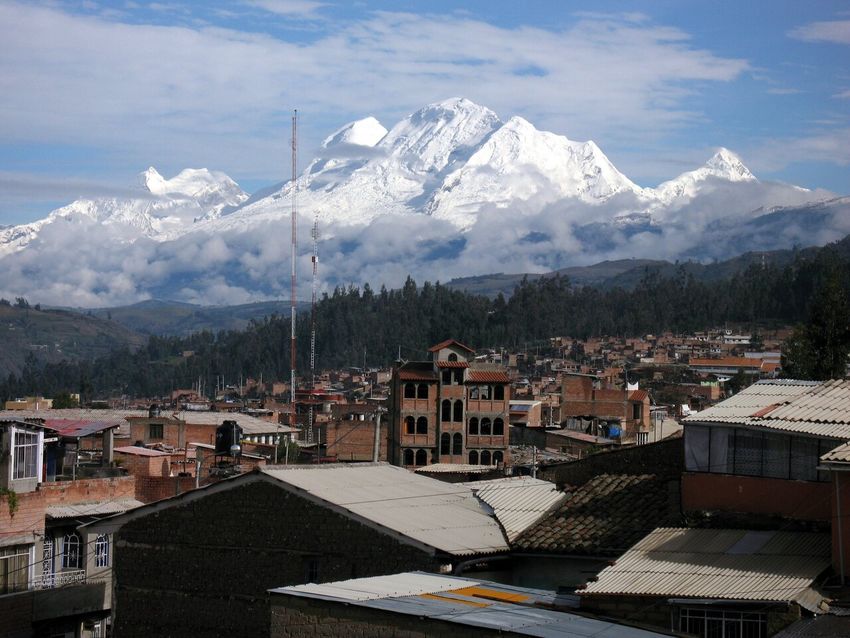
hinges on the link between greenhouse gas         Huaraz is a Peruvian city of about 120,000 residents that
emissions and particular climate change impacts. lies 1.8 miles (3 kilometers) above sea level, in view of
                                                           Palcaraju Glacier and other peaks in the Cordillera
"The scientific challenge was to provide the               Blanca mountains. Credit: Uwebart/Wikimedia
clearest and cleanest assessment of the physical
linkages between climate change and the
changing flood hazard," said co-author Gerard
Roe, a UW professor of Earth and space sciences. The new study first calculated the role of human
                                                 emissions in the observed temperature increase
In 2016, Roe and colleagues developed a method since the start of the industrial era around Palcaraju

                                                                                                             1/3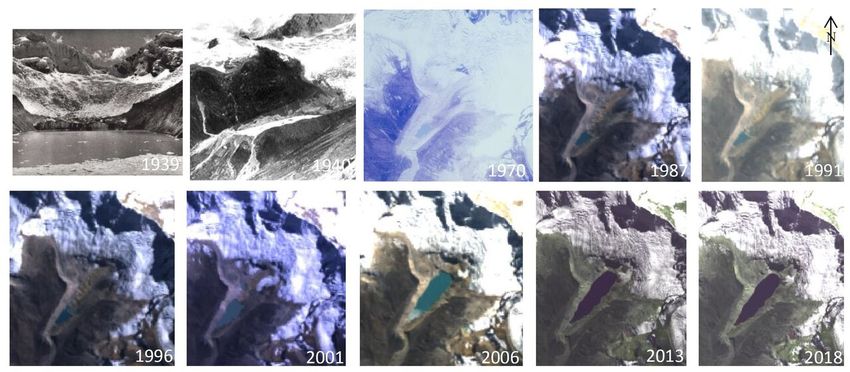
Glacier. It finds that human activity is responsible for
95% of the observed 1 degree Celsius (1.8 degrees
Fahrenheit) warming in this region since 1880.

The authors then used the UW-developed
technique to assess the relationship between these
warming temperatures and the observed long-term
retreat of the glacier that has caused Lake
Palcacocha to expand. Results show it is virtually
certain, with greater than 99% probability, that
human-induced climate change has caused
Palcaraju Glacier's retreat.

Lead author Rupert Stuart-Smith, a doctoral
student at Oxford, then used two methods to
assess the hazard of glacial lake outburst flooding,       Lake Palcacocha last burst its banks in 1941, killing at
in which an avalanche, landslide or rockfall induces       least 1,800 people in the city of Huaraz. Known as one of
                                                           the world's most dangerous lakes, its water level has
a tsunami wave that overtops the lake's banks, to
                                                           risen in recent years with the shrinking of Palcaraju
pinpoint how Lake Palcacocha's growth affects the
                                                           Glacier, which lies directly to the north. Credit: Georg
flood risk faced by the city of Huaraz below.              Kaser/Wikimedia

"We found that human influence on
climate—through greenhouse-gas emissions—is
responsible for virtually all of the warming that has      "Crucially, our findings establish a direct link
been observed in the region," said Stuart-Smith,           between emissions and the need to implement
who spent the summer of 2019 at the UW. "The               protective measures now, as well as any damages
study shows that warming has caused the retreat of         caused by flooding in the future," Stuart-Smith said.
the Palcaraju Glacier, which in turn has greatly
increased the flood risk."                              This is not the first time Huaraz has been
                                                        threatened by climate change. In 1941, an outburst
The study provides new evidence for an ongoing          flood from Lake Palcacocha, resulting from an ice
case in the German courts in which Saúl Luciano         and rock slide, killed at least 1,800 people. The
Lliuya, a farmer from Huaraz, has sued RWE,             study also found this flood to be influenced by
Germany's largest electricity producer, for its role in human-induced climate change—making it one of
creating global warming. The suit seeks                 the earliest identified fatal impacts of climate
reimbursement for current and future flood-risk         change.
reduction measures.
                                                           The lake's recent growth strains decades of
                                                           engineering efforts since the 1970s to contain the
                                                           lake's water.

                                                           "Around the world, the retreat of mountain glaciers
                                                           is one of the clearest indicators of climate change,"
                                                           Roe said. "Outburst floods threaten communities in
                                                           many mountainous regions, but this risk is
                                                           particularly severe in Huaraz, as well as elsewhere
                                                           in the Andes and in countries like Nepal and
                                                           Bhutan, where vulnerable populations live in the
                                                           path of the potential floodwaters."

                                                                                                            2/3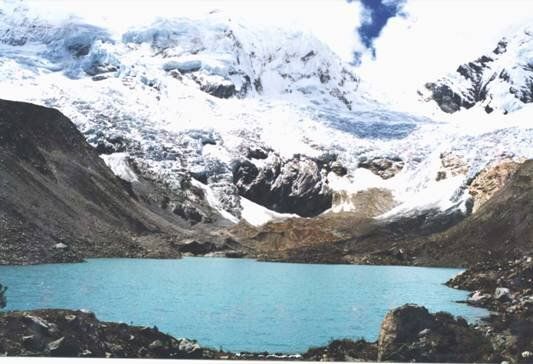
An interactive map is available at
                                   tableau.washington.edu/views/MapofHuaraz/FullMa
                                   p

                                     More information: Increased outburst flood
                                   hazard from Lake Palcacocha due to human-
                                   induced glacier retreat, Nature Geoscience (2021).
                                   DOI: 10.1038/s41561-021-00686-4 ,
                                   www.nature.com/articles/s41561-021-00686-4

                                     Provided by University of Washington
                                   APA citation: Global warming found to be culprit for flood risk in Peruvian Andes, other glacial lakes
                                   (2021, February 4) retrieved 11 May 2021 from https://phys.org/news/2021-02-global-culprit-peruvian-
                                   andes-glacial.html

                                   This document is subject to copyright. Apart from any fair dealing for the purpose of private study or research, no
                                   part may be reproduced without the written permission. The content is provided for information purposes only.

                                                                                                                                                3/3

Powered by TCPDF (www.tcpdf.org)
You can also read


