GYMS FITNESS FACILITIES - GUIDANCE ON PREPARING WORKPLACES FOR COVID-19 - Wisconsin Economic Development ...
←
→
Page content transcription
If your browser does not render page correctly, please read the page content below
GUIDANCE ON PREPARING WORKPLACES FOR COVID-19

 GYMS           FITNESS FACILITIES
          AND

                      1
Gyms and fitness facilities provide an important outlet
                                                                       for people seeking to improve their health and well-being.
                                                                       These facilities span a wide range of types, ranging from
                                                                       full-service facilities to specialty and boutique offerings.
                                                                       While many facilities have found ways to connect with
                                                                       their customers virtually, there is no replacement for the
                                                                       use of equipment and personal training services to meet
                                                                       individual customer needs. To ensure consistency in
                                                                       keeping you and your employees safe, this guide is
                                                                       ntended to provide general guidelines and best practices
                                                                       for gyms and fitness facilities looking to take steps to open
                                                                       their facility when it is time to do so. In addition, please see
                                                                       the “General Guidance for All Businesses” document for
                                                                       guidance that applies to all industries, and please consult
                                                                       the other available industry guides as relevant for your
                                                                       specific business type.

                                                                       Gyms and fitness facilities are faced with many
                                                                       challenges that must be addressed before reopening,
                                                                       including employee training and protection, minimizing
                                                                       the risk of transmission in the facility, and protecting
                                                                       customers. This document is designed to address these
                                                                       and other key challenges. Using personal protective
                                                                       equipment (PPE), physical barriers, physical distancing,
                                                                       appropriate cleaning and disinfection procedures, and the
                                                                       other steps described below can help minimize the
                                                                       potential for exposure and the spread of COVID-19.

Recommendations for Gyms
and Fitness Facilities
Employee health and hygiene
   Employees who have a fever or other symptoms of COVID-19                       Carry a towel. If employees get the urge to sneeze or
   should be instructed to stay home. Consider a wellness                         cough, they should use the towel to cover their nose,
   check of employees each day.                                                   mouth and mask, then wash their hands and face
                                                                                  thoroughly before going back to work.
   Maintain an adequate supply of paper towels, soap and hand
   sanitizer to allow employees to practice proper hand hygiene.
   Provide tissues for proper cough/sneeze etiquette and
                                                                       Clean and disinfect
   no-touch disposal receptacles.                                          According to Johns Hopkins School of Medicine and other
   Employees should take these steps:                                      credible health resources, COVID-19 is not spread through
                                                                           sweat. Still, items touched by many people in a gym (like
          Wash hands on arrival at work, after working with
                                                                           barbells, weight machines and aerobic fitness equipment)
          each member, after touching their mask, after using
                                                                           must be regularly disinfected because respiratory droplets
          the restroom and when leaving work.
                                                                           can settle on them.
          Wear a mask at work if physical distancing cannot be
          maintained on the job (for example, personal trainers
          and staff assisting members with
          exercises).
          Let the employer know if they have concerns about
          the PPE that is being provided.
                                                                           PROTECT       WASH OFTEN        DISINFECT         CAUTION
                                                                   2
Maintain an adequate supply of cleaning and disinfection              Towels and work clothing should be placed in plastic bags
products. The U.S. Environmental Protection Agency (EPA)              after each use, treated as potentially contaminated, and
has developed a list of products that meet EPA criteria for use       laundered by washing and drying on the highest
against the COVID-19 virus. Review product labels and safety          temperature setting allowable for the fabric. Face coverings
data sheets and follow manufacturer specifications.                   should be worn when staff handles dirty laundry. If members
                                                                      bring towels to the facility, the towels must be brought in
If surfaces are dirty, they should be cleaned using detergent
                                                                      clean and taken home by the member after working out.
or soap and water prior to disinfection.
                                                                      Increase cleaning frequency for restrooms, showers and
Consider using a checklist or audit system to track how often
                                                                      locker rooms, and consider design changes:
cleaning is conducted.
                                                                             Doors to multi-stall restrooms should be able to
Identify staff members who will be responsible for ensuring
                                                                             be opened and closed without touching handles if
regular cleaning and disinfection.
                                                                             feasible. Consider adding a foot pull to the door if one
Provide materials for members to wipe/disinfect equipment                    is not already in place. Place a trash can by the door
before and after exercise at each location/station/piece of                  if the door cannot be opened without touching the
equipment.                                                                   handle, so restroom users can cover the handle with
Increase the number of wipe stations through the facility.                   a paper towel and easily dispose of it afterward.

If members do not wipe/disinfect equipment after exercise,                   For single-occupancy restrooms, provide signage
consider providing “ready to clean” tags that members can                    and materials (paper towels and trash cans) for
place on equipment after use, signaling staff to ensure                      individuals to use without touching the handles.
equipment is disinfected before the next use.                                Consider restricting access with a key to allow better
                                                                             monitoring of restroom use and prompt disinfection.
Establish “before and after” workout and locker room
handwashing or sanitizing for all members and staff. Provide                 Post signs indicating that toilet lids (if present)
handwashing stations at the front of the facility, or provide                should be closed before flushing.
hand sanitizer if handwashing is not feasible.                               Post signs asking members and employees to wash
Minimize sharing of work tools and equipment such as                         hands before and after using the restroom.
phones, keyboards, cash registers and point-of-sale devices.                 Provide paper towels and disconnect or tape off hand
If sharing is necessary, disinfect equipment before and after                air dryers.
each use.
                                                                             Only allow shower and locker room use if partitions
Clean HVAC intakes and returns daily.                                        are in place or signs have been posted to specify
                                                                             physical distancing requirements. If partitions or
                                                                             proper distancing are not possible, these facilities
                                                                             should remain closed.
                                                                             Water shoes should be worn in locker rooms and
                                                                             showers.
                                                                  3
Physical distancing for equipment layout                                  Basketball courts and other areas where physical contact
                                                                          sports occur should be closed.
and activities                                                            Saunas and steam baths should be closed or limited to one
                                                                          member or family unit at a time.
   Consider spacing equipment at least six feet apart, with
   greater distancing for treadmills and other high-exertion              Staff should monitor physical distancing requirements
   aerobic fitness equipment. Equipment can be arranged in                in large whirlpools or swimming pools in outdoor or
   an “X” pattern to provide greater distancing.                          well-ventilated spaces and limit the number of members
                                                                          based on the size of the pool. See the guidelines for
   Physical barriers can also be helpful to create distancing or          entertainment and amusement facilities for more
   segregate exercise areas.                                              information on pool reopening and safe operation.
   Limit the number of members in the facility at one time.               Water fountains should be closed, and members
   Only those members that are actually exercising should be              encouraged to bring their own water.
   inside the facility. Members should not check in at a front            Juice bars and other food service areas should follow
   desk or wait in a reception area.                                      guidelines for restaurants.
   Use self check-in, or place a barrier or partition between front       Establish prepay systems or self-checkout systems (e.g.,
   desk staff and members arriving to check in.                           portable credit card portals that are cleaned after each use).
   Consider developing online signup systems (e.g., first-come,           Discourage the use of cash.
   first-served) with set-duration (e.g., one hour) workout               If a prepay system is not feasible, consider using a plexiglass
   periods.                                                               partition between cashiers and members.
   Consider creating specific hours for older adults with                 Members should use their own pens to sign credit card
   admittance by reservation only.                                        authorizations. If a pen provided by the facility must be used,
   Use tape, markers, paint and signage to mark distancing for            it should be disinfected after each use. The same applies for
   members.                                                               touchpad use.
   Consider offering planned circuit type workouts that facilitate        Establish an isolated area for all delivery companies to drop
   distancing and allow for wiping/disinfection of equipment              off materials and supplies (i.e., minimize their presence in
   during recovery between exercises.                                     the facility).
   Group exercise classes should only be offered if distancing
   requirements can be maintained and there is no
   person-to-person physical contact.
                                                                      4
Face coverings and gloves                                              Member health and safety
   Supply face masks or cloth face coverings for all employees.           Use social media and other communication to educate
                                                                          members on the steps being taken for their protection and
   Instruct your employees in how to properly put on and
                                                                          what they need to do to protect staff as well.
   remove a face mask or cloth face covering. The U.S. Centers
   for Disease Control and Prevention (CDC) provides guidance             Here’s what to ask of members, in person and through your
   on how to properly wear a face covering and offers tutorials           communications:
   for how to make one.                                                          If you are sick, stay home. If you have a temperature,
   If gloves are used, ensure they are changed after working                     stay home. If someone in your house is sick, stay
   with each member and that staff wash their hands after                        home. If you have allergies and can’t control sneezing,
   removing gloves.                                                              stay home.
   All members should wear face coverings when entering                          Use online gym/workout services if possible.
   and leaving the facility, and should consider wearing a mask                  When walking through the facility, maintain a
   during workouts.                                                              distance of at least six feet from other members
   Consider making face masks available to members who do                        and employees if at all possible.
   not bring their own for use at your facility. Considerations                  Plan your workout routine ahead of time to avoid
   should be made for members who are unable or unwilling                        lingering and socializing. This will allow more
   to wear a mask or cloth face cover.                                           members to work out given the reduced occupancy
                                                                                 necessitated by distancing requirements.
Engineering controls                                                             Limit the items you touch within the gym to only
   Consult an HVAC professional about increasing ventilation                     the items you will use.
   rates, the percentage of outdoor air that circulates into the                 Wear a mask as you enter and leave the building.
   system, maintaining relative humidity at 40 to 60% and                        Consider wearing a mask during your workout.
   placing restrooms under negative pressure.
                                                                                 Avoid using lifting gloves or other personal items
   Workplaces should consider guidance from the American                         that are not easily cleaned.
   Society of Heating, Refrigerating and Air-Conditioning
                                                                                 Wipe down each piece of equipment before and after
   Engineers when discussing ventilation changes with HVAC
                                                                                 you use it, using a fresh wipe each time, and dispose
   professionals.
                                                                                 of the wipes appropriately.
   If fans such as pedestal fans or hard-mounted fans are used
                                                                                 Wash your hands before and after you leave the
   in the facility, take steps to minimize air from fans blowing
                                                                                 facility. If it is not possible to wash your hands, use
   directly from one person toward another. If fans are disabled
                                                                                 hand sanitizer when you enter and before you leave.
   or removed, employers should remain aware of possible heat
   hazards and take steps to mitigate them.

                                                                   5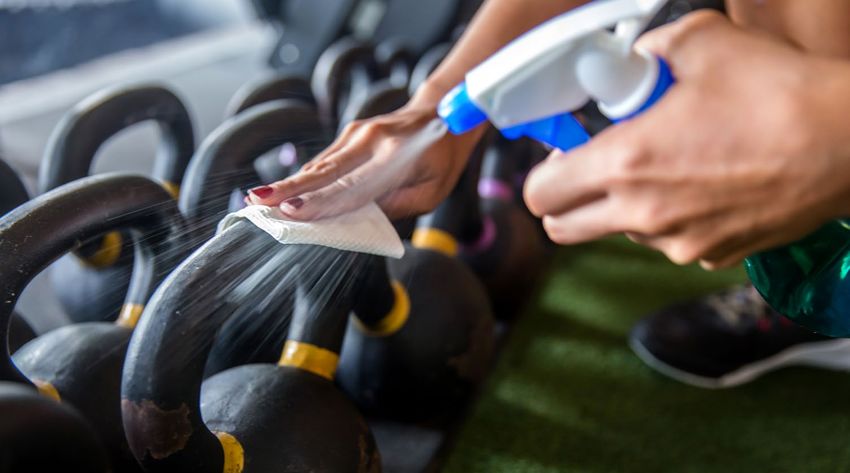
If you get the urge to sneeze or cough, put on your              Encourage members to use touchless payment options when
           mask (if not already wearing one) and cover your                 available. Minimize handling cash, credit cards, reward cards
           nose, mouth and mask with a napkin or handkerchief.              and mobile devices.
           Wash your hands and face thoroughly before
           returning to your activity.                                 Employee training, support and communication
           The facility has the right to refuse service to anyone
                                                                            Use routine meetings and emails to communicate with
           exhibiting symptoms or not following facility
                                                                            workers about actions being taken to prevent COVID-19
           guidelines.
                                                                            exposure.
   Consider a wellness screening with brief questions for
                                                                            Provide instruction and training to employees on topics
   members to enter the facility. For example:
                                                                            including:
           Have you, or has a person you have been in close
                                                                                     How to clean their work clothing properly at home
           contact with, been diagnosed with COVID-19 within
                                                                                     if laundry service is not provided
           the last 14 days? (Close contact is defined as six feet
           or less for more than 10 minutes.)                                        How to safely put on and emove gloves
           Have you experienced any cold- or flu-like symptoms                       Cleaning and disinfecting surfaces according
           in the last 72 hours (including fever, shortness of                       to product specifications
           breath, cough, sore throat or difficulty breathing)?                      Correct use of face masks or coverings
   Post signage on the front door letting members know about                         Physical distancing guidelines and ways to
   changes to your policies and instructing them to stay away if                     communicate them to members
   they are experiencing symptoms of COVID-19.
                                                                                     Employee illness reporting
   Install handwashing or sanitizing stations (with at least 60%
   alcohol if offering hand sanitizer) at the entrance to your              Train employees on how to recognize areas or practices that
   business and encourage members to use them.                              pose a risk for spreading the virus.

   Staff should visibly carry out proper sanitation practices               Define a process to quickly review concerns and provide
   and should actively encourage members to follow these                    mitigation strategies in these areas. Include a recognizing/
   practices.                                                               reporting module in your COVID-19 response plan.

   Remove all unnecessary touchpoints, especially those that                Consider assigning one or more employees to monitor
   cannot be sanitized.                                                     compliance with workplace guidance.

   Use disposable instead of reusable items whenever                        Post signage to remind your employees of safe practices,
   possible. Provide adequate trash receptacles, and increase               such as distancing, hand hygiene and cough/sneeze etiquette.
   trash removal frequency to accommodate additional waste.
   Discourage members from touching items they don’t intend            Additional resources
   to purchase.
                                                                       CDC Interim Guidance for Businesses and Employers to
                                                                       Plan and Respond to COVID-19: www.cdc.gov/coronavirus/2019
Business operations
                                                                       CDC General Business Frequently Asked Questions:
   Common-use areas (such as changing rooms, lounge areas,             www.cdc.gov/coronavirus/2019
   courtesy food and beverage bars, and child play areas) should
                                                                       American Industrial Hygiene Association Back to Work Safely webpage
   be closed if it is not possible to maintain social distancing and
                                                                       with guidance for gyms and workout facilities as well as other sectors:
   follow proper sanitizing practices.
                                                                       www.backtoworksafely.org
   The facility must maintain adequate records of its members,
                                                                       U.S. Occupational Safety and Health Administration Guidance
   including names, telephone numbers and visit dates, to
                                                                       on Preparing Workplaces for COVID-19: www.osha.gov
   assist if contact tracing becomes necessary. The facility must
   also maintain accurate work records of its staff for contact
   tracing purposes.

                                                                              IN PARTNERSHIP WITH WISCONSIN’S REGIONAL
                                                                              ECONOMIC DEVELOPMENT ORGANIZATIONS:
                                                                              7 Rivers Alliance                   Momentum West
                                                                              Centergy                             Prosperity Southwest
                                                                              Madison Region                       Grow North
                                                                               Economic Partnership                The New North
                                                                              Milwaukee 7                          Visions Northwest
CHECKLIST GUIDE FOR REOPENING
Your Gym or Fitness Facility
After reading through the available guidance for your business sector at wedc.org/reopen-guidelines use this checklist to ensure
that you have taken the necessary steps to open your business safely, protecting the health of your employees and customers.
In addition to reviewing this checklist, be sure to consult your local health department, as some communities may have
additional local regulations in place.
Policy Checklist
q Create a policy for identification and isolation of sick people, including employee self-monitoring, required reporting of illness,
sick leave policies and isolating individuals that become ill at work.
q Consider implementing a wellness screening with brief questions for customers to enter the facility.
q Assess leave policies for quarantined/isolated workers and those caring for sick family members.
q Create a policy on personal protective equipment (PPE). Recommend that employees wear face masks or cloth face coverings
when social distancing is not feasible, and recommend usage of face masks or cloth face coverings for public-facing activities.
q Connect employees to employee or community assistance resources such as the Wisconsin COVID-19 hotline (211)
or COVID-19 Resilient Wisconsin dhs.wisconsin.gov/covid-19
q Create a client service policy. To the extent possible, clients should wear face coverings when receiving services.
Recommend clients bring their own face mask or covering, and also provide them for clients who don’t bring their own.
Considerations should be made for clients who are unable or unwilling to wear a mask or cloth face cover. Refuse service
to any client who arrives with symptoms.
q Create a response plan in the event that an employee has COVID-19 symptoms or is suspected or confirmed to have COVID-19.
This should include criteria for impacted employees to return to work and guidance for identifying, communicating with and
accommodating potentially exposed workers.
Communications Plan Checklist
q Establish an employee communications schedule and develop a training plan for employees with modules on social distancing,
hygiene and sanitation best practices, what to do if they feel sick, proper use of PPE and cloth face coverings, and how to
educate customers about the new policies and practices.
q Develop a marketing plan for customers that addresses business signage, social media communications, new
business policies and customer instructions (stay home if you are sick, limit items you touch, closure of common areas,
hygiene including handwashing, social distancing reminder).
q Communicate with vendors/suppliers for contactless dropoff or to arrange deliveries during non-customer hours.
q Establish a system for continually updating customers on activity or service options and policies as circumstances change.
Facility Plan Checklist
q Post signage about policy changes for customers and employees.
q Provide tissues and no-touch trash receptacles.
q Set up sanitizer or handwashing stations in convenient locations around the business.
7q Remove unnecessary touchpoints and items that cannot be sanitized between uses (e.g., extra equipment, magazines).
Store any shared items behind counters and provide them to customers upon request so sanitizing can be completed
after each use.
q Install social distancing markers or directional arrows on floors to encourage maintaining distance of at least six feet where
possible, and to minimize contact.
q Increase physical space between equipment to six feet where possible. Consider greater distancing for high-exertion aerobic
fitness equipment such as treadmills. Equipment can be arranged in an X pattern to provide greater distancing.
q Provide disinfectant wipes adjacent to equipment for use before and after each exercise. Consider ‘ready to clean’ tags that
customers can place on equipment after each use.
q Consider adding clear plastic barrier protection at the cash register or entrance desk.
q Use disposable instead of reusable items whenever possible (e.g., drinking glasses, key cards).
q Close common areas such as lounge areas, courtesy food and beverage bars, and child play areas if possible. If left open,
sanitize after each use.
q Basketball courts and other physical contact sports areas should be closed.
q Minimize the need for employees to share equipment/tools (e.g., pens, markers, scissors, walkie-talkies) by purchasing addi-
tional sets as needed. If items must be shared, provide a means to sanitize them after each use.
q Consult with an HVAC professional and review national guidance when considering ventilation changes to reduce the risk of
COVID-19 tramsmission.
Operations Plan Checklist
q Before you reopen, sanitize; consult on HVAC and water systems, possibly increasing air flow; and ensure
fans are not blowing air directly from one person toward another.
q Assign one or more staff members (ideally one per shift) to take the lead on cleaning and disinfecting. Review cleaning/
disinfecting/sanitizing product labels to determine glove and other PPE requirements. Provide chemical hazard training
to employees.
q Increase cleaning frequency for restrooms, showers and locker rooms, and consider design changes to separate users.
q Eliminate unnecessary physical contact between staff and customers.
q Reduce capacity if possible to ensure adequate social distancing.
q For programmed events, stagger start times to reduce density of participants, minimize overlap and accommodate adequate
cleaning. Programmed activities should include registered individuals only, or include collection of participant information to
assist with contact tracing.
q Disposable items should be used instead of reusable items whenever possible. No refills (such as popcorn boxes and drink
containers) should be allowed.
q Purchase face masks or cloth face coverings for customers and PPE for staff.
q Purchase cleaning supplies appropriate to sanitize the type of surfaces and products found in your facility.
8q Towels and clothing should be placed in plastic bags after each use. Towels and work clothing should be washed at the highest
appropriate temperature setting and dried thoroughly between uses. Towels brought by customers must be clean upon arriv-
ing and taken home after each visit.
q Create a plan for accommodating at-risk customers by continuing virtual offerings or adding designated
by-appointment-only hours.
q Hold in-person meetings or group classes in open, well-ventilated spaces when possible.
q Maintain adequate records of your staff and visiting customers, including names, telephone numbers and visit dates, to assist
if contact tracing becomes necessary. Also maintain accurate work records of staff for contact tracing purposes.
q If you have on-premises food or restaurant facilities, please review the guidelines and checklist for restaurants and bars.
wedc.org/reopen-guidelines
q If you have on-premises swimming pools, whirlpools or other water facilities, please review the entertainment and amuse-
ment guidelines and checklist. wedc.org/reopen-guidelines
Cleaning Schedule
Between Customers/Frequently
q Common areas (door handles, payment machines)
q Customer touchpoints (balls, shoes, harnesses, helmets)
q Restrooms
Daily
q Clean HVAC intake
q Keep shared equipment that has been used (harnesses, lifejackets, etc.) out of circulation for 72 hours or sanitize it before
returning to inventory.
q Follow restaurant guidelines for food service areas. wedc.org/reopen-guidelines
6.9.2020
9You can also read


