Headache and migraine disease insight report - Improving the quality of care: A 10-point plan for better commissioning - Wilmington Healthcare
←
→
Page content transcription
If your browser does not render page correctly, please read the page content below
Headache and migraine
disease insight report
Improving the quality of care:
A 10-point plan for better commissioning

SUE THOMAS
HARRIET MANNING
KLÁRA LOVRICS

IN ASSOCIATION WITH:
Disclaimer
1.	Secondary care data is taken from the English Hospital Episode Statistics (HES) database produced by NHS Digital, the
    new trading name for the Health and Social Care Information Centre (HSCIC, http://www.digital.nhs.uk/hes) Copyright
    © 2018, the Health and Social Care Information Centre. Re-used with the permission of the Health and Social Care
    Information Centre. All rights reserved.
2.	HES Data must be used within the licencing restrictions set by NHS Digital, which are summarised below. Wilmington
    Healthcare accept no responsibility for the inappropriate use of HES data by your organisation.
      2.1.    ne of the basic principles for the release and use of HES data is to protect the privacy and confidentiality
             O
             of individuals. All users of HES data must consider the risk of identifying individuals in their analyses prior to
             publication/release.
		           2.1.1. Data should always be released at a high enough level of aggregation to prevent others being able to
                     ‘recognise’ a particular individual. To protect the privacy and confidentiality of individuals, Wilmington
                     Healthcare have applied suppression to the HES data - ‘*’ represents a figure between 1 and 5, ‘**’ indicates
                     that secondary suppression has been applied to prevent the calculation of a number between 1 and 5.
		           2.1.2. On no account should an attempt be made to decipher the process of creating anonymised data items.
      2.2.   You should be on the alert for any rare and unintentional breach of confidence, such as responding to a query
              relating to a news item that may add more information to that already in the public domain. If you recognise an
              individual while carrying out any analysis you must exercise professionalism and respect their confidentiality.
      2.3.   If you believe this identification could easily be made by others you should alert a member of the Wilmington
              Healthcare team using the contact details below. While appropriate handling of an accidental recognition is
              acceptable, the consequences of deliberately breaching confidentiality could be severe.
      2.4.   HES data must only be used exclusively for the provision of outputs to assist health and social care
              organisations.
      2.5.   HES data must not be used principally for commercial activities. The same aggregated HES data outputs
              must be made available, if requested, to all health and social care organisations, irrespective of their value to
              the company.
      2.6.   HES data must not be used for, including (but not limited to), the following activities:
		           2.6.1. R
                     elating HES data outputs to the use of commercially available products. An example being the
                    prescribing of pharmaceutical products
		           2.6.2. Any analysis of the impact of commercially available products. An example being pharmaceutical products
		           2.6.3. Targeting and marketing activity
      2.7.    ES data must be accessed, processed and used within England or Wales only. HES data must not be shared
             H
             outside of England or Wales without the prior written consent of Wilmington Healthcare.
      2.8.   If HES data are subject to a request under the Freedom of Information Act, then Wilmington Healthcare and NHS
             Digital must be consulted and must approve any response before a response is provided.
3.	2017/18 HES data are provisional and may be incomplete or contain errors for which no adjustments have yet been
    made. Counts produced from provisional data are likely to be lower than those generated for the same period in the
    final dataset. This shortfall will be most pronounced in the final month of the latest period, e.g. September from the
    April to September extract. It is also probable that clinical data are not complete, which may in particular affect the
    last two months of any given period. There may also be errors due to coding inconsistencies that have not yet been
    investigated and corrected.
4.    ICD-10 codes, terms and text © World Health Organization, 1992-2018
5.	The OPCS Classification of Interventions and Procedures, codes, terms and text is Crown copyright (2018) published
    by NHS Digital, the new trading name for the Health and Social Care Information Centre, and licensed under the Open
    Government Licence.
6.	Contains public sector information licensed under the Open Government Licence v3.0. A copy of the Open Government
    Licence is available at www.nationalarchives.gov.uk/doc/open-government-licence/open-government-licence.htm
7.	No part of this database, report or output shall be reproduced or distributed in any form or by any means, or stored in
    a database or retrieval system, without the prior written permission of Wilmington Healthcare Ltd. Information in this
    database is subject to change without notice. Access to this database is licensed subject to the condition that it shall
    not, by way of trade or otherwise, be lent, resold, hired out, or otherwise circulated in any form without prior consent of
    Wilmington Healthcare Ltd.
8.	Whilst every effort has been made to ensure the accuracy of this database, Wilmington Healthcare Ltd makes no
    representations or warranties of any kind, express or implied, about the completeness, accuracy, reliability or suitability
    of the data. Any reliance you place on the data is therefore strictly at your own risk. Other company names, products,
    marks and logos mentioned in this document may be the trade mark of their respective owners.
You can contact Wilmington Healthcare by telephoning 0845 121 3686, by e-mailing client.services@wilmingtonhealthcare.
com or by visiting www.wilmingtonhealthcare.com
Headache and migraine disease insight report
Improving the quality of care: A 10-point plan for better commissioning
Contents
SUMMARY �
INTRODUCTION 3
1. METHODOLOGY 5
2. ANALYSIS 6
2.1 Migraine and Headache Admissions 6
2.2 Admissions by gender and age 7
2.3 Indicative costs 8
2.4 Length of stay 9
2.5 Diagnostic testing 10
CALL FOR ACTION 11
RECOMMENDATIONS – A TEN-POINT PLAN FOR IMPROVEMENT 11
CONCLUSION 15
REFERENCES 16
IN ASSOCIATION WITH:Headache and migraine disease insight report
Improving the quality of care: A 10-point plan for better commissioning
Summary
Headache disorders place a huge demand on NHS resources and despite publication of the
National Institute for Health and Care Excellence (NICE) Clinical Guideline and Quality Standards on
Headache in 2012 and 2013 there are still significant rates of misdiagnosis and mismanagement of
people living with headache disorders.
A fundamental lack of understanding about the true cost of headache on a personal, societal
and NHS level means that health economies fail to prioritise this manageable, and sometimes
preventable, problem. Inequality of access to specialist headache clinics, and barriers to accessing
appropriate recommended treatments mean that people living with headache disorders are denied
supportive management.
The need for greater awareness of the problem through headache specific data collection and
analysis, coupled with improved education of health professionals could support commissioners to
improve access to services, thereby improving the lives of thousands of people who live with this
disabling condition.
Recommendations – a 10-point plan for improvement
1. Know your population to reduce unplanned admissions
2. Get smart with data
3. Promote the self-care agenda
4. Educate your healthcare teams in headache management
5. Ensure availability of services to meet the need in both primary and secondary care
6. Develop a local headache pathway so that everyone is aware of management plans
7.
Ensure headache disorders continue to be part of local Sustainability and
Transformation Partnership plans
8. Promote better medicines management
9. Link into local businesses to ensure a work friendly attitude is adopted
10. Work with the voluntary sector to improve patient outcomes
IN ASSOCIATION WITH:
Secondary care data is taken from the English Hospital Episode Statistics (HES) database produced by NHS Digital,
the new trading name for the Health and Social Care Information Centre (HSCIC, http://www.digital.nhs.uk/hes)
Copyright © 2010 - 2018, re-used with the permission of NHS Digital. All rights reserved.
2Headache and migraine disease insight report
Improving the quality of care: A 10-point plan for better commissioning
Introduction
This report focuses on headache and migraine hospital admissions to highlight opportunities that
exist for service transformation around headache and migraine. Migraine is estimated to cost the
NHS in the UK £150 million per year, mostly from the costs of prescription drugs and GP visits.
Further, the NHS expenditure on headache disorders is estimated at £250 million per year (APPG
2010). Currently secondary care services consume a significant proportion of expenditure and
there is a huge variation in the provision and availability of services that enhance patient care. It
is estimated that migraine and headache account for approximately 30% of neurology outpatient
appointments.
The World Health Organization states that:
“Migraine, tension-type headache and medication-overuse
headaches are of public health importance since they are
responsible for high population levels of disability and ill-health”.
(WHO, 2016)
It is estimated that around 1 in 7 people in the UK experience migraine, with the condition being
more prevalent in women, who are three times more likely than men to have the problem. There
are over 190,000 migraine attacks daily in the UK. Migraine can affect people at any age and can
last between 4 and 72 hours. It is estimated that 2% of the world’s population suffer from chronic
migraine, a greater prevalence than that of diabetes (The Migraine Trust, 2017).
Migraine has been identified as the second biggest cause of short-term absence from work and has
been estimated to cost the UK economy £2.5 billion annually, resulting from an average of 25 million
days taken off work per year (Migraine Action, 2017). In a recent survey, results suggest around
70% of respondents were unaware that migraine can also be classed as a disability, and 60% of
respondents did not feel their employers understood the condition (The Migraine Trust, 2017). This
appears to indicate a wider lack of understanding of migraine.
Having a migraine can often be a debilitating and distressing experience for a person who lives with
the condition. Migraine is complex in nature and comes in a variety of forms and range of symptoms,
even with the absence of a headache. Common symptoms include headache, nausea and vomiting
as well as a sensitivity to sound or light (The Migraine Trust, 2017). It is estimated that between
10% and 30% of those who experience migraine have migraine with aura (National Migraine Centre,
2017). Aura are temporary neurological symptoms often occurring before the onset of a migraine,
and include visual distortions, fatigue and tingling sensations (The Migraine Trust, 2017).
Whilst the exact cause for the onset of migraine is unknown there are a number of associated
dietary, hormonal, environmental and even emotional problems that may trigger the condition and
although treatment is available to alleviate symptoms the condition itself cannot be cured. Those
living with the condition may require medication or prophylactic treatments depending on the type
and severity of the migraine (NICE, 2012; Brain and Spine Foundation, 2017).
Secondary care data is taken from the English Hospital Episode Statistics (HES) database produced by NHS Digital,
the new trading name for the Health and Social Care Information Centre (HSCIC, http://www.digital.nhs.uk/hes)
Copyright © 2010 - 2018, re-used with the permission of NHS Digital. All rights reserved.
3Headache and migraine disease insight report
Improving the quality of care: A 10-point plan for better commissioning
A migraine attack is documented to occur across four or five stages. The first is a premonitory stage
which describes small physical changes that occur at the onset of a migraine, for example, fatigue. A
number of patients may experience aura after the premonitory stage. The main attack then follows,
at which point the individual will usually experience painful headaches often with nausea. After
the main attack comes the resolution stage where the pain or other symptoms begin to subside.
The final stage is referred to as the postdrome stage, which can deliver symptoms like those felt in
the premonitory stage. It can take hours or days for a “hangover” type of feeling to dissipate (The
Migraine Trust, 2017).
Headache is not usually accompanied by the other symptoms associated with migraine. Primary
headache disorders include tension-type headache, cluster headache, medication-overuse
headache, hemicrania continua and hypnic headache. These conditions can vary greatly in their
duration and severity. Tension-type headache for example produces a mild to moderate pain which
can last from 30 minutes to several days and can become chronic. Cluster headaches are usually
experienced on one side of the head and last between 30 and 60 minutes, sometimes every other
day or multiple times a day (The Migraine Trust, 2017).
Around 1 in 7 A migraine 25 million days Estimated to Women are three
people in the can last per year taken cost the UK times more likely
UK suffer between off work due economy £2.5 than men to have
from migraine 4 - 72 hours to migraine billion annually migraines
Understandably the intense pain and distress felt in a migraine attack may prompt a person to seek
emergency help, hence the high proportion of sufferers who are using emergency pathways as a
source of support. It has also been observed that those who suffer with a migraine or headache
disorder are more likely to suffer from depression than those who do not (WHO, 2013).
There are additional reasons why individuals seek emergency care, for example the limited
availability of same-day appointments at GP surgeries, long waiting times to see their GP, or
lack of information on prevention and management. It appears that there isa lack of training
around migraine. This is reflected by the fact that only 25% of medical schools around the UK
include teaching about headache disorders, and that there are only 12 specialist headache nurses
nationwide (The Migraine Trust, 2017). People with headache disorders often experience the
“revolving door” problem: they become frustrated and desperate after multiple visits to primary care
and eventually present themselves at A&E. It is estimated that around 60% of sufferers do not seek
help from their GP (The Migraine Trust, 2017), and may successfully treat themselves at home using
over-the-counter medication.
To ensure that services are utilised more effectively there is a need for the public to be aware of
when it is appropriate to seek emergency care and how to effectively manage symptoms.
IN ASSOCIATION WITH:
Secondary care data is taken from the English Hospital Episode Statistics (HES) database produced by NHS Digital,
the new trading name for the Health and Social Care Information Centre (HSCIC, http://www.digital.nhs.uk/hes)
Copyright © 2010 - 2018, re-used with the permission of NHS Digital. All rights reserved.
4Headache and migraine disease insight report
Improving the quality of care: A 10-point plan for better commissioning
1. Methodology
Insight into primary care headache and migraine services is problematic due to a nationwide lack
of data collection in this area. Hence, only a ‘snapshot’ is available by looking at patients admitted
into secondary care, and no conclusions regarding the use of primary and social care services can
be drawn. Secondary care data has greater availability due to Payment by Results activity which
incentivises data provision, but it should be noted that the quality of data may vary between trusts
for a variety of reasons not discussed in this report.
Hospital Episode Statistics (HES) data, published by NHS Digital, is used under licence to analyse
secondary care activity for migraine and headache. All activity within secondary care is recorded
by ICD-10 code (International Classification of Diseases Version 10). ICD-10 codes G43 (Migraine),
G44 (Other headache symptoms), and R51 (Headache) have been used to define migraine and
headache in this analysis. Brain Haemorrhage is also analysed as a comparison: ICD-10 codes
I60 (Subarachnoid haemorrhage), I61 (Intracerebral haemorrhage) and I62 (Other non-traumatic
intracranial haemorrhage). The HES data analysed is from the fiscal years 2015/16 and 2016/17.
Cost figures mentioned in this report are indicative figures and account for hospital coded activity;
we cannot derive the cost of primary and social care. Healthcare Resource Groups (HRGs) are
applied to groups of diagnoses and treatments which use similar amounts of NHS Resource, hence
patients’ diagnoses and procedures are allocated HRG codes, which are used to determine the cost
of care (Department of Health, 2012).
Secondary care data is taken from the English Hospital Episode Statistics (HES) database produced by NHS Digital,
the new trading name for the Health and Social Care Information Centre (HSCIC, http://www.digital.nhs.uk/hes)
Copyright © 2010 - 2018, re-used with the permission of NHS Digital. All rights reserved.
5Headache and migraine disease insight report
Improving the quality of care: A 10-point plan for better commissioning
2. Analysis
In this section, 2015/16 and 2016/17 hospital admissions data for migraine and headache are split by
age, gender and the type of admission (elective and non-elective), and includes the indicative costs
of admission. For data from the Diagnostic Imaging Dataset, published by NHS Digital, only data
from 2015/16 is available.
2.1 Migraine and Headache Admissions
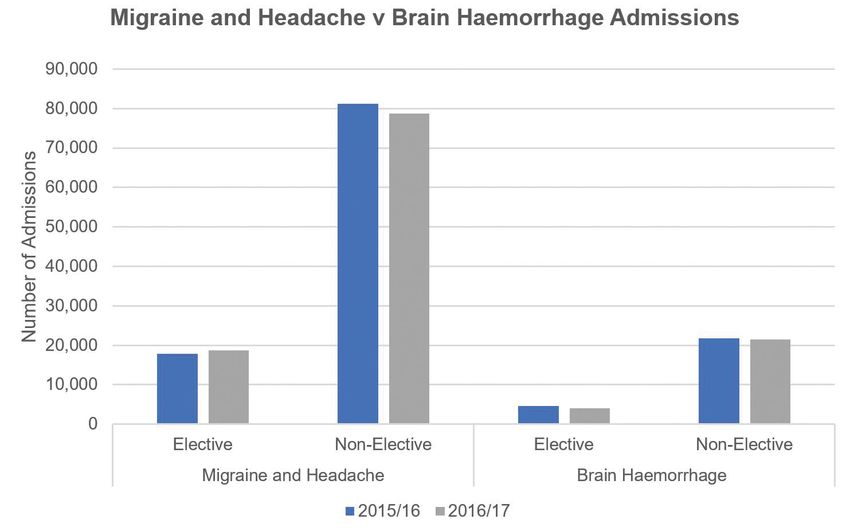
Between 2015/16 and 2016/17 there was a 5.1% increase in total admissions where migraine and
headache has been named as the main or secondary reason for admission. As a primary (main)
diagnosis there were a total of 98,964 admissions for migraine or headache in 2015/16 and 97,364
in 2016/17 (Figure 1), 82% of patient admissions were as emergencies in 2015/16 and 81% in 2016/17.
Hence, elective admissions with migraine or headache as a primary diagnosis only accounted for
18% of patient admissions in 2015/16 and 19% in 2016/17.
As shown in Figure 1, for comparison, there are fewer admissions with the less common diagnosis
of brain haemorrhage and these are primarily emergency admissions (Headway, 2017). Figure 1
demonstrates that many migraine and headache patients are opting to utilise emergency pathways
for treatment. Both migraine and brain haemorrhage involve an agonising headache, therefore one
of the likely reasons for non-elective attendance may be a fear of something more serious than
migraine or headache.
.
Figure 1: Patient admissions for migraine and headache compared with admissions for brain haemorrhage
across the fiscal years 2015/16 and 2016/17
IN ASSOCIATION WITH:
Secondary care data is taken from the English Hospital Episode Statistics (HES) database produced by NHS Digital,
the new trading name for the Health and Social Care Information Centre (HSCIC, http://www.digital.nhs.uk/hes)
Copyright © 2010 - 2018, re-used with the permission of NHS Digital. All rights reserved.
6Headache and migraine disease insight report
Improving the quality of care: A 10-point plan for better commissioning
2.2 Admissions by gender and age
To gain a better understanding of the types of patients accessing treatment in secondary care, the
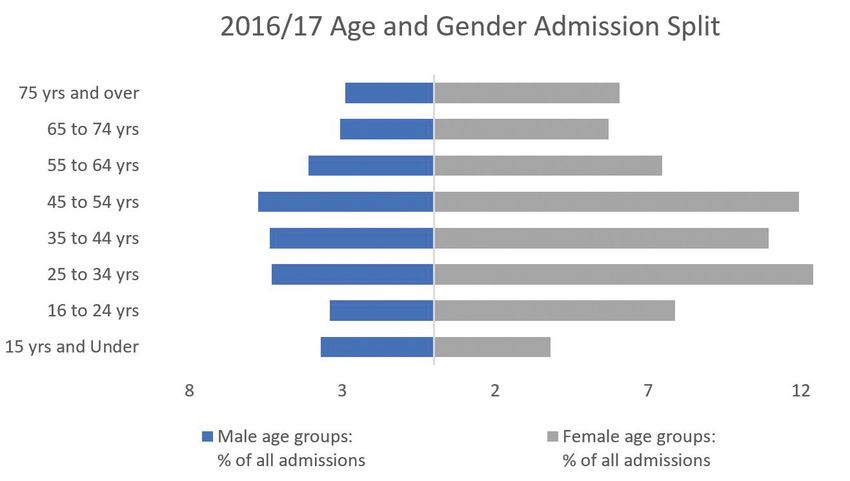
headache and migraine admissions have been analysed by age and gender (Figure 2).
The data shows that a sizeable proportion of patients being admitted for headache and migraine
are female, this may relate to hormonal triggers whereby fluctuating levels of oestrogen and
prostaglandin can trigger a migraine attack, referred to as a menstrual migraine (The Migraine Trust,
2017). This may offer some explanation as to why females are more likely to suffer from migraine,
but does not offer any rationale as to why they are finding themselves in secondary care instead of
utilising GP services or self-treating at home.
In terms of age, most female admissions occur in the 25 to 34 years age group closely followed by
the 45 to 54 years age group. Although there is no specific age of onset, it has been observed that
migraine can often begin in early adulthood (NHS, 2017). Referring again to hormonal changes,
the average age of menopause is 51 years, which may explain the relatively high number of female
patients in the 44 to 55 years age group (Menopause Health Matters, 2017).
For males, admissions were greatest in the age range 45 to 54 years, 19% of all male patients
belonged to this age group. There are fewer secondary care admissions for headache and migraine
for males (34%) compared to females (66%). Interestingly, the relatively high number of admissions
in the 45 to 54 group coincides with the age at which people are encouraged to undertake the NHS
40 - 74 years Health Check (NHS, 2017).
Figure 2: Age and gender split of all migraine and headache admissions in the 2016/17 fiscal year
Secondary care data is taken from the English Hospital Episode Statistics (HES) database produced by NHS Digital,
the new trading name for the Health and Social Care Information Centre (HSCIC, http://www.digital.nhs.uk/hes)
Copyright © 2010 - 2018, re-used with the permission of NHS Digital. All rights reserved.
7Headache and migraine disease insight report
Improving the quality of care: A 10-point plan for better commissioning
2.3 Indicative costs
Cost of Admissions
The total indicative cost of migraine and headache admissions in 2015/16 exceeded £64 million, 77%
of which was accounted for by emergency admissions. The equivalent indicative figure in 2016/17
exceeded £61 million, with emergency admissions accounting for 78% of costs. The indicative cost
per admission for 2015/16 was £655 and £630 in 2016/17. These figures highlight the significant
amount of money that might be better utilised for more preventative care, services and education.
2015/16 Migraine and headache Brain Haemorrhage
Cost of elective admissions £15,061,795 £22,795,158
Cost of non-elective admissions £49,773,409 £60,539,410
Average cost per admission £655 £3,173
Total cost of admissions £64,835,205 £83,334,567
2016/17 Migraine and headache Brain Haemorrhage
Cost of elective admissions £13,331,075 £25,760,588
Cost of non-elective admissions £48,043,648 £67,415,836
Average cost per admission £630 £3,643
Total cost of admissions £61,374,723 £93,176,424
Table 1: A breakdown of indicative costs for migraine and headache as a primary diagnosis for the fiscal years 2015/16
and 2016/17 in comparison to the indicative costs for brain haemorrhage as a primary diagnosis
IN ASSOCIATION WITH:
Secondary care data is taken from the English Hospital Episode Statistics (HES) database produced by NHS Digital,
the new trading name for the Health and Social Care Information Centre (HSCIC, http://www.digital.nhs.uk/hes)
Copyright © 2010 - 2018, re-used with the permission of NHS Digital. All rights reserved.
8Headache and migraine disease insight report
Improving the quality of care: A 10-point plan for better commissioning
2.4 Length of stay
In total, migraine and headache accounted for 73,638 bed days in 2015/16 and 65,994 in 2016/17.
Additionally there were 55,648 admissions not requiring an overnight stay in 2015/16 and 56,883 in
2016/17. (Table 2 and Table 3)
Overall, across 2016/17, 67% of all admissions did not result in an overnight stay. The total indicative
cost of these admissions across 2016/17 was over £30 million, which accounts for nearly 50% of the
total cost of admissions for the fiscal year. (Table 3)
Migraine & Migraine &
2015/16 headache 2016/17 Headache
Total elective bed days 5,723 Total elective bed days 5,979
Total non-elective bed days 67,906 Total non-elective bed days 60,015
Total bed days 73,638 Total bed days 65,994
Average length of stay 0.74 Average length of stay 0.68
Average length of stay 0.84 Average length of stay 0.76
(Non-elective admissions) (Non-elective admissions)
Table 2 : Bed days and length of stay for Migraine and Headache Admissions
2015/16 2016/17 Total
Number of zero-day admissions 41,638 42,801 84,439
Indicative cost of zero-day admissions £20,173,076 £20,770,200 £40,943,276
Number of day case admissions 14,010 14,082 28,092
Indicative cost of day case admissions £11,607,232 £10,068,845 £21,676,077
Table 3: Zero-day admissions (Non-elective) and Day case admissions (Elective) for migraine and headache, and the
related indicative costs
Secondary care data is taken from the English Hospital Episode Statistics (HES) database produced by NHS Digital,
the new trading name for the Health and Social Care Information Centre (HSCIC, http://www.digital.nhs.uk/hes)
Copyright © 2010 - 2018, re-used with the permission of NHS Digital. All rights reserved.
9Headache and migraine disease insight report
Improving the quality of care: A 10-point plan for better commissioning
2.5 Diagnostic testing
Patients who have been admitted with a migraine or a headache may be referred for a magnetic
resonance imaging (MRI) or computerised tomography (CT) brain scan. Brain scans may be
undertaken to exclude more complex reasons for the headache or migraine.
Within the cohort of patients who have a primary diagnosis of migraine or headache and present as
non-elective admissions, 71% were referred for a scan in 2015/16. This leads to an indicative cost of
over £39 million to the NHS. Of migraine and headache patients who had undertaken a scan 68%
were referred from A&E in 2015/16. This cost the NHS approximately £29 million. (Table 4)
2015/16 Admissions Count Patient Count Indicative Cost
Elective admissions 7,388 5,959 £6,591,786
Admissions from A&E 47,267 44,833 £29,512,580
Other non-elective 15,981 15,225 £9,897,534
Total admissions 70,636 62,771 £46,001,901
Table 4: Migraine and headache patients referred for a brain scan, via method of admission, in 2015/16
IN ASSOCIATION WITH:
Secondary care data is taken from the English Hospital Episode Statistics (HES) database produced by NHS Digital,
the new trading name for the Health and Social Care Information Centre (HSCIC, http://www.digital.nhs.uk/hes)
Copyright © 2010 - 2018, re-used with the permission of NHS Digital. All rights reserved.
10Headache and migraine disease insight report
Improving the quality of care: A 10-point plan for better commissioning
Call for action
This report has identified the cost of migraine and headache and from the analysis outlines 10
points for action that might support better service provision.
Recommendations – a 10-point plan for improvement
1. Know your population to reduce unplanned admissions
Profiling your population is the first step to understanding how to commission effective headache
and migraine services. Once you know roughly how many people are living with the problem in your
health economy and what demand exists you can plan accordingly.
The prevalence of headache is 14,000 per 100,000 therefore if you are a CCG of 250,000 patients
this means that its likely approximately 35,000 of individuals in the area will be living with a
headache disorder. (Based on 1 in 7 people suffering from migraine, The Migraine Trust, 2017)
2. Get smart with data
Hospital activity data can help you to understand how local services are performing and provide
an indication of current costs of admissions which might be offset with more appropriate service
provision. Check out your current performance:
• What are the admission rates, length of stay and readmission for headache and migraine?
• How do your figures compare with the national average and other CCGs?
3. Promote the self-care agenda
Check that sufferers have local access to self-management programmes and condition specific
information to increase their ability to self-care. The Migraine Trust has useful information about
self-management on their website (The Migraine Trust, 2017).
Encourage patients to understand the importance of keeping a headache diary, which not only
tracks the frequency and severity of their attacks, but also other factors such as their menstrual
cycle and lifestyle factors such as periods of stress, sleep deprivation, weather or exercise.
Recording this information is a key way that patients can work together with health professionals to
both make a firmer diagnosis and to monitor whether treatments are working. The Migraine Trust
has a diary template on their website (The Migraine Trust, 2017).
Pharmacists and opticians can provide a key resource in managing headaches in the community and
offer a valuable channel for dissemination of information and enhancing public awareness, although
they may not initially be considered as part of a management pathway. It is by using innovative
approaches such as these that public awareness can be improved.
Secondary care data is taken from the English Hospital Episode Statistics (HES) database produced by NHS Digital,
the new trading name for the Health and Social Care Information Centre (HSCIC, http://www.digital.nhs.uk/hes)
Copyright © 2010 - 2018, re-used with the permission of NHS Digital. All rights reserved.
11Headache and migraine disease insight report
Improving the quality of care: A 10-point plan for better commissioning
4. Educate your healthcare teams in headache management
The level of headache education and knowledge amongst non-specialist health professionals in
England is inadequate (APPG Headache 2014). Poor awareness, particularly amongst GPs, threatens
to undermine the implementation of the NICE headache guideline and the quality of care received
by patients. Greater GP training on headache should be prioritised as many headache patients are
likely to visit their GP.
However, initiatives to improve headache training are needed to address poor knowledge and
awareness amongst all health professionals who are likely to provide clinical support, for example,
nurses and general neurologists. Training can be sourced from www.neurologyacademy.org.
Encourage healthcare professionals to share expertise and good practice amongst themselves. If a
headache specialist nurse or GP with a specialist is available, it is useful for colleagues to be aware
of who this individual is so that they can discuss and refer patients if needed.
5. Ensure availability of services to meet need in both primary and secondary care
It is essential to support local services to develop an integrated approach to the management of
individuals with headache disorders as clinical and support services will span the breadth of health,
social and voluntary care. Additionally, the workplace environment should be considered as context
for the development of supportive headache networks. Commissioning plans should encompass all
aspects and ensure accountability for the full patient pathway.
Headache patients comprise about 30% of appointments at neurology outpatient clinics. It is
essential that these clinics are well resourced in order that GPs can refer patients to an expert,
and crucially that patients do not experience long waiting times for investigation. Well provisioned
secondary care helps support patients and helps divert them away from unnecessary presentation
at A&E.
Other services can also help alleviate the burden of patients with headache disorders on emergency
pathways. These include GPs with a special interest in headache and headache specialist nurses. Such
services give patients fast access to expert care, and importantly help support them by providing the
right help early on. However, there are only around 12 trained headache specialist nurses for the whole
of England which represents a significant shortfall in the face of such a large problem.
Depression is three times more common in people who suffer with migraine or severe headaches
compared to those who do not (WHO 2012). In an NHS that has parity of esteem for mental health
high on the agenda, adequate psychological support for migraine and headache patients should also
be part of the care package. It is vital too that professionals understand the nature of migraine and
headache which often sits at the intersection of physical and mental health.
The debilitating nature of migraine can have a detrimental impact on mental health, and it is worth
noting that in many cases underlying mental health factors may be an exacerbating or sometimes sole
cause of the migraine condition. Some patients benefit from cognitive behavioural therapy (CBT), and
for those with intractable migraines experiencing more than 10 days of headache per month this type
of therapeutic support is likely to be a worthwhile investment helping to reduce reliance on emergency
care. For more information see a review of CBT management (Harris et al., 2015).
IN ASSOCIATION WITH:
Secondary care data is taken from the English Hospital Episode Statistics (HES) database produced by NHS Digital,
the new trading name for the Health and Social Care Information Centre (HSCIC, http://www.digital.nhs.uk/hes)
Copyright © 2010 - 2018, re-used with the permission of NHS Digital. All rights reserved.
12Headache and migraine disease insight report
Improving the quality of care: A 10-point plan for better commissioning
6. Develop a local headache pathway so that everyone is aware of management plans
The lack of clearly defined pathways within the NHS leads to inefficiencies in the system and poor
outcomes for patients. It is essential that local integrated pathways are developed.
The problem of the “revolving door” for patients with migraine and headache who keep returning
to their GP and do not receive adequate treatment may be driving patients towards A&E in sheer
desperation for a resolution. It is essential that GPs are equipped with a pathway to follow for
patients who are making repeated visits about headache and migraine including how to escalate
their care, and who to refer to. It is estimated that 3% of GP consultations are for headache (Kernick
and Goadsby, 2009), so it is vital that GPs have a clear idea of the pathway to follow.
Thames Valley Strategic Clinical Network provides an initial outline of current and legacy pathway
work in the management of patients and services to people with headache disorders that is still a
useful resource (see References).
7. Ensure headache disorders continue to be part of local Sustainability and Transformation
Partnership plans
Migraine and headache represent the most common neurological reason for A&E attendance,
and comprise about a third of neurology outpatient appointments (The Migraine Trust, 2017). It is
essential that this patient population is considered in local STP plans.
8. Promote better medicines management
Migraine is estimated to cost the NHS in the UK £150 million per year, mostly from the costs of
prescription drugs and GP visits (APPG 2010), hence development of algorithms for prophylaxis and
increasing awareness of medication overuse, which can exacerbate the issues, are essential.
Secondary care data is taken from the English Hospital Episode Statistics (HES) database produced by NHS Digital,
the new trading name for the Health and Social Care Information Centre (HSCIC, http://www.digital.nhs.uk/hes)
Copyright © 2010 - 2018, re-used with the permission of NHS Digital. All rights reserved.
13Headache and migraine disease insight report
Improving the quality of care: A 10-point plan for better commissioning
9. Link into local businesses to ensure a work-friendly attitude is adopted
Chronic headache disorders are disabling and require the same flexibility and understanding that all
people with disability are entitled to in the workplace. Stress is a huge component of migraine and
headache disorders, whether caused by the chronic, intermittent disruption to a person’s work, to
their social and family commitments or to the distress of having a chronic condition that seemingly
cannot be resolved.
Stress is known to be an exacerbating factor in headache disorder, so in order for people to manage
their condition it is essential that they receive support and understanding from their employer and
colleagues. Workplaces can do a lot to not only support employees with a headache disorder, but
also assist by ensuring they are managing their work demands, have time and space to take regular
breaks and meal times, and receive an ergonomic assessment in their workspace. Simple steps
towards promoting staff wellbeing benefit all staff, particularly those with a headache disorder.
10. Work with the voluntary sector to improve patient outcomes
Charities, such as The Migraine Trust offer resources for people living with headache disorders such
as workplace advice and information regarding what benefits a sufferer may be entitled to. More
recognition of the value of this support is due.
IN ASSOCIATION WITH:
Secondary care data is taken from the English Hospital Episode Statistics (HES) database produced by NHS Digital,
the new trading name for the Health and Social Care Information Centre (HSCIC, http://www.digital.nhs.uk/hes)
Copyright © 2010 - 2018, re-used with the permission of NHS Digital. All rights reserved.
14Headache and migraine disease insight report
Improving the quality of care: A 10-point plan for better commissioning
In 2016/17 Migraine and headache
65,994 cost the NHS nearly
bed days were utilised £61 million
Conclusion
From this analysis migraine and headache reveals itself as a major challenge for our health services
and its patients. In 2016/17 alone, migraine and headache cost the NHS nearly £61 million in
admissions and utilised 65,994 bed days.
Headache disorders place great pressure on secondary and emergency care which are struggling
to cope, especially in winter when admissions to A&E are higher. Whilst it is recognised that
emergency care is appropriate in some cases, especially if there is an underlying condition,
improved alternative provision will help alleviate this burden.
This calls for the availability of improved education in the diagnosis and treatment of headache
disorders for clinicians and education in prevention and management for individuals with the
problem. Additionally, there is a need to ensure services are sustainable for the future and provide
the care required for those living with this distressing problem.
Secondary care data is taken from the English Hospital Episode Statistics (HES) database produced by NHS Digital,
the new trading name for the Health and Social Care Information Centre (HSCIC, http://www.digital.nhs.uk/hes)
Copyright © 2010 - 2018, re-used with the permission of NHS Digital. All rights reserved.
15Headache and migraine disease insight report
Improving the quality of care: A 10-point plan for better commissioning
References
APPG Headache (2014). Available at: The Migraine Trust (2017). Living with
www.migraine.org.uk/js/plugins/filemanager/ Migraine. Available at: www.migrainetrust.
files/APPGPHD_Report_on_Headache_ org/living-with-migraine/ Last accessed
Services_in_England__Executive_Summary. 06/12/2017.
pdf/ Last accessed: 05/01/2018.
The Migraine Trust (2017) Visiting your GP.
APPG Headache Meeting Archives (2016). Available at: https://www.migrainetrust.
Available at: www.migrainetrust.org/appg- org/living-with-migraine/seeking-medical-
archives/ Last accessed: 05/01/2018. advice/visiting-your-gp/ Last accessed
09/01/2017.
APPG (2010). Available at:
www.migrainetrust.org/wp-content/ Migraine Action (2017). Available at:
uploads/2015/12/2010Mar-APPGPHD_ www.migraine.org.uk/ Last accessed
REPORT_Headache_Disorders- 27/09/2017.
NotRespNotReso.pdf Last accessed:
05/01/2018. National Institute for Health and Care
Excellence (2012). Available at: cks.nice.org.
Brain and Spine Foundation (2017). Available uk/migraine Last accessed 27/09/2017.
at: www.brainandspine.org.uk/migraine Last
accessed 27/09/2017. NHS (2017). NHS Health Check. Available
at: www.nhs.uk/Conditions/nhs-health-
Harris P, Loveman E, Clegg A, Easton S, Berry check/Pages/NHS-Health-Check.aspx Last
N. (2015). Systematic review of cognitive accessed: 14/11/2017.
behavioural therapy for the management of
headaches and migraines in adults. British Thames Valley Strategic Clinical Network
Journal of Pain. 9 (4), p213-224. (2014). Headache Report. Available at: http://
tvscn.nhs.uk/wp-content/uploads/2014/08/
Headway (2017). Brain Haemorrhage. SCN-Headache-Report-Draft-V1-25-7-141.pdf
Available at: www.headway.org.uk/about- Last accessed 14/11/2017.
brain-injury/individuals/types-of-brain-
injury/brain-haemorrhage/ Last accessed World Health Organisation (2012, 2013, 2016).
27/09/2017. Headache Disorders. Available at:
http://www.who.int/mediacentre/factsheets/
Kernick D and Goadsby PJ. Headache: a fs277/en/ Last accessed: 14/11/2017.
practical manual. Oxford University Press
(2009).
Menopause Health Matters (2017).
Menopause Facts. Available at:
www.menopausehealthmatters.com/
menopause-facts/ Last accessed 14/11/2017.
The Migraine Trust (2017). Available at:
www.migrainetrust.org Last accessed
27/09/2017.
IN ASSOCIATION WITH:
1601268 495600
info@wilmingtonhealthcare.com
www.wilmingtonhealthcare.com
@WilmHealthcare
Beechwood House, 2-3 Commercial Way,
Christy Close, Southfields, Basildon, Essex SS15 6EF Wilmington Healthcare
IN ASSOCIATION WITH:
www.neurologyacademy.orgYou can also read


