St. Francis of Assisi Elementary School - 870 Victoria Drive, Vancouver, BC V5L 4E7 - Saint Francis of ...
←
→
Page content transcription
If your browser does not render page correctly, please read the page content below
September 2020-21 School Year Restart Plan-Stage 2
COVID-19 Public Health Guidance for K-12 School Settings UPDATED: September 9, 2020
Prepared: SFA School Restart Team

     St. Francis of Assisi Elementary School
                                            870 Victoria Drive, Vancouver, BC V5L 4E7
                                          Phone: 604.253.7311 Email: office@sfaschool.ca
                                                    Website:www.sfaschool.ca

                           COVID-19 2020-2021 Safety Plan
 Please note: This plan is subject to change. Families will be notified if
                          changes are made.

Key Actions for COVID-19 2020-21 Safety Plan
In accordance with the Ministry of Education’s K-12 Restart Plan, beginning on September 10, St. Francis
of Assisi School will be resuming K-7 in-class instruction. The 2020/21 school year will begin in Stage 2 of
the K-12 Restart Plan with the goal of maximizing in-class instruction for all students within the revised
public health guidelines.

I. Key Messages and Actions

Whenever possible, feasible and practical control measures, in accordance with the order of the Provincial Health
Officer, have been selected to provide the best/widest protection to all staff and students within the school
community.
This plan is posted at the school and also on the St. Francis of Assisi School website, and it has been communicated
to parents. This information is based on the best evidence currently available and will be updated as new
information becomes available.

    1. Physical Building
    ●   Signage to reinforce self-screening, hand hygiene, distancing and one-way use of hallways, adjustments to
        entrance and exit practices, adjustments to the use of playgrounds and school grounds, signage in
        bathrooms and availability of hand sanitizer will be clearly posted within the school building.
    ●   Ensure different washroom time for Learning Groups. An example would be: K and Grade 1 students are
        to use the washroom at 9:45 am, Grade 2 and 3 students at 10:00 am.
    ●   Increase airflow and ventilation where climate allows (open windows and doors).

The capacity limit is set for individuals not in the same Learning Group:

Office (school office and PE/Bookkeeper’s room) occupancy limit has been set to: 1 person

Common areas:
   . Bathroom occupancy: 2 persons
   . Staffroom: 2 people (4 people related- same family)
   . Library: 6 people
   . French Room: 1 person
   . Storeroom: 1 person
   . Learning Support Room: 3 people
                                                                                                                    1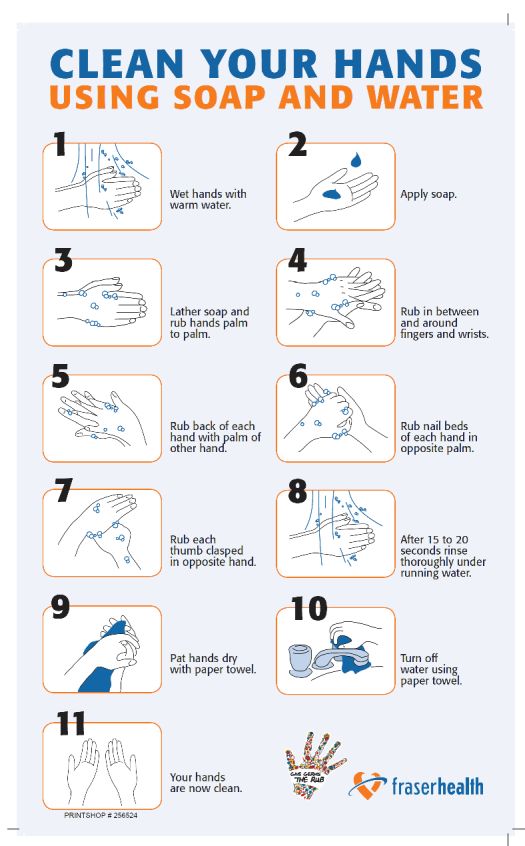
September 2020-21 School Year Restart Plan-Stage 2
COVID-19 Public Health Guidance for K-12 School Settings UPDATED: September 9, 2020
Prepared: SFA School Restart Team

    .   Bookkeeper/ PE Office: 1 person
    .   Washrooms: 2 persons/washroom (Boys/Girls)
    .   Gym Equipment Room: 1 person
    .   Boiler Room: 1 person
    .   Custodian Room: 1 person
    .   Stairwells will be designated 1 direction: All persons go downstairs using the north stairwell and upstairs
        via the south stairwell (Office)

    Recordkeeping

    Classroom Teachers
     ● Prepare and submit to the office a list of students in each Learning Group along with a
        classroom seating chart. This will be shared with public health should contact tracing
        need to occur.

    Office Staff
    ●    Keep a list of the date, names and contact information for all visitors who enter the school.
    ●    Keep a list of students who travel outside Canada during the 2020-21 school year.
    ●    Monitoring school attendance to track student and/or staff absence and compare against usual
         absenteeism patterns at the school.

  Access to School Site
    ●   Visitors, including parents will be limited or even prohibited from entering the school. Parents are not
        permitted to come to the school day to drop off lunches, supplies, etc.
    ●   If parents/caregivers need to contact the school principal or their student’s teachers, they will be directed
        to do so by phone or email. In-person visits should be for essential purposes and arranged in advance by
        appointment.
    ●   Visitors must be aware of, and follow safety protocols; limited in their access to necessary spaces only;
        and will be asked to confirm they have completed the requirements of a daily health check before
        entering the school building.

 Arrival Time and Procedure
    Students are to come to school between 8:30 am and 8:45 am in the morning. When students come in the
    morning, they will go to their designated areas where they will be picked up by their class teachers at 8:45 am.
    Children will have to wait for pick up. No playing or socializing will be allowed before and after school in order
    to practice appropriate physical distancing.
    In inclement weather, students will go straight to their classrooms upon arrival at 8:30 am or after.
    Grades K-7 students will enter using the intermediate playing court gate (big gate). They will wait in marked
    areas on the playing court and then be escorted by their class teacher to a classroom. Students displaying any
    symptoms will not be allowed to enter the school grounds. Upon entering the school building students will be
    asked to use hand sanitizer/wash their hands.

    Kindergarten and Grade 1 students will enter the school building using the Kindergarten door. Grade 2
    students will enter through the south door of Grade 2. Grade 3 will enter using the north door on the west
    side of the school building. Grades 4 and 5 students will enter through the front door. Grades 6 and 7
    students will enter via the Grade 7 stairwell.

                                                                                                                      2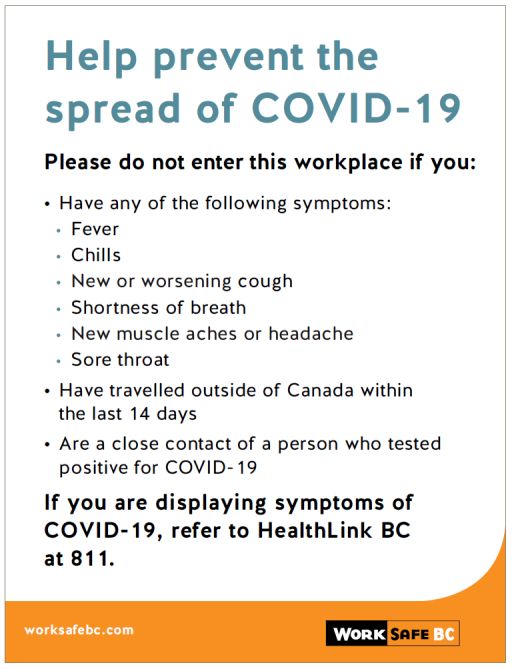
September 2020-21 School Year Restart Plan-Stage 2
COVID-19 Public Health Guidance for K-12 School Settings UPDATED: September 9, 2020
Prepared: SFA School Restart Team

    ●   All staff will enter the building only through the front door of the school. Staff members are to report to
        the office and sign in.
    ●   The playground is closed in the morning and after school, and we do not want children and parents milling
        about.
    ●   All parents are to use the entrance at the intermediate playing court to drop off their child. It is important
        that students arrive no later than 8:45 a.m. as staff members will be inside the building after this time.
    ●   Upon arrival, students are to report to their marked area where their teacher or EA will be waiting.
    ●   Class teachers will proceed with their Learning Groups and enter the building through designated doors.
    ●   Students will wash/sanitize their hands before class begins.

Dismissal Time and Procedure
    ●   Dismissal will be staggered. Kindergarten and Grade 1 students will be dismissed at 2:45 p.m. Grades 2
        and 3 at 2:50 pm; Grades 4 and 5 at 2:55 pm, and Grades 6 and 7 at 3:00 pm.
    ●   The students’ teacher or EA will escort the class back to the waiting area where they will wait to be picked
        up. The supervisor at the gate will call the students when their pick-up arrives.
    ●   Parents/ guardians are to arrive punctually to pick up their children after school.
    ●   Students are not to play after school, but are to go straight home.

Recess & Lunch
    ●   Two staggered recess and lunch breaks. Two learning groups will have breaks at the same time. In the
        event of inclement weather, all students will have their breaks in their classrooms. There will be no need
        for staggered breaks.

II. Learning Groups
Public Health guidelines for the K-12 school setting recognize that physical distancing is challenging.
Lowering the number of in-person, close interactions continues to be a key component of B.C.’s strategy
to prevent the spread of COVID-19.

Students will be placed in Learning Groups or cohorts with no more than 60 people. A Learning Group/Cohort is a
group of students and staff who remain together throughout a school term or year, and who primarily interact
with each other. The principle of Learning Groups is used to limit the number of interactions among students and
staff, as well as facilitate an effective and efficient rapid-response contact tracing protocol.

    ●   A cohort is a group of students and staff who remain together throughout a school term. The use of
        cohorts in schools allows for a significant reduction in the number of individual interactions, while
        allowing most students to receive in-person learning in a close-to-normal school environment.
    ●   Students will remain in an established cohort during the school day. The composition of the Learning
        Group will remain consistent for all activities that occur in the school day including but not limited to
        learning and breaks (lunch, recess, classroom changes, etc.)
    ●   This organization will help reduce the number of students in hallways and on outside play areas. Students
        will continue to receive support from staff who are not within their cohort by staff physically distancing
        and the use of Personal Protection Equipment (PPE) where appropriate.
    ●   At any given time, the size of a student's cohort will be limited to no more than 60 students. Learning
        Groups:
           —   K&1
                                                                                                                     3
September 2020-21 School Year Restart Plan-Stage 2
COVID-19 Public Health Guidance for K-12 School Settings UPDATED: September 9, 2020
Prepared: SFA School Restart Team
— 2&3
— 4&5
— 6&7
● Occupancy limits will be posted in certain areas (e.g. Staff Room, Learning Support
Room, Store Room, Library, etc.)
● The number of adults (teachers/EAs) interacting with groups of students throughout the day will be
minimized. Students will stay in assigned learning group cohorts to receive beneficial supports or services
(e.g. Learning Support). Within these supports or services, it is expected that cohorts and physical
distance are maintained insofar as it is practical to do while still ensuring the support, program or service
continues.
● Learning Groups will go outside when possible for lessons and/or play-exercise times.
● Encourage fixed seating arrangements over flexible seating arrangements where relevant student seats
should be facing in the same direction whenever possible.
● High touch surfaces will be cleaned by specialist teachers before the start of their lessons.
● Playground to be divided to accommodate Learning Groups. K to Grade3 will follow a set schedule to play
on the playground structure.
Exposure Control Measures
Exposure control measures help create safe environments by reducing the spread of communicable
diseases like COVID-19. Multiple protection strategies, informed by public health advice, will be
implemented to ensure that St. Francis of Assisi School is a safe environment and will include:
Staff
● Staff must assess themselves daily for symptoms of common cold, influenza, or COVID-19 prior to
entering the school. Should symptoms be present, staff must not report for work.
● Staff members are to sign in at the office each day and complete a self-assessment checklist provided by
CISVA to indicate they are healthy and have not been exposed to COVID-19.
● Through observations, school staff will conduct a daily health check of students for symptoms of
common cold, influenza, COVID-19, or other respiratory disease upon entry to the school/their
classroom.
Students/Parents/Families
● Parents/caregivers will be expected to check their children daily for signs and symptoms of illness prior to
school arrival. Children who appear to be ill will NOT be allowed in the school building. Parents are
encouraged to use Appendix B: Daily Health Check Example (attached) to check their children for signs
and symptoms of illness.
Case Finding, Contact Tracing and Outbreak Management
At the School Level
● Students who display any symptoms of a common cold, influenza, COVID-19, or other respiratory
diseases while in attendance at school will be separated from all students and school staff and placed in a
supervised area. Parents will be contacted and asked to pick up their child as soon as possible. Any
siblings in the school will be asked to self-isolate as well.
4September 2020-21 School Year Restart Plan-Stage 2
COVID-19 Public Health Guidance for K-12 School Settings UPDATED: September 9, 2020
Prepared: SFA School Restart Team
● Staff member is to put on a mask and immediately separate the sick child from others and put him/her
into a supervised area until the parent/guardian arrives. Apply physical distancing, respiratory etiquette,
and hand hygiene principles while waiting for pick up. Avoid touching student’s body fluids
(mucous/saliva). Wash hands thoroughly.
● The office will call the parent to arrive as soon as possible when notified their child is ill. The parent will
need to have a plan in place.
● Staff member to clean/disinfect the area where the child was relocated.
● Staff displaying any symptoms of a common cold, influenza, COVID-19, or other respiratory diseases
while in attendance at school will be asked to go home immediately.
● Anyone experiencing symptoms of illness should not return to school until they have been assessed by a
health-care provider to exclude COVID-19 or other infectious diseases and their symptoms have been
resolved.
● The office will record illness in First Aid records in the event this information is later needed.
● The office will contact 811 or the local public health unit to notify them of a potential case and seek
further input.
● In the event of a confirmed COVID-19 case in school, the school will follow the protocol in the updated
August 28, 2020 Guidelines for K-12 Settings (p.21).
● The school will notify local medical health officer if staff and/or student absenteeism exceeds 10 percent
of regular attendance, to help with the early identification of clusters or outbreaks.
At the Public Health Level
● If a staff or student in a school is confirmed by public health as positive for COVID-19, public health will
work with school administration to determine what actions should be taken, including if any staff or
students who have been in contact with that person need to self-isolate, and if other staff and students’
families should be notified.
● Schools should NOT provide notification to staff or students’ families if a staff member or student
becomes ill at home or at school, including if they display symptoms of COVID-19, unless directed to by
public health.
At the Home Level
● Children with common cold, influenza or COVID-19 like symptoms must stay home, be assessed by their
health care provider and tested for COVID-19.
● Self-isolation is also advised for those who are considered a close contact of a confirmed case and are
waiting to see if they develop COVID-19 illness.
● If concerned, parents can be advised to contact 8-1-1, or the local public health unit to seek further
input. They can also be advised to contact a family physician or nurse practitioner to be assessed for
COVID-19 and other infectious respiratory diseases.
IV.Infection Prevention
Hand washing and Hygiene
● Students will be asked to wash their hands frequently, including before coming to school. They will have
access to hand sanitizer when hand washing is not available.
● Teachers will be scheduling breaks to allow students to wash their hands.
5September 2020-21 School Year Restart Plan-Stage 2
COVID-19 Public Health Guidance for K-12 School Settings UPDATED: September 9, 2020
Prepared: SFA School Restart Team
● Washroom areas will be monitored and supervised. Maximum capacity in the washroom is 2, unless the
individuals are in the same learning group. Use of washrooms will be monitored. Assigned staff
members (e.g., educational assistants) are to assist with movement.
● Hand sanitizers will be available in each classroom and other areas including the front entry to the
school, office, staff room, library, etc.
Respiratory Etiquette
Students and staff should:
● Cough or sneeze into their elbow sleeve or a tissue. Throw away used tissues and immediately perform
hand hygiene.
● Refrain from touching their eyes, nose or mouth with unwashed hands.
● Refrain from sharing any food, drinks or unwashed utensils
Food and Personal Items
● Parents will be asked to label ALL personal items, including water bottles and masks. Cloth and
disposable masks are to be labeled with the students initials and grade and kept in a paper envelope or
cloth bag.
● The drinking fountains will be closed, but students can refill water bottles.
● Everything must fit into the student’s backpack (no extra bags), as the backpack is stored in the
classroom by/under the student’s desk or table. The cloak room will not be used for backpacks, but to be
used for student pull-out work (maximum 2 students in the learning group). Students are to take their
backpacks home each day.
● Students are to come to school in their gym uniform for the entire day on days they have gym.
● The classroom teacher will give more specifics, but in general, students are to bring:
- Filled water bottle (water fountains are disabled); water bottles may be filled at the filling station
on their own floor.)
- Snack/lunch in a container.
- Laptops and i-Pads can only be shared among students in the same learning groups; they have to
be disinfected before another student uses it.
- Personal devices can be brought in by students. Students should have their own school supplies.
There is no communal sharing of supplies.
- Personal size hand sanitizer-labeled with child’s name (optional).
● Hot lunch program is suspended until Term 2.
● Homemade food items are not to be made available to other students (e.g. birthday treats, bake sale
items).
● Staff coffee urns/stations will be suspended. Other staff room amenities (fridge, microwave, etc.) may be
continued to be used; however, staff are encouraged to use these items as infrequently as possible and
only with a routine cleaning. That is, disinfect all areas touched with the provided disinfectant and paper
towels. Hands must be washed before and after using shared staff room items.
● Staff to disinfect the area in the staff room after use.
● The Public Health Guidance says that "there is no need to limit the distribution or sharing of books or
paper based educational resources." However, laminated paper-based products should be cleaned and
disinfected daily if touched by multiple people.
● Avoid sharing communal equipment/supplies as much as possible.
Personal Protection Equipment and Cleaning
● Staff will have access to personal protection equipment and cleaning supplies. These items
must remain in the classroom and not travel between classrooms.
6September 2020-21 School Year Restart Plan-Stage 2
COVID-19 Public Health Guidance for K-12 School Settings UPDATED: September 9, 2020
Prepared: SFA School Restart Team
● Students will be trained on appropriate hand hygiene.
● Scheduled breaks will allow students to wash their hands frequently.
Use of Personal Protective Equipment
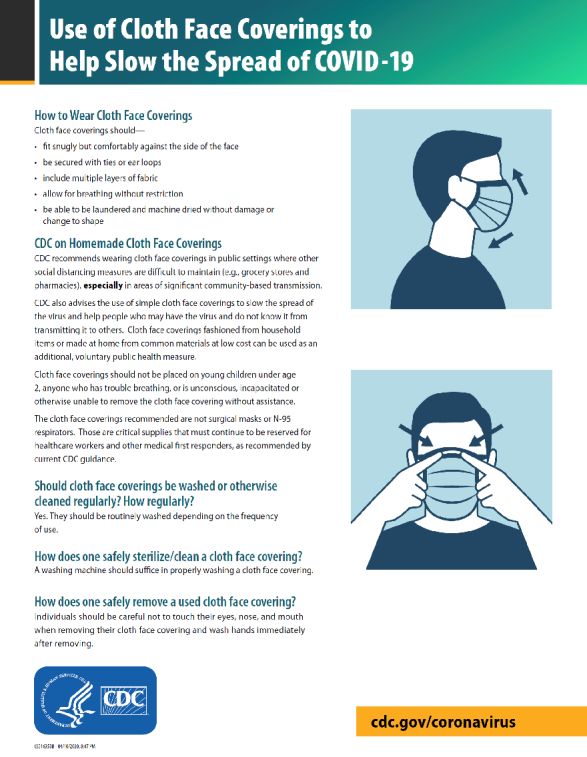
● Grade 6 and 7 students must wear a mask when they are out of their classroom; when they are
in common areas of the school; e.g., hallways, washroom, stairwell.
● Encouraged masking for students of all grades when they are not in their classroom. Masks are
encouraged for everyone when they are in the hallways, washroom or on the playground.
● Cloth and disposable masks can be labeled with the students initials and are to be kept in a
labeled plastic or cloth bag.
● Specialist teachers (French, Music and PE and Learning Support Department) to wear a protective shield
during instruction to facilitate reduced congregate exposure. A mask must also be worn if social distancing
cannot take place. Anytime a staff member works with a student not in his or her Learning Group a
protective shield and/ or a face mask must be worn.
● If parents need to consider PPE other than a face shield or mask for their child, please contact the
principal.
● Staff on supervision must wear a protective visor and/or a face mask.
● Anytime a staff member works with a student not in his or her Learning Group a visor and or a mask must
be worn.
Tip: In situations where voice delivery is not clear due to wearing of a face mask, a microphone headset will be
provided to teachers to use.
Physical Distancing
● Due to physical space limitations, St. Francis will seek virtual alternatives for larger gatherings and
assemblies.
● Avoid close greetings (e.g., hugs, handshakes).
● Encourage students and staff to not touch their faces.
● Stagger washroom breaks and class transition times to provide a greater amount of space for everyone.
● Take students outside more often.
Environmental Measures: Cleaning, Sanitizing and Disinfecting
Environmental Measures Cleaning and Disinfection Regular cleaning and disinfection are essential to preventing
the transmission of COVID-19 from contaminated objects and surfaces. Schools should be cleaned and disinfected
in accordance with the BCCDC’s Cleaning and Disinfectants for Public Settings document. This includes:
● General cleaning and disinfecting of the premises at least once a day.
● Cleaning and disinfecting of frequently-touched shared surfaces at least twice a day by class teacher/ EA
after recess and after lunch. (e.g. door knobs, light switches, toilet handles, tables, desks, chairs,
electronic devices, keyboards and toys).
● Cleaning and disinfecting of any surface that is visibly dirty.
● Using common, commercially available detergents and disinfectant products and closely following the
instructions on the label.
7September 2020-21 School Year Restart Plan-Stage 2
COVID-19 Public Health Guidance for K-12 School Settings UPDATED: September 9, 2020
Prepared: SFA School Restart Team
● Limiting items that are not easily cleaned and disinfected (e.g. fabric or soft items).
● Emptying garbage containers daily.
● Wearing disposable gloves when cleaning blood or body fluids (e.g. runny nose, vomit, stool, urine).
● Washing hands before wearing and after removing gloves.
● Washrooms should be cleaned at least twice a day keeping in line with the high touch surface area
protocols.
● Shared items where cross-contamination is possible (e.g. shared school supplies, devices, coffee/water
kettle, plates, etc.) should not be used.
● Drinking fountain will be disabled.
● Items that are not easily cleaned (e.g. fabric or soft items) are to be limited. Classroom carpets have been
removed.
● There is no evidence that COVID-19 virus is transmitted via textbooks, paper or other paper based
products. As such, there is no need to limit the distribution of books or paper based educational
resources to students.
● The custodian will ensure that hand washing supplies are available at all times (i.e. soap, paper towels and
minimum 60% alcohol-based hand sanitizer.) Also, cleaning products (e.g. Lysol wipes/ disinfecting
solution & paper towels) will be provided for cleaning desks, photocopiers and other common devices.
● In the staff room, any appliance utilized needs to be wiped down with a disinfecting wipe after use. The
dishwasher is not to be used. Dishes are not to be washed at school as washcloth and soap dispensers are
not single use. Staff to take containers/dishes home to wash. Also, staff must wipe down their eating area
with a disinfecting wipe prior to leaving. All containers must be removed from the refrigerator each day.
Any item left behind will be disposed of by the night time cleaning crew. All plates, cutlery, cups and
mugs, will be off limits. Staff are asked to bring their own, as well as beverages (coffee/tea etc.). The
microwave oven and the two fridges are to be used. Surfaces have to be disinfected after each use.
● Each classroom will have disinfecting spray/wipes to clean surfaces twice a day. Supervisors
(teachers/EA’s etc.) will do the disinfection of surfaces.
● If school electronic devices are used, they must be wiped down using a disinfecting wipe by the supervisor
at the end of each day, prior to charging.
● Students and staff are not to share school supplies. Pencils, pens, crayons, etc. must be labelled. This
includes fidgets for special needs students. No staff member is to use another staff member’s supplies.
VII. Staff Meetings
● Ensure social distancing and mandatory masks.
● Instruct teachers in the latest facts and basic information about coronavirus disease (COVID-19), including
its symptoms, complications, how it is transmitted and how to prevent transmission.
VIII. Additional Information
● School Bus:
- is to be cleaned and disinfected in accordance with BCCDC guidelines
- should be loaded from back to front and offloaded front to back
- keeping seating consistent and assign seats where possible. Each student should have their own seat
unless sharing with a member of their household.
- Bus driver and school office to keep up to date passenger lists to share with public health if contact
tracing needs to occur.
- Students should clean their hands before they leave home, when they leave school, and when they get
home.
- Students must wear face masks and/ or face shields on the bus.
8September 2020-21 School Year Restart Plan-Stage 2
COVID-19 Public Health Guidance for K-12 School Settings UPDATED: September 9, 2020
Prepared: SFA School Restart Team
- Due to space constraints, priority is given to students who used the bus service in the last school year.
● No extracurricular activities will take place unless they can be organized into learning groups, i.e. Grades 4
& 5, Grades 6 & 7. This restriction will be reviewed at the end of each term.
● Parent Participation – Schedules will be drawn for different jobs. Parents will be provided with PPE and
training.
IX. Additional Changes
● Buddy Classes will be postponed until January 2021. (This will be reviewed in January 2021.)
● Student Assemblies will be transmitted via video to the classrooms (i.e. first assembly of the year – Mrs.
Yam will address the students and this will be broadcast/live streamed to the classrooms.
● Before & After School Club will be in the Church Hall.
● All class field trips will be cancelled until further notice.
● Meet the Teacher Night – This will take place virtually. In order to minimize contact and for the safety of
all, parents will not be in the school for this event. Packages will be sent home with each child prior to the
evening.
● The Library will be closed this term.
Monthly Friday Mass
● Under discussion and likely will include rotations of learning groups/ classes at the church. (maximum
capacity is 50).
● Mass is to be live streamed.
X. Communication Strategies and Training
● Everyone in the school community (staff, students and parents) will know the policies around staying
home when they are sick. This information will be communicated in writing.
● All staff will be trained and informed as to how to keep themselves safe while at school. Formal staff
training and information sessions will be held on September 8, 2020 and include:
- the risks of exposure to COVID-19.
- how to report an exposure to or symptoms of COVID-19.
- safe procedures and instructions regarding proper hand washing, cough/sneezing etiquette, etc.
- run through the shape of the day, from morning drop-off, entering the school, washroom breaks,
recess and lunch supervision, and dismissal arrangements.
● Staff will be informed of changes made to work policies, practices, and procedures due to the COVID-19
pandemic. During the daily check-in/ staff meeting, updates will be provided when available.
● The health and safety measures in place prior to the pandemic are still in place.
● The administration will keep records of training meetings. Covid-19 related meetings are documented and
minutes available in the staff room and the Principal’s office.
● A bulletin board will be dedicated to sharing information with staff about policies and practices for COVID-
19.
● Signage will be posted around the school including occupancy limits and effective hand washing practices.
Signage will also be posted at the main entrance indicating who is restricted from entering the school
including anyone with symptoms.
XI. Monitor the Workplace and Update Plans
9September 2020-21 School Year Restart Plan-Stage 2
COVID-19 Public Health Guidance for K-12 School Settings UPDATED: September 9, 2020
Prepared: SFA School Restart Team
● As new information is provided, some of these protocols and guidelines may change.
● Steps will be taken to update policies and procedures and involve the staff in this process.
● All staff are asked to raise any safety concerns with the Principal.
XII. Age-specific Health Education
Accessed: This document was written by Lisa Bender (Education UNICEF NYHQ), with technical support from the UNICEF COVID-19 Secretariat
members (Carlos Navarro Colorado, Maya Arii & Hugo Razuri) as well as UNICEF WASH, C4D and Child Protection teams. Special thanks to
Maida Paisic (UNICEF EAPRO), Le Anh Lan (UNICEF Vietnam), Tserennadmid Nyamkhuu (UNICEF Mongolia), Dr, Maria D Van Kerkhove (WHO)
and Gwedolen Eamer (IFRC) for their close collaboration.
Below are suggestions on how to engage students of different ages on preventing and controlling the spread of
COVID-19 and other viruses.
● Activities should be contextualized further based on the specific needs of children (language, ability,
gender, etc.).
Hand washing
● Hand washing will become a routine activity carried out several times during the school day particularly:
— upon arrival and before going home
— before and after eating and drinking
— after using the toilet
— after sneezing/coughing into hands or tissue
— whenever hands are visibly dirty
— when transitioning to a different area (e.g. coming in from recess, etc.)
— Students will be using sinks in the upper hallway or in the washroom area (limit 2 children at a
time). Hand sanitizers are available in the classrooms and other areas of the school. If parents
have extra supplies (hand sanitizer and Lysol wipes) we would welcome your donation for your
child’s classroom.
Let’s Talk Hand washing (kid-friendly posters and videos from CBC Kids - Adapted from the World Health
Organization's recommendations for handwashing, but with a more kid-friendly approach.)
— https://www.cbc.ca/parents/learning/view/handwashing-poster-covid-19-kids
— https://www.cbc.ca/kidscbc2/the-feed/handwashing-101-how-to-become-a-handwashing-artist
DECODA - Good information about COVID-19 in an easy to understand format. The images and concise text of a
poster or infographic can convey a clear message.
— https://www.decoda.ca/read-all-about-lit/covid-19-posters-and-infographics/
Primary
● Make sure to listen to children’s concerns and answer their questions in an age-appropriate manner;
don’t overwhelm them with too much information. Encourage them to express and communicate their
feelings. Discuss the different reactions they may experience and explain that these are normal reactions
to an abnormal situation.
10September 2020-21 School Year Restart Plan-Stage 2
COVID-19 Public Health Guidance for K-12 School Settings UPDATED: September 9, 2020
Prepared: SFA School Restart Team
● Emphasize that children can do a lot to keep themselves and others safe. - Introduce the concept of social
distancing (standing further away from friends, avoiding large crowds, not touching people if you don’t
need to, etc.) - Focus on good health behaviors, such as covering coughs and sneezes with the elbow and
washing hands.
● Help children understand the basic concepts of disease prevention and control. Use exercises that
demonstrate how germs can spread. For example, by putting colored water in a spray bottle and spraying
over a piece of white paper. Observe how far the droplets travel.
● Demonstrate why it is important to wash hands for 20 seconds with soap and water - Put a small amount
of glitter in students’ hands and have them wash them with just water, notice how much glitter remains,
then have them wash for 20 seconds with soap and water.
Intermediate
● Make sure to listen to students’ concerns and answer their questions.
● Emphasize that students can do a lot to keep themselves and others safe.
● Introduce the concept of social distancing - Focus on good health behaviors, such as covering coughs and
sneezes with the elbow and washing hands - Remind students that they can model healthy behaviors for
their families.
● Encourage students to prevent and address stigma - Discuss the different reactions they may experience
and explain these are normal reactions to an abnormal situation. Encourage them to express and
communicate their feelings.
● Build students’ agency and have them promote facts about public health. - Have students make their own
Public Service Announcements through school announcements and posters.
● Incorporate relevant health education into other subjects - Science can cover the study of viruses, disease
transmission and the importance of vaccinations - Social studies can focus on the history of pandemics
and evolution of policies on public health and safety.
● Media literacy lessons can empower students to be critical thinkers and makers, effective communicators
and active citizens.
Free Covid-19 Prevention Resources (includes posters)
Below are links (hyperlinked/click on) to helpful posters and factsheets.
Physical distancing information
● Physical distancing poster
● Hand washing poster
● Hand sanitizer poster
● Be prepared factsheet
● Do not enter if you are sick or required to self-isolate poster
● Care for yourself and others
● Cleaning and disinfecting public settings
Videos
This child-friendly Covid-19 video was created by UBC’s Faculty of Medicine.
11September 2020-21 School Year Restart Plan-Stage 2
COVID-19 Public Health Guidance for K-12 School Settings UPDATED: September 9, 2020
Prepared: SFA School Restart Team
● https://www.who.int/news-room/q-a-detail/q-a-schools-and-covid-
19?fbclid=IwAR2lfvfchpcyEhlp_pTBmwskFfpI8jqlYgng1TzR8y85obsNFAeIeuVA5tI
About Kids Health
This hub includes resources on COVID-19 and how to help parents cope. There are resources on how to support
children’s mental health and general wellbeing through physical activity, sleep, nutrition and learning.
●
https://www.aboutkidshealth.ca/covid19?gclid=Cj0KCQjw7Nj5BRCZARIsABwxDKJlibL8Ac9gIBjzILwuJNQrr
J4XLLOoeFjsFX9YtmTULZ_XT5zloEwaAk_vEALw_wcB
Health Care Services
● The Provincial Health Officer advises anyone who is concerned that they are experiencing symptoms of
COVID-19 to contact their primary care provider or call 811. Translation services for 811 are available in
more than 130 languages.
● The Government of BC has also established a non-medical information hotline at 1-888-COVID19. Phone
lines are open 7 days a week and information is available in more than 110 languages.
● Additionally, you can use the COVID-19 self-assessment tool by visiting https://covid19.thrive.health/
● If you have symptoms, you can call 8-1-1 to pre-arrange testing. If you have symptoms associated with
COVID-19, self-isolate.
12September 2020-21 School Year Restart Plan-Stage 2
COVID-19 Public Health Guidance for K-12 School Settings UPDATED: September 9, 2020
Prepared: SFA School Restart Team
13September 2020-21 School Year Restart Plan-Stage 2
COVID-19 Public Health Guidance for K-12 School Settings UPDATED: September 9, 2020
Prepared: SFA School Restart Team
14September 2020-21 School Year Restart Plan-Stage 2
COVID-19 Public Health Guidance for K-12 School Settings UPDATED: September 9, 2020
Prepared: SFA School Restart Team
15You can also read


