SCHOOL GUIDE 2017-2018 - primary & secondary - Google Documenten
←
→
Page content transcription
If your browser does not render page correctly, please read the page content below
DE NIEUWE INTERNATIONALE SCHOOL ESPRIT
          education that makes sense

      SCHOOL GUIDE
            2017-2018
             primary & secondary
TABLE OF CONTENT

1. General information                                                          2
   1.1 Address and contact                                                      2
   1.2 School Board                                                             2
   1.3 Founding history, student numbers and expected grow                      2

2. School Profile                                                                3
   2.1 Vision and mission statement DENISE                                     3
   2.2 Language philosophy DENISE                                              3
   2.3 Core values and rules of behaviour                                       4

3. Educational programs                                                         5
   3.1 The five DENISE programmes                                               5
   3.2 Curriculum Book: learning goals                                         8
   3.3 Assessment philosophy                                                   8
   3.4 Academic Policy                                                         12
   3.5 Learning materials policy                                               12

4. Student affairs                                                              13
   4.1 Admission                                                               13
   4.2 Special Educational Needs                                               13

5. School Organisation                                                         15
   5.1 Time Table                                                              15
   5.2 School Fee                                                              15
   5.3 School Building                                                         16
   5.4 Year Calendar 2017-218                                                  16

6. Staff                                                                        17
   6.1 Organogram                                                              17
   6.2 School Management                                                       17
   6.3 Team of coordinators                                                    18
   6.4 Team of Primary Education Teachers                                      18
   6.5 Team of Secondary Education Teachers                                    18
   6.6 Team of Mentors                                                         19
   6.7 Team staff of support                                                   19

7. Communication                                                               20
   7.1 Communicate philosophy                                                  20
   7.2 What parents/guardians can expect from DENISE                           20
   7.3 What the school management and teachers expect from parents/guardians   20

DENISE - School Guide 2017-2018 - Page 1
1. General information
De Nieuwe Internationale School Esprit (DENISE) is a school voor primary education (IPC) and
secondary education (VMBO-TL, HAVO, VWO (IMYC) en Internationaal Baccalaureaat). DENISE
is a member of the Esprit Scholen Group (http://www.espritscholen.nl/home/) and the
iScholenGroep (www.ischolengroep.org).

1.1 Address and contact
De Nieuwe Internationale School Esprit
Pieter de Hoochstraat 78
1071 EJ Amsterdam
+31 20 480 2700
info@denise.espritscholen.nl | http://denise.espritscholen.nl
BRIN number Primary Education: 24TC
BRIN number Secondary Education: 17YS02

Principal: Leendert-Jan Veldhuyzen l.veldhuyzen@denise.espritscholen.nl
Team Leader Primary: Jutka Colson j.colson@denise.espritscholen.nl
Team Leader Secondary: Luc Sluijsmans l.sluijsmans@denise.espritscholen.nl
Management Assistent: Nelleke de Weerd: n.deweerd@denise.espritscholen.nl

1.2 School Board
College van Bestuur Esprit Scholen
Ruth Kervezee and Percy Henry
Prinses Irenestraat 59
1077 WV Amsterdam
020 5854811

1.3 Founding history, student numbers and expected grow
DENISE started in August 2014 as a pioneer-school where not only students, but also teachers
learn in close cooperation with parents. To maximize our impact and the learning outcomes, we
work closely together with other Esprit Schools like the Amsterdam International Community
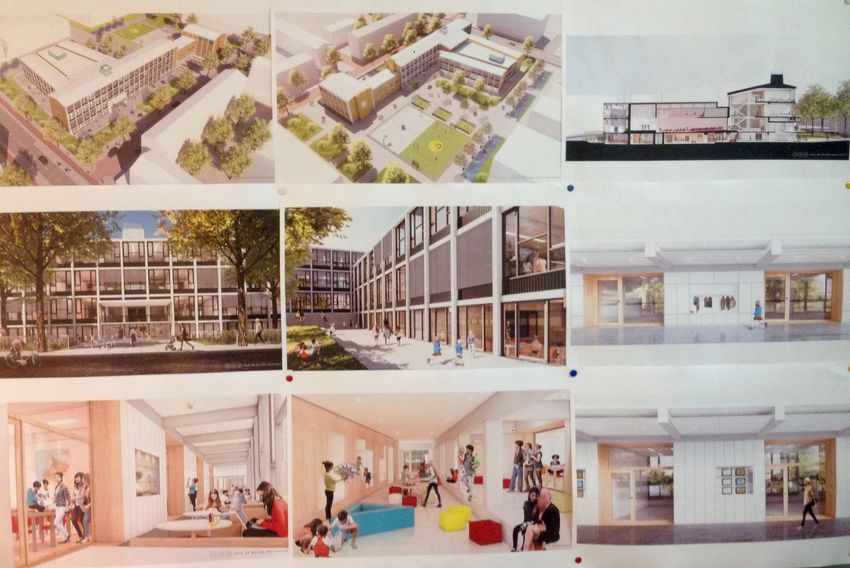
School, Mundus College, Marcanti College and the Europaschool. In 2019 we will move to a
new school building for 900 students (350 primary, 550 secondary).

 School Year     Students Primary      Students Secondary       Linked to diploma program

 2015-2016       105                   193                      41

 2016-2017       111                   242                      71

 2017-2018       121                   223 > 265                not available yet

DENISE - School Guide 2017-2018 - Page 2
2. School Profile

2.1 Vision and mission statement DENISE
De Nieuwe Internationale School Esprit (DENISE) in Amsterdam offers widely accessible
international education of high quality standing in present society with broad awareness of the
collective responsibility for the world we live in. We achieve this by offering a broad international
curriculum as well as an anchor for life in the Netherlands. DENISE is a school for all students
with an international mindset.

Also DENISE offers a first entry for newcomers to students age 4 till 18 and with a diverse
(educational) background. It is therefore a requirement that students can work and learn at their
own pace and at their own level. We prepare students for a Dutch or English diploma
programme, for which language shouldn’t be a barrier. Therefore, our main focus at DENISE is
language acquisition. Language enables independence of our students: with the language
students are able to study, make connections with other students and participate in Dutch
society. The curriculum allows differentiation into age-specific class levels. There is, however, a
minimum requirement - a basis that is the same for everyone.

Furthermore, in every programme DENISE offers we place high value on intercultural
competence and personal development. Through the International Mindedness & personal
goals students learn to interact and cooperate with each other, to be respectful and open
towards others, to solve problems together and to consider issues from multiple perspectives.

2.2 Language philosophy DENISE
At DENISE we offer international education for students from all around the world. Students
with different backgrounds, from different cultures and languages study together in one class.
We prepare students for a Dutch or English diploma programme, for which language does
prove to be a barrier. Therefore, our main focus at DENISE is language acquisition.
Language enables independence of our students: with the language students are able to study,
make connections with other students and participate in Dutch society.

At DENISE we believe it is important that students gain a basic understanding of the Dutch
language. Moreover, to function in an international environment, a sound understanding of the
English language is important. Consequently, a number of subjects in the IMYC-curriculum and
all subjects in our IB diploma program are taught in English. Finally, we encourage students to
maintain good use of their mother tongue. At DENISE, all teachers are language teachers, as
we believe all teachers bear responsibility for our students language acquisition.

   See for more information the language policy document.

DENISE - School Guide 2017-2018 - Page 3

2.3 Core values and rules of behaviour
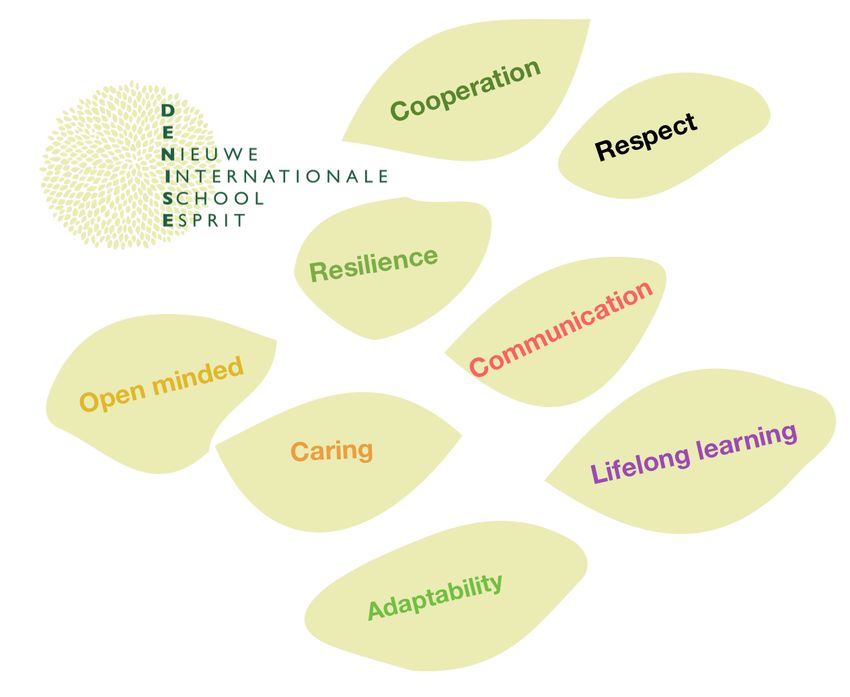
At DENISE, we respect each other, students, parents and everyone who is our guest. We treat
each other as we want to be treated ourselves. We don’t judge each other but get on with each
other. We ask and listen to each other. We talk to each other and help each other. Together, we
are responsible for the atmosphere of the school and shaping the eight core values of DENISE.

In addition, we follow these ten rules of behaviour.

   1.  Be on time for the lessons at the place you are expected.
   2.  Eat and drink in the appropriate places.
   3.  Treat peer students and employees with respect. Use respectful language.
   4.  Follow instructions of the staff of the school.
   5.  Leave the room clean.
   6.  Use your iPad and phone during class only for learning. The teacher decides when.
   7.  Don’t wear a jacket, cap or hoodie in class.
   8.  Homework is done and work is delivered by the deadline.
   9.  Making photos, videos and other recordings is only permitted as part of an assignment
       and with the permission of the people you are filming.
   10. Physical / verbal violence, stealing, weapons, drugs, smoking and drinking are
       prohibited inside and outside the school.

   See for more information the the anti-bully document.

DENISE - School Guide 2017-2018 - Page 4
3. Educational programs

3.1 The DENISE programmes
DENISE offers five different programmes so that every student can be served at their own
needs and personal choices. A curriculum coordinator coordinates each programme. An
examination secretary monitors the Diploma Programme. They are managed by the
management team of DENISE (Principal of the school, Team Leader Primary School and Team
Leader Secondary school).

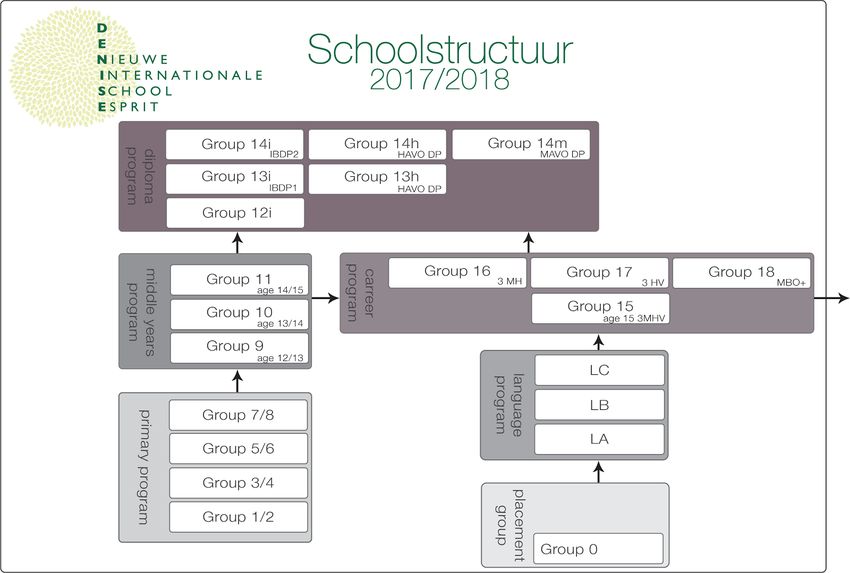
   0. The Placement Group
      Students between 12 and 18 years old, that do not or hardly speak Dutch, start in a
      intake class called group 0. In group 0 we try to get as much information as possible
      about the student, by having conversations with the parents and the student, doing
      tests and by observing the students behaviour in class. After group 0 the student will go
      Mundus College (BB/KG) or to one of four DENISE programmes for 12 till 18.

   1. The DENISE Primary Programme - Group 1-8; age 4-12.
      The DPP is a bilingual (Dutch-English) programme based on the national Dutch Primary
      Curriculum and the International Primary Curriculum (IPC) for Primary education.

   2. The DENISE Middle Years Programme - Group 9, 10, 11; age 12-14.
      The DMP a bilingual (Dutch-English) programme based on the national Dutch lower
      Secondary Curriculum and International Middle Years Curriculum (IMYC).

   3. The DENISE Career Programme - Group 15, 16, 17; age 15-18.
      The DCP is DENISE's lower secondary education program for students aged 15 years
      and older. The aim of this program is to prepare for a Diploma Programme in vocational
      education or adult education. This transition will in principle always be at the end of the
      school year, but can also be delayed one year. The education program is more focused
      on Dutch (language) education.

   4. The DENISE Diploma Programme - Group 12, 13, 14; age 15-18
      The DDP contains three different curricula to match our student populations’ wishes
      and needs and DENISE’s mission and vision statement. In 2015 we started our first
      Dutch MAVO Diploma Programme, in cooperation with Mundus College. We hope to
      copy this corporation model for a Dutch HAVO Diploma Programme in 2018 with
      Marcanti College. In 2016 we started a cooperation with the Amsterdam International
      Community School (AICS). Until the moment we start our own DP1 and DP2 they will
      accept our group 12 students in their IB Diploma Programme.

   5. The DENISE Language Programme - Language classes LA, LB, LC; age 12-18
      The DLP is for students from 12 years of age and older who do not master the Dutch
      language adequately. We distinguish three levels: LA: students who have little to no
      knowledge of the Dutch language. LB: Students have at minimum level of the Dutch
      language. LC: Students have reached a standard level of the Dutch language. Good
      enough to start in one of the groups in DENISE Secondary Education (age 12 - 18).

DENISE - School Guide 2017-2018 - Page 5
International Primary Curriculum and International Middle Year Program
The International Primary Curriculum (IPC) and the
International Middle Years Curriculum (IMYC)
improves the way that students learn. It is a
challenging, engaging, internationally-minded,
concept-focused curriculum designed specifically for
the unique learning needs of students in lower
secondary. The IMYC helps students to make
meaning of their learning by linking all subject
learning to a conceptual theme called ‘The Big Idea’.
Individual and collaborative research and recording
tasks are all linked to this Big Idea, supporting
subject
teachers in
facilitating
student-led,
subject-based learning. Learning tasks provide
opportunities for students to regularly problem solve, to
think creatively, and to develop personal skills such as
resilience, communication and adaptability.
Each exit point asks students to combine their
understanding from the unit of work; showing how all their
DENISE - School Guide 2017-2018 - Page 6learning links though the Big Idea and what that means to them personally and in a real world context. The work in planning and producing these projects provides opportunities for extensive creative and student-led learning and, as students share in the presentations of their peers, more new learning and creativity is shared. IMYC learning builds upon enquiry-based thematic primary and helps us to prepare students for the next stage of their learning. This includes the development of foundation subject knowledge and skills that students need for diploma programs like GCSE, iGCSE, IB Diploma and A levels. Students will develop skills required for complex researching and recording, for presenting and for using a range of media forms to present learning. In addition, the personal and international skills that students develop throughout their learning with the IMYC also provide crucial foundations for their senior school learning and even for future work opportunities. See for more information www.greatlearning.com/ipc/ and www.greatlearning.com/imyc Diploma Programme DENISE offers several opportunities for a diploma. At the moment we offer MAVO and HAVO and we are a candidate for International Baccalaureate. In the future we will offer a full customized diploma (maatwerk-diploma) for each individual student. MAVO The MAVO Diploma Programme is a one-year programme that prepare students for HAVO diploma or vocational education (MBO/ROC). HAVO The HAVO Diploma Programme is a one-year programme that prepares for higher vocational education (HBO). The International Baccalaureate (IB) In our group 12 we prepare students for the IB-DP. Until a possible moment in the future we offer IB ourselves (2018-2019) students will transfer to the AICS or any IBO school to complete their programme. The International Baccalaureate provides a challenging, internationally focused, broad and balanced educational experience for students aged 16 to 19. Students are required to study six subjects and a curriculum core concurrently over two years. The programme is designed to equip students with the basic academic skills needed for university study, further education and their chosen profession as well as developing the values and life skills needed to live a fulfilled and purposeful life. The driving force behind the Diploma Programme is a philosophy about the nature of education, which is expressed in the IB’s mission statement, in the IB learner profile and in the fundamental principles on which the curriculum is based and which continue to inspire its development. De Nieuwe Internationale School Esprit is a candidate school for the Diploma Programme. This school is pursuing authorization as an IB World School. These are schools that share a common philosophy—a commitment to high quality, challenging, international education that De Nieuwe Internationale School Esprit believes is important for our students. DENISE - School Guide 2017-2018 - Page 7
3.2 Curriculum Book: learning goals
The five programmes of DENISE meets the attainment targets for group 1-8 for primary school
and the key targets for group 9-11 in lower secondary education. The 58 core objectives for
primary and secondary education are not specified by level in the Netherlands. This situation
leaves space to offer students the first three years a mixed curriculum according to the "Middle
School" principe.

Learning goals are formulated for each subject and written down in our Curriculum Book. The
student will have a school year (September-July) to work on these goals. At several moments,
the teachers will assess how well the student performed on these learning goals based on the
student’s efforts and assignments. The teacher uses several assessment instruments.
Examples are tests, examinations, essays, extended practical work, projects, portfolios and oral
work. In December, March and June the teacher determines the student’s level using a 5
(groups 9-11, 15-18) or 7 (groups 12-14) point scale.

For each subject the teachers will assess how well the student performed on the learning goals.
Learning goals make clear which knowledge, skills or approaches to learning are important for
each subject. Working on and achieving learning goals is important for three reasons: 1) it will
help the student to discover the student’s interests; 2) it will help the student to better
understand how society works and how the student can contribute to it; 3) it will help the
student to be prepared for a Diploma Programme.

Students progress through the levels at their own pace and at any moment may move to the
next curriculum year. However, there are certain points at which a minimum level of success is
required in order to progress to the next school year. These moments are at the end of a
Language Class (A, B, C), at the end of primary school (to start group 9) and end of the Middle
Year Programme (to start group 12 or 14) and at the end of the Career Programme (to go to a
diploma programme). Group 12 is our Pre-DP preparatory group for our future IBDP 1 (Group
13) and IBDP 2 (Group 14). Before the start of group 12 and group 13 an assessment for
admission will be required.

   See for more information the admission policy document and the Curriculum Book.

3.3 Assessment philosophy
Our philosophy is that frequent, regular and continuous assessment during our programmes is
part of the learning process. The assessment is viewed as a tool that can be used to reach a
(personal) learning goal. Assessment is not a standalone goal where the learning stops, but is
part of the ongoing development of the student. During the five semesters per course-year
teachers use formative assessment to identify the learning needs of students and form part of
the learning process itself. Teachers use summative assessment to determine the level of
achievement of a student generally at the end of each semester. When appropriate teachers
use peer- and self-assessment: students assess their own work and each other’s work. If
relevant, students may also be actively involved in the setting criteria for work to be assessed
against.

DENISE - School Guide 2017-2018 - Page 8
Teachers of DENISE use the following guidelines when assessing their students.

   1. The assessment supports the learning goals and philosophical goals of the DENISE
      programmes.

   2. All assessments at DENISE are criterion-related. Teachers use a rubric with criteria to
      determine the level of achievement. Numbers indicate the level reached.

   3. The assessment results on the DENISE Report Card have a high level of reliability. The
      results predict student’s perspectives and opportunities with reference to a Diploma
      Programme (in or outside DENISE) or further study after graduation.

   4. The assessment tasks evaluate a learning goal or a number of learning goals of the
      strands.

   5. The assessment reflects the international mindedness of the DENISE programmes; it
      avoids cultural bias and it supports students with acquiring the Dutch and English
      language.

   6. The assessment pays attention to the higher-order cognitive skills as well at the more
      fundamental skills.

   7. Teachers are responsible for creating a variety of assessment tasks and instruments to
      ensure all learning goals for their subject are covered.

   8. The teachers benchmark their way of assessing student’s work by getting feedback
      from experienced senior examiners and statistical information (in or outside DENISE).

   9. Teachers are required to continuously record the progress of the students in
      Magister/Managebac. The records are available for other teachers, students and
      parents/guardians. Records need to be simple, clear and precise.

   10. Every teacher provides supportive feedback on the student’s performance during their
       semester. This feedback answers: What were the student’s learning goals? Did the
       student achieve these goals? Where to go next? What steps need to be taken to
       improve?

   11. In December, March and June a teacher writes a report card. The card will be
       addressed at the 10-minute meetings with the student’s parents/guardians. In these
       meetings, the student will discuss which goals the student has or has not not achieved
       (yet) and why.

   12. Teachers must keep a clear and accurate digital record of all assessment activities. The
       assessment instruments are digital and can be shared with the other teachers,
       curriculum coordinators and school management.

DENISE - School Guide 2017-2018 - Page 9
13. If a teacher suspects that a student is guilty of plagiarism, the teacher should not award
a level of achievement, inform the mentor and the curriculum coordinator and refer to
the school’s Academic Honesty Policy.
14. When designing assessments tasks, the language policy is taken into account.
15. Besides working on the student’s subject-specific knowledge and skills, each teacher
also stimulates the student to develop skills that help the student ‘learn to learn’: the
student’s approaches to learning. These skills include research skills, communication,
cooperation, self-management, thinking skills, effort, and academic honesty. The
student’s learning progress on these skills is also important to indicate which Diploma
Programme is attainable. Each teacher evaluates these skills on a scale with four
distinctions: improvement needed, competent, good or excellent.
DENISE teachers can expect from the student (to an increasing extent):
● to investigate research questions using different media;
● to communicate effectively and respectfully;
● to cooperate and collaborate well with peers;
● to self-manage learning and always be able to use feedback;
● to demonstrate critical thinking and problem solving skills;
● to come to class prepared and always use the class time well and reflect on homework;
● to create own work and know how to cite.
DENISE students can expect the teacher:
● to clearly identify the requirements for each piece of work by using a rubric;
● to provide adequate time for students to complete any given assessment task;
● to provide adequate access to any materials necessary for the successful completion of
any assessment task;
● to provide feedback within 10 working days of work being submitted.
DENISE teachers expect from parents/guardians:
● to offer constructive and positive support as their son/daughter complete their school
work; however, this support should not go so far as to compromise the authenticity of
the son’s/daughter’s work.
● to provide a quiet space at home/library and adequate time to complete their school
work.
● to provide access to internet and membership of a library;
● to visit the parent meetings (start school year, December and April or at the invitation of
the mentor).
See for more information the assessment policy document.
DENISE - School Guide 2017-2018 - Page 103.4 Academic Policy At DENISE we encourage our students to be academically honest. With our student population coming from different cultural and national backgrounds, we realise that not all students have the same standards when they enter. As an important task of our school is to classify the level a student is working on (mavo/havo/vwo), teachers want to be sure it is the student’s own work they assess. Therefore our academic honesty policy runs throughout the whole secondary school, already starting in the language classes. What we expect from students is different, depending on the grade they are in. Whereas we find it important that language students do not copy and paste from google translate and grade 9 students know how to recognise a source and make a list of used sources, we expect our DP students to use full APA referencing at all time. The details of what we expect per class can be found in the Academic Honesty Ibook (in English, see some screenshots in Appendix 1) and in the ‘overzicht verwachtingen academic honesty document’ (in Dutch, see Appendix 2). Both documents were customized for our school and came into being after an academic honesty workshop for teachers. The Ibook is available for all teachers, students and mentors and will be revised regularly. A Dutch translation is in the making. As you can read in the ‘overzicht verwachtingen academic honesty document’, the curriculum coordinators are responsible for the implementation of the standards in their programme. They will ensure the mentors in their programme give instructions to the students. Since students enter our school all the time throughout the school year we have made the mentor responsible for instructing the new students. When students newly arrive in our school they get access to the academic honesty Ibook, indicating what is expected from them in each grade. On the DENISE website students and teachers can find an academic honesty document, which explains the APA rules to them. The consequences of academic malpractice are mild for students who just arrived in our school and more severe for those who have stayed for a longer period of time. When students enter DP1 the DP coordinator sends the parents a letter, indicating the importance of academic honesty in the IB and explaining the consequences of academic malpractice in the DP. See for more information the academic honesty policy document. 3.5 Learning materials policy The learning tools of DENISE enables students to make his / her own choices within the curriculum. Therefore, we use the following principles: In Primary the first four years we use books and slowly growing into working with ipads on math and presentations. In Secondary most content will be delivered through the iPad and therefore we ask students (and parents) to arrange their own iPad. Students will keep them in a firm cover. Students will also bring a pen and notebook to school. Teachers develop customized educational materials and submit them through iTunes U and Google Drive. We encourages the development of open educational materials and free exchange through iTunes U. All teaching materials (from teachers and students) shared online will be accessed through a CC BY-SA 4.0 license (or later version). By doing so, the school supports the development of open educational materials. Additional folio material is present at school and is granted to students. See for more information the copyright policy document DENISE - School Guide 2017-2018 - Page 11
4. Student affairs

4.1 Admission
Applying for DENISE is possible for all students from age 4 to 18. When a child is 4 years old,
he or she can go to a primary school. Sinds a couple of years all primary schools in Amsterdam
have switched to a city wide equal admission policy. This means that applying for a primary
school and the allocating of the places follow the same rules on all the participating schools.
Around the third birthday of your child you will receive an explanatory brochure and an
application form from the municipality of Amsterdam. Students between 12 and 18 years old,
that do not or hardly speak Dutch, start in this intake class called group 0. In group 0 we try to
get as much information as possible about the student, by having conversations with the
parents and the student, doing tests and by observing the students behaviour in class. All the
information we obtain, is put it directly in our online student follow system, called Magister.

For other students it is the intake procedure and information we get from previous schools that
helps find out if and if so, which group is the best for the student.

   See for more information admission policy and assessment policy document

4.2 Special Educational Needs
At DENISE we offer international education for students from all around the world. Students
with different backgrounds, from different cultures and languages study together in one class.
Our students come from all over the world and quite a lot of them had a hard time coming here.
Some of them are refugees. Most non-western students experienced a totally different type of
education in their home country. With this in mind it becomes clear that a lot of our students
have special educational needs. Some problems revolve around language. The language policy
explains how we deal with students for whom Dutch is not their first language. In the Special
Educational Needs Policy we explain how we deal with other special educational needs (SEN)
such as social emotional problems, medical conditions, hear/speech/sight/physical problems,
autism, ADHD, ADD, dyscalculia and dyslexia. Since our mission is to make international
education available for all students in Amsterdam.

The care structure in DENISE differentiates between the special needs coordinator, the teacher
support coordinator, the student support coordinator and the mentor.

The mentor is the first person who deals with SEN of the students. When a teacher notices a
SEN, he or she will contact the mentor and the mentor will decide if the problem can be dealt
with alone, or if the help of the student support coordinator is needed.

The student support coordinator is accountable to the team leader and responsible for the
execution of the student guidance, the quality of plans and execution of them. The special
needs coordinator is accountable toward the team leader and is responsible for the care policy,
the plans, execution and quality of care policy. The teacher support coordinator takes care of
guiding teachers in the field of classroom management, pedagogical climate and didactics.

DENISE - School Guide 2017-2018 - Page 12
The teacher support coordinator is accountable towards the team leader and responsible for
the execution and support of teachers in their execution of care tasks, their approach and plans
and the quality of those. All students who are living in the Netherlands for more than one year
take a SON-R test with a psychologist. This tests also helps to indicate if the student has
special educational needs. Extra money is available from the government to support those
students.

Teachers receive training about SEN. We have had a training on dealing with highly gifted and
talented students and plan to have trainings during one of our Bootcamps on autism, ADHD,
depression/fear, eating disabilities and the ‘loaded’ background of some of our students.

Special Education Need Advisory Team / Zorgadviesteam (ZAT)
In addition to the support given to students from teachers, mentors and the dean the school
works with several advisors. A school worker, the health care coordinator, the school doctor,
the Attendance Officer (leerplichtambtenaar) and in some cases an employee of the Youth
Protection Region Amsterdam (Jeugdbescherming). All the advisors are member of the ZAT
and will meet 7 times a year to discuss students who need extra special educational need.
Everything discussed in the ZAT meetings is confidential information. Parent/guardians will be
notified if their son/daughter will be discussed. The school doctor and the confidential person
(vertrouwenspersoon) can also be consulted by parents/guardians and students.

Parent-Child Advisor / (ouder kind adviseur, OKA)
The Parent-Child Advisor (ouder kind adviseur, OKA) speaks with students who experience
problems in the social-emotional area and, if necessary, with their parents/guardians. The OKA
will also advise the mentors and she supports any reference to an institution for assistance.

Attendance officer (leerplichtambtenaar)
The Attendance Officer is responsible for supervising the Compulsory Education Act. When the
school reports unauthorized school absenteeism, the Attendance Officer will contact the
parents/guardians to investigate the reason for the absence.

M@zl
In case of frequent sickness absence, the school will register the student for M@zl: an intensive
collaboration between the Attendance Officer, the school doctor and the school to prevent or
minimize the school absenteeism.

   See for more information the special educational needs policy and language policy

DENISE - School Guide 2017-2018 - Page 13
5. School Organisation

5.1 Time Table

Primary
Monday, Tuesday, Thursday, Friday: 8.30am (welcome) lessons: 8.45am - 3.00pm
Wednesday: 8.30am (welcome) lessons: 8.45am -12.30pm

Secondary
8.15        Mentorlesson
8.40        1st

9.30        minibreak

9.40        2nd

10.30       3rd

11.20       break

11.40       4th

12.30       5th

13.20       break

13.50       6th

14.40       7th

15.30       8th
16.20       Closing

    See for more information about subjects
and hours in Secondary the website
http://denise.espritscholen.nl/home/

5.2 School Fee

DENISE is a public school without fees. We do
ask a voluntary parent-contribution depending
on income. The maximum contribution (Camp
included) in 2017/2018 is € 900,- for Primary
and € 320 for Secondary.

DENISE - School Guide 2017-2018 - Page 14
5.3 School Building Denise is located at the Pieter de Hoochstraat 78+80, near Museum Square in Amsterdam. In Spring 2019 we will move to Piet Mondriaanstraat, Nieuw West in Amsterdam (see design). 5.4 Year Calendar 2017-218 First day of School Thursday 7 September Autumn Holiday Friday 20 October 2017 - Friday 27 October Winter Holiday Monday 18 December 2017 - Friday 5 January 2018 Spring Holiday Friday 23 February 2018 - Friday 2 March 2018 2e Eastern Day Monday 2 April 2018 May Holiday Friday 27 april 2018 - Friday 4 mei 2018 Ascension Thursday 10 May 2018 2e Pinksterdag Monday 21 May 2018 Summer Holiday Friday 20 July 2018 - Wednesday 5 September 2018 DENISE - School Guide 2017-2018 - Page 15
6. Staff

6.1 Organogram

6.2 School Management

Role/task                                   Name
Principal                                   Leendert-Jan Veldhuyzen
Team Leader Primary Education:              Jutka Colson
Team Leader Secondary Education             Luc Sluijsmans

DENISE - School Guide 2017-2018 - Page 16
6.3 Team of coordinators

Program                                     Coordinator
Primary Program (IPC)                       Mari Varsanyi + Kaisa Swarts
Language Program                            Merel Kroese
Middle Years Program (IMYC)                 Merrit Vervenne
Career Program (CP)                         Sobhi Achtitah
Diploma Program (DP-coördinator)            Marlise Achterbergh
Student Counselor                           Jo Hooiveld + Pari ten Cate
Admission Coordinator (Secondary)           Merel Kroese
Special needs coordinator / student         Elsje Wijk + Gabriella Brescia
support coordinator/teacher support
coordinator
ICT Coördinator                             Suzanne Lustenhouwer

6.4 Team of Primary Education Teachers

Group                                       Teacher
GR1/2a                                      Stefan Elevelt
GR1/2b                                      Saskia Nivard
GR3/4a                                      Dominique Beurskens
GR3/4b                                      Willemijn Bekebrede
GR5/6                                       Ilse Bos + Kaisa Swarts
GR7/8                                       Esther Guerand + Kaisa Swarts

6.5 Team of Secondary Education Teachers

Subject                                     Teachers
Dutch / NT2                                 Anja Beemster, Ricky Dost, Sanne Gloerich,
                                            Marjolein de Jong, Merel Kroese (DP), Yvonne
                                            Franken, Petra van de Geest, Dominique
                                            Beurskens
English / EAL                               Suzanne Lustenhouwer (DP), Liselotte Sieffers,
                                            Paula Sutherland, Mari Varsanyi, Philip Blinko
Spanish                                     Rosana Navarro
French                                      Paula Sutherland, Ricky Dost
Math                                        Sobhi Achtitah, Bram van Laarhoven (DP)

DENISE - School Guide 2017-2018 - Page 17
Science Jo Hooiveld (DP), Stephanie Kane, Estevan
Veenstra (DP)
Social Studies Roland Kraaijpoel, Merrit Vervenne (DP), Benjamin
Zuurendonk (DP), Marlise Achterbergh (DP)
Knowledge Studies Marlise Achterbergh (DP)
Group Project / Personal Project Marlise Achterbergh (DP) / Estevan Veenstra (DP)
Music Elenne Klok, Leendert-Jan Veldhuyzen (DP),
Isabella van Wetten
Theater Maria Couprie, Jim de Groot, Bas Grevelink
Physical Education Matthijs van Schie, Pari ten Cate (DP)
6.6 Team of Mentors
Group Secondary Education Mentor
LA Marjolein de Jong + Petra van der Geest
LB Merel Kroese + Yvonne Franken
LC Anja Beemster
Group 9 Matthijs van Schie, Liselotte Sieffers
Group 10a Sanne Gloerich + Benjamin Zuurendonk
Group 10b Elenne Klok + Sobhi Achtitah
Group 11 Merrit Vervenne + Estevan Veenstra
Group 12 Marlise Achterbergh + Suzanne Lustenhouwer
Group 13 & 14 Roland Kraaijpoel
Group 15 Pari ten Cate and Philip Blinko
Group 16 Maria Couprie + Bram van Laarhoven
6.7 Team staff of support
Role/task Name
Management assistant Nelleke de Weerd
Student Administration Karin Koerts
Hostess Denise Petra Bulck, Sanaa Saad
Host, technical assistant and time table Ton van wijk
maker
Educational Assistants Primary Gina Lindeboom, Yosra Roshdy
DENISE - School Guide 2017-2018 - Page 187. Communication
7.1 Communicate philosophy
In a community where young people and adults learn and work together on a daily basis
anything can happen. Our students in the age of 4-18 develop themselves constantly and fast.
We would like to influence that process in the most positive way. Close cooperation and
contact between school, students and parents/guardians is crucial to reach that goal. The
school puts a lot of effort in optimizing all communication between school, students and
parents/guardians. Clear conventions between school and parents are necessary to make
things as transparent as possible. Our core values and rules of behaviour apply also for
parents/guardians and every one who cooperates with our school.
7.2 What parents/guardians can expect from DENISE
● Every month all parents/guardians receive a Parent Letter with the latest news
concerning school issues and program.
● The teacher (or mentor in Secondary) contacts parents/guardians about issues of
general kind concerning the student (results, presence and behaviour).
● The school management communicates with parents/guardians about events like
parent-evening, school trip, excursion or field trip etc.
● There is a school website and this school guide with specific information about
developments at school, schedules, curriculum, year calendar etc.
● Once every six weeks a coffee morning for Primary parents/guardians will take place.
Parents/guardians can meet each other, teachers and staff about all kinds of subject.
● The school management organises two Sounding Board Evenings per school year to
evaluate the program and organisation of the school and discuss new ideas.
● The teachers organises two Parent Meetings per school year to discuss the report card
of the students.
7.3 What the school management and teachers expect from parents/guardians
● Parents/guardians are deeply involved with everything covering their kids at school.
● Parents/guardians read parent letters and emails from school.
● They will take notice of the year schedule, especially the dates of the holidays. The
school does not grant leave around the holidays. Leave forms are available at the front
desk of the school or on the website and need to be send in two weeks ahead.
● Parents/guardians who are concerned about their child or an event at school should
contact the group teacher or mentor.
● Parents/guardians inform the group teacher or mentor about family matters that can
influence performance or behaviour at school
● Parents/guardians check the timetable and ‘het dagrooster’ on the website on a daily
basis. In case of illness / absence, the parents/guardians / guardians call the school
between 7.30 - 8.30am (020-4802700). In Secondary, if the door of the classroom is
closed, the lesson has begun. If the student comes in late, he/she are already marked
as absent (A). This can be changed 'too late' after a conversation with teacher and / or
mentor.
DENISE - School Guide 2017-2018 - Page 19● In case of an emergency parents/guardians call always via 020 480 2700
● At drop-off and pick-up time for Primary there is always an opportunity to ask a short
question or inform the group teacher. Between 8.00am and 8.30am the school
management and other staff is around and they are available for questions.
● It is always possible make an appointment with mentor, group teacher or school
management. Parents/guardians can send an email for contact to
info@denise.espritscholen.nl. In Secondary our policy is to e-mail the mentor for
questions. If that is not satisfying they can email school management.
● Changes to organization or policy are communicated by the school management to all
parents/guardians in the parent letter, depending on the nature and urgency of the
change.
● Private data from staff, students or parents/guardians is not provided to third parties.
● Highly personal, stressful or emotionally conversations are not conducted by the school
by telephone. You will receive an invitation for a conversation at school.
DENISE - School Guide 2017-2018 - Page 20You can also read


