2020-21 Service Agreement - Secretary, NSW Health Northern Sydney Local Health District - the Northern Sydney Local ...
←
→
Page content transcription
If your browser does not render page correctly, please read the page content below
2020-21 Service Agreement
AN AGREEMENT BETWEEN:

Secretary, NSW Health
AND THE

Northern Sydney Local Health District
FOR THE PERIOD

1 July 2020 – 30 June 2021
Contents
NSW Health Service Agreement – 2020-21................................................................ 1
1. Objectives of the Service Agreement ..................................................................... 3
2. Legislation, governance and performance framework ...................................... 4
    2.1 Legislation                                                                                                                  4
    2.2 Variation of the agreement                                                                                                   4
    2.3 National Agreement                                                                                                           4

    2.4 Governance                                                                                                                   5

3. Strategies and local priorities ................................................................................... 7
    3.1 NSW Premier’s Priorities                                                                                                     7

    3.2 NSW Health Strategic Priorities 2020-21                                                                                      8

    3.3 NSW Health Outcome and Business Plan 2019-20 to 2022-23                                                                      9
    3.4 Local priorities                                                                                                           11

4. NSW health services and networks ........................................................................12
    4.1 Services                                                                                                                   12
    4.2 Networks and services provided to other organisations                                                                      12

    4.3 Cross district referral networks                                                                                           12

    4.4 Supra LHD services                                                                                                         13

    4.5 Nationally Funded Centres                                                                                                  16

5. Budget ...........................................................................................................................17
    5.1 State Outcome Budget Schedule: Part 1                                                                                      17

    5.2 State Outcome Budget Schedule: Part 2                                                                                      18

    5.3 State Outcome Budget Schedule: Part 3                                                                                      19

    5.4 State Outcome Budget Schedule: Part 4                                                                                      20

    5.5 State Outcome Budget Schedule: Capital program                                                                             21

6. Purchased volumes ................................................................................................... 23
    6.1 Activity                                                                                                                   23
    6.2 Election Commitment                                                                                                        23

    6.3 NSW Health Strategic Priorities                                                                                            24

7. Performance against strategies and objectives.................................................. 25
    7.1 Key performance indicators                                                                                                 25

    7.2 Performance deliverables                                                                                                   33

2020–21 Service Agreement                                                                                                           2
1. Objectives of the Service Agreement
• To articulate responsibilities and accountabilities across all NSW Health entities for the delivery of
NSW Government and NSW Health priorities.
• To establish with Local Health Districts (Districts) and Speciality Health Networks (Networks) a
performance management and accountability system for the delivery of high quality, effective
healthcare services that promote, protect and maintain the health of the community, and provide
care and treatment to the people who need it, taking into account the particular needs of their
diverse communities.
• To develop formal and ongoing, effective partnerships with Aboriginal Community Controlled
Health Services ensuring all health plans and programs developed by Districts and Networks
include measurable objectives that reflect agreed Aboriginal health priorities.
• To promote accountability to Government and the community for service delivery and funding.
• To ensure that the CORE Values of Collaboration, Openness, Respect and Empowerment are
reinforced throughout NSW Health
• To ensure Districts and Networks engage in appropriate consultation with patients, carers and
communities in the design and delivery of health services.
• To ensure that Districts and Networks work together with clinical staff about key decisions, such as
resource allocation and service planning.
2020–21 Service Agreement: Objectives of the Service Agreement 32. Legislation, governance and performance framework 2.1 Legislation The Health Services Act 1997 (the Act) provides a legislative framework for the public health system, including setting out purposes and/or functions in relation to Local Health Districts (ss 8, 9, 10). Under the Act, the Health Secretary’s functions include: the facilitation of the achievement and maintenance of adequate standards of patient care within public hospitals, provision of governance, oversight and control of the public health system and the statutory health organisations within it, as well as in relation to other services provided by the public health system, and to facilitate the efficient and economic operation of the public health system (s.122). The Act allows the Health Secretary to enter into performance agreements with Local Health Districts in relation to the provision of health services and health support services (s.126). The performance agreement may include provisions of a service agreement. Under the Act the Minister may attach conditions to the payment of any subsidy (or part of any subsidy) (s.127). As a condition of subsidy all funding provided for specific purposes must be used for those purposes unless approved by the Health Secretary. 2.2 Variation of the agreement The Agreement may be amended at any time by agreement in writing between the Organisation and the Ministry of Health. The Agreement may also be varied by the Secretary or the Minister in exercise of their general powers under the Act, including determination of the role, functions and activities of Local Health Districts (s. 32). Any updates to finance or activity information further to the original contents of the Agreement will be provided through separate documents that may be issued by the Ministry of Health in the course of the year. 2.3 National Agreement The National Cabinet has reaffirmed that providing universal healthcare for all Australians is a shared priority and agreed in a Heads of Agreement for public hospitals funding from 1 July 2020 to 30 June 2025. That Agreement maintains activity based funding and the national efficient price. There is a focus on improved patient safety, quality of services and reduced unnecessary hospitalisations. The Commonwealth will continue its focus on reforms in primary care that are designed to improve patient outcomes and reduce avoidable hospital admissions. See http://www.coag.gov.au/agreements 2020–21 Service Agreement: Legislation, governance and performance framework 4
2.4     Governance
The Organisation must ensure that all applicable duties, obligations and accountabilities are
understood and complied with and that services are provided in a manner consistent with all NSW
Health policies, procedures, plans, circulars, inter-agency agreements, Ministerial directives and other
instruments and statutory obligations.

2.4.1   Clinical governance

NSW public health services are accredited against the National Safety and Quality Health Service
Standards.

https://www.safetyandquality.gov.au/our-work/assessment-to-the-nsqhs-standards/nsqhs-standards-
second-edition/

The Australian Safety and Quality Framework for Health Care provides a set of guiding principles that
can assist health services with their clinical governance obligations.
https://www.safetyandquality.gov.au/publications-and-resources/resource-library/australian-safety-
and-quality-framework-health-care

The NSW Patient Safety and Clinical Quality Program provides an important framework for
improvements to clinical quality.

http://www1.health.nsw.gov.au/pds/ActivePDSDocuments/PD2005_608.pdf

2.4.2   Corporate governance
The Organisation must ensure services are delivered in a manner consistent with the NSW Health
Corporate Governance and Accountability Compendium (the Compendium) seven corporate
governance standards. The Compendium is at:

http://www.health.nsw.gov.au/policies/manuals/pages/corporate-governance-compendium.aspx

Where applicable, the Organisation is to:

•   Provide required reports in accordance with timeframes advised by the Ministry;

•   Review and update the Manual of Delegations (PD2012_059) to ensure currency;
•   Ensure recommendations of the NSW Auditor-General, the Public Accounts Committee and the
    NSW Ombudsman, where accepted by NSW Health, are actioned in a timely and effective manner,
    and that repeat audit issues are avoided.

2.4.3   Procurement governance

The Organisation must ensure procurement of goods and services complies with the NSW Health
Goods and Services Procurement Policy Directive (PD2019_028). This policy directive details the
requirements for all staff undertaking procurement or disposal of goods and services on behalf of
NSW Health. https://www1.health.nsw.gov.au/pds/Pages/doc.aspx?dn=PD2019_028

2020–21 Service Agreement: Legislation, governance and performance framework                         5
2.4.4 Safety and Quality Accounts The Organisation will complete a Safety and Quality Account inclusive of an annual attestation statement as outlined by the National Safety and Quality Health Service Standards (Version 2.0). The account documents achievements and affirms an ongoing commitment to improving and integrating safety and quality into their functions. The Account provides information about the safety and quality of care delivered by the Organisation, including key state-wide mandatory measures, patient safety priorities, service improvements, integration initiatives, and three additional locally selected high priority measures. Locally selected high priority measures must demonstrate a holistic approach to safety and quality, and at least one of these must focus on improving safety and quality for Aboriginal patients. 2.4.5 Performance Framework Service Agreements are a central component of the NSW Health Performance Framework, which documents how the Ministry monitors and assesses the performance of public sector health services to achieve expected service levels, financial performance, governance and other requirements. The performance of a health service is assessed on whether the Organisation is meeting the strategic objectives for NSW Health and government, the Premier’s Priorities and performance against key performance indicators. The availability and implementation of governance structures and processes, and whether there has been a significant critical incident or sentinel event also influences the assessment. The Framework sets out responses to performance concerns and management processes that support the achievement of outcomes in accordance with NSW Health and government policies and priorities. Performance concerns will be raised with the Organisation for focused discussion at performance review meetings in line with the NSW Health Performance Framework available at: http://www.health.nsw.gov.au/Performance/Pages/frameworks.aspx 2020–21 Service Agreement: Legislation, governance and performance framework 6
3. Strategies and local priorities
The delivery of NSW Health strategies and priorities is the responsibility of the Ministry of Health,
health services and support organisations. These are to be reflected in the strategic, operational and
business plans of these entities.

3.1     NSW Premier’s Priorities
In June 2019, the NSW Premier set new social priorities to tackle tough community challenges, lift the
quality of life for everyone in NSW and put people at the heart of everything the Government does.
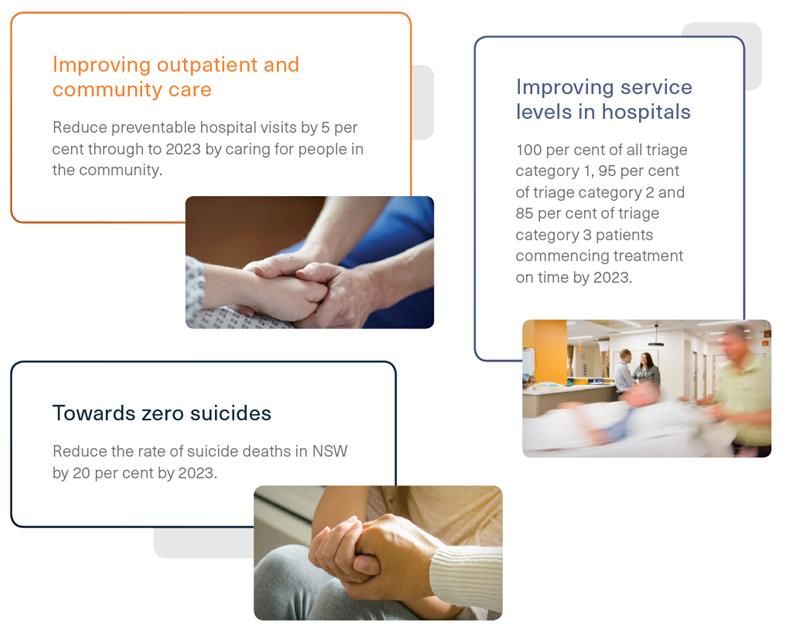
NSW Health is leading the three priorities for improving the health system:

NSW Health staff will continue to work together to deliver a sustainable health system that delivers
outcomes that matter to patients and the community, is personalised, invests in wellness and is
digitally enabled.

2020–21 Service Agreement: Strategies and local priorities                                          7
3.2     NSW Health Strategic Priorities 2020-21

2020–21 Service Agreement: Strategies and local priorities   8
3.3       NSW Health Outcome and Business Plan 2019-20 to 2022-23
The NSW Treasury Outcome Budgeting initiative intends to transform the way budget decisions are
made, and resources are managed in the NSW public sector. The overarching objective of Outcome
Budgeting is to shift the focus of the NSW Government to deliver better outcomes for the people of
NSW with increased transparency, accountability and value (TPP 18-091).
The NSW Health Outcome and Business Plan is an agreement between the Minister for Health and
Medical Research, the Secretary, NSW Health and the NSW Government setting out the outcomes and
objectives that will be focused on over the next four years.

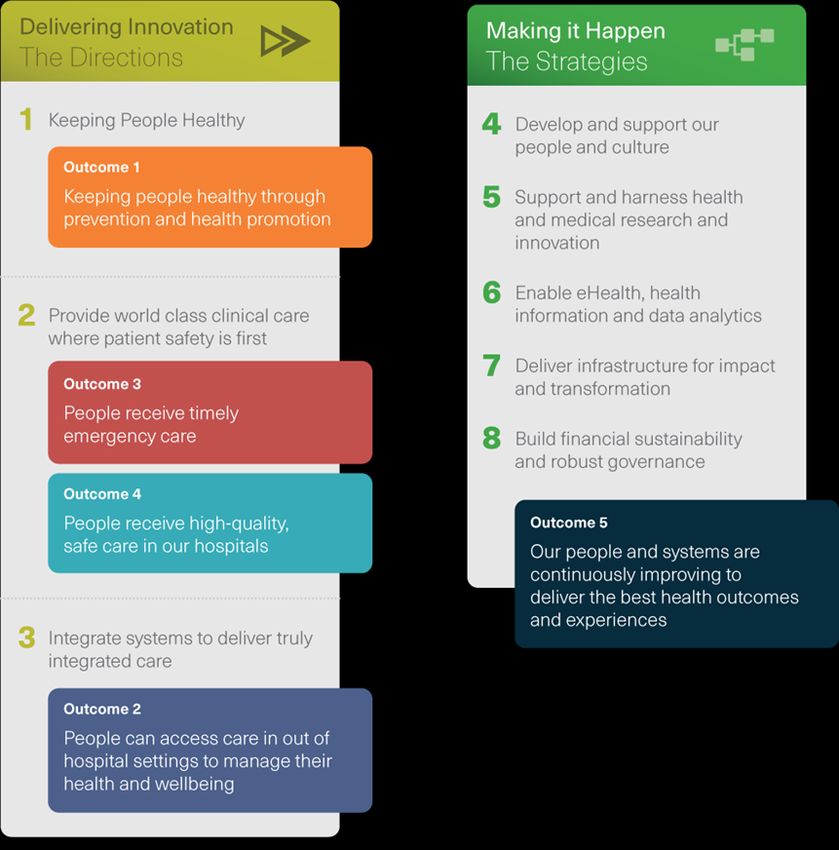
NSW Health has identified five state outcomes that it will achieve for the people of NSW. The state
outcomes cover the broad range of functions and services provided across care settings.

1. Keeping people healthy through prevention and health promotion

2. People can access care in and out of hospital settings to manage their health and wellbeing

3. People receive timely emergency care

4. People receive high-quality, safe care in our hospitals

5. Our people and systems are continuously improving to deliver the best health outcomes and
     experiences

To achieve these outcomes, NSW Health has set a series of ambitious targets and has a comprehensive
program of change initiatives in place. These targets have been built into key performance indicators
in the Service Agreement, the NSW Health Performance Framework, the NSW Health Purchasing
Framework and the funding model.

1
    https://www.treasury.nsw.gov.au/sites/default/files/2018-12/TPP18-09%20Outcome%20Budgeting.pdf

2020–21 Service Agreement: Strategies and local priorities                                           9
Alignment of directions and strategies to outcomes 2020–21 Service Agreement: Strategies and local priorities 10
3.4      Local priorities
Under the Health Services Act 1997, Boards have the function of ensuring that Districts and Networks
develop strategic plans to guide the delivery of services, and for approving these plans.

The Organisation is responsible for developing the following plans with Board oversight:

•   Strategic Plan
•   Clinical Services Plans

•   Safety and Quality Account and subsequent Safety and Quality Plan
•   Workforce Plan

•   Corporate Governance Plan

•   Asset Strategic Plan

It is recognised that the Organisation will implement local priorities to meet the needs of their
respective populations.
The Organisation’s local priorities for 2020-2021 are as follows:

Northern Sydney Local Health District (NSLHD) will continue to focus on delivering high-quality, timely
care for our residents. We will do this whilst responding to the changing demands of the COVID-19
pandemic, maintaining our high performance on emergency treatment performance and working to
re-establish our high performance for elective surgery following the pandemic. The allocation of
activity will be optimised to leverage the value and expertise of all of our health services and hospitals,
as well as ensure equity across our region.

NSLHD will prioritise the benefits realisation of capital investments to ensure the district is well
prepared for the commissioning of new services, including the Hornsby Ku-ring-gai Hospital stage 2
redevelopment. A clinical services plan for Ryde Hospital will be developed in response to the
announced $479 million capital funding and the intensive care unit (ICU) upgrade. The new GEM and
palliative care service at Mona Vale Hospital will commence in 2021, as well as ongoing collaboration
with HealthScope to ensure Northern Beaches Hospital provides the local population with timely
access to high-quality health care.

Improving the health and care of older people will remain a priority for NSLHD. Quality health care will
be supported by provision of services for patients within the home where possible, as well as
supporting residential aged care facilities to maintain safe, high-quality care across the patient journey.

A strategic framework will be established to guide the delivery of quality non-admitted health care in
NSLHD, including initiatives to improve patient outcomes and efficiency of care. This will include
building upon the successes of using Telehealth throughout the pandemic. A review of rehabilitation
services across the District will ensure optimum delivery of health care across a wide-range of settings.
NSLHD will continue to develop a platform for innovation and knowledge, allowing district staff to
develop new approaches for the delivery of care. Within this, the capture and utilisation of health
service data and the role this data plays in the effective management of health services, will be a focus
for the 2020/21 Financial Year.

2020–21 Service Agreement: Strategies and local priorities                                            11
4. NSW health services and networks

4.1      Services
The Organisation is to maintain up to date information for the public on its website regarding its
facilities and services including population health, inpatient services, community health, other non-
inpatient services and multipurpose services (where applicable), in accordance with approved role
delineation levels.
The Organisation is to enter into an annual Service Agreement with Affiliated Health Organisations
(AHOs) in receipt of subsidies in respect of services recognised under Schedule 3 of the Health Services
Act 1997.

The Organisation will also maintain up to date details of:
•   Non-Government Organisations (NGOs) for which the commissioning agency is the Organisation,
    noting that NGOs for which the commissioning agency is the NSW Ministry of Health are included
    in NSW Health Annual Reports.

•   Primary Health Networks with which the Organisation has a relationship.

4.2      Networks and services provided to other organisations
Each NSW Health service is a part of integrated networks of clinical services that aim to ensure timely
access to appropriate care for all eligible patients. The Organisation must ensure effective contribution,
where applicable, to the operation of statewide and local networks of retrieval, specialty service
transfer and inter-district networked specialty clinical services.

4.3      Cross district referral networks
Districts and Networks are part of a referral network with other relevant services, and must ensure the
continued effective operation of these networks, especially the following:

•   Critical Care Tertiary Referral Networks and Transfer of Care (Adults) - (PD2018_011)

•   Interfacility Transfer Process for Adult Patients Requiring Specialist Care - (PD2011_031)

•   Critical Care Tertiary Referral Networks (Paediatrics) - (PD2010_030)
•   Children and Adolescents - Inter-Facility Transfers - (PD2010_031)

•   Critical Care Tertiary Referral Networks (Perinatal) - (PD2010_069)
•   NSW State Spinal Cord Injury Referral Network - (PD2018_011)
•   NSW Major Trauma Referral Networks (Adults) - (PD2018_011)

•   Children and Adolescents with Mental Health Problems Requiring Inpatient Care - (PD2011_016)

•   Adult Mental Health Intensive Care Networks - (PD2019_024)

•   State-wide Intellectual Disability Mental Health Hubs

2020–21 Service Agreement: NSW health services and networks                                          12
4.4 Supra LHD services
Supra LHD services are provided across District and Network boundaries and are characterised by a
combination of the following factors:
• Services are provided on behalf of the State; that is, a significant proportion of service users are
from outside the host District’s/Network’s catchment
• Services are provided from limited sites across NSW
• Services are high cost with low-volume activity
• Individual clinicians or teams in Supra LHD services have specialised skills
• Provision of the service is dependent on highly specialised equipment and/or support services
• Significant investment in infrastructure is required
Ensuring equitable access to Supra LHD services will be a key focus.
The following information is included in all Service Agreements to provide an overview of recognised
Supra LHD services and Nationally Funded Centres in NSW.
Supra LHD service Measurement Locations Service requirement
unit
Adult Intensive Care Unit Beds/NWAU Royal North Shore (38) Services to be provided in
Westmead (49) accordance with Critical Care
Tertiary Referral Networks &
Nepean (21)
Transfer of Care (Adults) policy.
Liverpool (36+1/290 NWAU 2020/21)
Units with new beds in 2020-21
Royal Prince Alfred (51) will need to demonstrate
Concord (16) networked arrangements with
Prince of Wales (22+1/290 NWAU 2020/21) identified partner Level 4 AICU
services, in accordance with the
John Hunter (25+1/290 NWAU 2020/21)
recommended standards in the
St Vincent’s (21) NSW Agency for Clinical
St George (36) Innovation’s Intensive Care
Service Model: NSW Level 4 Adult
Intensive Care Unit
Mental Health Intensive Access Concord - McKay East Ward Provision of equitable access.
Care Hornsby - Mental Health Intensive Care Unit
Prince of Wales - Mental Health Intensive Care
Unit
Cumberland – Yaralla Ward
Orange Health Service - Orange Lachlan
Intensive Care Unit
Mater, Hunter New England – Psychiatric
Intensive Care Unit
Adult Liver Transplant Access Royal Prince Alfred Dependent on the availability of
matched organs, in accordance
with The Transplantation Society
of Australia and New Zealand,
Clinical Guidelines for Organ
Transplantation from Deceased
Donors, Version 1.0— April 2016
2020–21 Service Agreement: NSW health services and networks 13Supra LHD service Measurement Locations Service requirement
unit
State Spinal Cord Injury Access Prince of Wales Services to be provided in
Service (adult and Royal North Shore accordance with Critical Care
paediatric) Tertiary Referral Networks &
Royal Rehabilitation Centre, Sydney
Transfer of Care (Adults) and
SCHN – Westmead and Randwick Critical Care Tertiary Referral
Networks (Paediatrics) policies
Blood and Marrow Number St Vincent's (38) Provision of equitable access
Transplantation – Westmead (71)
Allogeneic
Royal Prince Alfred (26)
Liverpool (18)
Royal North Shore (26+13/166 NWAU 2020/21)
SCHN Randwick (26)
SCHN Westmead (26)
Blood and Marrow Access St Vincent's - to Gosford Provision of equitable access
Transplant Laboratory Westmead – to Nepean, Wollongong, SCHN
Westmead
Complex Epilepsy Access Westmead Provision of equitable access.
Royal Prince Alfred
Prince of Wales
SCHN
Extracorporeal Membrane Access Royal Prince Alfred Services to be provided in
Oxygenation Retrieval St Vincent's accordance with Critical Care
Tertiary Referral Networks &
Transfer of Care (Adults) policy
Heart, Lung and Heart Lung Number of St Vincent's (106) To provide heart, lung and heart
Transplantation Transplants lung transplantation services at a
level where all available donor
organs with matched recipients
are transplanted. These services
will be available equitably to all
referrals.
Dependent on the availability of
matched organs in accordance
with The Transplantation Society
of Australia and New Zealand,
Clinical Guidelines for Organ
Transplantation from Deceased
Donors, Version 1.1— May 2017.
High Risk Maternity Access Royal Prince Alfred Access for all women with high
Royal North Shore risk pregnancies, in accordance
with NSW Critical Care Networks
Royal Hospital for Women
(Perinatal) policy
Liverpool
John Hunter
Nepean
Westmead
2020–21 Service Agreement: NSW health services and networks 14Supra LHD service Measurement Locations Service requirement
unit
Neonatal Intensive Care Beds/NWAU SCHN Randwick (4) Services to be provided in
Service SCHN Westmead (23) accordance with NSW Critical
Care Networks (Perinatal) policy
Royal Prince Alfred (22)
Royal North Shore (16)
Royal Hospital for Women (16)
Liverpool (14+1/330 NWAU 2020/21)
John Hunter (19)
Nepean (12)
Westmead (24)
Peritonectomy NWAU St George (116) Provision of equitable access for
Royal Prince Alfred (60+8/74 NWAU 2020/21) referrals as per agreed protocols
Paediatric Intensive Care NWAU SCHN Randwick (13) Services to be provided in
SCHN Westmead (22) accordance with NSW Critical
Care Networks (Paediatrics) policy
John Hunter (4+1/289 NWAU 2020/21)
Severe Burn Service Access Concord Services to be provided in
Royal North Shore accordance with Critical Care
Tertiary Referral Networks &
SCHN Westmead
Transfer of Care (Adults), NSW
Burn Transfer Guidelines (ACI
2014) and Critical Care Tertiary
Referral Networks (Paediatrics)
policies
Sydney Dialysis Centre Access Royal North Shore In accordance with 2013 Sydney
Dialysis Centre funding
agreement with Northern Sydney
Local Health District
Hyperbaric Medicine Access Prince of Wales Provision of equitable access to
hyperbaric services.
Haematopoietic Stem Cell Number of St Vincent's (10) Provision of equitable access for
Transplantation for Severe Transplants all referrals as per NSW Referral
Scleroderma and Protocol for Haematopoietic
Stem Cell Transplantation for
Systemic Sclerosis, BMT Network,
Agency for Clinical Innovation,
2016.
Neurointervention Services Access Royal Prince Alfred As per the NSW Health strategic
endovascular clot retrieval Prince of Wales report - Planning for NSW NI
for Acute Ischaemic Stroke Services to 2031
Liverpool
John Hunter
SCHN
2020–21 Service Agreement: NSW health services and networks 15Supra LHD service Measurement Locations Service requirement
unit
Organ Retrieval Services Access St Vincent’s Services are to be provided in
Royal Prince Alfred line with the clinical service plan
for organ retrieval. Services
Westmead
should focus on a model which is
safe, sustainable and meets
donor family needs, clinical needs
and reflects best practice.
Norwood Procedure for Access SCHN Westmead Provision of equitable access for
Hypoplastic Left Heart all referrals
Syndrome (HLHS)
Telestroke Access Prince of Wales As per individual service
agreements
CAR T-cell therapy: Access As per individual service
• Acute lymphoblastic Sydney Children’s Hospital, Randwick agreements
leukaemia (ALL) for Royal Prince Alfred Hospital
children and young
adults:
• Adult diffuse large Royal Prince Alfred Hospital
B-cell lymphoma
(DLBCL)
4.5 Nationally Funded Centres
Service name Locations Service requirement
Pancreas Transplantation – Nationally Funded Centre Westmead As per Nationally Funded Centre
Agreement - Access for all patients
Paediatric Liver Transplantation – Nationally Funded Centre SCHN Westmead across Australia accepted onto
Nationally Funded Centre program
Islet Cell Transplantation – Nationally Funded Centre Westmead
2020–21 Service Agreement: NSW health services and networks 165. Budget 5.1 State Outcome Budget Schedule: Part 1 2020–21 Service Agreement: Budget 17
Note:
The above schedule represents the NSW Treasury’s transition to Outcome Budgeting (TPP 18-09) and aligns
to the NSW Health Business Plan 2019-20 to 2022-23. The NSW Treasury Outcome Budgeting initiative
intends to transform the way budget decisions are made, and resources are managed in the NSW public
sector. The initiative aims to shift the focus of the NSW Government to deliver better outcomes for the
people of NSW (TPP 18-09).

As this transition will take place across several years, figures listed in this schedule are currently unable to
accurately be carried through from LHD/SHN budgets to each facility. Some facility figures will therefore be
consolidated at a LHD/SHN level with investment allocation managed locally.
Figures included in this schedule do not include 2020-21 stimulus funding in response to the COVID-19
pandemic.

5.2     State Outcome Budget Schedule: Part 2

2020–21 Service Agreement: Budget                                                                     18
5.3    State Outcome Budget Schedule: Part 3

2020–21 Service Agreement: Budget              19
5.4    State Outcome Budget Schedule: Part 4

2020–21 Service Agreement: Budget              20
5.5            State Outcome Budget Schedule: Capital program

North Sydney Local Health District

                                                                                                                                                                                                              2020/21 Capital Budget Allocation by Source of Funds
                                                                                                                                                Estimated        Cost to Complete   Capital Budget

                                                                                      Project Code
PROJECTS MANAGED BY HEALTH SERVICE                                                                                    Estimated Total Cost
                                                                                                                                             Expenditure to 30           at           Allocation     MOH Funded1         Local Funds         Revenue       Lease Liabilities
                                                                                                     Reporting Silo        2020/21
                                                                                                                                                June 2020          30 June 2020       2020/21         2020/21             2020/21            2020/21          2020/21
2020/21 Capital Projects
                                                                                                                               $                     $                  $                 $               $                   $                 $                    $

WORKS IN PROGRESS

Asset Refurbishment/Replacement Strategy - Statewide                               P55345                ARRP             12,139,141            10,081,479          2,057,662         1,376,609       1,376,609               -                 -                    -
RNSH Linear Accelerator Equipment                                                  P56544                 LFI              4,500,000                 -              4,500,000         4,500,000           -               4,500,000             -                    -
RNSH State Assistance Fund PPP Lifecycle Costs                                     P56477                 LFI             14,000,000            4,366,020           9,633,980         4,633,980           -               4,633,980             -                    -
RNSH-Linear Accelerator Equipment #808                                             P56446                 LFI              4,000,000            2,934,659           1,065,341          850,000            -                850,000              -                    -
NSLHD Minor Works & Equipment                                                      P51069            Minor Works          57,308,251            49,486,342          7,821,909         7,821,909       4,460,000           3,361,909             -                    -
Statewide Home Dialysis Equipment (Sydney Dialysis Centre)                         P55203            Minor Works           9,104,300            7,103,200           2,001,100         1,998,000       1,998,000               -                 -                    -
EEGP - Design and Install solar PV system at Hornsby Ku-ring-gai Hospital          P56566               OTHER              1,473,046             568,634             904,412           904,412            -                904,412              -                    -
Northern Beaches Hospital Life Cycle Costs 1                                       P56534               OTHER            141,248,000             128,558           141,119,442         385,442         398,000                -                 -                    -
Royal North Shore Hospital Cyclical Maintenance                                    P54252               OTHER            208,402,295            68,220,261         140,182,034       12,411,000       12,411,000              -                 -                    -
Right of Use Asset
Estimated Cost to Complete Capital Budget Budget Budget Budget Balance
Project Code
PROJECTS MANAGED BY HEALTH INFRASTRUCTURE Estimated Total Cost
Expenditure to 30 at Allocation Est. Est. Est. to
Reporting Silo 2020/21
June 2020 30 June 2020 2020/21 2021/22 2022/23 2023/24 Complete
2020/21 Capital Projects
$ $ $ $ $ $ $ $
MAJOR NEW WORKS 2020/21
Manly Adolescent and Young Adult Hospice P56697 HI Silo 19,500,000 - 19,500,000 3,500,000 13,500,000 2,500,000 - -
TOTAL MAJOR NEW WORKS 19,500,000 - 19,500,000 3,500,000 13,500,000 2,500,000 - -
MAJOR WORKS IN PROGRESS
Hornsby Ku-ring-gai Hospital Redevelopment Stage 1 P54774 HI Silo 400,254,626 313,771,206 86,483,420 59,988,369 21,949,485 4,545,566 - -
Northern Beaches - Mona Vale Hosp. & Community Health (State $600M, $29M in WIP) P53985 HI Silo 618,900,000 597,273,446 21,626,554 17,456,955 4,169,599 - - -
TOTAL MAJOR WORKS IN PROGRESS 1,019,154,626 911,044,652 108,109,974 77,445,324 26,119,084 4,545,566 - -
TOTAL CAPITAL EXPENDITURE AUTHORISATION LIMIT MANAGED BY HEALTH INFRASTRUCTURE 1,038,654,626 911,044,652 127,609,974 80,945,324 39,619,084 7,045,566 - -
Notes:
Expenditure needs to remain within the Capital Expenditure Authorisation Limits (CEAL) indicated above
The above budgets do not include Right of Use Assets (Leases) entered into after 30 September 2020. These budgets will be issued through a separate process
Minor Works & Equipment >$10,000 Program is an annual allocation. Estimated Total Cost is calculated as Prior Year expenditure plus FY21 Budget Allocation
2020–21 Service Agreement: Budget 226. Purchased volumes
6.1 Activity
Investment by stream Outcome NWAU20 Performance metric
Acute 4 129,373 See KPIs – Strategy 8
Emergency Department 3 30,594 See KPIs – Strategy 8
Sub-Acute – Admitted 4 16,162 See KPIs – Strategy 8
Non-Admitted 2 34,284 See KPIs – Strategy 8
Public Dental Clinical Service – Total Dental Activity (DWAU) 1 15,996 See KPIs – Strategy 8
Mental Health – Admitted 4 12,256 See KPIs – Strategy 8
Mental Health – Non-Admitted 2 11,423 See KPIs – Strategy 8
Alcohol and other drug related – Admitted 1 1,148 See KPIs – Strategy 8
Alcohol and other drug related – Non-Admitted 1, 2 1,787 See KPIs – Strategy 8
Strategic investment item - Highly Specialised Services Outcome $ ‘000 Performance metric
Spinal Plastic Surgery 4 650 Service provided
6.2 Election Commitment
Strategic Target Performance metric
priority
Elective surgery volumes
Number of Admissions from Surgical Waiting List – Cataract 2.4 683 Achieve activity
extraction
Number of Paediatric Admissions from Elective Surgery Waiting List 2.4 1,107 See Key performance
indicators
2020–21 Service Agreement: Purchased volumes 236.3 NSW Health Strategic Priorities
Investment Strategic $ ‘000 NWAU20 Performance metric
priority
Providing world class clinical care where patient safety is first
Direct Access Colonoscopy (DAC) for 2.2 142 30 Implement one new DAC service to increase
positive immunochemical Faecal the proportion of colonoscopies with a
Occult Blood Test (iFOBT) positive iFOBT indication performed within 30
days across the district”.
Wound Management 2.2 142 30 Implement local wound models aligned with
the Leading Better Value Care Standards for
Wound Management to support the
provision of care in appropriate non-
admitted settings using identified Chronic
Wound HERO Clinics
Special considerations in baseline Strategic $ ‘000 NWAU20 Performance metric
investment priority
Integrate systems to deliver truly connected care
Clinical Redesign of NSW Health 3.5 283 NA Participate in monitoring and evaluation
Responses to Violence, Abuse and activities as described in the funding
Neglect agreement and Integrated Prevention and
Note:
Response to Violence, Abuse and Neglect
escalation
Evaluation Framework.
included
in overall Provide integrated 24/7 psychosocial and
budget medical forensic responses for victims of
domestic and family violence, child physical
abuse and neglect, and sexual assault.
Provide community engagement, education
and prevention for violence, abuse and
neglect.
2020–21 Service Agreement: Purchased volumes 247. Performance against strategies and objectives
7.1 Key performance indicators
The performance of the Organisation is assessed in terms of whether it is meeting key performance
indicator targets for NSW Health Strategic Priorities.
✓ Performing Performance at, or better than, target
Underperforming Performance within a tolerance range
Not performing Performance outside the tolerance threshold
Detailed specifications for the key performance indicators are provided in the Service Agreement Data
Supplement. See:
http://hird.health.nsw.gov.au/hird/view_data_resource_external_information.cfm?ItemID=23857
Strategy 1: Keep people healthy
Not Under
Strategic Performing
Measure Target Performing Performing
Priority
✓
Childhood Obesity – Children with height
1.1 70Strategy 1: Keep people healthy
Not Under
Strategic Performing
Measure Target Performing Performing
Priority
✓
Outcome 1 Keeping people healthy through prevention and health promotion
Children fully immunised at one year of age
1.4 95Strategy 2: Provide world class clinical care where patient safety is first
Not Under
Strategic Performing
Measure Target Performing Performing
Priority
✓
Hospital acquired gastrointestinal
bleeding Individual – See Data Supplement
(Rate per 10,000 episodes of care)
Hospital acquired medication
complications Individual – See Data Supplement
(Rate per 10,000 episodes of care)
Hospital acquired delirium
Individual – See Data Supplement
(Rate per 10,000 episodes of care)
Hospital acquired incontinence
Individual – See Data Supplement
(Rate per 10,000 episodes of care)
Hospital acquired endocrine
complications Individual – See Data Supplement
(Rate per 10,000 episodes of care)
Hospital acquired cardiac complications
Individual – See Data Supplement
(Rate per 10,000 episodes of care)
3rd or 4th degree perineal lacerations
during delivery Individual – See Data Supplement
(Rate per 10,000 episodes of care)
Hospital acquired neonatal birth trauma
Individual – See Data Supplement
(Rate per 10,000 episodes of care)
≥1%
0 andStrategy 2: Provide world class clinical care where patient safety is first
Not Under
Strategic Performing
Measure Target Performing Performing
Priority
✓
Emergency Treatment Performance –
2.4 Admitted 50Strategy 3: Integrate systems to deliver truly connected care
Not Under
Strategic Performing
Measure Target Performing Performing
Priority
✓
3.3 Mental Health
Acute readmission - Within 28 days (%) ≤13 >20 >13 and ≤20 ≤13
Acute Seclusion OccurrenceStrategy 3: Integrate systems to deliver truly connected care
Not Under
Strategic Performing
Measure Target Performing Performing
Priority
✓
Outcome 2 People can access care in and out of hospital settings to manage their health and wellbeing
2% or greater
Between 2%
decrease Greater than 2% or greater
3.1 Potentially preventable hospital services (%) increase and
compared to 2% increase decrease
2% decrease
previous year
Mental Health Acute Post-Discharge
3.3 Community Care - Follow up within seven days 75Strategy 5: Support and harness health and medical research and innovation
Not Under
Strategic Performing
Measure Target Performing Performing
Priority
✓
Research Governance Application
Authorisations – Site specific within 15
5.4 95Strategy 8 Build financial sustainability and robust governance
Not Under
Strategic Performing
Measure Target Performing Performing
Priority
✓
8.1 Purchased Activity Volumes - Variance (%):
Acute admitted – NWAU
Emergency department – NWAU
Non-admitted patients – NWAU
> +/-1.0%
Individual -
> +/-2.0% and ≤ +/-1.0%
See Budget
≤ +/-2.0%
Sub-acute services - Admitted – NWAU
Mental health – Admitted – NWAU
Mental health – Non-admitted – NWAU
Alcohol and other drug related Admitted
– NWAU
See > +/-1.0%
Purchased > +/-2.0% and ≤ +/-1.0%
Volumes ≤ +/-2.0%
Alcohol and other drug related Non-
Admitted – NWAU
See > +/-1.0%
Public dental clinical service – DWAU Purchased > +/-2.0% and ≤ +/-1.0%
Volumes ≤ +/-2.0%
>0 and
Expenditure Matched to Budget - General On budget or >0.5% On budget or
8.1 ≤0.5%
Fund - Variance (%) favourable unfavourable favourable
unfavourable
>0 and
Own Sourced Revenue Matched to Budget - On budget or >0.5% On budget or
8.1 ≤0.5%
General Fund - Variance (%) favourable unfavourable favourable
unfavourable
Favourable or Variation Variation Variation
Expenditure Projection: Actual compared to
8.1 equal to >2.0% to >1.5% and ≤1.5% to
forecast (%)
forecast forecast ≤2.0% forecast
Favourable or Variation Variation Variation
Revenue Projection: Actual compared to
8.1 equal to >2.0% to >1.5% and ≤1.5% to
forecast (%)
forecast forecast ≤2.0% forecast
2020–21 Service Agreement: Performance against strategies and objectives 327.2 Performance deliverables
Key deliverables under the NSW Health Strategic Priorities 2020-21 will also be monitored, noting that
process indicators and milestones are held in the detailed operational plans developed by the
Organisation.
7.2.1 Workplace culture
Determine how change can be affected at an individual, organisational and system level to improve
workplace culture and practices:
• The results of the People Matter Employee Survey will be used to identify areas of best practice and
improvement opportunities.
• The Junior Medical Officer Your Training and Wellbeing Matters Survey will monitor the quality of
supervision, education and training provided to junior medical officers and their welfare and
wellbeing.
• The Australian Medical Association, in conjunction with the Australian Salaried Medical Officers
Association, will undertake regular surveys of senior medical staff to assess clinical participation and
involvement in local decision making to deliver human centred care.
7.2.2 Value based healthcare
Value based healthcare is an approach for organising health systems and supports NSW Health’s
vision. In NSW value based healthcare means continually striving to deliver care that improves:
• The health outcomes that matter to patients
• The experience of receiving care
• The experience of providing care
• The effectiveness and efficiency of care
NSW Health is implementing value based healthcare by scaling and embedding statewide programs
(including Integrated Care, Leading Better Value Care, Collaborative Commissioning, and
Commissioning for Better Value), while supporting change through a range of system-wide enablers.
Value based healthcare is aligned with our Strategic Priorities and the focus of the NSW Government
to deliver better outcomes for the people of NSW.
Leading Better Value Care
The focus for the Leading Better Value Care program is to continue to sustainably scale and embed
existing Tranche 1 and Tranche 2 initiatives. Districts should continue progress on the 2019-20
deliverables, with a specific focus on using virtual care where appropriate to improve the reach,
outcomes and experiences from the LBVC initiatives.
The Ministry of Health and Pillar organisations will continue to assist districts by developing statewide
enablers and delivering tailored local support activities.
2020–21 Service Agreement: Performance against strategies and objectives 33Integrating care
It is expected that the Organisation will:
• Record new patient enrolments for all scaled initiatives in the Patient Flow Portal by 31 December
2020 (except Integrated Care- Residential Aged Care facility focussed initiative).
• Transition from the Integrated Care for People with Chronic Conditions model to the Planned Care
for Better Health (PCBH) model to deliver a service inclusive of all chronic diseases by delivering the
following milestones:
1. Submit a local implementation plan outlining how the Organisation will meet the four core
elements outlined in the PCBH Transformation plan (patient identification, assessment and
selection, intervention delivery and monitoring and review) by 15 December 2020
2. Commence use of the Risk of Hospitalisation algorithm to identify suitable patients replacing
the Chronic Conditions Patient Identification Algorithm by 31 March 2020
7.2.3 Towards Zero Suicides
Implementation of the three initiatives:
1. Zero Suicides in Care,
2. Alternatives to Emergency Departments,
3. Assertive Suicide Prevention Outreach Teams
For each of the three initiatives:
• The Organisation will recruit the minimum required FTE as per the supplementation letter, including
peer workers with a lived experience of suicide.
• The Organisation will submit an implementation plan to the Ministry that is informed by a local co-
design process.
• The Organisation will commence delivering the initiative.
2020–21 Service Agreement: Performance against strategies and objectives 34You can also read


