Health of Migrants in Singapore - Kai Hong Phua, Rachel Hui, Marie Nodzenski and Nicole Bacolod Lee Kuan Yew School of Public Policy
←
→
Page content transcription
If your browser does not render page correctly, please read the page content below
Health of Migrants in Singapore

      Kai Hong Phua, Rachel Hui,
  Marie Nodzenski and Nicole Bacolod
  Lee Kuan Yew School of Public Policy
    National University of Singapore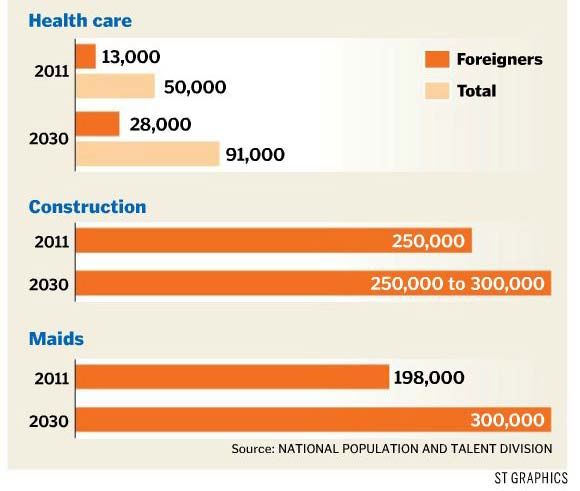
Overview: Migration in Asia
The size and nature of the problem
Growing intra-regional migration
Rapid development of Asian countries which have become more attractive to migrant workers
2010: 4 million migrants within ASEAN - 1/3 of total ASEAN migration (12.8 million) World Bank
Temporary, low-skilled and irregular migration
Restrictive immigration policies to prevent settlement of migrant workers have offered little
protection to migrant workers
Large flows of irregular migrants (estimates of 1.5 to 2 million irregular migrants in the region)
due to restrictive immigration policies and management of migration flows by private actors
Health issues faced by migrant workers
Migrants exposed to health risks at all stages of migration (origin, transit, destination, return)
Health risks for migrants compounded by the role played by the complex migration industry
(agencies, employers, etc ) – inability/reluctance of governments to deal with migration flows
The temporary nature of migration impacts on the health of migrant workers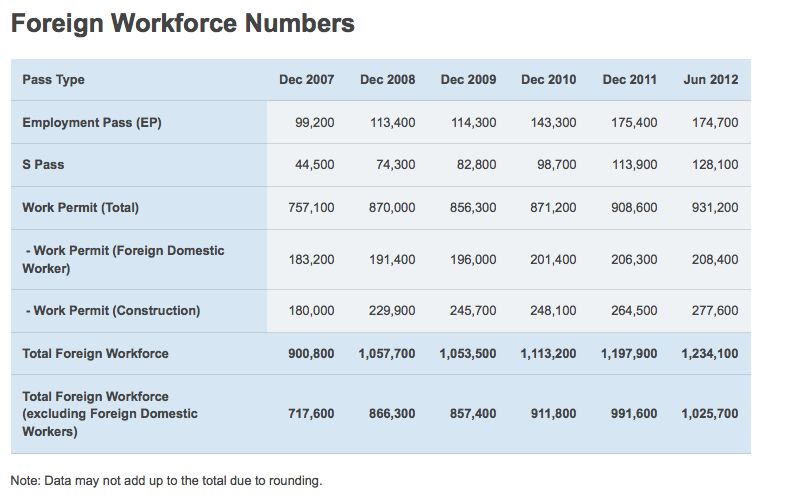
Migration Trends in ASEAN
Labour-sending countries versus labour-receiving countries
3 countries host 90% of ASEAN migrants - Malaysia (35%), Thailand (35%), Singapore (21%) Maloni, 2011
Malaysia and Thailand are both sending and receiving countries
Singapore and Brunei are only receiving countries
How does Singapore compare to other labour-receiving countries?
SECTORS - Migrant workers mainly in Construction, Manufacturing, Domestic Work and Services
SKILLS - Mainly low-skilled – Malaysia: 93% semi- or unskilled - 63% primary education or less ADB;
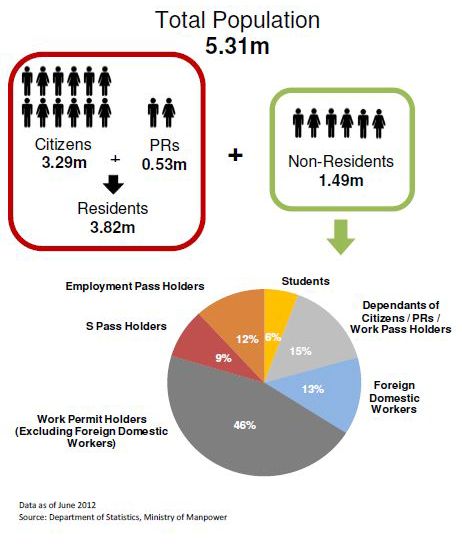
Singapore: 870,000 foreign workers low skilled - 46% Work Permit Holders National Population Talent Division
NATIONALITIES: Spore- Malaysia, Indonesia, Philippines; Malaysia - Indonesia, Philippines, Thailand;
Thailand - Myanmar, Lao PDR, Cambodia DRC Migration 2007, Version 4
IMMIGRATION POLICIES: Singapore - use of quotas, levies, security bonds, recruitment through
private agencies mainly; Malaysia - approved nationals for specific sectors, use of levies and quotas,
recruitment through private agencies mainly; Thailand - recruitment through bilateral agreements
with Cambodia, Lao PDR and Myanmar, large flows of irregular migrants - regularization processes.
Migrant Population of Singapore, 2012

Documented migrant workers in Singapore
-   Total foreign workforce make up close to 40% of Singapore’s total workforce (2012)
-   Workers under 3 types of work passes: Employment Pass, S Pass and Work Permit
-   931,200 Work Permit holders comprise 75% of the total foreign workforce
-   “Foreign Workers” – Work Permit holders who are low-wage migrant workers in low
    or semi-skilled manual jobs, including women employed as live-in domestic workers

                                               Source: Singapore Ministry of Manpower
Undocumented migrant workers in Singapore
• “Undocumented” migrant labour in the Singapore context
are typically “over-stayers” who enter on a tourist visa and stay on to work illegally
• Government was reported to have arrested 3760 such undocumented migrants in 2009,
compared to 12,000 in 1990s
• Singapore becoming an increasingly attractive place for undocumented migrant workProfile of Work Permit holders
• Employed in sectors “shunned” by Singaporeans (Dirty, Dangerous and Demanding),
bridging the gap between high demand and limited pool of local labour.
• Typically in construction, low-skilled manufacturing, maritime and service industries,
including domestic work, healthcare, retail, entertainment and hospitality. Mainly from
Malaysia, People’s Republic of China, Bangladesh, India, Thailand, Philippines and
Myanmar.
• Live-in foreign domestic workers (FDWs or “maids”) come mainly from Indonesia,
Philippines and Sri Lanka. Smaller numbers come from India, Myanmar, Bangladesh,
Thailand, Nepal and Pakistan. One in five families in Singapore currently hire one.
• Work Permit holders are subject to the following restrictions:
a) They may not bring family members with them
b) They need approval from the Ministry of Manpower before marriage to a Singapore
citizen or permanent resident
c) They are not allowed to become pregnant and give birth in Singapore.
Source: Adapted from ‘Joint Submission by members of Solidarity for Migrant Workers for the 11th Session of the Universal Periodic Review,
May 2011Policy dilemmas over foreign labour
• Policy dilemmas regarding immigration and foreign labour underscored by
major domestic headlines over the last two years
• Hot-button political topic in the 2011 General Election
• Public discontentment due to overcrowding and pressure on public goods and
services due to influx of foreign labour into Singapore from 2007 onwards,
political pressure to tighten foreign labour supply
• Government has vowed no U-turn on tightening the foreign labour policy:
limited quotas for companies hiring foreign labour and increased levies
• Recent paper published by National Population and Talent Division projects
that more foreigners will be needed to fill jobs required by Singapore’s
increasingly ageing society requiring more healthcare services, construction
to ramp up supply of housing, transport, healthcare and public infrastructure
• Increasing outcry among local small and medium businesses as well as
multinationals jittery about government’s labour policyProjection of foreign manpower demand
for healthcare sector, construction workers,
and foreign domestic workers
Recent paper released by National Population and Talent Division, Singapore, projecting
that by 2030, Singapore may need some 150,000 more foreign workers in these sectors:
Source: The Straits Times, 13 Nov 2012Policies governing migrant labour
in Singapore
General framework
• To dampen rising demand on foreign labour, stringent legislation put in place to restrict number
and ensure short-term migration status, also to govern their employment
• Quota based on “dependency ceilings” by sectors: Stringent allocation of foreign workers to
companies based on sector-specific ratio of local to foreign workers
• Foreign worker levies: Employers have to pay a levy to the government per month for hiring
foreign workers on Work Permits or S Passes in addition to monthly salary. Levy amount
determined by workers’ qualifications and company’s dependency ceiling. Levies raised every 6
months between July 2011 and July 2013. Current levy for construction workers: S$250 - S$500
per worker per month; current levy for FDWs: S$295 per month
• Levy concessions: available for families demonstrating specific need for FDWs: - having young
children, aged family members, family members with special needs
• Security bond for Work Permit holders: $5000 forfeited if conditions of Work Permit are violated
(including if FDWs become pregnant), or if workers fail to be repatriated after work permits end or
are cancelled
Recent changes to Employment of Foreign Manpower Act
• Introduction of policies to expedite enforcement / mete out harsher penalties against errant
companies and syndicates exploiting foreign workers and denying Singaporeans jobs by
circumventing existing regulations using means such as:
- declaring higher salaries than paid to their foreign workers
- illegally passing on the cost of the foreign worker levy and insurance premiums to them
- hiring “phantom” local workers to meet the required local to foreigner staff ratios.Legislation on migrant workers’ health
• Mandatory medical examination: Work Permits only issued if migrant worker passes a
mandatory medical exam including for TB, HIV, syphilis, malaria by a registered doctor within 14
days of arrival; Employers are able to obtain report direct from the doctor without worker’s
consent. (Joint report to UPR, MOM website). FDWs are additionally required to go for a six-
monthly medical examination to screen for infectious diseases and pregnancies. Pregnancy would
be a legitimate reason for termination of work and immediate repatriation.
• Mandatory medical insurance / personal accident policy: Employers are required to purchase
and maintain a minimum medical insurance coverage of S$15,000 per year for each Work Permit
holder for inpatient care and day surgery, including hospital bills for conditions that may not be
work-related. In addition, employers of FDWs must purchase personal accident policy with
minimum sum assured of S$40,000.
• Provisions for well-being and medical care of foreign workers: Employers are responsible for
bearing the costs of their workers’ “upkeep and maintenance” in Singapore, including the provision
of medical treatment. Employers are expected to ensure that their workers are provided with
adequate food, acceptable accommodation and safe working conditions.
• Exclusion of FDWs in legislation: FDWs are not covered under the Employment Act, which
specifies minimum rest days, hours of work, overtime entitlements, medical leave: nature of job as
“personal contract”, “too impractical to impose standard terms and conditions of service”. They are
also excluded from Work Injury Compensation Act, compulsory medical insurance in event of
accident provides less favourable extent of coverage and benefitsWork Injury Compensation Act
• The Work Injury Compensation Act (WICA) provides injured employees with a low-
cost and expeditious alternative to common law to settle compensation claims.
• To claim under WICA, the employee only needs to prove that he was injured in an
accident or suffered a disease due to his work.
• Engaging a lawyer is not required to file a WICA claim.
• Under WICA, the employer (or employer’s insurer) is liable to pay the compensation
regardless of who caused the accident/disease, and even after the employment has
ceased or the Work Pass (of a foreign worker) has been cancelled.
• Compensation amount is computed based on a fixed formula and is subject to caps.
• Dependents of deceased employees are also eligible to claim Work Injury
Compensation.
• Alternatively, the employee can file a civil suit against the negligent party under
common law for damages. However, to succeed, he and his lawyer will need to prove
that the employer or a third party had caused his injury. He will also need to
substantiate the amount of damages before the Courts, and damages are not
capped.
An injured employee can claim from either WICA or common law, but not from both.Changes to Work Injury Compensation Limits
Source: Singapore Ministry of ManpowerChanges to legislation:
Work Injury Compensation
b) Disallowing compensation for work-related fights
c) Expanding scope of compensable diseases
d) Disallowing work-related exclusion clauses
e) Clarifying the liability of employer’s insurer to pay when there are multiple
insurance policies
f) Clarifying the timeframe for filing a claim if one wishes to claim under WICA
after having filed a common law claim earlierRecent changes to legislation
affecting foreign labour
• Mandatory weekly rest day for Foreign Domestic Workers introduced in
March 2012, for all all new and renewed Work Permits effective Jan 2013
(with option of compensation in-lieu)
According to research done by the Singapore Committee for UN Women
in 2011, key findings revealed that maids work an average of 14 hours per
day and only 12 per cent have at least one day off per week.
Source: “Maids to get weekly rest days,” AsiaOne, 5 March 2012
• Tighter regulations on lorry safety introduced in 2011 to protect workers
travelling in the back of lorries:
Lorries must be retrofitted with canopies and higher side railings, with a
minimum deck area of 8 sq ft for each worker. Lorry owners could be fined
$1000 or jailed maximum of three months for not complying
-2011 Occupational Diseases, Total: 839
Snapshot of Excessive
Absorption of
Occupational
Lung Diseases: 1%
Chemicals: 1%
occupational safety Occupational Skin
Diseases: 6%
Others: 3%
Noise Induced Deafness: 741
(Total Singapore Occupational Skin Diseases: 52
Excessive Absorption of Chemicals: 10
workforce) Occupational Lung Diseases: 10
Noise Induced
Others: 26
Deafness: 89%
2011 Workplace Injuries, Total: 10,121
Marine:
Construction: 3%
18%
2011 Workplace Fatalities, Total: 61
Others: 5,629
Manufacturing: 2,284
Construction: 1,872
Marine:
Others: 56% Marine: 336 17%
Manufacturing: Construction: 22
23%
Construction: Others: 16
Manufacturing: 36%
Manufacturing: 13
21%
Marine: 10
Others:
26%
Source: 2011 Annual Report, Occupational Safety and Health Division, Singapore Ministry of ManpowerPolicy gaps in health and medical provisions
• Foreign Workers left income-less during the WICA Claim Process: Full
course of medical treatment and compensation assessment can last from a
few months to over two years. Workers are entitled to medical leave wages
during this time but many receive none. Employers routinely cancel injured
workers’ work permits – they are issued a “Special Pass” to facilitate legal
stay in Singapore but may not seek employment. Many incur debts for daily
expenses and costly medical treatment.
• Dependence on Employer’s Letter for Medical Treatment force Foreign
Workers to bear costs: Workers depend on “Letter of Guarantee” furnished
by employer/company in order to receive a waiver of upfront medical fees.
Employers are responsible under the law for this letter and the costs of any
necessary medical treatment (including conditions not work-related) but many
shirk their responsibilities, forcing workers to either bear the costs themselves
or forgo/postpone treatment.
• Medical Expenses over $30,000 (“No-man’s Land”): Removal of health
care subsidies for non-residents result in high medical charges for migrant
workers. Medical expenses for seriously injured workers can thus quickly
breach the S$30,000 ceiling. Responsibility towards any medical expenses
exceeding S$30,000 cap under WICA relies on goodwill, rather than legal
obligations of employers, in the absence of a medical emergency fund for
foreign workers.Major health issues identified by the
Joint Report submitted in May 2011
• Lack of access to medical/health services: Due to the removal of subsidized medical care
for migrant workers since 2007, many are denied medical insurance/treatment by errant
employers, contrary to official policy, and due to inconsistent enforcement. In worst cases,
workers seeking potentially costly medical treatment due to serious injury are repatriated by
errant employers
• Living conditions: Some workers are housed in cramped, poorly equipped and ventilated
and/or unhygienic living quarters, with inadequate nutrition
• Long hours: It is not uncommon for many construction, marine and service sector workers
to work 12 – 16 hours a day, breaching legislation on maximum hours of work
• Psycho-social health of FDWs: Well-being violations include inadequate food or
accommodation (43%), psychological abuse (30%) and non-payment of salary (14%)
(HOME, 2009)
Source: Joint Submission by Members of Solidarity for Migrant Workers for the 11th Session of
the Universal Periodic Review, May 2011Estimating the Social Costs of Migrants’ Health
in Singapore: A Preliminary Study
Methodology:
• Literature review of regional migration and health studies
• Referrals and visits to major voluntary organizations providing
social and health-related services (medical clinics, financial aid,
legal assistance, shelters and meal programs) to migrant workers:
1) Transient Workers Count Too (TWC2)
2) Humanitarian Organization for Migrant Economics (HOME)
3) Healthserve
• Case interviews of selected migrant workers with health issues,
using a structured questionnaire to elicit social and related costs
• Use of native languages (Tamil, Bengali, Tagalog and Bahasa)
• Extrapolation of direct and indirect costs from case studies to
estimate possible ranges in social costs of migrants’ healthSocial and Medical Costing Framework
Type of case Indirect Costs Direct Costs Intangible Costs Total
Injury Loss of productivity = - Medical (Hospital Pain and suffering
No. of months without and doctor’s fees, Stigma
work X average medicines, aids,
monthly salary rehabilitation, etc)
Transaction costs
Non-injury - Housing Stress and anxiety
Administrative costs - Transport Discrimination
- Food
Community/voluntary - Miscellaneous
contributions?
Sample: >2000 cases over 2-year period from Jun 2010 – May 2012; 1300 injury cases
Average monthly salary for Indian/Bangladeshi/Sri Lankan foreign workers on Work Permit
in construction and shipyard manual jobs: SGD $450 – $600Estimated Loss of Economic Productivity
Jun 10
Jul 10
Aug 10
Sep 10
Oct 10
Nov 10
Dec 10
Jan 11
Feb 11
Mar 11
Apr 11
Ma y 11
Jun 11
Jul 11
Aug 11
Sep 11
Oct 11
Nov 11
Dec 11
Jan 11
Feb 11
Mar 11
Apr 11
May 11
Jun 11
1-MOM;
2-injury;
3-ICA; No of months
NAME Special Pass No. Issue Date 4-other injury date without work $450 $600
Naranyana Samy Ramasamy AD041337 2 Jun 2, 10 0 1 1 1 1 1 1 1 1 1 9 $4,050 $5,400
Nakka Rama Krisna 2 Jun 3, 10 0 1 1 1 1 1 1 6 $2,700 $3,600
Monir Hossain Rehan Uddin AD028510 Jul 20, 10 2 Jun 7, 10 0 1 1 1 1 1 1 6 $2,700 $3,600
Rafiqul Isalm Asraf Ali Shek AD389958 2 Jun 7, 10 0 1 1 1 1 1 1 1 1 1 1 1 1 1 1 1 15 $6,750 $9,000
Veerasamy Suthakar 2 Jun 7, 10 0 1 1 2 $900 $1,200
Md Asaduzzaman Biswas
Asad Ali Hajh AJB 2 May 3, 11 0 1 1 1 1 1 5 $2,250 $3,000
Ruman Mridha Late Barek
Mridha 2 May 3, 11 0 1 1 1 1 1 1 1 1 1 1 1 1 1 13 $5,850 $7,800
Yeasin Abdul Karim AD365808 Jul 22, 11 2 May 6, 11 0 1 1 1 1 1 1 1 1 1 1 1 1 12 $5,400 $7,200
Moorthy Elavarasan AD343037 Jun 28, 11 2 May 9, 11 0 1 1 1 1 1 1 6 $2,700 $3,600
Sayful Islam Yousuf Khan AD310818 May 26, 11 2 May 10, 11 0 1 1 1 3 $1,350 $1,800
Eman Hossain Sarkar Ali 2 May 14, 12 0 1 1 1 1 1 1 1 1 1 1 1 1 1 13 $5,850 $7,800
Morshed Alam Saiful Islam 2 May 14, 12 0 1 1 1 1 1 1 1 1 1 1 1 1 1 13 $5,850 $7,800
Legend:
- Pink / blue boxes indicate non-attendance / attendance at food programme run by TWC2 (NGO providing migrant
workers’ assistance)
- Yellow: Long gap in attendance (approx .1 year) indicate worker may have returned to home country in the interim
- No. of months without work: inclusive of months in between Injury date and first date of attendance at food programmeYou can also read


