Higher education leadership responses applied in two South African comprehensive universities during the COVID-19 pandemic: A critical discourse ...
←
→
Page content transcription
If your browser does not render page correctly, please read the page content below
Transformation in Higher Education
ISSN: (Online) 2519-5638, (Print) 2415-0991
                                                              Page 1 of 9           Original Research

   Higher education leadership responses applied in two
   South African comprehensive universities during the
     COVID-19 pandemic: A critical discourse analysis

 Authors:                            Background: This article explored the leadership responses that were used by two comprehensive
 Kamvalethu Kele1                    universities in South Africa (Nelson Mandela University and University of Johannesburg) during
 Pedro Mzileni1
                                     the coronavirus disease 2019 (COVID-19) pandemic in continuing with the rolling out of their
 Affiliations:                       teaching and learning programmes safely and digitally under disruptive conditions.
 1
  Department of Sociology
 and Anthropology, Faculty           Aim: Whilst universities in the developing world such as South Africa were expected to face
 of Humanities, Nelson               challenges during the pandemic, this article showed that the leadership executives and general
 Mandela University,                 staff in two of its large universities, instead, crafted equitable and flexible improvisations to
 Gqeberha, South Africa              overcome the social challenges that could have posed a threat to their academic project.
 Corresponding author:               Setting: The selection of these two specific universities provided a unique opportunity to
 Pedro Mzileni,
                                     engage with comprehensive, massified and post-merger former Technikon-university
 pedro.mzileni@mandela.ac.za
                                     institutions that mainly cater for working-class students.
 Dates:
                                     Methods: The social justice theory was utilised to frame the study, whilst critical narrative
 Received: 16 Feb. 2021
 Accepted: 03 May 2021               analysis was the methodology.
 Published: 19 July 2021
                                     Results: This research reveals that South African comprehensive universities possess capacity
 How to cite this article:           to adapt and innovate in the middle of an institutional crisis using their flexible systems and
 Kele, K. & Mzileni, P., 2021,       agile personnel to drive the academy under such circumstances. The study also reveals that the
 ‘Higher education leadership        process of social justice is full of contradictions. As the universities created equitable measures
 responses applied in two
                                     to assist underprivileged students, these measures also generated injustices for others.
 South African comprehensive
 universities during the             Conclusion: This generated admirable and productive systematic traits to observe about some
 COVID-19 pandemic:
 A critical discourse analysis’,
                                     of our universities, as the South African higher education sector continued to engage with
 Transformation in Higher            difficult conversations such as transformation.
 Education 6(0), a114. https://
 doi.org/10.4102/the.v6i0.114        Keywords: online learning; higher education transformation; leadership response;
                                     comprehensive universities; social justice; coronavirus disease 2019 (COVID-19).
 Copyright:
 © 2021. The Authors.
 Licensee: AOSIS. This work
 is licensed under the
                                   Introduction
 Creative Commons                  Universities located in the developing countries were largely expected to fail in the running of
 Attribution License.              their learning and teaching responsibilities under the social conditions imposed by the coronavirus
                                   disease 2019 (COVID-19) pandemic (Salmi, Arnhold & Basset 2020). In South Africa specifically,
                                   the focus of the higher education response to this issue emphasised the material inequalities that
                                   exist between historically white urban universities and historically black rural universities
                                   (Czerniewicz et al. 2020:961), with the former possessing the necessary technology and
                                   infrastructure to migrate its systems to the online space, whilst the latter was compelled to put its
                                   systems to a hold.

                                   In this article, we want to reveal the leadership improvisations implemented by the other type of
                                   a university that is ‘missing’ from the conversation: the comprehensive university. South Africa
                                   has six comprehensive universities,1 but in this study, we will focus on two of them: Nelson
                                   Mandela University in Port Elizabeth and the University of Johannesburg in Gauteng.

                                   We make the case that these two universities are located in the developing country, South Africa,
 Read online:
                                   and have a low- and middle-income student profile (Nelson Mandela University 2019:46;
                Scan this QR       University of Johannesburg 2019:210) with teaching and learning systems that were underprepared
                code with your
                smart phone or     1.South Africa has six comprehensive universities, namely, (1) University of Johannesburg, (2) Nelson Mandela University, (3) Walter
                mobile device        Sisulu University, (4) University of Zululand, (5) University of Venda and (6) University of South Africa.
                to read online.
                                   Note: Special Collection: COVID-19.

                                                http://thejournal.org.za            Open Access
Page 2 of 9 Original Research
for the pandemic (Foxcroft2 & Bosire3 2020; Marwala4 2020a). We have selected the University of Johannesburg and
Yet, their leadership structures in collaboration with student Nelson Mandela University as case studies for this article
organisations and other stakeholders managed to frame because of their institutional similarities and for three
equitable, socially just and innovative plans that largely other major reasons.
accommodated their working-class students to overcome the
challenges of the pandemic. Firstly, their urban locations in the South African landscape and
profile of their student bodies – this refers to their ‘middle-
To breakdown this argument, the article has been divided income’ status as city-based institutions that are made up of
into eight parts. Firstly, we define comprehensive urban main campuses (Auckland Park Kingways campus for
universities in context. Secondly, we outline the study’s University of Johannesburg and Summerstrand campuses for
theoretical concept. Thirdly, we state the case for our Nelson Mandela University) and township campuses (Soweto
methodological approach. Fourthly, we critique how campus in University of Johannesburg and Missionvale campus
existing higher education literature frames equitable in Nelson Mandela University) and they have a growing
interventions in an environment of social deprivation and enrollment of students from poor and working-class families
political crisis. The fifth part presents how Nelson Mandela (Nelson Mandela University 2019:46; University of Johannesburg
University managed its teaching and learning affairs during 2019:210) who needed equitable material support from these two
the pandemic, whilst the sixth part looks at the University universities to (1) travel back to their homes when the pandemic
of Johannesburg’s case. On the seventh part, we table a began (Nelson Mandela University 2020a) and (2) be provided
critical discussion of the findings and then conclude the with devices by their universities to begin studying online
article on the eighth part. during the pandemic (Foxcroft & Bosire 2020; Marwala 2020a).
Defining comprehensive universities Secondly, their productive and proactive public engagement
in context with COVID-19 – where they supported their local neighbouring
communities and health institutions with protective equipment
Comprehensive universities can be generally defined as to fight the pandemic (Nelson Mandela University of
post-apartheid institutions of higher learning that are Johannesburg 2020) and, as mentioned earlier, also formulated
modelled around the following: alternative ways of delivering teaching and learning processes
1. diversifying their academic programmes into an astute during the pandemic for their students despite the generally
combination of short and distance learning programmes, limited resources in the higher education sector (DHET 2014:8).
vocational and skills training courses, higher certificates,
Thirdly, their general appetite to redefine themselves as ‘new-
diplomas and undergraduate and postgraduate
generation’ and ‘dynamic’ universities in Africa – where they
qualifications (Department of Education [DoE] 2004:5)
seek to spearhead the country’s social and innovative
2. they are post-2004/2005 multi-campus mergers between
possibilities (Brink 2010:259; Fraser-Moleketi 2019:4).
traditional universities, colleges, and former Technikons
into being the contemporary comprehensive universities
We define ‘leadership response’ for this article’s context as the
as we know them today (Nel 2007:2).
collective effort applied by the university executive, middle
3. observing a public mandate to massify student enrolments
management, lecturers and Heads of Departments, financial
for purposes of offering targeted skills training courses
and support service administrators, technical staff such as
that are related to industry, particularly for students who
security guards, cleaners, electricians, medical practitioners,
come from working-class backgrounds (DoE 2004:4)
COVID-19 screening and testing coordinators and volunteers,
4. they are overwhelmed with major infrastructural shortfalls property maintenance officers, student leaders, trade union
ranging from a lack of conducive student accommodation, leaders, government officials and general students who all
lack of access to internet connectivity and updated library converged systematically and on an ad hoc basis, driven by a
services amongst other basic services (Department of social justice ethos, to ensure that the 2020 academic year for
Higher Education and Training [DHET] 2014:6) these comprehensive universities was a ‘success’.5
5. embracing innovative and flexible practices of learning,
teaching and systematic leadership (Brink 2010:259)
6. preparing to adapt to rapid technological changes and
Social justice theory and
requirements to optimise the employability of their South African higher education
graduates (Brink 2010:259) The leading higher education studies scholars and practitioners
7. having closer relations with both urban and rural- in South Africa such as Badat (2009:459), Pityana (2010:39),
township communities and other external stakeholders, Jansen (2017:1), Swartz (2015a:2) and Habib (2019:x)
which ‘localises’ them as universities that are in service contextualise the concept of social justice as being the key
to society (DoE 2004:5). instrument in the utilisation of the post-apartheid university
2.Professor Cheryl Foxcroft is deputy vice chancellor: learning and teaching at Nelson for purposes of addressing poverty, underdevelopment and
Mandela University.
5.Our notion of ‘success’ in this article refers to what the higher education sector has
3.Dr Sam Bosire is a chief information technology officer at Nelson Mandela University. rather gained from the COVID-19 pandemic, which is systematic capabilities and
flexible improvisations that many disadvantaged students and comprehensive
4.Professor Tshilidzi Marwala is a vice chancellor at the University of Johannesburg. universities displayed under tough conditions to complete the academic year.
http://thejournal.org.za Open AccessPage 3 of 9 Original Research
inequality. In this framework, South Africa is understood as a sociocultural makeup of universities (Ndlovu-Gatsheni 2013,
society with deep-seated patterns of socioeconomic inequality cited in Godsell & Chikane 2016:59).
mainly categorised according to race, gender, class and
geographic origin (Black, Spreen & Vally 2020:41). To These protests although had macro- and micro-characteristics.
systematically and comprehensively address these challenges, Macro-characteristics were in the form of the struggle for the
equitable access to higher education and training for the poor is transformation of the country’s political economy to begin
one of the progressive options advanced by the country’s prioritising the needs of the poor and the working class, such
national consciousness (National Development Plan 2012:296). as public investment in free education and training to create
a skilled workforce with better opportunities to make
It is on this basis that South African vice chancellors livelihoods (Bond 2016:196–198). Micro-characteristics were
interviewed by Jansen (2017:xiii) have broadly supported in the form of the day-to-day struggles that students faced in
the #FeesMustFall movement’s campaign for free education in university campuses where they lacked access to basic needs
principle (2017:222–228) despite their numerous disagreements such as food, transport, toiletries, clothing items, stationery
with its tactics, which they deemed to be violently inhumane and subsistence allowances to participate in student social
(Habib 2019:26) and infringing on other people’s rights (Swartz life (Godsell & Chikane 2016:60).
2015b). Keet, Sattarzadeh and Munene (2017:2) harmonised
these differences by emphasising that ‘violence is not a The micro-struggle is what we want to underscore in this
prerequisite for radicalism and militancy in the current South article. From our experience, the everyday lives of poor
African context’. In other words, the social justice struggle can students in universities tend to be overlooked in conversations
be advanced under contradictory conditions of a radical about student protests. These conversations emphasise
approach and/or sometimes in a peaceful, systematic, statistics, slogans and political statements, which tend to
negotiated and consensus-generated method. envelope poor students under a single talk of statistical
averages. However, when the life of each poor student gets
When South African comprehensive universities were broken down into different pieces of stories and experiences,
faced with the COVID-19 pandemic that mainly posed a threat the conversation changes and begins to reveal the deep-
to the learning experiences of poorer students, they seated patterns of inhumanity and indignity that students
overwhelmingly made public commitments to do what endure as a result of being poor in urban universities.
was feasible at their disposal to equitably make their
systems accessible to these students (Foxcroft & Bosire 2020; For instance, the National Students Financial Aid Scheme
Marwala 2020a; University of South Africa 2020; Walter Sisulu (NSFAS) is widely known in South Africa for its administrative
University 2020; University of Venda 2020; University of incompetence, which compels poor students in universities
Zululand 2020). This mainly entailed providing technological to live without access to food and other basic needs for at
gadgets (computers/laptops, data and study material) to least half of their academic year (Habib 2019:64–65). As
poorer students for free, the flexible application of assessment such, student political organisations organise protests
deadlines to cater for those who might have connectivity in universities to fight for these basic needs by asking
breakdowns in their underdeveloped communities and applied universities themselves to intervene in these challenges and
socio-political pressure by student political organisations to provide food and basic needs to poor students (Jansen
secure the learning rights of disadvantaged students. 2017:172). It is on this score that Nelson Mandela University
institutionalised a food feeding scheme as part of its annual
It is on these grounds that we argue that universities budget programme to cater for the food shortages that its
applied a social justice framework in operationalising poor students endure as a result of state failure to administrate
their systems during the pandemic – where equitable, flexible financial aid efficiently and on time as per the academic
and politically astute methods of accessibility to the calendar (Nelson Mandela University 2019:48).
university practices were enabled for underprivileged
students to integrate and succeed within the genre of ‘equal The shifting of university responsibilities in this instance
opportunities for all’. towards the constant provision of food to poor students has
generated criticism from some practitioners in the higher
From #FeesMustFall to COVID-19: Higher education sector. Jansen (2017:172) is concerned that the South
education and socio-political crisis African university has become a ‘welfare university’ where the
South Africa’s socioeconomic profile characterised by high core function of quality and internationally competitive
levels of inequality, poverty and unemployment has filtered research, teaching, learning and engagement has been
into the higher education landscape. The 2015/2016 free compromised in favour of food aids for poor students – a
education protests emphasised this case. Students from poor function that should have been performed by the state. Jansen
communities, unable to pay university fees and also facing (2017:174–176) goes further to argue that students themselves
diminishing chances of obtaining employment in a crumbling have come to be entitled to these benefits as although they are
economy, took to the streets and revolted against the an expected function of the university – similar to the
unaffordability of higher education and the untransformed government functions of providing social grants to the older
patterns of coloniality that still define the epistemic and members of the families where these students come from.
http://thejournal.org.za Open AccessPage 4 of 9 Original Research
In our view, the framing of providing poor students with food dividends of a political breakthrough, which are (1) the right to
aid as being a shift to a ‘welfare university’ is not a neutral own land, wealth, identity and self-determine (macro) and (2)
observation. It is informed by a single orientation of also the right to dignity, employment, food, water, housing and
understanding what a university is and its purpose, which is social welfare (micro). In other words, a decolonised society
an orientation of a Western university in the case of Jansen. would be to live in a social reality that has all the characteristics
The Western university derives its value, purpose and of colonialism dismantled. Part of this social transformation
sustainability from undertaking research that is globally attempt entails the work carried out by universities during the
relevant to attract prestige and generate revenue subsidies, COVID-19 pandemic to make equitable measures to
endorsements and competitive student fees from international accommodate and support underprivileged students with basic
students (Ginsberg 2011:81–82). Without these economic needs. This article adds to the conversation by tabling how
assets, the university would be unable to maintain its comprehensive universities improvised their systems to support
credibility, relevance and prestige and could possibly collapse. these challenged yet resilient students.
Vice chancellors of top South African universities such as Wits
University (Habib 2019:ix–x) and University of Cape Town Finally, the COVID-19 pandemic in South Africa demonstrated
(Phakeng 2019) have also publicly endorsed such positions, how a public university located in South Africa is supposed
arguing that their universities seek to participate in this ‘global to shape itself. South African conditions call for a social
research prestige’ contest to keep their universities competitive. justice-oriented university that must (1) produce research
for humanity (the production of COVID-19 protective
Our critique towards these viewpoints is based on four equipment, sanitisers and vaccine research for the country’s
observations. Firstly, our understanding is that there are many public healthcare strategy is a case in point) and (2) be driven
different kinds of universities and their purposes, depending on by the ethos of Ubuntu (Masitera 2020:6) and provide welfare
the context of such institutions. Many different parts of the for vulnerable students in the form of food, transport,
world are experimenting with agricultural universities laptops, data and flexible learning and teaching programmes
(Nieuwenhuis, Verhaar & Hoeve 2003:171) and medical to achieve equitable access to higher education.
universities (Pepeta 2019) with a purpose of servicing their local
communities and societies as public institutions. The notion of a In this regard, the South African university must redefine
Western university concerned about abstract research that has a itself to be an active agent in service of humanity to dismantle
universal appeal for revenue generating purposes is but a single social inequalities through an equitable provision of university
model of a university that is not preferred in other societies. In services. These attributes of a university anchored on social
this instance, other universities located in other societies favour justice demonstrate that being a university that is in service of
a ‘down-to-earth’ approach where they do not only theorise society does not necessarily have to come at the expense of
people’s challenges but are also placed in context to serve research excellence. Instead, being a people-centred university
humanity and their local communities (Van Rooy 2003:xiii). In that is in service to society should be viewed as a prerequisite
this regard, South Africa can also generate from its own context for research excellence and institutional sustainability – where
and define its own model of a public university that would be we get to possess, as Mamdani (2009:215–216) proposed,
African public universities that will produce knowledge to
best suited to service its society that is mainly faced with
address the unique challenges of our continent.
challenges of poverty and unemployment.
Secondly, the notion of a ‘welfare university’ grossly Methodological note
minimises the socioeconomic legacy of the (post)apartheid A critical narrative analysis was utilised to conduct the study.
system, its generational impact and its intersectional reach. This critical analysis involved the reading and interpretation
Colonialism dispossessed and displaced the entire African of textual data from newspaper commentary and the decision
family. The poverty wages earned by adult workers in the statements taken and published by these two universities
untransformed economy of South Africa that still resembles under study (McAlpine 2016:33). We also used our own
apartheid wage scales is replicated by the student’s inability personal experiences from working and studying directly in
to pay for their basic needs in university (Satgar 2016:222). A one of these universities, at Nelson Mandela University. Our
South African university that exists out of these social intimate experiences of working and studying at Nelson
challenges ought to be redesigned to prepare itself to enrol Mandela University during the pandemic were used as a
students with such challenges and avail social support source of data generation, analysis (McAlpine 2016:34–35)
services to integrate such students into its university life. and triangulation (Holtzhausen 2001).
Thirdly, the ‘welfare university’ thesis fails to comprehend what The COVID-19 crisis was extensively covered in newspaper
the decolonisation argument tabled by students seeks to achieve. commentary given its widespread effects on every
One of the significant legacies of colonialism is the community as a communicable disease (Park et al. 2020,
proletarianisation of Black people and their communities to the cited in Hess & Waller 2021:22). It then becomes obvious as
extent where they cannot cater for their basic needs (Hendricks, to why the media was one of the useful sources to analyse
Ntsebeza & Helliker 2013:3–4). In this instance, the theory of the pandemic. In addition, media coverage of the pandemic
decolonisation entails a fight for both macro- and micro- carried a heavier form of government oversight, where
http://thejournal.org.za Open AccessPage 5 of 9 Original Research
public content about the pandemic had to be carried out The University then applied the following strategy to amend
accurately to keep the citizenry armed with valuable its teaching and learning programme to suit students who
and coordinated information as an attempt to minimise might have been affected by the pandemic:
misinformation (Eck & Hatz 2020:603) – as one higher Many of our students live in the townships, informal settlements
education practitioner stated: and rural areas where they do not have online access or a private
[T]he Covid-19 pandemic remains a communicable disease that space to study. We estimate that about 55% of our students have
can be defeated through collaborative strategies … it will be the laptops and connectivity and a further 10% could learn via their
smartphones. This means that about 35% of our students are
spirit of sacrifice, self-discipline, information sharing, and
currently not able to participate in digital learning and teaching
collective consciousness that will see our society overcome this
off campus … The pathways range from digital to face-to-face
period. (Jack 2020 para. 2)
when classes resume, to a blended approach which are
combinations of the two. Navigating them will take collective,
Newspaper articles as research tools have been widely ongoing effort from the university to care for and support our
commended in the social sciences mainly for their students and staff. We have consulted our staff and students and
investigative, brief, flexible and first-hand information colleagues at other universities in South Africa and internationally
reporting and analysis of complex events (Waldman 2004:71– and we have studied a wider range of articles on teaching during
72). In addition, as the digitalisation of information and the times of disruption. We are now in the preparation phase and the
rise of the smartphone industry accelerated, the public space pathways will start on 28 April. (Foxcroft & Bosire 2020 para. 11)
of news reporting has been democratised as individual
citizens are able to publish material from their gadgets Pathway 1 consisted of digital teaching and learning methods,
without the institutional regulations of traditional media which took place from April 28, and underprivileged students
houses (Obi-Ani, Anikwenze & Isiani 2020:1). What we have were provided with monthly 20GB data and laptops to
participate. Pathway 2 students were scheduled to receive
also observed although during the course of this study is that
face-to-face classes under COVID-19 regulations later in the
the traditional news agencies themselves have also
year. The student counselling service of the university
reconfigured their operations by tapping into the social
switched its services to a 24/7 online interface to provide
media space to distribute information.
social support for the challenging conditions. The university
also provided training to its teaching staff to manage digital
The period of the COVID-19 pandemic saw these flexibilities
migration including devices and data for them to work from
in information sharing productively converging at the benefit
their homes. Digital training was also provided for frontline
of readers and researchers. Our methodological engagement
technical staff to operate their securitisation, cleaning,
although with these pieces of data – newspaper articles and
communication and maintenance services under carefully
university statements – was both ‘empathetic and critical’ observed COVID-19 regulations – mask-to-mask interaction,
(Jansen 2017:xiii). Put differently, we appreciated the social distancing, regular sanitising and screening.
convenient availability of information, whilst at the same
time putting the same information under close scrutiny and
University of Johannesburg: Commitment to
critique guided by our social justice orientation.
innovation and stakeholder engagement
The University of Johannesburg also utilised its official website
Nelson Mandela University: Equitable learning
and online public newspaper platforms to communicate with
pathways
students, staff and the general public during the pandemic.
Nelson Mandela University used public statements and opinion The university’s framework to continue with classes under
pieces written by its senior executive members on nationwide COVID-19 conditions was driven by two aspects: (1) a
online newspaper platforms to communicate its COVID-19 pedagogy of care for its students and (2) its reliance on
teaching and learning measures to students, staff and the public. stakeholder engagement and ‘technological traditions’.
Its communication patterns covered two aspects: (1) the ethos
and value system driving its COVID-19 teaching and learning On the university’s ethos of care:
measures and (2) the improvisations taken in collaboration with There were several uncertainties, and the threats loomed large …
all relevant stakeholders to continue with the teaching and the odds seemed heavily stacked against the university, more so
learning project through digital platforms. when UJ has many first-generation and international students,
many of whom live in university-owned student residences or
On the ethos and value system of the University in applying private accommodation … for many of them, returning home
equitable and socially just measures to continue with studies was simply not an option. Physical distancing was required, but
more than ever before, social solidarity was needed … Whatever
online:
the decision, the safety and wellbeing of our students took
A ‘one-size-fits-all’ approach, such as only adopting online priority over other considerations … our goal was that the
learning to complete the first semester, would exclude many academic year must not be lost and that, in our approach, no
of our students. Given our strong commitment to social student should be left behind. (Parekh6 & Sinha7 2020 para. 3)
justice and equality, this is not an acceptable option for us, hence
6.Professor Angina Parekh is a deputy vice chancellor: academic at the University of
we have developed two learning and teaching pathways (and Johannesburg.
variations of these) to enable our students to complete their first
7.Professor Saurabh Sinha is a deputy vice chancellor: research and internationalisation
semester modules and the academic year. (Jack 2020: para. 2) at the University of Johannesburg.
http://thejournal.org.za Open AccessPage 6 of 9 Original Research
The university’s prior investment on technology and
stakeholder accord made its coping mechanisms with
COVID-19 manageable:
As South Africa’s reality is one of inequality, it was vital that we
recognise our vulnerabilities. More than ever before, we required
innovation and collaboration. In this regard, our teaching,
research, internationalisation strategy and trajectory proved
indispensable. (Parekh & Sinha 2020 para. 6)
I wish to thank the representations made by the Interim SRC8
regarding online teaching and learning. As a University that
embraces inclusivity, I am pleased to announce that the President
and Secretary-General of the Interim SRC are invited to the
Covid-19 Coordination Committee online meetings, as full
members of the committee. I also reiterate my gratitude to the
tremendous work that is being done by our academic and
support staff in recent weeks, who have worked tirelessly to
ensure that our operations continue uninterrupted. Special
thanks to our academic and administrative staff for their efforts
to ensure that our transition to online learning and teaching is as
seamless as possible. (Marwala 2020a para. 10)
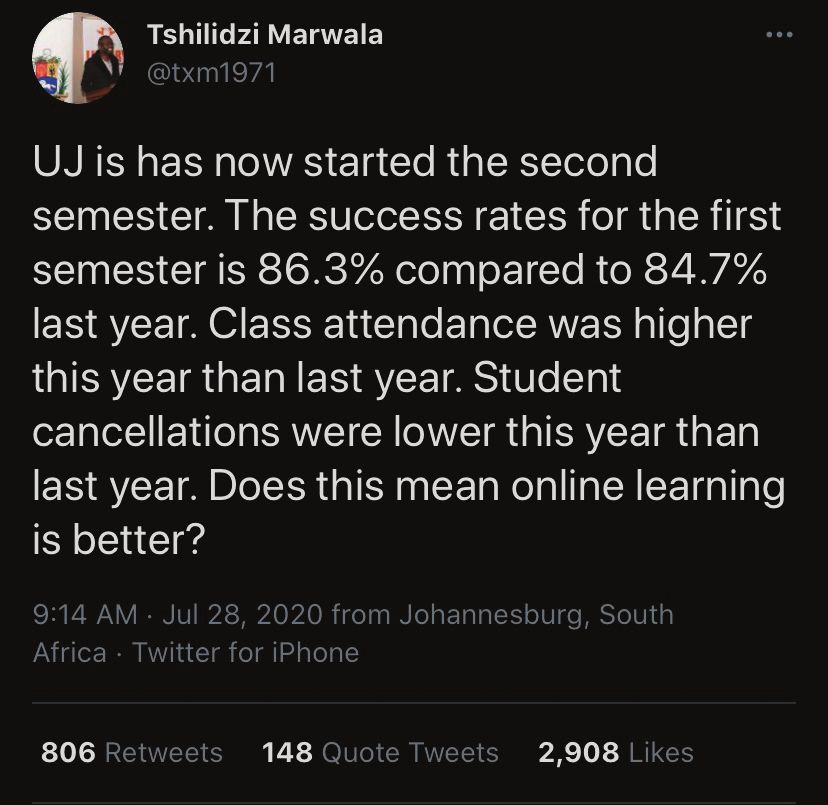
In 2018, when I took over the reins as vice-chancellor and Source: Marwala, T, 2020c, UJ is has now started the second semester: The success rates for
principal of the University of Johannesburg (UJ), I embarked on the first semester is 86.3% compared to 84.7% [Tweet], viewed 10 June 2021, from https://
twitter.com/txm1971/status/1288009976183771136
a journey to position the university at the forefront of the fourth
FIGURE 1: University of Johannesburg’s vice chancellor using social media,
industrial revolution (4IR). The goal of UJ is to foster a platform Twitter, to communicate COVID-19 learning and teaching successes with
for innovative and ground-breaking research to produce students, staff and the general public to generate open debate.
graduates who are agile and curious and able to be active
participants in a technology-driven and digital environment. The COVID-19 pandemic disrupted all these traditional
(Marwala 2020b:2)
arrangements of operationalising a university system in two
ways: (1) the lockdown period in South Africa between
A newspaper report also revealed that Marwala announced
March and June 2020 resulted in the cancellation of many
that the university’s online attendance superseded
traditional university ceremonies and events such as
physical attendance and that undergraduate success rate
graduations. The academic year was also extended into 2021
was 86.3% compared with 84.7% of the previous year
and (2) universities realised that poorer students are at an
(Pretoria News 2020).
extremely vulnerable position than ever before and social
measures had to be made quickly to provide basic needs for
Marwala later shared these statistics on Twitter to spark the
them such as food allowances, counselling services, data and
debate (Figure 1).
laptops. These are equitable measures that these universities
have not taken before. Previously, a threat to a traditional
Discussion layout of a university academic calendar year posed a
The leadership responses applied by Nelson Mandela potential collapse to the university system (Habib 2019:50).
University and University of Johannesburg ranged between However, the COVID-19 pandemic necessitated that
numerous forms of equitable care and flexible management universities dig further into their social justice orientation
of their systems. A modern university, generally, is known for and recognise the potential of the university system to
its rigid systems of certainty and predictability that are exclude especially when it is aided by the social conditions
tailored around an academic year. These systems are of the pandemic. As a result, we witnessed flexible forms of
determined a year before their scheduled implementation. assessment being applied wherein (1) students were given
This involves university teaching timetables, examination many opportunities to resubmit their assessments, (2) they
dates, graduation periods, planned enrolments and research interfaced with lecturers over social mediums such as
seasons for sabbaticals, visiting scholars, thesis defences and WhatsApp and telephone calls for consultation purposes
annual conferences. Added to these systemic certainties are and (3) university administrative systems adjusted their
the middle-class sensibilities that universities operate under registration, examination, fees payment, graduation and
where students are expected to have cash flow with them to marks completion dates to accommodate all possible
participate in the urban daily life of a university (Godsell & setbacks imparted by the pandemic.
Chikane 2016:60) – commuting to attend classes and library
activities, visiting coffee shops and restaurants for peer
Although these leadership improvisations were equitably
interaction, and going out to night evening, book launches
applied by universities, they were not without their fair
and career expos for social networking (Jansen 2017:180).
share of challenges and injustices. In some instances,
8.Student representative council (SRC) carries the student’s voice to university Nelson Mandela University and University of
committees. The SRCs in South Africa are generally made up of different student
political organisations. Johannesburg were also complicit in driving institutional
http://thejournal.org.za Open AccessPage 7 of 9 Original Research
exclusion by overemphasising their macro-achievements universities registered commendable and agile leadership
and underemphasising the micro-experiences of styles during the pandemic, but they also generated
students during the pandemic. These contradictions, as numerous injustices that emanate from the structural
Keet et al. (2017:2) indicated, are part and parcel of the obstacles that the comprehensive universities in South
‘messiness’ of the efforts towards attaining social Africa are faced with.
justice. In other words, the inequality climate of South Africa
entangles social transformation in a constant battle of
reproducing other injustices as it tries to resolve others.
Concluding observations
Essentially, this study has revealed that beyond the usually
Fairly, both universities provided equitable provisions dominant and extreme comparisons between privileged white
under the challenging conditions, but they also displayed research universities and poor black teaching universities,
other layers of unfairness. At Nelson Mandela University, there is another layer of universities in the sector that should
where we are based, the planned concept of Pathway 1 and receive scholarly attention in order for us to critically
Pathway 2 did not get implemented as planned. The understand the post-apartheid higher education trajectory
COVID-19 lockdown measures in South Africa continued and its potential. The comprehensive universities analysed in
for the whole of year and this made it impossible for the this study have demonstrated that they do possess
second group of students to return to the university management and leadership assets to navigate crisis and
campus for face-to-face classes. As a result, they had to innovate for purposes of realising a socially just higher
also form part of the Pathway 1 group and operate on education experience for their underprivileged students. It is
similar online conditions. This created a challenging these narratives of institutional creativity and perseverance
working environment for lecturers and administrators, that should also get more research attention alongside other
resulting in the academic year to carry on until April 2021. emerging discourses in higher education studies such as
At the time of writing this article, the Nelson Mandela transformation, decolonisation and Africanisation. The
University was facing student protests over the registration diversification of studying all kinds of universities and their
irregularities for the 2021 academic year, outstanding various experiences and practices would broaden our tools of
examination results from the 2020 academic year and the comprehension and language to better understand and
lack of food allowances to students by NSFAS and the theorise the social experiment of our post-apartheid higher
University’s scholarship scheme (Nelson Mandela education landscape.
University 2021).
Acknowledgements
For the University of Johannesburg, their leading student The authors would like to gratefully thank the academics
political organisation, the Economic Freedom Fighters and students in the Department of Sociology and
Student Command (EFF SC), issued a public statement on Anthropology in Nelson Mandela University for the
their Facebook account criticising the university and its vice critical comments made to this study at its preliminary
chancellor for not catering for the needs of all poor students stages when it was publicly presented at the postgraduate
and for also using social media to censure comments from research colloquium hosted in the Department on 27–28
students who publicly disagree with him: October 2020.
We have sent numerous communications to the University
pleading with them to suspend online learning during the
lockdown period until the demands contemplated above [in the
Competing interests
previous page of their statement] have been implemented – The authors have declared that no competing interests exist.
however the University continued to ignore the submission
made and went ahead to implement online learning … the VC
went further to pull media stunts on Twitter and Facebook …
Authors’ contributions
deleting our comments from his posts … we further submit to UJ K.K. conducted the literature study and presented the study
students finance to pay nsfas allowances to all students who have as an honour article. P.M. was the supervisor and assisted
not received their allowances. Currently, there are students who with the literature study, guided data interpretation and
still have not received their NSFAS allowances since February,
then wrote the journal article.
which is very much unacceptable and we call for a rectification
on this matter AS SOON AS POSSIBLE. (EFF SC University of
Johannesburg 2020) Ethical considerations
This article followed all ethical standards for a research
In essence, the leadership improvisations driven by these without direct contact with human or animal subjects.
universities might have been eloquently communicated in
public newspapers and social media by their executives as
being progressive, equitable, flexible, and socially just, but Funding information
it is equally important to triangulate such perspectives with This research received no specific grant from any
personal experiences and other people’s everyday funding agency in the public, commercial or not-for-profit
encounters to generate a critical conversation. Both sectors.
http://thejournal.org.za Open AccessPage 8 of 9 Original Research
Data availability Marwala, T., 2020a, COVID-19 update 08, Dear UJ Community, University of
Johannesburg Media Releases, viewed 14 April 2021, from https://www.uj.ac.za/
newandevents/Pages/COVID-19-UPDATE-08.aspx.
Data used for this study are publicly available on the
Marwala, T., 2020b, Closing the gap: The fourth industrial revolution in Africa, Pan
University’s communication platforms and newspapers. Macmillian, Johannesburg.
Marwala, T, 2020c, UJ is has now started the second semester: The success rates for
the first semester is 86.3% compared to 84.7% [Tweet], viewed 10 June 2021, from
Disclaimer https://twitter.com/txm1971/status/1288009976183771136
Masitera, E., 2020, ‘Towards a humane community: The search for disability justice in
The views, opinions, findings and recommendations higher education through African moral thinking’, Transformation in Higher
Education 5(0), a85. https://doi.org/10.4102/the.v5i0.85
expressed in this article are those of the authors and do not McAlpine, L., 2016, ‘Why might you use narrative methodology? A story about
reflect the policy or position of affiliated agencies of the narrative’, Estonian Journal of Education 4(1), 32–57. https://doi.org/10.12697/
eha.2016.4.1.02b
authors. National Development Plan, 2012, Our future – Make it work, Vision 2030 National
Development Plan, National Planning Commission, Pretoria.
References Ndlovu-Gatsheni, S., 2013, ‘Decolonising the university in Africa’, The Thinker 5(2),
46–51.
Badat, S., 2009, ‘Theorising institutional change: Post-1994 South African higher Nel, H., 2007, ‘Enhancing the student experience in a merged multi-campus
education’, Studies in Higher Education 34(4), 455–467. https://doi.org/10.1080/ university in South Africa’, Paper presented at the Annual Conference of the
03075070902772026 Society for Research into Higher Education, December 2007, Nelson Mandela
University, Port Elizabeth.
Black, S., Spreen, C.A. & Vally, S., 2020, ‘Education, Covid-19 and care: Social inequality
and social relations of value in South Africa and the United States’, Southern Nelson Mandela University, 2019, Integrated annual report 2019, viewed
African Review of Education 26(1), 40–61. 14 April 2021, from https://publications.mandela.ac.za/publications/media/
Store/documents/Annual%20Reports/88-Annual-Report-2019.pdf.
Bond, P., 2016, ‘To win free education, fossilised neoliberalism must fall’, in S. Booysen
(ed.), Fees must fall: Student revolt, decolonisation and governance in South Nelson Mandela University, 2020a, Mandela University students head home, viewed
Africa, pp. 192–213, Wits University Press, Johannesburg. 15 April 2021, from https://news.mandela.ac.za/News/Mandela-University-
students-head-home.
Brink, E., 2010, The university for a new generation, Division for Institutional
Advancement: University of Johannesburg, Johannesburg. Nelson Mandela University, 2020b, Mandela University plays its part in the fight
against COVID-19, viewed 15 April 2021, from https://www.mandela.ac.za/
Czerniewicz, L., Agherdien, N., Badenhorst, J., Belluigi, D., Chambers, T., Chili, M. et al., News-and-Events/Coronavirus-Information/COVID-19-Memos/Mandela-
2020, ‘A wake-up call: Equity, inequality and Covid-19 emergency remote teaching University-plays-its-part-in-the-fight-aga.
and learning’, Postdigital Science and Education 2(0), 946–967. https://doi.
org/10.1007/s42438-020-00187-4 Nelson Mandela University, 2021, Nelson Mandela University registration update,
viewed 17 April 2021, from https://news.mandela.ac.za/News/Nelson-
DoE, 2004, Creating comprehensive Universities in South Africa: A concept document, Mandela-University-Registration-Update.
Government of South Africa, Pretoria.
Nieuwenhuis, L., Verhaar, K. & Hoeve, A., 2003, ‘Networking between economy and
DHET, 2014, Building higher education: Infrastructure renewal, revitilisation, and education: Regional knowledge transfer in Dutch agriculture’, in R. Rutten, F.
development, Government of South Africa, Pretoria. Boekema & E. Kuijpers (eds.), Economic geography of higher education:
Knowledge infrastructure and learning regions, pp. 171–185, Routledge,
Eck, K. & Hatz, S., 2020, ‘State surveillance and the COVID-19 crisis’, Journal of London.
Human Rights 19(5), 603–612. https://doi.org/10.1080/14754835.2020.181
6163 Obi-Ani, N., Anikwenze, C. & Isiani, M.C., 2020, ‘Social media and the Covid-19
pandemic: Observations from Nigeria’, Cogent Arts & Humanities 7(1), 1–15.
EFF SC University of Johannesburg, 2020, UJ APK EFF student command statement https://doi.org/10.1080/23311983.2020.1799483
on UJ’s management failure to respond to 21 demands to e-learning, viewed
17 April 2021, from https://www.facebook.com/UJ-APK-EFF-Student- Parekh, A. & Sinha, S., 2020, UJ’s top executives explains how the Institution steered
command-272883529574218/photos/pcb.1342370495958844/13423703826 the 2020 academic year, viewed 16 April 2021, from https://www.uj.ac.za/
25522. newandevents/Pages/UJs-top-executives-explains-how-the-Institution-steered-
the-2020-academic-year.aspx.
Foxcroft, C. & Bosire, S., 2020, Nelson Mandela University’s conundrum – Online
teaching when 35% of students don’t have digital access, Daily Maverick, viewed Park, S., Fisher, C., Lee, J.Y., McGuinness, K., Sang, Y., O’Neil, M. et al., 2020, ‘Digital
14 April 2021, from https://www.dailymaverick.co.za/article/2020-04-23-nelson- news report: Australia 2020’, News and Media Research Centre, University of
mandela-universitys-conundrum-online-teaching-when-35-of-students-dont- Canberra, viewed 09 April 2021, from https://apo.org.au/node/305057.
have-digital-access/. Pepeta, L., 2019, ‘New medical school to open in 2021’, Mail and Guardian, viewed
Fraser-Moleketi, G., 2019, Chancellor’s graduation address, ceremony 1, Faculty of 17 April 2021, from https://mg.co.za/article/2019-10-18-00-new-medical-
Arts, Faculty of Law, Nelson Mandela University, Port Elizabeth. school-to-open-in-2021/.
Ginsberg, B., 2011, The fall of the faculty: The rise of the all-administrative university Phakeng, M., 2019, ‘UCT leaps up in world rankings’, UCT News, viewed 17 April
and why it matters, Oxford University Press, New York, NY. 2021, from https://www.news.uct.ac.za/article/-2019-09-12-uct-leaps-up-in-
world-rankings.
Godsell, G. & Chikane, R., 2016, ‘The roots of the revolution’, in S. Booysen (ed.),
Fees must fall: Student revolt, decolonisation and governance in South Africa, Pityana, B.N., 2010, Higher education, transformation and Africanisation – A
pp. 54–73, Wits University Press, Johannesburg. paradigm shift? Study South Africa: The Guide to South African Higher
Education, 9th Edition, International Education Association of South Africa,
Habib, A., 2019, Rebels and rage: Reflecting on #FeesMustFall, Jonathan Ball viewed 07 April 2021, from http://studysa.org/wp-content/uploads/2019/03/
Publishers, Johannesburg. Study-SA-9th-edition.pdf.
Hendricks, F., Ntsebeza, L. & Helliker, K., 2013, ‘Land question in South Africa’, in F. Pretoria News, 2020, Blending learning in the COVID-19 era: UJ’s agility in the 4IR
Hendricks, L. Ntsebeza & K. Helliker (eds.), The promise of land: Undoing a century space, Pretoria News, 05 August 2020, p. 4.
of dispossession in South Africa, pp. 1–28, Jacana Media, Auckland Park.
Salmi, J., Arnhold, N. & Basset, R.M., 2020, The Big Bad Wolf moves south: How
Hess, K. & Waller, L.J., 2021, ‘Local newspapers and coronavirus: Conceptualising COVID-19 affects higher education financing in developing countries, World
connections, comparisons and cures’, Media International Australia 178(1), Bank Blogs, Education for Global Development, viewed 13 April 2021, from
21–35. https://doi.org/10.1177/1329878X20956455 https://blogs.worldbank.org/education/big-bad-wolf-moves-south-how-covid-
19-affects-higher-education-financing-developing.
Holtzhausen, S., 2001, ‘Triangulation as a powerful tool to strengthen the
qualitative research design: The Resource-based Learning Career Satgar, V., 2016, ‘Bringing class back in: Against outsourcing during
Preparation Programme (RBLCPP) as a case study’, Presented at the Higher #FeesMustFall at Wits’, in S. Booysen (ed.), Fees must fall: Student revolt,
Education Close Up Conference 2, Lancaster University, 16th–18th July 2001, decolonisation and governance in South Africa, pp. 214–234, Wits University
viewed 09 April 2021, from http://www.leeds.ac.uk/educol/documents/ Press, Johannesburg.
00001759.htm.
Swartz, D., 2015a, Vice-Chancellor’s Report to Council, Fourth Quarter Review: 2015,
Jack, L., 2020, ‘The core value of Ubuntu in our praxis to navigate the COVID-19 Nelson Mandela University, Port Elizabeth.
pandemic’, Discourse of Student Life 2(7), viewed 08 April 2021, from https://
studentaffairs.mandela.ac.za/Discourse-of-Student-Life/August-2020-(1)/The- Swartz, D., 2015b, Vice-Chancellor’s communique to students and staff, 23
core-value-of-Ubuntu-in-our-praxis-to-navigate. October 2015, Nelson Mandela University, Port Elizabeth, viewed 07 April 2021,
from https://www.facebook.com/MandelaUni/posts/984405631611170.
Jansen, J., 2017, As by fire: The end of the South African University, Tafelberg
Publishers, Cape Town. University of Johannesburg, 2019, University of Johannesburg annual report 2019,
viewed 14 April 2021, from https://www.uj.ac.za/about/Documents/Annual%20
Keet, A., Sattarzadeh, S.D. & Munene, A., 2017, ‘An awkward, uneasy (de)coloniality reports/UJ_AnnualReport2019.pdf.
higher education and knowledge otherwise’, Education as Change 21(1), 1–12.
https://doi.org/10.17159/1947-9417/2017/2741 University of Johannesburg, 2020, UJ creates open-source, cheap ventilators as
COVID-19 cases rise, viewed 15 April 2021, from https://www.uj.ac.za/
Mamdani, M., 2009, Scholars in the marketplace: The dilemmas of neo-liberal reform newandevents/Pages/UJ-creates-open-source-cheap-ventilators-as-COVID-19-
at Makerere University 1989–2005, HSRC Press, Johannesburg. cases-rise.aspx.
http://thejournal.org.za Open AccessPage 9 of 9 Original Research
University of South Africa, 2020, Delivery of laptops to NSFAS students, University of Zululand, 2020, Distribution of laptops, viewed 14 April 2021, from
viewed 10 June 2021, from https://www.unisa.ac.za/sites/myunisa/default/Anno http://www.unizulu.ac.za/distribution-of-laptops/.
uncements/Delivery-of-laptops-to-NSFAS-students.
Van Rooy, Y., 2003, ‘Foreword’, in R. Rutten, F. Boekema, & E. Kuijpers (eds.),
University of South Africa, 2020b, Communique to students on the changes being Economic geography of higher education: Knowledge infrastructure and
made as a result of the Covid-19 lockdown, viewed 14 April 2021, from https:// learning regions, pp. xii–xiv, Routledge, London.
www.unisa.ac.za/sites/myunisa/default/Announcements/Communique-to-
students-on-the-changes-being-made-as-a-result-of-the-Covid%E2%80%9319- Waldman, M., 2004, ‘International newspapers and research’, The Serials Librarian
lockdown. 45(4), 71–80. https://doi.org/10.1300/J123v45n04_06
University of Venda, 2020, Dr Nthambeleni affirms Univen’s preparedness for the Walter Sisulu University, 2020, WSU invests R98 million in remote learning programme,
return of some students amid COVID-19, viewed 14 April 2021, from https:// viewed 14 April 2021, from https://www.wsu.ac.za/index.php/component/
www.univen.ac.za/news/dr-nthambeleni-affirms-univens-preparedness-for- content/article/286-wsu-newsletter/296-wsu-invests-r98-million-in-remote-
the-return-of-some-students-amid-covid-19/. learning-programme?Itemid=437.
http://thejournal.org.za Open AccessYou can also read


