HISPANEWS SPRING 2021 - The magazine of the College of Charleston's Department of Hispanic Studies
←
→
Page content transcription
If your browser does not render page correctly, please read the page content below
HISPANEWS
The magazine of the College of Charleston’s Department of Hispanic Studies
                              SPRING 2021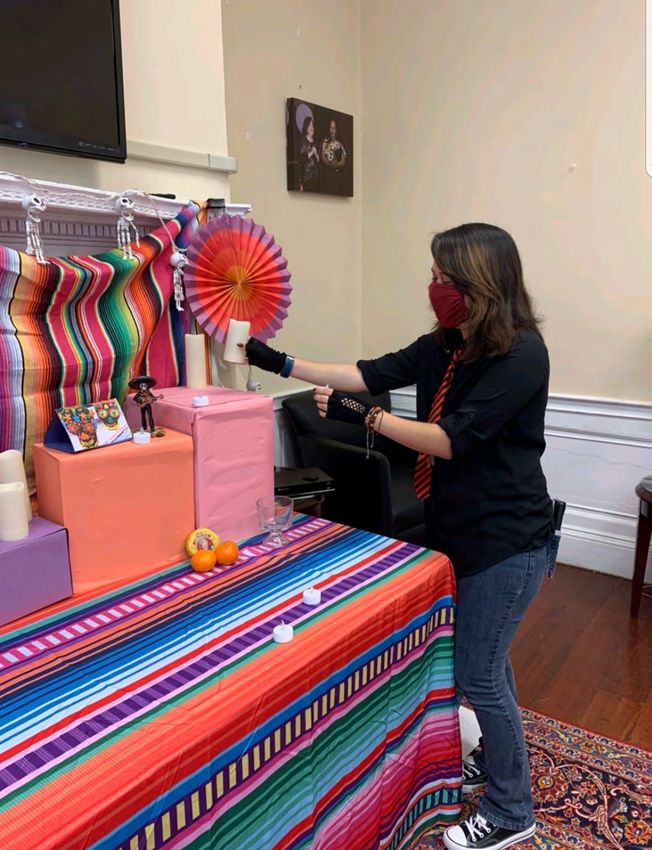
HISPANEWS
             The magazine of the College of Charleston’s Department of Hispanic Studies

                                          Editor
                            Prof. Daniel Delgado Díaz

                             Associate Editors
                                   Dr. Emily Beck
                                 Prof. Claudia Moran
                                  Ms. Laura Moses
                                  Dr. Haley Osborn

                              http://spanish.cofc.edu
HispaNews is an annual publication of the College of Charleston’s Department of Hispanic Studies.

    Direct all inquiries to HispaNews, Department of Hispanic Studies, College of Charleston,
         66 George Street, Charleston, South Carolina, 29424. (HispaNews@cofc.edu)

                                        Spring 2021
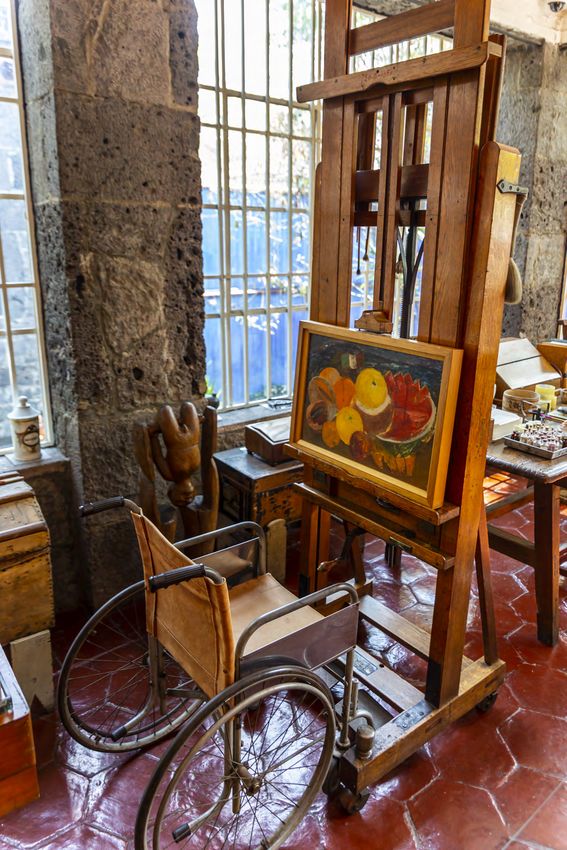
                         Front cover: Frida Kahlo Museum, Mexico City.

  HISPANEWS - HISPANIC STUDIES                                               SPRING 2021 - 2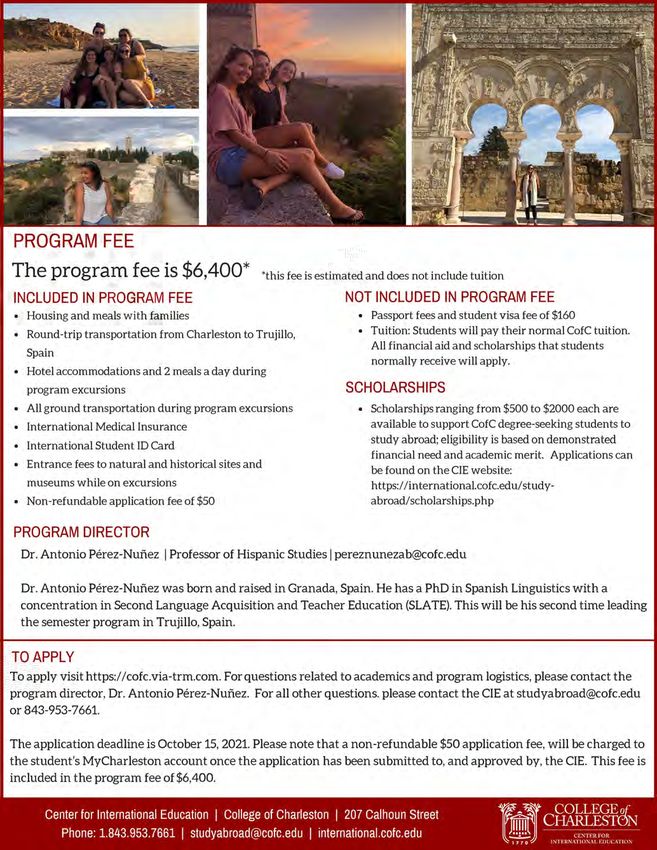
HISPANEWS

                         CONTENTS

  Welcome Message from the Chair            —————————       5

  New Faculty Interviews
       Dr. Falcon Restrepo-Ramos —————————————— 6
       Dr. Colleen Moorman       —————————————— 8
       Dr. Monica Styles         —————————————— 10

  Adjunct Faculty Spotlight
       Prof. Soledad Francis       —————————————— 11

  Study Abroad
       Spain - Spring 2022         —————————————— 13

  Our Students
       Annabela Paneda             —————————————— 15
       Student Focus               —————————————— 17

  Focus on the Faculty
       Faculty Bios         —————————————— 19
       Faculty Lectures     —————————————— 25
       CofC-UNLaM-USACH Conference ——————— 27

  The Online Experience
       Messages from Faculty and Students     ——————— 29

  Hispanic Studies Review          —————————————— 31

HISPANEWS - HISPANIC STUDIES                     SPRING 2021 - 3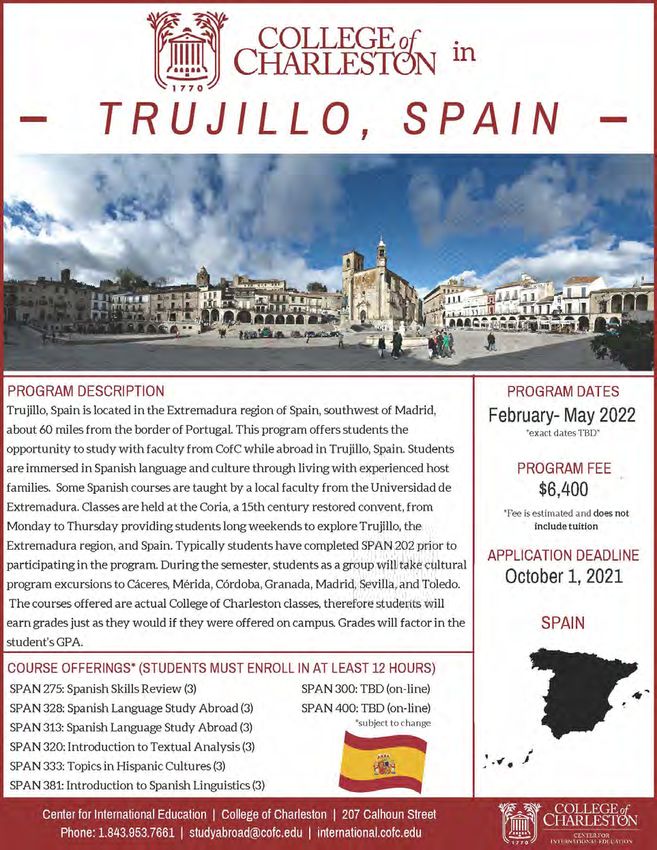
HISPANEWS

  Clubs and Activities
       Portuguese Club              ——————————————      32
       Hispanic-Latino Club         ——————————————      34
       Spanish Club                 ——————————————      35
       La Casa Hispana              ——————————————      36
       Linguistics Club             ——————————————      37
       Sigma Delta Pi               ——————————————      39

  Hispanic Studies Advisory Board   —————————————— 41

  Hispanic Studies Career Seminar Series
       Christin Stewart             —————————————— 42
       Hallie Ritzu                 —————————————— 43

  Alumni Corner
       Jessica Latham               —————————————— 44
       Christin Stewart             —————————————— 45

  Farewells
       Dr. Andrew Sobiesuo          —————————————— 46
       Dr. Félix Vásquez            —————————————— 49
       Dr. Marianne Verlinden       —————————————— 50

  Stay Connected / Giving           —————————————— 51

HISPANEWS - HISPANIC STUDIES                  SPRING 2021 - 4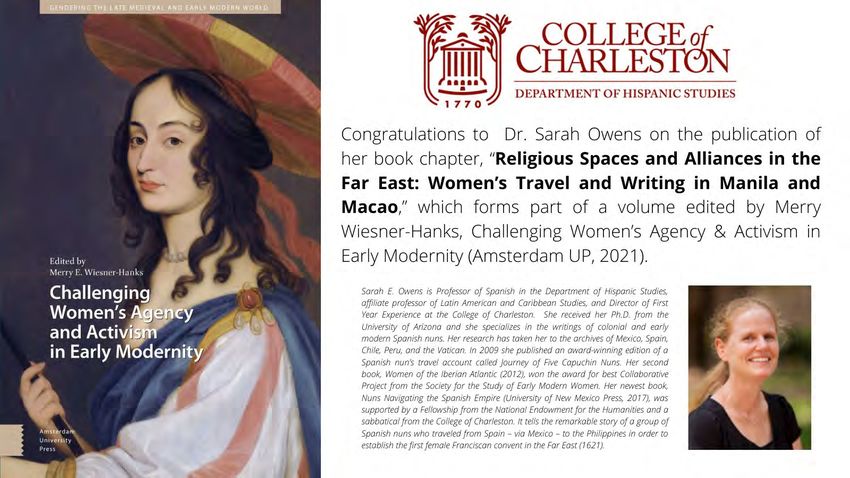
HISPANEWS

                       Welcome Message
                        From The Chair
                                                           The 2020-2021 academic year was one
                                                           marked by challenges, to be sure—
                                                           challenges related to adapting to online
                                                           and hybrid instruction; challenges
                                                           connected with balancing safety protocols
                                                           with the exigencies of daily life; challenges
                                                           managing the attendant stresses and
                                                           strains of a new and oft unsettling reality.
                                                           It was at the same time, however, a period
                                                           of opportunity.
                                                          Within the Hispanic Studies community,
                                                          faculty and students alike improvised and
                                                          innovated, embracing the online format to
                                                          hold such events as Spanish Club
Tertulias; online lectures, such as those organized by Drs. Ricard Viñas-de-Puig and Monica Styles
(Dr. Lisa Pearl’s “How Math Helps Us Better Understand Language” and Dr. Bárbara I. Abadía
Rexach’s “#LasVidasNegrasImportan: Colonization and Blackness in Puerto Rico”). Virtual Career
Seminars were given by HISP graduates Christin Stewart ’11 and Hallie Ritzu ’08. There was even a
three-day international conference—the 2021 CofC-UNLaM-USACH Conference—featuring
faculty and student presenters from Hispanic Studies and from its study abroad partners at the
Universidad Nacional de La Matanza (Buenos Aires, Argentina) and the Universidad de Santiago
(Chile).
Denied study abroad in Argentina, Chile, Spain and elsewhere, Hispanic Studies developed, in
conjunction with the Center for International Education, a program of virtual global internships for
its majors and minors, allowing them to use the language and cultural skills acquired during their
studies at the College in the professional context of their choosing.
The HISP community did all of this—and so much more—to compensate for what the pandemic
had so rudely and suddenly withdrawn from it. Yet, paradoxically, in taking away, the period of
2020-2021 also bestowed something precious: a renewed appreciation for the world beyond our
borders; a deeper understanding of the extent to which stepping outside one’s habitual space—one’s
country and culture—serves to enrich us.
Looking to the future, campus life will resume, as will chances for students and faculty to live, study
and present research abroad. When this time comes —and it won’t be long— Hispanic Studies will
be there, providing the sorts of experiences for which it has long been known, as well as new
opportunities (progeny of necessity and ingenuity) which trace their birth to the year just completed.
Michael A. Gómez
Chair, Department of Hispanic Studies

   HISPANEWS - HISPANIC STUDIES                                               SPRING 2021 - 5
HISPANEWS

         New Faculty Interview
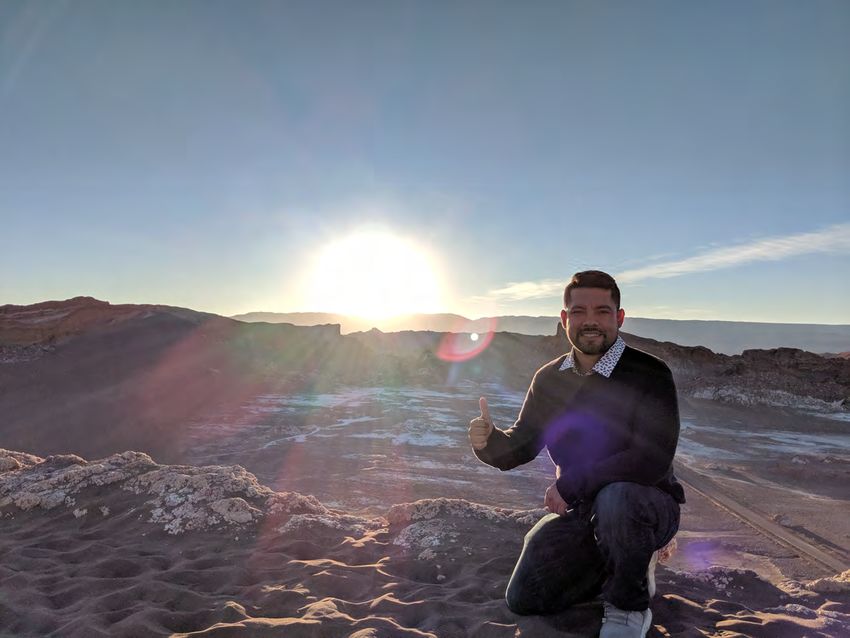
       Dr. Falcon Restrepo-Ramos
                                                                Can you tell us about your
                                                                background and how you
                                                                became interested in Spanish
                                                                and Linguistics?
                                                                I came to the US from Colombia in
                                                                2012 as an international graduate
                                                                student at West Virginia University.
                                                                At WVU I did my masters in
                                                                linguistics and then moved to Florida
                                                                to complete a PhD in Hispanic
                                                                linguistics. I am now about to finish
                                                                another degree in computational
                                                                linguistics at Indiana University. I
                                                                think I got the taste for languages and
                                                                linguistics thanks to my mom. She
                                                                also did the same bachelor’s degree
                                                                that I did at Universidad de
                                                                Antioquia in Colombia. The
                                                                inspiration for teaching came from
                                                                my father. Now retired, he was a high
                                                                school teacher.

                                                                Can you describe the various
                                                                aspects of your work?
                                                                I teach an array of Spanish and
                                                              linguistic courses. From beginning and
intermediate Spanish to content courses in linguistics, I am devoted to instilling in my students the
appreciation and competence for the language and culture along with critical skills for their future
careers and professions. For instance, in a new course offering for Fall 2021 entitled “Natural
Language Modeling for the Spanish Professions” students will build specialized vocabulary glossaries
and analyze their own Spanish language development with the use of computational technologies.
Currently, I am working on the development of SEÑAL, a program for the automatic analysis of
Spanish second language compositions. A computational tool that can process written learners’
corpora and extract measures of language development has enormous practical value in Spanish
and modern language departments alike. In sum, I enjoy what I do, and I am looking forward to the
next opportunities coming my way.

What do you enjoy the most and what is your favorite class to teach?
The best thing about teaching is seeing how your students grow intellectually from beginning to end
in the semester. I believe in making my classes not only relevant for their program of studies but also
for their lives and professions. I like all the classes I teach but I prefer teaching upper level and

   HISPANEWS - HISPANIC STUDIES                                               SPRING 2021 - 6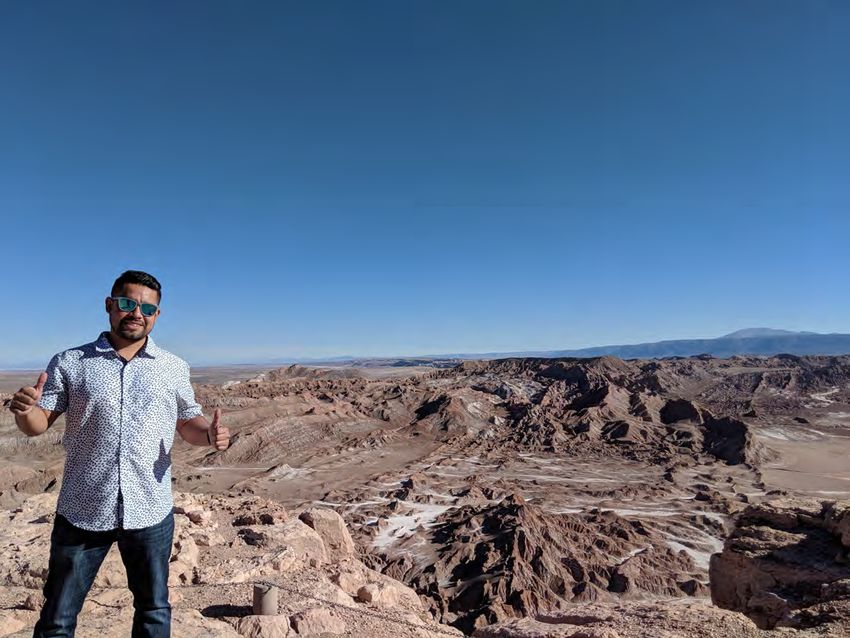
HISPANEWS

content courses because I can implement more of my own topics and resources into my class.

Why do you think languages are important to learn today?
Learning languages are important for a number of reasons. First, you can combine your love for
languages with any career you pursue. In particular, learning Spanish has an added value in the US
as the second most spoken language along with being in high demand for many professions in health,

legal, industry and other fields. Secondly, you can become more aware of the cultural differences and
gain a deep knowledge of cultural conventions of Spanish speaking countries. Finally, there is a
cognitive advantage to being bilingual (https://www.bbc.com/future/article/20160811-the-
amazing-benefits-of-being-bilingual). Competing languages in the brain develop cognitive skills that
are not available with other mental abilities, since the brain is constantly functioning to process both
or multiple languages. Besides, it can delay cognitive decay and the onset of dementia and Alzheimer
disease, while keeping yourself mentally fit.

Would you like to share anything else with our readers? What do you like to do
when you’re not teaching?
I like playing soccer, racketball, and cooking. I have an appetite for Latin food and Brazilian cheese
balls (pão de queijo). I also have other technical hobbies (building Legos, rc cars) and enjoy hanging
out with my friends.

   HISPANEWS - HISPANIC STUDIES                                                SPRING 2021 - 7
HISPANEWS

                New Faculty Interview
                Dr. Colleen Moorman
Can you tell us about
your background and
how you became
interested in Spanish and
Linguistics?
Learning Spanish felt like I was
deciphering a code or putting
together a puzzle. When I took
my first linguistics course, I felt
like everything suddenly clicked
because it allowed me to learn
how to break down languages
into their component pieces,
fi n d c o n n e c t i o n s a n d
commonalities across
languages, see how languages
evolved, and even run scientific
experiments about language.

My interest in both linguistics
and Spanish only grew after
studying abroad for a semester
in Valparaíso, Chile and a
summer in Granada, Spain.
Studying abroad gave me the
opportunity to observe cultural
and linguistic differences
firsthand, both the differences
between these Spanish-speaking countries and my own, and as well as between several Spanish-
speaking countries. These experiences also expanded my knowledge of the Spanish language, my
love of travel throughout Latin America and Europe, and my desire to learn more about both the
language and culture.

Can you describe the various aspects of your work?
I teach courses in both Spanish and in Linguistics. I love being in the classroom, interacting with
students and sharing my two passions with them. It’s so satisfying and exciting to see students’
speaking, writing, and comprehension skills develop so much over the course of a semester and to
watch students make connections as they learn more and more.

Outside of the classroom, I also conduct research about phonetics and phonology and second
language acquisition. My research is related to how students learn and develop their ability to
perceive and produce sounds in a second language. My aim is to better understand how students

    HISPANEWS - HISPANIC STUDIES                                           SPRING 2021 - 8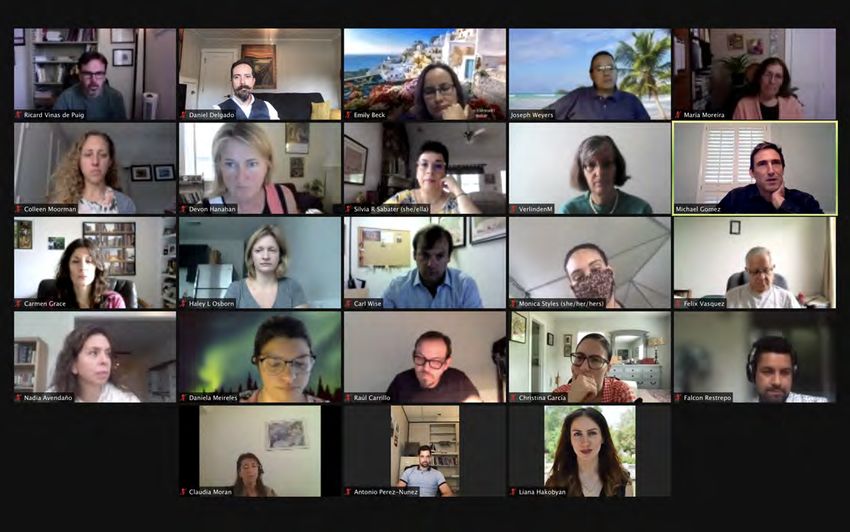
HISPANEWS

acquire the sounds of a second language and what language instructors can do to help students be
more successful in the language classroom and beyond.

What do you enjoy the most and what is your favorite class to teach?
I think my favorite part of my profession is being in the classroom and getting the chance to connect
with students on a personal level. I feel fortunate to be in a profession that is so dynamic, where no
two days are the same, let alone any two semesters. From semester to semester, as I work with new
students, teach new courses, and incorporate new materials, techniques, and technologies, my work is
always evolving to try to create more engaging learning experiences for students. I think this aspect
of teaching also keeps me more engaged with my work, as I am able to be creative and always find
ways to change and modify my teaching practice.

Would you like to share anything else with our readers? What do you like to do
when you’re not teaching?
When I’m not teaching, preparing lessons, or conducting research, I enjoy going for a run, trying out
new recipes in the kitchen, or just being outside. I’ve run several marathons and would like to train
for another one this summer. I also love going to the beach with friends, hiking, or doing any outdoor
activity on the water to stay active and clear my head.

   HISPANEWS - HISPANIC STUDIES                                              SPRING 2021 - 9
HISPANEWS

              New Faculty Interview
                Dr. Monica Styles
                                                          Can you tell us about your
                                                          background and how you became
                                                          interested in Spanish?
                                                          I always knew that I wanted to learn
                                                          another language because the idea of being
                                                          able to enter other cultures and understand
                                                          other experiences always fascinated me. I
                                                          think this is, in part, a natural outgrowth of
                                                          my Black/biracial identity; I have always
                                                          been navigating different spaces and
                                                          cultures and studying literature in the
                                                          Spanish language is a way of pursuing my
                                                          interests.

                                                          Can you describe your research
                                                          specialty?
                                                           My specialization is colonial Spanish
                                                           American studies. In my book project I
                                                           study how people of African descent have
                                                           participated in Latin American culture
                                                           starting from the earliest period of
                                                           discovery and conquest. The existence of
                                                          people of African descent in Spanish-
speaking countries has not been properly recognized throughout history up until the present and this
has contributed to the marginalization and oppression of Afro-descendants. This is a topic I have
discussed this semester with my students in the First-Year Experience seminar "Black Lives Matter in
the Hispanic World.”

What do you enjoy the most and what is your favorite class to teach?
I have enjoyed teaching Spanish 313 Spanish Writing Skills Through Culture because I get to discuss
short stories by authors such as Mario Vargas Llosa, Elena Poniatowska and Gabriel García
Márquez. When students reach the 300 level, they have already been exposed to most of the
grammar and vocabulary. They are putting the pieces together and becoming fluent. At this point, I
can comfortably use the language in class and we can analyze texts.

Why do you think languages are important to learn today?
I think languages are important to learn today —and will always be important— because in an
increasingly globalized world, in whatever industry, everyone needs cultural competence and
knowledge of languages to create broad networks and, ultimately, to be successful. Competence in
more than one language encourages mental dexterity and teaches us how to engage respectfully with
a variety of people from all walks of life. And also — it sparks joy, and joy is an important aspect of
being a human being!

   HISPANEWS - HISPANIC STUDIES                                               SPRING 2021 - 10
HISPANEWS
Adjunct Faculty Spotlight
Prof. Soledad Francis
Professor Soledad Francis is an Adjunct
Professor who has been teaching Spanish at
the College of Charleston since Spring
semester 2018. Let’s get to know more about
her!
Can you tell our readers about your
background?
I did my undergraduate work at the Universidad de
Concepción, Chile. I graduated with a bachelor’s in
mathematics education. I did my graduate work here at
the College of Charleston. I earned my Master in
Education and I was able to take classes from several
professors in the department.
How did you become interested in teaching
Spanish?
“Cosas de destino.” Long, long ago when living in
Indiana, I was offered the opportunity to teach at Purdue
University due to my background in education and being
a native speaker. When I decided to make this my
profession, I studied for my M.Ed. for teaching foreign
languages.
Can you tell us about your work here at the College of Charleston?
I am part of the basic language program. I usually teach four sections of Spanish 202 and one of a
different level. For the last couple of years, I have also taught some online classes.
What aspects of teaching do you find most rewarding, and what is your favorite
class to teach?
The most rewarding aspect of teaching is seeing success for students who struggle, who feel shy or
uncomfortable learning the language. I love being a part of their learning experience and helping
them to achieve things that they did not think they could do or that are difficult for them.
My favorite class to teach is Spanish 202 because I love to teach the subjunctive mood. For most
students, they do not see any use for it at the beginning of the semester, but as we explore the topic
they begin to appreciate it.
HISPANEWS - HISPANIC STUDIES SPRING 2021 - 11HISPANEWS
What, in your opinion, are the traits that a successful Spanish teacher needs to
have?
Being able to speak Spanish - haha! To name just a few, a successful Spanish teacher should be
organized, clear, non-intimidating and always look for ways to improve. It is essential that the
instructor have a good rapport with the class and create a learning environment in which the
students feel comfortable to ask questions and try to use the language, even if they make mistakes.
Could you share with us a memorable experience with your students?
This whole year has been very memorable but a very funny one happened last semester. In the
middle of the last day of classes, a student who was taking a second class with me decided to put on
a Darth Vader mask. I noticed him when I was explaining something, and he would nod his head
when he was agreeing with me. It was so unexpected that I couldn’t keep a straight face. I started to
laugh and couldn’t stop. I was not able to look at my screen for the rest of the class because I would
just laugh.
That is a great story! Thank you for taking the time to talk with us, Professor
Francis!
Trujillo Scholarship Fund
Have fond memories of your CofC study abroad experience?
Didn’t go abroad and wish you could have done so? Give to the
Trujillo Scholarship Fund at the below link and make the
wonderful possibility of study in Spain a reality for future
Spanish majors and minors.
https://give.cofc.edu/HispanicStudies
HISPANEWS - HISPANIC STUDIES SPRING 2021 - 12HISPANEWS
Study Abroad in Spain
Spring 2022
Although international travel was impacted by the pandemic, tell your friends to
mark their calendars to study abroad next spring!
HISPANEWS - HISPANIC STUDIES SPRING 2021 - 13HISPANEWS HISPANEWS - HISPANIC STUDIES SPRING 2021 - 14
HISPANEWS

                             Our Students
                          Annabela Paneda
Hello Annabela, and thank you for
agreeing to this interview with
HispaNews. First of all, could you tell
our readers a little about yourself,
where you are from, and why you chose
to come to the College of Charleston
and to study Spanish?
My name is Annabela Paneda and I am currently
a junior, going to be a senior in the Fall. I am a
Mexican American who is a native Spanish
speaker born in the US but lived in Mexico half
my life and now I live in the Clemson area. In the
eighth grade we took a tour of the campus and I
really liked the atmosphere in general. My main
degree is Foreign Language Education in
Spanish. I believe what made me want to study
Spanish was because I love the language I speak
and want to teach others who want to speak it as
well.

What advice do you have for a student
who wants to be a Spanish minor or major?
I believe the best advice I can give to students who want to be Spanish minors or majors is that if
they love the language and various cultures in the language then they should strive to be a minor or
                                                           major because knowing it in depth is
                                                             good for any future career.

                                                             You were awarded with the
                                                             Casa Hispana Scholarship for
                                                             2020-21, Congratulations!
                                                             Could you tell us about the
                                                             experience of living in Casa
                                                             Hispana?
                                                             I like the experience. I get to interact
                                                             and talk to people who also like
                                                             speaking Spanish and want to know
                                                             about my culture and experience it a
                                                             bit. This was the main reason I
                                                             decided to live in the Casa Hispana.

   HISPANEWS - HISPANIC STUDIES                                             SPRING 2021 - 15
HISPANEWS
Can you tell us about
your work as a Peer
Te a c h e r i n t h e
Conversation Classes?
How is the teaching
experience?
I really like working as a peer
teacher in the conversation
classes. It allows me to have
a small taste of what it
would be like to teach. I
believe every teacher of any
subject should have the
opportunity to do this. I
k n ow eve r y s t u d e n t i s
different and my future
classroom will not be like the
conversation classes I taught
but it does give me a good
starting point and I can build
from the experience. It also
lets me see if teaching is
something I really want to
do. The conversation classes
I teach make me happy and
confirm that I do want to be
a teacher. It gets me excited
to be teaching and planning
a unit of my own.
Could you tell us about other ways in which you
are involved with the Spanish program? Do you
participate in any club or extracurricular
activity related to your study of Spanish?
I am a member of the Hispanic Latino community as well
as the Spanish Club. When I can, I join in with the various
activities they have and I lend a hand to set up as well.
Thank you for talking with us, Annabela, and
best of luck with your studies!
HISPANEWS - HISPANIC STUDIES SPRING 2021 - 16HISPANEWS
Our Students
Student Focus
September 2020 - Sara Thornton
The Hispanic Studies experience that I have had has been amazing to say
the least. I find myself learning something incredible each day with the
department’s exceptional professors and courses. I learn so much from them
inside the classroom and outside during office hours or in helpful emails.
October 2020 - Tomás Cox
Choosing Hispanic Studies as a major gave me a deeper appreciation for the
culture. The Spanish professors have grown my passion and enthusiasm for
the language and culture. They taught me the history while polishing my
language and grammar skills. But they have also challenged me to take risks
by studying abroad. I studied abroad in Seville, Spain, where I saw the
monuments, history, and literature that I learned about from my professors.
November 2020 - John Quirk
My experience with the Hispanic Studies department has been phenomenal
so far. I have had the opportunity to study abroad in Havana, Cuba, which
has helped my development as a Spanish speaker immensely, and I hope to
study abroad again in the future. I have had some great professors—
including Dr. Hakobyan and Dr. Gómez—who have both shown profound
interest in the development of my Spanish skills as well as a passion for the
Spanish language.
December 2020 - Nicole Rogers
My Spanish classes have probably been the highlight of my four years at
CofC. I love the language, and the professors’ passion for their subject makes
them teach everything so well, which has made me love the language even
more. Their excitement is infectious.
HISPANEWS - HISPANIC STUDIES SPRING 2021 - 17HISPANEWS
January 2021 - Lily Andrews
Being a member of the Hispanic Studies Department has afforded me job
opportunities that allow me to encourage other students as they learn and
develop a passion for Spanish. I currently work as a Spanish tutor in the
CSL, and in Fall 2021 I’ll be facilitating an FYE Synthesis Seminar. I hope I
can be as helpful and encouraging to new Spanish students as the professors
in the department have been to me!
February 2021 - Isabel Del Mastro
I can honestly say that Hispanic Studies has been a major force in shaping
my college experience. I am so grateful for the opportunities and support
that the department and its members have given to me, and I am proud to
have shared this experience with so many amazing students and faculty!
March 2021 - Riley Taylor
Choosing a higher education path in Hispanic Studies has opened countless
doors for me as I progress towards my future career. Through the Spanish
language, I have been exposed to a world of history, culture, tradition, and
beauty that I otherwise would not have known existed.
April 2021 - Creighton Shelby
For me, Hispanic Studies is home. I came into college with a love and
fascination of the Spanish language and my professors and peers have
helped this grow since starting at the College. The Hispanic Studies
department here at College of Charleston has afforded me countless
opportunities such as living in the Spanish House, studying abroad in
Trujillo, Spain, and working on an independent study to more deeply
explore my interest in Spanish linguistics.
HISPANEWS - HISPANIC STUDIES SPRING 2021 - 18HISPANEWS
FOCUS ON THE FACULTY
Hispanic Studies departmental meeting via Zoom.
Dr. Nadia Avendaño
Dr. Nadia Avendaño presented a paper titled “Chicano/a Viet Nam War
Narratives: Articulating the Chicano/a Community’s Collective Experiences
of the War” at the first CofC-UNLaM (Universidad de La Matanza, Buenos
Aires) -USACH (Universidad de Santiago de Chile) conference held virtually
on April 6-8, 2021. She developed a new Latin American and Caribbean
Studies (LACS) course titled “Human Rights and Social Justice Movements
in Latin America, the Caribbean and in the Latinx Community.”
HISPANEWS - HISPANIC STUDIES SPRING 2021 - 19HISPANEWS
Dr. Emily Beck
Dr. Emily Beck continued to serve as the program director for the M.Ed. in
Languages and ESOL Graduate Certificate this year. She also served as the
secretary of the board for the professional association GEMELA (Grupo de
Estudios sobre la Mujer en España y las Américas). She taught all levels of
Spanish from introductory language courses through graduate students in
online and hybrid modes. This year has brought challenges but overall,
learning new professional teaching strategies and adapting teaching
techniques to Zoom has been a fun and rewarding experience. That said,
she can’t wait to return to normalcy!
Dr. Carmen Grace
Dr. Carmen M. Grace is Associate Chair for the Hispanic Studies
Department. She is currently working on an article entitled “La formación
del decorum en la predicación y en la pintura áureas” that she will submit for
publication this summer. In April, she attended the RSA Virtual 2021 (the
67th annual meeting of the Renaissance Society of America), where she
presented a paper entitled “Pintura y predicación: retórica de la seducción
en la España de la Edad Moderna.”
Prof. Devon Hanahan
Prof. Devon Hanahan was renewed as Senior Instructor this year and
continued to coordinate the Basic Spanish Language Program and to
sponsor the Casa Hispana. Although her study abroad trips to Barcelona
and Trujillo were cancelled, she stayed busy with the Compensation
Committee, the Alumni Board Executive Committee, and with her duties as
Faculty Marshal. She presented two workshops to the School of LCWA on
teaching hybrid/Zoom classes and three nationally broadcast professional
development webinars via Zoom: Personalizing the Online Classroom (September
2020), Culture: It’s Essential (November 2020), and Practical Paths to Integrating
Cultural Activities in the Language Classroom (March 2021). She presented a
session at SCOLT entitled The Three-part Student: How Solving this Mystery
Increases Students’ Use of L2 in the Classroom in March 2021. She is currently
revising the basic language syllabi, organizing departmental cultural
resources, and planning multiple graduation ceremonies in May. This
summer she will pilot a conversation partnership program with faculty from
the Universidad de Santiago in Chile.
HISPANEWS - HISPANIC STUDIES SPRING 2021 - 20HISPANEWS
Dr. Daniela Meireles
Dr. Daniela Meireles taught Portuguese and Spanish language courses that
carry a Sustainability flag as well as a newly developed Literature in
Translation Course on cultural representations of the Amazon Rainforest
and its peoples, which she was thrilled to teach. Dr. Meireles served on the
Portuguese Steering Committee, advised the CofC Portuguese Club and
hosted three special Bate-Papo conversation sessions in partnership with the
Portuguese Club at UT Austin, St. Mary’s University and the University of
Pittsburgh. The CofC Portuguese Club was also joined by members of the
Portuguese-speaking community in Charleston and Summerville. Dr.
Meireles presented work derived from her academic research at an
international conference hosted by the State University of Bahia
(Alagoinhas, BA) and is looking forward to participating at the 16th
Scientific Conference at FHO/UniAraras, São Paulo, Brazil in the Summer
of 2021.
Dr. Luci Moreira
During the 2020-21 academic year, Dr. Luci Moreira focused on teaching
SPAN 190, LTPO 270, and LACS 101 for the first time online. Learning
new technological tools, putting together films that are not easily available,
and summarizing 500 years of political history of Latin America and the
Caribbean took most of her time. One of the highlights for her LACS class
was an OEA (Organización de los Estados Americanos) meeting in which
students participated by representing the countries they had researched
during the semester, as their ambassadors. Dr. Moreira also submitted for
publication the book chapter “Perspectivas do ensino de português como L2
nos Estados Unidos: Imersão.” This chapter is part of Conexões: O Ensino de
Português nos Estados Unidos, edited by Kleber Aparecido da Silva and
Eduardo Viana, to be published by Mercado das Letras. She also presented
a paper entitled “Race, Class, and Identity in Regional Cuisines: the Case of
Brazil,” at the 68th Annual Meeting of SECOLAS (Southeastern Council
of Latin American Studies).
Dr. Antonio Pérez-Núñez
Dr. Antonio Pérez-Núñez taught courses in Spanish and in the FYE (First
Year Experience) program in the 2020-21 academic year. He served on
multiple committees and was the director of the spring’s semester program
in Trujillo, Spain, which was canceled due to the world health situation. He
was also appointed Associate Editor of Hispanic Studies Review. This year, Dr.
Pérez-Núñez was awarded tenure and promotion to Associate Professor in
the Department of Hispanic Studies.
HISPANEWS - HISPANIC STUDIES SPRING 2021 - 21HISPANEWS
Dr. Silvia Rodríguez Sabater
Dr. Silvia Rodriguez Sabater taught courses in Spanish and Applied
Linguistics and served on several committees: HISP Distance Education, the
college-wide Academic Task Force, and the implementation of the Strategic
Plan. As Faculty Coordinator for Online Education, she chaired the OE
Steering Committee, and participated in several projects: the resilient
teaching website, the online.cofc.edu website, the online education town hall
meeting, and online sample courses, among other activities. In addition,
Silvia became an associate editor for the journal Hispania. She also co-
organized the Innovations and Challenges in Second Language Teaching series, and
mentored faculty in the OE readiness course. Silvia presented her research
about mentorship at the 2nd International Conference on Literacy, Culture,
and Language Education, participated in the Coloquio Internacional de ELE,
the Symposium on Language Pedagogy in Higher Education, the ACTFL
Conference, and the U of Arizona SLAT Roundtable.
Dr. Ricard Viñas-de-Puig
At the beginning of the 2020-21 academic year, Dr. Ricard Viñas-de-Puig
was named Director of the Linguistics Studies Program. In that role, he is
responsible for recruiting efforts for the Linguistics Minor and serves as the
co-organizer of the Dr. Elizabeth Martinez-Gibson Linguistics Lecture
Series. He also developed a new course, LING 320 Fundamentals of
Generative Syntax, which was taught during the Spring ’21 semester.
Finally, he continued his research on experience predicates in Catalan and
Spanish, in preparation for his sabbatical, which will take place in Spring
’22.
Dr. Joseph Weyers
Dr. Joseph Weyers is the 2021 ExCEL Award winner for Outstanding
Faculty in the School of LCWA. He first received this honor in 2014. Dr.
Weyers is a leading voice in the field of address forms, focusing on the
Spanish of Medellín, Colombia. His original research explores multiple
facets of address, including speakers’ attitudes toward address forms and
how they are taught in educational domains. This year, he had two research
articles accepted for publication in Hispanic Studies Research Review and the
Southeastern Journal of Linguistics. He directed Creighton Shelby’s Bachelors
Essay on Inclusive Language, and the end product is high-quality research
and writing. Indeed, Dr. Weyers’ students, their interest, curiosity and love
for Spanish, continue to provide inspiration over the 25 years he has been at
the College of Charleston.
HISPANEWS - HISPANIC STUDIES SPRING 2021 - 22HISPANEWS
Prof. Devon Hanahan Named Among Top 10 Professors in U.S.
CEOWORLD magazine has named Devon Hanahan ’87 one of the Top 10 professors in the
nation. Hanahan, a senior instructor in the Department of Hispanic Studies, was ranked No.
6 in the magazine’s “Top 10 College Professors in the U.S.” list in September 2020.
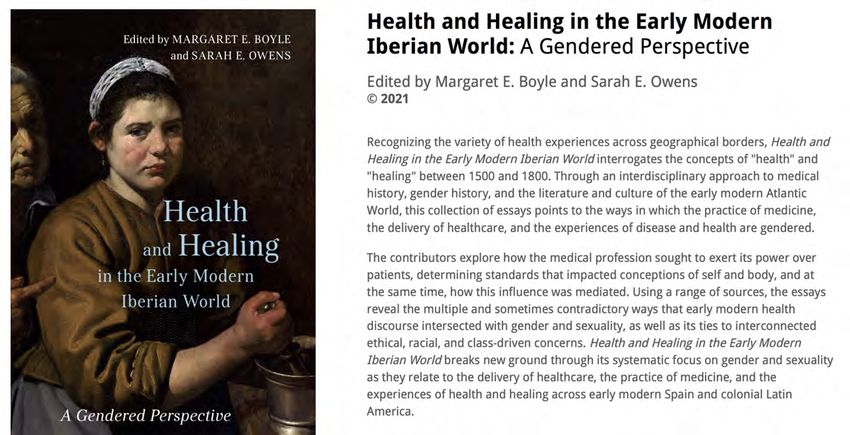
HISPANEWS - HISPANIC STUDIES SPRING 2021 - 23HISPANEWS Congratulations to Dr. Sarah Owens, for her co-authored work, Health and Healing in the Early Modern Iberian World: A Gendered Perspective (University of Toronto Press, 2021), and for her book chapter Religious Spaces and Alliances in the Far East: Women’s Travel and Writing in Manila and Macao in the book Challenging Women’s Agency and Activism in Early Modernity (Amsterdam UP, 2021). Both are now in print and ready for consumption. HISPANEWS - HISPANIC STUDIES SPRING 2021 - 24
HISPANEWS

      FOCUS ON THE FACULTY
            Lectures

                                   SPAN 495 Cultura, arte y arquitectura en el Barroco del imperio español
                                                                                                      Presents guest speaker

                                                                                                                                   Dr. Borja Franco Llopis
                                                                                                                             “Arte y Alteridad en la Iberia
                                                                                                                                 de la Edad Moderna”
                                                                                                                                                 (This lecture will be in Spanish)

                                                                                                                                   February 16, 2021 at 3 pm
                                                                                                                                                      Zoom Meeting

                                                                                                                                   https://cofc.zoom.us/j/3029806210

                                                                                                                            Borja Franco Llopis is an Associate
                                                                                                                            Professor at the Department of Art
                                                                                                                            History in the UNED (Spain). His
                                                                                                                            research is devoted to the visual
                                                                                                                            and literary representation of the
                                                                                                                            otherness in Southern Europe.

                                   Africa, engraved by Adrian Collaert based on the drawing by Maarten de Vos (1587-1589)
                                                                                                                               For more information, please contact
                                                                                                                               Dr. Carmen Grace at gracecm@cofc.edu

HISPANEWS - HISPANIC STUDIES                                                                                                  SPRING 2021 - 25
HISPANEWS HISPANEWS - HISPANIC STUDIES SPRING 2021 - 26
HISPANEWS

   FOCUS ON THE FACULTY
CofC-UNLaM-USACH Conference

HISPANEWS - HISPANIC STUDIES               SPRING 2021 - 27
HISPANEWS

Hispanic Studies hosted the first ever Hispanic Studies transcontinental congress, featuring student
and faculty presenters from the College of Charleston, the Universidad Nacional de La Matanza in
Buenos Aires, Argentina (UNLaM) and the Universidad de Santiago in Chile (USACH) on three
consecutive days April 6 – 8, 2021.

The internationally attended conference allowed College of Charleston faculty and students to share
recent research with our university partners at USACH and UNLaM. We look forward to future
collaborations with our friends abroad!

   HISPANEWS - HISPANIC STUDIES                                             SPRING 2021 - 28
HISPANEWS

         THE ONLINE EXPERIENCE
We asked professors and students to share with us something they love about the
              online or hybrid classes. Here are their messages!

                               Silvia Rodríguez Sabater:
                               I love the flexibility of teaching exclusively online
                               (asynchronously) for me and my students. We can do it from
                               anywhere and at any time! I also like that it helps my students
                               develop organizational, management, and tech skills while
                               learning the subject matter. I particularly enjoy the deliberate
                               design and structure of an online course and how it makes me an
                               overall better teacher. Another thing I enjoy is the personalized
                               interaction with all my students. I feel I know them better and I
                               can certainly learn their names quicker. I believe the online class
                               encourages participation from all my students including those
                               who may not be actively engaged in a F2F class and would be
                               hiding behind a desk. Finally, the tech tools I use make my
                               classes so cool!

Daniela Meireles:
I enjoy the flexibility and variety of methods that I encounter
while teaching online and hybrid courses. When instruction is
consistent and tasks make sense to students, platforms such as
Zoom breakout rooms and Flipgrid allow students to be creative
while engaging in conversation and speaking in the foreign
language. These platforms may lack kinesthetic components
that some learners need in the language acquisition process, but
they add variety and flexibility to teaching and learning when
online education is a choice or a must.

                               Luci Moreira:
                               In March 2020 we went online with optimism and resolve. Virtual
                               meetings became our public and professional meeting spaces.
                               My laptop crashed and I wondered: has my ever-present
                               colleague taken too-few breaks? Have we both exhausted our
                               capability to host Zoom meetings? Then, construction left me
                               without Internet service for a week. I looked outside and realized
                               that it was March 2021. I spent a trying year in a Zoom world, but
                               one that nevertheless included the support of my family, friends,
                               colleagues, and students. Without my classes I became truly
                               isolated, missing the halcyon days of my virtual connections.

  HISPANEWS - HISPANIC STUDIES                                            SPRING 2021 - 29
HISPANEWS
Emily Beck:
I love that students have a roomful of props at hand during Zoom
sessions. When they don't know the word for something, they
can just hold up the object (skateboard, stuffed animal, marker,
etc.). Using real objects in this way makes for a dynamic and
interactive way to learn new vocabulary and practice
conversational skills.
Devon Hanahan:
The best thing about teaching on zoom is that you can see their
faces instead of their masks!
Christina García:
Although I cannot wait to get back into the classroom, Zooming
has had its perks. My students get to take their Spanish classes
outdoors. We get all sorts of interesting backdrops, sounds of the
park and sounds of the city. Many of my students are out of state
or even out of the country. So, we get to learn about things in
New Jersey, Rhode Island and even St. Martin. For those at
home, we are all well acquainted with each other’s cats and
dogs. Most of all, since we are all going through this very peculiar
time together, there’s at least one thing we all share in common.
Kelsey Gallo:
I love how I can give class presentations via Google Slides. It
works just as well on Zoom as it does in person.
HISPANEWS - HISPANIC STUDIES SPRING 2021 - 30HISPANEWS
Hispanic Studies Review
Hispanic Studies Review (HSR) is an international refereed journal published twice a year by the
Department of Hispanic Studies at the College of Charleston. The journal welcomes submissions on
cultural studies, applied and theoretical linguistics, and the literatures of the Spanish-speaking worlds
and their contact zones. HSR particularly invites scholarship with approaches that are
interdisciplinary and/or engage innovative dialogues. HSR only accepts electronic submissions at
hsr@cofc.edu, and each manuscript will undergo a rigorous double-blind peer review.
Previously published material and work under consideration elsewhere will not be considered. HSR is
not responsible for the opinions expressed by contributors. The journal’s editorial team will respond
to contributors in a timely manner.
http://hispanicstudiesreview.cofc.edu
Editors
Editor: Carl Wise, College of Charleston
Associate Editor: Jorge Avilés-Diz, University of North Texas
Associate Editor: Antonio Pérez-Núñez, College of Charleston
Associate Editor: Haley Osborn, College of Charleston
Art Editor and Webmaster: Emily Harding, College of Charleston
Advising Editors: Mark P. Del Mastro & Michael Gómez, College of Charleston
Copy Editors
Philip Allen, University of Florida
Jorge Avilés-Diz, University of North Texas
Zachary G. Brandner, Texas Tech University
Carmen Grace, College of Charleston
Sara Zahler, Indiana University
Devon Hanahan, College of Charleston
Antonio Pérez Núñez, College of Charleston
Ricard Viñas de Puig, College of Charleston
Joseph Weyers, College of Charleston
Sara Zahler, Indiana University
HISPANEWS - HISPANIC STUDIES SPRING 2021 - 31HISPANEWS
Portuguese Club
Like everybody else at CofC, the Portuguese Club has been doing its part in stopping the spread of
the virus. Since its last in-person Bate-Papo conversation table, the Club has been offering online
activities to keep our Portuguese-speaking community engaged.
Currently advised by Dr. Daniela Meireles, the CofC Portuguese Club has been invigorated by the
joining of two new officers, Ms. Yazzy Rodrigues and Ms. Sara Muller, who, together with Ms.
Bailey Ferreira, are bringing a lot of “Luso-energy” and new ideas to the Club. The new president
and vice president made their debut on zoom in a “Meet and Greet the all-new Portuguese Club”
joined by CofC faculty and students and by Portuguese-speaking members of our external
community.
Ms. Sara Muller
Ms. Yazzy Rodrigues
The guests played a Kahoot game for a prize. The winner won an Açaí bowl, as the Club officers
highlighted the socio-cultural importance of this native Amazonian fruit in Brazil and outside of the
country. We all learned a lot!
In Spring 2021, The Portuguese Club also hosted Bate-Papo sessions with special guests. We were
joined by University of Texas-Austin’s Portuguese Flagship Program and by St. Mary’s University
Portuguese Department. We are interested in expanding our network of Portuguese speakers among
fellow Portuguese departments and their students in the U.S and abroad! Join us!
HISPANEWS - HISPANIC STUDIES SPRING 2021 - 32HISPANEWS Join the CofC Portuguese Club on Facebook to receive information about our upcoming conversation tables, movie nights, Feijoada dinner, and Brazilian barbecue events. Sejam bem- vindos! HISPANEWS - HISPANIC STUDIES SPRING 2021 - 33
HISPANEWS

                 Hispanic-Latino Club

The Hispanic Latino Club has continued to meet, organize and grow in membership, despite the
restrictions the pandemic has placed on events. With as many as 30 attendees at their virtual
meetings, the club continues to provide a community to CofC’s Hispanic/Latino students and all
others who wish to be a part of an identity-based club. If you follow the HLC on Instagram you
might have watched their fantastic video, composed of individual submissions where members
described why they identify as Hispanic/Latino. The club has also made it a point to expose their
social media followers to Latinx social justice activists, artists and leaders. Early in the fall in
collaboration with the Cougar Activities Board (CAB) the club hosted a three-part Social Justice
Speaker Series. In April, along with the Gender and Sexuality Equity Center, the club hosted a
discussion titled Marianismo and Machismo: The Sex and Gender we Don’t Talk About.

In addition to their socially conscious panels, the club also organized cultural and festive events
suited to our pandemic times. For Día de los Muertos, the club created a collaborative and socially
distant week-long event. Setting up the base of an altar at the Multicultural House, they created a
sign-up sheet to take turns going to the altar to add their own objects. Later in the week they held a
Zoom meeting to discuss the practice of altar-making. Together with Lambda Theta Phi the club
hosted a Kahoot event as well as a Virtual Lotería game night to close the semester.

   HISPANEWS - HISPANIC STUDIES                                              SPRING 2021 - 34
HISPANEWS
Spanish Club
The Spanish Club got creative for the 2020-21 academic year and kept Tertulia going during the
pandemic with multiple virtual events, including Trivia Night, Kahoot Game Night, and an online
screening and discussion of Juan Pablo Zaramella’s short film Viaje a Marte. The club also hosted a
“throwback Tertulia” in the spring in which students and faculty met in person to chat in Spanish. In
addition, the club helped promote a number of Hispanic Studies events, including Casa Hispana’s
Noche de Cocina and several academic lectures by College of Charleston faculty and invited guests.
HISPANEWS - HISPANIC STUDIES SPRING 2021 - 35HISPANEWS
La Casa Hispana
La Casa Hispana provided a much-needed language immersion experience for five students during
this shuttered pandemic year in which study abroad was not an option! The students started the
academic year enjoying the 2020 summer makeover of the house’s kitchen, downstairs bath and
other shared spaces. Residents used a new television/computer system to engage twice a month in
conversations with students from several Hispanic countries via Talk Abroad, inviting them into their
living room and chatting about a variety of shared interests. Dr. Michael Gómez, chair of Hispanic
Studies, established a library in the Casa with volumes including literary classics, cookbooks, popular
novels and graphic novels. The Casa co-sponsored with Sigma Delta Pi la Noche de Poesía via Zoom in
March, when sixteen students and professors recited their favorite poems and shared the importance
of the poems with the group. The Casa also hosted a cooking lesson for Enchiladas a la Michoacán. As
Covid restrictions lift, the house will return to its full capacity of nine residents and looks forward to
hosting many more events with the Department of Hispanic Studies.
HISPANEWS - HISPANIC STUDIES SPRING 2021 - 36HISPANEWS
Linguistics Club
In Fall 2020, the Linguistics Club celebrated two events of Movie Night and Discussion. They
streamed Disney's Atlantis (2001) for one meeting. On the following meeting there was a discussion on
linguistics in the movie and how anthropology, archeology, and linguistics interplay with each other
in Atlantis. The club also held a Trivia Night event, when they played a Kahoot full of linguistics
trivia, which included questions submitted by the members, and the student winner received a crafty
prize. The Trivia Night event in Spring 2021 was another Kahoot game which focused on language
trivia. The club’s advisor, Dr. Colleen Moorman, won the prize after defeating members and board
alike. In Spring 2021 the club held two student passion presentation events where two students per
meeting presented on aspects of linguistics they were passionate about. In the first event, President
Hails Tanaka presented on indigenous languages in film followed by a presentation by Katie Miceli
on the perception of syllable stress in the second language classroom as part of her bachelor's essay
research. In the second event, Tim Gasparik spoke about Hungarian and several of its unique
features as a language, followed by a presentation by Charlotte Heinrich about French idioms.
HISPANEWS - HISPANIC STUDIES SPRING 2021 - 37HISPANEWS The Linguistics program continued to strengthen our interdisciplinary ties and helped sponsor a collaborative conference that allowed CofC students to share research with our partners in France. HISPANEWS - HISPANIC STUDIES SPRING 2021 - 38
HISPANEWS

                           Sigma Delta Pi

The College of Charleston Sigma Delta Pi chapter, Nu Zeta, organized several activities this year. In
November 2020, seventeen students were inducted as new members of the chapter under the
direction of Dr. Divine. The following officials were elected: Isabel del Mastro, Riley Taylor and
Elizabeth Edmunds. In February 2021, they celebrated a Zoom Kahoot Game Night and the
winners received gift card prizes. In March, Sigma Delta Pi and La Casa Hispana co-hosted La
Noche de Poesía, where students were invited to recite poetry with the participation of faculty and
students from the Hispanic Studies Department and members of the community. In April, twenty
students were inducted as new members under the direction of Dr. Restrepo-Ramos and Dr. Grace.

   HISPANEWS - HISPANIC STUDIES                                             SPRING 2021 - 39
HISPANEWS
Noche de Poesía
SPAN major Ms. Isabel Del Mastro ’22 was recently
awarded National Spanish Honor Society Sigma Delta
Pi’s inaugural Virtual Internship Scholarship. The
internship, to be conducted during the upcoming
summer of 2021, will put Ms. Del Mastro into contact
with an organization in Medellín, Colombia, in either
the field of NGOs & Nonprofits or Languages &
Translation. Isabel was chosen, along with one other
student, from a highly competitive, national pool of
applicants. Our congratulations to her on this truly
impressive achievement!
HISPANEWS - HISPANIC STUDIES SPRING 2021 - 40HISPANEWS
Hispanic Studies
Advisory Board
Sarah Lee Copeland Adelaida Uribe Bennett, Louis Richard Doelling, Suzette Bussey,
Beck, Chair-Elect Immediate Past Chair Treasurer
Chair
Drew Fanning, LCWA Celina P. Anthony Hallie Ritzu María Asunción
Liaison Córdova
Mark P. Del Mastro Esther B. Ferguson
HISPANEWS - HISPANIC STUDIES SPRING 2021 - 41HISPANEWS
Hispanic Studies Career
Seminar Series
HISPANEWS - HISPANIC STUDIES SPRING 2021 - 42HISPANEWS HISPANEWS - HISPANIC STUDIES SPRING 2021 - 43
HISPANEWS

                           Alumni Corner

                                       Jessica Latham, '12
Jessica Latham was awarded the 2018 Teacher of the Year Award by the South Carolina Foreign
Language Teachers’ Association.         Jessica graduated magna cum laude from the College of
Charleston with a major in Spanish and minors in both Secondary Education and Russian Studies.
She was also a Fulbright Scholar at Moscow State University in the summer of 2014, and she earned
her M.A. in Applied Linguistics from the University of Massachusetts Boston in 2016. Currently she
is a faculty member of both Spanish and Russian languages at Lexington High School (Lexington,
SC / Lexington School District One) where she teaches Spanish 1, 2, 3 and 3 honors, and Russian 1
honors, 2 honors, and 3 honors. Beyond the classroom, she is Lexington High School’s sponsor of
the Russian Club and the SLAVA International Honors Society, among other distinguished
professional activities.
"The experiences that I had at College of Charleston were profoundly unique to the college when I
compare them to those of my colleagues who studied at other universities. My classes were small and
personal, the professors welcoming and inviting, but most importantly, they were genuinely interested
in you and how to fully develop your potential. More than once I went to office hours to get
additional assistance and the conversation morphed into what my goals and aspirations were and
how best to achieve them. More than once a professor took personal interest in me and encouraged
me to publish my essays and further develop classwork into potential research projects, so much so
that I finally did take that leap with the support and the guidance of that professor. What stood out
the most was the passion that my professors had for both their field and their research, but also for
their students, so much so that it was not difficult for me to find that same passion later with my own
students."

   HISPANEWS - HISPANIC STUDIES                                               SPRING 2021 - 44
HISPANEWS
Christin Stewart, ’11
Christin Stewart graduated with a Bachelor of Arts in Spanish and a Bachelor of Science in
Sociology from CofC in 2011. She has spent her career designing, implementing, and evaluating
policies and programs to improve access to health services in the areas of family planning, sexual and
reproductive health, and HIV across the globe. She is currently working in Raleigh, North Carolina
as a Quality Improvement Advisor with Upstream USA. Prior to joining Upstream USA, Christin
worked in international development at RTI International, providing technical program support in
the areas of health systems strengthening and HIV-related stigma and discrimination to USAID-
funded projects in Africa, Latin America, and Southeast Asia. Christin holds a Master of Public
Health in Health Behavior from the University of North Carolina Gillings School of Global Public
Health.
“I credit CofC's study abroad program in Trujillo, Spain for changing the trajectory of my education
and career. My positive experience in Trujillo convinced me to pursue a Spanish major and
ultimately led me to move to Nicaragua and begin my career in international development. I remain
close with my host family in Trujillo and visit them frequently, including for my host brother's
wedding last year.”
HISPANEWS - HISPANIC STUDIES SPRING 2021 - 45HISPANEWS
Dr. Andrew Sobiesuo
Farewell
I joined what was then the Languages Department at College of Charleston as Assistant Professor of
Spanish in 1990 after stints as Instructor at Ohio Wesleyan University and as Lecturer at The Ohio
State University. Five years later, the Languages Department would evolve into the Division of
Languages and Literatures with three separate academic departments to provide flexibility for each
unit to develop and expand at its own pace. The Department of Spanish (and Italian, later, for a
brief period), as the largest department in the Division, experienced unprecedented growth as
Spanish became the most desired foreign language nationally among college students at the time.
With much trepidation and a sense of hesitation and honor, I
accepted the new role of chair of the Department of Spanish in
1998. Whereas I never fathomed myself in such a role, I was
eventually convinced that being chair is one of the ultimate sacrifices
and contributions a faculty member can make to his/her
department. Under my stewardship, the department reached new
heights, from new faculty hires, revised and enriched curriculum
initiatives, and more faculty involvement in department affairs to an
increased sense of community and collegiality resulting in more
collaborative efforts.
One of my earlier decisions was to request a change of the name of
the department from Department of Spanish to Department of
Hispanic Studies to reflect more accurately the department’s mission
and vision. There was a renewed commitment to interdisciplinary
programs and in developing Portuguese at the College under the
umbrella of Hispanic Studies. The U.S. Department of Education
Title VI grant provided the resources to develop the Latin American
and Caribbean Studies (LACS) program, including a tenure-track
faculty hire for Portuguese with the backing of Hispanic Studies
faculty. The M.A. Program in Bilingual Legal Interpreting thrived
and many Hispanic Studies faculty participated in the Honors
program. With leadership by Hispanic Studies faculty, the first
student graduated with the Interdisciplinary minor in Linguistics in
May 2003, and the M.Ed in Languages program enrolled its first
cohort in summer 2003. Casa Hispanica (now La Casa Hispana)
would open the doors to its first residents in fall 2003, the concept
having been proposed and approved during the 2002-03 academic
year by the department faculty.
Meanwhile, the demand for Spanish courses and the quest for
continuous excellence placed a very high burden on the department.
For example, in my last year as chair (2002-03), faculty in Hispanic
Studies taught 256 course sections with a total enrollment of 5,710 students. Perhaps the most
dramatic development during that time was the increase in the number of Spanish majors and
HISPANEWS - HISPANIC STUDIES SPRING 2021 - 46You can also read


