History at Hillsborough Castle
←
→
Page content transcription
If your browser does not render page correctly, please read the page content below
History at Hillsborough Castle
Your short guide to the history of Hillsborough Castle and Gardens.

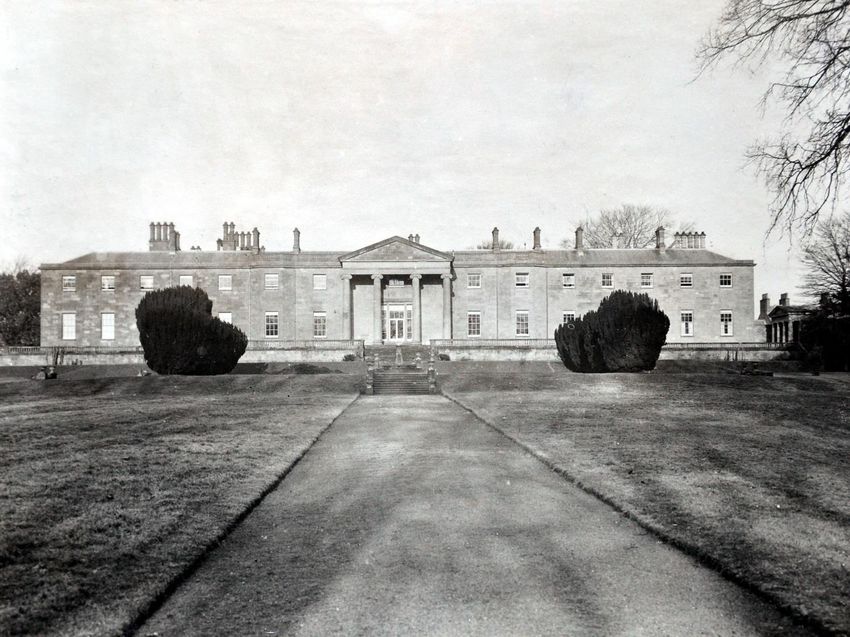
South Façade at Hillsborough Castle, circa 1926

                                                                      1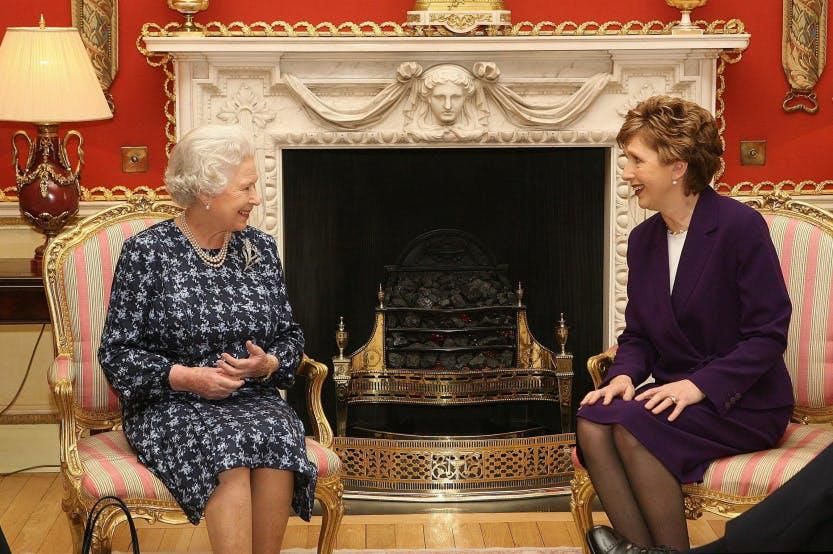
Contents
Brief history of Hillsborough Castle and Gardens ………………..……………………………3
Chronology ……………………………………………………………………………………………………9
Key characters associated with Hillsborough Castle ………………………………………….11
Frequently asked questions …………………………………………………………………………….16

                                                                         2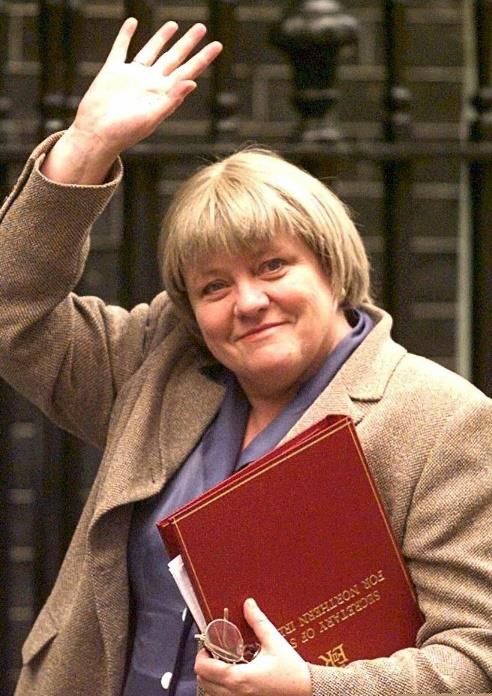
Brief History of Hillsborough Castle
Official residence of the British Monarch in Northern Ireland, pivotal venue in the
Northern Ireland peace process, Government House, and Georgian family home,
Hillsborough Castle has a rich and interesting history to discover.
Hillsborough Castle’s Origins
The origins of Hilllsborough Castle begin with Sir Moyses Hill, who was originally
from Devon. Moyses arrived in Ireland in 1573 as part of Walter Deveraux’s army,
with the intention of colonising Ulster. Initially appointed the governor of Olderfleet
Castle in Larne, Moyses was knighted in 1603.
In 1611 he was granted possession of the village of Cromlyn – today, Hillsborough –
and given the position of Provost Mareschal of the Province of Ulster in 1617. For
services to the Crown, Moyses was awarded 2,000 acres of land in County Antrim,
and 40,000 acres in County Down, creating an expansive estate.

                                                                                          3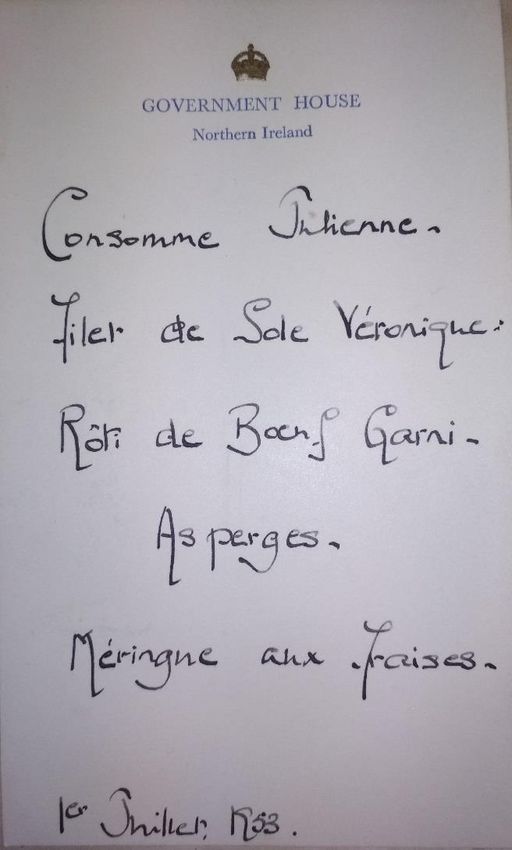
General map of Ulster showing the county boundaries as drawn by Sir John Perrott,
1584. Olderfleet Castle, Larne, shown in County Antrim and Hillsborough Castle
shown in County Down.
During the 1650s Hillsborough Fort was built with the purpose of protecting the road
from Carrickfergus to Dublin and the Hill family moved there from Lisburn. In 1660,
Charles II granted the head of the Hill family, Arthur Hill, the position of Constable
of the Fort, and granted a Royal Charter to create a borough.
The fort still stands in Hillsborough. Today, it is directly across the road from
Hillsborough Castle. Much of the fort, as seen today, including the defensive walls,
are from 1650s, but the gatehouse was remodelled in the 1750s to become a tea house
for social gatherings.

                                                                                     4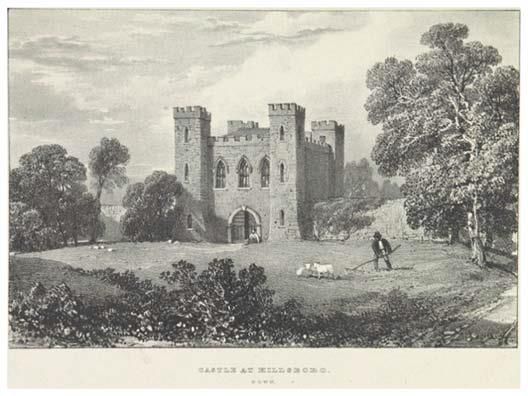
Image of Hillsborough Fort, mid 19th Century.

Georgian Family Home
Hillsborough Castle today is on the same site as the family home built by Wills Hill
during the late 1700s, although it has been extended and added to many times since
then. Indeed, many of the features of the village can be traced to this period,
including improvement work to St. Malachy’s Church and the Court & Market
Houses.
Although called a castle, Hillsborough is in fact, an ‘Irish Big House’, the name castle
referring back to the original fort, the first home of the Hill family.
Unlike other ‘Irish Big Houses’ Hillsborough is not approached by a long, sweeping
driveway and set far away from any town or village. Built as one side of a Georgian
square, it is an interesting mix of traditional ‘Big House’ and townhouse.
Wills Hill became the first Marquess of Downshire in 1789, having been created Earl
of Hillsborough in 1772. Wills had been Privy Councillor to George II in 1754. In
1768 he became the first Secretary of State for the Colonies, a role created to deal
with Britain’s increasingly troublesome colonies in North America.

                                                                                       5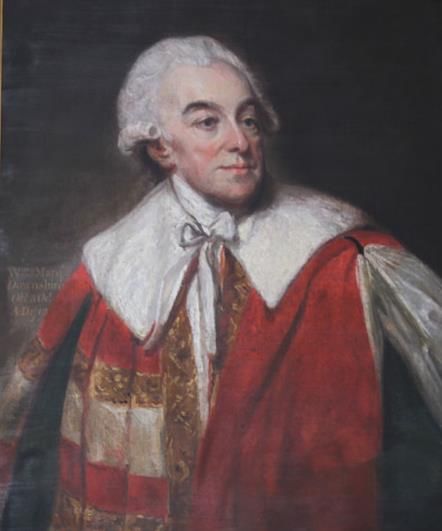
It was in this latter role, that Benjamin Franklin, known as one of the founding
fathers of the United States of America, paid a visit to Hillsborough Castle in 1771.
Wills Hill built not only the house, but also the Court House and Market House,
improved the Church and restored the fort, turning it into a fashionable pleasure
garden.
Throughout the centuries, successive members of the Hill family have added to,
expanded, and altered, the house and gardens. By the late 19th century however, the
family were spending much less time in Hillsborough, instead spending most of their
time on their English estate, Easthampstead Park in Berkshire. By 1909, the family
had decided to rent out the house, selling it completely to the British Government in
1925.

Government House
In 1925, the British Government bought Hillsborough Castle from the Hill family for
£24,000 (approximately £1.3 million today) and the house entered a new phase in its
history. The castle then became known as Government House, the official residence
of the Governor of Northern Ireland, remaining so for over 50 years.
There were 5 governors during this time, serving from 1925 until 1972.
   ❖ The 1st Governor: Duke of Abercorn, 1922 – 1945
   ❖ The 2nd Governor: Earl of Granville, 1945 – 1952
   ❖ The 3rd Governor: Lord Wakehurst, 1952 – 1964
   ❖ The 4th Governor: Lord Erskine, 1964 – 1968
   ❖ The 5th Governor: Lord Grey, 1968 – 1972
In 1934, during the time the Duke of Abercorn was in residence, Hillsborough Castle
suffered a devastating fire.
After the death of President von Hindenburg of Germany, the flag on the castle roof
was being hoisted to half-mast, when a member of staff carelessly discarded a lit
cigarette which set the flag alight. A large portion of the building was destroyed and
many of the structural changes we see today date from this period.

                                                                                         6
A Place of Politics
In 1972 Direct Rule from London was imposed and the role of Governor of Northern
Ireland was abolished. The role of the Secretary of State took its place and
Hillsborough Castle became the official residence of the Secretary of State while in
Northern Ireland.
The current Secretary of State, Brandon Lewis, still stays at Hillsborough Castle
when in Northern Ireland.
It has been in this phase of the castle’s history that it has hosted some of the most
important talks of modern Northern Irish political history and has been a venue of
negotiation, discussion and agreement.
In 1985 the Anglo-Irish Agreement was signed in the State Drawing Room at
Hillsborough Castle, by British Prime Minister Margaret Thatcher and Irish
Taoiseach Garret Fitzgerald. This agreement gave Dublin an advisory role in British
policy in Northern Ireland.
Discussions between political parties took place at Hillsborough Castle throughout
1997 and 1998, resulting in the Good Friday Agreement (officially known as the
7Belfast Agreement), which was signed on 10 April 1998. This was a seminal moment
in Northern Ireland’s history.
This was followed in 1999 by the Hillsborough Declaration, where Irish Taoiseach
Bertie Ahern and British Prime Minister Tony Blair, called for the timely
decommissioning of weapons.
In 2010, the Hillsborough Agreement was also signed at Hillsborough Castle,
resulting in the devolution of policing and justice powers to Northern Ireland.
Royal Connections
Hillsborough’s royal connections stretch back to the 17th century when King William
III stayed overnight at Hillsborough Fort when Charles II granted the town borough
status. The modern royals had a close association with Hillsborough during Governor
Granville’s residence. Governor Granville’s wife, Lady Rose Constance Bowes-Lyon,
was Queen Elizabeth’s sister (mother of the current Queen). In March 1946,
supported by her aunt and uncle, the then 19 year-old Princess Elizabeth, made her
first solo visit to Northern Ireland, during which she stayed at Hillsborough Castle.
After her coronation, in July 1953, Her Majesty The Queen, visited Northern Ireland,
and enjoyed a coronation banquet in the Throne Room at the castle.
Hillsborough Castle remains the official residence of the royal family while in
Northern Ireland.
8Chronology
1600s Sir Moyses Hill, from Devon, settles in Ulster, with estates at
Carrickfergus, Lisburn and Kilwarlin. Kilwarlin later becomes known as
Hillsborough, after the family.
1650s Hillsborough Fort is built, to protect the road from Carrickfergus to
Dublin, and the Hill family move here from Lisburn.
1662 Charles II grants the head of the Hill family the role of Constable of the
fort; the king also grants Hillsborough town status.
1758 Mary Delaney, diarist, and wife of the Dean of Down, visits Hillsborough
describing the fort, church, and plans of Wills Hill for further building.
1788 The house we now know as Hillsborough Castle is completed. Further
alterations are made by Wills Hills’s son during the late 1790s.
1844 A number of further additions to Hillsborough Castle are complete by
1844. The parkland is also enclosed and established, with an 18th
century ‘improved’ landscape, and a 19th ‘Picturesque’ landscape.
1900 By the turn of the century, the family are rarely at Hillsborough, and the
house is rented out.
1925 The house is purchased by the British Government, who undertake
alterations and repairs, and then hand it to the Government of Northern
Ireland to provide a home for the newly appointed Governor, the Duke
of Abercorn. With the loss of Dublin Castle, Hillsborough now also
provides an official residence for the Royal Family.
1934 On the death of President Hindenburg of Germany, the flag flying above
Hillsborough is lowered to half-mast. Within a short time smoke is seen
coming from the roof, and within two hours the whole central block
containing the State Apartments is destroyed. The British Office of
Works take two years to rebuild.
1940s Queen Elizabeth, the Queen Mother, and Princesses Elizabeth and
Margaret spend even more time at Hillsborough during the
Governorship of Lord and Lady Granville, the Queen Mother’s sister and
brother-in-law.
1973 Direct Rule is re-imposed in 1972 and the role of Governor is abolished.
Hillsborough Castle now becomes home to the Secretary of State for
Northern Ireland. The incumbent Labour Secretary of State feels
Hillsborough Castle is too ostentatious and chooses instead to travel to
the Culloden Hotel each evening.
1985 The Anglo-Irish Agreement is signed in the Drawing Room of
Hillsborough Castle, between British Prime Minister Margaret Thatcher,
and Irish Taoiseach Garret Fitzgerald.
1997 Mo Mowlam, as Secretary of State, is a key figure in Anglo-Irish talks.
92003 US President George W. Bush, and British Prime Minister Tony Blair
meet at Hillsborough to discuss NATO involvement in Iraq. The
following day Irish Taoiseach Bertie Ahern, joins them to hold further
political talks.
2009 The first meeting of the two heads of state; of the Republic of Ireland,
Mary McAleese, and the United Kingdom, HM Queen Elizabeth,
happens at Hillsborough Castle.
2010 Negotiation of the Hillsborough Castle Agreement, which enabled the
devolution of policing and justice powers to the power-sharing
Executive, takes place.
2011 Irish President Mary McAleese’s final official engagement outside
Ireland is a reception at Hillsborough Castle.
2014 Historic Royal Palaces takes over the management of Hillsborough
Castle from the Northern Ireland Office.
10Key Characters associated with
Hillsborough Castle
Wills Hill (1718 – 1793)
Wills Hill was the first Marquess of Downshire.
He held various positions during his lifetime,
including Secretary of State for the Colonies 1768-
72. This was at a critical time for relations
between Britain and America; the American War
of Independence broke out just a few years later.
Hillsborough Castle was built in the 1770s by
Wills Hill, he also had the parish church and
market house built, and the fort remodeled.
George Romney, the artist of this portrait, was
one of the most fashionable portrait artists of his
day. He painted many leading society figures,
most famously his muse Lady Emma Hamilton.
11Annie Fortescue Harrison (1848 – 1944)
Annie Jessie Fortescue Harrison was born in Calcutta,
India, and moved to Sussex with her family in 1865. In 1877
she married Lord Arthur Hill. She was his second wife after
he was widowed in 1874.
She gained renown during her lifetime as a successful
composer. Perhaps her most famous piece of music is “In
the Gloaming” which has been recorded many times,
including by Fats Waller.
Anecdotally, the song has gained a romantic backstory. It is
said that Arthur met Annie as a young man, prior to his first
marriage, and that they fell in love but were prevented from
marrying by the social norms of the day, their situation in
life being deemed too far apart.
Some years later, after the death of his first wife, Arthur was
attending a concert in London where he heard “In the
Gloaming”. The music and song recalled for him, Annie, his
lost love, and upon discovering that she was the composer
the two were reunited and eventually married.
Countess Granville (1890 – 1967)
Rose Constance Leveson-Gower, Countess
Granville, was married to William
Leveson-Gower, Earl Garnville, who was
Governor of Northern Ireland from 1945 –
1952. They lived at Hillsborough Castle,
then called Government House, during
this time and made some changes to the
interior décor of the house.
Countess Granville was sister to Queen
Elizabeth (the Queen Mother) and stood as
godmother to Princess Margaret Rose of
York. Her role as wife of the Governor of
Northern Ireland meant that the young
Princess Elizabeth could stay with close
family when on official engagements in
12Northern Ireland and learn the ropes of official royal overseas protocol supported by
family.
Today you can visit the Granville Garden, a rose garden created by Countess
Granville, which is situated directly outside the State Dining Room terrace. When
dining at Hillsborough Castle, HM the Queen, sits with her back to the fireplace in
the Dining Room, facing the Granville Garden.
Mo Mowlam (1949 – 2005)
Marjorie Mowlam, better known as Mo, was
Secretary of State to Northern Ireland from 1997
until 1999. Perhaps best known as a key player in
the talks leading up to the Belfast Agreement (The
Good Friday Agreement) which was signed in 1998,
Mo has very close associations with Hillsborough
Castle.
Known as a personable, down to earth, and at times,
irreverent politician, Mo brokered key talks been
Unionist and Republican parties in the relaxed
atmosphere of Hillsborough Castle. She was
particularly fond of the gardens and often took walks
on the estate, even requesting that some of her ashes
be scattered here upon her death.
Her Majesty Queen Elizabeth II
HM The Queen has visited Hillsborough Castle many times, the first being while she
was Princess Elizabeth, when she made her first official solo visit to Northern
Ireland, in order to launch a new ship by Harland & Wolff, the HMS Eagle.
Perhaps her most famous visit occurred after her coronation in July 1953, when a
banquet was held in celebration. Newspapers at the time described the simple
grandeur of the Throne Room prepared for dinner:
“No tablecloth obscured the gleaming mahogany and the place mats were of the
most simple white linen, scalloped in white; the service of white and gold china and
the plain coloured cut glass maintained the general simplicity of the setting.
The menu, too, was elegant rather than elaborate. There were only four courses –
consommé Julienne, filet de sole Veronique, roti de boeuf, asparagus and Merinque
aux fraises.” The Northern Whig, Thursday 2nd July, 1953.
13Important political meetings have also taken place with HM The Queen at
Hillsborough. In December 2005 she met Irish President Mary McAleese in the Red
Room at Hillsborough Castle. This was significant as it was the first meeting
between a reigning British Monarch and the head of an independent Ireland, on the
island of Ireland.
1415
Frequently Asked Questions
Why is it called Hillsborough Castle? It’s not a castle!
The name Hillsborough Castle refers to Hillsborough Fort, the Hill family’s first
home in the area. (Which does look more castle-like with its crenellations!) It was
also common for Anglo-Irish families of the period to refer to their grand country
houses as castles, as it was thought it reinforced the antiquity of their families.

Does the Queen actually stay here?
Yes, when members of the royal family visit Northern Ireland, Hillsborough Castle is
their official residence. As a working royal residence, it means that sometimes we
have to close to the public at short notice.

How often does the Royal Family visit?
It varies, but probably on average two – three times a year. The most well-known
occasion is for the Royal Garden Party, in late summer, hosted by a member of the
royal family, when invited guests enjoy tea in the beautiful grounds.

Is the village called Hillsborough because it is on a hill?
No! It’s named after the Hill family who resided here when the area was granted
borough status by Charles II. The fact it is also on a hill is a happy coincidence!

Does the Secretary of State stay here?
Yes. As well as being the official residence of the royal family while in Northern
Ireland, the Secretary of State also stays at Hillsborough Castle. It has been this way
since the last Governor of Northern Ireland left in 1972.

Is Hillsborough Castle haunted?
That’ll be up to you to decide when you visit! Some members of staff have reported
unexplained noises, footsteps overhead in rooms known to be empty and banging
doors, but that could all be explained by the wind, and creaks in old houses, couldn’t
it?

                                                                                      16
What kind of crimes were tried at the Court House?
Hillsborough Court House is a Petty Sessions court. That means that crimes of a less
serious nature were tried here. Examples would include: poaching, loitering, petty
larceny, disturbing the peace, drunkenness. It would not have been used to try
serious criminal cases, such as murder.
Did the fire completely destroy the castle?
The fire, started by the careless disposal of a member of staff’s cigarette, was
devastating to the central portion of the castle, with large portions of the interior
being badly damaged or destroyed.
The castle as we see it today is largely from the period of repair and rebuilding after
the fire.
The Abercorns were absent at the time of the fire but staff and villagers managed to
save a large number of valuable furniture and artwork, even removing some in
wheelbarrows!
17You can also read


