HOLY TRINITY TAUNTON - April 2021
←
→
Page content transcription
If your browser does not render page correctly, please read the page content below

HOLY TRINITY TAUNTON

                April 2021
Holy Trinity Service Times
During lockdown public services are as
follows:

                          Sunday
                         10.00am
                         Saturday
                         6.00pm

Services will also continue to be streamed:

      Sunday                     Tuesday – Saturday
10.00am and 6.30pm                   10.00am

        Services for Holy Week and Easter
           are listed after the Calendar

To access streamed services:

                               @ Holy Trinity Taunton

                                 Holy Trinity Taunton

Fr Julian can be emailed directly: frjulianssc@gmail.com
CALVERTS of Taunton
   For over 70 years we have enjoyed being your local
furnishings specialist for Furniture, Beds, Carpets, Fabrics
                         and Blinds
 Visit our extensive showrooms where you can view the most
      comprehensive selection of furnishings in Taunton.
                        Closed Sunday / Monday

          94/108 Station Road, Taunton, TA1 1PD
            Ample parking at rear of store off Canal Road

     Telephone: 01823 335823 Fax: 01823 336186
         Email: sales@calvertsfurniture.co.uk
             www.calvertsfurniture.co.uk

                    Traditional MENSWEAR

                              Extensive Stock of Sizes and Prices
                               38-60 Chest in Suits, Jackets, Blazers -
                               Ranges from The Label, Gurteen, ,
       of Taunton              Bladen Douglas
                               32-60 Waist in Trousers - Ranges from
                               Gurteen, Meyer Oakman, Douglas
                               FREE shortening if purchased from us
                               15-22 Collar in Shirts – Ranges from
                               Double Two, Peter England, Viyella
                               Small to 6XL in Knitwear - Ranges
                               from Franco Ponti, Massoti, Gabicci
                        70 Station Road, Taunton, TA1 1NX
                 Tel 01823 333169 Freephone 0800 056 1766
            Email: post@gurds.co.uk Website: ww.gurds.co.uk
Tuesday-Friday 8.45 to 1.00-2.00 to 5.30 Saturday 8.45 to 4.00 Closed Monday
QUEEN STREET GARAGE
    Car repairs, Servicing and MOT
         We are a small family run business.
      Our staff have over 30 years experience.
      All our technicians are fully qualified and
                attend ongoing training.

        SERVICES AVAILABLE
                   MOTS
                 Servicing
                   Repairs
             Diagnostic Checks
        Air Con Services and Repairs
        Brakes, Exhausts & Clutches
             Fleet Maintenance

             Tel: 01823 333385
             Fax: 01823 323982
       www.queenstreetgarage.co.uk
Queen Street Garage, Queen Street, Taunton,
                 TA1 3AX

2021

FR JULIAN WRITES…
Easter is nearly upon us, and for many people, this will likely be the most
pleasurable event for some months. Warmer weather, birdsong and
spring flowers all make us feel better, after what has been a very hard and
dark period of a winter lockdown. It may be that this could be relaxed in
the coming weeks, but its cause will be with us for some considerable time.

We have recently ‘held’ the first full Parochial Church Council (via
Zoom) since January last year. Since then we have made decisions on
an ad hoc basis. Although for some people, a PCC meeting isn’t the
definition of joy unbounded, for me this has given me a sense of
renewed hope. After a year of being reactive, I sense that we are all
becoming used to the idea of being proactive again, actually doing,
rather than being done to.

This balance between activity and passivity, doing or being done to, is
very much the basis of a marvellous book by W H Vanstone, ‘The
Stature of Waiting’. In it, he points out that the verbs applying to Jesus
in St John’s gospel are in the active – Jesus doing. Until… Until the
moment in the Garden of Gethsemane, when Jesus is ‘handed over’
(that’s really the meaning of the Greek verb, ‘paradidomi’). We may be
more used to the translation ‘betrayal’.

From that moment on, Jesus is in the passive, is done to. He is arrested.
He is tried. He is flogged. He is mocked. He is taken to the crucifixion
site. He is crucified. He dies. He is buried. But then, there is a
triumphant return to Jesus’ being active – he rises from the dead.

Vanstone points out that there are often many ‘paradidomi’ moments
in our lives. These may be rites of passage as we get older, starting
school. Getting a job. Getting married. Having children. Buying a
house. But then there is that moment, or moments, as significant to us
as for Jesus in the Garden.

That might be changing circumstances due to health problems.
Breakdowns in relationships. Loss of job. Retirement. All these things
change who we thought we were; we may feel that we have lost
control and that we are victims. For all of you, there is a tipping point,
a ‘paradidomi moment’.

Without doubt Covid 19 has been one such. It has adversely affected
not only our own lives, but that of our nation’s and our world. No
longer can we take previous expectations for granted, and we have had
to re-think our lives. We have felt out of control, and that we were
powerless. So let’s just think once more about the message of Easter,
and Jesus’ return to being a ‘doer’.

Too often our lives get out of control, sometimes without us even
noticing. We get drawn along a certain route, and after a while we have
no power, seemingly, to resist. And then it comes to a crunch – the
‘paradidomi moment’. The resurrection shows us that hope is
unconquerable, and will always win out. However, hope does not turn
the clock back to a rosy past which probably never existed. Hope
enables us to embrace and live a renewed future.

After his resurrection, Jesus wasn’t the same Jesus is some respects,
and neither were his disciples. They had to adjust to a new relationship
with Jesus but founded on the previous givens. Remember his words –
‘Don’t touch me!’ This renewal of life for him, for them, for us, is the
result of our acceptance of being active and passive. None of us is
either one or the other, and although I may have painted a black and
white picture, I know that life is grey! However, we would often think
of ourselves as one or the other.

We have to have the grace to accept that God is working within us
wherever we are, not just in physical terms. Psalm 139 tells us, ’If I go
down to the grave you are there also’. Nowhere is outside the activity
of God, as we can see in life around us at the moment, and resurrection
of Jesus.

Happy Easter!

With my prayers and all good wishes
                                                Fr Julian
CRY HARRY FOR ENGLAND AND ST GEORGE
Perhaps you, like me, had to study Shakepeare’s Henry V at school, or
have seen either Olivier or Branagh in the film versions. In which case
you will recognise this title as the closing part of Henry’s rallying cry to
his troops at Agincourt. It’s part of that speech, the beginning of which
everyone knows – ‘Once more unto the breach, dear friends…’

We all know that St George is the patron saint of
England. As we had Dewi Sant last month, it
seems only right that we have quick peek at St
George (apologies to Celts across the Irish Sea,
but St Patrick does seem to have higher profile
than either David or George!). However, St
George isn’t quite the great nationalist saint
that we might imagine.

To begin with, St George only became our patron saint in 1350, when
Edward III founded the Order of the Garter, a cult furthered by Henry
V’s victory at Agincourt. Previously, England was under the patronage
of St Edmund, a ninth century East Anglian king, who was martyred. St
Edmund is the patron saint of kings, and also, appropriately for today,
of pandemics.

St George was commonly accepted in both Greek and Latin traditions
as a Roman centurion who refused to accept pagan worship. He was
of Greek descent (from Cappadocia, now in Turkey) with a Syrian
mother who was from Lydda in Palestine. He was martyred by
beheading in 303, on April 23rd. One of the witnesses to this was the
Empress Alexandra, who converted and paid the same price.

He was formally declared a saint by Pope Gelasius in 494, who claimed
he was one of those 'whose names are justly revered among men but
whose acts are known only to God'.

He is also considered a prophetic figure in Islam, and is revered widely in
the near Middle East, England, Ethiopia, Georgia, Catalonia, Aragon, and
Moscow by Roman Catholics, the Orthodox, Lutherans and the Druze.
The infamous dragon only appeared around the 11th century, but has
been the stuff of popular legend ever since, partly due to a translation
of the story by William Caxton.

Following his martyrdom the remains of George were taken to Lod
(formerly Lydda) in Israel. The Church of St George in Lod became a
major focus of veneration for centuries.

Various relics of George reportedly are housed in both Western and
Eastern churches worldwide. However, in April 2019, the parish church
of São Jorge, Madeira Island, Portugal, solemnly received the relics of
George, patron saint of the parish. During the celebrations, the 504th
anniversary of its foundation, the relics were brought by the new
Bishop of Funchal, Dom Nuno Brás.

At least he’s getting physically closer to England!
                                                                 Fr Julian

EASTER LILIES

Once again, we have not been able to commemorate
loved ones through Easter lilies, as they just are not
available. Last year, churches were closed – clergy
even couldn’t go in – so we are at least in a slighty
better position today.

In order that we may have some opportunity to remember our dear
departed, cards are available at the back of church for you to write their
names on. These will then be made into a suitable display for Easter.

If you can’t get to church physically to complete a card, please email
your names to the parish office, and they will be entered on a card for
you, but please do so before Maundy Thursday.

Hopefully, next year…!
                                                                 Fr Julian
CALENDAR FOR APRIL The Sundays, readings and themes, and Saints days for April are listed below. 1 MAUNDY THURSDAY Theme: The Last Supper Readings: Exodus 12.1-4,11-14; 1 Cor 11.23-26; John 13.1-17&31b- 35 2 GOOD FRIDAY Theme: The Crucifixion Readings: Isaiah 52.13-53.12; Hebrews 4.14-16 7 5.7-9; John Passion 3 HOLY SATURDAY Theme: Light from Darkness 4 EASTER DAY Theme: The Resurrection Readings: Acts 10.34-43; 1 Corinthians 15.1-11; Mark 16.1-8 5 Mon in Easter Week 6 Tue in Easter Week 7 Wed in Easter Week 8 Thu in Easter Week 9 Fri in Easter Week 10 Sat in Easter Week 11 EASTER 2 Theme: The Victory of Faith Readings: Acts 4.32-35; 1 John 1.1-2.2; John 20.19-31 12 Mon S. Zeno, Bishop of Verona (371) 14 Wed S. Caradoc, Welsh Monk (1124) 16 Fri S. Bernadette Soubirous of Lourdes, Nun (1879) 18 EASTER 3 Theme: Our Advocate with the Father Readings: Acts 3.12-19; 1 John 3.1-7; Luke 24.36-48 19 Mon S. Alphege, Archbishop of Canterbury, Martyr (1012) 21 Wed S. Anselm, Archbishop of Canterbury, Monk & Writer (1109) 22 Thu S. Theodore, Monk & Bishop (613) 23 Fri S. George, Martyr, Patron of England (303) 25 EASTER 4 Theme: The Good Shepherd Readings: Acts 4.5-12; 1 John 3.16-24; John 10.11-18 26 Mon S. Cletus, Bishop of Rome, Martyr (1st Cent) 28 Wed S. Peter Chanel, Missionary, Martyr (1841) 29 Thu S. Catherine of Siena, Teacher (1380) 30 Fri S. Erkenwald, Bishop of London (693)
SERVICES FOR HOLY WEEK & EASTER
               Monday in Holy Week
    7.00pm Holy Eucharist & Address – streamed only
               Tuesday in Holy Week
    7.00pm Holy Eucharist & Address – streamed only
             Wednesday in Holy Week
    7.00pm Holy Eucharist & Address – streamed only

               MAUNDY THURSDAY
    7.30pm Mass of the Lord’s Supper – streamed only

                   GOOD FRIDAY
 10.00am Liturgy of the Lord’s Passion – public service
                                          and streamed
   2.00pm Last Hour Before the Cross – streamed only

                  HOLY SATURDAY
8.00pm Easter Vigil & First Mass of Easter – streamed only
                   EASTER DAY
    10.00am Parish Mass for Easter – public service
                                     and streamed
     6.30pm Evensong & Benediction - streamed only
MISSA LUBA AND THE BALLERINA I shall always associate the African setting of the Latin Mass with the ballet dancer Doreen Wells whose house I visited in the winter of 1970/71 over 50 years ago. It came about this way. I was working in London for the Inland Revenue Valuation Office, and my job was to inspect houses in Chelsea and Kensington under the old rating system when domestic rates were based on the rental values of dwelling houses. I made appointments to visit a number of terraced houses in First Street, Chelsea which in those days was in an area of gentrification which meant that as the original inhabitants left or died, their old unmodernised three and four storeyed Victorian houses, let out in parts, were being bought by celebrities and others and modernised for single family occupation. This was at a time when there were power cuts in London and quite often I stumbled across candle-lit basement dining rooms where the well-heeled had just finished a late breakfast. Despite the social differences, I gained an impression that this was a friendly neighbourhood. On one visit to a titled lady she told me she couldn’t stay very long as she had promised to take her elderly neighbour from the poorer side of the street to a hospital appointment. I was welcomed in another well-appointed house by the renowned dancer, Doreen Wells of the Sadler’s Wells Theatre Ballet. She was listening to an LP recording of the then popular Missa Luba and when I finished my survey of her property she gave me a cup of coffee and invited me to listen to the music about which I had expressed an interest. The Missa Luba is a setting of the Mass composed by Fr Guido Haazen, a Franciscan Friar from Belgium, and sung in styles traditional to the Democratic Republic of Congo. It became very popular in the late 1960s and featured in a number of films. The Gloria featured in Pasolini’s ‘The Gospel According to St. Matthew’ in 1964.
The Sanctus and Benedictus spent eleven weeks in the British charts in
1969.

I remember the haunting sound of that music as it echoed throughout
the house and I shall always link it with my meeting with the famous
ballerina.

Doreen Wells married the 9th Marquess of Londonderry in 1972 and
still retains the title of Marchioness.
                                                    George Coles

                    AN EASTER PRAYER

                 Loving Lord, today we remember
                        the veil of darkness
               transforming to the brightest light.
                      The most dreadful end
             becoming the most beautiful beginning.
               We remember with trembling hearts
                       the depths of despair
                fading to reveal hope everlasting.
                        The curse of death
                      defeated by eternal life.
             Today we remember with thankfulness
           your willingness to be pierced for our sins.
                    We sing with abounding joy
                      of your miraculous rise,
              from death’s tomb to resplendent life.
              Thank you for the promise of heaven
       and your generous invitation of eternal life for all.
                               Amen.

MAGAZINE DEADLINE: Wednesday 21st April
A RECIPE FOR APRIL
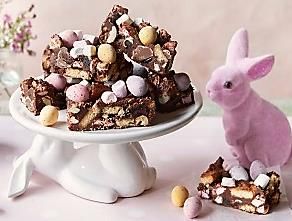
EASTER ROCKY ROAD
Many of us may have a treat of something chocolatey over Easter,
so here is an Easter version of Rocky Road for you to try.
Ingredients
175g/6oz dark chocolate, broken into pieces
125g/4½oz milk chocolate, broken into pieces
2 tbsp golden syrup
75g/2¾oz unsalted butter, diced
160g/5¾oz sugar-coated mini chocolate eggs
200g/7oz digestives or rich tea biscuits, broken into pieces
75g/2¾oz mini marshmallows
50g/1¾oz hazelnuts, roughly chopped
75g/2¾oz raisins
Method
1. Line a 20x30cm/8x12in baking tin with baking paper.
2. Place the dark and milk chocolate pieces in a large heatproof
bowl, add the golden syrup and butter. Set the bowl over a
pan of simmering water - don’t allow the bottom of the bowl
to touch the water. Stir from time to time until all ingredients
are melted and the mixture is smooth. (For speed, I often use
the microwave to melt these instead of the above method.)
3. Remove from the heat and leave to cool for 5 minutes – if
this is too hot the marshmallows will melt.
4. Cut the chocolate mini eggs in half (leaving a few whole) and
set aside one third of the eggs, including the whole ones for
decorating. Gently fold in the chocolate eggs, biscuits,
marshmallows, nuts and raisins into the chocolate mixture
and mix to combine. Spoon into the prepared tin and spread
level using the back of the spoon. Scatter with the reserved
whole and halved mini eggs.
5. Refrigerate for at least 1 hour, or until completely firm. Cut
into squares to serve.
Jane LaurenceHOLY TRINITY WINNERS
February 2021
1st Pat Franklin £39.50
2nd Wendy Burge £23.70
3rd Richard Tomlinson £15.80
EASTER FAITH
Three years after the Russian Revolution of 1917, a great anti-God rally
was arranged in Kiev. The powerful orator Bukharin was sent from
Moscow, and for an hour he demolished the Christian faith with
argument, abuse and ridicule. At the end there was silence.
Then a man rose and asked to speak. He was a priest of the Russian
Orthodox Church. He went and stood next to Bukharin. Facing the
people, he raised his arms and spoke just three triumphant words:
‘Christ is risen!’
At once the entire assembly rose to their feet and gave the joyful
response, ‘He is risen indeed!’ It was a devastating moment for an
atheist politician, who had no answer to give to this ancient Easter
liturgy. He had not realised he was simply too late: how can you
convince people that God does not exist when they have already
encountered Him.
From the Parish Pump
FOOD PARCELS
Akulah Agbami would like to thank all her friends at
Holy Trinity for their very generous response to her
appeal for donations towards the provision of food
parcels for vulnerable schoolchildren in the locality.
Children from several local schools will benefit from
your kindness.EASTER CUSTOMS AROUND THE WORLD Part 1
How do we celebrate Easter? Well, in addition to the special services
we have during Holy Week and Easter, in the UK we celebrate by having
hot cross buns on Good Friday, simnel cake on Easter Day, as well as
Easter biscuits and chocolate eggs delivered by the Easter bunny.
Whilst thinking about preparations for this great festival, I began to
wonder what people in other places around the world did to celebrate,
what traditions they have and what foods they eat. The following is
some of what I discovered.
It seems that the one thing in common with most countries is the use
of eggs, symbolising resurrection. In France they have the ‘cloches
volantes’ or ‘cloches de Pâques’, and not the Easter bunny, which
brings the Easter eggs. This stems from a tradition that no church bells
are rung before Easter, and to explain their silence children are told the
bells have flown to Rome to be blessed by the Pope. The bells then ring
out again on Easter Day having flown back to France loaded with sweet
treats which they drop into gardens for the children.
In Greece, on Holy Thursday, families boil and dye eggs a deep crimson
red, symbolising the blood of Christ. These eggs can be used in the
cracking game, tsourgrisma, which involves players trying to crack each
other’s eggs while keeping theirs intact. Whereas in
Germany families may have an ‘Ostereierbaum’ or Easter
tree which is decorated with hand painted eggs.
Finland and Sweden however have a more unusual ritual. They have a
centuries-old folk ritual that looks very similar to Halloween, when
children dress up as Easter witches (påskkärring) and go door-to-door
in their neighbourhoods in the hope of receiving chocolate.
There are some similarities in the celebrations
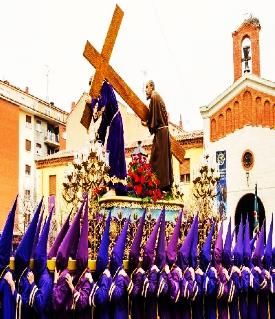
held in Italy and Spain. Both countries have
religious processions in which people dress in
ancient costumes or hooded robes and parade
artefacts, statues and carry religious floats
depicting Biblical scenes.In addition, on Maundy Thursday in the Spanish town of Verges the
‘dansa de la mort’ or death dance is performed. This parade lasts 3
hours during which everyone dresses in skeleton costumes and scenes
from the Passion are re-enacted.
Food also plays an important part in celebrations for all countries. For
the French traditional food revolves around lamb, cheese, potatoes
and chocolate. In the town of Bessières thousands of people gather to
make a giant omelette, usually consisting of 15,000 eggs and 40 cooks!
Italians enjoy a traditional cake called colomba di
pasqua. This is shaped like a dove, and is stuffed
with candied fruit and then sprinkled with almonds
and pearl sugar. The dove shape is a symbol of
peace and also of the dove bird that flew back to
Noah with an olive branch. For something savoury, a pizza chena is an
Easter pie filled with Italian meats, cheeses and egss, all encased in a
buttery, flaky pastry crust.
As well as the red eggs mentioned above, Greeks
have tsoureki which is an egg-enriched bread,
made from individual strands of dough braided
together. The three-strand braid symbolises the
Holy Trinity. The red eggs may be used to
decorate the tsoureki. They also have
Koulourakia in Greece which are buttery Easter biscuits.
For the Germans it is traditional to eat something green such as chervil
soup on Holy Thursday. They also have an enriched and spiced sweet
bread over Easter whereas in Austria they have a dense pound cake
called reindling. Austrians also eat ‘osterschinken im brotteig’, a
cooked ham baked in bread dough which may be stewed with
sauerkraut.
In Spain rosquillas de Semana Santa or Easter
doughnuts (Semana Santa means Holy Week) are
popular. Rosquillas are similar to doughnuts, but
have a denser texture as they’re made without
yeast. They can be dunked in flavoured icings,cinnamon sugar or left plain. They also have torrijas, which are a
variation on French toast. As well as these the mona de Pascua cake,
originating from Catalunya is a decadent dessert given from godparents
to their godchildren. It resembles a bread basket or large doughnut,
topped with as many brightly coloured eggs, feathers and figurines the
cake can hold.
Once again, Finland has something more unusual. It is a traditional
dessert for Easter called mämmi. Made from water, molasses, malted
rye, rye flour, and orange zest, this needs to be prepared 3 or 4 days in
advance to chill.
Part 2 in the next issue of Outlook - looking at the traditions of Eastern
Europe, Asia and the Americas.
Jane Laurence
☺ EASTER SMILE LINES ☺
Nice: The nice thing about becoming forgetful is that you can hide
your own Easter eggs.
From a church newsletter: This being Easter Sunday, we will ask Mrs
Brown, our church warden, to come forward and lay an egg on the altar.
From the Parish Pump
SPRING
(An acrostic Poem)
Spring has arrived with armfuls of blossom,
Petals of every colour and hue,
Rain and sun caressing the earth
Inspiring spring bulbs to come into view
Now is the time of new beginnings
Giving us pleasure all season through.
By Megan Carter from the Parish PumpALL IN THE MONTH OF APRIL
It was:
• 1900 years ago, on 26th April 121 that Marcus Aurelius, Emperor
of Rome (161-180AD) and Stoic philosopher was born. He was the
last of the rulers known as the Five Good Emperors, and the last
emperor of the Pax Romana, an age of relative peace and stability.
• 500 years ago, on 27th April 1521, Ferdinand Magellan, Portuguese
explorer, died aged 41, at the hands of natives in the Philippines.
• 300 years ago, on 3rd April 1721 that Robert Walpole became the
first British Prime Minister.
• 250 years ago, on 13th April 1771 that Richard Trevithick, mining
engineer and inventor of the first steam locomotive, was born.
• 125 years ago, from 6th to 15th April 1896 that the first modern
Summer Olympic Games were held in Athens.
• 95 years ago, on 21st April 1926 that Queen Elizabeth II was born
in Mayfair, London.
• 90 years ago, on 14th April 1931 that the first edition of the
Highway Code was published in the UK.
• 70 years ago, on 17th April 1951 that the Peak District National
Park was established. It was Britain’s first national park.
• 60 years ago, on 11th April 1961 that Nazi war criminal Adolf
Eichmann went on trial in Jerusalem. He was convicted on
12th September and executed in June 1962.
• 50 years ago, on 6th April 1971 that Igor Stravinsky, Russian
composer, died. He was one of the most important and influential
composers of the 20th century.
• 40 years ago, on 11th April 1981 that the Brixton riot took place in
London. 5,000 youths rampaged through the streets, attacking
police officers, damaging buildings, looting and setting cars alight.
• 30 years ago, on 3rd April 1991 that Graham Greene, novelist,
short story writer, playwright and journalist died.
• 20 years ago, on 7th April 2001 that NASA launched its Mars
Odyssey spacecraft to search for evidence of life and volcanic
activity on Mars.
• 10 years ago, on 29th April 2011 that the wedding of Prince
William and Catherine (Kate) Middleton took place at
Westminster Abbey in London.
From the Parish PumpHOLCOMBES CAR MART LTD
Taunton’s longest established used car dealer.
We are a family owned business that has been established since 1935.
We specialise in supplying low mileage vehicles which have been
carefully owned and well maintained.
74 East Reach, Taunton, Somerset, TA1 3HA
Tel: 01823 284530 www.holcombescarmart.co.ukPARISH DIRECTORY
VICAR Fr Julian Laurence 337890
READER Mr Michael Hemsley 251722
LAY PASTORAL Mrs Jane Laurence 354800
ASSISTANTS Mrs Jenni Llewellyn (Church Office)
CHURCHWARDENS Mr John Godley (Church Office) 354800
PARISH OFFICE Tues & Thurs 9.00am–11.00am 354800
Administrator:
PCC Vice-Chairman Mr Geraint Jones 284376
PCC Treasurer Mr John Rudge 664558
PCC Secretary Mrs Trudi Watkins 354800
Electoral Roll Secretary Mr Richard Tomlinson (Church Office)
Organist & Choir Trainer Mr Stephen Price 07452 994114
Editor of 'Outlook' Mr George Coles 288091
'Outlook' advertising Mr David Gill (Church Office) 354800
Sacristan Mr Peter Deal 278385
Captain of Bellringers Mrs Margaret Jordan 289519
Church Flowers Mrs Sylvia Paul 279436
Hall Booking Secretary Church Administrator (Church Office) 354800
Junior Church Mrs Pat Deal 278385
Mrs Sylvia Paul 279436
Data Protection Officer Mr David Watkins 354800
Safeguarding Officer Mrs Liz Clarke (Church Office)
Trinity Church School Trinity School, South Street 284128
Head of School Mr Steve Morton
Trinity Scout Group Mrs Stacey King 07984 170912You can also read


