How Do French Parents Determine Portion Sizes for Their Pre-Schooler? A Qualitative Exploration of the Parent-Child Division of Responsibility and ...
←
→
Page content transcription
If your browser does not render page correctly, please read the page content below
nutrients
Article
How Do French Parents Determine Portion Sizes for Their
Pre-Schooler? A Qualitative Exploration of the Parent–Child
Division of Responsibility and Influencing Factors
Kaat Philippe * , Sylvie Issanchou, Anaïs Roger, Valérie Feyen and Sandrine Monnery-Patris

                                          Centre des Sciences du Goût et de l’Alimentation, AgroSup Dijon, CNRS, INRAE, Université Bourgogne
                                          Franche-Comté, 21000 Dijon, France; sylvie.issanchou@inrae.fr (S.I.); anais.roger@inrae.fr (A.R.);
                                          valerie.feyen@inrae.fr (V.F.); sandrine.monnery-patris@inrae.fr (S.M.-P.)
                                          * Correspondence: kaat.philippe@inrae.fr

                                          Abstract: Large portion sizes can make children overeat, alter their self-regulation abilities and
                                          induce weight gain. However, little is known about how parents determine portion sizes for their
                                          children. Using semi-structured interviews with 5 fathers and 32 mothers of pre-schoolers, this
                                          study examined French parents’ food portioning practices. The division of responsibility between
                                          parent and child in deciding portion sizes was explored, as well as the influencing factors and
                                          possible sources of information. Parents described a wide range of practices. For most, determining
                                          portion sizes is an intuitive action that depends on habits and mainly arises from experiences with
                                feeding their child and his/her appetitive traits. Few parents grant autonomy to their child for

                                          portioning and serving food, especially for the first serving. Many influencing factors were identified,
Citation: Philippe, K.; Issanchou, S.;
                                          including child-related (e.g., appetite, food preferences), parent-related (e.g., avoiding food waste),
Roger, A.; Feyen, V.; Monnery-Patris,
                                          and external factors (e.g., influence of siblings, French food culture). Most parents do not search for
S. How Do French Parents Determine
                                          information/recommendations to guide their practices. Stimulating optimal self-regulation of eating
Portion Sizes for Their Pre-Schooler?
A Qualitative Exploration of the
                                          in children is important and parents can play a crucial role in this. This study identified barriers and
Parent–Child Division of                  facilitators to guide parents in providing appropriate portion sizes and help include children in this
Responsibility and Influencing            decision process.
Factors. Nutrients 2021, 13, 2769.
https://doi.org/10.3390/nu13082769        Keywords: qualitative research; food portioning practices; children; parental feeding practices; food
                                          culture; autonomy
Academic Editors: Rebecca Wyse and
Rachel Sutherland

Received: 15 July 2021                    1. Introduction
Accepted: 9 August 2021
                                                Parents play a key role in the development of young children’s eating habits and
Published: 12 August 2021
                                          preferences [1]. Parental feeding practices, or the behavioral strategies used to control what,
                                          how much, when, and where the child eats [2], constitute a possible means to prevent the
Publisher’s Note: MDPI stays neutral
                                          emergence of “unhealthy” eating habits and obesity. According to the theory of division
with regard to jurisdictional claims in
published maps and institutional affil-
                                          of responsibility in feeding [3], parents should be primarily responsible for the choice of
iations.
                                          foods served to the child (what), as well as where to and when to eat, while the child
                                          should decide on how much food to eat and whether to eat. This is based on the idea that
                                          children have the capacity to self-regulate their food intake according to their physiological
                                          needs, managed by their sensations of hunger and fullness [4]. In order to maintain optimal
                                          self-regulation of intake, the feeding relationship must be supportive and responsive to the
Copyright: © 2021 by the authors.
                                          child’s needs and capacities [5,6]. There must be both autonomy granted to the child and
Licensee MDPI, Basel, Switzerland.
                                          leadership taken up by the parent—for example, by providing a social context for feeding
This article is an open access article
                                          and enforcing certain rules and boundaries.
distributed under the terms and
conditions of the Creative Commons
                                                In practice, however, parents do not seem to follow these recommendations; they tend
Attribution (CC BY) license (https://
                                          to grant their child too much autonomy for deciding what to eat, but too little autonomy for
creativecommons.org/licenses/by/          deciding how much to eat [7]. It has been reported that if children rely on environmental
4.0/).                                    factors for their intake (e.g., inappropriate portion sizes, controlling parental feeding

Nutrients 2021, 13, 2769. https://doi.org/10.3390/nu13082769                                             https://www.mdpi.com/journal/nutrients
Nutrients 2021, 13, 2769 2 of 27
practices, availability of palatable foods) rather than their internal signals of hunger and
fullness, this could cause them to overeat, which in turn, if applied consistently, could
result in an increased risk of overweight and obesity [8–12]. The “portion size effect” can
illustrate this risk: when humans are served larger portions, they tend to eat more, and
this has been demonstrated robustly and reliably in both adults (for a review, see [13]) and
children (for a review, see [14]). A meta-analytic review by Zlatevska et al. [15] indicated
that when a double portion size is served, energy intake in adults and children increases
by 35% on average.
In addition, since young children are highly dependent on their parents for their food
intake, it is important to gain additional insight into parental food portioning practices, the
division of autonomy between parent and child in terms of determining portion sizes, and
the drivers of these practices. Here, the term “parental portioning practices” refers to the
decisions made by parents regarding the portion sizes of foods or beverages they serve
to their child. In 2018, Kairey et al. [16] published a systematic literature review on this
topic, including 14 quantitative and 14 qualitative studies with parents of children aged
2–12 years. The results of this review provide valuable insight into parental food portioning
practices and the drivers of these practices, but it is important to note that the majority of
the included studies were conducted in the USA (quantitative 11/14, qualitative 10/14).
Knowing that cultural differences exist with regard to eating habits, food attitudes [17,18],
and parental feeding practices [19,20], these results may not be automatically generalized
to other countries and cultures. To our knowledge, no qualitative study has examined
parental food portioning practices for pre-schoolers and the factors influencing them in
France. The specificity of the meal structure in France, where lunch and dinner are usually
composed of different components (i.e., starter, main course, dairy product, dessert) could,
for example, give rise to specific parental portioning practices.
Therefore, the main aim of the present study is to capture the variety of parental
portioning practices used for French pre-schoolers. Following the idea of Satter’s theory of
division of responsibility [3], the degree of autonomy granted to the child for serving food
and determining portion sizes will be explored here. The current study is explorative, but
we expect to observe a wide range of parental portioning practices, as well as differences
in the degree of autonomy granted to children in terms of deciding how much to eat. As
observed by Loth et al. [7], we expect most parents to grant their child little autonomy in
deciding how much to eat.
The second aim of this study is to identify the factors that underlie parental portioning
practices (e.g., parental perceptions, cultural aspects). Finally, the third aim of this study
is to explore parental use of information sources and recommendations regarding the
determination of portion sizes and parents’ perceptions and expectations about their use.
This could be useful for identifying parents’ need for guidance.
In the present study, parents of pre-schoolers aged 3 to 5 years will be targeted, as this
period can be challenging due to the peak in children rejecting food at this age [21,22] and
the deterioration in children’s self-regulation of food intake [8,23]. Furthermore, parents
with different educational levels and different family situations (two-parent vs. single-
parent households, different birth order of the target child) will be included because it is
known that parental practices can vary according to these characteristics. For example, a
recent cross-sectional study in France [24] using questionnaires found that mothers with a
lower level of education served larger portions to their child aged 8–11 years than mothers
with a higher level of education.
2. Materials and Methods
2.1. Ethics Statement
Ethical approval (n◦ 20-686) was granted for this study by the Institutional Review
Board (IRB00003888, IORG0003254, FWA00005831) of the French Institute of Medical
Research and Health. Study registration was conducted by the data protection service
involved (CNRS).Nutrients 2021, 13, 2769 3 of 27
2.2. Participants
Parents were eligible to participate if they were older than 18 years and if they had
at least one child aged 3–5 years. They were not eligible if their child suffered from a
condition that could influence his/her eating (e.g., swallowing difficulties, autism), as
we estimated that this could impact the feeding interactions between parent and child.
Parents were recruited from a research panel in Dijon (ChemoSens Platform’s PanelSens,
CNIL no. 1148039) via schools and via snowball sampling. A sampling matrix was used to
select a sample of participants who were diverse in terms of parental sex, level of education,
household composition, and birth order of the child. When conceptualizing this study, it
was estimated that approximately 40 parents would be needed to ensure that there was
a diverse sample of participants. However, a possible “saturation” effect of the data was
evaluated during the data collection phase, meaning that the recruitment of a certain group
of participants would be stopped if new interviews did not provide additional information
to that found in previous interviews of this group.
Finally, a total of 37 parents (32 mothers, 5 fathers) were selected to participate in this
study. Their characteristics and those of their children are presented in Table 1. Parents
received a voucher of twenty Euros to thank them for their participation.
2.3. Data Collection
Data collection took place in summer 2020, right after the first COVID-19 lockdown
in France. Due to ongoing infection risk at the time of data collection, it was not possible
to conduct the planned interviews in person. All steps of data collection were therefore
adapted so that they could be performed remotely, without physical presence.
2.3.1. Recruitment form and Informed Consent
Parents who were interested in participating were invited to complete an online
recruitment form. In this form, they were asked to provide information about their sex,
age, level of education, and household composition, as well as about their child’s age, birth
order, and possible illnesses influencing his/her eating behavior. Parents were also asked
to state their availability for a possible interview and to provide their contact details.
When parents were selected to participate, they received a link to an online informed
consent form. Information about this study and the data protection policy was provided
here. Parents were asked to confirm that they understood and agreed with the information
provided and that they agreed to have the interview recorded.
2.3.2. Interview Guide and Interview Procedure
Semi-structured telephone interviews were conducted in parents’ native language
(French). Interviews lasted an average of 43 min (from 23 to 78 min). They were conducted
by a research engineer, a research technician and a Master’s student in sociology with
previous interview experience. All interviewers were trained by the first and last author,
two psychologists (K.P. and S.M.-P.).
A semi-structured interview guide (available in Appendix A) was developed as a
means of support for the interviewers. The guide was developed based on theory (e.g.,
theory of division of responsibilities, [3]) and previous studies (e.g., [7]), but tailored to
this study’s specific objectives and adapted to the French food culture. In France, it is,
for example, common to consume a multiple-component lunch and dinner (starter, main
dish, dairy product, dessert), and this could have implications for portioning practices. For
children in France, the consumption of a mid-afternoon snack (“goûter”) is also a common
practice; it is even seen by many as an additional meal [25] (pp. 1–4).Nutrients 2021, 13, 2769 4 of 27
Table 1. Characteristics of participating parents (n = 37) and their children.
Parents’ Characteristics: n
Sex (female/male) 32/5
Age in years, mean (min.–max.) 33.9 (23–42)
Relationship status (couple/single parent) 30/7
Weight status:
Underweight (BMI < 18.5) 4
Healthy weight (18.5 ≤ BMI < 25) 18
Overweight (25 ≤ BMI < 30) 9
Obesity (BMI ≥ 30) 4
Unknown 2
Level of education:
Low (no diploma, high-school diploma, higher technology degree) 11
Middle (two or three-year higher education degree) 16
High (Master’s degree or higher) 10
Work status:
Working (part-time or full-time) 28
Unemployed, job seeker 3
Student 1
Other (e.g., parental leave, parent at home) 3
Unknown 2
Perception of financial situation:
You can’t make ends meet without going into debt 1
You get by but only just 0
Should be careful 8
It’s OK 22
At ease 3
Unknown/Does not wish to answer 3
Children’s characteristics:
Age:
3 years 17
4 years 12
5 years 8
Birth order:
Firstborn or only child 20
Child with older sibling(s) 17
Weight status a :
Underweight 5
Healthy weight 27
Overweight 3
Obesity 0
Unknown 2
aWeight categories for children corresponding to BMI-for-age percentiles based on growth charts for children
and teens ages 2 through 19 years of the Centers for Disease Control and Prevention (CDC).
The interviews always started with a short introduction of the interviewer and a brief
review of the study information and data protection policy. Parents were asked to verbally
confirm that they still agreed that an audio recording could be made and were asked to
avoid the use of personal names, if possible. If parents had more than one child aged
between 3 and 5 years, the interviewer specified which child would be the focus for the
interview, chosen based on the child’s age or birth order. The interview guide comprised
four main topic sections: (1) meal organization and composition; (2) meal service and
portion sizes; (3) family rules around eating; and (4) the child’s appetite, satiation, and
weight. For each section, there were a number of core questions, optional questions, and
probes. To obtain realistic descriptions, the interviewer tried to limit the questions to a
description of the meals and practices of the previous day, unless parents indicated thatNutrients 2021, 13, 2769 5 of 27
this day was very different from the family’s usual eating habits. In addition, a number of
questions did not focus on the previous day, but aimed to obtain a more general description
of practices or eating behaviors (e.g., “How would you describe your child’s appetite?”). At the
end of the interview, parents were asked if the COVID-19 pandemic (still) had an impact on
their current eating and feeding habits and thus if their descriptions during the interview
differed from their usual habits. They were also invited to share additional information that
had not yet been addressed and that they considered important. When they had nothing
further to add, they were thanked for their time and the following steps of this study were
explained to them.
The interview guide was pretested by inviting four parents (one father and three moth-
ers) for a telephone interview. The interviews all went well and only minor adjustments to
the guide were made, such as changing the order of certain questions and adding some
notes addressed to the interviewers. The data of these four parents were therefore also
included in this study’s analyses.
2.3.3. Final Survey
After the interview, parents received a web link to a final online survey with questions
complementing the data of the recruitment form and the interview. Parents were asked to
complete information about the child (birth date, sex, weight, height) and about themselves
(weight, height, work status, financial status). Due to the COVID-19 situation at the
moment of data collection, children’s and parents’ weight and height were parent-reported;
for the child, they were retrieved from the child’s health book or measured by the parent
himself/herself. Parents were also asked to answer questions regarding the following
topics.
Self-regulation of the child. To estimate how parents rate their child’s capacity to decide
appropriate portion sizes for themself, they were asked to complete the following phrase:
“If I did not guide the portion size of my child at mealtime . . . ”. Parents could choose
between: (1) “ . . . (s)he would be able to choose an appropriate portion size”, (2) “ . . . (s)he
would serve too large portions”, or (3) “ . . . (s)he would serve too little”.
Self-efficacy for identifying appropriate portion sizes. One item was used to estimate how
parents rate their own capacity to decide appropriate portion sizes for their child (“I am
confident that I know appropriate portion sizes for my child’s meals”). They were asked to
rate their answer on a 5-point scale ranging from “Do not agree at all” to “Totally agree”.
This item was selected from the self-efficacy scale of Fulkerson et al. [26] and translated to
French for this study.
Information sources. Three questions were used to obtain insight into possible sources
of information for parents regarding portioning practices. First, they were asked if they
“looked or asked for advice for the determination of portion sizes” (no or yes + description
if yes). Then, they were asked if they were “knowledgeable about recommendations
regarding determining portion sizes for children” (no or yes + description if yes). Finally,
they were asked if they were “interested in receiving recommendations or advice that could
guide them in determining portion sizes for their child” (5-point scale ranging from “I’m
not at all interested” to “I am very interested”).
The survey also included items to study children’s eating behaviors (appetite, food
enjoyment, food neophobia, and food pickiness), parents’ use of pressure to eat, their level
of restrained eating, and their motivations when buying food for the child, but these results
will not be presented in this paper.Nutrients 2021, 13, 2769 6 of 27
2.4. Data Transcription and Data Analysis
Interview recordings were transcribed verbatim. A thematic analysis was conducted
following the steps of Braun and Clarke [27]: (1) familiarization with the data, (2) initial
coding generation, (3) searching for themes based on initial coding, (4) review of the themes,
(5) theme definition and labelling, and (6) report writing.
The familiarization step (1) took place both throughout the data collection phase
(listening to recorded interviews) and after (reading the transcribed interviews). This aided
us in identifying preliminary patterns in the data and determining when the “saturation”
of the data occurred, meaning that new interviews did not provide additional information
to the data of the previous interviews. The first author had regular discussions with the
interviewers about the interviews and the emerging patterns in the data. After the data
familiarization phase, a group meeting (K.P. + S.M.-P. + V.F. + A.R.) took place to discuss
the emerging themes. Then, three interviews were selected for independent initial coding
by all researchers who were present at the group meeting. A data-led approach was used,
but coding was also partly guided by the topic sections of the interview guide. After the
independent coding phase, which was conducted by three researchers (A.R. + V.F. + K.P.),
the initial codes and associated themes and subthemes were discussed in the group until
a consensus was reached, resulting in a coding template. This template was used for
the subsequent coding of the interviews. When doubts or difficulties arose among the
coders regarding the placement of quotes, new group discussions took place and the
coding template for themes and subthemes was revised where needed until agreement
was reached between the coders. When all the interviews were coded, K.P. and S.M.-
P. reviewed, regrouped, and defined the themes and subthemes that were of particular
interest for answering the research questions of the current study and discussed the results
of this process with S.I.
2.5. Trustworthiness and Translation of Quotes
Member checking, a respondent validation technique, was applied in order to confirm
the interpretation of the data and increase the trustworthiness of the data [28]. After each
interview, a summary of the interview was written by the interviewer and discussed with
the first author. The summary was sent to the participant for validation and participants
were invited to share additional information that had come to mind after the interview [29].
In some cases, the research team added a specific question for the participant in order
to obtain additional information about a certain topic or to make sure that they fully
understood certain statements made by the participant.
A number of quotes were selected for this article to exemplify the results of the
thematic analyses. They were translated from French to English by a native English linguist
who is fluent in French and has been living in France for many years. The original French
quotes with their translation are presented in Appendix B. Brackets with dots in a quote
(“[ . . . ]”) indicate that a number of words or sentences have been skipped.
2.6. Data Analysis of the Survey
Descriptive statistics were used to describe the participants’ characteristics and quan-
tify the responses to the questions asked at the recruitment stage and in the final survey.
3. Results
A variety of themes and subthemes emerged from the analysis; an overview is pre-
sented in Table 2. Details about the themes and subthemes are described below.Nutrients 2021, 13, 2769 7 of 27
Table 2. Themes and subthemes resulting from the analysis.
Themes Subthemes
1. Food habits and composition of 1.1.1 Different components meal
1.1 French food culture 1.1.2 Nutritional values
meals
2.1.1 First serve versus following
serves
- Breakfast
- Lunch
2.1.2 Different practices for different - Mid-afternoon snack
meals? - Dinner
- Milk bottle
2.1 Who serves/who decides on
portion sizes? 2.1.3 Conditioned autonomy child
- Practical reasons
- For the child, “it’s a game”
- Self-regulation capacity child
2.1.4 Why does parent or child serve? - Child’s demands
- Influence other family
members
2. Parental portioning practices
2.2.1 Rules around serving and - Quantity of food
re-serving - Healthy vs. unhealthy foods
2.2.2 Tricks to determine portion sizes
- Child’s physical
2.2 Portion sizes activity/intake previous
meal/expression of hunger
2.2.3 What guides parents when - Child’s food preferences
determining portion sizes? - Parents’ confidence in own
portioning practices
- Information sources
3.1 Meal timing
3.2 Pressure to
3. Family rules around eating
eat/negotiating/bribing
3.3. Origins of feeding practices and 3.3.1 Own experiences in childhood
inter-generational transmission 3.3.2 Educational goals
3.1. Food Habits and Composition of Meals
Despite some minor deviations, all parents described that they follow the “French
eating model” in their family: three meals a day (breakfast, lunch, dinner) and a mid-
afternoon snack for the child. Meals are usually consumed at set times and at the table in
the company of other family members.
A milk bottle, cereals with milk, and bread are common breakfast foods/drinks. Lunch
and dinner usually consist of different components: a starter (salad), a main dish (proteins),
cheese or yoghurt, and a dessert (fruit or a sweet dessert). For the mid-afternoon snack,
food pleasure takes a central role in most families. Usually, something sweet is consumed,
e.g., biscuits, cake, fruit compote, cream dessert, (drink) yoghurt.
Food habits may alter between weekdays and weekend days, but in most families the
difference is fairly limited. If changes occur, they mostly concern the timing of the meals
or the extent of the meal—i.e., they may be more elaborate or festive on weekend days,
especially when guests are invited.
3.2. Parental Portioning Practices
3.2.1. Who Serves/Who Decides on Portion Sizes?
First Serve Versus Following Serves
In most families, a parent serves the pre-schooler and decides the portion size served.
However, differences were found between the first serving and any subsequent servings.
For the first serving, it is almost exclusively a parent who serves and decides. Most parents
decide on a minimum portion the child should consume, then, if the child is still hungry or
if he/she wants more, the child may receive or take another portion of the dish. At this
point, the child usually has some say in how much is served, based on their expressions of
hunger or their demands, or they may be allowed to serve themself.Nutrients 2021, 13, 2769 8 of 27
Indeed, I decide on the first serve. And then, if he’s still hungry, I serve again and I ask
him how much he wants. (U065)
Often, we serve him the first time. Then after, if they want seconds, I suggest they help
themselves. (TAL01)
Different Practices for Different Meals?
Differences in serving practices were observed between different meals. For lunch and
dinner, parents are mostly in control and little autonomy is granted to the child in terms
of serving themself and for determining portion sizes, especially for the first servings (as
described above). However, children are often allowed to take some cheese or a yoghurt
and a dessert themselves, which are mostly products with a predetermined quantity.
I’m the one who serves. Well, it’s me or my husband. We serve the children, yes. (Y214)
Yes, like at lunchtime in fact, I serve up on plates and then dish them out to everyone.
(C697)
However, I let her have her yoghurt, for example at lunchtime they can choose which
yoghurt they want. So she can go and open the fridge when I tell her she’s allowed to.
(P078)
For breakfast, children participate more actively in serving themselves or in choosing
what to eat (e.g., taking the food they want, pouring milk on their cereal), even though
there were also some families where the parents prepare and serve breakfast for their child.
According to some parents, what and how much the child eats at breakfast is strongly
based on habits, which means that they have to exercise less control.
At a push, the moment he guides me the most is in the morning about the quantity of
milk or cereals or regarding toast, he tells me what he wants in terms of quantities but
not for the other meals, I’m the one who decides. (R863)
Well, in the morning, they get up and they can help themselves. Well, I check what
they take, but as it’s always the same thing and the same portion size, let’s say I’m not
surprised. They don’t take advantage in terms of what they take, what she takes. (J086)
For the mid-afternoon snack, there is also more child autonomy, especially in terms of
food choice. Children can often decide what they want to eat and are allowed to take it
themselves.
Like in the morning, she chooses what she wants to eat, what she wants to drink. She
helps herself to cakes in the cupboard, she’ll ask me for a drink but generally I give her
water. (S615)
After, it’s true that I leave them more often than not to choose their own snacks at home.
I mean, I put things on the table and then I sort of leave them to it. (TAL01)
Conditioned Autonomy Child
As illustrated above, some parents grant more autonomy to their child than others.
This ranges from no autonomy (not for serving, not for determining portion sizes), to
interaction and discussion with the child about the portion size served by the parent, to
allowing the child to serve himself/herself. However, even when the child is invited to
say how much (s)he wants to eat or when serving, the parent will always monitor and
re-adjust when deemed necessary. The child is never granted full autonomy.
He helps himself, but I still keep an eye on him. (U065)
After, for everything else, I know pretty well how she eats, so I adapt, I ask her how much
she wants and sometimes her eyes are “bigger than her belly”, so I adapt by saying “eat
this first and if you want more, you can, but I think it’s already fine like that”. (N675)Nutrients 2021, 13, 2769 9 of 27
Why Does Parent or Child Serve?
When asked why it is the parent or child who serves, parents gave several reasons.
The most common reason was “practicality”. Parents serve, for example, because it is faster,
because the cook prepares the plates in the kitchen for everyone, to avoid danger (e.g.,
child getting burned by hot foods or by hot pots and pans), to avoid messy situations (e.g.,
when foods are too liquid), or because the tools used to serve are not adapted to the child’s
size or motoric skills.
But still, most of the time we serve [ . . . ] yes, it’s more practical and quicker to be honest
with you. (TAL01)
Very often we serve her, we serve her because everything is the same . . . Always because
of dexterity. It’s not easy to serve yourself from a dish [ . . . ] however, at the moment as
we’re eating quite a lot of raw vegetables, I let her serve herself. For example, when we
eat radishes, she helps herself to the radishes. (R371)
So I’d say it depends in fact. I push him to be a bit independent and to do things for
himself. But then, if things are too hot, or too runny, or not easy to serve, he doesn’t help
himself . . . but if it’s simple things, I don’t know. If he wants to serve himself from the
salad bowl and take the salad tongs and serve himself, I don’t mind. (T261)
Here, it is interesting to note that some parents cite practical reasons to defend their
habits, but also admit that they really just want to be in control.
I say to him “you help yourself but as it’s really runny I’ll do it with you” so I can control
it too. (N675)
Another reason why parents serve their child, is because they say that for their child
“it’s a game”; the child does not take serving and portioning seriously. During the interview,
parents were asked if they thought their child was capable of serving himself/herself or
determining appropriate portion sizes. Most parents answered that they think their child
would be able to serve the food, but not the right portion sizes or the right proportions (i.e.,
a balanced meal). They thought that children would serve too much of the foods they like.
One father explained that he thought his daughter “has not yet acquired the notion of quantity”.
Here, many parents admitted that their answer was a guess, that it is what they “think”
would happen, because “they haven’t really tested it” or “they would be surprised”. In the
final survey, parents were invited to answer a similar question. When presented with the
statement “If I did not guide the portion size of my child at mealtime . . . ”, 12 parents chose
the answer “ . . . (s)he would be able to choose an appropriate portion size”, 17 parents
chose the answer “ . . . (s)he would serve too large portions”, and 7 parents chose “ . . . (s)he
would serve too little”. There were no differences in answers when comparing different
groups of parents, e.g., groups based on the child’s age (3/4/5 years old), the child’s birth
order (first child or not), or the parent’s level of education (low/middle/high).
Furthermore, some children are allowed to serve themselves simply because they
request it:
When she asks, she serves herself, there’s no problem. (E492)
No, it’s him who asks. He wants to do it on his own. (TAL03)
One mother also explained that she serves the children because it was done that way
in her childhood (inter-generational transmission):
I serve the eldest too. It’s true that my parents served us when we were kids . . . Well, my
mother served us and it’s true that it’s . . . Yes, I tend to serve everyone. (Y214)
3.2.2. Portion Sizes
Rules around Serving and Re-Serving
Many families have clear rules about whether or not children are allowed a second
serving and what can be re-served, especially at lunch and dinner. As mentioned previously,
for the first serving parents usually serve a small portion size which the child should finish,Nutrients 2021, 13, 2769 10 of 27
then the child can (be) re-serve(d) if they are still hungry. Parents prefer this approach
because it contributes to avoiding food waste, and some parents also describe that a small
first portion encourages the children to eat. If children are served too much food from the
start, they are less likely to consume what is served.
I don’t like throwing food away too much, so I generally give him a portion that I know
he’ll be able to eat. But I’d rather he asks me for more rather than leave it. So I don’t serve
too much. (T261)
I prefer to serve less and that he eats everything and then at the worst I give him more if
he wants it, rather than serving a lot. I’ve noticed that if you serve a big amount straight
away there are times when he’ll look at his plate and then he’ll have two bites and . . . Yes,
he will stop. However, if we give him smaller quantities, he will eat more easily. He’ll
take them more easily. (Y214)
In contrast, one mother stated that she wants to teach her daughter to take the right
quantity from the start at the first serving, as she does not want to create the habit of
re-serving:
But when she helps herself [ . . . ] let’s say she doesn’t serve herself enough, sufficient
quantities so that she’ll want more. And that’s something I don’t want to teach her: to
serve herself again. That’s it. She helps herself once and that’s it. (K122)
However, in most families, re-serving is allowed but under certain conditions. For
example, re-serving is not unlimited, and a second or subsequent serving will always be
smaller than the previous one.
Yes, it’s me who decides, and when it’s something she’s really liked, she asks me for
seconds [ . . . ] In general I give her a little less. (S615)
So I ask him if he is really sure [to want more] because I don’t want him to waste food.
And if he’s sure, I give him a small portion more. I’d rather give him a little bit and then
serve him again a few times, than give him too much and then he doesn’t want it at all.
(T411)
Moreover, there are not only rules regarding the size of any re-serving, but also about
what can be re-served. Most parents allow their child to re-serve foods that they consider
healthy, (e.g., vegetables, fruit), but not “unhealthy, sugary” foods. Some parents also
described that they prefer to limit the re-servings of the main dish in favor of having a
dairy product and a dessert afterwards, while other parents prefer more re-servings of the
main dish and limiting or skipping the dairy product and/or dessert.
Yes, no, not dessert. If it’s something really sweet, I won’t give him more. A Danette or
something like that . . . because it’s a dessert, full stop. But if he wants more pasta salad
or vegetables, there’s no hassle. (S986)
If he asks me for a second ice cream, no, that’s out. If he asks me for another slice of cheese,
I give him a slice of cheese. If he wants a piece of fruit, he’ll get one. It depends on the
food. If I think it’s not bad for his health, I give him more. They are not overweight, so
there you go . . . If they’re hungry, they’re hungry. (Y023)
Sometimes when they want more, I tell them “yes, but there’s something else, you can eat
a yoghurt, fruit”. (N675)
We already try to make sure that they eat their main course well, because that’s the
priority in terms of balancing their diet. And then we’ll say that cheese and dessert are
“extras”. It’s, if really he’s still hungry, we try to balance it out so that he . . . so there you
go, the main course is enough for him and after, the dessert is a little more for pleasure.
(B681)
Tricks to Determine Portion Sizes
Parents described using certain “tricks” when determining the appropriate portion
sizes for their child. The most commonly used trick was serving the child’s food on a smallNutrients 2021, 13, 2769 11 of 27
plate or bowl, which helps parents to serve smaller portions. One parent even described
how every family member has a different size of tableware adapted to their age and size:
At home, it’s a bit like the three bears. *Laughter* There’s the big bowl, the medium bowl
and the small bowl. *Laughter* because it’s true that they are 10, 6 and 4 years old so the
portions are adapted according to their height. That’s how I’d put it. It’s true that the
youngest one, I give him smaller portions. Even if this means I’ll serve him again, well I
prefer . . . (TAL01)
Other parents do not use different tableware for the child, but rather adjust the child’s
portions in proportion to the portions of other family members—for example, smaller
portions than for older siblings, or half the portion of the parent.
I adapt his portion. Already, compared to his brother and sister, I give him a smaller
portion. (L691)
It’s about . . . what . . . I don’t know . . . I mean, half of my plate. (Y023)
Another trick used by parents to limit portions, is buying individual packages of
certain foods and drinks, e.g., compote, fruit juice, biscuits, cereal, yoghurt.
Yes, I buy a lot [of food] in individual portions for the children. Especially compotes, fruit
juices, these are things that I buy in individual portions. Even cakes, I try to buy things
in individual portions. If it’s cookies that are packed in twos, things like that. It’s easier
to carry and easier to ration. (T261)
A very limited number of parents also determine portions sizes by counting the
number of spoons:
So it’s, let’s talk in tablespoons, it might be easier. I would put two tablespoons in. I
prefer to put less than he eats in one go and then at the worst I’ll give him more if he
wants it rather than serving a big amount. (Y214)
What Guides Parents When Determining Portion Sizes?
Only a few parents described that they adapt the child’s first portion or the timing of
the meals according to the child’s physical activity that day, previous intakes during the
day, expressions of hunger, or sickness or fatigue. Nevertheless, all parents explained that
they know very well when their child is hungry and how they express this. Sensations of
satiation are more difficult for parents to read and are often not expressed verbally, but
rather through their behavior (e.g., stopping eating, pushing plate away).
Some parents also described that children’s food preferences play a role in the portion
size served. If the food served is a less well-liked, parents tend to give smaller portions of
this food than foods that are well accepted or liked:
He likes carbs a lot, but he has trouble with tabbouleh. So if there’s only tabbouleh and
fresh, raw vegetables, I’m bound to use smaller quantities because I know he won’t like it
so he’ll eat less. So that’s it, but otherwise it’s the same all the time. (S616)
When parents were explicitly asked how they know what “appropriate” portion sizes
for their child are, most parents explained that the determination is made based on “their
intuition” or “previous experience”, or that it is based “on the feeling” or “on sight”.
Parents say that they know their child’s appetite and how much the child normally eats,
so based on these habits they know how much to give, as expressed by this parent: “it is
based on what he eats regularly” (TAL05). Others described that they learned to adapt the
portion sizes to their child based on their observations—for example, they learned to give
larger portions because their child always asked for more food after the first portion.
As he gets older, we increase the quantities a bit more because we can see it, for example
we’ll try to . . . We’ll give him a quantity as we used to and then we’ll see that in the end
he’ll have several helpings and then we’ll say “well, maybe the quantity is too small”.
(Y214)Nutrients 2021, 13, 2769 12 of 27
Conversely, some parents know that portion sizes are good because the child does not
ask for more food and is not hungry in between meals. Some parents also refer to their
child’s health status: the child is “in good health”, “not overweight”, or “full of energy”.
The child’s weight was not a preoccupation for the parents in this sample; to illustrate this,
they referred to the child’s position in the “growth curves” and as “being in the norms”.
I know that the quantities of what she eats are adapted to her metabolism and that she
doesn’t take more than what she needs and not insufficient either, because she’s healthy.
((N675)
Some parents also feel confident about their portioning practices because they already
have experience with the older siblings of the pre-schooler—for example:
It’s through experience . . . yeah, it’s my third one eh. So, I think I did well with the
others. *laughter* so no change. (L691)
Parents’ explanations during the interview were also reflected in their answers to
the following statement in the survey: “I am confident that I know appropriate portion
sizes for my child’s meals”. Most parents (n = 26) indicated that they agreed, three parents
totally agreed, six parents indicated they were neutral about this statement, and one parent
did not totally agree.
The results of the survey also indicated that the majority of parents (n = 31) do not
search or ask for information. Those who do either ask the doctor for advice (n = 3) or
consult books or the internet (n = 3). In the next question, only seven parents expressed
that they know about recommendations for determining portion sizes: they referred to the
national health guidelines (PNNS) or knew about recommendations via their doctor, the
internet, or an early childhood center. Finally, the majority of parents responded that they
were interested (n = 16) or very interested (n = 10) in receiving recommendations or advice
concerning determining portion sizes for their child. The other parents were either neutral
(n = 6), not interested (n = 3), or not at all interested (n = 1).
3.3. Family Rules around Eating
3.3.1. Meal Timing
Most families eat at set times, especially during weekdays. When the child is hungry
before mealtimes, parents usually explain that it is not time yet to eat and that they will
have to wait. However, some exceptions exist. If it is very close to meal time, the child
usually has to wait. If there is still a lot of time between the moment when the child
expresses hunger and meal time, the timing of the meal is sometimes pushed forward or
the child is given a little snack (e.g., bread, cheese, raisins):
Well, yes . . . it all depends on the time. I explain to her that it’s soon [mealtime] or I’m
still attentive obviously about when she eats. If she’s a bit hungry earlier, we can move
her mealtime. (TAL06)
It depends on the time. If it’s 10 min before the meal, no. If it’s an hour before, yes I give
her a little something (TAL07)
3.3.2. Pressure to Eat/Negotiating/Bribing
In addition to eating at set times, parents described a number of feeding practices that
are used to make their child eat. As described previously, many parents serve their child a
small first portion which the child should finish, then the child can (be) re-serve(d) if they
are still hungry. Parents explained it is not always evident that the child will eat this first
portion. If this is not the case, most parents will make an effort to encourage their child
to eat a little more, and they will insist to a certain extent. Some will do so by saying how
many spoons the child still needs to eat or by indicating the amount on the plate that they
should finish. Others will negotiate with their child and some will bribe the child—for
example, if the child does not eat the predetermined quantity there will be no dessert, or
they cannot go for a walk together after the meal.Nutrients 2021, 13, 2769 13 of 27
Yes, when there’s a little bit left and I want him to eat more, I tell him “Well you eat two
more spoons”. And then you leave the rest . . . (TAL05)
In general, we try between brackets to blackmail him a bit, even if it doesn’t necessarily
work. We tell him there’s only this to eat you see. We tell him there’s only this to eat and
if he doesn’t eat, well there you go, there won’t be any cheese or dessert. (B681)
In contrast, a limited number of parents indicated that they avoid urging their child to
eat more. They maybe only insist on making their child taste the food offered:
But there’s no such thing as “you finish your meal and you get your dessert”. But no,
there isn’t. No *laugh* yes, no no there is none of that. (PRTAL03)
So I don’t actually force him to finish the plate and eat. [ . . . ] In fact, except when I
insist that he tastes something because I think it’s important to taste. Afterwards I don’t
ask him to eat, I ask him to taste [ . . . ] When you’re not hungry anymore, you’re not
hungry anymore [ . . . ] So I don’t force him to finish. (T261)
3.3.3. Origins of Feeding Practices and Inter-Generational Transmission
According to several parents, their own or their partner’s education in childhood has
influenced the establishment of their current feeding practices. They learned from their
own parents that it is important to at least taste the foods served, and/or to finish the
plate and to avoid waste. They also want to transfer these rules and values to their own
children.
And then it was, yes we used to finish off our plates. My mother is like me, she doesn’t
really like it if there are leftovers, so we prepare just about the right quantity for the meal
for everyone, so . . . So yes, I think that’s my way of doing it too *laughter* getting it
from my family, my parents (C697)
In addition to passing on rules and values from their own childhood, some parents
also explained what they want to teach their child about meal timing. As described above,
several parents teach their child to be patient and to wait to eat until it is time to eat. Related
to this, some teach that it is time to eat when it is mealtime or when everyone is sitting at
the table, and that is not good to eat or snack later when the table has been cleared.
Well, snacking . . . That, to be sure, is out of the question. When she tells us she’s hungry,
we tell her, for example, “Well, you should have eaten earlier.” (J086)
Several parents also teach their child that they should only ask for food when they
are (still) hungry and that they should only ask for what they are able to eat. Here, it is
important that the child learns to listen to his/her stomach, or to eat in compliance with
their sensations of hunger.
I start from the principle that she has to work it out for herself—If she asks for something
to eat, it’s that she wants it or she is hungry (N675)
So for the quantity, we ask them at the end of the meal to listen to their bellies, if they
want more or if it’s just greediness, so by hearing it time and again I think they have
understood the difference. (PRTAN01)
As cited above, some parents also explained that they want their child to differentiate
between wanting to eat because they are hungry or because they want to treat themselves
(“gourmandise”). One parent also explained the importance of transferring pleasure in
eating to the child:
Well, she loves it, I’m not going to say no to her, no. [ . . . ] I really want it to remain
a pleasure to eat. Me, I love it, I love to eat, I love to cook and I really want it to be a
pleasure for her. (K122)
4. Discussion
The results of this study provide insight into the portioning practices and family rules
around eating used by the parents of pre-schoolers in France, as well as into the drivers ofNutrients 2021, 13, 2769 14 of 27
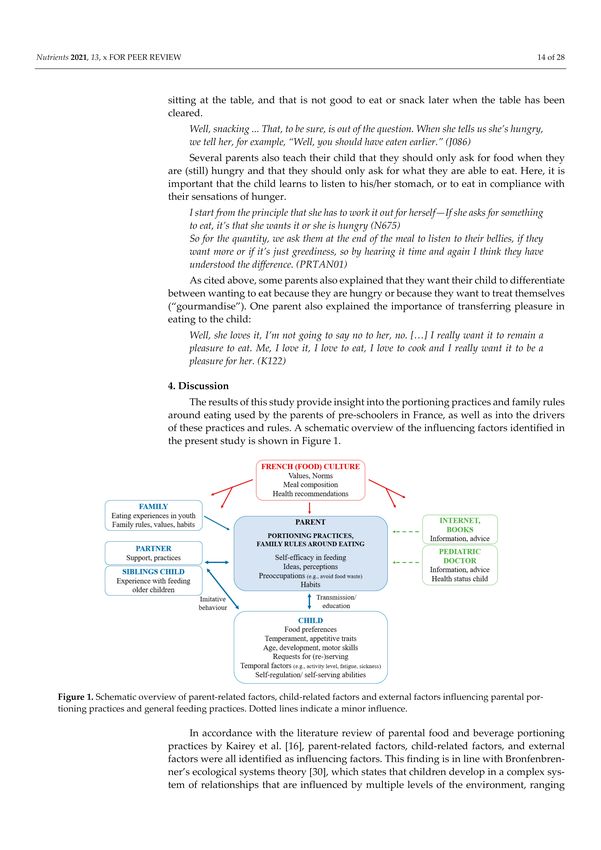
these practices and rules. A schematic overview of the influencing factors identified in the
present study is shown in Figure 1.
Figure 1. Schematic overview of parent-related factors, child-related factors and external factors
influencing parental portioning practices and general feeding practices. Dotted lines indicate a minor
influence.
In accordance with the literature review of parental food and beverage portioning
practices by Kairey et al. [16], parent-related factors, child-related factors, and external fac-
tors were all identified as influencing factors. This finding is in line with Bronfenbrenner’s
ecological systems theory [30], which states that children develop in a complex system of
relationships that are influenced by multiple levels of the environment, ranging from the
child’s immediate home environment (microsystem) to their larger environment, encom-
passing culture, norms, and values (macrosystem). Following this theory, we can indeed
assume that children’s capacity to self-regulate their food intake is influenced by factors on
different levels, such as by people/factors in their microsystem, e.g., parents and their food
portioning and feeding practices. In accordance with the theory, we observed that parents
and their practices are in turn influenced by their child’s behavior and characteristics
(bidirectional interactions between parent and child). Parents are also influenced by other
people in the child’s microsystem (siblings, other family members, the pediatric doctor)
and by factors in the macrosystem (culture, norms, health recommendations, etc.).
In this study, the division of responsibility between parent and pre-schooler in terms
of determining portion sizes and serving was explored (Satter’s theory [3]). Overall, even
though there was some variation in the degree of autonomy granted to children in this
study, most pre-schoolers were granted little autonomy to serve themselves or to determine
their own portion sizes. French parents are in control, or they at least guide the child or
monitor what (s)he is doing. This is similar to the findings of a recent study of Loth et al.
in the USA [7]. From the interviews, it is clear that French parents (try to) balance different
elements: they want to be responsive to children’s expressions of hunger and to take their
food preferences for portioning into account (child-related factors), but at the same time
they also want their child to eat a minimum portion, to taste the foods offered, and to avoid
food waste (parent-related factors).
In theory, young children are believed to be able to self-regulate their energy intake [4].
Following this idea, Satter [3] suggested that children should decide how much they eat and
if they want to eat. In practice, this does not seem to be entirely true: studies with infants
and pre-schoolers have shown, for example, that they do not adapt their energy-intake
if they were offered a snack before a meal [31,32]. In addition, a lot of inter-individual
variability exists with regard to children’s self-regulation capacities [33–35] and with regard
to children’s eating responses to portion sizes [36]. It may, therefore, not be advisable to
give children complete autonomy over their intake (how much). Instead, it is importantNutrients 2021, 13, 2769 15 of 27
that parents provide adequate structure and guidance for their child and that they are
responsive to their needs. Most parents in this study reported recognizing their child’s
hunger signals and “knowing” their child’s appetite. They prefer to start with a small
portion of food and then re-serve foods based on the child’s demands. Moreover, they
avoid serving portions that are too large and they do not insist that the child finishes the
entire plate. Yet, only a handful of parents (n = 5) described that they explicitly teach their
child to listen carefully to their stomach and their sensations of hunger when serving or
asking for food or to stop when they are full. This awareness of the relationship between
food and sensations of hunger should be encouraged among parents and children. This
could prevent children from learning to eat for external reasons, such as because food is
available or to bring comfort. This approach could also encourage parents to listen more
carefully to children’s sensations and to explore, together with the child, how (s)he can
obtain more experience and more autonomy in determining appropriate portion sizes for
himself/herself. The results of this study show that parents have little confidence in their
children’s self-regulation and self-serving capacities, often because parents have never
explored this with their child.
In line with the results of previous studies [7,37], more autonomy was given to the
child when serving breakfast or particularly when serving the mid-afternoon snack than
when serving other meals. These studies, conducted in the USA, showed that often more
flexibility is given with regard to the choice of foods eaten when snacking and when and
where the child snacks. In response, Loth et al. [7] discussed that it is desirable for parents
to provide sufficient structure, as snacks often make up a large share of the number of
daily calories consumed by children [38]. In France, we also found that children were
given more autonomy concerning choosing and serving snacks, but that an important
difference from countries such as the USA lies in the structure around snacking. In many
families in France, giving children a mid-afternoon snack (“goûter”) is a common practice:
62% of children aged 1–17 years consume it daily [39], and it is often considered as an
additional meal for children. Families usually have rules with regard to what, when
(often between 4.30 and 5.30 p.m. [40]) and where to snack, and there is little additional
snacking throughout the rest of the day. Moreover, it is interesting to know that the mid-
afternoon snack is a recommended practice by The French National Nutrition and Health
Program (PNNS) to diversify children’s diet and ensure that they have energy throughout
the day [25]. However, this does not mean that the mid-afternoon snack in France is
nutritionally adequate [39]. For many, this eating occasion is a moment of pleasure and
sweet foods are usually consumed [41]. Despite the adequate structure surrounding the
mid-afternoon snack in France, it is therefore still advisable to encourage parents to limit
children’s choices of snacks that are high in energy and encourage the consumption of
a range of healthier snacks, without sacrificing the pleasure that comes with this eating
moment [42].
In addition to the tradition of the mid-afternoon snack for children, it was clear during
the interviews that the French food culture, passed on over generations, plays an important
role in parental practices. Despite some minor deviations, all parents described that they
follow the “French eating model” in their family [43]: three meals a day (breakfast, lunch,
dinner) and a mid-afternoon snack for the child. Meals are usually consumed at set times
and at the table in the company of other family members. In most families, lunch and dinner
also consist of different components (i.e., starter, main course, dairy product, dessert), and
parents strive to offer a variety of foods to their family, in accordance with the French
health recommendations that stimulate the intake of a varied and balanced diet [44]. This
preoccupation also has a clear impact on parental portioning practices: many parents want
their child to at least taste all the foods offered, and they decide whether the child is allowed
to have an extra helping depending on the types of foods (s)he wants. If the child still wants
some “healthy” foods, (s)he is most likely allowed, but if (s)he wants more dessert it will
be refused. It must be noted, however, that these portioning strategies based on the types
of foods consumed have also been described by parents in other countries (e.g., [45,46];Nutrients 2021, 13, 2769 16 of 27
additionally, see the review by Kairey et al. [16]). Nevertheless, it is possible that when
striving to achieve a diverse diet, the use of different meal components in France may cause
parents to automatically limit the size of children’s food portions. This is necessary in order
to allow the child to eat a variety of foods at mealtime. In anticipation of the following
components, it could be assumed that children may also subconsciously learn that they
should not overeat right away but rather eat in moderation, otherwise they will not be able
to eat all components of the meal, and in particular, will not be able to enjoy the dessert
(which is probably their favorite dish).
The conscious focus of parents on food diversity stands in contrast with the rather
unconscious, intuitive actions used for portioning foods for children. Parents know very
well which foods they want their child to eat, but determine the portion given based on
“their intuition”, “previous experience”, “on the feeling”, “on sight”, or on their child’s food
preferences. This has also been described by parents in other qualitative studies (see review
by Kairey et al. [16]). However, in some of these previous studies, parents have expressed
doubts and difficulties with regard to determining appropriate portion sizes for their child,
while the parents in the present study expressed that they feel confident in these intuitive
practices and do not know of or look for recommendations. In France, recommendations
about portioning practices are very limited. The French high council of public health [47]
has formulated some recommendations regarding portion sizes for children aged 0–3 years
and 3–17 years. They stressed the necessity of adapting portion sizes to the child’s needs
and that there is no need to worry if the child follows a homogeneous growth trajectory
(pp. 29–30). It is indeed very important that portions are adapted to children’s individual
characteristics. Furthermore, it is interesting to note that the council did not give specific
quantitative indications about appropriate portion sizes, but only comparative indications—
for example, for children aged between 3 and 6 years, they state that the recommended
portion size corresponds to about half the portion size of an adult (pp. 29–30). This
comparative indication may be misleading and is obviously only advisable if parents eat
an appropriate portion size. Johnson et al. [48] found that the amounts parents served
themselves are indeed significantly positively associated with the amounts they served
their pre-schoolers. Some caution is thus needed when communicating recommendations
that use parental portions as a reference. Since parents’ portioning practices are rather
unconscious and based on habits, it could be an interesting strategy to use nudges or
to make changes in families’ environments in order to influence children’s intake in an
unconscious way [49]. Both Robinson and Matheson [49] and Hetherington and Blundell-
Birtill [50] identified the use of downsizing strategies—for example, using smaller tableware
or purchasing individual small packages of food—as particularly interesting for supporting
parents in serving appropriate portion sizes to children (and adolescents). Some parents
in the present study also described using these strategies and finding them helpful for
determining appropriate portion sizes for their child (to avoid giving portions that are
too large). It is, however, uncertain as to whether parents who do not use these strategies
currently will be receptive to recommendations about them. Parents in this study expressed
some interest in receiving recommendations or advice concerning determining portion sizes
for their child only when completing the final survey after the interview, but it is possible
that parents showed this interest merely to please the researchers (social desirability).
Population-based research is needed in order to assess this parental interest more properly.
In any case, since parents appear to be quite confident in their portioning practices and
do not actively search for information, it could be challenging to find a medium to convey
recommendations or advice.
In addition, it is important to point out that not only parents but also the government
and food industry can play an important role in stimulating the intake of appropriate
portion sizes. It is necessary, for example, to make sure that portion sizes of products do
not increase for reasons of industrial benefit and that the portion sizes given to children are
generally not too large. To illustrate, cultural differences exist in this matter, e.g., in France,You can also read


