Iceland eGovernment in - Europa EU
←
→
Page content transcription
If your browser does not render page correctly, please read the page content below

Country Profile

                                                   What’s inside
                                      Highlights
                                       Strategy
                              Legal Framework
                                          Actors
                                  Infrastructure
                           Services for Citizens
                        Services for Businesses

eGovernment in

              Iceland
       ISA²
Visit the e-Government factsheets online on Joinup.eu
Joinup is a collaborative platform set up by the European Commission as part of the ISA² programme.
ISA² supports the modernisation of the Public Administrations in Europe.
Joinup is freely accessible. It provides an observatory on interoperability and e-Government and associated domains
like semantic, open source and much more.
Moreover, the platform facilitates discussions between public administrations and experts. It also works as a
catalogue, where users can easily find and download already developed solutions.
The main services are:
Have all information you need at your finger tips;
Share information and learn;
Find, choose and re-use;
Enter in discussion.
This document is meant to present an overview of the eGoverment status in this country and not to be exhaustive in its
references and analysis. Even though every possible care has been taken by the authors to refer to and use valid data
from authentic sources, the European Commission does not guarantee the accuracy of the included information, nor
does it accept any responsibility for any use thereof.
Cover picture © AdobeStock
Content © European Commission
© European Union, 2018
Reuse is authorised, provided the source is acknowledged.
eGovernment in Iceland                                                                                   May 2018

Country Profile ......................................................................................................2

eGovernment Highlights........................................................................................8

eGovernment Strategy ..........................................................................................9

eGovernment Legal Framework .......................................................................... 11

eGovernment Actors ........................................................................................... 14

eGovernment Infrastructure ............................................................................... 17

eGovernment Services for Citizens ...................................................................... 21

eGovernment Services for Businesses ................................................................. 27

Disclaimer: The factsheet was updated solely through desk research conducted by the Wavestone
Luxembourg S.A. team.

eGovernment in Iceland                                                 May 2018

Country Profile
Basic data and indicators

Basic Data

Population (1 000): 338,349 inhabitants (2017)
GDP at market prices: 21,192.7 million Euros (2017)
GDP per inhabitant in PPS (Purchasing Power Standard EU 28 = 100): 128 (2016)
GDP growth rate: 3.6% (2017)
Inflation rate: -1.7% (2017)
Unemployment rate: 2.8% (2017)
General government gross debt (Percentage of GDP): No data available
General government deficit/surplus (Percentage of GDP): No data available
Area: 103,000 km2
Capital city: Reykjavik
Official language: Icelandic
Currency: ISK
Source: Eurostat (last update: 21 March 2018)

                                                                            [2]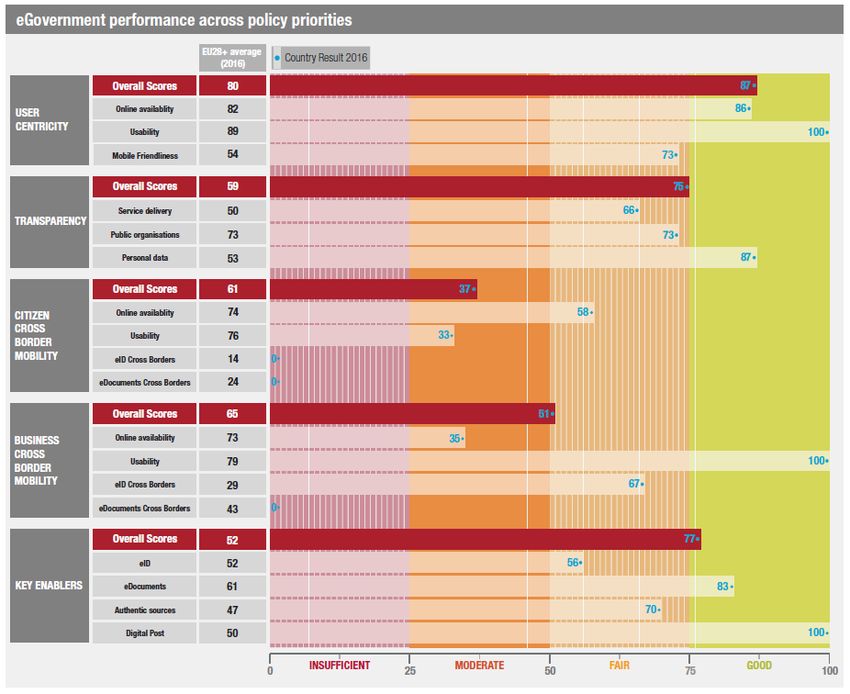
eGovernment in Iceland                                                             May 2018

Political Structure

Iceland is the most sparsely populated country in Europe with an average of approximately
three inhabitants per square kilometer. Independent for over 300 years, it was
subsequently ruled by Norway and Denmark. Limited home rule from Denmark was granted
in 1874 and complete independence attained in 1944. Literacy, longevity, income, and
social cohesion are first-rate by world standards.

Iceland is a republic, has a written constitution and a parliamentary form of Government.
The President of Iceland is elected by direct popular vote for a four-year term, with no term
limit. Most executive power rests with the Government, which is elected every four years in
separate elections.

Iceland boasts the world's oldest functioning legislative assembly, the Althingi, established
in 930 AD. The Althingi is a unicameral legislative body (Parliament) consisting of 63
members, elected from six constituencies for a four-year term on the basis of proportional
representation. Its Members jointly hold legislative as well as fiscal powers. Anyone who is
eligible to vote, with the exception of the President and the judges of the Supreme Court,
can be elected. After every election, the President grants one of the parliamentary leaders
of the political parties the authority to form a cabinet, usually beginning with the leader of
the largest party. If s/he is not successful, the President will summon another political party
leader to form a Government.

Judicial power lies within the Supreme Court or Hæstiréttur and eight district courts.
Justices are appointed for life by the Minister of Justice.

There are eight administrative regions, namely Austurland, Höfuðborgarsvæði, Norðurland
eystra, Norðurland vestra, Suðurland, Suðurnes (formerly Reykjanes), Vestfirðir and
Vesturland.

Iceland is a member of the European Free Trade Association (EFTA)          and the European
Economic Area (EEA).

Head of State: President Guðni Th. Jóhannesson (since 1 August 2016)
Head of Government: Prime Minister Katrín Jakobsdóttir (since 30 November 2017).

                                                                                           [3]
eGovernment in Iceland                                                                                                                  May 2018

Information Society Indicators

Generic Indicators

The following graphs present data for the latest Generic Information Society Indicators for
Iceland compared to the EU average. Statistical indicators in this section reflect those of
Eurostat at the time the Edition is being prepared.

       Percentage of households with                                                  Percentage of enterprises with
         Internet access in Iceland                                                     Internet access in Iceland

100%                                                                           100%

 95%

 90%
                                                                               98%

 85%

 80%
                                                                               96%
 75%

 70%                                                                                                                                        EU28
                                                                     EU28
                                                                     Iceland                                                                Iceland
   0                                                                              0
    2009   2010   2011   2012   2013    2014    2015   2016   2017                 2010   2011   2012   2013    2014   2015   2016   2017

   Source: Eurostat Information Society Indicators                                Source: Eurostat Information Society Indicators

                                                Percentage of individuals using
                                               the internet at least once a week
                                                           in Iceland
                                100%

                                 95%

                                 90%

                                 85%

                                 80%

                                 75%

                                 70%

                                 65%                                                                           EU28
                                                                                                               Iceland
                                       0
                                        2009 2010 2011 2012 2013 2014 2015 2016 2017

                                                Source: Eurostat Information Society Indicators

                                                                                                                                                      [4]
eGovernment in Iceland May 2018
Percentage of households with a Percentage of enterprises with a
broadband connection in Iceland broadband connection in Iceland
100%
98%
96%
94%
92%
90%
88%
EU28
86%
Iceland
0
2010 2011 2012 2013 2014 2015 2016 2017
Source: Eurostat Information Society Indicators Source: Eurostat Information Society Indicators
Percentage of individuals having Percentage of enterprises having
purchased/ordered online in the last received orders online within the
three months in Iceland previous year in Iceland
60% 35%
55%
30%
50%
45%
25%
40%
35% 20%
30%
25% 15%
20%
10%
15%
10% EU28 EU28
5%
5%
Iceland Iceland
0 0
2009 2010 2011 2012 2013 2014 2015 2016 2017 2010 2011 2012 2013 2014 2015 2016 2017
Source: Eurostat Information Society Indicators Source: Eurostat Information Society Indicators
[5]eGovernment in Iceland May 2018
eGovernment Indicators
The following graphs present data for the latest eGovernment Indicators for Iceland
compared to the EU average. Statistical indicators in this section reflect those of Eurostat at
the time the Edition is being prepared.
Percentage of individuals using the Percentage of individuals using the
internet for interacting with public internet for obtaining information from
authorities in Iceland public authorities in Iceland
90% 90%
80% 80%
70% 70%
60% 60%
50% 50%
40% 40%
30% 30%
20% 20%
EU28 EU28
10% 10%
Iceland Iceland
0 0
2009 2010 2011 2012 2013 2014 2015 2016 2017 2009 2010 2011 2012 2013 2014 2015 2016 2017
Source: Eurostat Information Society Indicators Source: Eurostat Information Society Indicators
Percentage of individuals using the Percentage of individuals using the
internet for downloading official forms internet for sending filled forms to
from public authorities in Iceland public authorities in Iceland
90% 90%
80% 80%
70% 70%
60% 60%
50% 50%
40% 40%
30% 30%
20% 20%
EU28
EU28
10% 10% Iceland
Iceland
0 0
2009 2010 2011 2012 2013 2014 2015 2016 2017 2009 2010 2011 2012 2013 2014 2015 2016 2017
Source: Eurostat Information Society Indicators Source: Eurostat Information Society Indicators
[6]eGovernment in Iceland May 2018
eGovernment State of Play
The graph below is the result of the latest eGovernment Benchmark Report, which monitors
the development of eGovernment in Europe, based on specific indicators. These indicators
are clustered within four main top-level benchmarks:
• User Centricity – indicates to what extent (information about) a service is provided
online and how this is perceived.
• Transparent Government – indicates to what extent governments are transparent
regarding: i) their own responsibilities and performance, ii) the process of service
delivery and iii) personal data involved.
• Cross Border Mobility – indicates to what extent EU citizens and businesses can use
online services in another country.
• Key Enablers – indicates the extent to which 5 technical pre-conditions are available
online. There are: Electronic Identification (eID), Electronic documents (eDocuments),
Authoritative Sources, and Digital Post. Digital Post refers to the possibility that
governments communicate only electronically with citizens or entrepreneurs through
e.g. personal mailboxes or other digital mail solutions.
This year’s measurement has selected a set of four life events that cover the most common
domains of public services, representative for both businesses and citizens: Starting a
business and early trading operations; Losing and finding a Job; Studying; Family Life (new
life event, measured for the first time). The figure below presents the development of
eGovernment in Iceland compared to the EU average score.
Source: eGovernment Benchmark Report 2017 Country Factsheets
[7]eGovernment in Iceland May 2018
eGovernment Highlights
Main eGovernment changes and key milestones in 2017
eGovernment Strategy
The Icelandic government has launched the Iceland Rural Fibre Project. It is a short-term
initiative to wire internet to 99.9% of Icelandic households by the end of 2020.
The Financial Plan for 2018-2022 has also been drafted, with the main objective to make
public services the principle of self-regulation and to ensure that the administrative data is
safe, timely, only recorded once and is protected by the best technical solutions at any
given time.
eGovernment Legal Framework
During the last year, there have been no changes linked to legal framework in Iceland.
eGovernment Actors
During the last year, there have been no changes linked to key actors and main contact
points related to digital public administration in Iceland.
eGovernment Infrastructure
During the last year, there have been no changes linked to eGovernment infrastructure in
Iceland.
eGovernment Services
During the last year, there have been no changes linked to digital services offered by public
administration in Iceland.
Other highlights
In 2017, according to the United Nations report on Measuring the Information Society,
Iceland had the most developed information society worldwide.
2001 – 2017
For previous eGovernment highlights, please consult the factsheets for past years,
accessible through this link.
[8]eGovernment in Iceland May 2018
eGovernment Strategy
Main strategic objectives and principles
National Cyber Security Strategy 2015 - 2026
The strategy is intended to address the protection of important elements of the
infrastructure in Iceland and the responses called for to protect against the growing cyber-
threats, which pose a hazard to the government, the economy and the ordinary citizen.
The first Action Plan, set for the period 2015 –
2018, together with the strategy shall be
examined and reviewed as necessary, at minimum
every four years. The measures planned for the
first period will call for a special effort to establish
broad collaboration needed between the
government and relevant stakeholders. The four
key objectives of the current Icelandic
cybersecurity strategy are the following:
Capacity building: the public, enterprises and
government should have the knowledge, skills
and equipment needed to cope with cyber security threats.
Increased resilience: Key factors in enhanced resilience are greater capacity in the
fields of assessment, preparedness and response.
Strengthened legislation: legislation should reflect the international demands and
obligations the country undertakes regarding cyber security and the protection of
personal data; and it must also support innovation and the development of security-
related services like hosting.
Tackling cybercrime: the police should have access to the professional knowledge,
skills and equipment needed to resolve issues concerning cyber security.
A special Cyber Security Council has been appointed, consisting of representatives of the
government bodies involved in the implementation of the strategy, in order to put the cyber
security strategy into action. The stakeholders (public and private entities) shall be
represented by another established body – the Cyber Security Forum.
Knowledge development
Society's knowledge of the possibilities and uses of information technology shall be
enriched, with the purpose of applying technology in the optimal manner for creating
employment, improving services, effectiveness in all respects and increasing democratic
participation. The focus shall be on building up knowledge among students, managers and
other State or municipal personnel, and in groups who have limited acquaintance of
information technology.
Financial Plan 2018-2022
The Ministries cooperating together have identified the following topics as areas to focus on
for the 2018-2022 Financial Plan:
Disclosure of information and operation of the basic files on important rights;
[9]eGovernment in Iceland May 2018
Statistics, coordination of statistics and economic research;
Electronic solutions, information and service providers and certificate issuance;
Infrastructure, procurement, maintenance and dissemination of country information;
Strategy, implementation and coordination of public administration and information
technology in the public sector.
The main objective is to make public services the principle of self-regulation and to ensure
that the administrative data is safe, timely and only recorded once, as well as protected by
the best technical solutions at any given time. Statistics are based on reliable data, serve
the needs of informed discussion and decision-making in society and fulfill international
commitments. Public sector services are based on information systems that meet ever-
changing needs and the technical demands of the public and industry. The public and
industry can access open-source data in one place with unsolicited information, monitor
various issues discussed in the administration, and participate in the transparent reporting
process for draft proposals, regulations and policy papers. Public data will be free of charge
and reusable as much as possible.
Iceland 2020 - Governmental policy statement for the economy and
community
Iceland 2020 forms the basis for the Icelandic government's policy-making and planning in
specific areas over the coming years. The monitoring of the 20 yardsticks that have been
defined in this chapter on economic and development objectives, as well as the previous
chapter on social objectives, give some indication of the progress made in moving Iceland
along on the path to welfare, knowledge and sustainable development. The Prime Minister's
Office is responsible for monitoring Iceland 2020 in relation to other ministries and ensuring
that the policies, plans, tasks and measures that are detailed below are followed. The Prime
Minister's Office will assess the status of the twenty objectives on an annual basis.
The main goal of the Iceland 2020 plan regarding eGovernment and the Information
Society is that by 2020, Iceland be in the top 10 nations on the eGovernment development
index and eParticipation Index measured by the United Nations. The previous Icelandic
Government Policy on Information Society 2008-2012 will be the base used for further
development and will be integrated in the general new plan.
Iceland Rural Fibre Project
The Iceland Rural Fibre Project is a short-term Government initiative to bring 100 Mb/s
wired internet to 99.9% of households and businesses nationwide by the end of 2020. The
State contributes funding for the project, and local governments can apply for subsidies
that depend on their own contributions. The project is overseen by the Telecommunications
Fund. Fibre network installation outside population centres also plays a role in upgrading
core communications systems nationwide, which is a prerequisite for greater reliability,
coverage, and data transmission speeds across all mobile networks outside densely
populated areas.
[10]eGovernment in Iceland May 2018
eGovernment Legal Framework
Main legal texts impacting on the development of eGovernment
eGovernment Legislation
Current Status
Information Act No. 140/2012
The act was approved by the parliament at the
end of 2012 and came into force on 1 January
2013. Its objective is to guarantee transparency in
government administration and the handling of
public interests, inter alia with the purpose of strengthening the following:
The right to information and the freedom of expression;
Possibilities for the public to participate in a democratic society;
The restraints exercised by the media and the public on government authorities;
Possibilities for the media to communicate information on public affairs;
Public confidence in government administration.
This act applies to all government activities and private entities owned by the state (51% of
shares or more).
Administrative Procedures Act (2003)
On 10 March 2003, the Administrative Procedures Act (No. 37/1993) was amended
(No. 51/2003), adding a special chapter on the electronic handling of matters by the Public
Administration. Through this modification, general obstacles to the development of
electronic administration were removed. While formulating the amendment, the committee
in question was guided by the concept of equivalent value, and also emphasised the need
to maintain technical impartiality. The alteration involved permission for the electronic
handling of governmental administration cases, but not an obligation.
Freedom of Information Legislation
Information Act, No. 50/1996
After the adoption of Act No. 140/2012, the older Information Act No. 50/1996 only applies
to municipalities with fewer than 1 000 citizens until 1 January 2016.
Data Protection/Privacy Legislation
Act on the Protection of Privacy as regards the Processing of Personal Data, No. 77/2000
The Act on the Protection of Privacy as regards the Processing of Personal Data
(No. 77/2000) was passed in 2000 and came into effect on 1 January 2001. The act
implements the EC Data Protection Directive (95/46/EC) and deals with how the protective
principle relates to data quality, and presents criteria for the legitimacy of data processing.
The act applies to any automated processing of personal data and to manual
processing of such data if it is, or is intended to become, a part of a file.
[11]eGovernment in Iceland May 2018
eSignatures Legislation
Regulation No. 780/2011 on electronic signatures
This regulation applies to the information to be included in qualified certificates,
requirements of certification service providers who issue qualified certificates, requirements
for secure signature creation devices, the mechanism for the registration, notifications and
disclosures of certification service providers and the mechanisms of regulation of
certification service providers issuing qualified certificates.
An electronic signature made using a qualified certificate does not constitute confirmation
of the time of signature creation.
Act on Electronic Signatures, No. 28/2001
Based on a similar EC Directive, article 4 of the Act stipulates that fully qualified electronic
signatures shall have the same force as handwritten signatures. Furthermore, it is
stipulated that other electronic signatures can be legally binding. Supporting legislation
comes through the Electronic Commerce Act, 2002 and the Administrative Procedures Act,
as amended in 2003.
eCommerce Legislation
Act on Electronic Commerce and other Electronic Services, No. 30/2002
The Act states that electronic contracts are equivalent to written contracts and that
electronic services provided by a service provider established in Iceland shall conform to
Icelandic law on the establishment and operation of the service. The Act does not apply to
electronic services relating to taxation. However, in this field, there are two main acts
applying to electronic commerce: the Income Tax Act, No. 90/2003, and the Value Added
Tax Act, No. 50/1988. According to the former, a legal entity is taxable in Iceland if it is
domiciled in this country. The latter introduces several special provisions concerning
imports.
eCommunications Legislation
Electronic Communications Act, No. 81/2003
The Telecommunications Act No. 107/1999 deregulated the telecommunications sector
by terminating the state monopoly. A further aim of the act was to enhance competition
and ensure that everyone had access to the basic services in this field. The legislation also
provided for the unbundling of local loops under certain conditions. The updated Act from
2003 implemented the latest EU Directives in Iceland.
eProcurement Legislation
Act on Public Purchasing, No. 84/2007
The older Public Procurement Act was replaced with Act No. 84/2007, a new comprehensive
Act on Public Purchasing. The Act incorporates the eProcurement provisions of European
Directives 2004/17/EC and 2004/18/EC. Rules on the use of electronic transmission are
liberalised regarding public procurement and dynamic procurement systems; the Act
furthermore regulates the use of eAuctions. Other provisions of the previous legislation,
such as the rules of procedure, remain largely unchanged.
[12]eGovernment in Iceland May 2018
eInvoicing Legislation
Although national Regulation 505/2013 stipulates the requirements for electronic invoices
to be considered legal, there is no legislation mandating the use of eInvoices in B2G public
procurement in Iceland. The Declaration of the Ministry of Finance and the Ministry of
Economic Affairs of 10 February 2014, does, however, recommend the use of eInvoices in
B2G public procurement as of 1 January 2015.
Re-use of Public Sector Information (PSI)
Current Status1
Conditions on the re-use of public sector information are partly covered by the Information
Act (No. 50/1996). The Act defines public access to information and the restrictions on the
right to information. In relation to the European Directive on the re-use of Public Sector
Information (PSI Directive, 2003/98/EC), the Act includes almost all items with the
exception of access and re-use of information through electronic means such as databases.
1
Europa – PSI Implementation Status
[13]eGovernment in Iceland May 2018
eGovernment Actors
Main roles and responsibilities
National eGovernment
Policy/Strategy
Network Society Council
The role of the Network Society Council is, amongst other things, to follow the
implementation of government and network security policies for the period 2015-2026. In
cooperation with stakeholders, it will set up a Network and Information Society
Consultation Group. The Council will, after consulting, formulate action proposals, regularly
write reports on their performance, and make government proposals for actions as
required. At the same time, the Network Security Council is consulted on issues relating to
network and information security.
Ministry of the Interior
The general organisational approach to eGovernment in Iceland is based on a centralised
policy and strategy but decentralised implementation. The Ministry of the Interior is
responsible for the formulation of the policy on the information society and eGovernment.
There is an extensive collaboration and consultation with other governmental bodies and
actors in the information society sphere.
Sigurður Ingi Jóhannsson
Minister of Transport and Local Government
Contact details:
Ministry of the Interior
Sölvhólsgata 7
150 Reykjavik
Tel.: +354 545 9000
Fax: +354 552 7340
E-mail: N/A
Source: http://eng.innanrikisraduneyti.is/
Coordination
Information Society Taskforce
The policy is coordinated and supervised by a special project management team, the
'Information Society Taskforce' (or eGovernment Taskforce), operating under the auspices
of the Ministry of the Interior. The Taskforce focuses on eGovernment issues in the policy
and coordinates Central eGovernment and Local eGovernment projects. This includes
assisting public institutions and Association of local Authorities in their efforts towards
achieving the policy’s main objectives. The Chairman of the Taskforce leads the efforts to
increase the use of IT to improve eServices to citizens and to increase the effectiveness of
government services.
[14]eGovernment in Iceland May 2018
Guðbjörg Sigurðardóttir
Director of Information Society Affairs
Contact details:
Ministry of the Interior
Sölvhólsgata 7
150 Reykjavik
Tel.: +354 545 9000
Fax: +354 552 7340
E-mail: gudbjorg.sigurdardottir@irr.is
Implementation
Government offices and public bodies
eGovernment implementation is highly decentralised and is undertaken by the Government
offices (ministries) and other public bodies according to their role(s) and subject(s). All
ministries and two representatives from local government form the eGovernment
Taskforce. In the current eGovernment strategy: ePower Expansion, the future vision is to
make sure that public services are built with democracy, efficiency and the needs of people
and industry in mind. A solid knowledge of information technology, along with access to
government data, will promote innovation and business growth. The general public will
affect public-sector decisions by helping to prepare them through online, open, and
transparent consultations.
Data Protection
Icelandic Data Protection Authority (DPA)
The Icelandic Data Protection Authority consists of a Board and a Secretariat. A managing
director (Data Protection Commissioner) is in charge of the daily management of the
Secretariat. The Icelandic Data Protection Authority exercises surveillance over processing
of data to which the Act on the Protection of Privacy as regards the Processing of Personal
Data applies. The decisions made by the Icelandic Data Protection Authority are final and
may not be brought before any other administrative authority. The decisions on the other
hand can be taken to the courts, and complaints concerning the administration of the
Authority can be addressed to the Parliamentary Ombudsman.
Regional & Local eGovernment
Policy/Strategy
Ministry of the Interior
As mentioned, Icelandic eGovernment policy and strategy are highly centralized but the
implementation is more decentralized. The policymaking and implementation is conducted
in cooperation between the ministries and the Association of Local Authorities.
Implementation
Association of Local Authorities
The country is divided into 79 municipalities (local authorities), which are independent but
under the supervision of the Ministry of Interior (formed on 1 January 2011 when the
[15]eGovernment in Iceland May 2018
Ministry of Justice and Human Rights and the Ministry of Transport, Communications and
Local Government merged). Their responsibilities lie on social welfare, health, education,
cultural matters and infrastructure. The Association of Local Authorities in Iceland is the
forum for co-operation between the local authorities.
[16]eGovernment in Iceland May 2018
eGovernment Infrastructure
Main eGovernment infrastructure components
Portals
Government Offices of Iceland (www.government.is)
This governmental portal is a website that links and redirects to all Icelandic ministries. It
contains information and online facilities for all government departments (ministries,
directorates, etc.).
www.island.is
This portal plays a central role in the new policy formulation for the Information Society for
2013 - 2017, the portal has three main functions:
It operates as government information and service portal. It provides easy access to
information on public services and to a large number of public forms.
It operates as a toolbox. Tools which are of use to all public bodies have been
developed on the island.is website. These include centralised authentication, electronic
document delivery (C2G and B2G), electronic document distribution (G2C and G2B) and
an electronic service layer.
Since May 2011 it provides 'My pages' services. There people obtain individualised
access to information about themselves in key registers owned by the authorities and
access to documents sent to them electronically by public bodies.
EUGO (eu-go.is)
This portal is the online point of single contact for people who want to start a business or
provide services in Iceland. The portal is organised according to the European Services
Directive which obliges EU/EES countries to simplify all procedures involved in starting and
carrying out a service activity. All information and necessary forms are available in both
Icelandic and English.
www.iceland.is
The www.iceland.is portal is supported by the Ministry of Foreign Affairs as the official
gateway to Iceland for foreigners. The portal contains a plethora of information on Iceland,
its nature, society, trading and investment opportunities, as well as links to many related
websites. The portal has absorbed the site www.iceland.org, which used to function as the
official gateway to the Icelandic Foreign Service, and thus it provides information about
Icelandic embassies abroad.
Multicultural Information Centre (www.mcc.is)
The Multicultural Information Center is a portal designed to provide assistance to
immigrants through an extensive number of services. Its fundamental role is to facilitate
communications between individuals from different backgrounds, and to enhance the
services provided to foreign citizens residing in Iceland and to those interested in moving to
Iceland. Among other services, the Multicultural center offers assistance through telephone
in English, Polish, Serbian/Croatian and Thai. The portal is the responsibility of the Ministry
of Welfare, established on 1 January 2011.
[17]eGovernment in Iceland May 2018
UT-Web of Information Technology (UT.is)
UT-Web of Information Technology is a comprehensive portal that provides useful
information on IT matters. This portal is mainly targeted towards people working in IT-
departments and managers in public institutions. Nevertheless, since the portal is of a
general nature, it can be of use to anyone who seeks information on information technology
and eGovernment. The Department of Administrative and Social Development at the Prime
Minister’s Office is responsible for the portal. The UT-Web has been operating since January
2006.
Network
Current status
Iceland has a large-scale infrastructure for telecommunications networks and services.
Reykjavík offers one of the largest optical-fiber networks currently available in any
capital city; mobile phone penetration is among the highest in the world.
The Telecommunications Fund was established by Act No. 132/2005, with the view to
allocate financial resources for projects that are aimed at developing telecommunications
infrastructure, at contributing to the safety and competitiveness of the Icelandic nation in
the field of telecommunications, and at achieving further goals, insofar as such projects are
provided for in the Telecom Policy Statement and are considered unlikely to be undertaken
on market terms.
FS Net
FS Net is a specialised high-speed network linking all upper secondary schools and
lifelong education centres in Iceland. FS Net is structured for fast, independent data
transport and builds on the IP protocol. All upper secondary schools and continuing
education centres are connected through a 100-Mbps link, with branch locations of
continuing education centres connected by 2-Mbps links. The network supports multicast
and traffic prioritisation and is also connected to the University and Research Network (RH
Net).
eIdentification/eAuthentication
Íslandsrót Certification Authority
Íslandsrót (Iceland Root) is the certification authority, responsible for issuing and
distributing eCertificates. It is controlled by the Ministry of Finance and stands at the top of
the organisation pyramid of electronic identification, constituting the source of trust in the
system of distributed electronic certificates. On the basis of 'Iceland Root', intermediate
certificates can be issued and used as a certification while waiting for the issue of the final
certificates. The final certificates can be tied to a specific person, such as private certificates
or employee certificates. Various government departments also issue digital certificates. For
example, the 1996 amendment to the Customs Act imposed electronic submissions using
digital certificates for all import and export companies.
[18]eGovernment in Iceland May 2018
eProcurement
Rikiskaup
According to the European Commission's 'Digitising Public Services in Europe: Putting
ambition into action – 9th Benchmark Measurement' report, Iceland’s eProcurement
platform is not available yet, in the sense that Iceland’s government planned to have only
one platform, Rikiskaup, the State Trading Centre. However, Rikiskaup already provides
eNotification services and it supports further eProcurement development. Buyers can send
email to suppliers within the same contract group through Rikiskaup. In addition, some
institutions have procurement systems where they can order online from eCatalogues.
Knowledge Management
Menntagatt: The Educational Gateway
This portal provides schools with convenient access to information and services on the
Internet. Content is being recorded and linked to courses, academic subjects and
curriculum goals. The Educational Gateway built on a public-private partnership, is run
by a private company and intends to integrate the content and services provided by public
and private parties.
Tungutaekni website
An information website maintained by the Icelandic Centre for Language Technology and
run jointly by the Institute of Linguistics at the University of Iceland, the School of
Computer Science at the Reykjavik University and the Department of Lexicography at the
Árni Magnússon Institute for Icelandic Studies. For over 1 000 years, Icelandic has served
not only as the language of Icelanders, but as the medium through which one of Europe’s
greatest literary treasures was preserved: the medieval sagas. However, since the
advent of computers, Icelandic, like many other languages, has found itself under
increasing pressure, particularly due to the extensive use of English. One of the main roles
of the centre is to collect information on language technology in Iceland and make it
available on the Internet to facilitate cooperation among interested parties and the use of
available resources.
Icelandic Library Consortium
It runs a union catalogue for Icelandic libraries, known as Gegnir. The company, which
was founded in November 2001, is owned by the Icelandic Government and a series of
municipalities around the country. Its purpose is to run a central, web-based library system
for most of the libraries in Iceland, thus making the best possible use of the country’s
modest library and information resources. The contract between Ex Libris and the
Consortium of Icelandic libraries assumes that the new library system will be used by all or
almost every one of the approximately 400 libraries in the country, and that legacy data
will be added to the new system in steps, based on their existing systems.
Hvar.is website
'Hvar.is' is the 'Iceland Consortia for eSubscriptions' website - a countrywide access portal
to electronic databases and eJournals. It provides information and access to more than
14,000 full-text journals, abstracts of articles from over 6 000 journals and 12 databases to
every resident of Iceland, who is connected to a domestic Internet service provider.
According to the Icelandic Government’s point of view, the idea of providing nationwide
access to databases of electronic bibliographies and full-text journals unites two lines of
[19]eGovernment in Iceland May 2018
thought: satisfying the urgent demand of libraries and their users for a diverse set of
databases and journals, and applying the adopted government policy of equal access for all
Icelanders to the information society.
Vísindavefur website
The Icelandic Web of Science was established in 2000. It contains information on all
aspects of science, covering fields from astronomy to ancient manuscripts. Visitors can
find answers to a wide variety of questions; should information be missing they have direct
access to experts responsible for maintaining and updating the web. The Visindavefur is
supported both by public institutions and private companies.
[20]eGovernment in Iceland May 2018
eGovernment Services for Citizens
Availability and sophistication of eServices for Citizens
The information in this section presents an overview of the basic public services, which
were identified by the European Commission and Member States under the Your Europe
initiative that is an EU site designed to help citizens do things in other European countries –
avoiding unnecessary inconvenience and red tape in regard to moving, living, studying,
working, shopping or simply travelling abroad.
The groups of services for citizens are as follows:
1. Travel
2. Work and retirement
3. Vehicles
4. Residence formalities
5. Education and youth
6. Health
7. Family
8. Consumers
1. Travel
Passenger rights, documents you need
Passport
Responsibility: Central Government, Ministry of the Interior
Website: https://www.skra.is/
Description: The application for a passport is a fully automated electronic procedure
where application forms are not needed.
Multicultural Information Centre
Responsibility: Ministry of Welfare
Website: http://www.mcc.is/
Description: The Multicultural Information Centre is a portal designed to provide
assistance to immigrants through an extensive number of services. Its
fundamental role is to facilitate communications between individuals from
different backgrounds, and to enhance the services provided to foreign
citizens residing in Iceland and to those interested in moving to Iceland.
Among other services, the Multicultural centre offers assistance through
telephone in English, Polish, Serbian/Croatian and Thai. The portal is the
responsibility of the Ministry of Welfare, established on 1 January 2011.
[21]eGovernment in Iceland May 2018
2. Work and retirement
Working abroad, finding a job abroad, retiring abroad
Job search services by labour offices
Responsibility: Central Government, Ministry of Welfare, Directorate of Labour
Website: https://www.vinnumalastofnun.is/;
http://reykjavik.is/en/administration
Description: Fully functional job search online service with multilingual information on
jobs. All services offer pre-selected jobs related to the profile of the job
searcher. Vacancies are automatically published in the European
Employment Services Job Mobility Portal.
Taxes, unemployment and benefits
Unemployment benefits
Responsibility: Central Government, Ministry of Welfare, Directorate of Labour
Website: https://www.vinnumalastofnun.is/
Description: Citizens apply electronically and follow the entire application procedure
through the web. Case handling and decision making is web based. One
exception: The applicant has to show up once, show his/her ID and sign
the application. S/he also has to bring some certificates on paper, e.g.
certificates from former employees.
Income taxes: declaration, notification of assessment
Responsibility: Central Government, Ministry of Finance, Directorate of Internal Revenue
Website: https://minn.rsk.is/thjonustusidur/
Description: Businesses submit electronic tax returns since 1997, and individuals since
1999. The system offers online guidance and has pre-entered all data that
a tax payer needs to fill in. Rule-based auditing is also in place. Over 90%
of the tax payers file electronically.
3. Vehicles
Driving license
Driver’s license
Responsibility: Regional Government, Ministry of the Interior
Website: http://www.syslumenn.is/
Description: Information is available, enabling citizens to start the procedure in order
to obtain a driving licence.
Registration
Car registration (new, used, imported cars)
Responsibility: Central Government, Ministry of the Interior, Road Traffic Directorate
Website: http://www.us.is
Description: Change of ownership must be confirmed through a bank. Payment is also
done through the bank. Each partner involved must log into his/her
personalised web page at the bank and confirm the change of ownership.
When all partners have confirmed the change of ownership and payment
has been completed, all partners receive a confirmation email.
[22]eGovernment in Iceland May 2018
4. Residence (and other) formalities
Documents and formalities
Announcement of moving (change of address)
Responsibility: Central Government, Ministry of the Interior
Website: https://www.skra.is/
Description: A form (PDF), available on the web, can be filled in electronically, then
printed out and sent by mail or fax.
Certificates (birth, marriage): request and delivery
Responsibility: Central Government, Ministry of the Interior, Multicultural and Information
Centre
Website: http://www.mcc.is/english/eng-administration/registers-iceland/
Description: Request for a certificate can be sent by email, or by a special enquiry
form.
Criminal Record Certificate
Responsibility: District Commissioners
Website: N/A
Description: If a person lives in Iceland, s/he should apply in person at the District
Commissioner (Syslumadur) in the corresponding municipality (see
Special notes and considerations for complete address). If a person lives
outside of Iceland, s/he must give a written authority to a representative
in Iceland to request the certificate on his/her behalf by fax or email.
Declaration to the police (e.g. in case of theft)
Responsibility: Central Government, Ministry of the Interior, Icelandic Police
Website: http://www.logreglan.is/english/
Description: The police scan incoming mail or inquiries submitted online through the
standard inquiry form and responds either by phone, or by visiting a given
address. This has to be followed up by a formal written report.
Housing (building and housing, environment)
Responsibility: Local Government (Municipalities)
Website: http://www.samband.is/
Description: Most of the municipalities have PDF forms available on the web.
[23]eGovernment in Iceland May 2018
5. Education and youth
School, university
Educational Gateway
Responsibility: Institute of Education (Menntamálastofnun)
Website: http://www.menntagatt.is/
Description: Iceland's 'Educational Gateway' features catalogued educational content
and searches related to curricular goals, teaching instructions, pictures,
interactive examinations, and other educational topics (in Icelandic, with
some information in English and Danish).
Enrolment in higher education/university
Responsibility: Central Government, Ministry of Education, Science and Culture
Website: http://www.hi.is/; http://www.unak.is/; http://www.bifrost.is/;
http://www.ru.is/
Description: Information only.
Public libraries (availability of catalogues, search tools)
Responsibility: Central Government and Municipalities forming Gegnir, 'The Icelandic
Library Consortium', Ministry of Education, Science and Culture
Website: http://gegnir.is/; www.hvar.is
Description: The Icelandic Library Consortium runs a union catalogue for Icelandic
libraries, known as Gegnir. The company's purpose is to run a central,
web-based library system for most of the libraries in Iceland.
Researchers
Information and assistance to researchers
Responsibility: EURAXESS Iceland
Website: https://www.euraxess.is/
Description: EURAXESS Iceland provides information and assistance to mobile
researchers – by means of the web portal and with the support of the
national EURAXESS Service Centres. The portal contains practical
information concerning professional and daily life, as well as information
on job and funding opportunities.
Research funding support
Responsibility: The Icelandic Centre for Research (Rannis)
Website: http://en.rannis.is/funding/
Description: Rannis administers the main public competitive funds in the fields of
research, innovation, education and culture in Iceland. Rannis coordinates
and promotes Icelandic participation in European cooperation
programmes, such as Horizon 2020, Erasmus+ and Creative Europe, as
well as other international programmes. Information on available national
funding opportunities for the researchers can be found on the website, as
well as open calls for proposals.
[24]eGovernment in Iceland May 2018
6. Health
Planned and unplanned healthcare
Health related services (interactive advice on the availability of services in
different hospitals; appointments for hospitals)
Responsibility: Central Government, Ministry of Welfare
Website: http://www.fsa.is (North region); http://www.fsi.is (North West region);
http://www.hsa.is (East region); http://www.hve.is/ (West region)
http://www.hjarta.is (Hjartavernd, The Icelandic Heart Association)
Description: At the national, regional and local hospitals and health care centres, the
patient has to make an appointment by phone. Booking online is done by
the private company Hjartavernd.
Medical costs (reimbursement or direct settlement)
Responsibility: Central Government, Ministry of Welfare, Social Insurance Administration
Website: http://www.tr.is/ (Information)
Description: Discount cards are sent out automatically to those who are entitled (have
reached a certain level of total cost). This is based on information from
private practicing doctors, hospitals and health care centres. If people
have paid too much, they will be automatically reimbursed; that sum will
be deposited in a bank account.
7. Family
Children, couples
Certificates (birth, marriage): request and delivery
Responsibility: Central Government, Ministry of the Interior, Multicultural and Information
Centre
Website: http://www.mcc.is/english/eng-administration/registers-iceland/
Description: Request for a certificate can be sent by email, or by a special enquiry
form.
Child allowances
Responsibility: Central Government, Ministry of Finance, Directorate of Internal Revenue
Website: https://www.rsk.is/english/individuals/child-benefits/
Description: This service is automatically granted by the tax authorities after receipt of
annual tax declaration.
[25]eGovernment in Iceland May 2018
8. Consumers
Shopping (your rights), unfair treatment
Consumer protection / Consumer issues
Responsibility: Registers Island
Website: www.island.is
Description: The portal operates as government information and service portal. It
provides easy access to information on public services and to a large
number of public forms. In the area of consumer protection, the following
areas are covered: advice and legal assistance (complaints and
guarantees, consumer advice, etc.), pricing and price labels, product
safety, and purchases and contracts.
Financial products and services
Savings and finances
Responsibility: Registers Iceland
Website: www.island.is
Description: The portal operates as government information and service portal. It
provides easy access to information on public services and to a large
number of public forms. In the area of financial information, two areas are
covered: finances (payment difficulties, security net) and taxes (personal
taxes, taxes on goods and services).
[26]eGovernment in Iceland May 2018
eGovernment Services for Businesses
Availability and sophistication of eServices for Businesses
The information in this section presents an overview of the basic public services, which
were identified by the European Commission and Member States under the Your Europe
initiative that is an EU site designed to help citizens do things in other European countries –
avoiding unnecessary inconvenience and red tape in regard to doing business abroad.
The groups of services for citizens are as follows:
1. Start and grow
2. VAT and customs
3. Staff
4. Product requirements
5. Public contracts
6. Environment
1. Start and grow
Start-ups, European Company
EUGO portal
Responsibility: Unternehmens Service Portal, Federal Ministries (municipalities)
Website: http://eu-go.is/
Description: This portal is the online point of single contact for people who want to
start a business or provide services in Iceland. The portal is organised
according to the European Services Directive which obliges EU/EES
countries to simplify all procedures involved in starting and carrying out a
service activity. All information and necessary forms are available in both
Icelandic and English.
Registration of a new company
Responsibility: Central Government, Ministry of Finance, Directorate of Internal Revenue
Website: https://www.rsk.is/english/companies/capital-gains/
Description: General information and forms to download in order to register a
company. More information can be obtained in the relevant legislation on
Establishing a company in Iceland (1 May 2006).
Intellectual property rights
Patents
Responsibility: Icelandic Patent Office under the Minister of Industries and Innovation
Website: http://www.els.is/en/
Description: Information on the patent, trademark and design processes in Iceland are
freely available at the web portal of the Icelandic Patent Office.
Furthermore, for instance, it offers the following online services:
application forms for the application for national patents, links to
application forms for European patents, and others.
[27]eGovernment in Iceland May 2018
Annual accounts
Submission of data to statistical offices
Responsibility: Central Government, Ministry of Economic Affairs, Statistics Iceland
Website: http://www.hagstofa.is/
Description: Statistic Iceland has direct access to information from tax authorities (i.e.
VAT, tax withholding, social contribution, and income tax) and direct
access to import and export registers of custom authorities. Information
on wages and prices is directly sent from the largest databases of private
and public companies; electronic forms are available for collecting data on
accommodation (password protected).
2. VAT and customs
VAT – Basic rules, Cross-border VAT, Check a VAT number (VIES), VAT refunds
VAT: declaration, notification
Responsibility: Central Government, Ministry of Finance, Directorate of Internal Revenue
Website: https://minn.rsk.is/thjonustusidur/
Description: The service is fully interactive.
Excise duties
Corporate tax: declaration, notification
Responsibility: Central Government, Ministry of Finance, Directorate of Internal Revenue
Website: https://www.rsk.is/english/individuals/taxable-income/
Description: Businesses have been allowed to submit electronic tax returns since 1997,
and individuals since 1999. A fully interactive system is operational.
Reporting imports/exports
Customs declarations (eCustoms)
Responsibility: Central Government, Ministry of Finance, Directorate of Customs
Website: http://www.tollur.is
Description: An interactive online service which allows users to receive and send
answers to customs' declarations and use digital signatures as a safety
measure. Features include import/export procedures for businesses, fully
automated customs procedures (enabling up to 100 % of all declarations
to become electronic). A full electronic case management procedure is
available.
3. Staff
Terms of employment, social security, equal treatment, redundancies
Social contributions for employees
Responsibility: Central Government, Ministry of Finance, Directorate of Internal Revenue
Website: https://www.rsk.is/english/individuals/allowances-deductions-and-credits/
Description: There are two ways of declaring social contribution for employees
(withheld tax and social security contribution), a web form for small
enterprises (less than 30 employees) and, for companies which can
generate an XML-document in their salary systems, a means of securely
transmitting that form to the tax authorities. In both cases, following a
verification procedure, an invoice is generated and transmitted to the
[28]eGovernment in Iceland May 2018
banks. The invoice can then be settled electronically.
Health and safety
Web portal of Administration of Occupational Safety and Health in Iceland
(AOSH)
Responsibility: Administration of Occupational Safety and Health in Iceland (AOSH)
Website: http://www.vinnueftirlit.is/english
Description: The Administration of Occupational Safety and Health (AOSH) is an
independent institution under the Ministry of Social Affairs. On their
website, a form for reporting the work-related accidents to the AOSH (in
Icelandic) can be found as well as further information regarding health
and safety at the workplace.
4. Product requirements
CE marking, mutual recognition, standardisation in Europe, classification, labelling,
packaging
Product safety in Iceland
Responsibility Registers Island
:
Website: www.island.is
Description: The portal operates as government information and service portal. It
provides easy access to information on public services and to a large
number of public forms. In the area of product safety, the following
areas are covered: product liability, safety supervision and the CE Mark.
Chemicals (REACH)
REACH (Registration, Evaluation, Authorisation and Restriction of Chemicals, EU
Regulation no 1907/2006) Helpdesk
Responsibility: The Environment Agency of Ireland
Website: http://www.ust.is/the-environment-agency-of-iceland/
Description: The Environment Agency is the competent authority for the application of
a number of related EU acts. The Environment Agency is responsible for
the helpdesk for REACH and CLP. Manufacturers, importers, exporters,
distributors, downstream users and others should be able to get key
information regarding the chemicals legislation in Iceland on this webpage
or via their e-mail or telephone contacts as enlisted on the portal.
[29]eGovernment in Iceland May 2018
5. Public contracts
Rules and procedures, tools and databases, reporting irregularities
Public procurement / eProcurement
Responsibility: Central Government, Ministry of Finance, The State Trading Centre
Website: http://www.rikiskaup.is
Description: Information and forms to download. Rikiskaup provides eNotification
services and it supports further eProcurement development. Buyers can
send an email to suppliers within the same contract group through
Rikiskaup. In addition, some institutions have procurement systems where
they can order online from eCatalogues.
6. Environment
EMAS certification, energy labels, eco-design, EU eco-label
Environment-related permits (incl. reporting)
Responsibility: Central Government, Ministry for the Environment, The Environment
Agency
Website: http://www.ust.is
Description: Information and forms to download.
[30]eGovernment in Iceland May 2018
European Commission
The factsheets present an overview of the state and progress of eGovernment in European
countries.
Joinup is a joint initiative by the Directorate General for Informatics (DIGIT) and the
Directorate General for Communications Networks, Content & Technology (DG CONNECT).
Contributor: The factsheet was updated through desk research conducted by the
Wavestone Luxembourg S.A. team.
Production/Publishing: ISA Editorial Team, Wavestone Luxembourg S.A.
[31]You can also read


