Enabling people to enjoy Auckland's public places
←
→
Page content transcription
If your browser does not render page correctly, please read the page content below
Enabling people to enjoy
      Auckland’s public places
      Protecting people from nuisance or safety risks
      interference, danger, obstruction, activities on parks and beaches

Statement of Proposal to amend the Public Safety and Nuisance Bylaw 2013,
Animal Management Bylaw 2015 and Traffic Bylaw 2015, and to revoke legacy
bylaws about fences for public consultation - 26 October to 5 December 2018
2

1             Have your say
Enabling people to enjoy Auckland’s public places
People use public places every day for activities like playing sport, fishing, flying a drone, boating, having
barbeques, picnics or spending time with family or whānau at the beach or park.
Sometimes people’s behaviour or their activities (including offensive behaviour, damage or misuse) can
cause nuisance or risk to safety that may stop other people from using or enjoying our public places.

What Auckland Council does
We make rules to protect people from nuisance or unsafe behaviours and activities in public places. This
includes parks, beaches, civic spaces and other places accessible to the public.
These rules are set out in the Auckland Council Public Safety and Nuisance Bylaw 2013, Te Ture ā-Rohe
Marutau ā-Iwi me te Whakapōrearea 2013 (the Bylaw).

Improving public safety and nuisance rules
We recently checked how well the rules are working and identified improvements. The main changes we
want to make include:
    •    clarifying expected behaviours and restrictions on people using public places
    •    prohibiting people from leaving or storing construction materials, boats, shipping containers and
         consumer goods in public places
    •    clarifying how council makes recreational fishing controls
    •    clarifying how council gives approval (permission) for activities on public places, such as for
         abseiling, landing an aircraft, or exceptions for doing something that would otherwise be prohibited
    •    clarify which public places the Bylaw applies to and enabling organisations in control of those
         places to approve bylaw exceptions
    •    clarifying rules about fences and revoking two legacy bylaws about fences
    •    using national legislation rather than bylaws for damage to council property, car window washing,
         mind altering substances, graffiti, noise, fish offal, gates in parks, fireworks on non-public places,
         street names and property numbering
    •    moving issues about animals, signage, stormwater and vehicles to existing council bylaws (Animal
         Management Bylaw 2015 and Traffic Bylaw 2015).

Summary of information in Statement of Proposal to amend the Auckland Council public safety and nuisance, animal management
and traffic bylaws, and to revoke legacy fencing bylaws for public consultation – 26 October to 5 December 2018.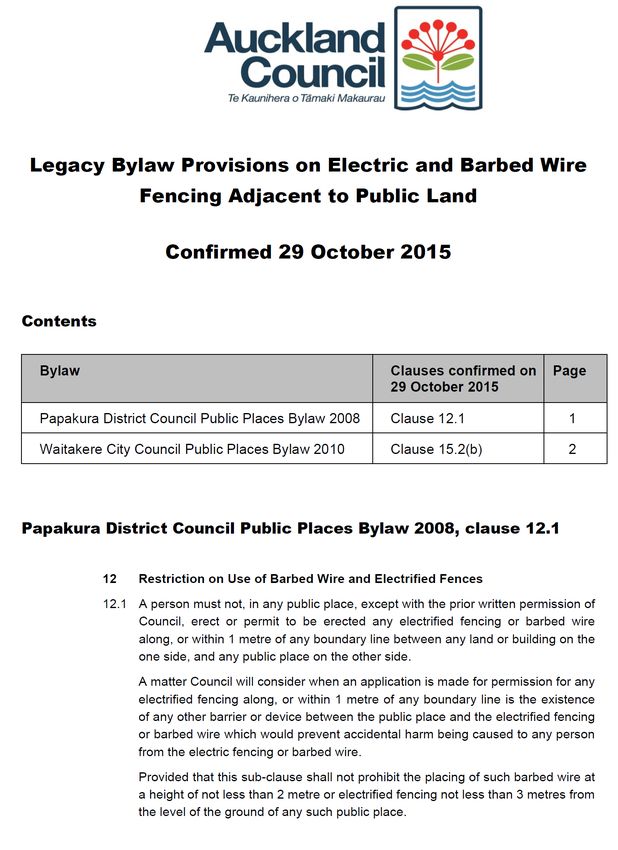
3

We want to know what you think
Starting on 26 October 2018 through to 5 December 2018, we want you to tell us what you think about
proposed changes to the Public Safety and Nuisance Bylaw 2013, Animal Management Bylaw 2015 and
Traffic Bylaw 2015, and revocation of legacy bylaws about fences.
Visit www.aucklandcouncil.govt.nz/have-your-say to find more information, give your feedback and find out
where you can drop in to a ‘Have your say’ event.

Summary of information in Statement of Proposal to amend the Auckland Council public safety and nuisance, animal management
and traffic bylaws, and to revoke legacy fencing bylaws for public consultation – 26 October to 5 December 2018.

4

2              What is the Bylaw
The Auckland Council Public Safety and Nuisance Bylaw 2013, Te Ture ā-Rohe Marutau ā-Iwi me te
Whakapōrearea 2013 (Bylaw) was made on 31 July 2013.
The Bylaw sets rules to protect people from nuisance or unsafe behaviours and activities (includes offensive
behaviour, damage or misuse) in public places.
The Bylaw applies to parks, beaches, civic spaces and other places accessible to the public, but generally
not roads. Rules on roads and footpaths next to roads are in the Auckland Transport Public Safety and
Nuisance Bylaw 2013 because they affect pedestrian and vehicular traffic.

Examples of behaviours and activities the Bylaw covers
 General behaviours                General activities
 •    interference with            •    access to parks and beaches           •    noise
      another person’s use         •    aircraft (including drones)           •    materials and objects
      or enjoyment of a            •    animals                               •    mind altering (psychoactive)
      public place                 •    boats                                      substances
                                   •    begging activity where                •    property numbers
 •    endangering another
                                        intimidating or nuisance              •    recreational beach activities
      person through use
                                   •    buildings, structures, tents          •    set netting
      of an object or item
                                   •    car window washing                    •    skateboards
 •    causing damage,              •    damage                                •    soil, shingle, shell, sand,
      obstruction, nuisance        •    fences                                     vegetation, plants, artefacts
      or a risk to safety.         •    fires                                 •    storage and packing goods
                                   •    fireworks                             •    street names
                                   •    fishing and fish offal                •    signs and posters
                                   •    gates                                 •    traps
                                   •    graffiti                              •    vegetation
                                   •    lifesaving equipment                  •    vehicles
                                                                              •    weapons.
                                   Activities on Regional Parks

                                   •    abseiling                             •    horse-riding
                                   •    animals                               •    hunting
                                   •    ashes                                 •    mining
                                   •    burials                               •    overnight stays
                                   •    camping                               •    set-netting.
                                   •    commercial filming

Statement of Proposal to amend the Auckland Council public safety and nuisance, animal management and traffic bylaws, and to
revoke legacy bylaws about fences for public consultation – 26 October to 5 December 2018.
5

3              What council proposes to change
Improving public safety and nuisance rules
We recently checked how well the current rules are working and identified improvements.
Council is now proposing to make changes to the Auckland Council Public Safety and Nuisance Bylaw 2013,
Animal Management Bylaw 2015 and Traffic Bylaw 2015, and to revoke legacy bylaws about fences. The
changes are being proposed to better protect people from nuisance and unsafe behaviours and activities in
public places. The major changes proposed are:
                 Proposed amendment                                       Reason for proposed change
 Use central government legislation instead of a               • issues already covered in central
 bylaw to address damage, car window washing,                    government legislation
 mind altering (psychoactive) substances, graffiti,            • does not affect Council’s current response to
 noise, fish offal, gates in parks, fireworks on non-            incidents
 public places, street names and property                      • public can still report issues. Council will
 numbering.                                                      continue to prioritise its response using a
                                                                 graduated response approach.
 Move issues about animals, drains, signage,                   • easier for public to find the bylaw they need
 stormwater and traffic to existing bylaws.                      if all issues about a topic are in the same
                                                                 bylaw.
 Prohibit leaving construction materials, boats,              • clearer as to what items must not be left on
 shipping containers and consumer goods in                       public places
 public places, unless approved by council. Other             • more freedom to leave other items so long
 things may be left provided they do not cause a                 as it does not cause a problem.
 problem (e.g. beach towel on beach).
 Clarify the expected behaviours and restrictions             •    rules easier to understand and avoids focus
 on the use of public places by improving the                      on vulnerable Aucklanders.
 Bylaw structure, stating behaviours expected
 from all Aucklanders, including regional park
 rules and using explanatory notes.
 Clarify how council makes controls and gives                 •    clearer how decisions are made about:
 approvals.                                                        o restricting recreational fishing activities
                                                                   o approving activities that would
                                                                        otherwise not be allowed.
 Clarify which public places the Bylaw applies to             •    avoids duplication and confusion about
 and enabling people in control of those public                    which public places the Bylaw applies to
 places to approve exemptions.                                •    allows the Maunga Authority, Auckland
                                                                   Transport and private owners of public
                                                                   places to approve bylaw exemptions on the
                                                                   areas they control.

If you want to know more, Appendix A shows the proposed changes to the public safety and nuisance,
animal, and traffic bylaws. Appendix B contains the legacy bylaws to be revoked. Appendix C shows what
the public safety and nuisance bylaw would look like if the proposed changes were made.

Statement of Proposal to amend the Auckland Council public safety and nuisance, animal management and traffic bylaws, and to
revoke legacy bylaws about fences for public consultation – 26 October to 5 December 2018.
6

4              How we implement the Bylaw
Council uses a ‘graduated response’ approach when responding to bylaw complaints (Figure 1). This means
that the types of response and response times will vary depending on the level of risk, seriousness of harm,
people’s attitude towards compliance, and what is most practical.
Lower risk issues are addressed at first with education, advice, and informal warnings. If this doesn’t work
council may issue formal warnings. For serious or ongoing bylaw breaches, Council may seize property or
prosecute offenders. Penalties could include a fine of up to $20,000.

Figure 1: Council’s risk-based, ‘graduated response’ approach

How the ‘graduated response’ approach may be applied to bylaw issues currently and if any proposed
changes are made are illustrated in the Table on the next page.

Statement of Proposal to amend the Auckland Council public safety and nuisance, animal management and traffic bylaws, and to
revoke legacy bylaws about fences for public consultation – 26 October to 5 December 2018.
7

Table 1: How council may respond to bylaw issues

 Nuisance, noise, intimidation (including in relation to begging activity) damage, obstruction unsafe
 /dangerous behaviour including use of objects, mind altering substances, setting off fireworks

 • In general, Council responds to complaints as soon as possible based on the level of nuisance or risk to
   safety. If the person responsible is identified, they are asked to stop, leave or remove the object. Formal
   warnings may be issued. Serious cases may result in court prosecution. Items abandoned in public places
   may be seized, impounded and reimbursement is sought from owners.
 • for nuisance, intimidating behaviour or obstruction, Council and City Watch patrol the central business
   district up to four times a day, education/advice provided.
 • for complex social issues such as behaviour around begging activity or rough sleeping, Council uses a
   managed approach. Council and City Watch provide advice and support to access social services
   alongside Salvation Army, Lifewise and the City mission. Where appropriate, warnings may be given,
   businesses may obtain trespass notices, and persistent offenders may be referred New Beginnings Court
   or face prosecution. For behaviour that is a health or safety risk, police or ambulance services are called.
 • for setting off fireworks, Council responds to complaints and patrols public ‘hot spots’ during Guy
   Fawkes. Education and advice used to address behaviour. Police and Fire services are called if there is an
   imminent safety threat. Noise Control responds to noise complaints from fireworks on private property.
 Interfering with lifesaving equipment, damage including to council property, planting vegetation, graffiti,
 taking plants, soil, shells, rocks

 • Council repairs damage as soon as possible depending on the nature of the issue. If the person is caught
   in the act they are asked to stop, formal warnings may be issued. Serious damage may be reported to
   police and offenders taken to court.
 Gates, doors, vegetation, structures, tents, consumer goods

 • Council responds as soon as possible depending on the nature of the issue, the property owner is asked
   to address the issue. If they refuse, formal warnings may be given followed by court prosecution.
 • for complex social issues such as behaviour around homelessness and rough sleeping, Council uses a
   managed approach to address the storing or leaving of their possessions. If items are obstructing
   peoples’ use of a public place Council asks that they are moved out of the way to a place nearby.
 Hunting, scattering ashes, burial of bodies, abseiling, vehicles, killing or losing control of animals, mining,
 landing an aircraft, remaining on a closed park or beach, gates left open / closed, set netting/crab potting

 • Council responds as soon as possible depending on the nature of the issue. If the person responsible is
   identified, they are asked to stop otherwise they will be asked to leave.
 • Council may request people’s names and contact details to support further enforcement action including
   by police. Court prosecution could follow depending on the seriousness of the issue.
 Damage and display of street names and property/building numbers

 • Council repairs damage. A person caught in the act of damaging a street sign or property number could
   face police prosecution. Council asks people not displaying a correct street number to display the correct
   number. If they refuse, formal warnings and notices will follow.

Statement of Proposal to amend the Auckland Council public safety and nuisance, animal management and traffic bylaws, and to
revoke legacy bylaws about fences for public consultation – 26 October to 5 December 2018.
8

5              How we got here

Decisions leading to the proposed changes
The Local Government Act 2002 requires council to review its bylaws to determine whether they are
effective, efficient and still needed.
Auckland Council reviewed the Bylaw, reported its findings and considered its options at meetings in
March, April, May and June 2018 as summarised below:

       Committee review decisions            Revoke bylaw about                       Amend bylaw about

                                        road signs, building /
               08 Mar 2018                                                       fireworks and storing or
                                        property numbers,
               (REG/2018/15)            lifesaving equipment and                 packing goods
                                        car window washing
                                                                                  water courses, storm
                                                                                  water, rock, shingle, sand,
               12 Apr 2018             Damage to council property,
                                                                                  vegetation, plants,
                                       opening a drain and
               (REG/2018/20)                                                      materials, objects,
                                       disturbing a surface
                                                                                  structures, buildings, tents
                                                                                  and doors or gates
                                        excessive noise, mind
                                        altering substances,
               10 May 2018              begging activity that                   a person’s use or enjoyment
                                        intimidates or causes a                 of a place, reckless use,
               (REG/2018/38)            nuisance, graffiti, posters,            fences and fires
                                        signs, advertising and
                                        legacy bylaws about fences
                                                                                 access to parks or beaches,
               14 Jun 2018                                                       aircraft, activities on a park
                                        gates in parks and fish offal
               (REG/2018/43)                                                     or beach, vehicles, weapons,
                                                                                 traps, animal and boats

This statement of proposal was approved for public consultation by the Governing Body in September 2018
to commence the process to amend the Auckland Council Public Safety and Nuisance Bylaw 2013, Animal
Management Bylaw 2015, and Traffic Bylaw 2015, and to revoke legacy bylaws about fences.
Go to www.aucklandcouncil.govt.nz/have‐your‐say for copies of the above decisions including a summary
of options considered.

Statement of Proposal to amend the Auckland Council public safety and nuisance, animal management and traffic bylaws, and to
revoke legacy bylaws about fences for public consultation – 26 October to 5 December 2018.
9
6 We want your input
You have an opportunity to tell us your views.
We would like to know what you think about proposed changes to the Auckland Council Public Safety and
Nuisance Bylaw 2013, Animal Management Bylaw 2015 and Traffic Bylaw 2015, and revocation of legacy
bylaws about fences.
Give us your feedback
Starting on 26 October 2018 through to 5 December 2018 we are asking for feedback on
proposed changes to the Auckland Council Public Safety and Nuisance Bylaw 2013, Animal
Management Bylaw 2015, Traffic Bylaw 2015, and revocation of legacy bylaws about fences.
You can give your feedback:
• in person at one of our ‘Have your say’ events – visit our website for details
• online at our website www.aucklandcouncil.govt.nz/have-your-say
Online services are available at our libraries.
Your name and feedback will be available to the public in our reports and online. All other
personal details will remain private.
Yo
Statement of Proposal to amend the Auckland Council public safety and nuisance, animal management and traffic bylaws, and to
revoke legacy bylaws about fences for public consultation – 26 October to 5 December 2018.10
Appendix A: Proposed changes
The following tables show the proposed changes to the Auckland Council public safety and nuisance, animal management, and traffic bylaws. However,
“related information” not critical to a proposed change is referenced as “[refer Appendix C for more related information]” to reduce table size.
Proposed changes are shown under the heading “New Clause”. Existing words to be removed are shown in strikethrough and new words shown underlined.
Table 1: Amendments to Public Safety and Nuisance Bylaw 2013
Bylaw clauses are shown in order of relevance to the public.
Existing Clause New Clause Reasons
Part 2 Public Safety, Nuisance, General Part 2 Public Safety, Nuisance, General Bbehaviour and use of public • Amended heading to be easier
Behaviour and Street Naming and places Street Naming and Numbering to understand.
Numbering 6 Nuisances, safety and Bad behaviours prohibited in any public places
• Clause amended to better
6 Nuisances, safety and behaviour in (1) A person must not use a public place to: (a) wilfully obstruct, disturb,
any public place address nuisance or unsafe
or interfere with, alarm, distress, intimidate or harm any other person
(1) A person must not use a public place behaviours.
in their use or enjoyment of that public place.;
to: • See also Section “4 How we
Related information about bad behaviour, other regulations
(a) wilfully obstruct, disturb or implement the Bylaw” of the
interfere with any other person The Summary Offences Act 1981 enables the New Zealand Police to proposal for information on
in their use or enjoyment of address more serious instances of obstruction, intimidation, disorderly and
offensive behaviour or language in public places. how the Bylaw is used.
that public place;
6(1)(b) [A person must not use a public [Existing clause removed, not shown here to reduce table size] • Clause removed because
place to] create a nuisance through the Schedule 1, 9E Noise Council can address noise
use or playing of any instrument (musical issues using other
Related information about matters addressed in other regulations
or otherwise), any type of public address
The Resource Management Act 1991 enables Council to address noise existing regulations.
system or any type of amplified sound
system, or from making any excessive affecting private property from a public place. The Trading and Events in
sound or noise; Public Places Bylaw 2015 regulates noise from street performers. Other
noise in a public place is addressed under Clause 6(1) of this Bylaw.
Statement of Proposal to amend the Auckland Council public safety and nuisance, animal management and traffic bylaws, and to revoke legacy bylaws about fences for public consultation – 26
October to 5 December 2018.11
6(1)(c) [A person must not use a public 6(2) A person in a public place must not use any item or object material • Clause amended to improve
place to] use any material or thing or thing (including a vehicle, bicycle, motorised scooter, model certainty by removing
(including a vehicle, bicycle, motorised aircraft, skateboard, roller skates or roller blades, shopping trolley or examples that may be
scooter, model aircraft, skateboard, roller similar object) recklessly or in a manner way which may intimidate, considered to limit its use
skates or roller blades, shopping trolley be dangerous, be injurious to or cause a nuisance to any person.;
and to specifically address
or similar object) recklessly or in a 7 Restrictions on the use of public places
manner which may intimidate, be new issues about the use of
(1) A person must comply with any restrictions on the use of public
dangerous, be injurious to or cause a drones.
places in Schedule 1 (for example, fireworks, UAVs (including
nuisance to any person;
drones), fences, fires, weapons, hunting, storing objects, camping or
set netting).
Schedule 1, 12 UAV (Unmanned Aerial Vehicle)
(1) A person must not use an UAV in or over a Council controlled public
place unless Council has given prior written approval.
(2) UAV means an unmanned aerial vehicle and includes a drone and
model aircraft.
Related information about general approval for UAV use
Council has given a general approval for the use of UAVs on Council parks,
subject to conditions on the types of UAVs, where to fly and code of
conduct.
Related information about UAVs, other regulations
In general, Clause 6(2) of this Bylaw prohibits use of UAVs that is reckless,
intimidates, dangerous, injurious or a nuisance over public places.
In general, use of RPAS, UAV, UAS, drones, model aircraft, gyro gliders and
parasails, unmanned balloons, kites, and rockets must comply with Part
101 and 102 of the Civil Aviation rules. Part 101 applies to UAVs under
25kg and specifies when and where they can be flown, for example night
restrictions, keeping UAV in sight at all times, altitude restrictions above
120m and no flying with 4km of an aerodrome. Part 102 applies to UAVs
over 25kgs and that cannot comply with Part 101 and requires the person
to obtain certification as an unmanned aircraft operator.
Statement of Proposal to amend the Auckland Council public safety and nuisance, animal management and traffic bylaws, and to revoke legacy bylaws about fences for public consultation – 26
October to 5 December 2018.12
UAV use over roads is regulated by Auckland Transport.
UAV use for filming in public places requires Council approval under the
Trading and Events in Public Places Bylaw 2015.
UAV use over private property requires approval of the property owner
under Rule 101.207(a)(1)(ii) of the Civil Aviation (Offences) Regulations
2006.
Concerns about UAVs and privacy are addressed in the Privacy Act 1993.
6(1)(d) [A person must not use a public [Existing clause amended entirely, not shown here] • Clause amended to make it
place to] install or maintain a fence Schedule 1, 6 Fences clear that a person must not
(including a razor-wire and electric fence) use a public place for private
(1) A person must not install a fence on any public place, unless the
in a manner that may cause an injury or
relevant authority has given prior written approval. fencing, and to prevent
nuisance to any person;
fences on private property
(2) The owner of a property must not allow a fence that is likely to
that is likely to harm people
cause an injury or nuisance to any person in a public place to be
in public places.
installed, modified or remain on that property, unless the relevant
authority has given prior written approval. • Stock fences in general are
allowed as typically they are
(3) Fence means a barrier that divides (or partially divides) two areas of
not adjacent to a footpath
land and anything part of or associated with that fence, including
where it would likely cause a
any gate, barbed-wire, razor-wire, or electricity.
concern.
[refer Appendix C for more related information]
6(1)(e) [A person must not use a public [Existing clause removed, not shown here to reduce table size] • Clause removed because the
place to] consume, inject or inhale or Schedule 1, 9C Mind altering and psychoactive substances issues are better addressed
distribute or offer for sale any mind- by the New Zealand Police
Related information about matters addressed in other regulations
altering substance;
The Summary Offences Act 1981 enables the New Zealand Police to using existing legislation.
address offensive and disorderly behaviour, obstruction and intimidation Council can still monitor
associated with the use of psychoactive substances. complaints to provide
The Psychoactive Substances Act 2013 enables the New Zealand Police to information to the New
address possession, distribution or offering to sell all psychoactive Zealand Police.
substances in a public.
Statement of Proposal to amend the Auckland Council public safety and nuisance, animal management and traffic bylaws, and to revoke legacy bylaws about fences for public consultation – 26
October to 5 December 2018.13
6(1)(f) [A person must not use a public [Existing clause removed, not shown here to reduce table size] • Clause removed because
place to] beg, in a manner that may Schedule 1, 1C Begging activity Council can address issues
intimidate or cause a nuisance to any using other existing
Related information to matters addressed in other regulations
person; regulations.
Begging activity or soliciting on the roads and footpaths next to a road are
regulated in the Auckland Transport Public Safety and Nuisance Bylaw • See also proposed changes to
2013. In all other public places, Clause 6(1) of this Bylaw regulates begging existing Clause 6(1)(a) about
activity that may intimidate or cause a nuisance in the same way as any bad behaviours that apply to
other activity.
all Aucklanders.
• See also Section “4 How we
implement the Bylaw” about
how Council takes a
managed approach to
behaviour around begging
activity or rough sleeping.
(g) [A person must not use a public place [Existing clause removed, not shown here to reduce table size] • Clause removed because the
to] wash or offer to wash a vehicle or any Schedule 1, 4C Car window washing issues are better addressed
part thereof, in a manner that may be by the New Zealand Police
Related information to matters addressed in other regulations
unsafe or intimidate or cause a nuisance
Clause 11.6A of the Land Transport (Road User) Rule 2004 prohibits a using existing legislation.
to any person, or cause an obstruction to
traffic. pedestrian from washing or offering to wash a vehicle, or part of a vehicle, Council can still monitor
on a road unless the vehicle is legally parked. The New Zealand Police complaints to provide
enforce the rule who may issue to $150 infringement notices under section information to the New
4 of the Land Transport (Offences and Penalties) Regulations 1999.
Zealand Police.
6(2) Except at a facility or site specifically [Existing clause removed, not shown here to reduce table size] • Clause removed because –
provided, or with the prior written Schedule 1, 9A Graffiti o New Zealand Police can
approval of the council or a council address issues about
Related information about matters addressed in other regulations
controlled organisation, a person must graffiti using other
not use a public place to: Graffiti is prohibited under section 11A of the Summary Offences Act 1981.
Council’s Graffiti eradication programme (for example the Adopt-a-Spot existing legislation.
(a) display or fix any graffiti, posters,
programme) helps the New Zealand Police collect evidence to support
signs or advertising devices on any prosecutions and eradicates graffiti.
Statement of Proposal to amend the Auckland Council public safety and nuisance, animal management and traffic bylaws, and to revoke legacy bylaws about fences for public consultation – 26
October to 5 December 2018.14
property that is under the control of o Council can address
the council or a council controlled Schedule 1, 9G Posters, signs and advertising issues about posters,
organisation; Related information about matters addressed in other regulations signs and advertising
The Auckland Council Signage Bylaw 2015 requires signs, advertising devices using other
devices and posters in public places to ensure they comply with certain existing regulations.
requirements relating to location, visual amenity, safety, type, and
content.
The Auckland Unitary Plan regulates billboards as part of a comprehensive
development or within a scheduled historic heritage place.
Auckland Transport regulates billboards on the Auckland transport
network including billboards placed in the road reserve or on the state
highway network.
6(2)(b) [Except at a facility or site [Existing clause amended entirely, not shown here] • Clause amended to make it
specifically provided, or with the prior Schedule 1, 7 Fires clearer where people can
written approval of the council or a light fires, and that Fire and
(1) A person must not light a fire in a public place unless –
council controlled organisation, a person Emergency Act New Zealand
must not use a public place to] light a fire (a) the fire is contained in a facility provided by the relevant
may impose further
(except in an appliance designed for authority; or
outdoor cooking subject to any restriction restrictions (for example at
(b) the fire is contained in a portable gas barbeque in a Council
imposed by the council on the lighting of times of the year when the
fires). controlled public place; or
risk of fires is high).
(c) the relevant authority has given prior written approval.
(2) Any Fire and Emergency New Zealand Act 2017 provision, regulation
or notice that restricts fires in a public place applies instead of
subclause (1), for example a restricted or prohibited fire season.
Related information about fires, other regulations
The Auckland Unitary Plan prohibits the outdoor burning of household or
commercial waste materials that create excessive smoke and hazardous
pollutants when burnt.
Section 94(1)(a) of the Reserves Act 1977 prohibits fires in reserves except
in a fireplace in any camping ground or picnic area.
Statement of Proposal to amend the Auckland Council public safety and nuisance, animal management and traffic bylaws, and to revoke legacy bylaws about fences for public consultation – 26
October to 5 December 2018.15
The Outdoor Fire Safety Bylaw 2014 regulates fires on residential, business
and rural land, and contains provisions that allow for hāngi and other
ethnic cooking fires.
6(3) A person must not set off fireworks, [Existing clause amended entirely, not shown here] • Clause retains ban on
flares or any other explosive Schedule 1, 8 Fireworks, flares, explosive materials fireworks in public places but
material: is amended to enable the
(1) A person must not set off any firework, flare or any other explosive
(a) In a public place, except with material in a public place, unless the relevant authority has given relevant authority (for
the prior written approval of prior written approval. example, the Maunga
the council or a council
(2) Firework means an object containing hazardous substances with Authority) to approve
controlled organisation; and
explosive properties. exemptions.
(b) In any other place, in a way
Related information about fireworks, other regulations • Clause about fireworks on
that does or is likely to create a
nuisance or endanger any On private property, fireworks are permitted provided – other places that affects
person, property, dog or other • they do not cause injury or alarm to any person in a public place under people in a public place
animal in a public place. section 35 of the Summary Offences Act 1981, for example throwing removed because the New
fireworks at people in public places from private property Zealand Police can address
• excessive noise under section 326-328 of the Resource Management this issue using existing
Act 1991, for example fireworks set off late at night. legislation, and in regard to
The Trading and Events in Public Places Bylaw 2015 requires approval for animals is outside of
public firework displays on Council controlled public places. Council’s powers.
7(1) Except with the prior written [Existing clause removed, not shown here to reduce table size] • Clause removed because
approval of the council or a council Schedule 1, 5B Damage Council and New Zealand
controlled organisation, a person Police can address issues
Related information about matters addressed in other regulations
must not cause damage on a public
Damage to anything in any public place is be prohibited. For example – using other existing
place including but not limited to:
The Local Government Act 2002 and Summary Offences Act 1981 prohibit regulations.
(a) damaging, removing, disturbing
or interfering with any property wilful, negligent or malicious damage, obstruction, interference with any • Clause 7(3) amended to be
that is under the control of the property. Examples include vandalising park furniture, opening a drain easier to understand by
council or a council controlled cover, interfering with drainage and depositing materials. bringing references to all
organisation, including: exempted authorities into
the same clause.
Statement of Proposal to amend the Auckland Council public safety and nuisance, animal management and traffic bylaws, and to revoke legacy bylaws about fences for public consultation – 26
October to 5 December 2018.16
(i) any archaeological, The Auckland Council Stormwater Bylaw 2015 prohibits pollution, damage
heritage, historic or waahi or obstruction to the stormwater network. This includes drains,
tapu site; and watercourses, inlet structures, pipes and other conduits.
(ii) any structure, street Section 94(1)(e) of the Reserves Act 1977 prohibits wilfully breaking or
furniture, artefact, damaging any fence, building, apparatus or erection on any reserve.
surface, natural feature, The Auckland Unitary Plan regulates activity affecting archaeological,
grass plot, flowerbed, tree, heritage, and waahi tapu sites.
shrub or plant; and
The Auckland Transport Public Safety and Nuisance Bylaw 2013 prohibits
(iii) any furnishing, fitting or damage on the Auckland transport system that is transport related. This
equipment in a building includes damage to the footpath, street signs, grass berms or anything on
accessible by the public; the road corridor.
(b) polluting, damaging, placing See also ‘11 Soil, rock, ... or other naturally occurring thing’ and to ‘13
any obstruction in, or vegetation’.
interfering with any water
course or stormwater drain or 11A Storm water drains, channels and water channels
channel;
Related information about matters addressed in other regulations
(c) placing a structure, opening a
drain or disturbing a surface The Stormwater Bylaw 2015 addresses placing a structure, opening a drain,
that is likely to be injurious to polluting, damaging, obstructing, or interfering with a storm water drain,
or cause a nuisance to any channel or water channel.
person or to cause damage to
that public place; 3(3) This Bylaw does not apply to Council, emergency services, civil
defence personnel or network utility operators exercising their lawful
7(3) Clause 7(1) does not apply to work
functions.
by a network utility operator that it
is entitled by statute to undertake in
a public place and provided all
otherwise necessary authorisation is
obtained.
7(1)(d) [Except with the prior written [Existing clause amended entirely, not shown here] • Clause amended to be easier
approval of the council or a council to understand.
Statement of Proposal to amend the Auckland Council public safety and nuisance, animal management and traffic bylaws, and to revoke legacy bylaws about fences for public consultation – 26
October to 5 December 2018.17
controlled organisation, a person must Schedule 1, 11 Soil, rock, shingle, shell, sand, vegetation, material, object
not cause damage on a public place or other naturally occurring thing
including but not limited to] depositing, (1) A person must not disturb, move or remove any naturally occurring
moving or removing rock, shingle, sand,
thing from a public place unless the relevant authority has given prior
vegetation, or any material or artefact; or
written approval, for example removing rocks from a beach to
landscape their garden at home.
(2) Naturally occurring thing means soil, rock, shingle, shell, sand,
vegetation, material, object or any other naturally occurring thing.
Related information about naturally occurring things, other regulations
The Litter Act 1979 and Solid Waste Bylaw 2012 prohibit the deposition of
material.
[refer Appendix C for more related information]
7(1)(e) [Except with the prior written [Existing clause amended entirely, not shown here] • Clause amended to more
approval of the council or a council Schedule 1, 13 Vegetation clearly apply to activity which
controlled organisation, a person must is not only damage, but also
(1) A person must not –
not cause damage on a public place
planting and vegetation
including but not limited to] removing or (a) allow vegetation to encroach on or over a public place that is
damaging any tree, shrub or plant of any encroachment), and be
likely to cause a safety risk, nuisance or obstruction to people in
kind or part thereof or planting, sowing easier to understand.
that public place, unless the relevant authority has given prior
or scattering the seed of any tree, shrub
written approval. • See also proposed changes to
or plant of any kind. other parts of clause 7(1)
(b) sow or plant any vegetation in or on a public place (for example,
about damage.
extending a private garden over the boundary into a park),
• Related to clause 8(1)(c)
unless the relevant authority has given prior written approval.
about vegetation
(2) Vegetation means any seed, plant, shrub or tree or the produce of encroachment.
any seed, hedge, plant, shrub or tree, whether dead or alive.
Related information about vegetation, other regulations
The planting on berms next to roads is regulated and requires approval of
Auckland Transport in accordance with its encroachment policy.
Statement of Proposal to amend the Auckland Council public safety and nuisance, animal management and traffic bylaws, and to revoke legacy bylaws about fences for public consultation – 26
October to 5 December 2018.18
The Auckland Transport Public Safety and Nuisance Bylaw 2013 and
section 355 Local Government Act 1974 prohibit vegetation encroachment
on roads and footpaths and berms next to roads.
[refer Appendix C for more related information]
See also ‘5B damage’.
8(1) Except with the prior written [Existing clause amended entirely, not shown here] • Clause amended to more
approval of the council or a council 6(3) A person must not erect, construct, place, leave or abandon any clearly prohibit things that
controlled organisation, a person object, vehicle, material or structure in a public place that is likely to cause cause a problem instead of
must not use a public place to: a safety risk, nuisance, damage, obstruction, disturbance, or interference everything (for example, a
(a) place or leave any material, to any person in their use or enjoyment of that public place. beach towel on the beach
object, thing or structure; Schedule 1 while you’re swimming) and
(b) erect, construct, or place a building, 3 Building or construction materials, equipment and amenities be easier to understand.
structure, tent or projection of a
(1) A person must not place or leave any building or construction • See also proposed changes to
building structure or tent or any
part thereof, on, under, over or materials, equipment and amenities (including portable toilets) in a clause 9(5)(n) and (o) in
across a public place; public place unless the relevant authority has given prior written relation to boats.
8(2) Clause 8(1)(b) does not apply to approval.
• See also Section “4 How we
tents or similar structures and any 4 Building, structure, tent implement the Bylaw” of the
supporting fixtures (including ropes
(1) A person must not erect, construct, place or leave any part or proposal for information
and pegs) that are erected
projection of a building, structure or tent in a public place unless – about how Council takes a
temporarily for the purposes of
providing shade and: (a) the tent is erected temporarily for the purposes of providing managed approach to
shade provided the tent (including ropes and pegs) does not
(a) do not impede or obstruct the complex social issues such as
contravene clause 6(3); or
movement of any vehicles or rough sleeping.
person or cause a nuisance; (b) the relevant authority has given prior written approval.
and 10 Shipping or storage containers
(b) are of a size that do not create (1) A person must not place or leave any shipping or storage container in a
a visual obstruction. public place unless the relevant authority has given prior written
approval.
Statement of Proposal to amend the Auckland Council public safety and nuisance, animal management and traffic bylaws, and to revoke legacy bylaws about fences for public consultation – 26
October to 5 December 2018.19
8(1)(c) [Except with the prior written [Refer to existing clause 7(1)(e) for amendments] • Clause amended to more
approval of the council or a council clearly apply to the effects on
controlled organisation, a person must all public places (not only
not use a public place to] allow
traffic) and be easier to
vegetation to encroach over a public
place in a manner that may cause a understand.
nuisance to any person or an obstruction • See proposed changes to
to traffic; other parts of clause 7(1)(e)
about vegetation.
8(1)(d) [Except with the prior written [Existing clause amended entirely, not shown here] • Clause amended to more
approval of the council or a council Schedule 1, 9 Gates or doors clearly apply to activity and
controlled organisation, a person must not only obstructions.
A person must not allow a gate or door to be located on or swing out over
not use a public place to] hang a door or
a public place unless the relevant authority has given prior written
gate on any premises capable of being
approval.
swung over or across or otherwise
encroaching on a public place; Related information about gates or doors, other regulations
Section 22 of the Summary Offences Act 1981 enables the New Zealand
Police to request a person remove a gate or door that is obstructing a
public way.
The Trespass Act 1980 also enables Council to trespass a person who does
not leave any gate on a park in the manner it was found.
8(1)(e) [Except with the prior written [Existing clause amended entirely, not shown here] • Clause amended to more
approval of the council or a council Schedule 1, 5 Consumer goods clearly apply to activity and
controlled organisation, a person must not only obstructions.
(1) A person must not store or pack consumer goods in a public place
not use a public place to] store or pack
unless the relevant authority has given prior written approval. Exceptions are provided for
goods on a public place.
Related information about consumer goods, other regulations the outdoor display of goods
The Trading and Events in Public Places Bylaw 2015 applies (instead of this and other commercial
bylaw) to the outdoor display of goods and other commercial activities. activities.
Statement of Proposal to amend the Auckland Council public safety and nuisance, animal management and traffic bylaws, and to revoke legacy bylaws about fences for public consultation – 26
October to 5 December 2018.20
9(1) The council may restrict or close [Existing clause amended entirely, not shown here] • Clause amended to be easier
entry to all or any portion of a park 7(4) A person must not enter or remain in a Council controlled public to understand, provide
or beach during such times as are place that Council has – guidance on how decisions
considered necessary to prevent
(a) restricted or closed access to the public (for example, to protect are made and to remove
damage to, ensure public safety in
public safety from unsafe or damaged areas, protect flora from duplication with Council’s
or around, or allow maintenance of
disease, protect fauna from disturbance, or for maintenance trading and events bylaw.
the park or beach.
activity); or
(b) set aside for exclusive use of a particular group for the duration
9(2) The council may temporarily set of that use, unless that person is part of that group (for example,
aside whole or part of a park or to allow areas to be temporarily booked for small and large
beach for the exclusive use of events such as weddings, family picnics, triathlons, concerts or
particular groups or for specified festivals); or
activities during set times. The
(c) marked out for a specified activity while that activity is in
council may charge for the exclusive
progress, unless that person is a participant in the activity (for
use of any or part of a park or
example, sporting events).
beach.
Related information
Other mechanisms to obtain exclusive use include leases to clubs and
9(5) In addition to any other control that
events under the Auckland Council Trading and Events in Public Places
applies to a public place, a person
Bylaw 2015.
must not:
Part 3 Controls and Approvals
(a) enter a park or beach or any
part thereof that is closed to 10 Restricting access
the public; (1) The Council may restrict or close entry to the whole (or part) of any
Council controlled public place, either generally or for one or more
specified periods for any one or more of the following purposes –
(a) to protect flora, fauna, land, structures, infrastructure from
damage;
(b) to protect public health and safety;
(c) to allow for maintenance; or
(d) to allow exclusive use for any group or specified activity.
Related information
Statement of Proposal to amend the Auckland Council public safety and nuisance, animal management and traffic bylaws, and to revoke legacy bylaws about fences for public consultation – 26
October to 5 December 2018.21
Any decision to restrict access to a beach will consider the impact on any
protected customary rights under the Marine and Coastal Area (Takutai
Moana) Act 2011.
9(3) The council may make controls to [Existing clause amended entirely, not shown here] • Clause amended to be easier
prohibit or restrict any recreational 7(2) A person must comply with any recreational fishing control made to understand, provide
activity on the whole or part of any under clause 8. guidance on how decisions
beach, during such times and/or
8 Recreational fishing controls are made.
seasons as are considered
necessary, to ensure public safety (1) The Council may make a control about any recreational fishing • See also proposed changes to
and prevent nuisance. Recreational activity in a Council controlled public place, including set netting and clause 6(1)(a) about
activities include: surfcasting. interference with other
(a) fishing activities (for example, (2) Any control made under clause 8(1) – people’s enjoyment of public
set-netting and (a) may prohibit or restrict the activity either generally or for one or places.
surfcasting);and more specified periods (for example, during summer months);
(b) other activities that may cause (b) may prohibit or restrict the activity either on the whole or part
a nuisance or endanger public of an area (for example, in front of flagged areas for the
safety. purposes of swimming and body boarding under clause 18(2) of
9(4) The council must ensure public the Auckland Council Navigation Safety Bylaw 2014);
notice is given of any control made (c) must be made in accordance with Clause 9; and
under subclause (3), in a manner (d) may be amended, replaced or revoked in accordance with
that the council considers Clause 9 with all necessary modifications.
appropriate in the circumstances. 9 Procedure for making recreational fishing controls
9(7) Any control specified by the council (1) The Council must before making a control under clause 8 be satisfied
under this clause may: that –
(a) prohibit, restrict or control any (a) there is evidence that the area to which the control is intended
matter or thing generally, for to apply has experienced a higher level of risk to public safety
any specific category of case, or than otherwise inherently exists or a high level of public
in a particular case; nuisance; and
(b) apply to all park and beaches, a (b) there is evidence of high levels of non-compliance with any
specified park or beach or any fishing practice guidelines that indirectly protect public safety
specified part of a park or (for example the Ministry of Primary Industries Set Net Code of
beach; Practice); and
Statement of Proposal to amend the Auckland Council public safety and nuisance, animal management and traffic bylaws, and to revoke legacy bylaws about fences for public consultation – 26
October to 5 December 2018.22
(c) apply to Auckland or to a (c) the control is appropriate and proportionate in light of the
specified part of Auckland; evidence; and
(d) apply at all times or at any (d) the control can be justified as a reasonable limitation on
specified time or period of people’s rights and freedoms; and
time. (e) the control is enforceable.
Related information
The Council must also comply with the decision-making requirements
under Subpart 1 of Part 6 of the Local Government Act 2002 when making
a control under clause 8. This includes defining the problem, identifying
and assessing all reasonably practicable options, and considering the views
of persons affected by the decision.
Schedule 1
5A Crab potting
Related information about matters addressed in other regulations
The Fisheries Act 1996 enables the Ministry for Primary Industries to
ensure the sustainability of New Zealand’s fisheries, including crabs. Rules
about crab pots cover the daily bag limits and size restrictions.
The Litter Act 1979 enables Council to address offal, carcasses, pots or
other material left behind on a beach, including the issue of infringement
fees.
9J Set netting
Related information to clause 7 and other regulations
Council has made controls to prohibit set netting in the following public
places –
• Te Haruhi beach and Army Bay beach (Shakespear Regional Park)
within 200 metres seaward of the Mean High Water Spring from 20
December to 31 March each year (Resolution RBC/2014/55)
• Arkles Bay within 200 metres seaward of the Mean High Water Spring
from Labour weekend until Easter weekend each year (Resolution
RBC/2015/39)
Statement of Proposal to amend the Auckland Council public safety and nuisance, animal management and traffic bylaws, and to revoke legacy bylaws about fences for public consultation – 26
October to 5 December 2018.23
• Little Omaha Bay (Omaha beach) within 200 metres seaward of the
Mean High Water Spring from Labour weekend until Easter weekend
each year (Resolution RBC/2016/19).
• The above controls do not apply to customary food gathering by Māori
under the Fisheries (Kaimoana Customary Fishing) Regulations 1998.
Section 13.6.1.5 of the Auckland Council Regional Parks Management Plan
2010 prohibits a person from set netting activity in a regional park.
Clause 6(1) of this Bylaw prohibits set netting activity that intentionally
obstructs, disturbs, interferes or intimidates any person in their use or
enjoyment of a beach.
The Fisheries Act 1996 enables the Ministry for Primary Industries to
ensure the sustainability of New Zealand’s fisheries. Rules about set
netting cover net length, mesh size, how and where nets can be set. Set
netting is prohibited along the region’s West Coast and Manukau Harbour
entrance. Infringement fines may be issued under The Fisheries (Amateur
Fishing) Regulations 2013.
The Department of Conservation manages fishing threats to Maui dolphins
on Auckland’s west coast. This includes prohibition on set netting.
The Litter Act 1979 enables Council to address fish offal, fish carcasses,
fishing hooks or other material left behind on a beach.
9(5)(b) [In addition to any other control [Existing clause amended entirely, not shown here] • Clause amended to be easier
that applies to a public place, a person Schedule 1, 1 Aircraft to understand.
must not] except in the case of an (1) A person must not land or take-off in an aircraft on a Council
• See also clause 6(1)(c) about
emergency, or with the prior written controlled public place unless –
UAVs.
approval of the council: (a) Council has given prior written approval; or
• See also clause 9(5)(l) about
(i) land or take off in an aircraft from a (b) it is an emergency.
park or beach; animals.
Statement of Proposal to amend the Auckland Council public safety and nuisance, animal management and traffic bylaws, and to revoke legacy bylaws about fences for public consultation – 26
October to 5 December 2018.24
(ii) use an aircraft to set down, pick up, (2) Aircraft means any machine (except an unmanned aerial vehicle
or recover any person, animal, (UAV)) that can derive support in the atmosphere from the reactions
carcass, or article of any description of the air otherwise than by the reactions of the air against the
on or from a park or beach. surface of the earth.
Related information about aircraft, other regulations
The Trading and Events in Public Places Bylaw 2015 requires Council
approval to use aircraft for filming. Filming means moving or still images
for commercial purposes or at a scale that may obstruct use of a public
place, but excludes filming of a private celebration, event or news.
[refer Appendix C for more related information]
9(5) [In addition to any other control that [Existing clause amended entirely, not shown here] • Clause amended to be easier
applies to a public place, a person 7(3) A person must not engage in any prohibited or restricted activity to understand, including
must not:] specified in – referencing or regional park
(c) engage in any recreational activity (a) a parks management plan for regional parks; or rules.
that is prohibited or restricted by
(b) any other parks management plan made or reviewed on or • Table 1B contains regional
the council on a park or beach, or
from 2 November 2010. park rules not included in this
any part thereof;
Example Table.
(g) engage in any activity on a park that
is prohibited or restricted by a parks All city and district Council parks management plans inherited by Auckland
management plan; Council on 1 November 2010 are not enforced by this Bylaw, unless they
have been reviewed on or from 2 November 2010.
(h) enter or remain on a park for the
purpose of carrying out any activity Related information
for which approval from the council Schedule 1 includes parks management plan rules as related information
is required under a parks to assist the reader. However, some rules may not yet have been included.
management plan or other [refer to Table 1B for a list of parks rules not in this Table]
regulation without that approval;
9(5) [In addition to any other control that [Existing clause amended entirely, not shown here] • Clause amended to enable
applies to a public place, a person must 16 Vehicle provisions to transition to traffic bylaw the regulation of vehicles on
not:] parks and beaches using
(1) A person must not drive, ride, propel or wheel any vehicle on a park
(e) drive, ride, propel or wheel any except on places and subject to any conditions Council specifies. council’s traffic bylaw, which
vehicle on a park except on places provides more effective
specified by the council for the
Statement of Proposal to amend the Auckland Council public safety and nuisance, animal management and traffic bylaws, and to revoke legacy bylaws about fences for public consultation – 26
October to 5 December 2018.25
driving or riding of vehicles and (2) A person must not park any vehicle on a park except in a place set regulatory frameworks and
subject to any controls that the aside and subject to any conditions Council specifies. penalties.
council specifies; (3) A person must not drive, ride, propel or wheel or park any vehicle on • See also Table 4 for proposed
(f) park any vehicle except in a place a beach except –
changes to the council’s
set aside on a park by the council for (a) to deposit or retrieve a boat in the water, provided –
parking and subject to any controls traffic bylaw.
(i) there is vehicular access to the beach (for example, a boat
that the council may specify;
ramp);
(j) stop or stand a vehicle or leave a
(ii) the vehicle is driven using a direct route;
bicycle on a park in such a place that
it causes or is likely to cause (iii) the vehicle speed does not exceed 10km/h; and
obstructions to any entrance, (ii) the vehicle is removed from the beach immediately upon
thoroughfare, path or track; retrieval or depositing of the boat;
(m) except in the case of an emergency, (b) in the case of an emergency; or
or with the prior written approval of (c) Council has given prior written approval.
the council, drive, ride, propel or (4) However, subclauses (1), (2) and (3) cease to apply from the date
wheel or park any vehicle on a specified in a resolution under the Auckland Council Traffic Bylaw
beach. This restriction does not 2015 that specifically addresses the matters they relate to.
apply to any person driving a vehicle
Related information
by a direct route at a speed not
exceeding 10km/h on a beach The Auckland Council Traffic Bylaw 2015 is made under the Land Transport
where vehicular access is permitted, Act 1998 which provides alternative ways to regulate vehicles in council
to deposit or retrieve a boat in the controlled public places that are not part of the Auckland Transport
water. Every vehicle must be System. For example –
removed from the beach • restricting vehicles on parks and beaches using conditions instead of
immediately upon retrieval or prior approval (clause 8(1)(a), 8(2)(a) and 8(5))
depositing of the boat;
• regulating the stopping, parking and leaving of vehicles (clause 11 and
12)
• enabling the New Zealand Police to enforce the traffic bylaw by issuing
$150 infringement notices (Schedule 1 of the Land Transport (Offences
and Penalties) Regulations 1999 via section 22AB of the Land Transport
Act 1998).
Statement of Proposal to amend the Auckland Council public safety and nuisance, animal management and traffic bylaws, and to revoke legacy bylaws about fences for public consultation – 26
October to 5 December 2018.You can also read


