Implementation Plan for the Southern Brown Bandicoot Sub-Regional Species Strategy - Melbourne Strategic Assessment
←
→
Page content transcription
If your browser does not render page correctly, please read the page content below
Implementation Plan for the
 Southern Brown Bandicoot
     Sub-Regional Species
                  Strategy

             Melbourne Strategic Assessment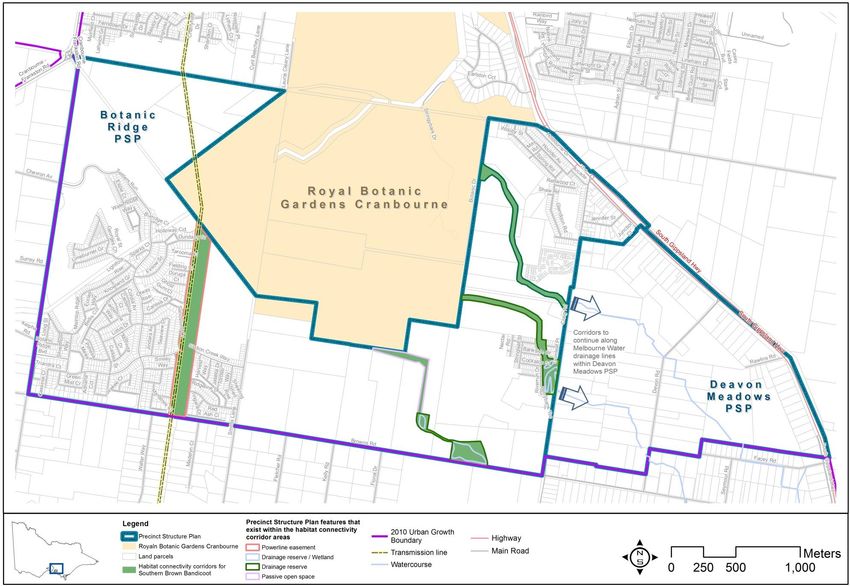
Photo credit
DELWP Remote camera survey, Chinaman Island October 2016

© The State of Victoria Department of Environment, Land, Water and Planning 2016

This work is licensed under a Creative Commons Attribution 4.0 International licence. You are free to re-use the work under that licence,
on the condition that you credit the State of Victoria as author. The licence does not apply to any images, photographs or branding,
including the Victorian Coat of Arms, the Victorian Government logo and the Department of Environment, Land, Water and Planning
(DELWP) logo. To view a copy of this licence, visit http://creativecommons.org/licenses/by/4.0/
ISBN 978-1-76047-686-1 (pdf)

Disclaimer
This publication may be of assistance to you but the State of Victoria and its employees do not guarantee that the publication is without
flaw of any kind or is wholly appropriate for your particular purposes and therefore disclaims all liability for any error, loss or other
consequence which may arise from you relying on any information in this publication.

Accessibility
If you would like to receive this publication in an alternative format, please telephone the
DELWP Customer Service Centre on 136186, email customer.service@delwp.vic.gov.au,
or via the National Relay Service on 133 677 www.relayservice.com.au. This document is
also available on the internet at www.delwp.vic.gov.au.

Contents

Acknowledgements ......................................................................................................................................... 1
Introduction ...................................................................................................................................................... 2
The Melbourne Strategic Assessment Program .......................................................................................... 2
Sub-regional Species Strategy for the Southern Brown Bandicoot .......................................................... 2
Funding ............................................................................................................................................................. 5
Monitoring and reporting ................................................................................................................................ 6
MSA Ecological Reference Group ................................................................................................................. 6
Conservation program .................................................................................................................................... 7
Key direction 1: Undertake community engagement .................................................................................. 7
Key direction 2: Create bandicoot friendly suburbs in Botanic Ridge and Devon Meadows ................. 7
Key direction 3: Improve scientific understanding of the Southern Brown Bandicoot ........................... 8
Key direction 4: Create a habitat connectivity network ............................................................................... 8
Summary of conservation actions for 2017 - 2022 .....................................................................................11
References .....................................................................................................................................................13

Acknowledgements
The Department of Environment, Land, Water and Planning (DELWP) thanks the key implementation
partners: City of Casey, the Melbourne Water, Parks Victoria and the Royal Botanic Gardens Victoria for
contributing and providing advice on this plan. The development of this plan also relied on the advice from a
number of experts with knowledge of the ecology of the Southern Brown Bandicoot and experience in its on-
ground management. DELWP would also like to thank Dr Pia Lentini for the use of the Southern Brown
Bandicoot population viability analysis model which provided a basis for further adaptation and development
under this program.

                                           Implementation Plan for the Southern Brown Bandicoot Sub-Regional Species Strategy                                        1
Introduction
This plan outlines how progress towards conservation outcomes for
the Southern Brown Bandicoot under the Melbourne Strategic
Assessment program will be achieved from 2017 - 2026.
The Department of Environment, Land, Water and Planning (DELWP) developed this plan based on expert
advice received through a series of workshops and discussions, and the results of the Southern Brown
Bandicoot Population Viability Analysis model (PVA model). It was also supported by an analysis of
feasibility and cost of potential activities, drawing on input from stakeholders across the management area.
This plan outlines the key directions for conservation actions for the Southern Brown Bandicoot under the
Melbourne Strategic Assessment (MSA) and how they will be delivered over the next ten years.
The Melbourne Strategic Assessment Program
In 2008, the Victorian Government identified the need to expand Melbourne’s Urban Growth Boundary
(UGB). It was expected the expansion would impact Matters of National Environmental Significance (MNES).
The Environment Protection and Biodiversity Conservation Act 1999 (EPBC Act) controls actions that may
have a significant impact on MNES. If a proponent wants an action assessed for environmental impacts
under the EPBC Act, they must refer the action to the Commonwealth Department of the Environment and
Energy. Under the EPBC Act, the Commonwealth Minister of the Environment may agree to undertake a
strategic assessment on the impacts of actions under a policy, plan or program.
In 2010, the Commonwealth Minister for Environment endorsed a strategic assessment agreement with the
Victorian State Government, known as the MSA (Victorian Government, 2009). The assessment was in
relation to the expansion of Melbourne’s UGB and proposed construction of a Regional Rail Link and
transport corridor.
The Commonwealth Government approved urban development in Melbourne’s expanded UGB, on the
condition that development is undertaken in accordance with the endorsed program outlined in Delivering
Melbourne’s Newest Sustainable Communities (program report) (Victorian Government 2009). The program
report outlines the commitments the Victorian Government made to mitigate the impacts of urban
development on MNES, including the Southern Brown Bandicoot.
Under the MSA program, DELWP is committed to ensuring the persistence of the Southern Brown Bandicoot
in Melbourne’s south east.
Sub-regional Species Strategy for the Southern Brown Bandicoot
The program report required the Victorian Government to prepare the Sub-regional Species Strategy for the
Southern Brown Bandicoot (the sub-regional strategy) (DEPI 2014).
The purpose of the sub-regional strategy is to:
▪ ensure functioning sustainable populations within and adjacent to the growth areas, with connectivity
between populations
▪ protect and enhance all Southern Brown Bandicoot populations, including the population at the
Royal Botanic Gardens Victoria’s Cranbourne Gardens (RBGC).
The development of this implementation plan by DELWP is a requirement under the approved sub-regional
strategy. The strategy and this implementation plan focus on the Southern Brown Bandicoot Management
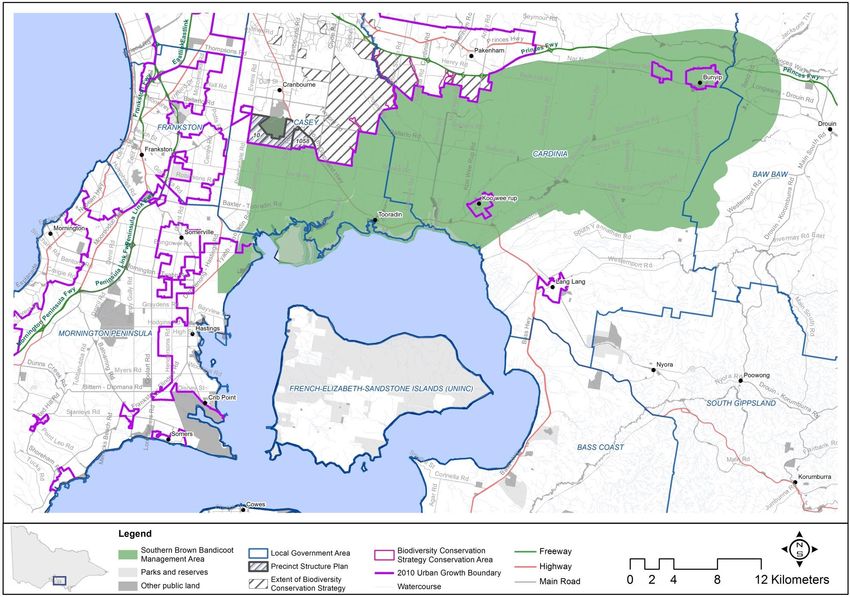
Area (management area). The management area is approximately 60,000 ha and includes the RBGC and
the habitat connectivity corridors in Botanic Ridge and Devon Meadows, and a large area adjacent to the
UGB (Figures 1 and 2). Further details about the management area can be found in the sub-regional
strategy.
2 Implementation Plan for the Southern Brown Bandicoot Sub-Regional Species StrategyFigure 1: Southern Brown Bandicoot Management Area.
Implementation Plan for the Southern Brown Bandicoot Sub-Regional Species Strategy 3Figure 2: Southern Brown Bandicoot habitat connectivity corridors 4 Implementation Plan for the Southern Brown Bandicoot Sub-Regional Species Strategy
Population Viability Analysis and Decision Support Models
The conservation actions outlined in this plan were informed by the findings of a population viability analysis
(PVA) model and decision support model developed for the Southern Brown Bandicoot.
The PVA provides a means for synthesizing current information relevant to the risk of extinction of the
Southern Brown Bandicoot, and can estimate the benefit of different management actions in reducing the
risk. A decision support model integrates the estimated benefit of each management action obtained from
the PVA with estimates of the cost and feasibility to evaluate cost effectiveness of the different management
options. Conservation actions for the Southern Brown Bandicoot within the management area were informed
by both the PVA and the decision support model.
These tools provide DELWP and key partners the ability to:
▪ examine the costs and benefits of different management options
▪ prioritise conservation actions to deliver program outcomes
▪ collate and synthesize information relevant to the conservation of the Southern Brown Bandicoot
▪ provide a transparent collation of information that can be regularly updated using data collected by
the MSA program and the broader scientific community. This will allow management approaches to
be adapted based on up-to-date knowledge and understanding of the species.
The PVA was based on an existing model developed by Pia Lentini and refined using the best available
scientific data and expert advice. It will be updated as further information on the population dynamics and
species responses to management actions becomes available, in consultation with experts.
The PVA will continue to be used to:
▪ prioritise research by identifying important knowledge gaps and uncertainties about the Southern
Brown Bandicoot
▪ inform priorities for investment in on-ground management or land acquisition projects within the
management area outside the UGB.
Funding
The conservation actions outlined in this plan will be funded by a cost recovery model in which fees are
collected from developers within specified areas of the South-Eastern growth corridor. The fees are used to
mitigate the impacts of urban development on Southern Brown Bandicoot habitat in the area outlined in the
sub-regional strategy (DEPI 2014).
The fees will be collected as urban development in the growth corridor proceeds over the next 30 to 40
years. Expenditure on conservation actions in any year is therefore dependent on the amount of funding that
has been received, and existing obligations. There may be periods, particularly in the initial phases of the
program where there may be existing commitments for SBB that must be met, such as for the construction of
culverts or creation of habitat corridors during development within the UGB. It may also be preferable at
times to accrue funds over several years rather than allocate small budgets each year. For example, to
purchase land to protect and manage as a reserve, or to establish an incentive program to fund
enhancement and protection for the species on private land.
The cost recovery model has been developed in accordance with the State Government’s Cost Recovery
Guidelines and rules regarding competition policy. Further details about the cost-recovery model, including
the fee structure and prices, can be found in Habitat Compensation under the Biodiversity Conservation
Strategy – Melbourne Strategic Assessment (DEPI 2013).
Implementation Plan for the Southern Brown Bandicoot Sub-Regional Species Strategy 5Monitoring and reporting
Monitoring and reporting of Southern Brown Bandicoot management is required under the program report to
assess the effectiveness of conservation actions for the species.
The conservation outcomes outlined in this plan will be monitored by DELWP in accordance with the MSA
Monitoring and Reporting Framework (MRF) (DELWP 2015a). The MRF sets outs how the Victorian
Government will monitor and report on activities, processes, program outputs and program outcomes
established to deliver and implement the MSA, including an annual report of funds received and expenditure.
The MRF outlines how DELWP will:
▪ monitor and report on the overall progress towards outcomes using the key performance indicators
(KPI) developed for the program
▪ evaluate the progress of the program implementation every five years.
The protocols for measuring KPIs for each program outcome are detailed in Monitoring and Reporting
Framework: Technical Protocols for Program Outcomes (DELWP 2015b).
The results of the outcome monitoring will be reported every 5 years. The outputs of annual activities will be
reported on an annual basis as part of the yearly progress report.
MSA Ecological Reference Group
DELWP established the MSA Ecological Reference Group (ERG) as an advisory body to play a key role in
guiding ecological design and implementation of the MSA program.
The purpose of this group is to provide expertise and advice to DELWP on the design and implementation of
ecological monitoring, adaptive management and research relevant to the MSA.
The specific roles of the MSA ERG are to:
▪ understand the desired outcomes of the MSA program and how these align with management and
scientific knowledge
▪ facilitate communication between DELWP and the wider ecological and scientific expert community
▪ help maintain the integrity of the program as issues emerge that require changes to be considered
within resourcing and policy constraints
▪ resolve matters of substance brought to the group by DELWP or otherwise arising
▪ advise on research priorities and gaps to enable program objectives to be efficiently achieved.
The MSA ERG is made up of technical experts in experimental design, decision systems, monitoring, land
management, restoration, and prioritisation. The current members of the ERG are:
▪ Prof Andrew Bennett - La Trobe University
▪ Prof. Michael Clarke - LaTrobe University
▪ Dr. John Morgan - La Trobe University
▪ Dr. Kirsten Paris - University of Melbourne
▪ Dr Josh Dorrough - Natural Regeneration Australia
Additional experts may be called upon for advice or to participate in workshops or meetings on specific
issues, for example providing input into refining the PVA for the Southern Brown Bandicoot and genetic
analysis etc.
6 Implementation Plan for the Southern Brown Bandicoot Sub-Regional Species StrategyConservation program
The persistence of Southern Brown Bandicoot populations in Melbourne’s south east is a key conservation
outcome to be achieved under the MSA program. DELWP and implementation partners will deliver a range
of conservation actions to achieve this, focusing on:
▪ functioning sustainable populations within and adjacent to the growth areas, with connectivity
between populations
▪ protection and enhancement of all populations, including the population at the RBGC.
Key direction 1: Undertake community engagement
Increased community understanding, participation and support of management actions is critical to
successful conservation outcomes for the Southern Brown Bandicoot in the management area.
DELWP will fund a part time Community Engagement Officer position based at the RBGC, who will
implement a Southern Brown Bandicoot engagement program (engagement program). The role will be
initially funded for 3 years. The aim of the engagement program will be to increase public understanding of
the importance of the Southern Brown Bandicoot, the threats to its survival, and ways the community can get
involved to protect the species.
The officer will:
▪ develop educational material for use by different groups
▪ develop interpretive signs and materials for the RBGC, habitat connectivity corridors and areas
within the habitat connectivity network
▪ collaborate with local government, schools, developers and community groups
▪ attend or support community events to provide information and educational materials
▪ ensure landowners understand that as well as bandicoots, other animals may utilise the habitat area
including venomous snakes and how risks can be managed
▪ in collaboration with the City of Casey, encourage increased understanding, participation and
ownership of the actions that will be undertaken to conserve the Southern Brown Bandicoot such as
commitment of the community to exclude cats, and keep dogs in yards or on leads within Botanic
Ridge and Devon Meadows.
The role of the officer will also be to encourage and support local government, community and developers to
create bandicoot friendly suburbs in the Botanic Ridge and Devon Meadows precincts. Through these
activities, it is anticipated that the officer will foster community stewardship of the Southern Brown Bandicoot
so the public feel empowered to play a role in the species’ conservation and persistence.
Key direction 2: Create bandicoot friendly suburbs in Botanic Ridge and Devon
Meadows
Located within the south-east growth corridor, the RBGC contains an important population of Southern
Brown Bandicoot. DELWP will support developers, local government and community groups in Botanic
Ridge and Devon Meadows to design Southern Brown Bandicoot friendly suburbs. The objective of this
action is to create landscapes that contain suitable shelter and foraging areas for the species and support
movement from the RBGC.
The following mechanisms will assist to achieve this action:
▪ Residents in these suburbs will be prohibited from owning cats to minimise predator threat to
bandicoots in these areas. The restriction will be enforced by local government.
▪ Developers and landowners will be encouraged to plant native vegetation for bandicoot habitat
through the provision of information on the Southern Brown Bandicoot and a plant species list. This
Implementation Plan for the Southern Brown Bandicoot Sub-Regional Species Strategy 7will complement and support the initiatives of some developers who for example provide home
buyers with a $1,000 voucher for the purchase of native plants for their garden.
▪ Based on expert advice, DELWP will design standards and fund the construction of dry culverts
under roads to support the protected passage of Southern Brown Bandicoots where roads planned
for construction cross the habitat connectivity corridors, both within the Botanic Ridge and Devon
Meadows suburbs, and connecting these corridors to the adjacent land outside the current Urban
Growth Boundary.
▪ City of Casey will consider the introduction and enforcement of local by-laws to reduce threats to
bandicoots. For example, require dogs to be on leads in parks and on footpaths.
▪ Where possible, developers, local government and VicRoads will seek to mitigate the risk of
Southern Brown Bandicoot road kill through the design of new roads. This will include culverts under
roads greater than 5 metres wide to provide passage for Southern Brown Bandicoot, large vegetated
median strips on wide roads and where possible, appropriate speed limits or speed abatement
devices adjacent to Southern Brown Bandicoot habitat.
Habitat connectivity corridors for the Southern Brown Bandicoot will be created and enhanced in Botanic
Ridge and Devon Meadows precincts to enable movement from the RBGC into neighbouring suburbs. This
will be achieved through revegetation and landscaping to create and improve habitat in the two drainage
reserves running in a south easterly direction from the eastern boundary of the RBGC, the public open space
corridor running south from RBGC to Brown’s Rd and the power line easement in Botanic Ridge Stage 1.
A landscape plan will be prepared by the developer for each of the corridors setting out the details of
revegetation and landscaping for Southern Brown Bandicoot habitat. The plan will provide for the creation
and enhancement of habitat while ensuring the primary functions of the areas (such as drainage or
recreation) are maintained and fire risk is managed to ensure no increased risk to adjacent residential areas.
The plan will be prepared in consultation withthe relevant authorities.
Where possible, the landscape design of the corridors within each precinct will create habitat a minimum of
30m wide (wider in the power line easement) and which provides at least 50% average foliage density in the
0.2-1 metre height range in order to provide suitable habitat for the Southern Brown Bandicoot.
Funding to create, enhance and manage habitat will only be provided for appropriate activities that are
additional to existing land management obligations in each habitat connectivitiy corridor.
Key direction 3: Improve scientific understanding of the Southern Brown Bandicoot
The PVA model provides a means of collating and integrating current information and evidence to predict the
risk of extinction of the Southern Brown Bandicoot. DELWP will use the PVA model to prioritise research
funding through the MSA by identifying key knowledge gaps and uncertainties that influence extinction risk
the most and will influence on-ground management decisions. The model can be updated over time as new
knowledge comes to hand, providing more confidence in model predictions. Other contributions of research
to resolve key knowledge gaps and uncertainties or data from the scientific community are encouraged.
Key direction 4: Create a habitat connectivity network
Connectivity of populations is vital to the persistence of Southern Brown Bandicoot, as it allows individuals to
move through the landscape more easily providing for the exchange of individuals and genes within and
between populations. Movement of individuals between connected populations and re-colonisation of
unoccupied habitat can reduce the risk of population decline or extinction.
Grant programs and land acquisition will be used to create a Southern Brown Bandicoot habitat connectivity
network to enable bandicoots to disperse more easily throughout the management area. In order to
encourage landowners to create and protect existing Southern Brown Bandicoot habitat, DELWP will fund
grant programs for private land to enhance habitat connectivity within the management area. The grant
programs will be voluntary.
8 Implementation Plan for the Southern Brown Bandicoot Sub-Regional Species StrategyThe grant programs may include:
▪ Fixed term agreements in which landowners will be paid through either small grants or stewardship
agreements, to undertake conservation activities that protect and enhance habitat for the species,
such as management of remnant vegetation, fox control and revegetation; and
▪ Permanent protection agreements for permanent protection and management of existing Southern
Brown Bandicoot to protect existing habitat or potential habitat in strategic locations.
These programs must complement other schemes including Landcare projects, grants, conservation reserve
management and fox control programs undertaken in the management area by local government, Parks
Victoria, Port Phillip and Westernport Catchment Management Authority and the Western Port Biosphere
Foundation.
Parcels of land which provide habitat and/or key connectivity between habitat areas may be identified for
priority acquisition. These would be voluntary sales, acquired for the reserve system and managed by Parks
Victoria or as local reserves owned and managed by local government, secured through an on-title
permanent protection agreement.
The draft Protecting Victoria’s Environment – Biodiversity 2036 (Biodiversity Plan) being prepared by
DELWP, proposes a regional and community level conservation planning approach to investment. This
approach, which is being further refined as part of the development of the final Biodiversity Plan, is intended
to strengthen communication and engagement between all investor groups, to improve working relationships
and forge partnership approaches to biodiversity funding. This process will provide an opportunity for the
MSA program as an investor to partner with landholders, government agencies, community groups and other
organisations in the identification and development of programs to create a habitat connectivity network. It
will also be an opportunity for delivery partners to leverage funding to support the persistence of the
Southern Brown Bandicoot.
The PVA and decision support model will be used to guide MSA investment decisions about which grant
programs will have the most cost-effective benefit for the species. While programs specifically targeting
conservation actions for the Southern Brown Bandicoot in this area may not be a priority project for Victorian
Government investment under the Biodiversity Plan in comparison to other potential locations and actions,
they will still be acknowledged and accounted for in reporting on progress towards the Biodiversity Plan
targets as well as the outcomes of the MSA.
Given regulatory and timing requirements to deliver other components of this Implementation Plan (e.g.
culverts, habitat connectivity corridors, genetic rescue), funding for the implementation of the habitat
connectivity network is unlikely to be available for another five years until adequate funds have accrued from
habitat compensation fees as urban development proceeds.
Key direction 5: Develop and implement a genetic rescue strategy
In 2016, Monash University conducted a genetic analysis of tissue samples collected from the Southern
Brown Bandicoot populations on Quail Island, RBGC and along Koo Wee Rup Swamp to determine the need
for genetic rescue. The study also looked at samples from individuals from a presumed extensive natural
population in the Lower Glenelg River region in South Australia. The study identified relatively low levels of
genetic variation within all sampled populations and restricted gene flow between populations. The results
suggest that the sampled populations could be vulnerable to decline as a consequence of reduced fitness
due to low genetic diversity.
A state-wide strategy to improve the genetic fitness of Southern Brown Bandicoot populations will be
developed. The development of the plan will include:
▪ Analysis of samples from another presumed extensive population (such as in East Gippsland,
Otway Ranges etc.) to assess “natural” levels of genetic diversity within the taxon and identify
potential source populations.
▪ A risk assessment of any translocation and gene mixing (i.e. the risk of proceeding or not with the
genetic rescue to both the source and recipient populations).
Implementation Plan for the Southern Brown Bandicoot Sub-Regional Species Strategy 9▪ Forward simulations of genetic rescue scenarios and likely population outcomes that would result
from them.
▪ A monitoring program addressing the impact on both populations and genetics.
▪ Animal welfare standards and other regulatory requirements under the Wildlife Act 1975.
The plan will consider the status and relative importance of all populations, with a particular focus on the
RBGC and Quail Island populations in the genetic rescue and conservation of the species. There may be
consideration of the future potential to establish new genetically diverse populations in areas of the former
range of the species where a significant reduction of threats such as foxes has been demonstrated.
10 Implementation Plan for the Southern Brown Bandicoot Sub-Regional Species StrategySummary of conservation actions for 2017 - 2022
Key direction Actions 2017 – 2022 Implementation partners Timing
Undertake community Engage with developers, landowners, school children and new Royal Botanic Gardens Commence July 2017
education residents to ensure they are aware of the Southern Brown Bandicoot Victoria (lead)
and the importance of habitat and predator control for the species.
Provide support on Southern Brown Bandicoot awareness to other
programs (e.g. local government programs, Gardens for Wildlife,
Landcare etc.).
Create Bandicoot friendly Develop revegetation and culvert standards, plant species lists and DELWP 2017
suburbs in Botanic Ridge and review landscape and culvert design.
Devon Meadows precincts
Construct and maintain culverts where habitat corridors within the Developers, City of Casey, As roads are constructed
precincts cross roads. VicRoads
Undertake actions to ensure bandicoot friendly suburbs including cat City of Casey On-going
exclusion from the suburbs, consideration of bandicoots in open
space and transport designs.
Create and enhance habitat for the Southern Brown Bandicoot in the Melbourne Water (lead) As development occurs
two drainage reserves in Botanic Ridge (from the RBGC east to on surrounding
DELWP properties
Craig’s Road).
Within the limitations of the corridor design, create and enhance City of Casey As development occurs
habitat for the Southern Brown Bandicoot in the open space/ on surrounding
equestrian corridor (from the RBGC south to Browns Road). properties
Create and enhance habitat for the Southern Brown Bandicoot in the City of Casey, DELWP Commence design and
power line easement in Botanic Ridge (from the RBGC south to planning in 2017
Browns Road).
Ensure the development of the Devon Meadows Precinct Structure Victorian Planning Authority, As the Precinct Structure
Plan provides for the creation and enhancement of the drainage DELWP City of Casey Plan is developed
corridors and where possible, the design of open space reserves
and other areas considers habitat requirements for the Southern
Brown Bandicoot.
Improve scientific DELWP will use the PVA model to prioritise MSA funding for DELWP, scientific community On-going
understanding of the research by identifying key knowledge gaps and uncertainties.
Implementation Plan for the Southern Brown Bandicoot Sub-Regional Species Strategy 11Key direction Actions 2017 – 2022 Implementation partners Timing
Southern Brown Bandicoot The model will be updated over time as new knowledge comes to
hand.
The scientific community are encouraged to submit data and to
undertake research that will improve the reliability/accuracy of the
PVA model.
Create a habitat connectivity Identify alternative funding streams to support the delivery of All On-going
network outcomes for the Southern Brown Bandicoot in the management
area.
Seek to leverage funds through the Biodiversity Plan implementation
e.g. biodiversity planning process and other funding opportunities.
Genetic rescue of Southern Increase connectivity between Southern Brown Bandicoot Melbourne Water, DELWP Commence 2017
Brown Bandicoot populations populations in Koo Wee Rup Swamp in an effort to improve gene
flow - revegetate and enhance Melbourne Water and Crown land
between Koo Wee Rup and Bayles where feasible
Develop and implement a strategy to improve the genetic fitnessof DELWP Commence 2017
Southern Brown Bandicoot populations in Victoria, which will outline
the relative importance of the Quail Island and RBGC Southern
Brown Bandicoot populations.
Undertake key priority on-ground actions to support genetic rescue Parks Victoria, City of Casey Commence 2017
particularly targeted towards pig and fox control on and adjacent to
Quail Island
12 Implementation Plan for the Southern Brown Bandicoot Sub-Regional Species StrategyReferences
DEPI (2013) Habitat compensation under the Biodiversity Conservation Strategy – Melbourne Strategic
Assessment. Department of Environment and Primary Industries, Victorian Government, East Melbourne.
DELWP (2015) Monitoring and Reporting Framework: Melbourne Strategic Assessment. Department of
Environment, Land, Water and Planning, Victorian Government, East Melbourne.
DEPI (2014) Sub-regional Species Strategy for the Southern Brown Bandicoot. Department of Environment
and Primary Industries, Victorian Government, East Melbourne.
Victorian Government (2009) Delivering Melbourne’s Newest Sustainable Communities – Program Report.
Victorian Government, Department of Planning and Community Development, East Melbourne.
Implementation Plan for the Southern Brown Bandicoot Sub-Regional Species Strategy 13References delwp.vic.gov.au 14 Implementation Plan for the Southern Brown Bandicoot Sub-Regional Species Strategy
You can also read


