Improved Optical Flow for Gesture-based Human-robot Interaction
←
→
Page content transcription
If your browser does not render page correctly, please read the page content below
Improved Optical Flow for Gesture-based Human-robot Interaction
                                                                     Jen-Yen Chang1 , Antonio Tejero-de-Pablos1 and Tatsuya Harada12

                                            Abstract— Gesture interaction is a natural way of commu-                Fig. 1: Overview of our pipeline. The input video from the
                                         nicating with a robot as an alternative to speech. Gesture                 robot’s camera is used to estimate the optical flow with
                                         recognition methods leverage optical flow in order to under-               our novel method. Then, through optical flow-based gesture
                                         stand human motion. However, while accurate optical flow                   recognition, the robot’s operating system (e.g., ROS) selects
                                         estimation (i.e., traditional) methods are costly in terms of              which module to run.
arXiv:1905.08685v1 [cs.HC] 21 May 2019

                                         runtime, fast estimation (i.e., deep learning) methods’ accuracy
                                         can be improved. In this paper, we present a pipeline for
                                         gesture-based human-robot interaction that uses a novel optical
                                         flow estimation method in order to achieve an improved                                            RGB video Input
                                         speed-accuracy trade-off. Our optical flow estimation method
                                         introduces four improvements to previous deep learning-based
                                         methods: strong feature extractors, attention to contours, mid-
                                         way features, and a combination of these three. This results in                          Improved optical flow estimation
                                         a better understanding of motion, and a finer representation of
                                         silhouettes. In order to evaluate our pipeline, we generated our
                                         own dataset, MIBURI, which contains gestures to command a
                                         house service robot. In our experiments, we show how our                                        Gesture recognition
                                         method improves not only optical flow estimation, but also
                                         gesture recognition, offering a speed-accuracy trade-off more
                                         realistic for practical robot applications.
                                                                                                                                         ROS action modules
                                                               I. I NTRODUCTION
                                            In our society, people have a constant need to communi-
                                         cate with each other (e.g., via voice or gestures). Although
                                         voice is normally preferred for its directness, sometimes                        Tracking       Pick up object    …      Open door
                                         verbal communication is not possible due to environmental
                                         factors such as noise, or the inability of one of the interlocu-
                                         tors to communicate, due to, e.g., a speech/hearing disability
                                         or when the interlocutor speaks in another language or has a                  In computer vision, gestures can be recognized using an
                                         very strong accent. In such cases, humans use gestures as an               action recognition method [5] [6]. These methods include
                                         alternative modality for interaction [1]. On the other hand,               optical flow estimation in their pipeline to facilitate under-
                                         robots are increasingly being adopted in our daily life. There             standing the dynamic nature and the spatio-temporal features
                                         has been a rising demand for domestic service robots for                   of gestures. Current optical flow estimation methods have
                                         entertainment purposes [2], taking care of elders or hospital              limitations: (1) they result in a blurry representation of the
                                         patients [3], and carrying out domestic tasks. An example of               human silhouette that misses a lot of detail, and (2) they are
                                         these robots are the Human Support Robot (HSR) developed                   time-costly. Algorithms with an excessive runtime are not
                                         by Toyota and Pepper developed by Softbank Robotics. The                   suitable for real time gesture-based HRI. If recognizing a
                                         speech recognition modules installed in house service robots               gesture takes too long (e.g., 30s), communication is heavily
                                         (e.g., DeepSpeech [4] or Google Speech API) have achieved                  hindered. On the other hand, if the recognition time is fast
                                         near human level performance. However, similarly to hu-                    but the accuracy is poor, recognition mistakes will make the
                                         mans, human-robot verbal communication is also affected                    communication impossible.
                                         by factors such as noisy environments, a malfunctioning                       In this work, we present a gesture recognition pipeline
                                         microphone, or situations in which the robot and the human                 (Fig. 1) designed for human-robot interaction that achieves a
                                         do not “speak” the same language. In order to achieve a more               good trade-off balance between speed and accuracy. In order
                                         reliable human-robot interaction (HRI), an alternative way to              to obtain a finer spatio-temporal representation of human
                                         communicate with the robot is necessary. As with humans,                   motion, we proposed a novel optical flow that pays attention
                                         gestures provide an alternative modality for communication,                to the human body silhouette, and thus, achieves a better
                                         and thus, gesture recognition plays an important role in HRI.              recognition accuracy. Our contributions are:
                                            1 is with the Graduate School of Information Science and Technology,
                                                                                                                      •   Three novel optical flow estimation methods that incor-
                                         The University of Tokyo, Japan. Email: {chou, antonio-t, harada}@mi.t.u-         porate attention to allow for better gesture recognition.
                                         tokyo.ac.jp
                                            2 is with the RIKEN Center for Advanced Intelligence Project (RIKEN       •   An optical-flow based gesture recognition pipeline
                                         AIP), Tokyo, Japan. Email: tatsuya.harada@riken.jp                               with improved speed-accuracy trade-off, designed for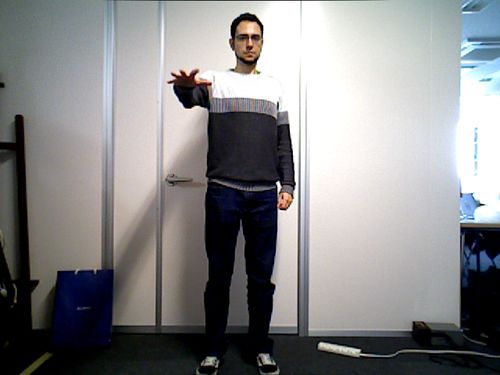
human-robot interaction.                                              network, FlowNet [17], proposed two networks, namely
  •   A self-generated dataset for human-robot interaction,                 FlowNetS and FlowNetC, and greatly improved the runtime
      MIBURI1 , designed to command the robot to complete                   of previous work. Zhu et al. [18] developed an optical flow
      household tasks.                                                      estimation method called DenseNet by extending a deep
                                                                            network for image classification, and demonstrated that it
                        II. R ELATED WORK                                   outperforms other unsupervised methods. FlowNet 2.0 [19]
A. Human-Robot Interaction Via Gestures                                     is a follow-up paper of FlowNet [17]. They stacked two
   Nowadays, most human-robot interaction methods are                       optical flow estimation networks (FlowNetS and FlowNetC)
speech recognition-based [7] [8]. Unfortunately, the use of                 and achieved state-of-the-art results comparable to traditional
speech recognition is somewhat limited, due to environ-                     optical flow methods while running on 8 to 140 fps depend-
mental, hardware, or linguistic problems (Sec. I). Gesture                  ing on the desired accuracy (the higher the accuracy, the
communication serves as a natural alternative to speech                     slower the runtime). However, one of the main problems of
[1]. Previous works [9], [10] study the effect of robots                    FlowNet 2.0 [19] is its model size (parameter counts). Since
performing gestures to communicate with humans. However,                    the architecture is stacked, the parameter count is naturally
our interest is in humans commanding the robot through                      high. Recently, some methods focused on obtaining the same
gestures. Most existing works on human-robot interaction                    accuracy while reducing its model size [20].
(HRI) via gestures focus on hand gesture recognition [11].                    III. O PTICAL F LOW- BASED G ESTURE R ECOGNITION
However, hand gestures limit the motion to only the hand
part of the human body, which may not be intuitive enough                      Figure 1 depicts an overview of the basic pipeline of
for general human users to perform. Unlike these works, we                  our gesture recognition method for human-robot interaction
also refer to motions involving the whole body as gestures.                 (HRI). The RGB video of the user performing a gesture is fed
                                                                            to our optical-flow estimation method, and then, the resulting
B. Gesture Recognition and Optical-Flow based Gesture                       optical flow is used to recognize the gesture.
Recognition                                                                    We implemented our modules by taking into account the
   In robot vision, gestures can be recognized using action                 trade-off between the recognition accuracy and speed. While
recognition methods that combine appearance and motion.                     most gesture/action recognition methods employ optical flow
Whereas color-only methods [12] can recognize certain                       (Sec. II-C), they mainly use traditional optical flow estima-
activities such as sports, their representation of motion is                tion. We argue that using deep learning for estimating optical
not fine enough to differentiate between similar gestures. In               flow results in a better trade-off between gesture recognition
contrast, optical flow is a better representation of motion.                runtime and accuracy, and thus, is adequate for HRI. We also
Deep learning-based action recognition using optical flow                   argue that adding an attention mechanism to deep learning
achieved outstanding results with the two-stream network                    optical flow estimation results in a higher accuracy, not only
approach [5] developed by Simonyan et al.. They trained two                 for optical flow estimation (reduces blurriness in contours),
separate convolutional neural networks to explicitly capture                but also for gesture recognition (refines the user’s silhouette).
spatial features from color images and temporal features from                  Following the same criteria, we feed our optical flow to the
optical flow. Finding Action Tubes [13] extended the work of                TSN action recognition network [6] (Sec. II-B), as it features
Simonyan et al. by proposing candidate regions descriptors                  state-of-the-art accuracy with short recognition time. That is,
instead of full images in order to localize the action to                   approximately one second on a GTX 1080 GPU, for action
improve the recognition accuracy. However, the trade-off                    recognition on 120 images (4 seconds of video at 30fps).
between the runtime of recognizing the gesture and accuracy                    The next section explains in detail our contribution in
of such recognition can be improved. Recent approaches such                 optical flow estimation.
as Temporal Segment Networks (TSN) [6], and [14] further                                  IV. O PTICAL FLOW ESTIMATION
extended the two-stream approach. More concretely, TSN
proposed to concatenate video frames into segments for a                       We define optical flow estimation as the task of predicting
better speed-accuracy trade-off.                                            motion pixel-wise in two consecutive frames. It can be also
                                                                            seen as a way of understanding the spatio-temporal features
C. Optical Flow Estimation                                                  of movements, actions and gestures. We aim to improve
   In optical flow-based gesture recognition, such as the                   estimation accuracy in three ways: by using stronger image
previously described [14] and [6], in order to estimate optical             feature extractors, by adding attention to the estimation,
flow from the input images, researchers deployed traditional                and by emphasizing mid-level feature representations. Based
optical flow estimation methods, namely the TVL1 [15],                      on this, we propose three novel optical flow estimation
and the work of Brox et al. [16]. These optical flow esti-                  networks.
mation methods reached state-of-the-art accuracy, but they
                                                                            A. Stronger feature extractors
are slow. To tackle this, researchers leveraged deep learning
techniques. The first attempt of a deep optical flow estimation                Optical flow estimation aims to predict how pixels move,
                                                                            and thus, we have to understand images at pixel-level. That
  1 MIBURI   project URL: https://www.mi.t.u-tokyo.ac.jp/projects/miburi/   is, first we extract features from each pixel of an image, then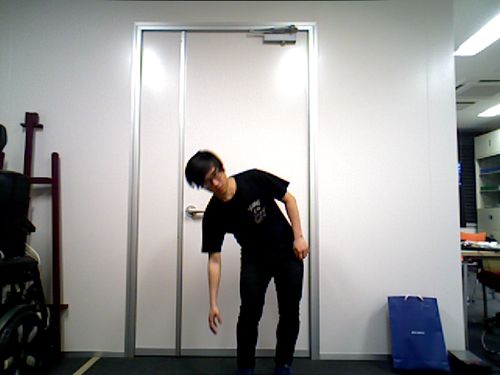
Fig. 2: Proposed optical flow estimation networks. Top left: original FlowNetS [17]. Top right: AttFlowNet{Res, Inc, NeXt32,
NeXt64}. Bottom left: MidFlowNet{Res, Inc, NeXt32, NeXt64} [17]. Bottom right: AttMidFlowNet{Res, Inc, NeXt32,
NeXt64}. For all figures below, orange blocks are convolutional layers (feature extractors), blue blocks are transposed
convolutional layers, green blocks are optical flow estimators, yellow blocks are attention calculators. Numbers indicate
layer size (same number, same size).

                                                                                    2                       6       5         4       3       2           1
                                                                            3
                                                                    4
                                                            5
                                                        6                                                   +       +         +       +       +           +
                                                                                            1 2 3 4 5 6     x 6     x 5           4       3           2       1       0
                                                                                                                              x       x       x           x
                      1       2       3   4     5   6   6   5       4       3

                                                                                                            6       5         4       3       2           1

                                                                                                                                  4               3               2               1
                                                                3               2           1
                                                                                                             downsample
                                                    4                                                                                             +               +               +
                  downsample
                                                                                                                              4   +       3       x       2       x       1       x   0
                                                                                                    1 2   3 4 5 6       cat
                                                            3           2               1       0
                                                                                                                                  x
                                                                                                                                                  3               2               1
        1 2   3   4       5       6       cat       4
                                                                                                                                  4
                                                                                                                upsample                          5
                          upsample
                                                            5                                                                             5               6
                                                                                                                                                  +               +           6
                                                                        6
                                                                                                                                                  x               x
                                                                5               6
                                                                                                                                                  5               6

we match the features between two consecutive images, and                                             This makes the contours between different entities sharper.
finally we estimate pixel-level movement. Therefore, we can                                           To achieve this, our novel network adopts an attention
expect that a better understanding of the images results in a                                         mechanism that was originally used for putting emphasis on
more accurate matching. As shown in [18], in optical flow                                             keywords in the field of natural language processing [25].
estimation, feature extractors trained on image classification                                        This attention mechanism enlarges the difference between
tasks are recommendable for unsupervised learning.                                                    dissimilar optical flow values, so estimations for pixels
   Our novel optical flow estimation uses stronger feature                                            within the same moving entity will be similar. The overall
extraction blocks (i.e. blocks capable of extracting more                                             formula for applying attention to a layer is
discriminative features, tested in image classification tasks)
onto an existing baseline estimation network. We chose                                                              y = sigmoid(x + x ∗ attention(x)),                                    (1)
FlowNetS [17] as our base network due to its well-balanced                                            where x is the input features to the layer, y is the output
speed-accuracy trade-off. For this purpose, we resorted to                                            of the layer, and attention(x) is a set of convolutional
four feature extractors widely used for classifying the Im-                                           layers (details in Table I). When attention(x) is 0, the
ageNet dataset [21]: ResNet [22], Inception [23], ResNext                                             output features will be the same as the original features.
(4x32d block) and ResNext (4x64d block) [24]. We replaced                                             Finally, a sigmoid activation function is applied. Thus, large
the simple convolutional layers present in FlowNetS [17]                                              estimations are enlarged whereas smaller estimations remain
with an adaptation of ResNet, Inception and ResNext. We                                               similar. Attention allows preserving the silhouettes of the
named these optical flow estimation networks as FlowNe-                                               moving parts of the image. Figure 2 (top-right) shows a
tRes, FlowNetInc, FlowNeXt32 and FlowNeXt64 respec-                                                   schematic diagram, derived from the original FlowNetS
tively (Fig. 2).                                                                                      [17]. We named these optical flow estimation networks
                                                                                                      as AttFlowNetRes, AttFlowNetInc, AttFlowNext32, and At-
B. Attention module                                                                                   tFlowNext64 respectively. It is also noted that starting from
  Once the feature extraction is improved, we target the                                              here, we added additional upscaling back to the original
optical-flow estimation. Ideally, pixels belonging to the same                                        resolution, as the final estimation resolution of FlowNetS
entity (e.g., a hand) should have similar optical flow values.                                        [17] is only to the 1/4 of the original resolution.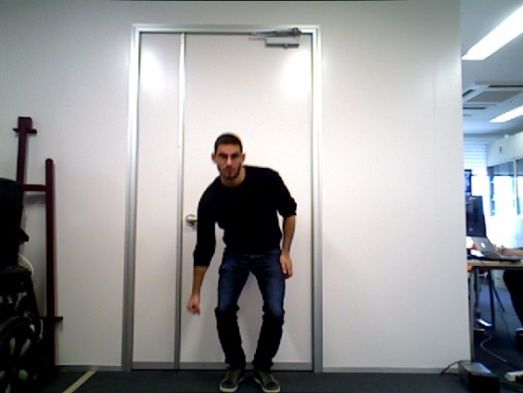
TABLE I: Architecture of our attention module                TABLE II: General architecture of MidFlowNet
        Name       Kernel   Strides     Input      Ch I — O
                                                                   {Res,Inc,NeXt}. Bi up means bilinear upsampling.
                                                                   Avg down means average-pooling. the output of biup
       attconv1     3x3       2            x        x — x/4
       attconv2     3x3       2        attconv1    x/4 — x/8       and avgdown has the same size as block4 1. Pr means
      attdeconv1    4x4       2        attconv2    x/8 — x/4       optical flow estimation. Loss is EPE loss. Deconv is
      attdeconv2    4x4       2       attdeconv2    x/4 — x        deconvolution followed by LeakyRelu activation. Up is only
                                                                   deconvolution. Concat concatenates at the channel axis.
                                                                        Layer Name   Kernel    Strides     Input      Ch I/O
C. Midway module
                                                                           block1      7x7       2       Im1+Im2        6/64
   One of the major challenges with optical flow estimation                block2      5x5       2         block1      64/128
is predicting a correct general direction of the motion. This is           block3      5x5       2         block2     128/256
normally solved by using a pyramid structure, like the one                block3 1     1x1       1         block3     256/256
                                                                           block4      1x1       2        block3 1    256/512
presented in SpyNet [26] or [27]. These pyramid methods                   block4 1     1x1       1         block4     512/512
learn features starting from the largest feature patches down              block5      1x1       2        block4 1    512/512
to the smallest ones. However, we lose estimation accuracy                block5 1     1x1       1         block5     512/512
when we take the same strategy on estimations when we                      block6      1x1       2        block5 1    512/1024
upscale back to the original resolution. We argue that, in                block6 1     1x1       1         block6    1024/1024
                                                                           biup 1                         block6 1   1024/1024
order to estimate the overall optical flow more accurately,                biup 2                         block5 1    512/512
mid-level estimations are crucial. Mid-level means that the              avgdown 1                        block3 1    256/256
scale of the estimation is scaled-down from the original                 avgdown 2                         block2     128/128
input frame size, but not too small so that each pixel can                 concat
                                                                                       biup 1 + biup 2 + block4 1
                                                                                                                      -/2432
represent its nearby estimation but will not over represent.                           + avgdown 1 + avgdown 2
                                                                         pr4+loss4     3x3        1        concat      2432/2
Therefore, the estimation will have more uniform patches
                                                                           down4       4x4        2      pr4+loss4       2/2
overall, and no sharp changes inside the same object, but will            deconv4      4x4        2        concat     2432/512
have sharp contrasts especially on the contours. Therefore,               concat5     block5 1 + deconv4 + down4       -/1026
we designed a novel module that puts emphasis on the mid-                pr5+loss5     3x3        1       concat5      1026/2
level estimations. A schematic diagram is shown in Fig. 2                  down5       4x4        2      pr5+loss5       2/2
(bottom-left). We named these optical flow estimation net-                deconv5      4x4        2       concat5    1026/1024
                                                                          concat6     block6 1 + deconv5 + down5       -/2050
works MidFlowNetRes, MidFlowNetInc, MidFlowNext32,
                                                                         pr6+loss6     3x3        1       block6 1     2050/2
and MidFlowNext64 respectively. Table II shows the archi-                   up4        4x4        2      pr4+loss4       2/2
tecture and layer sizes of our MidFlowNet.                                deconv3      4x4        2        concat     2432/256
                                                                          concat3      block3 1 + deconv3 + up4         -/514
D. Attention-midway module                                               pr3+loss3     3x3        1       concat3      514/2
   Our proposed novel optical-flow estimation method is                     up3        4x4        2      pr3+loss3       2/2
based on the combination of attention and midway. This                    deconv2      4x4        2       concat3     512/128
                                                                          concat2      block3 1 + deconv2 + up3         -/258
way, we manage to simultaneously put emphasis on both
                                                                         pr2+loss2     3x3        1       concat2      258/2
the mid-level estimations and the contours. Figure 2 shows                  up2        4x4        2      pr2+loss2       2/2
a schematic diagram. We named these optical flow esti-                    deconv1      4x4        2       concat2      258/64
mation networks as AttMidFlowNetRes, AttMidFlowNetInc,                    concat1            deconv1 + up2               -/66
AttMidFlowNext32, and AttMidFlowNext64 respectively.                     pr1+loss1     3x3        1       concat1       66/2
                                                                            up1        4x4        2      pr1+loss1       2/2
                       V. E XPERIMENTS                                    deconv0      4x4        2       concat1      66/32
                                                                          concat0            deconv0 + up1               -/34
   To the best of our knowledge, previous gesture recognition
                                                                         pr0+loss0     3x3        1       concat0       34/2
works do not discuss whether having a more accurate optical
flow estimator results on more accurate gesture recognition.
In order to shed light on the matter, we have conducted two
                                                                   A. MIBURI: Video gesture Dataset for commanding Home
experiments. First, we compared our optical flow estimation
                                                                   Service Robots
methods against the state of the art. Then, we evaluate the
improvement in gesture recognition accuracy when using our            In order to evaluate the performance of gesture recognition
estimated optical flow. In each experiment, our proposed           for commanding a home service robot, a video dataset of
method for optical flow estimation and gesture recognition         gestures is required. Since, to the best of our knowledge, no
is trained end-to-end. For this, in order to evaluate the          existing public dataset fits our needs, we generated our own.
recognition of gestures to command a home service robot, we           Our dataset, MIBURI, was collected using HSR robot’s
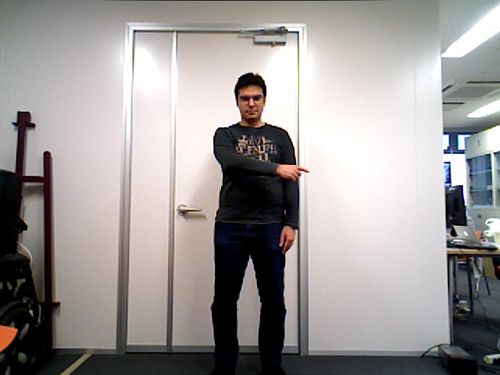
generated our own dataset, MIBURI. The runtime provided            head camera, an ASUS Xtion (640×480 resolution). It
in this section corresponds to the execution times of our          contains 10 gestures: pick-bag, drop-bag, follow-me, stop-
algorithms in an Nvidia TITAN X GPU, with data stored on           follow-me, bring-drink, bring-food, on-the-left, on-the-right,
SSD (to minimize data reading time).                               yes/confirm, no/decline (see examples in Fig. 3).
Fig. 3: Examples of our MIBURI dataset (top): pick-bag,                 to estimate optical flow. It is created by applying affine
drop-bag, on-the-left. Examples of the ChaLearn IGR dataset             transformations to real images and synthetically rendered
(bottom): surgeon needle holder, italian d’accordo, volleyball          chairs. The dataset contains 22,872 image pairs: 22,232
referee substitution                                                    training and 640 test samples according to the standard
                                                                        evaluation split, with resolution 512×384. MPI Sintel [29]
                                                                        is a synthetic dataset derived from a short open source
                                                                        animated 3D movie. There are 1,628 frames, 1,064 for
                                                                        training and 564 for testing with a resolution of 1024×436.
                                                                        The difference between them is that Clean pass contains
                                                                        realistic illuminations and reflections, and Final pass added
                                                                        additionally rendering effects like atmospheric effects and
                                                                        defocusing blurs.
                                                                           We measured the performance of our estimation networks
                                                                        via End Point Error (EPE). EPE is calculated using Euclidean
                                                                        distance between the ground truth optical flow and the
                                                                        estimated optical flow. For training, we used exclusively
TABLE III: Results of optical flow estimation in EPE (End               FlyingChairs train set, since MPI Sintel is too small for
Point End, the lower the better). The runtime reported is on            large-scale deep learning training. Then, FlyingChairs is
FlyingChairs.                                                           tested in its test set, and both Sintel results are on their
                        Flying-   Sintel   Sintel              Flow
                                                                        respective train sets.
       Model            Chairs    clean     final   Params.   runtime      1) Discussion:
                        (EPE)     (EPE)    (EPE)                (s)        Stronger feature extractors generalize better: Our base
                             Related works                              networks with stronger feature extractors perform similarly
   FlowNetS [17]          2.71      4.50      5.45    38.5M   0.080     to FlowNetS and FlowNetC on our training dataset, Fly-
   FlowNetC [17]          2.19      4.31      5.87     39M    0.150     ingChairs, but outperform both of these networks on both
    SpyNet [26]           2.63      4.12      5.57     1.2M   0.069
                                                                        of the Sintel passes. This is because, while FlowNetS and
    Zu et al. [18]        4.73        -      10.07      2M    0.130
    MSCSL [20]            2.08      3.39      4.70        -   0.060     FlowNetC achieved a good EPE on FlyingChairs, they do
                 Ours: base (stronger feature extractors)               not generalize well to other datasets.
    FlowNeXt32            2.58      3.82      4.38    33.8M   0.066        Stronger feature extractors are more robust to noise:
    FlowNeXt64            2.70      4.14      4.65    49.3M   0.071     Although some related works, e.g. MSCSL, achieved better
    FlowNetRes            2.26      3.56      4.06    52.2M   0.055     Sintel clean results, we observed that our base networks
     FlowNetInc           2.27      3.94      4.40    25.9M   0.044
                          Ours: with attention
                                                                        achieved better Sintel final results. This proves that by
  AttFlowNeXt32           1.94      5.08      6.91    26.8M   0.060     adapting stronger feature extractors onto learning optical
  AttFlowNeXt64           1.62      4.71      6.65    42.3M   0.074     flow, the networks can understand motion better and ignore
                          Ours: with midway                             the additional atmospheric effects and motion blurs included
  MidFlowNeXt32           1.74      5.85      7.86    51.2M   0.055     in the final pass better, thus obtaining closer results between
  MidFlowNeXt64           1.48      5.30      7.45    66.8M   0.076     the Sintel clean and Sintel final benchmarks.
                   Ours: with attention and midway
 AttMidFlowNeXt32         1.51      4.89      6.62    48.4M   0.074
                                                                           Our method outperforms others in FlyingChairs: By
 AttMidFlowNeXt64         1.60      5.25      6.74    64.0M   0.092     adding the attention mechanism, midway estimations and
                                                                        attention-midway combined, we significantly outperformed
                                                                        other methods on the training set, FlyingChairs, with an
   When selecting the motion for each gesture, we applied               improvement of between 20% to 45%. However, we per-
the following criteria: (1) they are easily understandable for          formed poorer on the Sintel dataset. We think it is be-
general people, even the first time they see them; (2) they are         cause of the dataset difference between Sintel and Fly-
natural for humans to perform. These two points are essential           ingChairs, also discussed in [17]. Sintel has larger motions
from the perspective of HRI, since gestures should be used              than FlyingChairs. When performing deconvolutions, the
effortlessly to command the robot [28]. We recorded gestures            larger motions will more likely be upsampled less accurately,
for 15 users (among them 3 females and 12 males ranged                  therefore resulting in an larger EPE. Hence, when we reached
from age 22 to age 30) and four repetitions per gesture, which          very accurate FlyingChairs estimations, which feature more
sums up to a total of 600 videos consisting of 69835 frames.            smaller motions, we will suffer on Sintel. Nevertheless, our
The average duration of the video is 3.88s.                             attention and midway networks, individually and combined,
                                                                        achieve the highest accuracy to date to our knowledge on the
B. Optical flow estimation evaluation                                   FlyingChairs dataset.
  Table III shows the optical flow estimation results. We                  Our method improves the speed-accuracy trade-off:
evaluated our networks with the FlyingChairs dataset [17],              Adding an attention module improves runtime (faster execu-
and the MPI Sintel dataset [29]. FlyingChairs [17] is a                 tion) and reduces the model size (less memory consumed).
synthetic dataset designed specifically for training CNNs               Then, the midway module reduces the runtime but increases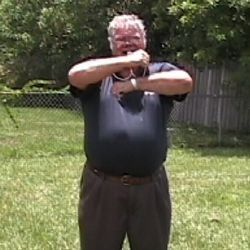
1) Discussion:
TABLE IV: Gesture recognition accuracy with our proposed              Attention improves gesture recognition: Adding at-
optical flow. The runtime reported is on MIBURI, and               tention to our deep learning-based networks translated to
includes gesture recognition optical flow estimation.              a better gesture recognition performance in both datasets.
                             MIBURI     ChaLearn IGR Recognition   This effect can be observed for TSN/FlowNeXt{32/64} vs
          Model
                           accuracy (%) accuracy (%) runtime (s)   TSN/AttFlowNeXt{32/64} and TSN/MidFlowNeXt{32/64}
                                Baseline                           vs TSN/AttMidFlowNext{32/64}. As we hypothesized, since
     iDT+FV+SVM                 98.3             -        27.1     attention provides a more refined human silhouette, human
      TSN (default)             96.9           94.55      11.1
                                                                   motion is better represented, and thus, the performance of
     TSN/FlowNetS               73.9           84.98       1.7
               Ours: base (stronger feature extractors)
                                                                   optical flow-based gesture recognition methods is improved.
   TSN/FlowNeXt32               92.1           76.83      4.7         Better EPE does not necessarily imply better gesture
   TSN/FlowNeXt64               93.8           81.79      7.9      recognition: In our experiments with MIBURI, improve-
                          Ours: with attention                     ment in optical flow and gesture recognition is correlated.
  TSN/AttFlowNeXt32             96.9           84.31      4.1      For ChaLearn IGR on the other hand, in spite of being
  TSN/AttFlowNeXt64             96.9           87.51      6.4
                                                                   outperformed in optical flow estimation by our networks,
                          Ours: with midway
  TSN/MidFlowNeXt32             96.9           85.94      6.0
                                                                   TSN/FlowNetS achieves better recognition accuracy than our
  TSN/MidFlowNeXt64             96.9           85.02      8.5      base. The reason for this mismatch is that, whereas only
                    Ours: with attention and midway                correctly-recognized motions account for gesture recogni-
 TSN/AttMidFlowNeXt32           96.9           86.00      7.2      tion, EPE metric also takes into account correctly-recognized
 TSN/AttMidFlowNeXt64           98.4           85.43      9.6      background pixels. The way of obtaining a good score in
                                                                   both metrics is by providing an accurate representation of
                                                                   the human silhouette, like in our attention mechanism.
the model size. The best speed-accuracy trade-off is achieved         Our method improves the speed-accuracy trade-off:
on the FlyingChairs dataset by combining attention and             Compared to traditional optical flow estimation methods,
midway since, although the runtime increases by 10%, the           deep learning-based methods allow for a faster gesture
accuracy increases by 45%.                                         recognition, which has a lot of impact in HRI. With
                                                                   our MIBURI dataset, comparing TSN/FlowNeXt{32/64}
C. Gesture recognition evaluation                                  vs TSN/AttFlowNeXt{32/64}, adding attention improved
                                                                   recognition accuracy by 7% to 10% while runtime decreases,
   Table IV shows the gesture recognition accuracy when            achieving the best speed-accuracy trade-off. While other
using our optical flow estimation methods. For that, we used       configurations achieve higher accuracies, their recognition
our MIBURI dataset and the Isolated Gesture Recognition            runtime makes them prohibitive for HRI.
Challenge (IGR) dataset. In MIBURI, our training split
contains the first three gesture repetitions of each user for                               VI. C ONCLUSION
training, and the remaining for testing. The IGR dataset (in          In this paper, we presented a novel optical flow estimation
ICPR 2016) was derived from one of the popular gesture             method and evaluated it in a gesture recognition pipeline for
recognition datasets, the ChaLearn Gesture Dataset 2011            human-robot interaction. We presented four ways of improv-
[30]. It includes in total 47933 RGB-D gesture videos, where       ing optical flow estimation: stronger feature extractors, atten-
each RGB-D video represents an isolated gesture (we only           tion mechanism, midway mechanism, and a combination of
used the RGB channels). The dataset is split in 35878 videos       the latter. Due to the lack of gesture datasets for commanding
for training, 5784 videos for validation and 6271 videos for       house service robots, we generated a gesture dataset called
testing. The resolution is 240×320. There are 249 gestures         MIBURI. We proved that our method allows for a better
labels performed by 21 different individuals. The gestures         representation of motion, improving the optical flow esti-
are very diverse (e.g., music notes, diving signals, referee       mation of existing deep learning-based gesture recognition
signals), which makes it more challenging than MIBURI.             work. This improvements also lead to more accurate gesture
   We chose the optical flow branch of the Temporal Segment        recognition, and achieve a better speed-accuracy trade-off. In
Network (TSN) [6] as our gesture recognition method, since         the future, we plan to extend this work by integrating it with a
its performance is state-of-the-art and the speed-accuracy         robot, and comparing the efficiency of gesture-based human-
trade-off is well balanced. We compared it to three baselines:     robot interaction against current voice-controlled approaches.
First, improved dense trajectories (iDT) [31] with Fisher vec-
tor (FV) encoding [32] and support vector machines (SVM)                                ACKNOWLEDGMENT
classifier, which combined were the state of the art before          This work was partially supported by JST CREST Grant
deep learning [31]. Second, TSN (default) uses traditional         Number JPMJCR1403, Japan. The authors have participated
(i.e., non-deep learning-based) optical flow estimation [15].      in the HSR developer community2 and made use of HSR
Third, TSN/FlowNetS is TSN’s optical flow branch replaced          hardware and software platforms.
with optical flow estimation from FlowNetS [17].
                                                                     2 https://newsroom.toyota.co.jp/jp/detail/8709536
R EFERENCES [23] C. Szegedy, V. Vanhoucke, S. Ioffe, J. Shlens, and Z. Wojna, “Re-
thinking the inception architecture for computer vision,” in IEEE
[1] Goldin-Meadow, “The role of gesture in communication and thinking.” Conference on Computer Vision and Pattern Recognition (CVPR),
Trends in cognitive sciences, vol. 3 11, pp. 419–429, 1999. 2016.
[2] M. Lohse, F. Hegel, and B. Wrede, “Domestic applications for [24] S. Xie, R. Girshick, P. Dollár, Z. Tu, and K. He, “Aggregated residual
social robots: an online survey on the influence of appearance and transformations for deep neural networks,” in IEEE Conference on
capabilities,” Journal of Physical Agents, vol. 2, pp. 21–32, June 2008. Computer Vision and Pattern Recognition (CVPR), 2017.
[25] D. Bahdanau, K. Cho, and Y. Bengio, “Neural machine translation by
[3] I. Leite, C. Martinho, and A. Paiva, “Social robots for long-term
jointly learning to align and translate,” in International Conference on
interaction: A survey,” International Journal of Social Robotics, vol. 5,
Learning Representations (ICLR), 2015.
April 2013.
[26] A. Ranjan and M. J. Black, “Optical flow estimation using a spatial
[4] D. Amodei et al., “Deep speech 2: End-to-end speech recognition in
pyramid network,” in IEEE Conference on Computer Vision and
english and mandarin,” in IEEE International Conference on Machine
Pattern Recognition (CVPR), 2017.
Learning (ICML), 2016.
[27] B. D. Lucas and T. Kanade, “An iterative image registration technique
[5] K. Simonyan and A. Zisserman, “Two-stream convolutional networks with an application to stereo vision,” in International Joint Conference
for action recognition in videos,” in Neural Information Processing on Artificial Intelligence (IJCAI), vol. 2, 1981, pp. 674–679.
Systems (NIPS), 2014. [28] J. L. Raheja, R. Shyam, U. Kumar, and P. B. Prasad, “Real-time
[6] L. Wang, Y. Xiong, Z. Wang, Y. Qiao, D. Lin, X. Tang, and L. V. Gool, robotic hand control using hand gestures,” in International Conference
“Temporal segment networks: Towards good practices for deep action on Machine Learning and Computing (ICMLC), Feb 2010, pp. 12–16.
recognition,” in European Conference on Computer Vision (ECCV), [29] D. J. Butler, J. Wulff, G. B. Stanley, and M. J. Black, “A naturalistic
2016. open source movie for optical flow evaluation,” in European Con-
[7] H. Medicherla and A. Sekmen, “Human–robot interaction via voice- ference on Computer Vision (ECCV), ser. Part IV, LNCS 7577, A.
controllable intelligent user interface,” Robotica, vol. 25, no. 5, pp. Fitzgibbon et al. (Eds.), Ed. Springer-Verlag, Oct 2012, pp. 611–
521–527, 2007. 625.
[8] O. Mubin, J. Henderson, and C. Bartneck, “You just do not understand [30] I. Guyon, V. Athitsos, P. Jangyodsuk, and H. J. Escalante, “The
me! speech recognition in human robot interaction,” in IEEE Interna- chalearn gesture dataset (cgd 2011),” Machine Vision and Applications,
tional Symposium on Robot and Human Interactive Communication vol. 25, no. 8, pp. 1929–1951, Nov. 2014.
(RO-MAN), Aug 2014, pp. 637–642. [31] H. Wang and C. Schmid, “Action recognition with improved trajecto-
[9] M. Salem, S. Kopp, I. Wachsmuth, K. Rohlfing, and F. Joublin, “Gen- ries,” in IEEE Conference on Computer Vision and Pattern Recognition
eration and evaluation of communicative robot gesture,” International (CVPR), Dec. 2013, pp. 3551–3558.
Journal of Social Robotics, vol. 4, no. 2, pp. 201–217, April 2012. [32] J. Sánchez, F. Perronnin, T. Mensink, and J. Verbeek, “Image clas-
[10] B. Gleeson, K. MacLean, A. Haddadi, E. Croft, and J. Alcazar, sification with the fisher vector: Theory and practice,” International
“Gestures for industry intuitive human-robot communication from Journal of Computer Vision (IJCV), vol. 105, no. 3, pp. 222–245, Dec
human observation,” in International Conference on Human-Robot 2013.
Interaction (HRI), March 2013, pp. 349–356.
[11] L. Brethes, P. Menezes, F. Lerasle, and J. Hayet, “Face tracking
and hand gesture recognition for human-robot interaction,” in IEEE
International Conference on Robotics and Automation (ICRA), vol. 2,
April 2004, pp. 1901–1906.
[12] K. Soomro, A. Roshan Zamir, and M. Shah, “UCF101: A dataset
of 101 human actions classes from videos in the wild,” in IEEE
International Conference on Computer Vision (ICCV), Dec 2012.
[13] G. Gkioxari and J. Malik, “Finding action tubes,” in IEEE Conference
on Computer Vision and Pattern Recognition (CVPR), 2015.
[14] C. Feichtenhofer, A. Pinz, and A. Zisserman, “Convolutional two-
stream network fusion for video action recognition,” in IEEE Confer-
ence on Computer Vision and Pattern Recognition (CVPR), 2016.
[15] C. Zach, T. Pock, and H. Bischof, “A duality based approach for
realtime tv-l1 optical flow,” in Pattern Recognition, F. A. Hamprecht,
C. Schnörr, and B. Jähne, Eds., 2007, pp. 214–223.
[16] T. Brox, A. Bruhn, N. Papenberg, and J. Weickert, “High accuracy
optical flow estimation based on a theory for warping,” in European
Conference on Computer Vision (ECCV), vol. 3024, May 2004, pp.
25–36.
[17] A. Dosovitskiy, P. Fischer, E. Ilg, P. Häusser, C. Hazırbaş, V. Golkov,
P. v.d. Smagt, D. Cremers, and T. Brox, “Flownet: Learning optical
flow with convolutional networks,” in IEEE International Conference
on Computer Vision (ICCV), 2015.
[18] Y. Zhu and S. D. Newsam, “Densenet for dense flow,” in International
Conference on Image Processing (ICIP), 2017.
[19] E. Ilg, N. Mayer, T. Saikia, M. Keuper, A. Dosovitskiy, and T. Brox,
“Flownet 2.0: Evolution of optical flow estimation with deep net-
works,” in IEEE Conference on Computer Vision and Pattern Recog-
nition (CVPR), 2017.
[20] S. Zhao, X. Li, and O. E. F. Bourahla, “Deep optical flow
estimation via multi-scale correspondence structure learning,” CoRR,
vol. abs/1707.07301, 2017. [Online]. Available: http://arxiv.org/abs/
1707.07301
[21] J. Deng, W. Dong, R. Socher, L. Li, K. Li, and L. Fei-Fei, “Imagenet:
A large-scale hierarchical image database,” in IEEE Conference on
Computer Vision and Pattern Recognition (CVPR), June 2009, pp.
248–255.
[22] K. He, X. Zhang, S. Ren, and J. Sun, “Deep residual learning for image
recognition,” in IEEE Conference on Computer Vision and Pattern
Recognition (CVPR), 2016.You can also read


