INDIGENOUS ACADEMIC STRATEGY - Tarrkarri Tirrka (Future Learning) 2019-2024 The Mid-point Update - The University of Adelaide
←
→
Page content transcription
If your browser does not render page correctly, please read the page content below
Tarrkarri Tirrka
(Future Learning) 2019-2024
The Mid-point Update

INDIGENOUS
ACADEMIC
STRATEGY
adelaide.edu.au

VISION
By 2024, the University of Adelaide
will graduate Indigenous leaders of
distinction and prepare graduates who
value reconciliation and new knowledge
for progress in the wider community.
The University will be recognised
internationally for teaching and research
excellence in Aboriginal and Torres Strait
Islanders education.

Cover image: Close up of a Kaurna Shield – carved,
painted and photographed by Patrick Ikaringanyi Ferguson.

Mission
To create an end-to-end experience for Aboriginal
students that sees them graduate at the same rate
as all students, through a focus on ‘joining up’
policies, systems and support services, developing
culturally respectful dialogues and strengthening
cross-University relationships.
                                           The University of Adelaide   1
WELCOME
                                                              TO COUNTRY
                                                                Ngadlurlu Kaurna miyurna
                                                                tampinthi. Parna yarta mathanya
                                                                Wama Tarntanyaku.

                                                                University of Adelaide Kaurna yartangka
                                                                yuwanthi—Tarntanyangga (North Terrace),
                                                                Waitengga, Roseworthyngga kuma. (Lit. the
                                                                University of Adelaide stands on Kaurna land in
                                                                                                                  Acknowledgment
                                                                Adelaide (North Terrace, Waite and Roseworthy.)   The University of Adelaide acknowledges the
                                                                This Kaurna Welcome was provided by Kaurna        traditional custodians of the land occupied by
                                                                Elder, Uncle Rod O’Brien and Dr Robert Amery      the University of Adelaide, the Kaurna people.
                                                                of the Linguistics Department at the University
                                                                                                                  We pay our respect to Elders past, present and
                                                                of Adelaide.
                                                                                                                  future to the Ancestors and to the Land, its
                                                                                                                  knowledges and culture which are embodied
                                                                                                                  within and throughout the Country.
                                                                                                                  For the purposes of this paper, Indigenous
                                                                                                                  refers to, and is used interchangeably with,
                                                                                                                  Aboriginal and/or Torres Strait Islander people
                                                                                                                  and/or Australian First Nation’s people. This
                                                                                                                  term is used for brevity only, acknowledging the
                                                                                                                  diversity of views with regard to preferences for
                                                                                                                  using these terms.

2   Tarrkarri Tirrka 2019-2024 Indigenous Academic Strategy
FOREWORD
FROM THE
VICE-CHANCELLOR
AND PRESIDENT
Every day, thousands of people walk on the grounds of
the University of Adelaide and its three campuses.

Just as these staff and students are connected     Five years later, our new strategic plan, Future
to the legacy of those that worked and studied     Making, challenges us to think about the future,
before them, so too are we all connected to        and our role within it. It reminds us that, as a
our country’s First Peoples. We acknowledge        great university, we must accept responsibility to
the Kaurna people, the original custodians of      the communities we serve. Our revised Tarrkarri
the Adelaide Plains and the land on which the      Tirrka reaffirms this commitment, setting new
University of Adelaide now stands.                 benchmarks to further increase Aboriginal and
                                                   Torres Strait Islander participation and success,
The University of Adelaide was founded on
                                                   and directing our expertise in education and
a vision of equality, “to prepare, for South
                                                   research to improving Indigenous outcomes
Australia, young leaders shaped by education
                                                   across the state and Country. Importantly, the
rather than by birth or wealth”. Although
                                                   integration of an empowerment framework will
the University has changed much in its 145-
                                                   support the next development of Aboriginal self-
year history, this remains a key tenet of our
                                                   determination. I am proud to endorse Tarrkarri
identity. When first launched in 2013, Tarrkarri
                                                   Tirrka and look forward to seeing the fulfilment
Tirrka (Future Learning) echoed this founding
                                                   of this strategy.
ideal and highlighted our commitment to
increasing Aboriginal and Torres Strait Islander
representation and to balancing the systemic       Professor Peter Rathjen, AO
inequality experienced by Indigenous Australia.    Vice-Chancellor and President

                                                                                                        The University of Adelaide   3
MESSAGE FROM THE DEAN OF
       INDIGENOUS RESEARCH AND
       EDUCATION STRATEGY
                                                              'Our commitment: empowering Aboriginal
                                                              communities, now and in the future.'

                                                              It's my pleasure to offer the mid-term update to      Now is the time to establish ‘empowerment’ as
                                                              the Tarrkarri Tirrka Strategy (the Strategy), which   the lens through which Indigenous leadership is
                                                              builds on progress to date and strives to make        viewed, and make success in higher education
                                                              the University of Adelaide a leader in Aboriginal     an expectation for Aboriginal and Torres
                                                              education and research.                               Strait communities.
                                                              The next five years provide the opportunity to        From a personal experience, I know very well
                                                              reflect on our journey, drive future performance      how challenging this journey can be. But our
                                                              forward and ultimately support students to            connection to it lies deep within us—deeper
                                                              achieve their aspirations and goals. This Strategy    perhaps, than in virtually any other culture.
                                                              recognises Indigenous students' incredibly            Education has been integral to Aboriginal
                                                              diverse capabilities and academic interests,          peoples for millennia, with knowledge passed
                                                              and positions us to play a significant role in        down from generation to generation. With this
                                                              their education nationwide--a key aspect of           Strategy we continue that proud tradition, with
                                                              this updated version is a shift to an Indigenous      a simple offer to all Indigenous communities:
                                                              empowerment framework.                                empower your passion and create your own story

                                                                                                                    Professor Shane Hearn
                                                                                                                    Dean of Indigenous Research
                                                                                                                    and Education Strategy

4   Tarrkarri Tirrka 2019-2024 Indigenous Academic Strategy
INTRODUCTION
   This document records Tarrkarri Tirrka's
   achievements to date, and reviews its
   focus and recommendations for the next
   five years. It aims to enhance Indigenous
   student outcomes and provides an
   opportunity to review, evaluate and
   update the progress of its original
   22 recommendations.

                                    The University of Adelaide   5
TARRKARRI TIRRKA
         (FUTURE LEARNING)
                                                              2019-2024 Indigenous
                                                              Academic Strategy
                                                              This year, 2019, marks the mid-point of Tarrkarri Tirrka, the
                                                              University of Adelaide’s Aboriginal and Torres Strait Islander
                                                              Education Strategy. It coincides with the release of the University’s
                                                              Future Making Strategic Plan and first Reconciliation Action
                                                              Plan (RAP).
                                                              Tarrkarri Tirrka provides an integrated, whole-of-institution approach
                                                              to achieving positive Indigenous education outcomes. Significant
                                                              consultation within the University and broader community has
                                                              shown Tarrkarri Tirrka’s objectives remain relevant to our overarching
                                                              goals: recruiting Indigenous students and supporting them through
                                                              to graduation and employment. However, in response to social,
                                                              economic and political change, data and best-practice have been
                                                              leveraged to adapt domains of strategic focus and address areas of
                                                              improvement and opportunity.
                                                              This document, then, does not supersede Tarrkarri Tirrka, but rather
                                                              builds on its momentum.

6   Tarrkarri Tirrka 2019-2024 Indigenous Academic Strategy
INTEGRATING THE
EMPOWERMENT
FRAMEWORK
Empowering Aboriginal people who aspire to make a
difference lies at the heart of Tarrkarri Tirrka. It marks
a fundamental shift from the traditional approach to
Indigenous higher education.

Supporting this objective, this Tarrkarri Tirrka   Practically, empowering students means
mid-point update includes an Empowerment           equipping them with the skills and networks to
Framework to ensure greater inclusion and better   take charge of their own lives and lead change
education outcomes by 2024. The framework          in their communities. This includes developing
is designed to enhance partnerships within         and connecting University systems that
and beyond the University and encourage            enable choices, reduce bottlenecks and ensure
all partners to play a role in recognising that    we're giving Aboriginal people a high-quality
Aboriginal people are the key agents of their      education experience.
educational success.

                                                                                              The University of Adelaide   7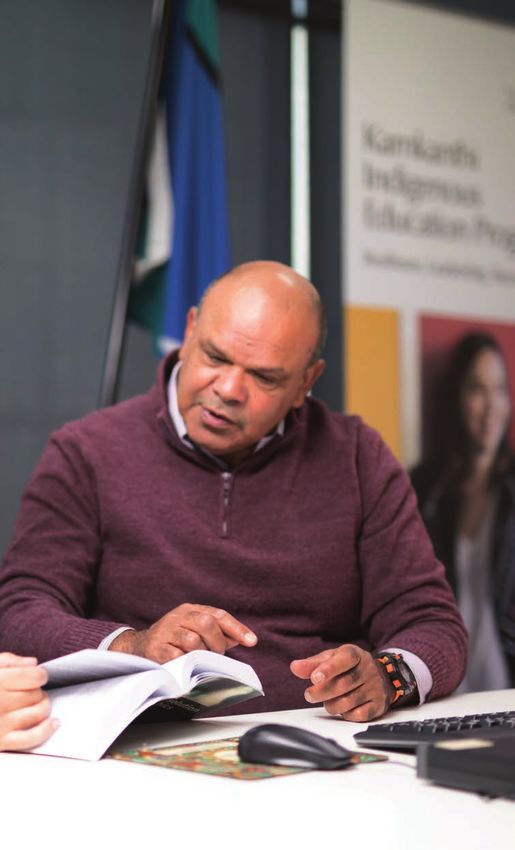
Core empowerment features of this                             • increased industry engagement and support
                                                                through our SANTOS Engineering Camp
plan include:                                                                                                     Key challenges
                                                              • undertaken an Aboriginal student
• innovation in Aboriginal student recruitment                                                                    Matters requiring ongoing focus, support
                                                                accommodation project with SA Housing
  and outreach                                                                                                    and resourcing include:
                                                              • grown the Cadetship Program's participation
• ‘joined up’ services to create success                                                                          • changes in government policy that
                                                                by 430% since 2016
• strengthening the Cultural Capability                                                                             change strategy, funding or other
                                                              • released the Aboriginal Research Footprint,         elements of our established approach.
  framework
                                                                celebrating the University's research impact in
• a global connection to Aboriginal knowledges                  the Aboriginal community                          • attracting and developing higher-degree-
  and research                                                                                                      by-research (HDR) students
                                                              • developed the Aboriginal Research Capability
• a culture of data-driven decision-making                      and Capacity Framework                            • attracting and retaining Indigenous
                                                                                                                    students as other career and life
• Aboriginal research capability.                             • developed a University-wide Indigenous              prospects compete for their interest.
                                                                Marketing and Communications Strategy
Key successes and achievements                                  for implementation                                • identifying and quantifying Indigenous
                                                                                                                    research impact
Since Tarrkarri Tirrka's commencement in 2013,                • launched the first Abroginal STEM academy
we have:                                                        for Year 11s and 12s                              • establishing the University’s value
                                                                                                                    proposition, given three other local
• delivered Yangadlitya (For the Future), the                 • appointed three Kaurna Cultural Advisors to         universities
  University's first Reconciliation Action Plan                 ensure respectful cultural protocols
  (2019-2021)                                                                                                     • reducing student attrition in increasingly
                                                              • formed an Indigenous Knowledges Advisory            competitive contexts
• endorsed an 'Aboriginal student                               Panel to help embed cultural knowledges in
  graduate attribute'                                           our curriculum                                    • developing our Aboriginal academic staff
                                                                                                                    to help achieve our Vision
• developed and implemented the Karnkanthi                    • completed University-wide mapping
  Education Program (which represents the                       Indigenous-student support services               • improving Aboriginal-led research
  Empowerment Model)                                                                                                output
                                                              • in 2018, graduated the largest number of
• streamlined the Wirltu Yarlu Academic                         Indigenous students on record (47) and            • socialising cultural best-practice across
  Mentoring Program to maximise uptake                          improved retention by 8%.                           the University

• established cultural spaces in the library (all                                                                 • reducing service duplication and
  three campuses) and across the University                                                                         enhancing efficiency to improve
                                                                                                                    student experience, and emphasising
                                                                                                                    collaboration to improve staff experience
                                                                                                                  • ongoing development of an Aboriginal
                                                                                                                    Curriculum Framework
                                                                                                                  • embedding adequate, ongoing cultural
                                                                                                                    training for all staff.
                                                                                                                  The following recommendations take into
                                                                                                                  account these challenges and support
                                                                                                                  Wirltu Yarlu in achieving its aspirations
                                                                                                                  by 2024.

8   Tarrkarri Tirrka 2019-2024 Indigenous Academic Strategy
SUMMARY OF
RECOMMENDATIONS
These updated recommendations facilitate Recommendation 4
ongoing partnerships between Wirltu Yarlu and
the broader University to: ensure Indigenous Noting that our Aboriginal and Torres Strait
excellence; prioritise Indigenous employment; Islander students provide a key talent pipeline
and improve the coordination and performance for our staff cohort, continue to work toward
of Indigenous students' recruitment, support, the Commonwealth aspirational target of 3%
success and completion. of total staff being Aboriginal and/or Torres
Strait Islander.
Recommendations reference the hub-and-spoke
model (page 12), encouraging divisions and
Recommendation 5
faculties to develop their own Local Indigenous
Action Plans in consultation with Wirltu Yarlu Establish a Pro Vice-Chancellor position to
provide strategic leadership and performance
Recommendation 1 uplift in Indigenous engagement, education,
research and employment.
All faculties to develop a Local Indigenous
Action Plans, with annual targets and evaluation
Recommendation 6
strategies, to improve Indigenous student
academic outcomes. Implement, monitor and evaluate the
University’s Innovate 2019 – 2021 Reconciliation
Recommendation 2 Action Plan (RAP) and develop a Stretch
supersession for 2021 implementation.
Wirltu Yarlu to maintain a maximum student
uptake of its Aboriginal Mentoring Program.
Recommendation 7
Recommendation 3 Embed RAP core actions, especially in ‘Cultural
Recognition’, further enabling visibility.
Implement the Indigenous Marketing and
Communication Strategy University-wide.
The University of Adelaide 9Recommendation 8 Recommendation 15
Implement a University-wide Indigenous Provide a central platform to access information
Curriculum Framework, with adequate ongoing on, and apply for, all financial scholarships for
funding, to ensure appropriate and integrated Indigenous students, with annual reporting
teaching and learning. to stakeholders.
Recommendation 9 Recommendation 16
Consult with the Domestic Recruitment Team Recognise and celebrate Kaurna traditional
(DRT) and faculties to implement student owners, and all Aboriginal and Torres Strait
outreach and engagement strategy. Islander cultures, by implementing the cultural
protocols document.
Recommendation 10
Develop and deliver cultural competency and
Recommendation 17
awareness training, face-to-face and online, to Include Indigenous Elders, community members
all new University staff, and embed ongoing and groups in formal and informal partnerships
cultural fitness in all position descriptions. and ceremonial University occasions.
Recommendation 11 Recommendation 18
Continue supporting faculties to lift data quality Develop and facilitate financially accessible and
and reporting accuracy for Indigenous students. academically-based national and international
experiences and connections for Indigenous staff
Recommendation 12 and students.
Implement the Aboriginal Research
Development Program to facilitate and support Recommendation 19
the HDR pipeline for Indigenous students. Establish an International Indigenous
Academic Alliance.
Recommendation 13
Increase Indigenous HDR-student enrolments
Recommendation 20
and completions with pathways to early Establish an Indigenous Alumni Group.
academic development and employment.
Recommendation 21
Recommendation 14 Establish an Indigenous Research Hub, with an
Ensure Indigenous membership and emphasis on online and block delivery.
representation in the University Ethics and
Human Research Committee, and have
Indigenous perspectives mandated in ethics
submissions regarding work involving Indigenous
subject matter and/or communities.
10 Tarrkarri Tirrka 2019-2024 Indigenous Academic StrategyINNOVATION
IN ABORIGINAL
STUDENT
Our outreach and recruitment approaches Our Karnkanthi Program, for example, positively
instil awareness of the University as a place impacts learning ability and university readiness,
of learning for Indigenous students—one that which in turn can inspire lifelong learning.
helps to overcome their underrepresentation And we’ve established ‘Clusters of Indigenous
RECRUITMENT
in the university system. This requires an Academic Excellence’ to bridge secondary and
understanding of entrenched disadvantage, higher education. Through this approach, Wirltu
and a holistic approach to nurturing confidence Yarlu has already established the first Aboriginal
AND OUTREACH
and aspirations. STEM academy, and in the coming five years at
least two more clusters will be developed.
Positioning outreach
To prepare Aboriginal and Torres Strait Islander
peoples for higher education, their cultural
identity must be taken into account, as well as What will change?
their unique experiences, strengths and barriers.
Through Wirltu Yarlu’s Focusing on the whole person prepares them to • University offers to Aboriginal school leavers will
increase 30% each year to 2024.
thrive in an environment that is, for many, a new
outreach, the University and daunting concept. • Aboriginal student success, retention and
completion rates will climb to match those of non-
establishes strong connections As a leader in Australian higher education,
we have the opportunity to inspire prospective Aboriginal students.
with Aboriginal students Aboriginal and Torres Strait Islander students to • Aboriginal students’ pass rate will more rapidly
transform their lives through continuous learning approach that of non-Aboriginal students.
before they join our campus. and by performing at their best. Communicating
• A stronger HDR focus will see more students on
this to them will break down their perceived
Critically, this builds their barriers to higher education and help them
HDR pathways.
realise their full potential. • A focus on outreach will improve Aboriginal
belief in the possibility of school leavers’ belief in the possibility of
Signposts to university attending university.
successful university study. • The Karnkanthi Program will further increase the
Outreach gives us the opportunity to enhance
Aboriginal education outcomes. It has been number and success of Indigenous students at
shown that deeper pre-university engagement the University.
improves Indigenous-student outcomes on
multiple fronts, including confidence, academic
performance and social and physical wellbeing.
The University of Adelaide 11JOINING UP ABORIGINAL
STUDENT SERVICES
Faculty-based support is not always
culturally appropriate, nor are ‘general’
Professions
Law
student support teams extensively trained What will change? Commerce
to respond to, or fully understand, the • Wirltu Yarlu will remain the central Economics
complexities and cultural nuances many ‘hub’ for: Indigenous-student support;
Aboriginal students face. teaching Indigenous knowledges;
and increasing Indigenous culture Health
In the coming five years, Wirltu Yarlu Sciences
will establish Aboriginal student support appreciation and understanding.
Medicine
partnerships focused on improving • A core group of staff will be established Nursing Arts
outcomes for all Aboriginal students. This in each faculty to support their Allied Health Education
is best represented via the hub-and-spoke Indigenous students. How this support Music
model shown in Figure 1, which places will be shared with Wirltu Yarlu will be Social Sciences
Wirltu Yarlu in service of all faculties, Humanities
subject to an agreed model of practice
offering specialised, culturally appropriate
WIRLTU
led by Wirltu Yarlu.
advice and support.
Ongoing collaborative relationships
between Wirltu Yarlu and the faculty-
Figure 1 illustrates the potential hub-and-spoke
YARLU
based units will be essential. Wirltu Yarlu
staff and the faculties will co-design the model, with each faculty supported by a dedicated
working model. Indigenous Unit and oriented around Wirltu Yarlu.
Science
ECMS Environment
Engineering Science Ed
Computer Science Biomedical Scences
SABE Life Sciences
Earth Sciences
12 Tarrkarri Tirrka 2019-2024 Indigenous Academic StrategyA ROBUST
CULTURAL
CAPABILITY
FRAMEWORK
The University’s Reconciliation Action
Plan (RAP) embeds reconciliation and
Aboriginal-focused intentions within
mainstream operations, strengthening our
cultural agenda and ultimately improving
outcomes for Indigenous students.
It outlines tangible actions that will contribute to: advancing Reconciliation
Australia’s three pillars of reconciliation; helping us develop respectful
Indigenous-community relationships; and creating meaningful opportunities
for Aboriginal and Torres Strait Islander peoples.
The University of Adelaide 13TEACHING
AND LEARNING
STRATEGIC PRIORITIES
We have the opportunity to incorporate
traditional Indigenous methods of teaching, and
emphasise Indigenous perspectives, to enrich all What will change?
students’ education when updating University- • Teaching quality, and value to
wide curricula. the curriculum, will be assessed
Indigenous knowledges, methodologies and annually in all faculties to support
pedagogies are increasingly recognised and continuous improvement.
utilised by modern science. Drawing on 65,000 • Revised online ‘Indigenous cultural
years of experience, they remain highly relevant awareness’ modules will be offered to
today, particularly in relation to sustainability all staff and required as part of formal
and community. inductions; ongoing ‘cultural fitness’
In order to ensure cultural sensitivity, a coherent, training will be embedded in staff
integrated approach to the teaching and learning professional development.
of Indigenous-related content will be outlined in • A plan to deliver coursework on
an Aboriginal Curriculum Framework (ACF). Indigenous knowledges will be
The ACF will include guiding principles for resourced, developed and delivered
Indigenous teaching, both present and in future. across multiple modes.
It will also promote collaborative approaches to
embedding the ‘Aboriginal Graduate Attribute’ • Cultural Awareness Competence
and developing cultural competences in training will be offered as
all students. a core component of Staff
Induction and ongoing staff
Professional Development.
14 Tarrkarri Tirrka 2019-2024 Indigenous Academic Strategy‘BRIDGES IN
BRIDGES OUT’
Leveraging online
experiences
Online learning’s flexibility overcomes many of the
barriers Indigenous students face. This includes their
desire to remain on-Country, and responsibilities to
family and community.
As we increase the University’s digital footprint
and move into the online teaching space, we have
greater opportunity to increase Aboriginal and
ONLINE LEARNING’S Torres Strait Islander student numbers and better
tailor their education to their unique experiences and
FLEXIBILITY OVERCOMES circumstances. Online learning’s flexibility overcomes
many of the barriers Indigenous students face. This
MANY OF THE includes their desire to remain on-Country, and
responsibilities to family and community.
BARRIERS INDIGENOUS
STUDENTS FACE.
The University of Adelaide 15ABORIGINAL RESEARCH
STRATEGIC PRIORITIES
The University of Adelaide delivers tangible
research benefits to the Aboriginal community,
as demonstrated through our Aboriginal What will change?
Research Footprint Report. And ongoing
collaboration and meaningful engagement with • The number of Indigenous students
Indigenous researchers, community groups and undertaking HDRs will increase.
stakeholders is paramount to sustaining our • Research grant income will
Indigenous research capability. increase through a collaborative
We will continue increasing production and cross-disciplinary Indigenous
of relevant, rigorous, quality research that research environment.
contributes to: ‘Closing the Gap’ in Aboriginal
• Research projects identified and/
disadvantage; upholding Indigenous Australians’
or developed by the community
intrinsic rights to self-determination; and
will increase, with meaningful and
establishing us as a national leader in
ongoing effect.
Aboriginal research.
• Connection across industry and
Through collaboration, a greater share
community will be further developed
of Indigenous-led federal research grant
through an engaged Indigenous
applications and ‘end user’ partnerships, we’ll
work to identify unique, cross-disciplinary Alumni Network.
solutions to the challenges faced by Aboriginal
and broader Australia.
Our future Indigenous-led research will:
prioritise Indigenous knowledges and knowledge
systems; develop long-term sustainability;
enhance inclusion and growth for Aboriginal
society and economy; and deliver social, health
and economic benefits for all Australians.
16 Tarrkarri Tirrka 2019-2024 Indigenous Academic StrategyA GLOBAL ALLIANCE FOR
ABORIGINAL KNOWLEDGES
AND RESEARCH
Advancing Indigenous education is a core
strategy for many overseas universities,
particularly in New Zealand and Canada. What will change?
To align with this movement, we propose
forming an International Higher Education • The suite of options for students to
Indigenous Alliance. understand Aboriginal and Torres Strait
Islander culture and knowledge in a
This will enable us to: form strong links with, global context will broaden.
and learn from, institutions achieving sustained
success in Indigenous education and research; • An international multi-university
develop synergies and collaborations that span Strategic Advisory Committee will be
academic and research interests; enhance established, with membership from
students’ learning experience by expanding institutions that have achieved sustained
cultural learning opportunities; and enhance our success in Indigenous education
standing among Alliance institutions. and research.
• Our strategies will be informed
by international evidence
supporting ambitious targets and
enabling benchmarking.
The University of Adelaide 17DATA DRIVEN
DECISION MAKING
Becoming a leader in Aboriginal higher
education requires the enhanced use of high-
quality data to: understand inequalities; target What will change?
interventions buffering against risk; and build
academic resilience in our Aboriginal students. • Enhanced data collection and monitoring
In the next five years, it will be key for our will drive performance to meet
decision-making, and enable us to track and Indigenous strategic targets.
monitor how our progress in meeting Tarrkarri • Greater focus on transparency and
Tirrka’s 21 recommendations. improved accountability.
In our increasingly competitive tertiary • Targeted measures established and
education environment, we must use new ways regularly reported by Planning and
to increase Indigenous student enrolments, Analytics to guide identified performance
engagement, retention and completion rates. indicators’ monitoring.
This includes using advanced analytics to
• Local Indigenous Actions Plans will be
understand their challenges and facilitate their
developed for each University stakeholder,
journey from applicant to alumnus.
faculty and division, with annual targets
Using this more systematic approach will also and indicators used to assess performance
have the benefit of generating buy-in from all in priority areas.
faculties and key stakeholders (internal and
• An annual Scorecard Report process
external). It will provide clear evidence of what
will monitor and report Tarrkarri Tirrka
does and doesn’t work, and support programs’
and RAP implementation to the
resource allocations.
Vice-Chancellor.
18 Tarrkarri Tirrka 2019-2024 Indigenous Academic StrategyTARGETS
AND MONITORING
In Tarrkarri Tirrka’s final five years of implementation
we aim to achieve the updated recommendations and
become a benchmark in Aboriginal and Torres Strait
Islander higher education.
This mid-point update sets high expectations Informed by key documents, particularly the
for engagement and excellence for all key University’s RAP, the LIAPs will be focused on
stakeholders—faculty, administration, staff, achieving impact and improving outcomes. They
students and alumni. will ensure accountability for progress toward
all targets, including allocating appropriate
To overcome our acknowledged challenges and
resources and implementing necessary
deliver intended outcomes, all stakeholders’
support mechanisms.
roles and responsibilities should be developed
carefully and deliberately each year. It’s proposed To track performance effectively, LIAPs will be
that DVCs, Executive Deans, Chief Officers, assessed annually with each stakeholder and
faculties, business areas and the Dean IRES will reported in the annual Indigenous Scorecard (IS)
work proactively to develop Local Indigenous for review by VC.
Action Plans (LIAPs).
The University of Adelaide 19TARGETS
AND KEY
PERFORMANCE
INDICATORS
This mid-point review has provided
the opportunity to re-evaluate
the calculation and intent of our
Aboriginal and Torres Strait Islander
student targets.
Our overarching goal, of having 2% Indigenous students by 2024
and/or parity in performance with non-Indigenous students,
remains. However, we are modifying the method (and modelling)
used to achieve it. This aligns with faculty recommendations and
reflects real trends in Aboriginal and Torres Strait Islander student
data. Parity sets the aspirational target; achieving it should be viewed
through the context of state and national Indigenous student trends
and population data.
Baseline targets have been set by Planning and Analytics, in
consultation with faculties and key stakeholders, as follows.
20 Tarrkarri Tirrka 2019-2024 Indigenous Academic StrategyTARGET
RE-SETTING
2017-2024
Proposed re-set enrolment targets for 2017
to 2024 do not include enabling, as there was
Student load targets total: 5% annual increase
significant program change in 2017 (e.g. UPP Table 1: Total Indigenous student growth targets 2017 – 2024
repositioned, Karnkanthi commenced).
Our ‘total’ annual student target is a composite
of the undergraduate and postgraduate student Number of student 2017 Targets
targets proposed below. Building from a 5% enrolments Baseline
annual increase in undergraduate cohorts to
‘future proof’ postgraduate participation, these 2020 2021 2022 2023 2024
targets also factor a decrease in the proportion
of commencing students within cohorts, thus All Students 242 271 286 300 315 331
indicating an expected increase in Indigenous
student retention and success beyond their
Commencing 123 117 117 117 117 116
entry year.
Calculations for postgraduate student growth
Total does not include UPP or enabling students
(Table 3) do not factor 5% annual growth, due to
diverse requirements for postgraduate study.
These targets represent almost 40% growth in the
total Indigenous student population across the
University from 2017 to 2024.
The University of Adelaide 21Undergraduate
Table 2: Undergraduate Indigenous student growth targets 2017 - 2024
In 2018, we implemented Indigenous Student Success Plans
Undergraduate 2017 Targets (SSPs). SSPs include a rigorous and consistent student enrolment
enrolments Baseline process, consisting of self- and academic assessments. Students who
aren’t academically ready for university right now are provided with
2020 2021 2022 2023 2024 support and tuition to give them the best chance of entering and
succeeding in their program of choice in future.
All Students 202 234 246 258 271 284 These targets represent a 41% increase in our Indigenous student
undergraduate population from 2017 to 2024.
Commencing 87 101 101 101 100 99
Total does not include UPP or enabling students
Postgraduate
Table 3: Table 3: Indigenous postgraduate growth targets 2017 – 2024: total, postgraduate coursework
(PGCW) & higher degrees by research (HDR)
Postgraduate and undergraduate students require different
Number of Indigenous 2017 Targets pathways, conditions and support to successfully complete their
student enrolments Baseline program. Postgraduate targets are appropriate and achievable
based on current trends and initiatives to increase Indigenous
2020 2021 2022 2023 2024 participation. These targets represent a 73% increase in HDR
student load across the University from 2017 to 2024.
Total 40 37 40 42 44 47 These targets represent an 18% increase to Indigenous
Total postgraduate study overall, and 73% increase in HDR
Commencing 17 13 13 13 13 13 student load across the University from 2017 to 2024.
Total 29 22 24 25 26 28
PGCW
Commencing 14 10 10 10 10 10
Total 11 15 16 17 18 19
HDR
Commencing 3 3 3 3 3 3
Total does not include UPP or enabling students
22 Tarrkarri Tirrka 2019-2024 Indigenous Academic StrategyEnabling
Table 4: Indigenous Enabling Pathway enrolment targets 2017 - 2024
UPP Enabling is distinct from undergraduate and
Number of Student Targets postgraduate, so is therefore not included in total
Enabling/Pathway Enrolments student number targets proposed. However, preparatory
programs are still considered a cornerstone of Indigenous
2020 2021 2022 2023 2024 participation in higher education for older students who
may be returning to study after a time in the workforce.
Total 55 55 55 55 55 The Karnkanthi Indigenous Education Program is
offered to Aboriginal and Torres Strait Islander students
in Years 10, 11 and 12, who aspire to attend university.
It is an enabling program that aims to develop resilience,
University Enabling Program 10 10 10 10 10 leadership and success skills in our students, so that they
may be successful at university.
Total 45 45 45 45 45
Karnkanthi Y11 15 15 15 15 15
Y12 30 30 30 30 30
The University of Adelaide 23STUDENT RETENTION, SUCCESS
AND COMPLETION TARGETS
Student retention, success and completion targets retention
Table 5: Indigenous student retention rates targets 2017 – 2024.
Retention targets aim to increase Indigenous rates
Indigenous retention rate 2016 Targets by 13% from 2016 to 2024, reaching parity with
Baseline overall domestic rates in the baseline year (86%)
by 2024. Calculation includes both undergraduate
2020 2021 2022 2023 2024 and postgraduate students; at the institutional level,
retention can be a problematic indicator due to the
76% two-year time lag for accurate calculation.
Retention rate 82% 83% 84% 85% 86%
Total does not include UPP or enabling students
Success
Table 6: Indigenous student success rates targets 2017 – 2024.
Success targets aim to increase Indigenous success
Targets rates by 27% from 2017 to 2024, reaching parity
Indigenous success rate 2017
with overall domestic rates in the baseline year
baseline (90%) by 2024. Success is a valuable indicator as
2020 2021 2022 2023 2024 it demonstrates the proportion of units attempted
to those passed, and therefore the likelihood of
retention, progression and completion in ‘real time’.
Success rate 68% 76% 78% 81% 83% 86%
Total does not include UPP or enabling students
Baseline Data: Department of Education and Training
24 Tarrkarri Tirrka 2019-2024 Indigenous Academic StrategyCompletions
Table 7: Indigenous student completions targets 2017 - 2024
Completions targets are based on a sliding scale
Indigenous completions 2017 Targets towards 20% of total student target (Table 1)
completing in 2024. If achieved, they will increase
baseline Indigenous completions by 100% from 2017
2020 2021 2022 2023 2024 to 2024.
Completion Number 32 43 49 54 60 66
^Data are for Semester 1 2019 only
Workforce
Table 8: University of Adelaide Indigenous workforce targets 2017 - 2024
Indigenous staff targets are set within the
2019 2020 2024 University’s Enterprise Agreement. From 2019 to
Indigenous workforce 2018 (actual) 2024 we aim to increase the Indigenous workforce
from 2% to 3% of total staff. This updated target
Target Actual^ Target Target is aligned to the national Indigenous population
proportion, and the agreement with Prime
Indigenous professional 44 50 75 55 70 Minister and Cabinet via the Indigenous Student
Success Program.
Indigenous academic 11 16 22 22 54
Total Indigenous staff 55 60 97 65 90
^Data are for Semester 1 2019 only
The University of Adelaide 25ENHANCING INDIGENOUS
OPPORTUNITIES ACROSS
THE UNIVERSITY REQUIRES
A STRATEGIC APPROACH
WITH INSTITUTIONAL
SUPPORT AND ONGOING
TARGETED INVESTMENT.
26 Tarrkarri Tirrka 2019-2024 Indigenous Academic StrategySTRATEGIC
ALIGNMENT
Enhancing Indigenous opportunities across the
University requires a comprehensive strategic
approach, with institutional support and ongoing,
targeted investment.
This Tarrkarri Tirrka Mid-point Update National:
incorporates changes in the Indigenous higher
education landscape; it aligns with internal and • The Review of Australian Higher Education
national reviews, policies, and strategies. (Bradley Review, 2008)
• Universities Australia National Best Practice
Internally: Framework for Indigenous Cultural Competency
in Australian Universities (2011)
• Future Making and subsequent
‘Pillar Plans’ (2019); • Review of Higher Education Access and
Outcomes for Aboriginal and Torres Strait
• University of Adelaide’s Yangadlitya
Islander People (Behrendt et al., 2012)
Reconciliation Action Plan (2019);
• Australian Council of Graduate Research’s Good
• University of Adelaide Enterprise Agreement
Practice Guidelines for Aboriginal and Torres
and Aboriginal and Torres Strait Islander
Strait Islander Research Education (2016).
Employment Strategy (2018).
Federal Policy:
• Indigenous Student Success Program update
(2017)
• Research Block Grants and Research Training
Program Scholarships update (2017)
The University of Adelaide 27GOVERNANCE
AND STRATEGIC
STEERING
COMMITTEE
Responsibility for Tarrkarri In partnership, its implementation rests with the Dean, Indigenous
Research and Education Strategy (DIRES), who heads a University-
Tirrka rests with the Deputy wide network to realise Tarrkarri Tirrka Mid-point review's 21
updated recommendations.
Vice-Chancellor and To ensure a cohesive approach, all recommendations will also be
assigned a Lead, Partner and Support.
Vice-President (Academic). The Indigenous Education and Engagement Committee (IEEC)
continues to provide governance structure for Tarrkarri Tirrka,
and facilitates the University-wide network. Each faculty, division
and business area has representative members, who report to their
respective managers on Tarrkarri Tirrka’s progress. The IEEC oversees
and monitors implementation of both Tarrkarri Tirrka and the
Reconciliation Action Plan.
The committee, which also includes students, sets and monitors targets
and key performance indicators, guides evaluation of their impact, and
drafts any related communication strategies. It meets six times a year
to review progress.
28 Tarrkarri Tirrka 2019-2024 Indigenous Academic StrategyThe University of Adelaide 29
FOR FURTHER ENQUIRIES
The University of Adelaide SA 5005 Australia

ENQUIRIES future.ask.adelaide.edu.au

TELEPHONE +61 8 8313 7335

FREE-CALL 1800 061 459

     adelaide.edu.au

     facebook.com/uniofadelaide

     twitter.com/uniofadelaide

     snapchat.com/add/uniofadelaide

     instagram.com/uniofadelaide

     UniAdelaide_China

     weibo.com/uniadelaide

© The University of Adelaide.
Published December 2019 5451-1
CRICOS 00123M

DISCLAIMER The information in this publication is current
as at the date of printing and is subject to change. You can
find updated information on our website at adelaide.edu.au
or contact us on 1800 061 459. The University of Adelaide
assumes no responsibility for the accuracy of information
provided by third parties.
You can also read


