Interim Report 2018

  Cathay Pacific Airways Limited
       Stock Code: 00293
←
→
Page content transcription
If your browser does not render page correctly, please read the page content below
Interim Report 2018
Cathay Pacific Airways Limited
Stock Code: 00293Hong Kong
— Cathay Pacific
— Cathay Pacific Freighter
— Cathay Dragon
— Air Hong Kong
Contents Corporate Information
2 Financial and Operational Highlights Cathay Pacific Airways Limited is incorporated in Hong Kong with limited liability.
3 Chairman’s Letter
Investor relations
5 2018 Interim Review
For further information about Cathay Pacific Airways Limited, please contact:
12 Review of Operations
Corporate Affairs Department Email: ir@cathaypacific.com
16 Financial Review
Cathay Pacific Airways Limited Tel: (852) 2747 5210
19 Review Report 4th Floor, Central Tower Fax: (852) 2810 6563
20 Condensed Financial Statements Cathay Pacific City
Cathay Pacific’s main Internet address is
Hong Kong International Airport
42 Information Provided in Accordance www.cathaypacific.com
Hong Kong
with the Listing RulesCathay Pacific Airways Limited Interim Report 2018 1 Cathay Pacific Airways Limited (“Cathay Pacific”) is an international airline registered and based in Hong Kong. Together with Hong Kong Dragon Airlines Limited (“Cathay Dragon”), it offers scheduled passenger and cargo services to 212 destinations in 53 countries and territories. Cathay Pacific was founded in Hong Kong in 1946. It has been deeply committed to its home base over the last seven decades and remains so committed, making substantial investments to develop Hong Kong as one of the world’s leading international aviation centres. The Cathay Pacific Group operated 206 aircraft at 30th June 2018. Cathay Pacific itself operated 148 aircraft at that date. Its other investments include catering and ground-handling companies and its corporate headquarters and cargo terminal at Hong Kong International Airport. Cathay Pacific continues to invest heavily in its home city. At 30th June 2018 it had 78 new aircraft due for delivery up to 2024. Cathay Dragon, a regional airline registered and based in Hong Kong, is a wholly owned subsidiary of Cathay Pacific operating 47 aircraft on scheduled services to 54 destinations in Mainland China and elsewhere in Asia. Cathay Pacific owns 18.13% of Air China Limited (“Air China”), the national flag carrier and a leading provider of passenger, cargo and other airline-related services in Mainland China. Cathay Pacific is the majority shareholder in AHK Air Hong Kong Limited (“Air Hong Kong”), an all-cargo carrier providing scheduled services in Asia. Cathay Pacific and its subsidiaries employ more than 32,400 people worldwide, of whom around 25,800 are employed in Hong Kong. Cathay Pacific is listed on The Stock Exchange of Hong Kong Limited, as are its substantial shareholders Swire Pacific Limited (“Swire Pacific”) and Air China. Cathay Pacific is a founding member of the oneworld global alliance, whose combined network serves more than 1,000 destinations worldwide. Cathay Dragon is an affiliate member of oneworld.
2   Financial and Operational Highlights

    Group Financial Statistics
                                                                                                                  2018              2017
                                                                                                           Six months ended 30th June              Change

    Results
    Revenue                                                                                HK$ million         53,078            45,858           +15.7%
    Loss attributable to the shareholders of Cathay Pacific                                HK$ million            (263)           (2,051)          +1,788
    Loss per share                                                                          HK cents              (6.7)            (52.1)           +45.4
    Dividend per share                                                                           HK$              0.10                     –        +0.10
    Loss margin                                                                                     %             (0.5)              (4.5)       +4.0%pt

                                                                                                             30th June    31st December

    Financial position
    Funds attributable to the shareholders of Cathay Pacific                               HK$ million         65,056            61,101            +6.5%
    Net borrowings                                                                         HK$ million         55,272            59,300             -6.8%
    Shareholders’ funds per share                                                                HK$              16.5              15.5           +6.5%
    Net debt/equity ratio                                                                      Times              0.85              0.97       -0.12 times

    Operating Statistics – Cathay Pacific and Cathay Dragon
                                                                                                                  2018              2017
                                                                                                           Six months ended 30th June              Change

    Available tonne kilometres (“ATK”)                                                         Million         15,747            15,190            +3.7%
    Available seat kilometres (“ASK”)                                                          Million         75,770            73,444            +3.2%
    Available cargo & mail tonne kilometres (“AFTK”)                                           Million          8,542             8,206            +4.1%
    Passenger revenue per ASK                                                               HK cents              46.8              43.7           +7.1%
    Revenue passenger kilometres (“RPK”)                                                       Million         63,810            62,242            +2.5%
    Revenue passengers carried                                                                   ‘000          17,485            17,163            +1.9%
    Passenger load factor                                                                           %             84.2              84.7          -0.5%pt
    Passenger yield                                                                         HK cents              55.4              51.5           +7.6%
    Cargo and mail revenue per AFTK                                                              HK$              1.32              1.10          +20.0%
    Cargo and mail revenue tonne kilometres (“RFTK”)                                           Million          5,831             5,435            +7.3%
    Cargo and mail carried                                                                ‘000 tonnes           1,038               966            +7.5%
    Cargo and mail load factor                                                                      %             68.3              66.2         +2.1%pt
    Cargo and mail yield                                                                         HK$              1.93              1.66          +16.3%
    Cost per ATK (with fuel)                                                                     HK$              3.29              3.14           +4.8%
    Fuel consumption per million revenue tonne kilometres                                      Barrels          1,840             1,888             -2.5%
    Cost per ATK (without fuel)                                                                  HK$              2.29              2.17           +5.5%
    Underlying* cost per ATK (without fuel)                                                      HK$              2.20              2.13           +3.3%
    ATK per HK$’000 staff cost                                                                    Unit          1,783             1,739            +2.5%
    Aircraft utilisation                                                                Hours per day             12.2              12.3            -0.8%
    On-time performance                                                                             %             74.1              73.1         +1.0%pt

    * Underlying costs exclude exceptional items and are adjusted for the effect of foreign currency movements and adoption of HKFRS 15.
Chairman’s Letter Cathay Pacific Airways Limited Interim Report 2018 3
The operating environment for our airlines remains challenging. We are half way through our
three year transformation programme, which is designed to make our businesses leaner,
more agile and more effective competitors. The programme is on track. Despite higher fuel
prices, we performed much better in the first half of 2018 than in the first half of 2017. The
Cathay Pacific Group reported an attributable loss of HK$263 million for the first six months
of 2018. This compares to an attributable loss of HK$2,051 million in the first half of 2017.
The loss per share in the first half of 2018 was HK6.7 cents compared to a loss per share of
HK52.1 cents in the first half of 2017. Our airlines, Cathay Pacific and Cathay Dragon,
reported an attributable loss of HK$904 million for the first six months of 2018, compared to
an attributable loss of HK$2,765 million in the first half of 2017. Revenue generation was
satisfactory during the first half of 2018, with passenger yield improving. Our cargo business
was strong, with growth in both volume and yield. We benefited from a weak US dollar during
the early part of the period, but were adversely affected by significantly increased fuel prices.
Business performance Cargo revenue improved, reflecting strong demand.
Tonnage carried grew faster than capacity and yield
The Group’s passenger revenue increased by 10.4% to
strengthened, reflecting increasing demand for specialist
HK$35,452 million in the first half of 2018. Capacity
cargo shipments and the movement of higher value goods
increased by 3.2%. The growth reflected the introduction of
to and from Asia. The Group’s cargo revenue in the first half
five new routes, increased frequencies on existing routes
of 2018 was HK$12,971 million, an increase of 23.4%
and the use of larger aircraft on popular routes. The load
compared to the same period in 2017. The cargo capacity
factor decreased by 0.5 percentage points to 84.2%.
of Cathay Pacific and Cathay Dragon increased by 4.1%.
Passengers carried increased by 1.9% to 17.5 million. Yield
The load factor increased by 2.1 percentage points, to
increased by 7.6% to HK55.4 cents. This reflected
68.3%. Tonnage carried increased by 7.5% to 1.0 million
improvements in revenue management, favourable foreign
tonnes. Yield increased by 16.3% to HK$1.93.
currency movements, increased revenue from fuel
surcharges and strong premium class demand. There was Total fuel costs for Cathay Pacific and Cathay Dragon
satisfactory growth in ancillary revenue. (before the effect of fuel hedging) increased by HK$3,621
million (or 31.6%) compared with the first half of 2017,
Cathay Dragon introduced services to Nanning in January
reflecting a 27.9% increase in average into plane fuel prices
and to Jinan in March. Cathay Pacific introduced services to
and a 2.1% increase in consumption. Fuel is the Group’s
Brussels in March, to Dublin in June and a seasonal service
most significant cost, accounting for 30.1% of total
to Copenhagen in May. These services have been well
operating costs in the first half of 2018 (compared to 30.4%
received and have strengthened the connectivity of Hong
in the same period in 2017). Fuel hedging losses were
Kong International Airport. Cathay Pacific’s seasonal service
reduced. After taking fuel hedging into account, fuel costs
to Barcelona became a year-round service in April. Cathay
increased by HK$1,037 million (or 7.1%) compared with the
Dragon reintroduced a service to Tokyo Haneda in March.
first half of 2017. Fuel consumption per revenue tonne
We stopped flying to Kota Kinabalu in January and to
kilometre fell by 2.5%, as a result of the introduction of more
Dusseldorf in March.
fuel efficient aircraft.4 Chairman’s Letter
There was a 5.5% increase in non-fuel costs per available Prospects
tonne kilometre, to HK$2.29. Disregarding the effect of
Our airlines usually perform better in the second half of the
foreign currency movements, exceptional items and the
year than in the first half of the year. We expect this to be the
impact of adopting a new accounting standard, the increase
case in 2018. The strength of the US dollar and economic
was 3.3%. The increase reflected higher depreciation and
uncertainty arising from global trade concerns remain
finance costs resulting from the acquisition of aircraft,
challenges. But we still expect passenger yields to continue
increased route related expenses and costs incurred to
to improve and the cargo business to remain strong. Fuel
improve our customer proposition.
prices are expected to be higher. Hedging losses will reduce
The contribution from our subsidiaries and associated but net fuel costs will increase. Our new aircraft will improve
companies was reduced, principally because of weaker fuel efficiency and we expect to generate more
results from Air China Cargo. ancillary revenue.
In June, we received the first of 20 new Airbus A350-1000 Our transformation programme will continue. We believe
aircraft, a larger version of the Airbus A350-900 aircraft that we are on track to achieve our objective of achieving
already in the fleet. The new aircraft will be used on the new sustainable long-term performance for our airline
service which we are introducing to Washington D.C. in businesses. There is still much to do, but I am confident in
September and on other long-haul routes. At 30th June our future. Of course, our success can only be achieved with
2018, we had 78 new aircraft on order for delivery over the the extraordinary efforts of management and service
next five years. These new aircraft will improve our fuel and delivery professionals. Their dedication and devotion to
operating efficiency and reduce our emissions. Cathay Pacific has shone through during recent difficult
times. I thank them for their commitment and their loyalty.
Our Airbus A350 aircraft have inflight Wi-Fi and our latest
seats and inflight entertainment systems. We are retrofitting Cathay Pacific has been Hong Kong’s home airline for over
the economy class cabins of our 65 Boeing 777 aircraft. The seven decades. We remain fully committed to this
retrofit includes the introduction of inflight Wi-Fi, which is magnificent city. We will continue to make substantial
also being introduced on our Airbus A330 aircraft. We are investments in the development and strengthening of Hong
introducing restaurant style dining on long haul business Kong’s position as Asia’s largest international aviation hub.
class services. Our loyalty programmes are being made
more rewarding and competitive.
John Slosar
Chairman
Hong Kong, 8th August 20182018 Interim Review Cathay Pacific Airways Limited Interim Report 2018 5
The operating environment for our airlines has been • In 2018, we are reviewing our branding and improving
challenging for some time. In particular, intense what we offer to customers where it matters most,
competition has led to overcapacity on key passenger especially the quality of food and the style of service.
routes and is severely affecting our business. In 2017, We are increasing ancillary sources of revenue. We have
we embarked on a three year transformation completed the groundwork for a transformation of our
programme. At the halfway point we are on track and global call centres. We have improved crew rostering.
showing results. Despite higher fuel prices, we We have started to transform our integrated operations
performed much better in the first half of 2018 than in centre. We have improved the productivity of line
the first half of 2017. The transformation programme maintenance at outports. Our staff training focuses more
has the goal of making our airlines more consumer on the customer and less on rules.
focused and responsive, and in doing so increasing our
• Our aim is to achieve continuous improvement in all areas
revenue and containing costs. In 2017 we built the right
of our business. We are reengineering the nine core
foundations, strategy and structure. We reorganised
business processes. We are investing more in digital and
our head office and focused on containing costs and
analytical capability and in process automation. Our Global
improving efficiencies. This year, we are improving the
Business Services team will take on tasks resulting from
customer proposition, productivity and the analysis of
the reengineering of our core business processes.
our business, establishing a global business services
The transformation programme includes over 700
team and reorganising our nine core business
separate initiatives.
processes. In the first half of 2018, we introduced
five new passenger routes. The premium class
passenger load factor was high. Our cargo business
Innovation
continued to grow.
• We took delivery of our first Airbus A350-1000 aircraft
in June 2018. The Airbus A350-1000 has a longer range
Transformation and more capacity than the Airbus A350-900. We
expect to have 20 aircraft of this type in service by the
• Premium class demand is strong. So is cargo demand.
end of 2021.
But there are still structural challenges. Competing
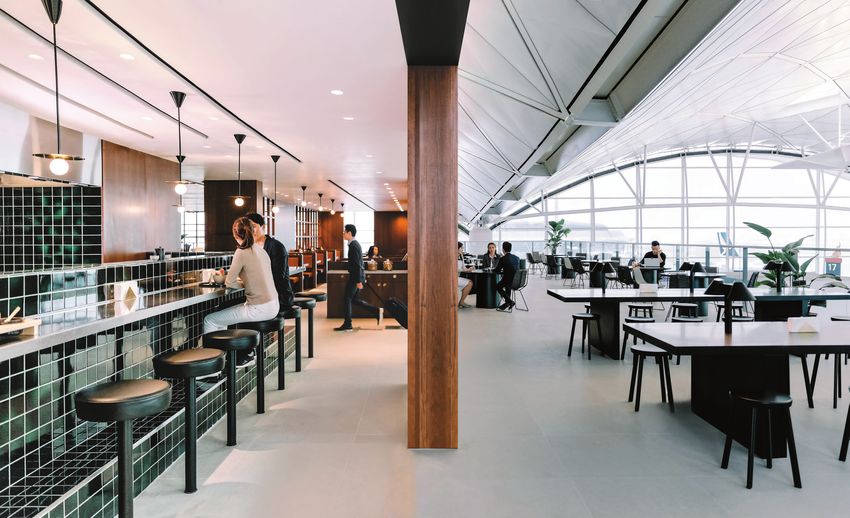
capacity and non-stop flights are increasing. Our • The Deck, Cathay Pacific’s latest business class lounge at
competitor airlines are getting better. Passenger Hong Kong International Airport, opened in March 2018.
expectations are changing. We closed The Cabin in April 2018.
• In 2017, we laid the foundations of our transformation. • We commenced the installation of new economy class
A new head office organisation was put in place with seats, in a new configuration on our Boeing 777-300ER
clearer accountabilities. We reduced headcount by 600 and Boeing 777-300 aircraft in April. The new seats have
and created centres of excellence to reduce duplication been ergonomically-designed and feature thicker
and to improve efficiency. We formed a central digital cushioning for optimal comfort. An enhanced inflight
team with the ability to experiment rapidly. We improved entertainment experience as well as larger personal
our ability to analyse data. We expanded our network, screens on the Boeing 777-300ER aircraft are also part
improved our loyalty offering for Marco Polo and Asia of this enhancement programme.
Miles members, established a social care team and
• We are installing Wi-Fi on our Boeing 777 and Airbus
started digital surveys.
A330 aircraft. The Airbus A350 aircraft are already
Wi-Fi enabled.6 2018 Interim Review
• We have introduced more meal options and a restaurant • Cathay Pacific will introduce four passenger flights per
style of dining experience on our business class services week to Washington D.C. in September 2018 and three
to Chicago and London Gatwick and we will roll this passenger flights per week on a seasonal basis to Cape
programme out across all long haul routes. Town in November 2018.
• Self-service bag tagging facilities were introduced in • From March 2019, Cathay Pacific will introduce four
Melbourne, Nagoya, Perth, Seoul, Tokyo-Narita and passenger flights per week to Seattle using the Airbus
Tokyo-Haneda (for Cathay Dragon) in the first half of A350-900 aircraft.
2018. Self-service bag drop facilities were introduced
• Cathay Dragon introduced four passenger flights per
in Brisbane and Melbourne.
week to Nanning in January 2018 and to Jinan in
March 2018.
Awards • Cathay Dragon will introduce passenger flights to Davao
• In January 2018, Cathay Pacific and Cathay Dragon City in the Philippines and to Medan in Indonesia in
service teams and individual staff members won October 2018.
honours at the Hong Kong Customer Service Excellence • In March 2018, Cathay Dragon reintroduced the
Awards 2017. service to Tokyo Haneda which had been suspended in
• In February 2018, Cathay Pacific won Best First Class October 2017.
Sparkling at the Cellars in the Sky 2017 Awards. • From March 2018, the frequency of Cathay Pacific’s
• In March 2018, Cathay Pacific won Best Entertainment service to Tel Aviv was increased from four to six
(Asia and Australia region) at the APEX Regional passenger flights per week during peak season.
Passenger Choice Awards. The service is operated by Airbus A350-900 aircraft.
The service will become daily from October 2018 and
will be operated by Airbus A350-1000 aircraft in
Hub development seasonal highs.
• In the first half of 2018, the passenger capacity of Cathay • In April 2018, Cathay Pacific’s previously seasonal service
Pacific and Cathay Dragon increased by 3.2%, reflecting to Barcelona became a year-round passenger service.
the launch of routes to Brussels, Copenhagen, Dublin,
• From October 2018, Cathay Pacific will increase the
Jinan and Nanning and increases in frequency on some
frequency of its passenger services to Adelaide from five
existing routes. Cathay Pacific’s passenger capacity
to six flights per week.
increased by 2.4%. Cathay Dragon’s passenger capacity
increased by 8.9%. • From March 2018, Cathay Dragon increased the
frequency of its passenger service to Fukuoka from
• We are doing more to improve the reliability of our
11 flights per week to twice daily on a seasonal basis.
operations. In the first half of 2018, our on-time
performance improved compared to the first half of 2017. • Cathay Pacific will increase capacity on its Delhi
passenger service from October 2018. One of the two
• Cathay Pacific introduced four passenger flights per week
daily flights will be operated by Boeing 777-300ER aircraft
to Brussels in March 2018 and to Dublin in June 2018 and
instead of Airbus A330-300 aircraft.
three passenger flights per week on a seasonal basis to
Copenhagen in May 2018. • Cathay Pacific will increase capacity on its Mumbai
passenger service from October 2018. Three of the
10 weekly flights will be operated by Boeing 777-300ER
aircraft instead of Airbus A330-300 aircraft.Cathay Pacific Airways Limited Interim Report 2018 7
• Cathay Pacific will increase capacity on its Chennai flights between Almaty and Astana. Air Astana’s KC code
passenger service from December 2018. The daily flight has been placed on some Cathay Pacific flights to
will be operated by Boeing 777-300ER aircraft instead of Melbourne, Perth, Singapore and Sydney.
Airbus A330-300 aircraft.
• In July 2018, Cathay Pacific entered into a codeshare
• From October 2018, Cathay Pacific will reduce the agreement with Brussels Airlines. The CX code has been
frequency of its passenger service to Madrid from five to placed on Brussels Airlines’ flights between Brussels and
four flights per week during the winter season. seven popular destinations across Europe: Berlin (Berlin-
Tegel), Hamburg, Lyon (Lyon-Saint Exupery), Marseilles,
• From October 2018, Cathay Pacific will reduce the
Toulouse, Oslo and Prague.
frequency of its passenger service to Paris from 11 to 10
flights per week during the winter season.
• Cathay Pacific’s passenger services to Amsterdam and Environment
Madrid will be operated by Airbus A350-1000 aircraft • Cathay Pacific participates in an International Civil Aviation
from October and December 2018 respectively. From Organization task force which leads the aviation industry’s
December, services to Manchester will also be operated work in developing proposals for a fair, equitable and
by Airbus A350-1000 on a seasonal basis. effective global agreement on emissions.
• In February 2018, Cathay Dragon introduced a business • Cathay Pacific engages with regulators and groups (the
class service to Da Nang. IATA Environment Committee, the Sustainable Aviation
• Cathay Dragon stopped flying to Kota Kinabalu in Fuel Users Group, the Roundtable on Sustainable
January 2018. Biomaterials and the Association of Asia Pacific Airlines)
involved in shaping climate change and aviation policy.
• Cathay Pacific stopped flying to Dusseldorf in The aim is to increase awareness of climate change and
March 2018. to develop appropriate solutions for the aviation industry.
• For freighter services, Cathay Pacific increased • In compliance with the European Union’s Emissions
frequencies to Chennai from six flights weekly to daily and Trading Scheme, our 2017 emissions data from intra-EU
its Mumbai from twice weekly to three times in June 2018. flights were reported on by an external auditor in January
It also stopped flying to Calgary in March 2018. 2018 and our emissions report was submitted to the UK
Environment Agency in February 2018.
• Additional capacity will be added to key routes in America
during the second half of 2018 to meet seasonal demand. • All our Airbus A350-1000 aircraft are being flown on
their delivery flights from Toulouse using fuel containing
10% biofuel.
Partnerships
• Unopened food items from inbound Cathay Pacific flights
• In February 2018, Cathay Pacific entered into a codeshare
to Hong Kong are collected by Feeding Hong Kong, a
agreement with ferry operator Cotai Water Jet. The CX
non-profit organisation which provides surplus food to
code has been placed on Cotai Water Jet services
Hong Kong charities for distribution to people in need.
operating between Hong Kong International Airport and
Approximately 140 tonnes of surplus food were donated
the Taipa Ferry Terminal in Macao.
during the first half 2018.
• In March 2018, Cathay Pacific entered into a codeshare
• In March 2018, Cathay Pacific participated in WWF’s
agreement with Air Astana. The CX code has been placed
annual Earth Hour activity. We switched off all non-
on Air Astana’s flights between Hong Kong and Almaty,
essential lighting in our buildings and on billboards.
Bangkok and Almaty, Seoul and Almaty and on some8 2018 Interim Review
• Our retired Airbus A340 aircraft are being dealt with Scout Association of Hong Kong. Participants gain first-
under PAMELA (Airbus’ Process for Advanced hand knowledge of the Hong Kong aviation industry and
Management of End-of-Life Aircraft). This enables old are mentored by Cathay Dragon pilots. The 2018
aircraft to be dismantled (and disposed of or recycled) programme commenced in March with 30 participants.
in a sustainable manner. To date, over 270 participants have graduated from the
programme. About 40% of the graduates have started
• We share environmental best practice and experience
aviation-related careers.
with Air China.
• Cathay Pacific is a constituent of the FTSE4Good Index
and the Hang Seng Corporate Sustainability Index. Commitment to employees
We responded to the Carbon Disclosure Project climate • At 30th June 2018, the Cathay Pacific Group employed
change questionnaire. more than 32,400 people worldwide. Around 25,800 of
• Our Sustainable Development Report for 2017 was these people are based in Hong Kong. Cathay Pacific
published in July 2018. The report is available for viewing employs around 22,000 people worldwide. Cathay Dragon
at http://downloads.cathaypacific.com/cx/aboutus/ employs more than 3,400 people.
sd/2017/pdf/cx-sd-report-2017-en.pdf. • Cathay Pacific recruited around 1,200 employees in the
first six months of 2018, including around 470 cabin crew
and around 90 pilots. Cathay Dragon recruited around
Contribution to the community 140 cabin crew and 15 pilots in the same period.
• Cathay Pacific supports UNICEF through its “Change for
• We regularly review our human resources and
Good” inflight fundraising programme. Since its
remuneration policies in the light of legislation, industry
introduction in 1991, more than HK$176 million has been
practice, market conditions and the performance of
raised through the programme.
individuals and the Group.
• A percentage of the “Change for Good” donations are
passed to the Cathay Pacific Wheelchair Bank, which
raises funds to provide specially adapted wheelchairs for Fleet development
children with neuromuscular diseases. Since its formation, • At 30th June 2018, Cathay Pacific operated 148 aircraft,
the bank has raised more than HK$16.8 million, benefiting Cathay Dragon operated 47 aircraft and Air Hong Kong
around 540 children. operated 11 aircraft (a total of 206 aircraft). There are 78
• In June, a group of 13 Cathay Pacific employees travelled new aircraft on order for delivery up to 2024.
to Guizhou province in Mainland China as part of a • We took delivery of our first Airbus A350-1000 aircraft in
“Change for Good” field trip organised by UNICEF. June 2018. We expect to take delivery of a further seven
The aim was to give them a better understanding of how aircraft of this type in the second half of 2018 and to have
“Change for Good” donations are used to help to improve a total of 20 in service by the end of 2021.
the lives of disadvantaged children and their families.
• We will take delivery of two used Boeing 777-300 aircraft
• We organised tours of our headquarters at Hong Kong in the second half of 2018, and one Boeing 777-300ER
International Airport, Cathay Pacific City, for around 2,600 will be returned to its lessor.
visitors in the first six months of 2018.
• The operating leases of three Airbus A330-300 aircraft
• The Cathay Dragon aviation certification programme is expired in the first half of 2018. The aircraft were returned
organised with the Hong Kong Air Cadet Corps and the to their lessors.Cathay Pacific Airways Limited Interim Report 2018 9
Fleet profile*
Number at 30th June 2018
Leased Firm orders Expiry of operating leases
‘20 and ‘24 and
Aircraft type Owned Finance Operating Total ‘18 ‘19 beyond Total ‘18 ‘19 ‘20 ‘21 ‘22 ‘23 beyond
Aircraft operated by Cathay Pacific:
A330-300 20 11 3 34 1 2
A350-900 16 4 2 22 2 4 6 2
A350-1000 1 1 7(a) 4 8 19
747-400BCF 1(b) 1 1
747-400ERF 6 6
747-8F 3 11 14
777-200 5 5
777-300 12 12 2 3 5(c)
777-300ER 19 11 23 53 1 1 6 4 2 9
777-9X 21 21
Total 76 43 29 148 9 9 33 51 2 2 2 6 4 2 11
Aircraft operated by Cathay Dragon:
A320-200 5 10 15 1 3 3 3
A321-200 2 6 8 1 2 2 1
A321-200neo 32 32
A330-300 10 14 (d)
24 2 3 2 2 4 1
Total 17 30 47 32 32 2 4 6 7 9 1 1
Aircraft operated by Air Hong Kong:
A300-600F 3 7 10 7
747-400BCF 1 (b/d)
1 1
Total 3 8 11 8
Grand total 96 43 67(d) 206 9 9 65 83 12 6 8 13 13 3 12
* The table does not reflect aircraft movements after 30th June 2018.
(a) One aircraft has been delivered in July 2018.
(b) A freighter leased to Air Hong Kong was returned to Cathay Pacific in June and will be returned to the lessor in the second half of 2018.
(c) Five used Boeing 777-300 aircraft will be delivered from the second half of 2018.
(d) 59 of the 67 aircraft which are subjected to operating leases are leased from third parties. The remaining eight of such aircraft (one Boeing 747-400BCF
and seven Airbus A330-300s) are leased within the Group.10 2018 Interim Review
Review of other subsidiaries and Asia Miles Limited (“AML”)
associates • AML, a wholly owned subsidiary, manages the Cathay
Pacific Group’s reward programme. It has more than 10
AHK Air Hong Kong Limited (“Air Hong Kong”)
million members.
• Air Hong Kong is the only all-cargo airline in Hong Kong.
It is 60% owned by Cathay Pacific. It operates express • AML achieved an increase in profit in the first half of 2018
cargo services for DHL Express. compared with the first half of 2017 due to an increase in
business volume.
• Air Hong Kong operates three owned Airbus A300-600F
freighters, seven dry leased Airbus A300-600F freighters, Cathay Pacific Catering Services (H.K.) Limited
one Boeing 747-400BCF converted freighters dry (“CPCS”) and kitchens outside Hong Kong
leased from Cathay Pacific. It also operates two wet
• CPCS, a wholly owned subsidiary, operates the principal
leased Airbus A330-300 passenger-to-freighter
flight kitchen in Hong Kong.
converted freighters.
• CPCS provides flight catering services to 52 international
• Air Hong Kong operates six flights per week services to
airlines in Hong Kong. It produced 82,450 meals for 205
Bangkok, Ho Chi Minh City, Osaka, Penang (via Ho Chi
flights per day on average in the first half of 2018
Minh City), Seoul, Shanghai, Singapore, Taipei and
(a decrease of 0.5% and an increase of 1.0% respectively
Tokyo and five flights per week services to Beijing, Manila
compared with the first half of 2017).
and Nagoya.
• CPCS’s profit in the first half of 2018 decreased
• On-time performance was 85% within 15 minutes in the
compared with the first half of 2017. Increase in material
first half of 2018.
and staff costs more than offset an increase in revenue.
• Compared with the first half of 2017, capacity decreased
• The profits of the flight kitchens outside Hong Kong in the
by 1.6% to 372 million available tonne kilometres in the
first half of 2018 decreased compared with the first half
first half of 2018. The load factor decreased by 1.1
of 2017.
percentage point to 64.4%. Revenue tonne kilometres
decreased by 3.2% to 240 million. Cathay Pacific Services Limited (“CPSL”)
• Air Hong Kong recorded an increase in profit in the first • CPSL, a wholly owned subsidiary, owns and operates the
half of 2018 compared with the first half of 2017. Group’s cargo terminal at Hong Kong International Airport.
The terminal’s annual handling capacity is 2.6 million
• In November 2017, Air Hong Kong agreed to enter into
tonnes. The terminal handles cargo for Cathay Pacific,
sale and leaseback transactions with DHL International in
Cathay Dragon, Air Hong Kong and 13 other airlines.
respect of eight Airbus A300-600F freighters and
associated equipment. Five of these transactions were • CPSL handled 1,006 thousand tonnes of cargo in the first
completed in 2017. Three of them will be completed in half of 2018 (an increase of 3% compared with the first
2018. Cathay Pacific entered into an agreement with DHL half of 2017), 54% of which were transhipments. Export
International for Cathay Pacific to acquire from DHL and import shipments accounted for 29% and 17%
International at the end of 2018 the 40% shareholding in respectively of the total.
Air Hong Kong that it does not already own, with the result
that Air Hong Kong will become a wholly owned subsidiary • The financial results in the first half of 2018 declined
of Cathay Pacific. Air Hong Kong will continue to operate compared with the first half of 2017. This was mainly
an agreed freighter network to destinations in Asia for due to a higher volume of transit cargo and increased
DHL International under a new block space agreement cost pressures.
between Air Hong Kong and DHL International for an initial
term of 15 years commencing on 1st January 2019.Cathay Pacific Airways Limited Interim Report 2018 11
Hong Kong Airport Services Limited (“HAS”) • For the six months ended 31st March 2018, Air China’s
results improved compared to the six months ended 31st
• HAS, a wholly owned subsidiary, provides ramp and
March 2017. This reflected traffic and revenue growth for
passenger handling services at Hong Kong International
both passenger and cargo, together with the benefits of a
Airport. At 30th June 2018, it provided ground handling
stronger Renminbi through the first quarter of the year.
services to 22 airlines, including Cathay Pacific and
This was partly offset by rising fuel costs.
Cathay Dragon.
• In the first half of 2018, HAS had 42.7% and 2.9% market Air China Cargo Co., Ltd. (“Air China Cargo”)
shares in ramp and passenger handling businesses • Air China Cargo, in which Cathay Pacific owns an equity
respectively at Hong Kong International Airport. In 2017, and an economic interest, is the leading provider of air
HAS had a 20% share in the passenger handling business. cargo services in Mainland China. It has its headquarters
The decrease to 2.9% in the first half of 2018 reflects the in Beijing. Its main operating base is in Shanghai Pudong.
transfer of Cathay Dragon passenger handling from HAS
to Cathay Pacific itself. • At 30th June 2018, Air China Cargo operated
15 freighters. It flies to nine cities in Mainland China and
• Ramp handling increased by 5.8% and passenger 11 cities outside Mainland China. Taking into account its
handling decreased by 44.2%, in each case between the rights to carry cargo in the bellies of Air China’s passenger
first halves of 2017 and 2018. aircraft, Air China Cargo has connections to more than
190 destinations.
• The financial results for the first half of 2018 improved
compared with the first half of 2017. This principally • In the first half of 2018, Air China Cargo’s profits were
reflected better staff efficiency and more ramp lower than in the first half of 2017. Unrealised exchange
handling business. losses on loans denominated in United States dollars
more than offset an underlying favourable operating result
• HAS’ ramp handling licence at Hong Kong International
associated with an improved cargo yield, despite
Airport has been renewed for 10 years from July 2018.
increased operating costs due to higher fuel prices.
Air China Limited (“Air China”)
• Air China, in which Cathay Pacific has a 18.13% interest, is
the national flag carrier and leading provider of passenger,
cargo and other airline-related services in Mainland China.
• At 30th June 2018, Air China operated 308 domestic and
126 international (including regional) routes to 42
countries and regions, including 69 overseas cities, four
regional cities and 116 domestic cities.
• Our share of Air China’s results is based on its financial
statements drawn up three months in arrears.
Consequently our 2018 interim results include Air China’s
results for the six months ended 31st March 2018,
adjusted for any significant events or transactions for the
period from 1st April 2018 to 30th June 2018.12 Review of Operations
Passenger services
Our passenger business in the first half of 2018 was stronger than in the first half of 2017. The Group’s passenger
revenue in the first six months of 2018 was HK$35,452 million, an increase of 10.4% compared to the same period in
2017. Capacity increased by 3.2%, reflecting the launching of new routes to Brussels, Copenhagen, Dublin, Jinan and
Nanning and increased frequencies on other routes. The load factor decreased by 0.5 percentage points, to 84.2%.
Yield increased by 7.6% (6.6% before the adoption of HKFRS 15) to HK55.4 cents, reflecting improvements in revenue
management, favourable foreign currency movements at the beginning of the period, increased revenue from fuel
surcharges and strong premium class demand. Demand for corporate travel strengthened, particularly on routes to
Europe and the United States. Non-corporate premium class demand also increased. Economy class demand,
especially on Southeast Asian and Southwest Pacific routes, was weaker than expected, reflecting strong competition
and overcapacity.
Available seat kilometres (“ASK”), load factor and yield by region for Cathay Pacific and Cathay Dragon passenger services for
the first half of 2018 were as follows:
ASK (million) Load factor (%) Yield*
2018 2017 Change 2018 2017 Change Change
India, Middle East, Sri Lanka and South Africa 5,884 5,896 -0.2% 81.7 83.6 -1.9%pt +11.5%
Southwest Pacific 9,301 8,760 +6.2% 81.6 85.2 -3.6%pt +3.0%
Southeast Asia 10,362 10,088 +2.7% 83.2 84.2 -1.0%pt +9.0%
Europe 15,143 13,548 +11.8% 86.2 89.0 -2.8%pt +9.7%
North Asia 15,588 15,349 +1.6% 80.4 80.0 +0.4%pt +7.4%
Americas 19,492 19,803 -1.6% 88.2 85.8 +2.4%pt +4.2%
Overall 75,770 73,444 +3.2% 84.2 84.7 -0.5%pt +6.6%
* Before the adoption of HKFRS 15 to allow for comparability.
• Premium class demand was strong, particularly on long • We added significant capacity to Europe including the
haul routes. introduction of Brussels, Copenhagen and Dublin, and
increased frequencies to London Gatwick and
• Demand during Chinese New Year and the Easter holiday
Manchester. Traffic volumes are yet to catch up with
period was strong, particularly on short haul destinations.
this newly deployed capacity. Yield has improved on
• Our Indian routes benefited from through traffic to the European routes.
United States due to a portable electronics ban on other
• Yield on routes between Mainland China and Hong Kong
Middle Eastern carriers.
improved due to a lower proportion of transit passengers.
• Demand on Middle East routes was strong driven by
• Demand for travel to and from Japan remained robust
robust bookings from Mainland China and Japan.
with strong demand from Japan and the Pearl River
• Competition remained fierce on Southwest Pacific routes Delta region.
driven by increased capacity from other carriers. Less
• Demand on the South Korean route grew, however,
reliance on transit passengers helped to improve yield.
this was from a low base following political concerns in the
• Yield improved on Southeast Asia routes. Demand early part of 2017.
for travel to and from Singapore and Bangkok
remained popular.Cathay Pacific Airways Limited Interim Report 2018 13
• Despite the reduction of capacity in Americas, revenue • In April 2018, Cathay Pacific’s previously seasonal service
and efficiency remained strong driven by inward bound to Barcelona became a year-round service.
flows to Hong Kong.
• From October 2018, Cathay Pacific will increase the
• We sold premium class tickets on a promotional basis to frequency of its passenger services to Adelaide from five
leisure travellers. to six flights per week.
• Our weekly “fanfares” promotions in Hong Kong • From March 2018, Cathay Dragon increased the
demonstrate our commitment to offering good-value frequency of its passenger service to Fukuoka from
fares in our home market. 11 flights per week to twice daily on a seasonal basis.
• Cathay Pacific introduced four passenger flights per week • Cathay Pacific will increase capacity on its Delhi service
to Brussels in March 2018 and to Dublin in June 2018 and from October 2018. One of the two daily flights will be
three passenger flights per week on a seasonal basis to operated by Boeing 777-300ER aircraft instead of Airbus
Copenhagen in May 2018. These services are operated A330-300 aircraft.
by the Airbus A350-900 aircraft.
• Cathay Pacific will increase capacity on its Mumbai
• Cathay Pacific will introduce four passenger flights per service from October 2018. Three of the 10 weekly flights
week to Washington D.C. in September 2018 using the will be operated by Boeing 777-300ER aircraft instead of
Airbus A350-1000 aircraft and three passenger flights per Airbus A330-300 aircraft.
week on a seasonal basis to Cape Town in November
• Cathay Pacific will increase capacity on its Chennai
2018 using the Airbus A350-900 aircraft.
service from December 2018. The daily flight will be
• From March 2019, Cathay Pacific will introduce four operated by Boeing 777-300ER aircraft instead of Airbus
passenger flights per week to Seattle using the Airbus A330-300 aircraft.
A350-900 aircraft.
• From October 2018, Cathay Pacific will reduce the
• Cathay Dragon introduced four passenger flights per frequency of its passenger service to Madrid from five to
week to Nanning in January 2018 and to Jinan in four flights per week during the winter season.
March 2018.
• From October 2018, Cathay Pacific will reduce the
• Cathay Dragon will introduce passenger flights to Davao frequency of its passenger service to Paris from 11 to 10
City in the Philippines and to Medan in Indonesia in flights per week during the winter season.
October 2018.
• Cathay Pacific’s passenger services to Amsterdam and
• In March 2018, Cathay Dragon reintroduced the Madrid will be operated by Airbus A350-1000 aircraft
service to Tokyo Haneda which had been suspended in from October and December 2018 respectively. From
October 2017. December, services to Manchester will also be operated
by Airbus A350-1000 aircraft on a seasonal basis.
• From March 2018, the frequency of Cathay Pacific’s
service to Tel Aviv was increased from four to six • In February 2018, Cathay Dragon introduced a business
passenger flights per week during peak season. class service to Da Nang.
The service is operated by Airbus A350-900 aircraft.
• Cathay Dragon stopped flying to Kota Kinabalu in
The service will become daily from October 2018 and will
January 2018.
be operated by Airbus A350-1000 aircraft during
seasonal highs. • Cathay Pacific stopped flying to Dusseldorf in
March 2018.14 Review of Operations
Cargo services
The Group’s cargo revenue in the first six months of 2018 was HK$12,971 million, an increase of 23.4% compared to the
same period in 2017. This reflected strong demand, favourable exchange rates at the beginning of the period and
increased revenue from fuel surcharges. The cargo capacity of Cathay Pacific and Cathay Dragon increased by 4.1%.
The load factor increased by 2.1 percentage points to 68.3%. Tonnage carried increased by 7.5%. Yield increased by
16.3% to HK$1.93, reflecting increasing demand for specialist cargo shipments and the movement of higher value
goods to and from Asia.
Available cargo and mail tonne kilometres (“AFTK”), load factor and yield for Cathay Pacific and Cathay Dragon cargo services for
the first half of 2018 were as follows:
AFTK (million) Load factor (%) Yield
2018 2017 Change 2018 2017 Change Change
Cathay Pacific and Cathay Dragon 8,542 8,206 +4.1% 68.3 66.2 +2.1%pt +16.3%
• Cargo demand was strong in the first half of 2018 and • Additional capacity will be added to key routes in
overall tonnage grew faster than capacity. Shipments America during second half of 2018 to cope with
from Hong Kong and Mainland China were stable and seasonal demand.
trans-shipment from the Indian subcontinent, Europe,
Japan and Southeast Asia were strong.
Loyalty and reward programmes
• E-commerce shipments from Asia remained strong whilst
exports of machinery and food from Europe and the Marco Polo Club
Americas to Asia continued to grow, resulting in a more
• The Marco Polo Club loyalty programme provides
balanced trade flow. We carried cargo to and from more
benefits and services to the frequent flyers of Cathay
places in Europe in line with the expansion of our
Pacific and Cathay Dragon.
passenger network in Europe.
• Marco Polo Club members contribute to almost a quarter
• We now offer our customers more cargo product options
of the revenues of Cathay Pacific and Cathay Dragon.
for the transportation of high-value, temperature-sensitive
pharmaceutical products through new rental agreements • Club points are earned by reference to cabin class,
with va-Q-tec and Sonoco for their special thermal fare class and distance travelled.
containers. This complements our existing solutions with
• Silver members (and above) have unlimited access to
Envirotainer, DoKaSch and CSafe.
lounges when flying on Cathay Pacific or Cathay Dragon
• Cathay Pacific increased freighter service frequencies to and all members are entitled to priority boarding and
Chennai from six times weekly to daily, and Mumbai from check-in.
twice to three times weekly in June 2018. It also stopped
flying to Calgary in March 2018.Cathay Pacific Airways Limited Interim Report 2018 15 Asia Miles • Asia Miles is a leading travel and lifestyle rewards programme in Asia. It has more than 10 million members and over 700 partners worldwide, including 27 airlines, more than 150 hotel brands, over 400 restaurants, and retail shops. • There was a 4.7% increase in redemptions by Asia Miles members on Cathay Pacific and Cathay Dragon flights in the first half of 2018 compared to the same period of last year. • Marco Polo Club members are also members of Asia Miles. Antitrust proceedings Cathay Pacific remains the subject of antitrust proceedings in various jurisdictions. The outcomes are subject to uncertainties. Cathay Pacific is not in a position to assess the full potential liabilities but makes provisions based on relevant facts and circumstances in line with accounting policy 20 on page 109 in the 2017 Annual Report.
16   Financial Review

     Revenue
                                                                          Group                    Cathay Pacific and Cathay Dragon

                                                                Six months ended 30th June           Six months ended 30th June

                                                               2018          2017                   2018           2017
                                                              HK$M          HK$M         Change    HK$M           HK$M         Change

     Passenger services                                      35,452       32,105       +10.4%     35,452        32,105        +10.4%
     Cargo services                                          12,971       10,515       +23.4%     11,276          9,007       +25.2%
     Catering, recoveries and other services                  4,655         3,238      +43.8%      4,299          2,832       +51.8%
     Total revenue                                           53,078       45,858       +15.7%     51,027        43,944        +16.1%

     Before the adoption of HKFRS 15 Group passenger services revenue increased by 9.4% compared with a 3.2% increase in
     capacity (as did combined Cathay Pacific and Cathay Dragon), Group cargo services revenue increased by 23.0% (combined
     Cathay Pacific and Cathay Dragon by 24.8% compared with a 4.1% increase in capacity) and Group catering, recoveries and
     other services increased by 27.3% (combined Cathay Pacific and Cathay Dragon by 30.2%).

     Operating expenses
                                                                          Group                    Cathay Pacific and Cathay Dragon

                                                                Six months ended 30th June           Six months ended 30th June

                                                               2018          2017                   2018           2017
                                                              HK$M          HK$M         Change    HK$M           HK$M         Change

     Staff                                                    9,935         9,845        +0.9%     8,834          8,736        +1.1%
     Inflight service and passenger expenses                  2,625         2,412        +8.8%     2,625          2,412        +8.8%
     Landing, parking and route expenses                      8,648         7,307      +18.4%      8,472          7,161       +18.3%
     Fuel, including hedging losses                          16,046       14,937         +7.4%    15,737        14,700         +7.1%
     Aircraft maintenance                                     4,691         4,461        +5.2%     4,490          4,302        +4.4%
     Aircraft depreciation and operating leases               6,362         5,581      +14.0%      6,212          5,496       +13.0%
     Other depreciation, amortisation and operating leases    1,424         1,372        +3.8%     1,045            950       +10.0%
     Commissions                                               398           320       +24.4%        398            320       +24.4%
     Others                                                   2,252         2,157        +4.4%     3,061          2,929        +4.5%
     Operating expenses                                      52,381       48,392         +8.2%    50,874        47,006         +8.2%
     Net finance charges                                      1,010          814       +24.1%        896            693       +29.3%
     Total operating expenses                                53,391       49,206         +8.5%    51,770        47,699         +8.5%

     Before the adoption of HKFRS 15 the Group’s total operating expenses increased by 6.7% (combined Cathay Pacific and Cathay
     Dragon by 6.5%).
Cathay Pacific Airways Limited Interim Report 2018 17
Operating results analysis
2018 2017 Change
HK$M HK$M HK$M
Airlines’ loss (after exceptional items*) before taxation (743) (3,755) +3,012
Gains on disposal of investment and deemed partial disposal of associate – 830 -830
Taxation (161) 160 -321
Airlines’ loss after taxation (904) (2,765) +1,861
Share of profits from subsidiaries and associates 641 714 -73
Loss attributable to the shareholders of Cathay Pacific (263) (2,051) +1,788
* Exceptional items include a HK$101 million gain on the disposal of CO2 emissions credits (2017: provisions for a European Commission airfreight fine of
Euros 57.12 million (equivalent to approximately HK$498 million) and redundancy costs of HK$224 million for the reorganisation of our head office).
The changes in the airlines’ loss (adjusting for exceptional items, the presentational impact of HKFRS 15 and isolating the effect
of foreign currency movements) before taxation can be analysed as follows:
Exceptional HKFRS 15 Currency
Reported items adoption movement Adjusted ATK unit *
HK$M HK$M HK$M HK$M HK$M % change Note
2017 Airlines’ loss before tax (3,755) (3,755)
Changes:
– Passenger and Cargo revenue 5,616 (375) (793) 4,448 +6.9% 1
– Other revenue 1,467 (613) (19) 835 +24.9% 2
– Staff (98) (224) 31 (291) -0.2% 3
– Inflight service and passenger expenses (213) (12) 16 (209) +4.8% 4
– Landing, parking and route expenses (1,311) 761 154 (396) +1.8% 5
– Fuel, including hedging losses (1,037) 2 (1,035) +3.3% 6
– Aircraft maintenance (188) 6 (182) +0.5% 7
– Owning the assets ** (1,014) 24 (990) +9.8% 8
– Other items (including commissions) (210) (599) 239 304 (266) +5.8% 9
Sub-total (743) (823) – (275) (1,841)
– Net impact of foreign currency movements 275
– Movement in non-recurring exceptional items 823
2018 Airlines’ loss before tax (743)
* ATK unit % change represents the adjusted revenue or cost component change per ATK.
** includes aircraft and other depreciation and operating leases, and net finance charges.
Note:
1) As per Review of Operations section for passenger and cargo services.
2) The growth principally reflects cargo flown under Atlas (5Y) operations together with lease back income, and an increase in Asia Miles activity. The
associated costs are within owning the assets and other items respectively. Passenger and Cargo ancillary revenue growth has been satisfactory.
3) There has been a reduction in our unit staff costs following on from the reorganisation of our head office in mid-2017.
4) We have invested more in our customer proposition (catering, inflight entertainment and lounges).
5) Increased route related expenses (inflationary pressures in navigation, overflying, landing and parking).
6) Fuel costs increased due to a 27.9% rise in the average into-plane fuel price and a 2.1% rise in consumption. This was partially offset by a 79.8% decrease
in fuel hedging losses.
7) Costs have been held in line with capacity.
8) Higher depreciation and finance costs resulting from rising interest rates and the investment in additional efficient aircraft capacity (fuel consumption per
revenue tonne kilometre reduced by 2.5%).
9) Increased investment in digital enablement, Asia Miles proposition and marketing of new ports.18 Financial Review
• The combined cost per ATK (with fuel) of Cathay Pacific Financial position
and Cathay Dragon increased from HK$3.14 to HK$3.29,
• Additions to property, plant and equipment were HK$3,675
an increase of 4.8%.
million, comprising HK$3,578 million in respect of aircraft
• The cost per ATK (without fuel) of Cathay Pacific and and related equipment, HK$28 million in respect of
Cathay Dragon increased from HK$2.17 to HK$2.29, an buildings and HK$69 million in respect of other equipment.
increase of 5.5%.
• Borrowings are mainly denominated in United States
• The underlying cost per ATK (without fuel), which excludes dollars, Hong Kong dollars and Japanese yen, and are fully
exceptional items and adjusts for the effect of foreign repayable by 2029, with 50.7% currently at fixed rates of
currency movements and the adoption of HKFRS 15, interest after taking into account derivative transactions.
increased from HK$2.13 to HK$2.20, an increase of 3.3%.
• Liquid funds, 87.2% of which are denominated in United
States dollars, decreased by 19.4% to HK$15,394 million.
Fuel expenditure and hedging • Net borrowings (after taking liquid funds into account)
A breakdown of the Group’s fuel cost is shown below: decreased by 6.8% to HK$55,272 million.
Six months ended 30th June • Funds attributable to the shareholders of Cathay Pacific
2018 2017 increased by 6.5% to HK$65,056 million. This was due to
HK$M HK$M
unrealised hedging gains of HK$3,587 million recognised
Gross fuel cost 15,393 11,700 in the cash flow hedge reserve, an increase of HK$631
Fuel hedging losses 653 3,237 million taken to retained profit on initial application of
Fuel cost 16,046 14,937 HKFRS 15 as noted in note 2(b) to the financial
statements and other reserve movements.
Fuel costs increased due to a 27.9% rise in the average into-
• The net debt/equity ratio decreased from 0.97 times to
plane fuel price and a 2.1% rise in consumption.
0.85 times.
This was partially offset by a 79.8% decrease in fuel
hedging losses. • The Group’s policies in relation to financial risk
management and the management of currency,
interest rate and fuel price exposures are set out in the
2017 Annual Report.Review Report Cathay Pacific Airways Limited Interim Report 2018 19
To the Board of Directors of Cathay Pacific Airways Limited
(Incorporated in Hong Kong with limited liability)
Introduction Scope of review
We have reviewed the interim financial report set out on We conducted our review in accordance with Hong Kong
pages 20 to 41 which comprises the consolidated Standard on Review Engagements 2410, Review of interim
statement of financial position of Cathay Pacific Airways financial information performed by the independent auditor
Limited (the “Company”) and its subsidiaries (together the of the entity, issued by the Hong Kong Institute of Certified
“Group”) as of 30th June 2018 and the related consolidated Public Accountants. A review of the interim financial report
statement of profit or loss and other comprehensive consists of making enquiries, primarily of persons
income, consolidated statement of changes in equity and responsible for financial and accounting matters, and
consolidated statement of cash flows for the six month applying analytical and other review procedures. A review is
period then ended and explanatory notes. The Rules substantially less in scope than an audit conducted in
Governing the Listing of Securities on The Stock Exchange accordance with Hong Kong Standards on Auditing and
of Hong Kong Limited require the preparation of an interim consequently does not enable us to obtain assurance that
financial report to be in compliance with the relevant we would become aware of all significant matters that might
provisions thereof and Hong Kong Accounting Standard 34, be identified in an audit. Accordingly we do not express an
Interim financial reporting, issued by the Hong Kong Institute audit opinion.
of Certified Public Accountants. The directors are
responsible for the preparation and presentation of the
interim financial report in accordance with Hong Kong Conclusion
Accounting Standard 34.
Based on our review, nothing has come to our attention that
Our responsibility is to form a conclusion, based on our causes us to believe that the interim financial report as at
review, on the interim financial report and to report our 30th June 2018 is not prepared, in all material respects, in
conclusion solely to you, as a body, in accordance with our accordance with Hong Kong Accounting Standard 34,
agreed terms of engagement, and for no other purpose. Interim financial reporting.
We do not assume responsibility towards or accept liability
to any other person for the contents of this report.
KPMG
Certified Public Accountants
8th Floor, Prince’s Building
10 Chater Road
Central, Hong Kong
8th August 201820 Condensed Financial Statements
Consolidated Statement of Profit or Loss and Other Comprehensive Income
for the six months ended 30th June 2018 – Unaudited
2018 2017 2018 2017
Note HK$M HK$M US$M US$M
Revenue
Passenger services 35,452 32,105 4,545 4,116
Cargo services 12,971 10,515 1,662 1,348
Catering, recoveries and other services 4,655 3,238 597 415
Total revenue 53,078 45,858 6,804 5,879
Expenses
Staff (9,935) (9,845) (1,274) (1,262)
Inflight service and passenger expenses (2,625) (2,412) (337) (309)
Landing, parking and route expenses (8,648) (7,307) (1,109) (937)
Fuel, including hedging losses (16,046) (14,937) (2,057) (1,915)
Aircraft maintenance (4,691) (4,461) (600) (572)
Aircraft depreciation and operating leases (6,362) (5,581) (816) (715)
Other depreciation, amortisation and operating leases (1,424) (1,372) (182) (176)
Commissions (398) (320) (51) (41)
Others (2,252) (2,157) (289) (276)
Operating expenses (52,381) (48,392) (6,715) (6,203)
Operating profit/(loss) before non-recurring items 697 (2,534) 89 (324)
Gain on disposal of a long-term investment – 586 – 75
Gain on deemed partial disposal of an associate 4 – 244 – 31
Operating profit/(loss) 5 697 (1,704) 89 (218)
Finance charges (1,169) (1,061) (149) (140)
Finance income 159 247 20 36
Net finance charges 6 (1,010) (814) (129) (104)
Share of profits of associates 449 533 57 68
Profit/(loss) before taxation 136 (1,985) 17 (254)
Taxation 7 (211) 84 (27) 10
Loss for the period (75) (1,901) (10) (244)
Non-controlling interests (188) (150) (24) (19)
Loss attributable to the shareholders of Cathay Pacific (263) (2,051) (34) (263)
Loss per share (basic and diluted) 8 (6.7)¢ (52.1)¢ (0.9)¢ (6.7)¢
Loss for the period (75) (1,901) (10) (244)
Other comprehensive income
Items that may be reclassified subsequently to profit or loss:
Cash flow hedges 4,074 (939) 522 (120)
Revaluation of available-for-sale financial assets – (506) – (65)
Share of other comprehensive income of associates 63 356 8 46
Exchange differences on translation of foreign operations (353) 852 (45) 109
Other comprehensive income for the period, net of taxation 9 3,784 (237) 485 (30)
Total comprehensive income for the period 3,709 (2,138) 475 (274)
Total comprehensive income attributable to
Shareholders of Cathay Pacific 3,521 (2,288) 451 (293)
Non-controlling interests 188 150 24 19
3,709 (2,138) 475 (274)
The financial statements are prepared and presented in HK$, the functional currency. The US$ figures are shown only as supplementary information and are
translated at US$1:HK$7.8.
The notes on pages 24 to 41 form part of these financial statements.You can also read


