International Student Handbook - Saint Leo University
←
→
Page content transcription
If your browser does not render page correctly, please read the page content below
International Student Handbook
        Saint Leo University
TABLE OF CONTENTS
Introduction ......................................................3
1.    First & Foremost ...................................... 4
2.    Life at Saint Leo University ...................... 6
3.    Living in The Area.................................... 9
4.    Living in The United States .....................16
5.    Adjustments & Culture Shock .................23
6.    Banking & Money Matters ......................27
7.    Immigration Matters ................................31
8. Arrests, Convictions, & Immigration
Consequences...............................................35
Other Helpful Hints ........................................37

                                                                   ii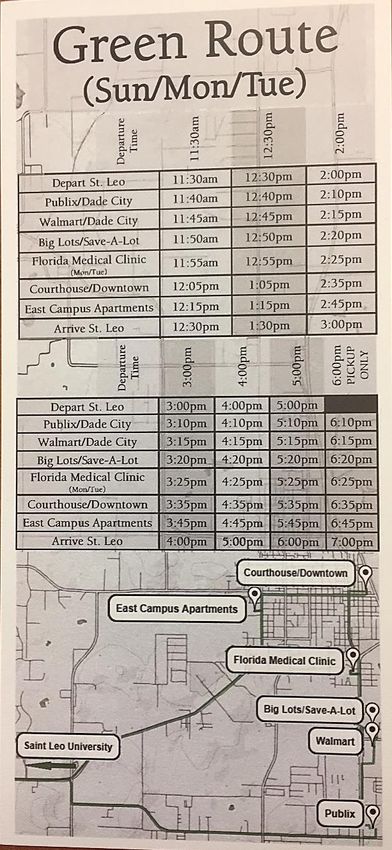
International Student Handbook
Saint Leo University
Introduction
This handbook is designed to be used with the Saint Leo University Student Handbook. All
efforts have been made in this handbook to provide useful and current information. If this
handbook does not address an issue, please feel free to contact any of the professional staff
members below:
Maribeth Stevens, Assistant Vice President for University Enrollment
Admission Building, (352) 588-8284
maribeth.stevens@saintleo.edu
Paige Ramsey-Hamacher, Executive Director & PDSO/RO for Center for
Global Engagement
Office Student Activities Building #221, (352) 588-8489 / (352) 588-8442
paige.ramsey.hamacher@saintleo.edu / global@saintleo.edu
Immigration matters, homesickness, culture shock, personal matters
Sumira Anderson, Director &DSO/ARO
Admission Building, (352) 588-7267
sumira.anderson@saintleo.edu
Carol Hope Grant, Assistant Director & DSO/ARO for International Services
Student Activities Building #221, (352) 588-8471 / (352) 588-8442
carol.hopegrant@saintleo.edu / global@saintleo.edu
Immigration matters, homesickness, culture shock, personal
Lawson Jolly, Director of Counseling Services
DeChantal Hall #123 (352) 588-8354
lawson.jolly@saintleo.edu
Homesickness, culture shock, personal matters, roommate conflicts, etc.
Career Services
Student Activities Building #203, (352) 588-8346
career.services@saintleo.edu
Career development, life planning skills
Faculty Advisor / Success Coach
Academic advising, registration
Registrar’s Office
Saint Edward Hall, (352) 588-8460
Your RA
Roommate conflicts, Residence Hall issues, homesickness
August 23, 2021 3
International Student Handbook
Saint Leo University
1. First & Foremost
Important Things to Do When You First Arrive:
Meet your Resident Assistant (RA). He or she is there to answer any questions and help you with any
problems that you may have with residential life.
Attend the mandatory Orientation program. During Orientation, you will learn valuable information about
Saint Leo University (SLU) and the Tampa Bay area, as well as meet classmates. You will also receive a
Saint Leo University Student Handbook that is to be used in connection with this handbook. These books
are your guides to Saint Leo University and contain important and valuable information.
If you would like your family members to have access to your educational record at Saint Leo, be sure to fill
out the FERPA form and return it to the Registrar’s Office.
Go to the Center for Global Engagement - CGE (Suite #221) in the Student Activities Building with your
I-20 / DS 2019, passport, F1 or J1 visa stamp and I-94 (electronic or paper) so copies can be made.
The CGE must have these documents in order to register you in SEVIS.
If you live on-campus, go to the Stephen Herrmann Mail Center located next to the elevator on the second
floor in the Student Community Center to get your mailbox number and address for here on campus.
Go to University Technology Services (Phone # from on-campus ext. 8888 and from off-campus:
(352-588-8888) for your Saint Leo email address or for computer questions. For your Saint Leo provided
PIN#, please contact CGE (Center for Global Engagement) at (352) 588-8442.
August 23, 2021 4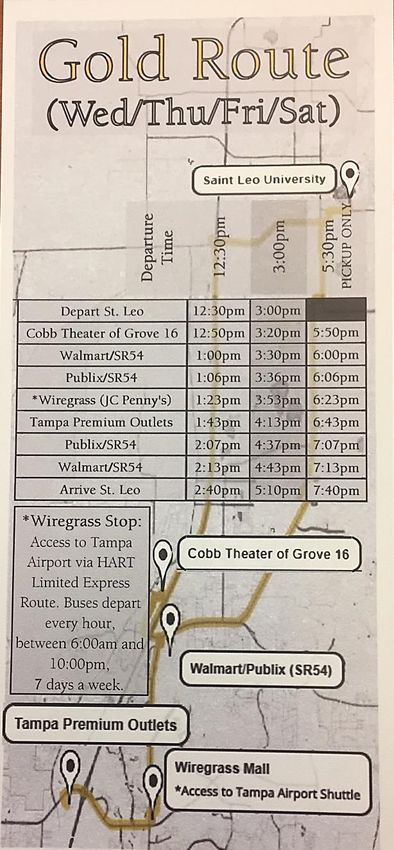
International Student Handbook
Saint Leo University
Go to Student Financial Support Center to learn how to pay your school fees and to familiarize yourself with
the Student Financial Support Center operating system and the payment plans available to you.
Open a checking account (see the section on Banking & Money Matters). Having a checking account is not
mandatory, but it will be useful during your stay in the U.S. During Orientation you will learn how to open a
checking account.
Get an identification (ID) card. If you apply for a checking account, then you need an ID card to cash
personal checks or to pay for merchandise with personal checks. You can obtain a Florida ID card for $25
from the Florida Driver’s License Offices in Dade City, Wesley Chapel, Land O Lakes, or Tampa; you
should make an appointment online. In addition to a Florida ID, you will be issued a SLU ID during
orientation or at the Student Financial Support Center. Carry your SLU ID with you at all times as it is
also your meal card, your library card, your key card for some buildings, and a second form of
identification. With it, you can also be admitted to athletic and student events.
Get your health insurance information and ID card (see the section on Health Insurance). Health
insurance is mandatory for all students and the Saint Leo University Insurance Policy can be waived
online if you have sufficient US based health coverage. As an Undergraduate student, if you do not waive
the insurance by the deadline, you will automatically be enrolled in the Saint Leo policy. Graduate
students are responsible for procuring their own Health Insurance. If you were not given a policy book
and insurance card prior to Orientation, you need to obtain one at Student Financial Support Center in St.
Edward Hall
August 23, 2021 5
International Student Handbook
Saint Leo University
2. Life at Saint Leo University
THIS SECTION INCLUDES:
Food & Cooking
Lodging & Off Campus Housing
Saint Leo Transportation
Campus Activities
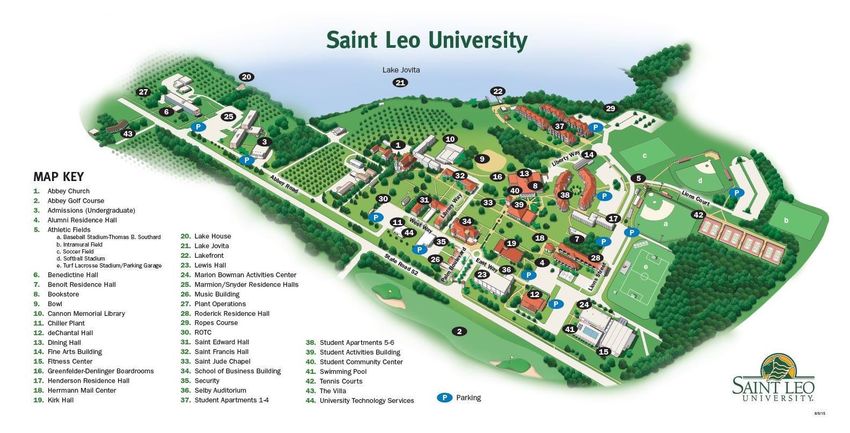
Map of Campus
FOOD AND COOKING
One adjustment that almost all students must make concerns the differences in food
preferences. For American students, the adjustment involves getting used to “institutional food”
instead of the “home cooking” they are accustomed to. For international students, the
adjustment may involve this aspect as well as getting used to new types of food, prepared in
unfamiliar ways, and seasoned with unfamiliar spices.
Cooking is prohibited in all residence halls except the apartments. In November during
International Education Week, ISA and CGE host an International Food Night (Feast for the
World) on campus, and on that day, all students interested in cooking a dish from home can
do so for the entire campus to enjoy. Check in with the Center for Global Engagement (CGE)
or member of the Intercultural Student Association (ISA) regarding the date that this will occur
and let us know if you want to cook for that day.
LODGING & OFF CAMPUS HOUSING
If you are not planning to return home during the holidays when the residence halls are closed,
then you must find other room accommodations. If you want to remain in the area, an option is
available to you, as well as some local apartments if you choose to live off-campus* after your
Junior year.
Colonial Grand Candlewood
Sweet Water Preserve at Zephyr Ridge
Cypress Grand Dade City Apartments
Majestic Oak Oak Run Apartments
Hilltop Landings Townview
*All Undergraduate full-time University Campus students are required to live on campus. Exceptions are allowed for those students living and
commuting from home, married students, veterans, non-traditional students, or senior students who have earned more than 90 credit
hours. Please contact Residence Life if you have any questions at +13525888268.
August 23, 2021 6International Student Handbook
Saint Leo University
SAINT LEO TRANSPORTATION
AIRPORT SHUTTLE
Saint Leo University is pleased to offer complimentary transportation to/from the Tampa
International Airport (TPA) at the beginning of the school year and at university breaks (not
including Spring Break). To take advantage of this service, students can call the Campus
Safety office, well in advance of their arrival/departure, at (352) 588-8432 to find out what the
shuttle schedule is and reserve a seat available during those times. If you are travelling with
family, other accommodations must be made.
GREEN & GOLD SHUTTLE
The daily Green & Gold shuttles run opposite days and offer students the chance to see the
area around Saint Leo, FL. The routes will take students to grocery stores, movie theaters,
malls, Walmart, and offer an easy way to get access to the Tampa International Airport, outside
of the holiday shuttle schedule.
August 23, 2021 7International Student Handbook
Saint Leo University
CAMPUS ACTIVITIES
Each month, the Student Activities office puts up an activities calendar which announces on-
campus activities, such as campus and professional organization meetings, cultural and
sporting events, and other university information. The activities calendars are distributed widely
across campus. Calendars are posted on all campus bulletin boards and in the Student
Community Center. To get the most up-to-date information about activities, please be sure to
check the online calendar.
The student newspaper, The Lion’s Pride, is published once a month in paper and online and
includes articles about campus events. Newspapers are located all around campus.
You can view all of the clubs and organizations on campus here at the Student Activities and
Campus Life webpage.
BENEDICTS COFFEEHOUSE, FÜZ–SAINT LEO UNIVERSITY FUSION EATERY & THE HUNGRY LION
FOOD TRUCK
No matter where you are on campus, Benedict’s Coffeehouse serves up a fun and relaxing place to
meet between classes, take a break with friends, or settle in with an extra jolt of energy to get you
through a long night. Drop by for a hot or cold Starbucks beverage and remember to ask for your Pride
Perks rewards card – buy 9 and the next one is free! Your Pride Perks rewards card has one more
perk. After your 10th free beverage, turn in your Pride Perks rewards card for a chance to win in our
monthly prize drawing! Visit Benedict’s Coffeehouse at the east end of Kirk Lawn
Located upstairs from the dining hall on the main floor of the Student Community Center. FÜZ is an
ideal spot to take a break from your day and share a meal with friends or grab a quick bite to eat and
be on your way. Our Mexican & Asian Fusion menu is designed to provide high-quality, fresh food
options in a friendly, convenient atmosphere. We are your one-stop food shop! Need toothpaste or
items you might find at a convenience store? Stop by FÜZ first before you make an unnecessary trip to
a store!
The Hungry Lion Food Truck currently will be open to students, faculty, and staff, from 11:30 a.m.-
1:30 p.m. Tuesdays through Thursdays, and it is located off of the Student Community Center’s
Lakeview Patio. The menu includes steak, turkey, or black bean burgers; pizzas; melts; grinders;
tomato bisque soup; creamy macaroni and cheese; hand-cut chips dusted with blue cheese and
Parmesan; and rosemary garlic butter Tuscan fries.
August 23, 2021 8MAP OF CAMPUS August 23, 2021 8
International Student Handbook
Saint Leo University
3. Living in The Area
THIS SECTION INCLUDES:
Mail & Communication
Churches
Ethnic Restaurants
Ethnic Grocery Stores
Other Transportation
Weather
MAIL & COMMUNICATION
FAXES
A facsimile (FAX) machine is located in the Office of Student Affairs and in the CGE
Office, both located in the Student Activities Building (SAB).
POSTAL SERVICE
All residential students will get a mail code when they arrive at Saint Leo University. Mail
and package pickup can be done in the Stephen Herrmann Mail Center located in the
Student Community Center next to the elevator on the 2nd floor (above the Dining Hall).
UNITED PARCEL SERVICE
Packages may be sent to domestic or international locations by using UPS (United
Parcel Service), FedEx or DHL. If you want to send packages by Courier or pick up
packages that were sent to you by Courier, see the Campus Mail Room attendant.
CHURCHES
CATHOLIC CHURCHES
University Ministry Mass in Saint Leo Abbey―Sunday Mass: 7:00 p.m.
Holy Name Monastery—Saint Leo, Sunday Mass: 10:30 a.m.
Saint Leo Abbey—Saint Leo, Sunday Mass: 10:00 a.m.
St. Anthony of Padua— San Antonio, Saturday Mass: 8:15 a.m.
Sunday Mass: 8:00 a.m., 9:30 a.m., 11:00 a.m., and 5p.m.---14404 14th St, Dade City
St. Rita Catholic Church—corner of 14th St. & Robinson St, Dade City,
Saturday Mass: 4:30 p.m.; Sunday Mass: 8:00 a.m. and 11:00 a.m.
Spanish Mass: Wednesday: 7:30 p.m. and Sunday: 5 p.m.
Sacred Heart Catholic Church---32145 Saint Joe Rd. Dade City (352) 588-3641
Saturday: 4:00 p.m. vigil; Sunday: 8:00 a.m. and 10:30 a.m.
August 23, 2021 9International Student Handbook
Saint Leo University
PROTESTANT CHURCHES
First United Methodist Church—37628 Church Ave, Dade City (352) 567-5604
Sunday Worship: 11:00 a.m.
First Presbyterian Church—37412 Church Ave, Dade City (352) 567-
2591 Sunday Worship: 10:30 a.m.
Community United Methodist Church―32606 Michigan Ave, San Antonio (352) 588-0322
Sunday Worship: 9:00 a.m.
CHRISTIAN CHURCHES
Church of Christ---14303 12th Street Dade City (352) 567-1472
Sunday Worship: 10:00 a.m.
Primera Iglesia Hispana Discipulos De Cristo---38250 River Rd. Dade City (813) 355-1335
Church of God of Prophecy—38207 Raven Rd., Zephyrhills (352) 567-0544
Calvary Assembly of God—13544 Hwy 98 Bypass, Dade City (352) 567-2038
Sunday Worship: 10:30 a.m. Wednesday Worship: 7:00 p.m.
EPISCOPAL CHURCHES
St Mary’s Episcopal Church—37637 N 11th St., Dade City (352)567-3888
Office: 37637 Magnolia Ave. Dade City
Sunday Worship: 7:45 a.m., 10:00 a.m. Thursday Worship: 10:00 a.m.
LUTHERAN CHURCHES
Shepherd of the Hills Lutheran Church—37015 Orange Valley Lane, Dade City (352) 567-
8424 Sunday Worship: 9:30 a.m.
BAPTIST CHURCHES
Blanton Baptist Church---17351 Hyland Ln. Dade City (352) 521-7047
Calvary Baptist Church---14312 17th St. Dade City (352) 521-0653
First Baptist Church—37511 Church Ave, Dade City (352) 567-3265
Sunday Worship: 9:15 a.m., 10:45 a.m.
First Baptist Church of Ridge Manor---34132 Ridge Manor Blvd. Dade City (352) 583-4140
Grace Baptist Church---10011 US Hwy 301 Dade City (352) 567-6436
New Hope Baptist Church---21431 US Hwy 301 Dade City (352) 583-2002
Pasadena Baptist Church---35845 Clinton Ave. Dade City (352) 521-0545
Piney Grove Baptist Church---31027 SR 52 Dade City (352) 588-4471
St. John Missionary Baptist Church---14549 8th St. Dade City (352) 567-3807
St. Paul Missionary Baptist Church---14518 7th St. Dade City (352) 567-6565
August 23, 2021 10International Student Handbook
Saint Leo University
CHURCHES IN TAMPA
Baha’i
Baha’i Faith—3112 Nundy Rd., Tampa (813) 963-0080
Buddhist
Dzogchen Buddhist Society—3111 Tampa St, Tampa (813) 223-3037
Wat Mongkolratanaram Thai Buddhist Temple— 5306 Palm River Rd, Tampa (813) 621-
1669
Eastern Orthodox
Holy Protection Ukrainian Orthodox Church—3820 Moores Lake Rd, Dover
(813) 659-0123
St. Elizabeth Orthodox Church―5129 NW 53rd Ave, Gainesville (352) 371-7258
Hindu
Hindu Temple of Florida—5509 Lynn Rd, Tampa (813) 962-6890
Vishnu Mandir—5803 Lynn Rd. Tampa (727) 492-1010
Hispanic
Iglesia Cristiana La Nueva Jerusalem—3101 Kingsway Rd, Seffner (813) 684-2754
Islam
Islamic Society of Tampa Bay Area Mosque—7326 E. Sligh Ave. Tampa (813) 628-0007
Jewish
Congregation Kol Ami ― 3919 Moran Rd, Tampa (813) 962-6338
Korean
Tampa Korean United Methodist ― 26211 E County Line Rd, Wesley Chapel (813) 907-
5815
Tampa Korean Evangelical (Duranno Church) ― 6002 Lakeside Dr, Lutz (813) 968-2030
First Korean Presbyterian Church ― 4307 W Humphrey St, Tampa (813) 243-8838
Spanish Speaking
Iglesia Bautista Redención —5609 Lois Ave. N, Tampa (813) 884-8099
Iglesia Cristiana Oasis De Amor—6922 20th Ave. S. (813) 629-1797
Incarnation Catholic Church—5124 Gateway Dr. (813) 885-7861
Syrian
Mar Gregorios Syrian Orthodox Church—12001 58th St. N. (813) 985-6070
August 23, 2021 11International Student Handbook
Saint Leo University
ETHNIC RESTAURANTS IN DADE CITY, SAN ANTONIO, & ZEPHYRHILLS
Best Thai & Sushi
o 35354 State Road 54, Zephyrhills, FL 33541 (813) 782-2201
China Buffet
o 12632 US Highway 301, Dade City, FL33525 (352) 567-8088
China 1
o 12850 US Highway 301, Dade City, FL 33525 (352) 521-3368
Del Carmen
o 14415 7th St, Dade City, FL 33523 (352) 518-0419
Francesco’s Restaurant & Pizzeria
o 14418 7th Street, Dade City, FL 33523 (352) 518-0009
Hong Kong Restaurant
o 7821 Gall Blvd, Zephyrhills (813) 779-8088
Little Ninja
o 5709 6th Street, Zephyrhills (813) 395-5908
Pancho's Villa Mexican Restaurant
o 32804 Pennsylvania Ave. San Antonio (352) 588-3037
Piccola Italia
o 37502 SR 54 W, Zephyrhills (813) 782-2856
Saigon Café
o 5118 Gall Blvd., Zephyrhills, Fl 33542 (813) 715-0983
The Golden Panda Restaurant & Buffet
o 37915 Eiland Blvd, Zephyrhills (813) 779-1581
BEAUTY SUPPLY STORE WITH ETHNIC PRODUCTS
Sally Beauty
o 1267 Bruce B Downs Blvd, Wesley Chapel (813) 994-0298
o 7725 Gall Blvd, Zephyrhills (813) 788-4067
ETHNIC GROCERY STORES IN TAMPA
Bravo Supermarket
o 14821 North 7th Street, Dade City, FL 33523, (352) 521-0505
o 6906 N Armenia Ave, Tampa, FL 33604, (813) 935-5075
Caribbean One-Stop Grocery Inc.
o 5010 15th St. N. (813) 559-1853
Lien Hoa Oriental Market
o 3692 W Waters Ave. (813) 932-1044
Kim Brothers Oriental Supermarket
o 4021 W Hillsborough Ave. (813) 886-8989
La Altagracia Grocery
o 2805 N12th St. (813) 229-1109
La Mercedes Supermarket
o 6724 Hanley Rd. (813) 882-9497
La Teresita Grocery
o 3302 W Columbus Dr. (813) 876-2024
Latin Touch Spanish Grocery
o 736 Brandon Blvd. W. (813) 681-7995
August 23, 2021 12International Student Handbook
Saint Leo University
Los Amigos Grocery & Meats
o 2223 Stuart St. (813) 248-9848
Oceanic Oriental Supermarket
o 1609 N. Tampa Street (813) 228-8110
Md Oriental Market
o 1106 E. Fowler Ave., Tampa (813) 868-1688
World Market
o 5831 Wesley Grove Blvd., Wesley Chapel (813) 371-2433
Tan Phat Oriental Market
o 8202 N. Armenia Ave, Tampa (813) 935-3707
OTHER TRANSPORTATION
TAXI
Hiring a taxi is one option to consider if you need to get off campus, outside the Green & Gold
Shuttle Service. Taxi companies in the area are:
Bruce and Mike’s Taxi Cab Service (813) 758-8633
Wesley Chapel Taxi (813) 995-7030
W.C. (Wesley Chapel) Cab & Car Service (813) 598-2430
Pasco Cab (813) 990-0069
Uber (download the Uber app from your app store)
Lyft (download the Lyft app from your app store)
To get an estimate on the cost of the service, call the company and tell them where you want to
go.
CARS
Cars provide the most convenient way to get around the area, but unless you have an ample
supply of money to pay for the car, insurance, driver’s license, fuel, and repairs, it is advised
that you do not purchase a car. Florida law requires that every driver obtain a driver’s license by
taking both a written and driving skills exam. The fee for the license is $48 without tax and fees.
You can find all the license and registration fees online here. This license is only valid while you
have a valid I-20 or DS2019 and will have to be renewed based on your immigration
documents. You must bring with you two proofs of residence which can include a cell phone bill
with your address in the US (no PO boxes) and your immigration documentation (such as
passport, I20, I94, etc). Go to the website to get more information on what you need to bring
with you to the office in order to get your Driver’s license or Florida ID card. The office will scan
your documentation and then send your card to you once they have verified all your
documentation.
August 23, 2021 13International Student Handbook
Saint Leo University
Important Note: You must have a valid driver’s license to drive and own a vehicle. A Florida Driver’s
Handbook is available, free of charge, at the Florida Driver’s License Office or online here. Call the
Customer Service Center at: (850) 617-2000 for more information and directions. You must also
purchase a license plate and registration tag for your car. These are available in the Tax Collector’s
office, East Pasco Government Center - 14236 Sixth Street, in Dade City (352) 521-4360.
Remember these points when purchasing a car:
Take along a friend who has had experience buying a car.
Do not be talked into buying a more expensive car than you can afford.
Do not believe everything you hear from a salesperson. If car dealers were not
making a profit, they would be out of business.
Test drive the car yourself. Make sure it is insured, however, before you drive it.
Look for rust and dents on the car’s body; test the windshield wipers, windows,
directional signals, heater, air conditioner, and head, tail, and brake lights to
make sure they work.
Get a mechanic’s opinion on the engine, brakes, clutch, transmission, etc. A
thorough check will cost about $100, but is well worth it.
When buying from an automobile dealer, get a written guarantee that the
dealership will pay in full for all repairs needed within 30 days of the purchase.
Compare prices offered at the different car dealerships and used car lots.
Check the history of a used car to determine whether it had been used as a
rental, taxi, police, or family car.
Do not always believe the mileage on the odometer.
Remember to register your car with Saint Leo so that you can obtain your parking
decal and avoid parking tickets.
INSURANCE
Automobile insurance is necessary since the automobile owner is financially responsible for
damage to property or injury to another person in case of an accident. The State of Florida
requires that all car owners have at least personal injury protection (P.I.P.) insurance to protect
the car owner from liability in the case of injury, death, or damage to another party. Other forms
of insurance are collision, which compensates the car owner in case of an accident with another
car, and comprehensive, which covers losses from vandalism or theft.
Private insurance companies are listed online and can be found by typing “auto insurance” into
a search engine on the internet. You should consult at least three different insurance agents
before choosing a policy to get the best price. Several factors, such as age of the driver and the
value of the car, are used to determine the cost of the insurance policy.
August 23, 2021 14International Student Handbook
Saint Leo University
WEATHER
The weather in Central Florida is ever changing. The hot season (summer) is from mid-April
until mid-October. Daytime temperatures generally range from 90°F (32.2oC) to 100°F (37.8oC)
accompanied by very high humidity. The nighttime temperatures usually drop to 70°F (21.1oC).
Many summer afternoons produce what Floridians call sun showers or liquid sunshine in which
it rains for about 15 to 60 minutes while the sun is still shining. Summertime is also the storm
season. It is not uncommon to have thunder and lightning storms which usually last for only a
short time. Carrying an umbrella is advisable.
Central Florida’s cooler winter weather begins in November and continues until February or
March, with temperatures ranging from 20°F (-6oC) at night to 70°F (21oC) during the day (See
the section on conversions for the formula to convert degrees Fahrenheit to degrees Celsius).
August 23, 2021 15International Student Handbook
Saint Leo University
4. Living in The United States
THIS SECTION INCLUDES:
International Taxation
Clothing Sizes (Men’s & Women’s)
Measurements
COOKING, UNITS & CONVERSIONS
Grocery Stores
Health Insurance
INTERNATIONAL TAXATION
As an international student in the US, it’s important that you understand the tax requirements of
your visa and your filing obligations with the IRS. If you did not work or receive any income in
the US, you are legally obliged to file the Form 8843. If you worked or received a stipend,
grant, or allowance in the USA (over a certain amount) you may also need to file the Form
1040NR.
The following information will give you a basic understanding of your responsibilities and tell you
how to get more information. Do not construe the information presented here as individual tax
advice. Federal income tax obligations of students of F, J, or M status: Everyone in the United
States, regardless of immigration status, is responsible each year for submitting a complete and
accurate income tax statement to the Internal Revenue Service (IRS), an agency of the U.S.
Treasury Department. Americans call the process "filing a tax return". Foreign students,
regardless of whether they work or earn income while in the United States, must file an
appropriate return each year. In many countries, the government assesses and collects from
individuals the tax they owe. In the United States, however, it is each individual's personal
responsibility to meet his or her tax obligation; the government will not do it for you, but it will
penalize you if you do not do it yourself.
The CGE staff is neither qualified nor permitted to give individual tax advice. Students with
complicated tax situations may wish to consult with a tax preparation service, professional tax
accountant, or tax attorney who is knowledgeable about nonresident tax law. During the spring
semester, CGE sends an email to the international population with links to the tax forms and
also a link to Sprintax which is an online international tax preparation service. The following
websites can help you figure out your tax responsibilities: U.S. Tax Guide for Aliens and
Sprintax.
August 23, 2021 16International Student Handbook
Saint Leo University
TAX TREATIES
The United States has tax treaties with a number of foreign countries. Under these treaties,
residents (not necessarily citizens) of foreign countries are taxed at a reduced rate, or are
exempt from U.S. taxes on certain items of income they receive from sources within the United
States. These reduced rates and exemptions vary among countries and specific items of
income.
A list of all the countries with Tax Treaties can be found here on the IRS website.
CLOTHING SIZES
Clothing sizes in the United States differ from sizes in other countries. Ready-to-wear clothes
sold in stores are generally standardized in size. Fitting rooms are provided in stores so that you
may try on the clothing items before you purchase them to see if they fit properly. Be sure that
you are satisfied with what you buy—you are not obligated to buy any garment that does not fit
or satisfy you.
Make sure you read the labels on every garment that you purchase. There are many different
types of fabrics with different washing instructions. Many silk and rayon fabrics are dry clean
only, which can become very costly. Machine washable fabrics, such as all cotton and
cotton/polyester blends, are recommended to save money.
WOMEN’S CLOTHING SIZES
Comparative Sizes Dresses, Coats, Suits, And Skirts Junior Sizes (Women Over 5’6” Tall)
USA 7 9 11 13 15
England 9 11 13 15 17
European 34 36 38 40 42
Misses sizes (women 5’2” to 5’8” Tall)
USA/ England 8 10 12 14 16
European 34 36 38 40 42
Shoes
USA 5 - 5½ 6½ - 7 7½ - 8 8 – 8½ 9 9½ - 10
European 36 37- 38 38 – 39½ 39 – 40 40½ 41-42
United Kingdom 3½ - 4 5 – 5½ 6 – 6½ 6½ - 7 7½ 8–8½
To find the correct shoe size, ask a salesperson to measure your foot. Always try the shoes on
before you leave the store because shoes cannot usually be returned after they are purchased.
August 23, 2021 17International Student Handbook
Saint Leo University
Socks usually correspond to shoe size. Ask a salesperson for help if you cannot find the right
size.
Dresses are sized according to the bust measurement (number of inches around the fullest part
of the bust) and by hip measurement. Skirts are sold by the waist measurement. Bra sizes
consist of two measurements: inches (number of inches around the chest area under the arms)
and cup size, which depends on the size of the bust. Cup sizes are A, B, C, D, DD with A being
the smallest size and DD being the largest size. Panties are sold in small, medium, or large
sizes or by a series of size numbers (5, 6, 7, etc.). Full slips are sold by the bust size and in
correspondence with the length of a dress or skirt. Ask a salesperson for assistance if you do
not know your size.
MEN’S CLOTHING SIZES
Comparative Sizes Coats and Pajamas
USA/ England 36 38 40 42 44
European 46 48 50 52 54
Shirts
USA/ England 14 15 16
European 36 38 40
Shoes
USA 5 6 7 8 9 10 11 12
European 37 38 39 41 42 43 44-45 46
United Kingdom 4 5 6 7 8 9 10 11
To find the correct shoe size, ask a salesperson to measure your foot. Always try the shoes on
before you leave the store because shoes cannot usually be returned after you purchase them.
Socks usually correspond to shoe size. Ask a salesperson for help if you cannot find the right
size.
Trousers are sold according to waist measurements (in inches) and inseam measurement
(length of the seam in inches from the crotch seam to the bottom of the leg). Department stores
usually sell trousers already hemmed.
Shirts are sold according to neck measurement (in inches), and sleeve length if long sleeved
(number of inches from the center of the top of the back, across the shoulder, and down the arm
to the bottom of the cuff). For example, 15x32 means 15 inches around the neck and 32-inch
sleeve length. Suits are sold according to the chest and waist measurements and come in short,
medium, or long lengths. Always try on the suit and check for fit in front of a mirror. The
salesperson will be able to tell you what size you should wear.
August 23, 2021 18International Student Handbook
Saint Leo University
MEASUREMENTS
COOKING
OVEN
(C=Celsius degrees, F=Fahrenheit degrees)
very slow cooking temperature = 107°C = 200°F
slow cooking temperature = 149°C = 225°F
moderate cooking temperature = 177°C = 350°F
hot cooking temperature = 218°C = 425°F
very hot cooking temperature = 232-260°C = 450-500°F
STOVE
water boils at 100°C = 212°F
milk is scalded at 51°C = 150°F
UNITS
DRY MEASURE
Equivalencies 1 pound = 16 ounces = 453.59 grams
1 gram = .035 ounces
1 kilogram = 2.2046 pounds
LIQUID MEASURE
Equivalencies 1 British gallon = 1.2 US gallons (gal.)
1 liter = 1.057 liquid quarts = 10 deciliters
1 deciliter (dcl.) = 6 tbsp. 2 tsp. = 3.38 US fluid oz.
VOLUME MEASUREMENTS
Common abbreviations gal. = gallon qt. = quart
pt. = pint oz. = ounce
cc = cubic centimeters net wt. = weight of contents
(not including weight of container)
T or Tbsp. = tablespoon t or tsp. = teaspoon
Approximate equivalencies 1 gallon = 4 liters 1 quart = 1 liter
1 pint = ½ liter 1 ounce = 30 cubic centimeters
1 tablespoon = 15 cc 1 teaspoon = 5 cc
LINEAR MEASUREMENTS
Common abbreviations yd. = yard ft. or ‘ = foot in. or “ = inch
August 23, 2021 19International Student Handbook
Saint Leo University
Equivalencies 1 foot = 12 inches = .3048 meters
1 yard = 3 feet = .9144 meters
1 meter = 39.37 inches = 3.28 feet = 1.09 yards
1 mile = 1.6 kilometers
Conversions to convert multiply by:
ounces to grams ounces 28.35
grams to ounces grams .035
liters to quarts liters .91
quarts to liters quarts 1.057
inches to cm. inches 2.54
cm. to inches cm ................. 39
Celsius (Centigrade) to multiply Celsius (Centigrade) degrees by 9/5, then add 32
Fahrenheit
Fahrenheit to Celsius subtract 32 from Fahrenheit degrees, then multiply by 5/9
(Centigrade)
GROCERY SHOPPING
For your convenience, most grocery stores accept cash, debit or credit cards. Usually it is
easiest to use your ATM / Debit card which has the Visa or MasterCard logo and you can
purchase groceries that way.
FOOD PACKAGING
Food is sold in a variety of ways. Packaged and canned food is sold by weight and in units of
dry and liquid volume. The content’s weight and, occasionally, the number of servings are
marked on the label. Ingredients are listed in order of quantity. For example, if the contents are
listed as “potatoes, carrots, meat, water, spices,” then there are more potatoes than anything
else – then carrots, then meat, then water and spices. Read the label to determine whether it
contains what you want to purchase.
The shopper who buys food for its nutritional value can find bargains among less known brand
names because the cost of advertising is passed on to the customer. The quality of “name
brand” products may be somewhat better, but if the nutritional value of the cheaper brand is
comparable, then it may be the better buy. Also, look for the quantity on the canned or boxed
item. Sometimes the cheaper brand offers larger quantities at lower prices.
Fresh fruit and vegetables are usually sold by the pound. Typically, you put the amount of each
item you wish to buy in separate bags that are located in the produce area. These bags are then
weighed and priced at the checkout counter. To save a little money, buy only fruit and
vegetables that are in season. Vegetables such as radishes, cucumbers, and corn are in
season only in the summer (June to August). You might save some money by purchasing fruit
August 23, 2021 20International Student Handbook
Saint Leo University
or vegetables called “day-old” or “seconds,” which are too ripe to sell at normal prices but are
not rotten.
Eggs are packed in cartons by the dozen (12 items in a dozen). Milk is sold by the pint, quart,
half-gallon, and gallon and is either homogenized, low-fat, or skim (the cream is removed). The
date stamped on the carton indicates how long the milk should remain fresh.
Again, it is highly recommended to use bottled water to drink rather than drinking the tap water.
The water is safe, however by drinking bottled water, you may be able to prevent upset
stomach. Each country's water contains different minerals, bacteria, etc., so your body needs to
become accustomed to the water.
Most coffee is sold in vacuum-packed cans or “bricks” in a variety of “grinds” to match the type
of coffee maker you have. Instant coffee is sold in glass jars, cardboard “cans,” and boxes of
single-serving packets. Some grocery stores also sell whole coffee beans in bags that you may
grind in the store to suit your own tastes and needs. Flour, sugar and rice are sold in 1, 2, and 5
pound bags.
HEALTH INSURANCE
Health insurance coverage is essential while you are in the United States since you are
responsible for payment of any medical expenses you incur. If you do not have an insurance
policy, from a Florida-based company, then a doctor or hospital may refuse to treat you or
require cash payment, in full, in advance of treatment. Health care in the U.S. is mandatory.
Saint Leo University requires all full-time undergraduate students attending University Campus
through our traditional program to carry health insurance. All full-time campus students are
automatically enrolled in the program and may waive out by completing the online waiver
process with comparable coverage. This policy does not apply to Graduate students, Online
students, Weekend and Evening students or students attending any of our Distance Learning
Centers.
Undergraduate students coming to University Campus for the 2021 Fall semester will be
charged for coverage from August 1, 2021 to July 31, 2022. Students enrolling in the 2021 Fall
semester must waive the insurance no later than September 15, 2021. For students entering in
the Spring 2022 semester coverage runs from January 1 – July 31, 2022. Students enrolled in
the Spring semester must waive the insurance no later than January 22, 2022. There will be no
exceptions to these deadlines. Click here to access the insurance waiver.
Students with health insurance coverage provided through either a group or individual plan
comparable to the University's insurance policy, may waive** the University program. Insurance
coverage provided by a non-US company or through a travel medical policy will not be
considered valid for waiver purposes. If you experience issues with the waiver please
contact Student Accounts at (352) 588-6600 or email them at: StudentAccounts@saintleo.edu.
August 23, 2021 21International Student Handbook
Saint Leo University
Information regarding pricing and instructions for completing the waiver is available at this
website.
Another option that you could consider is Study USA healthcare, for which you could contact
John Tolson (john@jwtins.com or visit website). If you would like to consider alternative sources
you should visit this website before committing to any insurance plan be sure to scrutinize the
policy carefully and if possible get a second opinion. Health insurance assures that all students
have access to surrounding medical facilities. However, it does not guarantee that you will not
be asked for immediate payment; however, it does guarantee that a doctor will treat you.
Keep all bills and receipts that you receive from the doctor or hospital. When you visit a health
care facility, ask the person who takes your insurance card if the facility will send the bill to the
insurance company or whether you must file the insurance claim yourself. Some facilities will
not file any insurance claims.
The Saint Leo University Health Center and Student Financial Support Center can help you in
answering some of your questions regarding your insurance policy and filing your claims.
Insurance policy booklets, claim forms, and insurance cards may also be obtained through the
Saint Leo University Health Center located in DeChantal Hall if you did not receive them before
registration.
August 23, 2021 22International Student Handbook
Saint Leo University
5. Adjustments & Culture Shock
THIS SECTION INCLUDES:
Jet Lag
Culture Shock
Homesickness
JET LAG
To avoid some of the problems of jet lag (adjusting to the difference in time at the new location);
there are a few simple rules to follow on the airplane.
Drink liquids to avoid dehydration
Water and fruit juices are the best to drink. Alcohol will further dehydrate you during
your flight and hits you stronger and faster on a plane. It can also cause joint swelling
and make it harder to adjust to time changes.
Exercise
Stretch during your flight. If possible, sit in a bulkhead or aisle seat to stretch your
legs. Some planes have extra legroom in the emergency exit seat over the wing.
Sleep
If at all possible, sleep on the flight. If you can find an empty row, lift the armrests
and stretch out. This will help you to be awake when you arrive at your destination.
Set your watch
Change your watch to the new time when your flight departs. Attempt to eat meals
on the "new" time. This will help your body’s adjustment to the new time zone.
Don’t sleep on arrival
When you arrive at your destination, it is important to adjust to the local time. If you
arrive in the morning, attempt to stay awake until a usual bedtime (or at least until
8:00 or 9:00 p.m.). If you arrive later in the evening, force yourself to go to sleep
early. Usually, if you get a regular night's sleep, you will wake at the normal time the
next morning, and be able to function normally. Try to establish a regular sleeping
pattern as soon as possible.
CULTURE SHOCK
"Culture Shock" is the term used to describe the more pronounced reactions to the
psychological disorientation most people experience when they move for an extended period of
time into a culture markedly different from their own. It can cause intense discomfort, often
accompanied by irritability, bitterness, resentment, homesickness, and depression. In some
cases, distinct physical symptoms of psychosomatic illness occur.
For some people, the bout with culture shock is brief and hardly noticeable. These are usually
people whose personalities provide them with a kind of natural immunity. For most of us,
August 23, 2021 23International Student Handbook
Saint Leo University
however, culture shock is something we have to deal with at the beginning of our stay abroad. It
may surprise you that culture shock is a real health issue when traveling abroad. Traveling
through time zones and for long periods of time, facing new values, habits, and methods of daily
life can leave travelers impatient, bewildered, and depressed.
You may find yourself alternately exhilarated and exasperated, thrilled at the experiences the
new culture offers you and frustrated with the culture's differences from your own. Early in your
experience, you will likely have ups and downs. The feelings you experience are natural. If you
are angry, impatient, homesick, or depressed your first few days, remind yourself that these
things will pass once you have rested and are eating normally. If depression persists, however,
do seek professional assistance from a counselor or doctor. If you are not sure about
something, whether it is a simple question about where a service can be found, or a more
complex matter, such as expectations about friendship and dating, ask someone you trust.
In a sense, culture shock is the occupational hazard of overseas living through which one has to
be willing to go in order to have the pleasures of experiencing other countries and cultures in
depth. All of us have known frustration at one time or another. Although related, and similar in
emotional content, culture shock is different from frustration. Frustration is always traceable to a
specific action or cause and goes away when the situation is remedied or the cause is removed.
Some of the common causes of frustration are: the ambiguity of a particular situation; the actual
situation not matching preconceived ideas of what it would be like; unrealistic goals; not being
able to see results; using the wrong methods to achieve objectives (i.e., methods which are
inappropriate to the new culture).
Frustration may be uncomfortable, but it is generally short-lived as compared to culture shock.
Culture shock has two quite distinctive features:
It does not result from a specific event or series of events. It comes instead from the
experience of encountering ways of doing, organizing, perceiving or valuing things which
are different from yours and which threaten your basic, unconscious belief that your
enculturated customs, assumptions, values and behaviors are "right."
It does not strike suddenly or have a single principal cause. Instead it is cumulative. It
builds up slowly, from a series of small events which are difficult to identify.
Culture shock comes from:
Being cut off from the cultural clues and known patterns with which you are familiar;
especially the subtle, indirect ways you normally have of expressing feelings. All the
nuances and shades of meaning that you understand instinctively and use to make your
life comprehensible are suddenly taken from you.
Living and/or studying (working) over an extended period of time in a situation that is
ambiguous.
Having your own values (which you had heretofore considered as absolutes) brought
into question -- which yanks your moral rug out from under you.
Being continually put into positions in which you are expected to function with maximum
skill and speed, but where the rules have not been adequately explained.
August 23, 2021 24International Student Handbook
Saint Leo University
As indicated earlier, culture shock progresses slowly. One's first reaction to different ways of
doing things may be "How quaint!" When it becomes clear that the differences are not simply
quaint, an effort is frequently made to dismiss them by pointing out the fundamental sameness
of human nature. After all, people are really basically the same under the skin, aren't they?
Eventually, the focus shifts to the differences themselves, sometimes to such an extent that they
seem to be overwhelming. The final stage comes when the differences are narrowed down to a
few of the most troubling, and then are blown up out of all proportion (for Americans, standards
of cleanliness, attitudes toward punctuality, and the value of human life tend to loom especially
large). By now the sojourner is in an acute state of distress. The host culture has become the
scapegoat for the natural difficulties inherent in the cross-cultural encounter. Culture shock has
set in. Here is a list of some of the symptoms that may be observed in relatively severe cases of
culture shock:
Homesickness
Boredom
Withdrawal
Need for excessive amounts of sleep
Compulsive eating
Compulsive drinking (remember – the legal drinking age in the U.S. is 21 years old)
Irritability
Exaggerated cleanliness
Stereotyping of host nationals
Hostility toward host nationals
Loss of ability to work effectively
Unexplainable fits of weeping
Physical ailments (psychosomatic illnesses)
Not everyone will experience this severe a case of culture shock, nor will all these symptoms be
observed. Many people ride through culture shock with some ease, only now and again experi-
encing the more serious reactions, but many others don't. For those that do experience this, it is
important to know that the above responses can occur, that culture shock is in some degree
inevitable, and that their reactions are emotional and not easily subject to rational management.
This knowledge should give you a better understanding of what is happening to you and resolve
to work at hastening your recovery.
August 23, 2021 25International Student Handbook
Saint Leo University
HOMESICKNESS
We tend to think of being homesick as something associated with being young and at
summer camp, but anyone can be homesick at any time. It can come from just missing
the familiarity of home surroundings, the regularity of university classes, the inexplicable
fear of new places, and just being outside your normal routine. It may not happen at all,
may be a fleeting experience or stay awhile. It may take a call home or talking to a
friend or program director to sort out these feelings. One of the surest remedies for
homesickness is to plunge into the experience and immerse yourself into new places,
sights and people. It is important to know that many have experienced homesickness
and recovered.
There is a tool which will be very useful to you in all stages of your travels, while in the U.S. and
when you return to your home country. Please utilize this website. It will assist you immensely in
understanding your expectations about study abroad and in coping with culture shock and
reverse culture shock as well. The website is called “What’s Up With Culture?”. There are two
other websites which will assist you in learning more about the culture and customs of the US
and how to adjust; EducationUSA and EduPass.
August 23, 2021 26International Student Handbook
Saint Leo University
6. Banking & Money Matters
THIS SECTION INCLUDES:
Banking—Checking and Savings accounts
Credit cards
U.S. currency and coins
BANKING
CHECKING ACCOUNTS
In the U.S, most purchases are paid for by check cards or debit cards. These cards are accepted at
most places that accept Visa or MasterCard. The purchases made on these cards are deducted from
your checking account. It is in your best interest to open a checking account as soon as possible. Do
not hesitate to ask questions. Opening a checking account allows you to access your funds, while
eliminating the need for traveler’s checks or large sums of money.
You can find your bank statements online or through mobile apps you can download to your
phone. This statement lists all transactions (cash and check deposits, cash and check
withdrawals, service fees, etc.) associated with your account in the past month. It also shows the
balance of funds that remain available in your account at the time the statement was completed.
While much less common, purchases can also be paid for by check. Personal checks are not accepted
everywhere and two forms of identification, such as your student ID card, Florida ID card, or driver’s license are
usually required when you pay for purchases with a check. The bank representative will explain the check-
writing process to you
Bouncing a check means writing a check for more money than you have in your checking account. Most
banks charge a $30 fee for every check that bounces. REPEATED OFFENSES ARE SEVERELY
PENALIZED AND MAY RESULT IN YOUR BEING CHARGED WITH A CRIME AND HAVING TO
APPEAR IN A COURT OF LAW. Always be sure that when you write a check, you have more than the
amount of the check in your account. Also, if your balance falls below the minimum balance amount set by
the bank, a service charge is deducted from your account.
August 23, 2021 27International Student Handbook
Saint Leo University
SAVINGS ACCOUNTS
Opening a bank account as a foreign national can be very stressful. If you're still living in your home
country, consider seeking out a U.S-based multinational bank that has branches where you live and
opening an account with them before you leave. Or see if your current bank has branches near
campus. Such a move should simplify applying for a U.S. account at one of its branches in this
country.
If you have money that you do not plan to use for several months or longer, consider opening a savings
account to earn interest (a monetary gain) on this money. Every bank or savings and loan association
will have several types of savings accounts. The length of time the money remains in the account
determines the rate of interest paid to you.
Saint Leo University has provided an ATM (through the First National Bank of Pasco) outside the Campus
Safety Office on campus and inside the Dining Hall. An Automated Teller Machine (ATM) is a
computerized machine through which you can make deposits or withdrawals 24 hours a day. The bank
will issue you a plastic card so that you can use the ATM. ATMs are located at banks and other locations,
such as supermarkets. Some bank systems are part of the “Honor” system of automated tellers that lets
you use your card at ATMs in different cities throughout Florida, out of state and in some Caribbean
islands. Withdrawals and deposits made at an ATM will be automatically subtracted from your savings or
checking account. Be sure to save your receipts after making a transaction at an ATM so that you can
keep an accurate record of withdrawals or in case the ATM malfunctions.
THINGS TO CONSIDER WHEN CHOOSING A BANK AND OPENING AN ACCOUNT:
Convenience of location to you
Minimum amount required to open a checking account
Minimum monthly balance required to avoid the bank closing your account or paying a
service charge
Bank lobby hours of operation
Drive-in hours of operation
Monthly service charge
Charge on returned checks
Price of purchasing checks
Minimum amount required to open a savings account and the rate of interest
Location(s) of ATMs
Amount for fees such as the overdraft fee
August 23, 2021 28International Student Handbook
Saint Leo University
Some of the banks in the area are listed below. Check the Internet for other
banks and locations. Every bank has different types of accounts to meet the
different needs of its patrons.
SunTrust Bank
11704 US Hwy 301, Dade City (352) 458-3755
13844 7th St., Dade City (352) 567-7700
Bank of America
37939 E. Church Ave., Dade City (352) 567-5628
Wells Fargo Bank
11938 Curley St., San Antonio- ATM ONLY
14210 7th St., Dade City (352) 521-6200
First National Bank of Pasco
13315 US Hwy 301, Dade City (352) 521-0141
Center State Bank
14045 7th Street, Dade City (352) 521-0715
CITI Bank
ATM on Campus
Free International Transfers between accounts
TD Bank
26649 Silver Maple Pkwy, Wesley Chapel (813) 994-7590
o Cross- Border Banking with Canada
San Antonio Citizens Federal Credit Union
37925 Church Ave. Dade City (352) 588-2732
12542 Curley Street, San Antonio (352) 588-2732
August 23, 2021 29International Student Handbook
Saint Leo University
CREDIT CARDS
Credit cards are often called “plastic money” because they are made of plastic and can be used
in place of money or a check. The three most widely accepted credit cards are VISA,
MasterCard, and American Express. You may apply for a credit card at your bank. As an
international student you will not have any “credit” with the U.S. banks, so you may have to get
a secured credit card to establish a line of credit. Depending on the bank, you will have to put
$200 to $400 down as a deposit. Once you have your card, you can pay for purchases at many
businesses by showing the card and signing the bill.
Once a month, you will receive a statement from the credit card company showing the total
amount that you owe. If you pay the entire amount due, you avoid paying any interest charges
that will be added to following month’s bill. You may decide to pay only the required monthly
payment and owe the balance plus the corresponding interest charges on the unpaid amount.
The major problem with credit cards is that people often charge more than they can actually
afford. Make sure you do not charge more than you will be able to pay for when the bill comes.
The penalties can be severe for misuse of the credit card and failure to make payment.
Some credit cards can be obtained without an annual fee.
U.S. CURRENCY AND COINS
PAPER CURRENCY
The medium of exchange in the US is the dollar ($). Paper money comes in the form of $1, $5,
$10, $20, $50, and $100 bills. Paper bills also come in the forms of $500 and $1,000 bills, but
these are rarely used.
COINS
1 cent = a penny (small and copper in color)
5 cents = a nickel (larger than a penny and silver in color)
10 cents = a dime (smallest silver coin)
25 cents = a quarter (larger than a nickel and silver in color)
August 23, 2021 30International Student Handbook
Saint Leo University
7. Immigration Matters
The Student/Exchange Visitor Visa and the I-20/DS 2019 Form
New students who are not permanent residents of the United States or U.S. citizens are
required to have a student visa to enter the United States to study. The student visa (F1
or J1) status may be obtained only if the student has a valid I-20 Form (F status) or
DS2019 (J status) from the college or university the student plans to attend. The initial I-
20 Form or DS 2019 is issued by the Center for Global Engagement at Saint Leo
University.
It is very important that you keep your I-20 Form or DS 2019 Form and I-94 Card
(electronic or paper) with your passport at all times. When you re-enter the country, you
can retrieve your electronic I94 at this website.
Currently enrolled students who wish to go home for the holidays or to travel outside the
United States are required to have their I-20 or DS 2019 validated prior to departure
from the United States. Please see Paige Ramsey-Hamacher or Carol Hope Grant in
the Center for Global Engagement (CGE) for validation. Requests for verification need
to be made at least 15 days prior to departure. Do not wait until the day you plan to
leave to try to obtain validation. Failure to obtain proper authorization to return to Saint
Leo University will prevent you from gaining re-entry into the United States.
Please refer to the BridgeUSA pages on the Saint Leo University website which provide
specific information regarding the J1 Visa and the rights and responsibilities pertaining
to the J visa. Many of the following pieces of information for the F visa are good
guidelines to follow if on the J1 visa as well.
The U.S. Citizenship and Immigration Services published a final rule in the
Federal Register on December 11, 2002, which created several changes to the F-1
regulations under which those on the F1 visa have been admitted to the U.S.
The following rules apply to those in F-1 and F-2 status:
Entry and Exit from the U.S:
New students may enter the U.S. up to 30 days before the start date on the I-20.
Students who withdraw from school with approval from the Center for Global
Engagement (CGE) have a 15-day grace period to leave the U.S. before they fall out
of status.
If the Center for Global Engagement (CGE) did not authorize the withdrawal, the
student has no grace period to leave the U.S. and is immediately out of status
August 23, 2021 31International Student Handbook
Saint Leo University
Distance Education:
Students may only take one class (3 credits) of distance learning (online education)
per term if that class does not require physical attendance for classes, exams or
other purposes on the campus where it is offered.
Concurrent Enrollment:
Students who are also enrolled at a second university in addition to SLU must
provide CGE with copies of their class schedules from both schools to verify
combined full-time enrollment each term. CGE must receive the class schedules no
later than 15 days after the school semester has begun.
Reduced Course Load:
Students must be taking a full time course load of no less than 12 credit hours
(undergraduate) or 6 credit hours (graduate) per semester. The following discusses
times when it may be acceptable to fall below full time status.
Students may reduce their course load below full time for 2 reasons: academic or
medical. In both cases, they must first obtain authorization from CGE before they
drop any classes.
Academic reasons, such as initial difficulty with English or reading requirements,
unfamiliarity with American teaching methods, or improper course level placement,
permit the CGE to authorize the student to reduce his/her course load to 6 hours for
one term only per academic level. Such students must resume a full course load the
next term, including summer
Students who fall ill or need to take maternity leave may be authorized by the CGE to
reduce their course load or take no classes at all for up to 12 months total per
academic level. Such students must provide the CGE with a letter from a licensed
Medical Doctor, Doctor of Osteopathy, or a licensed Clinical Psychologist before
dropping courses. CGE must re-authorize reduced course load for illness before
each term begins with new documentation from the medical provider.
Students must notify CGE at the beginning of the term in which they return to class
full time after taking a reduced course load to avoid falling out of status.
Students may take a reduced course load in their final term if only one or two classes
are needed to complete the degree — but may not continue to be enrolled only for
administrative purposes if all degree requirements are met (thesis/dissertation has
been defended and approved).
Extensions:
Students must apply for an extension of form I-20 prior to current I-20 end date.
No extension may be granted if students do not request one prior to their current I-20
end date.
Extensions may be granted at any time prior to the I-20 end date
Transfer:
Upon completion of a degree program, students may remain in the U.S. for up to 5
months’ maximum when transferring to a new degree program. The 5-month period
begins on the completion date of the first degree program.
Students who have fallen out of status are ineligible for transfer; they must either
apply for reinstatement from USCIS or depart and re-enter the U.S. with an initial
entry I-20 for a new program.
August 23, 2021 32You can also read


