Introduction: Pandemic Asia - Jeff Kingston - Japan Focus
←
→
Page content transcription
If your browser does not render page correctly, please read the page content below
Volume 18 | Issue 14 | Number 2 | Article ID 5417 | Jul 15, 2020
    The Asia-Pacific Journal | Japan Focus

Introduction: Pandemic Asia

Jeff Kingston

This transnational collaborative special issue is
an effort to assess the impact and implications
of the COVID-19 outbreak in Asia. This is a two-
part special issue with Part I focusing mostly on
East Asia, while Part II includes case studies
from South and Southeast Asia in addition to
transnational geo-political assessments. Most
of the essays feature probing analyses of public
policies and pandemic politics, but some                         Source: Nikkei Asian Review
provide more personal reflections on life in a          (https://vdata.nikkei.com/en/newsgraphics/coro
time of outbreak (see Chen, Cleveland,                     navirus-chart-list/#countryInfectedTrend)
Horiguchi, and Wake in Part I).

                                                        Pandemic Politics
As Michael Bartos discusses in his lead-off
                                                        Our authors examine the political ramifications
essay, Asia is no stranger to pandemics. In
                                                        of COVID-19 and how governments have
these case studies spanning the region, we find
                                                        exploited the crisis to advance existing agendas
that not all governments learned the lessons of
                                                        using the pandemic as cover, or to distract
those prior pandemics while a few, notably
                                                        public attention from other controversial
Singapore, South Korea, and Taiwan, have
                                                        policies. For example, Samrat Chowdhury in
acted resolutely to contain transmission
                                                        Part II of this special issue notes that India PM
precisely because of lessons learned.
                                                        Narendra Modi was, prior to the pandemic,
Leadership, and these governments’
                                                        facing large scale demonstrations against his
willingness to rely on science as a basis for
                                                        recent initiatives to strip Muslims of their
public health countermeasures, clearly matters.
                                                        citizenship. His Islamophobia resonates among
On the whole, Asia has not yet faced the same
                                                        Hindu zealots, often stoking violent intolerance
coronavirus whirlwind that swept through
                                                        of diversity in an incredibly diverse society, but
Europe and continues to wreak havoc in the
                                                        with his abrupt announcement of a lockdown,
US, but there are significant variations within
                                                        the demonstrations were contained, far better
the region and uncertainty about the reliability
                                                        in fact than the COVID-19 outbreak. Modi’s
of official data.
                                                        shambolic mismanagement of the pandemic in
                                                        India, resulting in the mass exodus of migrant
                                                        workers to their home villages, demonstrates
                                                        how much leadership matters. Like Indians,
                                                        Americans know too well the catastrophic
                                                        consequences that an inept leader can inflict.
                                                        The escalating numbers of cases and deaths in

                                                    1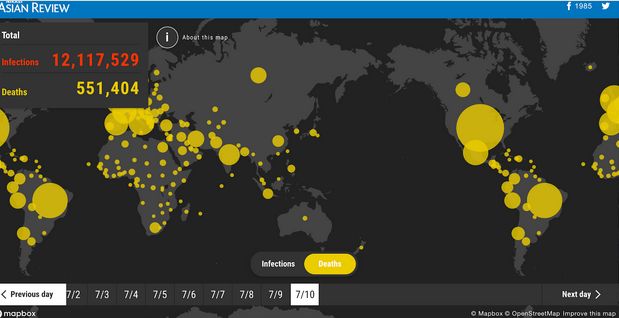
18 | 14 | 2
    APJ | JF

India highlight the folly of the lack of               hopefully authorities will act accordingly.
preparation on the foreseeable consequences of         Clearly, there are powerful financial reasons
an abrupt lockdown in a nation with creaky             for wishing risk away, but the impact of
healthcare infrastructure, limited safety net,         COVID-19 on public health and economic and
and large informal economy of migrant                  social well-being has been catastrophic,
workers. Here in Part I, Michiel Baas examines         highlighting the urgency of prudent investment
the precarity of such migrant workers in India         in upgrading countermeasure capacities.
and Singapore, and how the pandemic                    Nations with good public health infrastructure
challenges their marginalization in uplifting          have fared better in coping with the pandemic
narratives and from public attention. In the           in terms of testing, tracing, isolating, and
Philippines, Quijano, Fernando, and Pangilinan         treating. For the destitute, vulnerable, and
argue in Part II that President Rodrigo Duterte        marginalized communities across Asia, the
boosted transmission with an ill-advised               pandemic has highlighted their limited access
program (since cancelled) to incentivize people        to healthcare and how they are at highest risk
to leave crowded urban centers and return to           precisely due to their lack of access to
their home villages.                                   resources and networks of influence. Inequality
                                                       should thus also be prioritized in the crisis
                                                       response policy agenda.

                                                       There is a temptation to ascribe democratic
                                                       backsliding in Asia to the pandemic, but some
                                                       of Asia’s democracies (including Bangladesh,
                                                       India, Myanmar, Nepal, the Philippines and Sri
                                                       Lanka) had pre-existing conditions that left
                                                       them vulnerable to the politics of pandemic. As
                                                       Croissant argues, “The global erosion of
                                                       democracy preceded the COVID-19 pandemic,
                                                       but its outbreak is accelerating the dynamics of
                                                       democratic regression. As governments around
                                                       the world fight the spread of the coronavirus,
The pandemic has generated opportunities for           the number of countries in which democratic
leaders, bureaucrats, security forces, and the         leaders acquire emergency powers and
well-connected, while reinforcing the                  autocrats step up repression is rapidly
pathologies of inequality, the force multiplier        increasing. The uneven performance of many
for transmission. Along the lines of the adage         democracies in containing the pandemic and
“never waste a crisis”, various institutions and       mitigating its public health effects rekindles
actors have managed to turn the pandemic to            debates about the effectiveness of democratic
their advantage by securing budgets and                rule compared to authoritarian regimes”
expanding turf while engaging in cronyism and          (Croissant 2020).
repression and fending off reforms. The
COVID-19 outbreak has also raised awareness            Indeed, there is vibrant debate about whether
of public health shortcomings, and the urgent          authoritarian governance is better suited to
need for better preparations, but in the               swiftly enacting effective countermeasures
meantime healthcare capacity will be stretched         such as lockdowns and quarantines, but the
as the pandemic wanes, surges, and lingers. It         relative success of Australia, Japan, New
is clear that wishful thinking is not a sound          Zealand, Singapore, South Korea and Taiwan
basis for managing pandemic risks and                  demonstrate that democracies, thus far, have a

                                                   2
18 | 14 | 2
APJ | JF
reasonably good track record on containing Korea
COVID-19. Yet, as is becoming ever more
apparent, the pandemic has not petered out -
new outbreaks and second or third waves
counsel caution against making any grand
claims about the virtues of different political
systems. What does seem clear is that populist
governments such as in India and the
Philippines have been struggling to enact
coherent and consistent countermeasures.
South Korean President Moon Jae-in and
Croissant (2020) suggests that these failures
Taiwan President Tsai Ing-wen
might provoke a popular backlash and
reinvigorate democratic institutions and
practices. Perhaps, but the legitimacy of The essays on East Asia highlight that, in
democratic despots like Modi and Duterte addition to robust public health systems, a
hinges more on their grandstanding political successful response depends on competent
performances that divert attention away from leadership, capable bureaucracies, pandemic
their failures and failings, rather than effective preparations, access to reliable information,
policymaking beneficial to the public. and coherent crisis communications to keep the
public informed and nurture trust in the
Beyond invoking emergency powers, some government’s emergency countermeasures.
Asian democracies have militarized pandemic Much depended on learning the lessons from
countermeasures, but as our authors contend previous pandemics, as well as aggressive
in Part II, a security first approach doesn’t public health policies supported by strong
appear to be effective in containing the public health systems and consistent political
outbreak in nations ranging from Bangladesh leadership and messaging. This is not an
and Sri Lanka to Indonesia and the Philippines. affirmation of the discredited Asian values
For security forces, the pandemic has been a thesis, or ammunition for the democratic
golden opportunity to assert power, or as Jun versus authoritarian debate, but rather
Honna argues in the case of Indonesia (in Part highlights the importance of sound
2), claw back lost turf and undo reforms and preparations, effective implementation, and
constraints imposed since the downfall of civic engagement in containment efforts.
President Suharto in 1998. Similarly, Udan
Fernando suggests (in Part 2) that Sri Lanka’s Taiwan and South Korea score high on these
newly elected President Gotobhaya Rajapaksa criteria (see essays in Part I by Rowen, Hioe,
(2019-) has managed to navigate the lockdown and Park). In contrast, according to Azby
to sidestep constitutional checks-and-balances Brown, Japan has fared reasonably well thus
and reaffirm the military’s central role in the far despite deeply flawed communication and
polity. Politicians hope that securitization of the mediocre leadership. He argues that public
pandemic response will boost discipline and trust in government is not very high in Japan
stifle dissent, but to the extent that the and as a result, speculates that people took the
pandemic worsens, state security may be held initiative to protect their health of their own
responsible, possibly causing a backlash. volition, rather than waiting for the
government to take action. Park points out that
two transmission clusters in South Korea
occurred among groups with little trust in
Models of Success: Taiwan and South government due to a history of antagonism and
318 | 14 | 2
APJ | JF
harassment. Members of a religious cult in As Naoko Wake explains, his race-baiting with
Daegu and the LGBT community in Seoul were his insistence on describing COVID-19 as the
wary of cooperating with authorities, and this “China virus” and willful Othering has
has hampered containment efforts because endangered Asian Americans and subjected
such efforts rely on cooperation and trust. In them to prejudice and indignities that reflects
his essay on Australia, Bartos, while crediting something far worse than an information
authorities with effective countermeasures, deficit.
suggests that more active public engagement is
necessary for ongoing efforts towards virtual In Hong Kong, following the city-state’s smart
elimination of the virus. Here too, gaining handling of the outbreak that drew on lessons
community trust and cooperation by local learned from the 2003 SARS pandemic, Beijing
empowerment is essential. has enacted national security legislation to
stifle anti-government dissent. As Simon
Cartledge argues, although the economic
fallout will probably be severe, 2020 will be
Pandemic Tensions and Diversions remembered mostly for the political
consequences.
The escalating war of words between Beijing
and Washington over the COVID-19 outbreak is The implications of political developments in
symptomatic of the burgeoning geo-political Hong Kong for Taiwan remain uncertain, but
rivalry between the US and China. David Moser the essays by Ian Rowen and Brian Hioe do
and Anonymous both write in Part I about the highlight the rapid and successful response by
mutual recriminations, and how President President Tsai Ing-wen’s government. Like
Donald Trump’s egregious mismanagement of Hong Kong, lessons were learned from the
COVID-19 countermeasures has been exploited 2003 SARS outbreak and preparations made.
by China’s state media and on social media to Despite no lockdown, Taiwan managed border
discredit not only the president, but also controls and quickly rolled out effective
democracy. Initial domestic frustrations among countermeasures that relied on testing,
Chinese citizens with how the state handled the tracking, and quarantine to limit transmissions.
outbreak in Wuhan have shifted to outrage over This was a science driven approach that paid
US blame-mongering against China. Deflecting dividends but would not have been possible
attention to US shortcomings and the without the island’s excellent public health
president’s erratic performance has facilitated infrastructure and residents’ faith in
a triumphalist Chinese narrative and authorities.
represents an own goal by Trump, handing Xi a
propaganda victory. David Moser explains,
“how the COVID-19 epidemic of 2020 Japanese Exceptionalism?
exacerbated existing tensions between the US
and China, and how these escalations in state- Japan is something of an outlier in Asia in
to-state conflict were in large part due to terms of its dilatory response by a complacent
America’s information deficit with the PRC.” It leadership that prioritized public relations over
seems clear that media representations of the public health. The botched quarantine of
other in both countries has fueled escalating passengers and crew on the Diamond Princess
mutual misunderstandings. The information cruise ship in Yokohama Bay was an alarming
deficit has also politicized the pandemic and crisis response to the first outbreak in Asia
partially explains President Trump’s decision to outside China (Kingston 2020a). This was
withdraw from the World Health Organization. compounded by the poorly monitored
418 | 14 | 2
APJ | JF
disembarkation of Japanese passengers, many March, the Olympics were postponed to 2021
of whom returned home on public transport. In and the summit was shelved. This set the stage
traditional media and on social media, Prime for Abe’s declaration of a limited state of
Minister Abe Shinzo was severely criticized in emergency covering just 7 prefectures,
February for being disengaged, and there was extended nationwide a week later. As infections
considerable speculation that his government surged, it appeared Japan’s luck was running
was not ramping up testing in order to out.
suppress the number of cases. His abrupt
decision at the end of February to order the The “Japan model” and the government’s
closure of schools nationwide without erratic response have drawn harsh domestic
consulting relevant experts or educational criticism (Yano 2020). In his essay here,
authorities smacked of politics, trying to appear submitted in June before Abe disbanded his
decisive, but the public backlash was harsh, Expert Group, Ambassador Togo Kazuhiko
especially from working parents who suddenly gives Abe the benefit of doubt on his crisis
had to sort out child-care. response. Abe, however, has sunk in Japanese
public opinion polls, partly due to negative
perceptions of his crisis management (Takeuchi
2020). As Takeuchi reports, in May 55% of the
public disapproved of his pandemic response
while just 36% approved, but as of June positive
perceptions rose to 46%. A subsequent Kyodo
poll showed his approval rating slipping to a
near record low of 36.7 percent while
disapproval surged to 49.7 percent, owing in
part to suspicions of cronyism involving
government outsourcing of pandemic
countermeasure services, but mostly due to a
political scandal in his party related to election
Abe’s abrupt school closure and layoffs rigging by a close associate and his wife
of non-regular workers derail (Mainichi 2020a).
Womenomics
As of mid-2020, Japan has recorded less than
1,000 deaths from COVID-19; the number of
The Japanese government maintains that its cases has increased as restrictions were eased
approach to testing was driven by a cluster- in June, but that is mostly a function of
based approach that devoted limited resources increased testing. In early May, under intense
to tracking clusters of transmissions and criticism by health experts and the public, the
tracing contacts for infections, but by mid- government suddenly eased eligibility criteria
March this strategy was no longer working for getting tested and approved the use of
because more than half of transmissions could antigen tests to supplement the limited
not be traced. It appears that until then, the capacity for PCR tests (Reuters 2020). Prior to
government held out hopes for staging the that, only people with a fever of at least 37.5 C
2020 Olympics, worrying that travel bans, and (99.5 F) for four consecutive days qualified for
a declaration of national emergency would testing, which raised concerns over the
eliminate such prospects. Moreover, PM Abe possibility that such a rule would fuel
hoped that a planned summit with President Xi community transmission by sending infected
in April might still be possible. By the end of people home. As Azby Brown notes here, the
518 | 14 | 2
APJ | JF
government has belatedly tried to make the support, recently winning reelection by a huge
case for limited testing in terms of not landslide. Her prominent position as head of a
overwhelming hospitals and testing centers megapolis of 13 million residents, together with
with the “worried well”. Some health national media attention, have spread her
professionals defend the cluster-based message across the archipelago at a crucial
approach, arguing that it was pragmatic and time when cases and anxieties were rising.
effective by focusing on super-spreaders Abe’s few press conferences were carefully
(Sakamoto 2020), but as Brown notes, some stage managed and he could not match her
prominent epidemiologists remain quite critical media presence. She once worked as a
of this limited testing approach. newscaster on television and understands
traditional media and social media in ways that
In a nation of 126 million, with 28% of the Abe clearly doesn’t. Abe was relentlessly
population over age 65, Japan seems to have mocked over his pricey but inadequate policy of
dodged the bullet for the time being. distributing two masks to every household,
Interestingly, this relative success has not called “Abenomask”, that drew on public
helped Abe as his public support ratings have dissatisfaction with the sputtering range of
sunk and his negative ratings have spiked. policies called Abenomics.
Basically, the public has not credited Abe with
containing the outbreak as he is blamed for
waiting too long to declare a state of
emergency and not showing leadership in the
crisis (Kingston 2020b). So, if Abe doesn’t get
any credit for the limited toll of the outbreak,
how is this relative success explained? Early on
the public adopted sensible precautions and
stuck with the program, wearing masks to
impede transmission, staying home and
observing social distancing guidelines.
Moreover, levels of personal hygiene are high
and relatively few people have the habit of
handshaking, hugging and kissing. Some
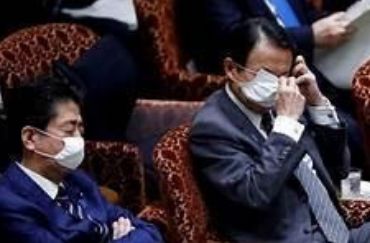
speculate that mandatory TB vaccinations are a PM Abe and Deputy PM Aso in masks
factor while others even argue that Japanese during Diet deliberations
language itself is a barrier to transmission
because the way it is spoken doesn’t project
droplets. This linguistic explanation, however,
overlooks the high death toll a century ago Moreover, netizens blasted a video Abe tweeted
during the Spanish flu when over 400,000 of him coping with lockdown at his well-
Japanese died. appointed residence where he cuddled his dog,
sipped tea and channel surfed, suggesting he
Clearly, Tokyo Governor Koike Yuriko has done was totally out of touch with public concerns. It
a better job at communicating with the public. also did not help that his inner circle of
She holds frequent press conferences and has advisors on managing the pandemic were all
consistently urged people to stay home and elderly politicians who viewed the crisis
businesses to shut down. There is no penalty through the prism of political implications
for non-compliance, but by engaging the public rather than the science of epidemiology, a
she has earned their trust and won their major contrast to President Tsai Ing-wen’s
618 | 14 | 2
APJ | JF
crisis team in Taiwan (Kasuya and Tung, 2020). Trust, as we see in this special issue, is hard to
At the end of June, Abe abruptly disbanded his earn and just as easily lost. In situations where
Experts Group of scientific advisors in favor of the public has learned to be skeptical of their
a panel of celebrity scientists and others government, this can leave people to their own
lacking a background in epidemiology. devices. In Japan, they responded well (mask
Apparently, the original Expert Group made wearing, handwashing, social distancing), but
awkward policy suggestions at odds with the this is not a model for nations without high
prime ministers’ political agenda, levels of social cohesion and social capital.
recommending, for example, against easing Moreover, shifting responsibility from the state
constraints on business operations. With the to the people prevents a coordinated response
economy tanking, Abe prefers to boost business and heightens the risk of amplifying the
activity while the Experts Group was warning negative consequences where social distancing
of the risks of doing so. Yet again, it seems Abe is not an option and access to healthcare is
remains complacent about mitigating public limited. Based on the cases of Taiwan and
health risks. He is also in trouble over his South Korea, consistent messaging and
strong arming of the bureaucracy to approve conveying reliable information are crucial to
the domestically produced drug Avigan for gaining public cooperation and coping with the
treating COVID-19 (Sakaguchi 2020), especially coronavirus. Alas, Modi and Trump have
now that the results of initial clinical trials have demonstrated the folly of not doing so.
been disappointing (Mainichi 2020b).
In contrast to Abe’s poor leadership, Nathan
Park argues here that South Korean President
Moon Jae-in won public trust and admiration
for his deft crisis response countermeasures,
Sources:
including large scale testing and tracking,
scoring an unprecedented landslide election Croissant, Aurel. (2020) “Democracies with
victory in the April legislative elections. He Preexisting Conditions and the Coronavirus in
provided resolute political leadership, rallied the Indo-Pacific
public compliance, and relied on a science (http://www.theasanforum.org/democracies-wit
driven response while avoiding a hard h-preexisting-conditions-and-the-coronavirus-
lockdown. Like Taiwan, South Korea is a model in-the-indo-pacific/?dat=)”, The Asia Forum,
for how to manage a pandemic with extensive June 6.
testing, tracing, tracking, and treatment, quite
in contrast to Japan’s very limited testing and Kasuya, Yuko and Hans. H. Tung, 2020.
tracking. A second wave of cases in June that “Taiwan has a lot to teach Japan about
erupted in Seoul’s gay district highlights the coronavirus response
challenges that remain in containing the (https://asia.nikkei.com/Opinion/Taiwan-has-a-l
outbreak as communities that have little reason ot-to-teach-Japan-about-coronavirus-response)”
to trust the government are less inclined to Nikkei Asia Review, April 20.
comply with guidelines and more concerned
with protecting their own privacy. Kingston, Jeff, 2020a. “Japan’s response to the
coronavirus is a slow motion train wreck
(https://www.washingtonpost.com/opinions/202
0/02/21/japans-response-coronavirus-is-slow-
motion-train-wreck/)”, Washington Post, Feb.
Conclusion 21.
718 | 14 | 2
APJ | JF
Kingston, Jeff, 2020b.”COVID-19 is a Test for blunder2)”, Nikkei Asian Review, June 14.
World Leaders. So Far Abe is Failing
(https://thediplomat.com/2020/04/covid-19-is-a- Sakamoto, Haruka, 2020. “Japan’s Pragmatic
test-for-world-leaders-so-far-japans-abe-is- Approach to COVID-19 testing
(https://thediplomat.com/2020/06/japans-pragm
failing/)”, The Diplomat, April 23.
atic-approach-to-covid-19-testing/)”, The
Mainichi, 2020a. “Ex-minister's arrest pushes Diplomat, June 26.
support for Abe's Cabinet lower: Kyodo poll”
Takeuchi, Yusuke, 2020. “Abe’s Approval
(https://mainichi.jp/english/articles/20200621/p
plunges 11 points after missteps on coronavirus
2g/00m/0na/053000c), June 21. aid
(https://asia.nikkei.com/Politics/Abe-s-approval-
Mainichi, 2020b. “Avigan study fails to
plunges-11-points-after-missteps-on-
demonstrate benefit in COVID-19 study coronavirus-aid)”, Nikkei Asian Review, June 8.
(https://mainichi.jp/english/articles/20200710/p
2g/00m/0fe/107000c)”, July 10. Yano, Hisahiko, 2020. “Japan’s Coronavirus
response offers little clarity and few lessons
Sakaguchi, Yukihiro, 2020. “Abe's arm-twisting (https://asia.nikkei.com/Spotlight/Coronavirus/J
of bureaucrats paved way for Avigan blunder apan-s-coronavirus-response-offers-little-
(https://asia.nikkei.com/Politics/Abe-s-arm-twist clarity-and-few-lessons)”, Nikkei Asian Review,
ing-of-bureaucrats-paved-way-for-Avigan- May 26.
This article is a part of the Special Issue: Pandemic Asia, Part I. See the Table of Contents
here (http://www.apjjf.org/2020/14/APJ.html).
See the Table of Contents for Part II (http://apjjf.org/2020/15/APJ.html).
Readers of this special may be also interested in another COVID-19 special, Vulnerable
Populations Under COVID-19 in Japan (https://apjjf.org/2020/18/ToC.html), edited by
David H. Slater.
Jeff Kingston is Director of Asian Studies and Professor of History at Temple University,
Japan. Most recently, he wrote The Politics of Religion, Nationalism and Identity (2019)
(https://www.amazon.com/Politics-Religion-Nationalism-Identity-Asia/dp/1442276878/?tag=th
easipacjo0b-20) and Japan (2019)
(https://www.amazon.com/Japan-Jeff-Kingston/dp/1509525459/?tag=theasipacjo0b-20), edited
Critical Issues in Contemporary Japan (2019, rev 2nd ed.)
(https://www.amazon.com/Critical-Issues-Contemporary-Japan-Kingston/dp/0815352069/?tag
=theasipacjo0b-20) and Press Freedom in Contemporary Japan (2017)
(https://www.amazon.com/Press-Freedom-Contemporary-Japan-Kingston/dp/1138189596/?tag
=theasipacjo0b-20) and co-edited Press Freedom in Contemporary Asia (2019)
818 | 14 | 2
APJ | JF
(https://www.amazon.com/Press-Freedom-Contemporary-Asia-Burrett/dp/1138584843/?tag=t
heasipacjo0b-20) and Japan’s Foreign Relations with Asia (2018)
(https://www.amazon.com/Japans-Foreign-Relations-James-Brown/dp/113805545X/?tag=theas
ipacjo0b-20). His current research focuses on transitional justice and the politics of memory.
kingston@tuj.temple.edu (https://apjjf.org/mailto:kingston@tuj.temple.edu)
9You can also read


