Smoke-Free Arizona Act It's A Benefit, Not a Ban - Arizona Department of ...
←
→
Page content transcription
If your browser does not render page correctly, please read the page content below

Annual Report 2018

Smoke-Free Arizona Act
It’s A Benefit, Not a Ban

Douglas A. Ducey, Governor
                         State of Arizona

                           Cara M. Christ
          Director, Arizona Department of Health Services

          ARIZONA DEPARTMENT OF HEALTH SERVICES
            Bureau of Epidemiology and Disease Control

                   Office of Environmental Health
                    Smoke-Free Arizona Program
                   150 N. 18th Avenue, Suite 140
                   Phoenix, Arizona 85007-3245
                           (602) 364-3118
    This publication can be made available in alternative format.
              Please contact the number listed above.

Permission to quote from or reproduce materials from this publication
           is granted when due acknowledgment is made.

      “Equal Opportunity/Reasonable Accommodation Employer”
TABLE OF CONTENTS
      Executive Summary                                                       1
1.0   Smoke-Free Arizona Program                                              2
      1.1 Program Background and History                                      2
      1.2 Roles and Responsibilities of ADHS                                  3
      1.3 Roles and Responsibilities of the County Health Departments         4
           1.3.1 Education and Compliance                                     4
           1.3.2 Enforcement of the Law                                       6
      1.4 Amount and Source of Program Funding                                7
2.0   Compliance                                                              8
      2.1 Verifying Compliance through Complaint Response and Routine
          Inspections                                                         8
      2.2 Complaint Numbers Stabilize With Increased Compliance Throughout
          Arizona                                                          8
      2.3 Investigation                                                       11
3.0   Enforcement                                                             12
      3.1 Initiating Legal Procedures                                         12
      3.2 Achieving Compliance Through Legal Proceedings                      12
4.0   Education                                                               13
      4.1 The Smoke-Free Arizona Website: www.smokefreearizona.org            13
      4.2 Answering the Information Hotline: 1-877-297-8677                   14
      4.3 “No Smoking” Signs                                                  15
      4.4 Advisory Visits and Consultations                                   16
5.0   Outreach                                                                17
      5.1 Reaching Out to Public Places and Places of Employment              17
      5.2 Reaching Out to the Community: Success Stories                      19
      5.3 Educational Newsletter                                              21
      5.4 Working with Smoke-Free Arizona Partners                            22
6.0   Protecting the Health of Arizonans                                      23
      6.1 State of Tobacco Control Report Card: Smoke-Free Arizona Scores a
          Grade A                                                             23
      6.2 Empower Program                                                     24
      6.3 The City of Douglas Adopts the Tobacco 21 Initiative - Preventing
          Tobacco Addiction Foundation                                        25

7.0   Conclusion                                                              26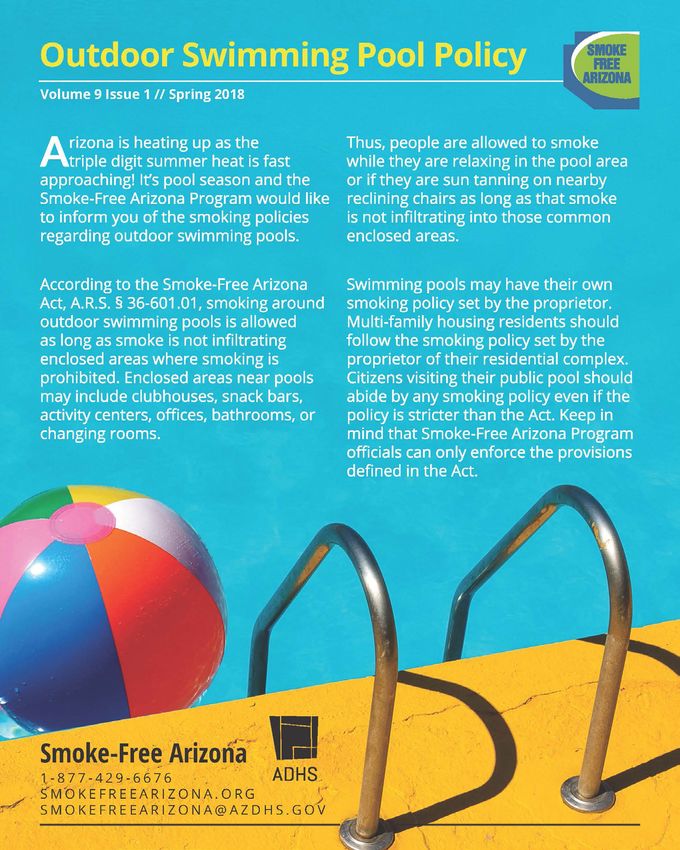
EXECUTIVE SUMMARY
On November 7, 2006, Arizona voters approved Proposition 201, the Smoke-Free Arizona Act, A.R.S.§
36-601.01 (“the Act” or ”the Law”). The Law went into effect on May 1, 2007, prohibiting smoking
inside and within 20 feet of entrances, open windows, and ventilation systems of most enclosed public
places and places of employment, with a few exemptions.
While the Act prohibits smoking inside most enclosed public places and places of employment in
Arizona, smoking is allowed in establishments that meet specific exemption criteria. There are seven
exemptions, including private residences, designated smoking rooms in hotels and motels, retail
tobacco stores, veterans and fraternal clubs, smoking when associated with a religious ceremony
pursuant to the American Indian Religious Freedom Act of 1978, outdoor patios, and theatrical
performances upon a stage or in the course of a film or television production.
Also included in Proposition 201, was the imposition of a two-cent tax per pack of cigarettes to be
deposited into the Smoke-Free Arizona Fund, which must be used to enforce the provisions of the
Law. If proprietors of an establishment does not correct violations as requested, demonstrates willful
violations, or exhibits a pattern of noncompliance with the Act, they are subject to enforcement
action. The proprietor may receive a Notice of Violation (NOV) or an assessment of civil penalty fines
between $100 and $500 for each violation. If injunctive relief is requested, the Superior Court may
impose appropriate injunctive relief and civil penalty fines up to $5,000 per violation.
The Arizona Department of Health Services (ADHS), through delegation agreements with all of
Arizona’s counties, works to ensure that Arizonans are protected from secondhand smoke exposure
in most enclosed public places and places of employment. The county health departments conduct
consultations and on-site visits at public places and places of employment, including but not limited to,
local businesses, bars, and restaurants to provide education and to ensure continued compliance with
the Smoke-Free Arizona Act. Between May 1, 2017 and April 30, 2018, a total of 23,332 educational
visits, consultations, and on-site visits were conducted. Many business proprietors have made steps
to go above and beyond the requirements of the Smoke-Free Arizona Act. In addition to making
the necessary changes to comply with the Act, such as posting the required “No Smoking” signs
and moving ashtrays, proprietors have also continued to build outdoor patios, provide designated
smoking areas, and establish in-house policies that are more strict than the Act to accommodate their
employees and customers.
During the eleventh year after the Law went into effect, between May 1, 2017 and April 30, 2018, a
total of 1,148 complaints alleging violations of the Smoke-Free Arizona Act were filed statewide. Most
of the complaints were regarding people smoking keeping or having ashtrays located outside within
twenty feet of an entrance.
A total of seven NOVs were issued statewide between May 1, 2017 and April 30, 2018, four of which
were issued by the Coconino County Public Health Services District, two of which were issued by
ADHS for Maricopa County Health Department and one which was issued by the Mohave County
Environmental Health Department. No new cases were brought before the Superior Court for
injunctive relief this year.
With our eleventh year, the Smoke-Free Arizona (SFA) Program continues to ensure the health and
wellness of Arizonans by protecting them from secondhand smoke exposure in most enclosed public
places and places of employment.

1.0 SMOKE-FREE ARIZONA
                  PROGRAM
                             1.1 BACKGROUND AND HISTORY
                             Secondhand smoke is defined as the combination of smoke exhaled by a smoker and the
                             smoke generated by the burning end of a cigarette (or other tobacco product). Secondhand
                             smoke is a mixture of 4,000 chemical compounds that are released into the air as gases and
                             particles. Of these 4,000 compounds, 69 have been identified as carcinogens or cancer-
                             causing agents, with 11 having been specifically identified as human carcinogens.

                             Exposure to secondhand smoke is a health concern for people of all ages. In 1992, the
                             U.S. Environmental Protection Agency (EPA) officially listed secondhand smoke as a Class
                             A Carcinogen. In 2006, the U.S. Surgeon General’s report stated that there is no risk-free
                             level of exposure to secondhand smoke. Breathing even a little secondhand smoke can be
                             harmful to your health.

                             In November of 2006, Arizona voters made their voices heard by passing the Smoke-Free
                             Arizona Act, A.R.S. § 36-601.01 (“the Act” or “the Law”). The Act protects all Arizonans
                             from the harmful effects of secondhand smoke exposure in most enclosed public places
                             and places of employment and within 20 feet of entrances, open windows, and ventilation
                             systems. Also included in the Act, is a two-cent tax per pack of cigarettes to be deposited
                             in the Smoke-Free Arizona Fund, which must be used to enforce the provisions of the Law.
                             The Act went into effect on May 1, 2007.

                             The Act prohibits smoking inside enclosed public places and places of employment with a
                             few exemptions:

           Private           Hotel and          Retail            Veterans         Smoking           Outdoor          A theatrical
           residences,       motel              tobacco           and              when              patios so long   performance
           except when       rooms that         stores that are   fraternal        associated        as tobacco       upon a stage or
           used as a                            physically                                           smoke does not   in the course of
                             are rented to                        clubs when       with a
           licensed child    guests and are     separated so                                         enter areas      a film or
           care, adult day                      that smoke from   they are not     religious         where smoking    television
                             designated as                        open to the
           care, or health   smoking rooms;     retail tobacco                     ceremony          is prohibited    production
           care facility                        stores does not   general public                     through
                             provided,                                             practice
                             however, that      infiltrate into                                      entrances,
                                                areas where                        pursuant to the   windows,
                             not more than                                         American Indian
                             fifty percent of   smoking is                                           ventilation
                                                prohibited                         Religious         systems, or
                             rooms rented to                                       Freedom Act of
                             guests in a        under the                                            other means
                                                provisions of                      1978
                             hotel or motel
                             are so             this section
                             designated

SMOKE-FREE ARIZONA ANNUAL REPORT | 2018                                                                                              2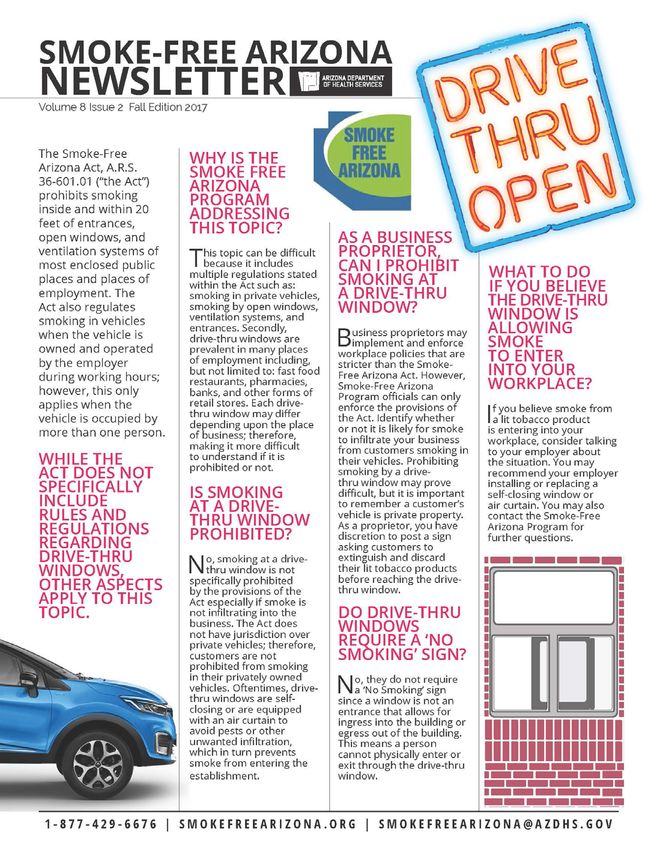
For each exemption to the Act, there are specific requirements that must be met to qualify.
                               These criteria are defined in the Act and in the Arizona Administrative Code, Title 9, Chapter
                               2, Article 1.

                               Under the Act, the proprietor of a public place or a place of employment is responsible for:

                               Removing                 Posting                 Educating             Prohibiting            Informing
                               all indoor ashtrays      the required “No        all existing and      anyone, such as        violators by
                               and smoking              Smoking” signs at       prospective           employees,             politely requesting
                               receptacles, and         every entrance          employees about       vendors, visitors,     that they
                               moving all               into the                the Act               and customers          extinguish their lit
                               outdoors ashtrays        establishment                                 from smoking           tobacco product or
                               and smoking                                                            within 20 feet of      that they smoke
                               receptacles at                                                         all entrances, open    outside at least 20
                               least 20 feet away                                                     windows, and           feet away from the
                               of entrances                                                           ventilation            entrance, open
                                                                                                      systems, and           window, or
                                                                                                      inside the             ventilation system
                                                                                                      establishment

                               If proprietors of an establishment do not correct violations as requested, or demonstrate
                               willful violations or a pattern of noncompliance with the Act, they are subject to
                               enforcement action. They may receive a Notice of Violation (“NOV”) or an assessment
                               of civil penalty fines between $100 and $500 for each violation. If injunctive relief is
                               requested, the Superior Court may impose appropriate injunctive relief and civil penalty
                               fines up to $5,000 per violation.

                              1.2 ROLES AND RESPONSIBILITIES OF ADHS
                              The provisions of the Act assign implementation and enforcement of the Law to ADHS. In
                              order to accomplish this, the Office of Environmental Health, due to its extensive experience
                              with education, inspections, investigations, and enforcement, oversees the Smoke-Free
                              Arizona Program.

                              The Smoke-Free Arizona Program is responsible for:

                 Providing free signage to           Maintaining the                  Answering inquiries              Taking complaints coming
                 businesses                          Smoke-Free Arizona website:      coming through the               through the complaint line:
                                                     www.smokefreearizona.org         information line:                1-877-429-6676, or from the
                                                                                      1-877-297-8677,                  nosmokingarizona@azdhs.gov
                                                                                      or from the                      mailbox
                                                                                      smokefreearizona@azdhs.gov
                                                                                      mailbox

                 Conducting on-site                  Maintaining a statewide          Providing training to new        Providing educational
                 advisory visits                     database used by the county      and existing health              materials to county health
                                                     health departments for           educators and environmental      departments
                                                     complaint investigations and     health inspectors
                                                     referrals

                  Assisting county health            Providing guidance to the         Initiating enforcement
                  departments during                 county health departments         procedures for cases referred
                  complaint investigations or        with regard to education,         by Cochise, Gila, Maricopa,
                  advisory visits by riding along    compliance, and enforcement       Santa Cruz, and Yavapai
                  with the health educators or                                         Counties
                  the environmental health
                  inspectors

SMOKE-FREE ARIZONA ANNUAL REPORT | 2018                                                                                                              3
1.3 ROLES AND RESPONSIBILITIES OF THE
                              COUNTY HEALTH DEPARTMENTS
                              1.3.1 EDUCATION AND COMPLIANCE
                              ADHS and the county health departments work diligently to protect all Arizonans from
                              secondhand smoke exposure and to ensure uniform compliance with the Law throughout
                              the State. For the first time in eleven years, delegation agreements have been signed
                              with all fifteen counties to assist ADHS with education and compliance. The new
                              delegation agreements involve Smoke-Free Arizona and Food Safety & Environmental
                              Health inspections. These agreements will be in effect for 15 years. Depending on the
                              infrastructure of the county health department, education and compliance assistance
                              are performed by either health educators from their Tobacco Education and Prevention
                              Program, or by environmental health inspectors from their Environmental Services Division.

FIGURE 1
LEAD PROGRAM RESPONSIBLE              TOBACCO EDUCATION
FOR EDUCATION AND                     AND PREVENTION (TEP)
COMPLIANCE FOR EACH                   ENVIRONMENTAL SERVICES                                               APACHE
COUNTY HEALTH DEPARTMENT              DIVISION (ESD)
                                                                                    COCONINO
                                      ESD AND TEP                  MOHAVE

                                                                                                    NAVAJO

                                                                                YAVAPAI

                                                                    LA PAZ
                                                                                                   GILA
                                                                               MARICOPA
                                                                                                              GREENLEE

                                                                                           PINAL          GRAHAM
                                                                    YUMA

                                                                                       PIMA
                                                                                                           COCHISE

                                                                                              SANTA CRUZ

                              ENVIRONMENTAL SERVICES DIVISION
                              The Environmental Services Division is the lead program for education and compliance
                              in Cochise, Gila, Graham, Greenlee, Mohave, Navajo, Pinal, and Santa Cruz Counties.
                              Environmental health inspectors verify compliance and provide education about the Act
                              during routine food safety and environmental health inspections. Smoke-Free Arizona
                              violations have been included on inspection checklists to monitor compliance with the Act.
                              In addition, environmental health inspectors carry “No Smoking” signs and educational
                              brochures for distribution during routine inspections and complaint investigations.

   SMOKE-FREE ARIZONA ANNUAL REPORT | 2018                                                                                 4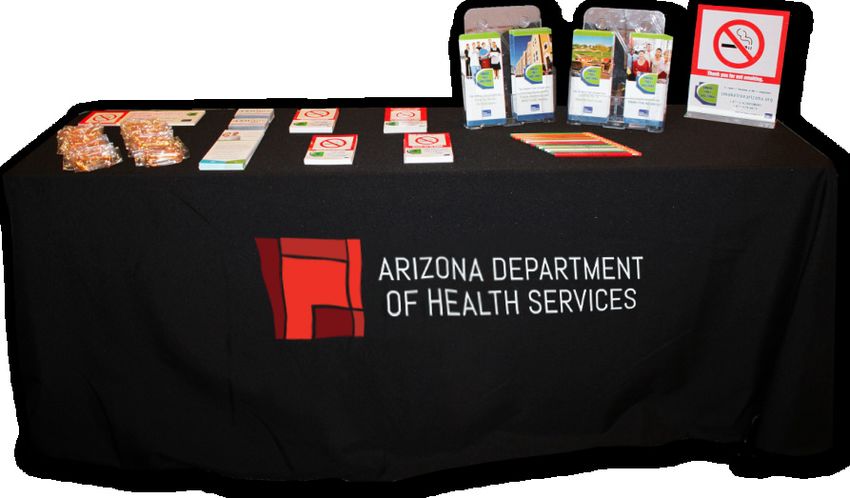
TOBACCO EDUCATION AND PREVENTION PROGRAM
                           The Tobacco Education and Prevention Program are responsible for compliance and
                           education in Coconino, La Paz, Maricopa, Pima, Yavapai, and Yuma Counties. Health
                           educators have been actively working with businesses in their communities by providing
                           education about the Smoke-Free Arizona Act and explaining the benefits of smoke-free
                           environments.

                           In the majority of these counties, a solid partnership exists between the Tobacco Education
                           and Prevention Program and the Environmental Services Division. For example, if an
                           environmental health inspector observes a smoking violation during a routine inspection in
                           a food establishment, they will notify the health educator. The health educator will follow-
                           up with the person in charge of the food establishment to ensure compliance with the Law.

                           APACHE COUNTY DUAL LEAD PROGRAMS:
                           ENVIRONMENTAL SERVICES DIVISION & TOBACCO
                           EDUCATION AND PREVENTION PROGRAM
                           Joining efforts of health educators from the Tobacco Education and Prevention Program and
                           environmental health inspectors from the Environmental Health Services Division is the key
                           to ensuring compliance in Apache County.

                           For establishments permitted under the Apache County Health Code, such as restaurants,
                           bars, grocery stores, hotels/motels, and public accommodations, education and complaint
                           investigations are conducted by environmental health inspectors. For non-permitted
                           establishments such as retail stores, repair shops, business offices, and shopping centers,
                           education and complaint investigations are conducted by health educators from the
                           Tobacco Education and Prevention Program.

                           SANTA CRUZ COUNTY
                           For the first time in 11 years, ADHS signed a delegation agreement to delegate education,
                           compliance, and enforcement activities of the Smoke-Free Arizona Act to the Santa Cruz
                           County Health Department. Environmental health inspectors will investigate complaints,
                           conduct advisory visits and on-site inspections, and educate the community about the Law
                           and its requirements.

SMOKE-FREE ARIZONA ANNUAL REPORT | 2018                                                                                   5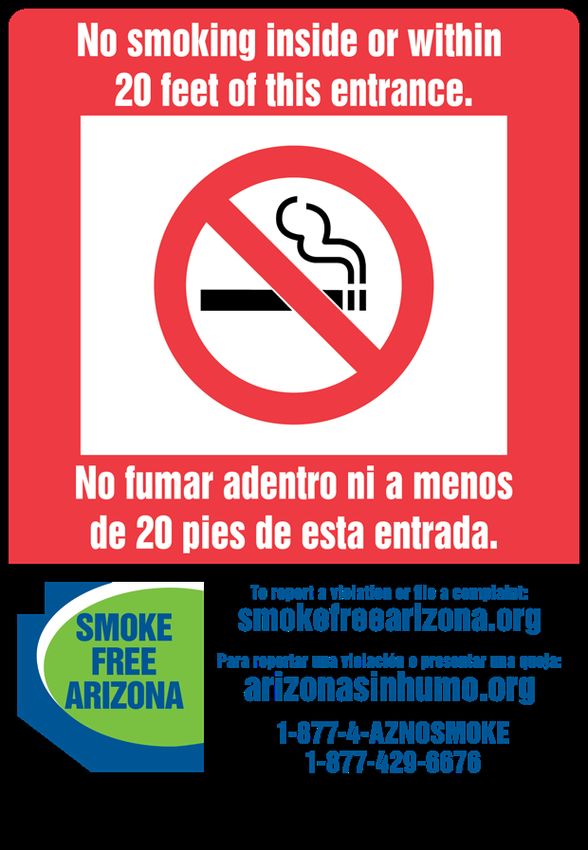
1.3.2 ENFORCEMENT OF THE LAW
                               Ten county health departments have the delegated authority for enforcement activities such
                               as issuing Notices of Violation (NOVs), assessing civil penalty fines, attending administrative
                               hearings, and seeking injunctive relief.

FIGURE 2
ENFORCEMENT                            ARIZONA DEPARTMENT OF
RESPONSIBILITIES FOR EACH              HEALTH SERVICES

COUNTY HEALTH DEPARTMENT               COUNTY                                                                 APACHE
                                       ENFORCEMENT
                                                                                        COCONINO
                                                                      MOHAVE

                                                                                                       NAVAJO

                                                                                   YAVAPAI

                                                                       LA PAZ
                                                                                                      GILA
                                                                                   MARICOPA
                                                                                                                 GREENLEE

                                                                                              PINAL          GRAHAM
                                                                       YUMA

                                                                                          PIMA
                                                                                                              COCHISE

                                                                                                 SANTA CRUZ

                               The counties conducting their own enforcement activities are Apache, Coconino, Graham,
                               Greenlee, La Paz, Mohave, Navajo, Pima, Pinal and Yuma. For these counties, the delegation
                               agreement delineates the enforcement duties and additional funding is provided to support
                               these duties.

                               For the remaining five counties, Cochise, Gila, Maricopa, Santa Cruz, and Yavapai, ADHS
                               provides assistance for enforcement. This means that once a pattern of noncompliance
                               is documented, or there is evidence of willful violation of the Act, the county health
                               department refers the case to ADHS for enforcement. The enforcement procedures are
                               explained in Section 3.0 of this report.

    SMOKE-FREE ARIZONA ANNUAL REPORT | 2018                                                                                 6
1.4 AMOUNT AND SOURCE OF PROGRAM FUNDING
The Smoke-Free Arizona Act includes a two-cent tax that is imposed on each pack of
cigarettes purchased. The money collected from this tax is deposited into the Smoke-Free
Arizona Fund and used to enforce the Act. Any money remaining in the Smoke-Free Arizona
Fund, after ADHS and its delegates have met enforcement obligations for the fiscal year, is
deposited into the Tobacco Products Tax Fund and used for education programs to reduce
and eliminate tobacco use.
The total revenue for the Smoke-Free Arizona Fund from May 1, 2017 to April 30, 2018 was
$2,836,916.23.
FIGURE 3 $4.0 Million
SMOKE-FREE ARIZONA FUND
YEAR TAX REVENUE FROM
MAY 1, 2007 TO APRIL 30, 2018
$3.0
$2.0
$1.0
2008 2009 2010 2011 2012 2013 2014 2015 2016 2017 2018
FISCAL YEAR
SMOKE-FREE ARIZONA ANNUAL REPORT | 2018 72.0 COMPLIANCE
2.1 VERIFYING COMPLIANCE THROUGH COMPLAINT
RESPONSE AND ROUTINE INSPECTIONS
Compliance with the Smoke-Free Arizona Act is continuing to increase throughout the
State. Compliance is monitored through complaint response inspections at enclosed public
places and places of employment. Additionally, compliance is verified during routine food
safety inspections conducted at foodservice establishments, such as bars and restaurants.
During the eleventh year of the Smoke-Free Arizona Act, business proprietors have
continued to go above and beyond the requirements of the Smoke-Free Arizona Act. In
addition to making the necessary changes to comply with the Act, such as posting the
required “No Smoking” signs and moving ashtrays, proprietors continue to build outdoor
patios, provide designated smoking areas, and establish in-house smoking policies that are
more strict than the Act to accommodate their employees and customers.
2.2 COMPLAINT NUMBERS STABILIZE WITH INCREASED
COMPLIANCE THROUGHOUT ARIZONA
The ADHS Smoke-Free Arizona Program continues to encourage members of the public
to report violations of the Smoke-Free Arizona Act. Complaints can be filed by one of the
following:
Filling out an online Calling the toll-free Sending an e-mail to
complaint form at Smoke-Free Arizona hotline at nosmokingarizona@azdhs.gov
www.smokefreearizona.org 1-877-429-6676
During the eleventh year after the Act went into effect, between May 1, 2017 and April
30, 2018, a total of 1,148 complaints alleging violations of the Smoke-Free Arizona Act
were filed statewide. The numbers of complaints filed this year resulted in a decrease when
compared to last year’s total of 1,418 complaints.
Overall, the predominant type of complaint over the last three years has been consistent.
Most of the complaints were regarding people smoking outside within twenty feet of an
entrance and the presence of ashtrays located outside within twenty feet of an entrance.
SMOKE-FREE ARIZONA ANNUAL REPORT | 2018 8FIGURE 4 136
TOTAL COMPLAINTS FILED
STATEWIDE BETWEEN
MAY 1, 2017 TO APRIL 30, 2018 112
104 107
98 100
92 93
88 85
COMPLAINTS
72
60
MAY JUN JUL AUG SEP OCT NOV DEC JAN FEB MAR APR
MONTH
Of the 1,148 complaints received, 1,022 complaints (89%) reporting violations of the
Act were located in Maricopa, Pima, and Mohave counties.
FIGURE 5
TOP THREE COUNTIES WITH
THE HIGHEST PERCENTAGE OF
COMPLAINTS BETWEEN
MAY 1, 2017 TO APRIL 30, 2018
MOHAVE
3%
MARICOPA
77%
PIMA
9%
SMOKE-FREE ARIZONA ANNUAL REPORT | 2018 9FIGURE 6
COMPARISON OF COMPLAINTS
FILED STATEWIDE BETWEEN
MAY 1, 2017 TO APRIL 30, 2018
APACHE
COCONINO 0
MOHAVE
18
32 NAVAJO
8
YAVAPAI
22
LA PAZ
2 MARICOPA
GILA
13
885 GREENLEE
PINAL GRAHAM 12
11 18
YUMA
10
PIMA
106 COCHISE
SANTA CRUZ
7
4
With the exception of year 1, May 1, 2007 – April 30, 2008, which showed 4,803
complaints filed, yearly complaint numbers have been consistent since May 1, 2008,
averaging 1,437 complaints per year. Efforts to educate business owners and to
incorporate compliance checks into routine food safety inspections continue to result in
maintaining a steady number of complaints and thus continuing to achieve compliance
statewide.
FIGURE 7 4,803
NUMBER OF COMPLAINTS FOR
COUNTY BETWEEN
MAY 1, 2007 AND APRIL 30, 2018
COMPLAINTS
1,776
1,681
1,396 1,408 1,494 1,295 1,278
1,475 1,418
1,148
2008 2009 2010 2011 2012 2013 2014 2015 2016 2017 2018
FISCAL YEAR
SMOKE-FREE ARIZONA ANNUAL REPORT | 2018 102.3 INVESTIGATION
FIGURE 8
NUMBER OF INSPECTIONS FOR
EACH COUNTY BETWEEN
MAY 1, 2017 AND APRIL 30, 2018 APACHE
COCONINO 0
MOHAVE
20
27 NAVAJO
8
YAVAPAI
25
LA PAZ
2 MARICOPA
GILA
8
1,089 GREENLEE
PINAL GRAHAM 10
10 2
YUMA
10
PIMA
86 COCHISE
SANTA CRUZ
9
1
Complaints alleging violations of the Smoke-Free Arizona Act are investigated by the
individual county’s health department in all fifteen counties. Once a complaint is received
and it is determined that the allegations are valid violations of the Act, an unannounced
inspection will take place and/or the business proprietor is notified within 15 days of
the complaint. From May 1, 2017 to April 30, 2018, 1,307 complaint inspections were
conducted statewide. (See Figure 8). When necessary, Smoke-Free Arizona Specialists
go in pairs to perform inspections. For example, during night inspections and for cases
where the evidence may be difficult to find. If a violation of the Act is observed during an
inspection, the proprietor is requested to correct the violation at the time of the inspection.
If the violation is not corrected at that time, a re-inspection will take place to verify that a
corrective action has been made. Re-inspections have shown to be an effective approach in
achieving compliance.
An effective approach while conducting complaint investigations is to conduct a joint
inspection. Occasionally, the county health departments request assistance during difficult
inspections. The inspection might involve indoor smoking. When confronted with the
evidence of violations, some proprietors can be inflexible to the request to perform the
necessary corrective actions as soon as possible. The ADHS Smoke-Free Arizona Program
takes this opportunity to partner with the county health departments to approach
challenging situations or proprietors and to help these businesses come into compliance
with the Act through joint inspections.
Complainants may follow-up on their complaints by calling the ADHS Smoke-Free Arizona
Program or their county health department. Complaint investigation findings are entered
into a database that can be accessed by Smoke-Free Arizona Program officials only.
SMOKE-FREE ARIZONA ANNUAL REPORT | 2018 113.0 ENFORCEMENT
3.1 INITIATING LEGAL PROCEDURES
Ten of the fifteen Arizona county health departments have the delegated authority to
enforce the provisions of the Smoke-Free Arizona Act. These include Apache, Coconino,
Graham, Greenlee, La Paz, Mohave, Navajo, Pima, Pinal and Yuma Counties. The ADHS
Smoke-Free Arizona Program is responsible for enforcement in the remaining five counties,
including Cochise, Gila, Maricopa, Santa Cruz, and Yavapai (See Figure 2). If proprietors of
an establishment do not correct violations as requested, demonstrate willful violations,
or a pattern of noncompliance with the Act, they are subject to enforcement action, may
receive a Notice of Violation (“NOV”) or may be assessed civil penalty fines between $100
and $500 for each violation. If injunctive relief is requested, the Superior Court may impose
appropriate injunctive relief and civil penalty fines up to $5,000 per violation.
3.2 ACHIEVING COMPLIANCE THROUGH LEGAL
PROCEEDINGS
Enforcement actions take place when educational efforts fail to result in compliance with
the Smoke-Free Arizona Act in a timely manner. The ADHS Smoke-Free Arizona Program
has had tremendous support from the Education and Health Section attorneys from the
Office of the Arizona Attorney General and from the Office of Administrative Counsel and
Rules at ADHS. This support, combined with an effective enforcement protocol, allows
ADHS to better serve the county health departments when cases are referred to ADHS for
enforcement.
Notices of Violation (NOV) are issued in response to a pattern of noncompliance or willful
violations of the Law. An NOV details violations that have been observed and documented
during complaint investigations. A total of seven NOVs were issued statewide between
May 1, 2017 and April 30, 2018, four of which were issued by the Coconino County
Public Health Services District, two were issued by ADHS for the Maricopa County Health
Department, and one which was issued by the Mohave County Environmental Health
Department. For the two NOVs issued by ADHS, settlement agreements were reached with
a total of $350 collected in fines. ADHS defers the total amount of fines if a settlement
agreement is signed. If proprietors who have reached settlement agreements are found in
violation again, they are responsible for any previous and new civil money penalties.
Between May 1, 2017 and April 30, 2018, there were no administrative hearings held for
ADHS. Additionally, no new cases were brought before the Superior Court for injunctive
relief this year.
SMOKE-FREE ARIZONA ANNUAL REPORT | 2018 124.0 EDUCATION
As we cross the threshold of the eleventh year after implementation of the Smoke-Free
Arizona Act, we continue to make major strides to improve the communication and
educational information disseminated to the public and businesses of Arizona about the Act.
4.1 THE SMOKE-FREE ARIZON WEBSITE:
WWW.SMOKEFREEARIZONA.ORG
As the main channel of communication with the public, business owners, and other partners
throughout Arizona, the Smoke-Free Arizona website is an essential part of the Smoke-
Free Arizona (SFA) Program. The SFA website contains detailed information about all the
requirements of the Act and how these requirements apply to different indoor and outdoor
areas.
Key features of the program are highlighted on the website such as reporting violations,
ordering signs, complying with the law, outdoor areas, residential areas, exemptions and
publications. Most importantly, visitors to the website can also access links to the rules and
statutes, frequently asked questions, and other resources. The Smoke-Free Arizona website
is maintained by updating or adding relevant information that can aid in reaching the general
public and assisting proprietors to comply with the Act.
Since the Law went into effect, the website’s most popular features are:
Business owners are able to order required “No Smoking” signage free of charge from
the website
Concerned citizens are able to report violations of the Act by filing a complaint form
online in three easy steps
Individuals can submit complaints directly on the Smoke-Free Arizona website or they
can also submit a complaint by emailing NoSmokingArizona@azdhs.gov. The Smoke-
Free Arizona Act allows concerned citizens to file complaints anonymously. Allowing
citizens to file complaints alleging violations of the Law is not only mandated by the Act,
but it is also an effective tool to aid in education and compliance assistance. For more
information about provisions of the Law, individuals can make inquiries by emailing
SmokeFreeArizona@azdhs.gov.
SMOKE-FREE ARIZONA ANNUAL REPORT | 2018 134.2 ANSWERING THE INFORMATION HOTLINE:
1-877-297-8677
As required by the Smoke-Free Arizona Act, ADHS provides a 24/7 toll-free information line
to answer inquiries, fulfill requests for free signage, and document reports of violations from
the general public and business owners.
An approximate combined total of 884 calls were received between May 1, 2017 and
April 30, 2018. Sixty-eight percent of the calls received were inquiries about the Smoke-
Free Arizona Act, while the remaining calls were either requests for free signage or from
individuals reporting violations of the Act.
90 94
FIGURE 9 82 83 85
NUMBER OF CALLS RECEIVED
70 74 70
BETWEEN MAY 1, 207 AND 64 68
APRIL 30, 2018 59
45
CALLS
MAY JUN JUL AUG SEP OCT NOV DEC JAN FEB MAR APR
MONTH
68%
22%
of the calls were
of the calls were to place
a complaint.
Inquiries.
10% of the calls were to order No Smoking Signage.
Of these calls, the top five types of inquiries received during business hours were regarding:
Questions Multi-Family Designated Sign How
about the housing/ smoking requirements complaints
20’ Rule private area are
residences investigated
SMOKE-FREE ARIZONA ANNUAL REPORT | 2018 144.3 “NO SMOKING” SIGNS
The Smoke-Free Arizona Act requires that most enclosed public places and places of
employment in Arizona have a “No Smoking” sign posted at every entrance. All entrances
should have signs posted except for doors leading to an outdoor patio and doors used as
an emergency exit. Signs should include all the required information and be clearly and
conspicuously posted. Business owners have the option to order “No Smoking” signs free of
charge from the Smoke-Free Arizona Program or they may choose to create their own signs
as long as the required information is included.
To meet the signage requirements of the Smoke-Free Arizona Act § 36-601.01, the
proprietor shall post signs that contain:
The international no smoking symbol (consisting of a pictorial representation of
a burning cigarette enclosed in a red circle with a red bar across it) or the words “No
Smoking”
A citation to A.R.S. § 36-601.01
The telephone number for making complaints (1-877-429-6676)
The website address for making complaints (www.smokefreearizona.org)
For public places or places of employment, signs should be no smaller than 4 inches
by 6 inches;
For business vehicles, signs should be no smaller than 2 inches by 3 inches.
In 2018, 925 sign orders were placed by businesses. In addition, signs are distributed to
businesses during complaint inspections, advisory visits, educational visits, and routine
inspections conducted by county health educators and health inspectors.
In 2018, a total of 40,343 signs were distributed statewide. The demand for free signs
has remained steady over the years. On average, the Smoke-Free Arizona Program has
distributed approximately 47,539 signs yearly over the last ten years.
SMOKE-FREE ARIZONA ANNUAL REPORT | 2018 154.4 ADVISORY VISITS AND CONSULTATIONS
Arizona county health departments and Smoke-Free Arizona Program staff provide
compliance assistance to proprietors by performing advisory visits or conducting
consultations at their public place or place of employment. Upon request, county
environmental health inspectors, county health educators, and ADHS Smoke-Free Arizona
Program Specialists visit public places and places of employment to assist with answering
any questions that the proprietor may have about a specific area of concern. Advisory
visits or consultations may also occur as part of a new business compliance check or as
educational outreach efforts. Between May 1, 2017 and April 30, 2018, a total of 23,332
educational visits and consultations were conducted.
All advisory visits and consultations are tracked. The Smoke-Free Arizona Program
documents these advisory visits using an Advisory Form. The standard Advisory Form
not only documents the visit and the establishment’s information, but it also provides
information to business proprietors, including a list of requirements of the Act with which
proprietors must comply.
County environmental health inspectors, county health educators, and Smoke-Free Arizona
Program Specialists do not perform plan review for outdoor patios; however, they can
ensure that proprietors understand the requirements of the outdoor patio exemption.
SMOKE-FREE ARIZONA ANNUAL REPORT | 2018 165.0 OUTREACH
5.1 REACHING OUT TO PUBLIC PLACES AND PLACES OF
EMPLOYMENT
Between May 1, 2017 and April 30, 2018, the ADHS Smoke-Free Arizona Program
Specialists, as well as county health educators and county environmental health specialists,
conducted 135 educational presentations. Health educator and program representatives
conducted presentations to large employers and community partners, such as schools
and after-school programs, doctor’s offices, community centers, apartment complexes,
city wellness groups and employees, city chamber of commerce, local department of
transportation, and churches. All combined, an estimated 133,290 people attended these
educational presentations.
HEALTH FAIRS
The Smoke-Free Arizona Program and county health educators used health fairs as an
effective forum to provide education to the public face-to-face regarding the requirements
of the Smoke-Free Arizona Act. The Smoke-Free Arizona Program partners with the
Wellness Council of Arizona to outreach to large employers and distribute information at
wellness health fairs.
This year, the Smoke-Free Arizona Program attended the Greater Phoenix Chamber of
Commerce and the Phoenix Business and Workforce Development Center for the Healthy
Arizona Worksites Program, and the Highway Patrol Public Safety Health Fair at the State
Fair Grounds. The Program also attended the Arizona Environmental Health Association
Conference which hosted 150 registered sanitarians.
Some of the wellness fairs and events attended by program specialists and health educators
included dental offices, health festivals, a tobacco alliance event, an employee wellness fair
at a casino, county fairs, and child fairs.
SMOKE-FREE ARIZONA ANNUAL REPORT | 2018 17COUNTY HEALTH DEPARTMENT ASSESSMENTS
In 2012, the Smoke-Free Arizona Program commenced a new venture with each of the
State’s county health departments by conducting on-site assessments. The assessment
visits, which will occur every two calendar years, are intended to provide the counties
with a platform to showcase their educational and outreach efforts, share experiences,
highlight strengths, discuss difficult inspections, seek guidance, and detail their enforcement
practices.
The 2018 county health department assessments began in March and will be concluded
by December 2018. This year 7 county assessments have been completed and every
county health department will be visited this year. As a result, the assessments will provide
the Smoke-Free Arizona Program an opportunity to become more familiar with how the
counties operate their programs, improve communication, and ensure all Smoke-Free
programs are more consistent statewide. As the Program moves forward, these assessments
will only continue to prove valuable in ensuring the health of Arizonans.
SMOKE-FREE ARIZONA ANNUAL REPORT | 2018 185.2 REACHING OUT TO THE COMMUNITY: SUCCESS
STORIES
COCONINO COUNTY: EDUCATION TO THE YOUTH
The Coconino County Smoke-Free Arizona program found a real honor and pleasure to
travel the Navajo and Hopi Reservations. As part of the NB3 Fit Week, the Coconino
County inspector and educator attended the morning sunrise prayer and walk/run at Buffalo
Park in Flagstaff. An educational board was made specifically for these events. They did
several things but most importantly distinguished between commercial and traditional
tobacco use. As we know traditional tobacco is sacred to Native Americans, but in recent
times it is sometimes hard to find. Many individuals have started to use cigarettes in their
ceremonies; the education was meant to show the difference between the two tobacco
plants and why commercial tobacco shouldn’t be used during ceremonies or smoked at all.
The educational board displayed diabetes prevention strategies, since diabetes is a large
problem within the Native American community. The theme for NB3 Fit Week was to
encourage Native American youth to get regular exercise, eat well and drink more water.
The educator was also a part of Indigenous Games night as part of the NB3 fit week and
it was a blast. The same board was utilized for Puente School in Flagstaff which was open
to youth and their parents. It was sponsored by NACA (Native Americans for Community
Action).
The Youth in Wellness expo events were held on the Hopi reservation where Coconino
County visited five schools. Four of the wellness expos were similar to health fairs where
all grades were encouraged to spend 15-20 minutes at each table. The Coconino Program
was asked to come back to Moencopi Day School to do one presentation a week after
one of the expos for the 6th-grade class. An hour presentation was given, which included
a knowledge retention quiz; fun prizes for the kids were provided. The Coconino County
Program found these activities on the Hopi and Navajo reservations to be very rewarding
experiences.
PINAL COUNTY: HEALTH EDUCATION VIA MUSIC
Pinal County Environmental Health Services continues to protect the citizens of Pinal
County by ensuring compliance with the Smoke‐Free Arizona Act. Pinal County’s approach
to Smoke‐Free Arizona has remained pro‐active during 2017‐2018, conducting 2,415
Smoke‐Free Arizona inspections at permitted establishments and in response to citizen’s
complaints at non‐permitted facilities. They also consistently answer questions for citizens
and business owners and provide consultations on every Pre‐Operational Inspection
conducted. The Arizona Department of Health Services and the Pinal County Health
Department collaborate to provide literature and signs to businesses to ensure compliance
with the Act. This proactive approach has resulted in more consistent compliance and
reduced public complaints.
SMOKE-FREE ARIZONA ANNUAL REPORT | 2018 19In April 2018, the Pinal County Public Health Services District had an information booth at
Country Thunder, the largest music festival in Arizona. The record attendance for this event
was estimated at 30,000 participants per day, for four days. At the booth, representatives
of the department distributed Smoke-Free Arizona literature and answered questions about
the Act. This was a great way to reach out to the public and provide public health outreach
about the Smoke-Free rules in Arizona.
YUMA COUNTY: SUCCESS THROUGH PARTNERSHIP
The Yuma County Smoke-Free Arizona (SFA) Program developed and maintained successful
agency partnerships and collaborations, which provided effective results in relation to
educating community members on the Smoke-Free Arizona Act and the harmful effects
of secondhand smoke. The Yuma County SFA Program was able to do this through a
multi-agency partnership including Yuma County’s SFA Program, Tobacco Use Prevention
Program, Arizona Smoke-Free Living (ASFL) and several local housing complexes with the
goal of implementing smoke-free policies.
The overall goal of this unified partnership was to guide and assist four local public housing
and multi-family properties with their efforts to adopt smoke-free policies due to the HUD
mandated smoke-free transition. SFA Program maintained a solid partnership with the
ASFL Coalition and together worked diligently to provide technical assistance within their
own realm of expertise and program services to Yuma County Housing Department, AZ
Southwest Management, Housing America Corporation, and Las Brisas Sunset Apartments
during their policy transition. Agencies could opt for either a ‘gold policy’ meaning, 100%
smoke free or ‘silver policy’ meaning they allowed designated smoking areas on the
property, which met the Smoke-Free Act standards.
The SFA Program role in this multi-agency partnership was to provide technical support by
conducting thorough inspections of the housing properties and provided recommendations
on designated smoke free areas, and how to clearly mark areas as designated smoking
areas. The Yuma County SFA Program also provided ‘no smoking’ signage placement
recommendations, assisted with measuring already in place smoke free areas to ensure
compliance and provided SFA signs. In addition, educational presentations were provided to
several units and their tenants, on the SFA Act and secondhand smoke. Proper education of
the SFA law was also provided to staff at property manager’s request.
As of today, El Bien Estar, Southwest Management, and Las Brisas Apartments are
implementing smoke free policies, and Yuma County Housing policy is set to go into effect
July 2018. Policy changes like this encourage healthy behaviors in tenants and employees
living in public housing and multi-family properties. In the end, it was great to see a
multi-agency collaboration like this pull together to provide expertise to housing units to
successfully implement smoke free policies.
SMOKE-FREE ARIZONA ANNUAL REPORT | 2018 205.3 EDUCATIONAL NEWSLETTER
In a continued effort to disseminate information about the Act, two new Smoke-Free
Arizona newsletters were created and distributed to citizens and businesses of Arizona
during the last year. The fall newsletter was designed to answer questions and dispel
misconceptions about smoking near a drive-thru window. This newsletter was distributed
electronically to approximately 10,361 business proprietors, and was received by 9,623
contacts. The spring newsletter explains how the Act applies to pool areas in public settings
and apartment complexes. This newsletter was sent to approximately 10,205 recipients via
email, and was received by 9,457 contacts.
The two Smoke-Free Arizona newsletters were distributed electronically to an approximate
collective total of 20,566 business proprietors throughout Arizona. The distribution of the
Smoke-Free Arizona newsletter is a successful and cost-effective educational outreach
effort.
The images below are copies of the Smoke-Free Arizona newsletters.
SMOKE-FREE ARIZONA ANNUAL REPORT | 2018 215.4 WORKING WITH SMOKE-FREE ARIZONA PARTNERS
One of the most important and constant partnerships the Smoke-Free Arizona Program has
is with the county health departments and other community partners such as the Arizona
Attorney General’s Office and the Hot Spot Liquor Taskforce.
The ADHS Smoke-Free Arizona Program has had tremendous support from the Education
and Health Section attorneys from the Office of the Arizona Attorney General and from
the Office of Administrative Counsel and Rules at ADHS. The Assistant Attorney General’s
Office collaborates directly with the Smoke-Free Arizona Program when cases are settled or
when they go to administrative hearings. They are the ones issuing Notices of Violation (see
Section 3.2) and often executing the final determination of the judge resulting in monetary
civil penalties. They can also handle fine collection activities for the Department when a
proprietor refuses to pay monetary civil penalties. Our great partnership with the Hot Spot
Liquor Task Force is very effective in attaining compliance across a spectrum of regulatory
agencies. The Smoke-Free Arizona Program attends meetings and collaborates with the
taskforce on joint inspections. Public places and places of employment that are found to
be in violation of multiple state and local laws are inspected to ensure good public health
practices and safety of patrons. Some of the agencies in the taskforce are police department
precincts, the Maricopa County Environmental Health Department, Arizona Department
of Revenue, Phoenix city council, gaming department, and local and federal tobacco
enforcement.
SMOKE-FREE ARIZONA ANNUAL REPORT | 2018 226.0 PROTECTING THE HEALTH
OF ARIZONANS
6.1 STATE OF TOBACCO CONTROL REPORT CARD:
SMOKE-FREE ARIZONA SCORES A GRADE “A”
The American Lung Association (ALA) State of Tobacco Control report tracks progress
on key tobacco control policies at the state and federal level. The ALA assigns grades to
tobacco control laws and regulations enacted based on recognized criteria for effective
tobacco control measures. The grading criteria were developed by an advisory committee
assembled by the National Cancer Institute.
The grade for each state is based on a total of all points received in all categories. A grade
A
of “A” is assigned for excellent tobacco control policies while an “F” indicates inadequate
policies. This year, once again and for the eleventh consecutive year, Arizona was one of 25
states to earn a grade A in The American Lung Association State of Tobacco Control 2018
Report, for maintaining a strong and comprehensive enforcement program of the Smoke-
SMOKEFREE AIR
Free Arizona Act. The ADHS continues to work in partnership with the American Lung
Association in Arizona to make sure that the Law is appropriately enforced throughout the
state.
AK SMOKE-FREE AIR LAWS GRADES, 2018 ME
VT NH
A
WA MT ND MN WI MI NY MA RI
B
ID WY SD IA IL IN OH PA NJ CT
C
OR NV CO NE MO KY WV VA MD DE
D
CA UT NM KS AR TN NC SC DC
F
AZ OK LA MS AL GA
HI TX FL
SMOKE-FREE ARIZONA ANNUAL REPORT | 2018 236.2 EMPOWER PROGRAM
Over the years, the Smoke-Free Arizona Program has partnered with the ADHS Bureau of
Nutrition and Physical Activity to provide educational materials for the Empower Program.
The Empower Program is a nutrition and tobacco-free program that ADHS licensed child
care facilities may choose to participate in. ADHS facilities participating in the Empower
Program pledge to adopt 10 standards that support healthy eating, encourage active play,
prevent exposure to second-and third-hand smoke, practice sun safety and promote good
oral health habits in exchange for reduced licensing fees. To meet Standard 10 the facility
has to provide and maintain a smoke-free environment. Standard 10 of the Empower
Program goes above and beyond the requirements of the Smoke-Free Arizona Act and
the Department of Economic Security (DES) Administrative Code. In this Standard, child
care facilities are further ensuring a smoke-free environment for the children in their care
by writing a smoke-free environment policy. More information about the importance of
this standard and a smoke-free sample policy are included on the Empower website. In
a continued collaboration, the Smoke-Free Arizona Program provided one “No Smoking”
4 x 6 sticker sign per Empower kit. This year 500 signs were provided and 1,000 of the
general brochures, 500 in English and 500 in Spanish, were provided for the Empower
kits, which are given to all the Empower facilities to utilize and be in compliance with the
Act. Additionally, DES now requires their contractors to implement the Empower Program,
resulting in an additional 600 child care homes. In total, approximately 3,000 child care
facilities in Arizona now implement the Empower Program, affecting over 220,000 children.
SMOKE-FREE ARIZONA ANNUAL REPORT | 2018 246.3 THE CITY OF DOUGLAS ADOPTS THE TOBACCO
21 INITIATIVE – PREVENTING TOBACCO ADDICTION
FOUNDATION
Established in 1996 the Preventing Tobacco Addiction Foundation strives to reduce the
terrible toll of smoking and tobacco use through a preventive effort. The belief that tobacco
use is a voluntary risk continually undertaken by smokers themselves is belied by the fact
that virtually all nicotine use begins in adolescence when experimentation and risk-taking
are part and parcel of normal development. This foundation’s focus is on raising the legal
minimum tobacco sales age to 21.
Led by the Cochise County Youth Health Coalition, a group of 30 local high school students
proposed to the City mayor and council to a adopt a policy change that would raise the legal
age to buy tobacco products to 21 in Douglas. The coalition, also known as DCrew, and who
have been active since 2011, have presented their case through countless presentations and
dedicated nearly 1600 volunteer hours to the city through various projects and initiatives.
On April 12, 2017, DCrew presented their Tobacco 21 initiative at the monthly mayor and
council meeting. They provided education and statistical information regarding the tobacco
use rates among middle and high school students.
The coalition proposed the Tobacco 21 ordinance, if passed, will include all tobacco
products including electronic nicotine delivery systems and e-juice. On July 12, 2017,
Douglas became the second community in Arizona to pass a Tobacco 21 ordinance. This
successful policy chance is all due to the enormous efforts from the DCrew and truly shows
how relentless effort from any age can improve the health of Arizona residents.
DCrew calls for Tobacco 21
SMOKE-FREE ARIZONA ANNUAL REPORT | 2018 257.0 CONCLUSION
The eleventh year of the Smoke-Free Arizona Act saw a continuous number of inquiries
from Arizona citizens and a continued stabilization in the number of complaints filed by
concerned citizens.
Partnerships with county health educators and county environmental health inspectors
provided education and timely complaint assistance to citizens and business owners
throughout their communities. Providing awareness of the Act results in higher levels of
compliance, which was achieved in multiple ways including but not limited to: educational
outreach, compliance assistance during complaint inspections, advisory visits, health
fairs, conferences, and the media. For the eleventh consecutive year, the American Lung
Association State of Tobacco Control report card awarded an “A” to the Smoke-Free Arizona
Program recognizing the success the program has achieved by using the methods previously
mentioned.
The ADHS Smoke-Free Arizona Program continues to encourage members of the public
to report violations of the Act by filling out a complaint form online, by calling the toll-free
complaint line, or via email. A total number of 1,148 complaints were filed between May 1,
2017 and April 30, 2018. Most of the complaints, as in years past, were regarding people
smoking outside, but within 20 feet of an entrance, and the presence of an ashtray placed
outside within 20 feet of an entrance. Compared to the total number of complaints, only a
minimal number of complaints resulted in legal proceedings. Enforcement took place only
when educational efforts did not result in timely compliance.
We are pleased to report that the eleventh year of implementation of the Smoke-Free
Arizona Act has continued to provide cleaner air for the citizens of Arizona demonstrating
“It’s a Benefit, Not a Ban.”
SMOKE-FREE ARIZONA ANNUAL REPORT | 2018 26For questions regarding
this report please contact:
MYRNA MOTTA
Program Manager
Smoke-Free Arizona
Arizona Department of Health Services
Office of Environmental Health
150 North 18th Avenue, Suite 140
Phoenix, AZ 85007
(602) 364-3118
myrna.motta@azdhs.govYou can also read


